Showing posts with label poetry. Show all posts

Saturday, July 05, 2014

Watch John Coltrane Turn His Handwritten Poem Into a Sublime Musical Passage on "A Love Supreme"


Via Open Culture, of course. I had no idea that this piece (the 4th movement, "Psalm," on A Love Supreme) was John Coltrane's translation of his own poem into such a sublime piece of music. Amazing.

Watch John Coltrane Turn His Handwritten Poem Into a Sublime Musical Passage on A Love Supreme

in Music, Poetry | July 4th, 2014


On Vimeo, James Cary describes his video creation:
A few years ago, knowing I absolutely adored the John Coltrane album, “A Love Supreme” my wife gave me this incredible book by Ashley Kahn : “A Love Surpreme/The Story of John Coltrane’s Signature Album.” Reading the book, I discovered something remarkable: the fourth movement, Psalm, was actually John Coltrane playing the ‘words’ of the poem that was included in the original liner notes. Apparently he put the handwritten poem on the music stand in front of him, and ‘played’ it, as if it were music. I immediately played the movement while reading the poem, and the hair stood up on the back of my neck. It was one of the most inspirational and spiritual moments of my life.
I’ve seen some nice versions of this posted on the net, but wanted to make one using his exact handwriting. I also wanted to keep it simple. The music and John’s poem are what’s important. I hope you enjoy this. I hope this inspires you, no matter what ‘God’ you may believe in.
You can find a transcript of the poem below the jump. And while we have your attention, we’d also strongly encourage you to explore another post from our archive: John Coltrane’s Handwritten Outline for His Masterpiece A Love Supreme. Housed at the Smithsonian’s National Museum of American History, this handwritten document captures Coltrane’s original sketch for his 33-minute jazz masterpiece. It’s truly a treasure of American history.

via Ellen McGirt


I will do all I can to be worthy of Thee O Lord. 
It all has to do with it. 
Thank you God. 
Peace. 
There is none other. 
God is. It is so beautiful. 
Thank you God. God is all. 
Help us to resolve our fears and weaknesses. 
Thank you God. 
In You all things are possible. 
We know. God made us so. 
Keep your eye on God. 
God is. He always was. He always will be. 
No matter what…it is God. 
He is gracious and merciful. 
It is most important that I know Thee. 
Words, sounds, speech, men, memory, thoughts, 
fears and emotions – time – all related … 
all made from one … all made in one. 
Blessed be His name. 
Thought waves – heat waves-all vibrations – 
all paths lead to God. Thank you God. 

His way … it is so lovely … it is gracious. 
It is merciful – thank you God. 
One thought can produce millions of vibrations 
and they all go back to God … everything does. 
Thank you God. 
Have no fear … believe … thank you God. 
The universe has many wonders. God is all. His way … it is so wonderful. 
Thoughts – deeds – vibrations, etc. 
They all go back to God and He cleanses all. 
He is gracious and merciful…thank you God. 
Glory to God … God is so alive. 
God is. 
God loves. 
May I be acceptable in Thy sight. 
We are all one in His grace. 
The fact that we do exist is acknowledgement of Thee O Lord. 
Thank you God. 
God will wash away all our tears … 
He always has … 
He always will. 
Seek Him everyday. In all ways seek God everyday. 
Let us sing all songs to God 
To whom all praise is due … praise God. 
No road is an easy one, but they all 
go back to God. 
With all we share God. 
It is all with God. 
It is all with Thee. 
Obey the Lord. 
Blessed is He. 
We are from one thing … the will of God … thank you God. 
I have seen God – I have seen ungodly – 
none can be greater – none can compare to God. 
Thank you God. 
He will remake us … He always has and He always will. 
It is true – blessed be His name – thank you God. 
God breathes through us so completely … 
so gently we hardly feel it … yet, 
it is our everything. 
Thank you God. 
ELATION-ELEGANCE-EXALTATION
All from God. 
Thank you God. Amen. 

JOHN COLTRANE – December, 1964

Friday, May 30, 2014

In Basho’s Footsteps: Hiking the Narrow Road to the Deep North Three Centuries Later


Beautiful project, worthy of support. This, of course, comes from Open Culture, the curators of cool on the internets.

In Basho’s Footsteps: Hiking the Narrow Road to the Deep North Three Centuries Later

May 28th, 2014 | Open Culture


Matsuo Basho (1644–1694) lived his peculiar life on the conviction that art could create an awareness that allowed one to see into and communicate the essence of experience. Throughout his life he searched for the state of being one with the object of his poems, something he believed a poet needed to reach in order to write truthfully. This life-long search brought Basho to wandering. He thought that travelling would lead to a state of karumi (lightness), essential for art. In May 1689, when he was already a renowned poet in Japan, he sold his house and embarked on his greatest trip. Basho travelled light, always on foot and always slowly, looking carefully and deeply. He sought to leave everything behind (even himself) and have a direct experience with the nature around him, and he saw Zen Buddhism and travelling as the way to achieve this. He walked 2000 kilometers around the northern coast of Honshu (Japan’s main island), writing prose and poetry along the way, and compiling it all in a book that changed the course of Japanese literature, The Narrow Road to the Deep North.


We are Pablo Fernández (writer) and Anya Gleizer (painter), the adventurers and artists behind In Basho’s Footsteps. 325 years have passed since Basho began hiking the Narrow Road. This summer, we will retrace his trail, in an effort to come in contact with Basho’s approach to art and travelling. We will hike for three months, camping on the way, travelling as lightly and austerely as possible. We will write and paint along the route, and compile what we produce in an artist’s book. It will be hard, but art avails no compromises. Of course, apart from the physical and mental hardships, there are financial ones (flights and food for three months, and publishing costs). To make the project possible, we have used Kickstarter, a crowdfunding platform. With Kickstarter people are able to fund the projects they like, and receive a reward in exchange (we are giving our backers copies of our book, silk-screen prints and even paintings, depending on the pledge). This is a great way of creating an audience involved in the creation process. We don’t only receive financial support, but also very useful feedback, and we will be able to show our audience how the book is coming together. Because we want our art to reach as many people as possible, we are giving a digital edition of the book to everyone who backs the project with more than $5, before the book is accessible to the general public. Our Kickstarter campaign ends on June 4th. It has been a great success so far: We have already covered the travelling costs and now we are funding the publishing costs. For us, crowd-funding has opened up the traditional obstacles between creators and readers. This summer, with the help of all our supporters, we will retrace Basho’s Footsteps.

Editor’s note: This has been a guest post by Pablo Fernández and Anya Gleizer. Please consider supporting their great project here. Also find translations of Basho’s poetry in our collection, 600 Free eBooks for iPad, Kindle & Other Devices.

Wednesday, March 19, 2014

Robert Hass, Eva Saulitis & Gary Snyder: Writing Nature


The 2014 AWP Conference and Bookfair was held in Seattle, WA, from February 27 - March 1, 2014. Among the panel discussions, one feature two of my favorites talking about "writing nature," Robert Hass and Gary Snyder. They were joined by poet and non-fiction author Eva Saulitis, with Peggy Shumaker acting as host and moderator.

Robert Hass, Eva Saulitis, & Gary Snyder: Writing Nature

Event Date: 02.28.14


Robert Hass, Eva Saulitis, & Gary Snyder: Writing Nature from Association of Writers and Writing Programs on FORA.tv

Author and marine biologist Eva Saulitis joins legendary poets Robert Hass and Gary Snyder for a reading followed by a conversation, moderated by Peggy Shumaker, about the task of writing about nature in a culture that often prizes easily commodifiable academic achievement over messier ways of knowing: the lyric, the spiritual, the sublime.

Bio


Robert L. Hass (born March 1, 1941, San Francisco) is an American poet. He served as Poet Laureate of the United States from 1995 to 1997. He won the 2007 National Book Award and shared the 2008 Pulitzer Prize for the collection Time and Materials: Poems 1997-2005.

Eva Saulitis, a writer and marine biologist, has studied the killer whales of Prince William Sound, Alaska for twenty-five years. She is the author of a book of essays Leaving Resurrection: Chronicles of a Whale Scientist, the poetry collection Many Ways to Say It, and Into Great Silence: A Memoir of Discovery and Loss among Vanishing Orcas. She has received fellowships from the Rasmuson Foundation and the Alaska State Council on the Arts and is an associate professor in the University of Alaska Low-Residency MFA program.

Peggy Shumaker's newest book is Toucan Nest: Poems of Costa Rica. Her memoir is Just Breathe Normally. A former Alaska State Writer Laureate, she edits the Alaska Literary Series and Boreal Books, publishing literature and fine art from Alaska. She teaches at the Rainier Writing Workshop and the MFA at Pacific Lutheran University.

Gary Snyder, best known as a poet, is an essayist, lecturer, and environmental activist. He is the author of over twenty books, including Turtle Island, winner of the 1975 Pulitzer Prize for Poetry. He served for many years as a faculty member at the University of California, Davis and has been a translator of ancient Chinese and modern Japanese literary texts into English.

Related Links


Tuesday, March 18, 2014

Song of the Reed: The Poetry of Rumi


The 2014 AWP Conference and Bookfair was held in Seattle, WA, from February 27 - March 1, 2014. Among the panel discussions, one focused and the life and poetry of Rumi, featuring Coleman Barks (one of the best known translators), Brad Gooch (author of a forthcoming Rumi biography), and Buddhist poet Anne Waldman (another of my favorites poets).

Song of the Reed: The Poetry of Rumi

Event Date: 03.01.14
Speakers: Coleman Barks, Brad Gooch, Anne Waldman


Song of the Reed: The Poetry of Rumi from Association of Writers and Writing Programs on FORA.tv

Thirteenth-century Persian poet Rumi is now the most popular poet in the United States. In this event, leading Rumi interpreter, Coleman Barks, reads his beloved versions of the Sufi poet’s verse, biographer Brad Gooch shares research into Rumi’s lived experience, and poet Anne Waldman reflects on Rumi’s contribution to poetry’s ecstatic tradition.

Bio


Coleman Barks has taught poetry and creative writing at the University of Georgia for thirty years. He is the author of numerous Rumi translations. His work with Rumi was the subject of an hour-long segment in Bill Moyers' Language of Life series on PBS, and he is a featured poet and translator in Bill Moyers' poetry special, "Fooling with Words." His own books of poetry include Winter Sky: Poems 1968-2008.

Brad Gooch’s Flannery: A Biography of Flannery O’Connor was a 2010 National Book Critics Circle Award finalist and a New York Times notable book. His short story collection Jailbait and Other Stories won the 1985 Writer’s Choice Award, sponsored by the Pushcart Foundation and National Endowment for the Arts. A Guggenheim fellow in biography, he has received a National Endowment for the Humanities fellowship and is a professor of English at William Paterson University. He is currently at work on a biography and translations of Rumi.

Anne Waldman
is the author of more than forty books, including Fast Speaking Woman and Vow to Poetry, a collection of essays, and The Iovis Trilogy: Colors in the Mechanism of Concealment, an epic poem and twenty-five-year project. With Allen Ginsberg she co-founded the Jack Kerouac School of Disembodied Poetics at Naropa University, where she is a Distinguished Professor of Poetics. She received a 2013 Guggenheim Fellowship, the Poetry Society of America’s Shelley Memorial Award, and has recently been appointed a Chancellor of the Academy of American Poets.

Wednesday, June 12, 2013

Hear the Very First Recording of Allen Ginsberg Reading His Epic Poem “Howl” (1956)


Allen Ginsberg's great American poem, "Howl," was for me (like so many others before and after) a pivotal moment in my understanding of poetry, of art, and of America. Before reading "Howl," I had help William Carlos Williams (Ginsberg's mentor) and Robinson Jeffers as the poets I from whom I tried to learn the craft of poetry. Ginsberg changed that.

Here is some biography from The Academy of American Poets:
He was admitted to Columbia University, and as a student there in the 1940s, he began close friendships with William S. Burroughs, Neal Cassady, and Jack Kerouac, all of whom later became leading figures of the Beat movement. The group led Ginsberg to a "New Vision," which he defined in his journal: "Since art is merely and ultimately self-expressive, we conclude that the fullest art, the most individual, uninfluenced, unrepressed, uninhibited expression of art is true expression and the true art."

Around this time, Ginsberg also had what he referred to as his "Blake vision," an auditory hallucination of William Blake reading his poems "Ah Sunflower," "The Sick Rose," and "Little Girl Lost." Ginsberg noted the occurrence several times as a pivotal moment for him in his comprehension of the universe, affecting fundamental beliefs about his life and his work. While Ginsberg claimed that no drugs were involved, he later stated that he used various drugs in an attempt to recapture the feelings inspired by the vision.

In 1954, Ginsberg moved to San Francisco. His mentor, William Carlos Williams, introduced him to key figures in the San Francisco poetry scene, including Kenneth Rexroth. He also met Michael McClure, who handed off the duties of curating a reading for the newly-established "6" Gallery. With the help of Rexroth, the result was "The '6' Gallery Reading" which took place on October 7, 1955. The event has been hailed as the birth of the Beat Generation, in no small part because it was also the first public reading of Ginsberg's "Howl," a poem which garnered world-wide attention for him and the poets he associated with.

In response to Ginsberg's reading, McClure wrote: "Ginsberg read on to the end of the poem, which left us standing in wonder, or cheering and wondering, but knowing at the deepest level that a barrier had been broken, that a human voice and body had been hurled against the harsh wall of America..."

Shortly after Howl and Other Poems was published in 1956 by City Lights Bookstore, it was banned for obscenity. The work overcame censorship trials, however, and became one of the most widely read poems of the century, translated into more than twenty-two languages.
Below is the first ever recorded reading of "Howl," a major find for lovers of poetry, especially Beat poetry.

Hear the Very First Recording of Allen Ginsberg Reading His Epic Poem “Howl” (1956)


June 12th, 2013


Occasionally I slip into an ivory tower mentality in which the idea of a banned book seems quaint—associated with silly scandals over the tame sex in James Joyce or D.H. Lawrence, or more recent, misguided dust-ups over Huckleberry Finn. After all, I think, we live in an age when bestseller lists are topped (no pun) by tawdry fan fiction like Fifty Shades of Grey. Nothing’s sacred. But this notion is a massive blind spot on my part; the whole awareness-raising mission of the annual Banned Books Week seeks to dispel such complacency. Books are challenged, suppressed, and banned all the time in public schools and libraries, even if we’ve moved past outright government censorship of the publishing industry.

It’s also easy to forget that Allen Ginsberg’s generation-defining poem “Howl” was once almost a casualty of censorship. The most likely successor to Walt Whitman’s vision, Ginsberg’s oracular utterances did not sit well with U.S. Customs, who in 1957 tried to seize every copy of the British second printing. When that failed, police arrested the poem’s publisher, Lawrence Ferlinghetti, and he and Ginsberg’s “Howl” were put on trial for obscenity. Apparently, phrases like “cock and endless balls” did not sit well with the authorities. But the court vindicated them all.


The story of Howl’s publication begins in 1955, when 29-year-old Ginsberg read part of the poem at the Six Gallery, where Ferlinghetti—owner of San Francisco’s City Lights bookstore—sat in attendance. Deciding that Ginsberg’s epic lament “knocked the sides out of things,” Ferlinghetti offered to publish “Howl” and brought out the first edition in 1956. Prior to this reading, “Howl” existed in the form of an earlier poem called “Dream Record, 1955,” which poet Kenneth Rexroth told Ginsberg sounded “too formal… like you’re wearing Columbia University Brooks Brothers ties.” Ginsberg’s rewrite jettisoned the ivy league propriety.

Unfortunately, no audio exists of that first reading, but above (or via these links: StreamiTunes ) you can hear the first recorded reading of “Howl,” from February, 1956 at Portland’s Reed College. The recording sat dormant in Reed’s archives for over fifty years until scholar John Suiter rediscovered it in 2008. In it, Ginsberg reads his great prophetic work, not with the cadences of a street preacher or jazzman—both of which he had in his repertoire—but in an almost robotic monotone with an undertone of manic urgency. Ginsberg’s reading, before an intimate group of students in a dormitory lounge, took place only just before the first printing of the poem in the City Lights edition.

The recordings listed above all appear in our collection of 525 Free Audio Books. Just look for the Poetry section.

Related Content:


Josh Jones is a writer and musician based in Washington, DC. Follow him at @jdmagness

Thursday, June 06, 2013

Gary Snyder - Just One Breath: The Practice of Poetry and Meditation

Here is a wonderful article by poet and Buddhist, Gary Snyder, recipient of the Pulizter Price in literature for his poetry collection, Turtle Island (1975), and he is also the author of an excellent collection of essays, Practice of the Wild (1990). His 2008 collection of poems, Mountains and Rivers Without End: Poem, is probably one of my favorites.

This essay comes from the Tricycle Wisdom Collection.

Just One Breath: The Practice of Poetry and Meditation

Gary Snyder 

Wisdom Collection

To access the content within the Wisdom Collection,
join Tricycle as a Supporting or Sustaining Member


IN THIS WORLD of onrushing events the act of meditation—even just a "one-breath" meditation—straightening the back, clearing the mind for a moment—is a refreshing island in the stream. Although the term meditation has mystical and religious connotations for many people, it is a simple and plain activity. Attention: deliberate stillness and silence. As anyone who has practiced sitting knows, the quieted mind has many paths, most of them tedious and ordinary. Then, right in the midst of meditation, totally unexpected images or feelings may sometimes erupt, and there is a way into a vivid transparency. But whatever comes up, sitting is always instructive. There is ample testimony that a practice of meditation pursued over months and years brings some degree of self-understanding, serenity, focus, and self-confidence to the person who stays with it. There is also a deep gratitude that one comes to feel for this world of beings, teachers, and teachings.

No one—guru or roshi or priest—can program for long what a person might think or feel in private reflection. We learn that we cannot in any literal sense control our mind. Meditation cannot serve an ideology. A meditation teacher can only help a student understand the phenomena that rise from his or her own inner world—after the fact—and give tips on directions to go. A meditation teacher can be a check or guide for the wayfarer to measure herself against, and like any experienced guide can give good warning of brushy paths and dead-end canyons from personal experience. The teacher provides questions, not answers. Within a traditional Buddhist framework of ethical values and psychological insight, the mind essentially reveals itself.

Meditation is not just a rest or retreat from the turmoil of the stream or the impurity of the world. It is a way of being the stream, so that one can be at home in both the white water and the eddies. Meditation may take one out of the world, but it also puts one totally into it. Poems are a bit like this too. The experience of a poem gives both distance and involvement: one is closer and farther at the same time.

TRADITIONS OF DELIBERATE ATTENTION to consciousness, and of making poems, are as old as humankind. Meditation looks inward, poetry holds forth. One is private, the other is out in the world. One enters the moment, the other shares it. But in practice it is never entirely clear which is doing which. In any case, we do know that in spite of the contemporary public perception of meditation and poetry as special, exotic, and difficult, they are both as old and as common as grass. The one goes back to essential moments of stillness and deep inwardness, and the other to the fundamental impulse of expression and presentation.

People often confuse meditation with prayer, devotion, or vision. They are not the same. Meditation as a practice does not address itself to a deity or present itself as an opportunity for revelation. This is not to say that people who are meditating do not occasionally think they have received a revelation or experienced visions. They do. But to those for whom meditation is their central practice, a vision or a revelation is seen as just another phenomenon of consciousness and as such is not to be taken as exceptional. The meditator would simply experience the ground of consciousness, and in doing so avoid excluding or excessively elevating any thought or feeling. To do this one must release all sense of the "I" as experiencer, even the "I" that might think it is privileged to communicate with the divine. It is in sensitive areas such as these that a teacher can be a great help. This is mostly a description of the Buddhist meditation tradition, which has hewed consistently to a nontheistic practice over the centuries.

Poetry has also been part of Buddhism from early on. From the 2,500-year-old songs of forest-dwelling monks and nuns of India to the vivid colloquial poems of Kenji Miyazawa in 1930s Japan, there is a continuous thread. Poetry has had a primary place of respect in Chinese literary culture, and many of the best-known poems of the Chinese canon are touched with Ch'an and Taoist insight. Some of the finest poets of China were even acknowledged Ch'an adepts—Bai Juyi and Su Dungpo, to name just two.

Although the Chinese Ch'an masters liked to say "The lowest class of monk is the one who indulges in literature," we have to remember that blame is often praise in the Ch'an world. The Ch'an training halls, with their unconventional dharma discourses and vivid mimed exchanges, and the tradition of the Chinese lyric poems, shih, with their lucid and allusive brevity, were clearly shaping each other by the early Tang dynasty.


Ch'an teachers and students have always written their own sort of in-house poems as well. In formalgung-an (koan) study, a student is often called upon to present a few lines of poetry from the Chinese canon as a proof of the completeness of his or her understanding—an exercise called zho-yu, "capping verses" (jakugo in Japanese). Such exchanges have been described in the book A Zen Forest by Soiku Shigematsu, a Japanese Rinzai Zen priest. Shigematsu Osho has handily translated hundreds of the couplets as borrowed from Chinese poetry and proverb. They are intense:
Words, words, words—fluttering drizzle and snow.
Silence, silence, silence—a roaring thunderbolt.
Bring back the dead!
Kill the living!
This tune, another tune—no one understands.
Rain has passed, leaving the pond brimming in the autumn light.
The fire of catastrophe has burned out all
Millions of miles no mist, not a grain of dust!
One phrase after another
Each moment refreshing.
These bits of poems are not simply bandied about between Zen students as some kind of in-group wisdom or slangy shorthand for larger meanings. They are used sparingly, in interviews with the teacher, as a mode of reaching even deeper than a "personal" answer to a problem, as a way of confirming that one has touched base with a larger Mind. They are valued not for the literary metaphor but for the challenge presented by the exercise of physically actualizing the metaphor in the present. They help the student bring symbols and abstractions back to earth, into the body. Zen exquisitely develops this possibility—yet it's not far from the natural work of poems and proverbs anyway.

The Buddhist world has produced numerous poets and singers of the dharma whose works are still admired and loved. Milarepa, whose songs are known by heart among Tibetans, and Basho, whose haiku are read worldwide, are perhaps the most famous.

I STARTED WRITING POETRY in my adolescence, to give voice to some powerful experiences that I had while doing snowpeak mountaineering in the Pacific Northwest. At first I wrote "directly as I felt." Then I discovered the work of Robinson Jeffers and D.H. Lawrence. Aha, I thought, there is more to poetry. I became aware of poetry as a craft—a matter of working with materials and tools—that has a history, with different applications and strategies all over the world over tens of thousands of years. I came to understand poetry as a furthering of language. (Language is not something you learn in school, it is a world you're born into. It is part of the wildness of Mind. You master your home tongue without conscious effort by the age of five. Language with its sinuous syntax is not unlike the thermal dynamics of weather systems, or energy exchanges in the food chain—completely natural and vital, part of what and who we are. Poetry is the leap off of [or into] that.)

I ran into a poem by Gerard Manley Hopkins with the lines,
O the mind, mind has mountains; cliffs of fall
Frightful, sheer, no-man-fathomed. Hold them cheap
May who ne'er hung there. Nor does long our small
Durance deal with that steep or deep
This helped me realize that literal mountains were not the only place to climb. I was recovering at the time from a little frostbite suffered on a winter ascent of Mt. Hood. (It should be said that mountaineering is not simply some sort of challenging quest. It has that aspect, but for dedicated climbers the strategy, the companionship, and the cooperation is what makes climbing the game it is.) Climbing also opened me up to the impermanence, the total scariness, the literal voidness under my feet, the exposure, as we say, of consciousness itself. What deep and soulful thoughts that witnessing the gulf below can give you.

MY INTEREST IN WRITING brought me to the twentieth-century modernists and Chinese poetry; and my thoughts on nature and wilderness brought me to Taoism and then to Zen. This growing awareness of Zen was also interwoven with the discovery of Chinese landscape painting. I studied classical Chinese with Peter Boodberg and Shih-hsiang Chen at Berkeley. I learned of the poet Han-shan in seminars with Professor Chen and began a little translating of my own. I came to see that some of the finest of the Chinese poems had a mysteriously plain quality, and I wanted to understand where that came from. I started doing sitting meditation, zazen, by myself at home. These various strands got drawn together in the summer of 1955 when I was a trail-crew worker in the High Sierra of California. I started writing poems out of the labor on the trails that echoed the crispness of classical Chinese poems and also had the flavor of my nightly meditations up on the cliffs.

On those clear nights in the High Sierra I saw the stars as further rocks and trails leading onward and out. Although I had written dozens of poems before, these were the first I could acknowledge as entirely my own. They are in the collection Riprap. I made plans to travel to Japan, to learn more of meditation. A year or so later, in Kyoto, I asked my teacher Oda Sesso Roshi, "Sometimes I write poetry. Is that all right?" He laughed and said, "It's all right as long as it comes out of your true self." He also said "You know, poets have to play a lot, asobi." That seemed an odd thing to say, because the word asobi has an implication of wandering the bars and pleasure quarters, the behavior of a decadent wastrel. I knew he didn't mean that. For many years while doing Zen practice around Kyoto, I virtually quit writing poetry. It didn't bother me. My thought was, Zen is serious, poetry is not serious. In any case, you have to be completely serious when you do Zen practice. So I tried to be serious and I didn't write many poems. I studied with him for six years.

IN 1966, JUST BEFORE ODA ROSHI DIED, I had a talk with him in the hospital. I said, "Roshi! So it's Zen is serious, poetry is not serious." He said "No, no—poetry is serious! Zen is not serious." I had it all wrong! I don't know if it was by accident or it was a gift he gave me, but I started writing more, and maybe I did a little less sitting, too. I think I had come to understand something about play: to be truly serious you have to play. That's on the side of poetry, and of meditation, too. In fact, play is essential to everything we do—working on cars, cooking, raising children, running corporations—and poetry is nothing special. Language is no big deal. Mind is no big deal. Meaning or no-meaning, it's perfectly okay. We take what's given us, with gratitude.

The poet in us can be seen at both the beginning and the end of a life. Everybody knows a child can come up with a rhyme, a song, a poem that will delight us. At the same time, the old priest on his deathbed will write a poem, his last act. The most refined and accomplished people will express their deepest understanding in a poem—and the absolute beginner will not hesitate to try to express a transient transcendent moment. There is no sure way to predict which poem will be better than the other.

Poetry is democratic, Zen is elite. No! Zen is democratic, poetry is elite. Which is it? Everybody can do zazen, but only a few do poetry. Everybody can do poetry but only a few can really do zazen. Poetry (and the literary world) has sometimes been perceived as dangerous to the spirit career, but also poems have been called upon to express the most delicate and profound spiritual understanding.

We can appreciate Ikkyu's probing poem:
Ridiculing Literature 
Humans are endowed with / the stupidity of horses and cattle.
Poetry was originally a / work out of hell.
Self-pride, false pride, / suffering from the passions,
We must sigh for those taking this path / to intimacy with demons.
Ikkyu, a fifteenth-century Japanese Zen master and a fine (and strikingly fearless) poet himself, laughingly ridiculed his fellow poets, knowing as he did the distractions and temptations that might come with literary aspirations. His "intimacy with demons" is not to be seen in the light of the occidental romance with alienation, however. In Japanese art, demons are funny little guys, as solid as horses and cows, who gnash their fangs and cross their eyes. Poetry is a way of celebrating the actuality of a nondual universe in all its facets. Its risk is that it declines to exclude demons. Buddhism offers demons a hand and then tries to teach them to sit. But there are tricky little poetry/ego demons that do come along, tempting us with suffering or with insight, with success or failure. There are demons practicing meditation and writing poetry in the same room with the rest of us, and we are all indeed intimate. It didn't really trouble Ikkyu.

On seeing Ikkyu's poem (and these comments) my friend Doc wrote me from his fish camp:
Ikkyu says, "Humans are endowed with the stupidity of horses and cattle."
I think Ikkyu is full of shit.
Humans are endowed with a stupidity all their own.
Horses and cattle know what to do.
They do it well.
He is right about poetry as a work out of hell.
We ought to know.
Phenomena experience themselves as themselves.
They don't need poetry.
We are looking at a mystery here.
How do these things have such an obstinancy and yet are dependent on my consciousness?
When I practice fishing with two teenagers
poetry never occurs to me.
But later it does.
I can go over the whole day.
Hooray! That's what being human is all about.
It is just as much a weakness as a strength.
You say a language is (a wild system born with us.)
I agree.
It is wilder than wild.
If we were just wild we wouldn't need language.
Maybe we are beyond wild.
That makes me feel better. 
-Doc Dachtler
Kanaka Creek


BEYOND WILD. This can indeed include language. Poetry is how language experiences itself. It's not that the deepest spiritual insights cannot be expressed in words (they can, in fact) but that wordscannot be expressed in words. So our poems are full of real presences. "Save a ghost," you might be asked by your teacher—or an owl, or a rainforest, or a demon. Walking that through and then putting a poem to it is a step on the way toward realization. But the path has many switchbacks and a spiritual journey is strewn with almost as many land mines as a poet's path. Let us all be careful (and loose as a goose) together.

SPENDING TIME with your own mind is humbling and broadening. One finds that there's no one in charge, and is reminded that no thought lasts for long. The marks of the Buddhist teachings are impermanence, no-self, the inevitability of suffering, interconnectedness, emptiness, the vastness of mind, and the provision of a Way to realization. An accomplished poem, like an exemplary life, is a brief presentation, a uniqueness in the oneness, a complete expression, and a kind gift exchange in the mind-energy webs. In the No play Basho (Banana Plant) it is said that "all poetry and art are offerings to the Buddha." These various Buddhist ideas in play with the ancient Chinese sense of poetry are part of the weave that produced an elegant plainness, which we name the Zen aesthetic.

Tu Fu said, "The ideas of a poet should be noble and simple." In Ch'an circles it has been said "Unformed people delight in the gaudy and in novelty. Cooked people delight in the ordinary." This plainness, this ordinary actuality, is what Buddhists call thusness, or tathata. There is nothing special about actuality because it is all right here. There's no need to call attention to it, to bring it up vividly and display it. Therefore the ultimate subject matter of a "mystical" Buddhist poetry is profoundly ordinary. This elusive ordinary actuality that is so touching and refreshing, all rolled together in imagination and language, is the work of all the arts. (The really fine poems are maybe the invisible ones, that show no special insight, no remarkable beauty. But no one has ever really written a great poem that had perfectly no insight, instructive unfolding, syntactic deliciousness—it is only a distant ideal.)

So there will never be some one sort of identifiable "meditation poetry." In spite of the elegant and somewhat decadent Plain Zen ideal, gaudiness and novelty and enthusiastic vulgarity are also fully real. Bulging eyeballs, big lolling tongues, stomping feet, cackles and howls— all are there in the tradition of practice. And there will never be—one devoutly hopes—one final and exclusive style of Buddhism. I keep looking for poems that see the moment, that play freely with what's given,
Teasing the demonic
Wrestling the wrathful
Laughing with the lustful
Seducing the shy
Wiping dirty noses and sewing torn shirts
Sending philosophers home to their wives in time for dinner
Dousing bureaucrats in rivers
Taking mothers mountain climbing
Eating the ordinary
appreciating that so much can be done on this precious planet of samsara.

Gary Snyder lives in the northern Sierra Nevada and Practices in the Linji Ch'an (Zen) Buddhist tradition. Pulitzer prize-winning poet and essayist, his most recent book is Practice of the Wild (North Point Press).

Adapted from the Introduction to Beneath a Single Moon: Legacies of Buddhism in Contemporary American Poetry. Edited by Kent Johnson and Craig Paulenich. (Shambhala Publications)

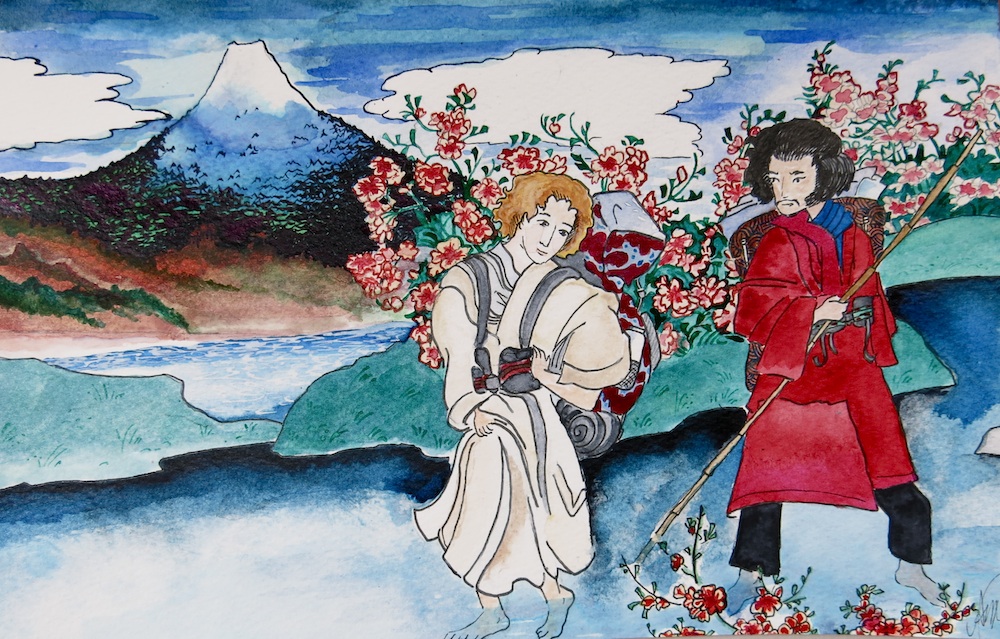
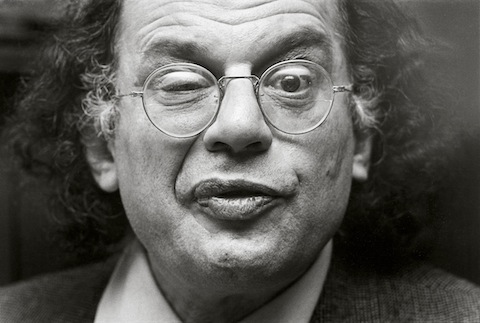
Images © Allen Ginsberg (1) and Mayumi Oda (2 and 3).

Sunday, March 31, 2013

Poem - A.R. Ammons: Easter Morning


Easter Morning

by A. R. Ammons


I have a life that did not become,
that turned aside and stopped,
astonished:
I hold it in me like a pregnancy or
as on my lap a child
not to grow old but dwell on

it is to his grave I most
frequently return and return
to ask what is wrong, what was
wrong, to see it all by
the light of a different necessity
but the grave will not heal
and the child,
stirring, must share my grave
with me, an old man having
gotten by on what was left

when I go back to my home country in these
fresh far-away days, it’s convenient to visit
everybody, aunts and uncles, those who used to say,
look how he’s shooting up, and the
trinket aunts who always had a little
something in their pocketbooks, cinnamon bark
or a penny or nickel, and uncles who
were the rumored fathers of cousins
who whispered of them as of great, if
troubled, presences, and school

teachers, just about everybody older
(and some younger) collected in one place
waiting, particularly, but not for
me, mother and father there, too, and others
close, close as burrowing
under skin, all in the graveyard
assembled, done for, the world they
used to wield, have trouble and joy
in, gone

the child in me that could not become
was not ready for others to go,
to go on into change, blessings and
horrors, but stands there by the road
where the mishap occurred, crying out for
help, come and fix this or we
can’t get by, but the great ones who
were to return, they could not or did
not hear and went on in a flurry and
now, I say in the graveyard, here
lies the flurry, now it can’t come
back with help or helpful asides, now
we all buy the bitter
incompletions, pick up the knots of
horror, silently raving, and go on
crashing into empty ends not
completions, not rondures the fullness
has come into and spent itself from

I stand on the stump
of a child, whether myself
or my little brother who died, and
yell as far as I can, I cannot leave this place,
for me it is the dearest and the worst,
it is life nearest to life which is
life lost: it is my place where
I must stand and fail,
calling attention with tears
to the branches not lofting
boughs into space, to the barren
air that holds the world that was my world

though the incompletions
(& completions) burn out
standing in the flash high-burn
momentary structure of ash, still it
is a picture-book, letter-perfect
Easter morning: I have been for a
walk: the wind is tranquil: the brook
works without flashing in an abundant
tranquility: the birds are lively with
voice: I saw something I had
never seen before: two great birds,
maybe eagles, blackwinged, whitenecked
and –headed, came from the south oaring
the great wings steadily; they went
directly over me, high up, and kept on
due north: but then one bird,
the one behind, veered a little to the
left and the other bird kept on seeming
not to notice for a minute: the first
began to circle as if looking for
something, coasting, resting its wings
on the down side of some of the circles:
the other bird came back and they both
circled, looking perhaps for a draft;
they turned a few more times, possibly
rising—at least, clearly resting—
then flew on falling into distance till
they broke across the local bush and
trees: it was a sight of bountiful
majesty and integrity: the having
patterns and routes, breaking
from them to explore other patterns or
better ways to routes, and then the
return: a dance sacred as the sap in
the trees, permanent in its descriptions
as the ripples round the brook’s
ripplestone: fresh as this particular
flood of burn breaking across us now
from the sun.

Sunday, February 03, 2013

18 Animations of Classic Literary Works: From Plato and Shakespeare, to Kafka, Hemingway and Gaiman

From Open Culture, a unique collection of animated videos based on great works of literature. I particularly liked Shel Silverstein's The Giving Tree and an animated mash-up of the spirits of Franz Kafka and Hunter S. Thompson.

18 Animations of Classic Literary Works: From Plato and Shakespeare, to Kafka, Hemingway and Gaiman


December 12th, 2012

Yesterday we featured Piotr Dumala’s 2000 animation of Fyodor Dostoyevsky’s classic novel, Crime and Punishment, and it reminded us of many other literary works that have been wonderfully re-imagined by animators — many that we’ve featured here over the years. Rather than leaving these wondrous works buried in the archives, we’re bringing them back and putting them all on display. And what better place to start than with a foundational text — Plato’s Republic. We were tempted to show you a claymation version of the seminal philosophical work (watch here), but we decided to go instead with Orson Welles’ 1973 narration of The Cave Allegory, which features the surreal artistic work of Dick Oden.
Staying with the Greeks for another moment … This one may have Sophocles and Aeschylus spinning in their graves. Or, who knows, perhaps they would have enjoyed this bizarre twist on the Oedipus myth. Running eight minutes, Jason Wishnow’s 2004 film features vegetables in the starring roles. One of the first stop-motion films shot with a digital still camera, Oedipus took two years to make with a volunteer staff of 100. The film has since been screened at 70+ film festivals and was eventually acquired by the Sundance Channel. Separate videos show you the behind-the-scenes making of the film, plus the storyboards used during production.
Between 1992 and 1994, HBO aired The Animated Shakespeare, which brought to life 12 famous Shakespeare plays. Leon Garfield, a well-known British children’s author, wrote the scripts, mainly using Shakespearian language. And some talented Russian artists did the animation. Above, we give you the first part of the animated Romeo & Juliet. Get Part 2 and Part 3 here, and find other animated Shakespeare plays on this Youtube Channel.
Eight years before Piotr Dumala tackled Dostoyevsky’s Crime and Punishment, Dumala produced a short animated film based on The Diaries of Franz Kafka. Once again, you can see his method, known as “destructive animation,” in action. It’s well worth the 16 minutes. Or you can spend time with this 2007 Japanese animation of Kafka’s cryptic tale of “A Country Doctor.” And if you’re still hankering for animated Kafka, don’t miss Orson Welles’ Narration of the Parable, “Before the Law”.
The animated sequence above is from the 1974 film adaptation of Herman Hesse’s 1927 novel SteppenwolfIn this scene, the Harry Haller character played by Max von Sydow reads from the “Tractate on the Steppenwolf.” The visual imagery was created by Czech artist Jaroslav Bradác.
In 1999, Aleksandr Petrov won the Academy Award for Short Film (among other awards) for a film that follows the plot line of Ernest Hemingway’s classic novella, The Old Man and the Sea (1952). As noted here, Petrov’s technique involves painting pastels on glass, and he and his son painted a total of 29,000 images for this work. Rather incredible. It’s permanently listed in our collection of Oscar Winning Films Available Online and our collection of 500 Free Movies Online.
Italo Calvino, one of Italy’s finest postwar writers, published Italian Folktales in 1956, a series of 200 fairy tales based sometimes loosely, sometimes more strictly, on stories from a great folk tradition. Upon the collection’s publication, The New York Times named Italian Folktales one of the ten best books of the year.  And more than a half century later, the stories continue to delight. Case in point: in 2007, John Turturro, the star of numerous Coen brothers and Spike Lee films, began working on Fiabe italiane, a play adapted from Calvino’s collection of fables. The animated video above features Turturro reading “The False Grandmother,” Calvino’s reworking of Little Red Riding Hood. Kevin Ruelle illustrated the clip, which was produced as part of Flypmedia’s more extensive coverage of Turturro’s adaptation. You can find another animation of a Calvino story (The Distance of the Moon) on YouTube here.
Emily Dickinson’s poetry is widely celebrated for its beauty and originality. To celebrate her birthday (it just passed us by earlier this week) we bring you this little film of her poem, “I Started Early–Took My Dog,” from the “Poetry Everywhere” series by PBS and the Poetry Foundation. The poem is animated by Maria Vasilkovsky and read by actress Blair Brown.
E.B. White, beloved author of Charlotte’s WebStuart Little, and the classic English writing guide The Elements of Style, died in 1985. Not long before his death, he agreed to narrate an adaptation of “The Family That Dwelt Apart,” a touching story he wrote for The New Yorker. The 1983 film was animated by the Canadian director Yvon Malette, and it received an Oscar nomination.
Shel Silverstein wrote The Giving Tree in 1964, a widely loved children’s book now translated into more than 30 languages. It’s a story about the human condition, about giving and receiving, using and getting used, neediness and greediness, although many finer points of the story are open to interpretation. Today, we’re rewinding the videotape to 1973, when Silverstein’s little book was turned into a 10 minute animated film. Silverstein narrates the story himself and also plays the harmonica.
The online bookseller Good Books created an animated mash-up of the spirits of Franz Kafka and Hunter S. Thompson. Under a bucket hat, behind aviator sunglasses, and deep into an altered mental state, our narrator feels the sudden, urgent need for a copy of Kafka’s Metamorphosis. Unwilling to make the purchase in “the great river of mediocrity,” he instead makes the buy from “a bunch of rose-tinted, willfully delusional Pollyannas giving away all the money they make — every guilt-ridden cent.” The animation, created by a studio called Buck, should easily meet the aesthetic demands of any viewer in their own altered state or looking to get into one.
39 Degrees North, a Beijing motion graphics studio, started developing an unconventional Christmas card last year. And once they got going, there was no turning back. Above, we have the end result – an animated version of an uber dark Christmas poem (read text here) written by Neil Gaiman, the bestselling author of sci-fi and fantasy short stories. The poem was published in Gaiman’s collection, Smoke and Mirrors.
This collaboration between filmmaker Spike Jonze and handbag designer Olympia Le-Tan doesn’t bring a particular literary tale to life. Rather this stop motion film uses 3,000 pieces of cut felt to show famous books springing into motion in the iconic Parisian bookstore, Shakespeare and Company. It’s called  Mourir Auprès de Toi. Are there impressive literary animations that didn’t make our list? Please let us know in the comments below. We’d love to know about them.

Thursday, January 17, 2013

NPR's On Being - The Ecstatic Faith of Rumi

From Krista Tippett's NPR show, On Being, a wonderful episode from last spring (2012) on the poetry and faith of the Sufi master, Rumi. Enjoy!


THE ECSTATIC FAITH OF RUMI

March 8, 2012

The 13th-century Muslim mystic and poet Rumi has long shaped Muslims around the world and has now become popular in the West. Rumi created a new language of love within the Islamic mystical tradition of Sufism. We hear his poetry as we delve into his world and listen for its echoes in our own.

Voices on the Radio


Fatemeh Keshavarz - Keshavarz is professor of Persian & Comparative Literature at Washington University in St. Louis, and the author of several books, including Reading Mystical Lyric: The Case of Jalal aI-Din Rumi.

Listen:
Additional Unheard Cuts: Rumi

A Great Wagon


When I see your face, the stones start spinning!
You appear; all studying wanders.
I lose my place.

Water turns pearly.
Fire dies down and doesn't destroy.

In your presence I don't want what I thought
I wanted, those three little hanging lamps.

Inside your face the ancient manuscripts
Seem like rusty mirrors.

You breathe; new shapes appear,
and the music of a desire as widespread
as Spring begins to move
like a great wagon.
Drive slowly.
Some of us walking alongside
are lame!

~

Today, like every other day, we wake up empty
and frightened. Don't open the door to the study
and begin reading. Take down a musical instrument.

Let the beauty we love be what we do.
There are hundreds of ways to kneel and kiss the ground.

~

Out beyond ideas of wrongdoing and rightdoing,
there is a field. I'll meet you there.

When the soul lies down in that grass,
the world is too full to talk about.
Ideas, language, even the phrase each other
doesn't make any sense.

~

The breeze at dawn has secrets to tell you.
Don't go back to sleep.
You must ask for what you really want.
Don't go back to sleep.
People are going back and forth across the doorsill
where the two worlds touch.
The door is round and open.
Don't go back to sleep.

I would love to kiss you.
The price of kissing is your life.

Now my loving is running toward my life shouting,
What a bargain, let's buy it.

~

Daylight, full of small dancing particles
and the one great turning, our souls
are dancing with you, without feet, they dance.
Can you see them when I whisper in your ear?

~

They try to say what you are, spiritual or sexual?
They wonder about Solomon and all his wives.

In the body of the world, they say, there is a soul
and you are that.

But we have ways within each other
that will never be said by anyone.

~

Come to the orchard in Spring.
There is light and wine, and sweethearts
in the pomegranate flowers.

If you do not come, these do not matter.
If you do come, these do not matter.

Tuesday, December 18, 2012

Eric G. Wilson - Poetry Makes You Weird

In this article from The Chronicle Review, Eric Wilson recounts his first adventure as a recruiter for the English department he was in, and how that experience became a positive influence in how he views his profession.

As a former English major, minor expert in 20th Century American poetry, and a one-time poet myself, I can assure you this is true.

Poetry Makes You Weird

By Eric G. Wilson
December 10, 2012

Pat Kinsella for The Chronicle Review

In my first semester as a tenure-track English professor, my chairman asked me to represent our department at a weekend recruiting fair for high-school seniors. My job would be to court prospective majors. Knowing that "yes" was the right pre-tenure answer, I agreed, and so found myself that next Saturday morning standing behind a folding table, cheap brochures littered on its brown surface. I was irritable, hung over, and resentful.

A father and son immediately appeared, in virginal Wake Forest T-shirts and blond crew cuts. They smiled at me as if I had just praised their promptness. The younger looked up at dad, and father nodded to son, and son blurted: "Sell me the English major!" Through my brain's murk, I searched for the hype. Failing to find it, I confessed: "It makes you weird."

After a confused "OK," the two looked down, backed away, and were gone. They shouldn't have been so hasty. I had revealed to them, though I didn't know it then, the great payoff of literary study: It estranges us from our normal habits of thought and perception, nullifies old conceptual maps, and so propels us into uncharted regions, outlandish and bracing, where we must create, if we are to thrive, coordinates more capacious, more sublime than the ones we already know. The uncanny—not truth, beauty, or goodness—is literature's boon.

Like most English professors, I endure the grumbling of undergraduates subjected to literature requirements. "What's the use?" they ask. "Why must I study complicated, densely worded fictions that have little to do with the real world?" In the past, I had my elevated answers ready. What Aristotle says of poetry is true of all great literature. It is "more philosophical and a higher thing than history: for poetry tends to express the universal, history the particular." Wordsworth believes that the literary—which is mainly, for him, verse—also invigorates our emotions, issuing from the "spontaneous overflow of powerful feelings," thus arousing us from "savage torpor." He would have heartily concurred with Matthew Arnold: Poetry teaches us "how to live."

The students I pelted with this rhetoric would squint into the "I'm thinking" expression, and, brown-nosing, say, "I see." If they'd read Plato, they could have countered that poetry is an irrational fomenting of lies. Or they could have invoked Auden, who admitted that poetry "makes nothing happen."

But I now no longer unleash the literary giants. I simply tell my disgruntled students about the first time I read, as an undergraduate, these lines:

There's a certain Slant of light,

Winter Afternoons—

That oppresses, like the Heft

Of Cathedral Tunes—

I had often witnessed beams of dull December light with a melancholy I didn't understand. Dickinson's flash clarified my feelings: In the impoverished glow of the cold time were heavy reminders of brightness I desired but couldn't possess. But this affliction had fever, intimations of future heat that was luminous, like hymns.

Dickinson's verse spelled out the abstruse, made the strange familiar. In this new intimacy, however, was a novel astonishment: The chilly light from that day onward exposed the enigmas of longing, both tormenting and radiant. Her poetry left me amazed—caught in wonderment as well as labyrinth.

Other epiphanies followed. What I had taken for granted was shattered; the marvelous erupted amid the fragments. In Whitman I saw ordinary grass morph into the "uncut hair of graves." In Eliot's "Prufrock," I watched twilight transmogrify into "a patient etherized upon a table." The grass, the evening—in these metaphors, they grew more lucid than before, and more cryptic.

Shelley articulates literature's invigorating disorientation: "Poetry lifts the veil from the hidden beauty of the world, and makes familiar objects be as if they were not familiar." But the result of that alienation is not only an aesthetic rush; it is also a moral life. In shocking us into awareness, poetry urges us to relate to the world in fresh ways. The problem is, How do I connect my own mind, relatively familiar, with what is before me, enticingly bizarre?

Shelley answers: Imagine what it's like to be what you perceive. To accomplish that connection requires "a going out of our nature, and an identification of ourselves with the beautiful which exists in thought, action, or person, not our own." I take that to mean that the more distinctly we imagine the plight of another, the more empathy we feel, and the more beauty we appreciate. As Shelley put it, "The great instrument of moral good is the imagination; and poetry administers to the effect by acting upon the cause."
Go read the second half of the article.