Showing posts with label Nature. Show all posts

Saturday, October 25, 2014

The Science of Awe (via Sierra Club)

Who cares about the science of awe - it's interesting and it's fun to puzzle out these questions, but awe is best experienced, not studied.

Interestingly, it was only 2003 that Dacher Keltner of the University of California, Berkeley, and Jonathan Haidt, then at the University of Virginia, proposed awe as an emotion worth studying. “In the upper reaches of pleasure and on the boundary of fear,” they wrote in the journal Cognition and Emotion, “awe is felt about diverse events and objects, from waterfalls to childbirth to scenes of devastation. . . . Fleeting and rare, experiences of awe can change the course of a life in profound and permanent ways.”

This is an interesting article from The Sierra Club.

The Science of Awe

Can psychologists chart what happens when nature blows your mind?


By Jake AbrAhamson
November 6, 2014

Cedar Wright enjoy a view of the long way down, moments after getting the first ascent of the Virgin Tower in Enshi Grand Canyon National Park, China. | Photo by Keith Ladzinski

A FEW YEARS AGO, I RAN Utah’s Green River with a group of 13-year-olds. Our first day was a grueling, 26-mile slog through mostly flat water, with a few Class I and II rapids as our prize. I knew the real reward would come when we entered the most majestic part of Desolation Canyon in a couple of days, but they wouldn’t take my word for it. They were slouched in their boats asking, “Why are we doing this?”

That evening a thunderstorm rolled into the river valley, and we spent an hour in our tents. It was one of the most intense and otherworldly storms I’d ever seen. When thunder struck, it felt like my body was inside God’s clap, and the lightning galvanized the entire sky. Eventually the sky cleared. I stepped out of my tent as if exiting a bomb shelter, with a distinct feeling that the world would be different. The kids seemed to emerge from their tents at the exact same instant. The air was heavy and hot, the sky a color I had never imagined—gold from the land to the firmament. Time slowed. The mountains, the people, and the river flowing through it all seemed held together by an intelligent pattern.

The frustration of the day’s paddle was wiped away. I felt benevolent and open toward the kids. Making dinner was easy. The storm had pulled us together.

Looking back, I was puzzled by the experience. What had happened to me during that thunderstorm? I know humans don’t move in unison accidentally, so why did I think we’d emerged from our tents in perfect sync? I’m not a spiritual person, or a gushy one, so what caused this quasi-religious feeling that the mountains, people, and river were hanging together in ethereal balance?

I am both thrilled and dispirited to report that science has answered these questions.

Scientifically speaking, the storm brought me into a state of awe, an emotion that, psychologists are coming to understand, can have profoundly positive effects on people. It happens when people encounter a vast and unexpected stimulus, something that makes them feel small and forces them to revise their mental models of what’s possible in the world. In its wake, people act more generously and ethically, think more critically when encountering persuasive stimuli, like arguments or advertisements, and often feel a deeper connection to others and the world in general. Awe prompts people to redirect concern away from the self and toward everything else. And about three-quarters of the time, it’s elicited by nature.

In June 2014, the Sierra Club’s Inspiring Connections Outdoors program (formerly known as Inner City Outings) arranged to take 25 Oakland High School students on a two-day rafting trip down Northern California’s American River. They also took part in a study designed to quantify the biological and emotional benefits of such a trip. | Photos by Jayms Ramirez


IT WAS ONLY 11 YEARS AGO that psychologists Dacher Keltner of the University of California, Berkeley, and Jonathan Haidt, then at the University of Virginia, proposed awe as an emotion worth studying. “In the upper reaches of pleasure and on the boundary of fear,” they wrote in the journal Cognition and Emotion in 2003, “awe is felt about diverse events and objects, from waterfalls to childbirth to scenes of devastation. . . . Fleeting and rare, experiences of awe can change the course of a life in profound and permanent ways.”

Over twenty studies later, the picture of awe is clearer and more detailed. “In various studies we’ve asked people, ‘What’s running through your mind when you feel awe?’” Keltner said, “and they’ll say things like ‘I want to make the world better,’ or ‘I just feel like being quiet,’ or ‘I feel like purifying things.’ It makes you humble. It makes you curious about the world.” To awe, Keltner attributes both the faith of Krishna, who, according to myth, on being shown the secrets of the universe through a third eye, was suddenly ready to do God’s work; and the desire of John Muir to protect the environment, which was brought about by his life-altering experiences in the Sierra. Throughout his writings, Muir described quintessential awe experiences. Take this moment, when he feels pleasurably energized by the massive and threatening Mt. Hood: “There stood Mount Hood in all the glory of the alpenglow, looming immensely high, beaming with intelligence, and so impressive that one was overawed as if suddenly brought before some superior being newly arrived from the sky.”

Not surprisingly, such experiences are tough to replicate in a laboratory setting. To elicit and study awe, Keltner and his peers instead rely on mind-bending videos, quick exposures to nature amid urbanized landscapes, or vast and disorienting stimuli. In an early study, participants were asked to stare at a replica of a T. rex skeleton. These techniques work. Psychologists can show certain awe-inducing videos to a test group and then ask questions about how cognition, other emotions, and self-concept are affected by the experience.

However, Keltner, a tan Californian with sandy, shoulder-length hair and a wholesome smile—who cites hiking in the High Sierra, meeting the Dalai Lama, and the births of his daughters as among the greatest awe events in his life—thinks scientists can gain a new perspective on the emotion if they move away from amazing-video, dinosaur-skeleton awe. To conduct what Keltner believes will be the first study to measure the long-term, physical health benefits of awe, he and a team of grad students are moving the laboratory into the woods.

“The science of emotion gets really exciting when you get as close to the phenomenon as possible,” Keltner told me. “We want to engage with people and observe them when they’re really out there on the river or lying under the stars.”


WHICH IS WHY I FIND MYSELF pulling into an eddy on California’s American River with a boatload of students from Oakland High School and their environmental science teacher and guide, Kevin Jordan. A hundred yards ahead, the water drops at a commotion of river and rocks called Troublemaker. It churns with whitewater and white noise. The kids wait calmly as Jordan wrangles the other boats before we make the plunge. This is just one of seven Sierra Club Inspiring Connections Outdoors trips during which Keltner’s awe study will take place.

One of the boats holds Craig Anderson, a trim, towering doctoral student who studies with Keltner. He wears a vintage Seattle Mariners cap with a GoPro camera mounted on top, which he uses to tape the kids’ interactions on the rafts before, during, and after rapids. “We can analyze people’s facial expressions muscle by muscle,” he told me earlier. “We can run the vocals through a program. Are people kidding around? Are they calm? Are they working as a team?”

Anderson and Keltner want to study the effect a two-day rafting trip will have on people’s lives, and they suspect that awe will play a major role in the story their data have to tell. Yesterday, the 25-odd students spat into vials and answered survey questions about how often they felt happy, sad, or stressed and how well they’ve been sleeping. They will spit into other vials when the trip ends and fill out similar surveys a month from now. The saliva samples will show how awe correlates with levels of stress hormones and the genes related to dopamine function.

About five miles upriver, the Chile Bar dam has closed its gates, and now what’s left of the river is literally flowing by beneath us. Jordan points to a black band on a boulder. “That rock’s already got three inches of wet. We’ll be carrying our rafts if we don’t ride this faucet.” He calls, “All forward,” and we charge toward Troublemaker.

For a few seconds, we lose ourselves. The drop sucks us into a vortex of froth. A wave plops over the starboard gunwale. And then we shoot out, bow slapping the surface, everyone gasping and soaked. A black granite fin rises up ahead. We fly around a bend into shade, and the water fades from emerald to black. Then it calms and deepens. The kids are all gasping, or smiling, or both. Jordan lets everyone in his boat jump into the water.

Jordan’s been taking his high school students on outings for over a decade. They’ve been to Hawaii and kayaked off Catalina Island, but the rivers of central California are his natural habitat. He wants to take the kids on a snow trip to see where the rivers begin, and “so they remember that there was snow in the Sierra Nevada.” I ask who of the floaters has seen snow, and half of them shoot up their hands.

Jordan stands, gets his balance, and peers downriver—a mariner in a crow’s nest. A kid bobs near the bow. The bands on the boulders are growing. “Get that road kill in the boat,” he says. “We gotta get down this river before the water runs out.”


“WHAT'S COOL ABOUT AWE is that it literally blows your mind,” Anderson says, referring to how its stimuli force people to revise their mental frames of reference. We are sitting on the bank watching night come over the canyon. Since we set up camp an hour ago, the beach has grown by 15 feet. The river is at “fish flows,” the minimum level for sustaining life.

“We might do some analyses by raft. We know emotions are contagious. If there was one really awe-prone person, did that make other people feel awe? You might have noticed that in the swimming sections, in one raft, everyone was in the water, and in another, nobody was in the water.”

For much of the night, Anderson can be found sitting on the beach, knees to chest, contemplative, eyes fixed river­ward. He grew up an Eagle Scout in New Mexico. As a young child, he loved watching Star Trek and pondering the show’s moral dilemmas, and he’s still taken by the unfathomable depths of the universe. “I’ve always been into space, thinking about how vast it is. Even now, the hairs are raising on my neck just talking about it.” (Piloerection is a telltale accompaniment to awe.) His favorite awe-eliciting videos are the opening to the movie Contact and a three-­minute clip that begins on Earth’s surface and gradually zooms out to one of the largest known stars in the universe, beside which our planet appears as a mere pixel. He says that he doesn’t often use segments from Planet Earth or other nature documentaries for research because viewers feel intense compassion for the animals, which muddies the results.

Before the light disappears completely, Anderson gets up to distribute paper and pens to the students, who are keeping journals as part of the study.

Today we experienced the little beauties of nature, one writes. I was able to be me and learn about the things around me.

My favorite rapid was Triple Threat. It was scary but fun at the same time, writes another.

The most amazing experience I had on this trip was meeting new people, learning new things about others, and experiencing the events with everyone. Meeting new people lets me see the different kinds of personality of each person and adds spice to life, journals a third student.

I ask Anderson if he thinks feeling awe in nature will make these kids care more about the river that’s trickling by through the dark.

“Generally speaking, yes. They say they feel more connected, not just to people but to the world around them. When you’re having your mind blown like this, people’s self-concerns really aren’t at the front of their minds. All your attention is directed outward, toward the thing that’s eliciting awe, on the outside environment, and on others around you. Also, they’re saying they’re appreciating the beauty of their surroundings, and if you’re appreciating the beauty of something, you want to take care of it. You don’t want to see it ruined.”

The next morning, we have to wait for the water. Jordan sits on a boat for hours, watching as birds putter about in the littoral zone. He sees eight species in the first 10 minutes. They pick bugs out of the mud. The dam’s daily releases determine this ecosystem’s rhythms.

Around 11:30, the river finally shows up, and Jordan calls the kids into a circle. “Let’s go, young scholars! The faucet is on!” His solemn reverence for the river is contagious. The sun peeks over the hills, bringing the temperature up by about 20 degrees.

“We’re going through a really important transition today,” Jordan says. He paces in place as he speaks, his head down as he gathers his thoughts, then he lifts his chin to project. “You’ll see that when we enter the reservoir, the biodiversity disappears. It’s like the reservoir in Oakland.”

For a while, we ride amid pale yellow, dried-out hills, with a few oak trees at the tops. “It takes a lot to live up there,” Jordan says to the kids in our boat. We pound through one rapid after another. Then he brings us into the gorge. The walls rise up and close in, and suddenly everything is greener, even the water, which intermittently bubbles and froths in emerald whirlpools. We spill into Satan’s Cesspool, bounce through Bouncing Rock. I recall a possible explanation that Keltner casually proposed for why, when people are asked to recall awe-inspiring experiences, they so often cite nature. It is Edward O. Wilson’s biophilia hypothesis: the idea that humans are instinctively fond of living systems and see life-giving power in vigorous water or dense greenery. At some evolutionary level, we think the river looks better at high flow, when the dam allows it through.

That afternoon we emerge into civilization. People are crouched on boulders, panning for gold. A family is sitting in the river on beach chairs. The water is up to their chests. It seems as if they’re waiting for the river to burst through the dam and carry them away.

We take out at a place called Salmon Falls. But there are no falls or salmon. Not anymore. The namesake hydraulics were inundated by the backup behind Folsom Dam in 1955, along with the salmon’s historic spawning route. Now they stop below the dam, where they’re corralled and turned into food. The ecosystem is all but post-natural: lifeless dirt and concrete detritus.

With his call of “young scholars,” Jordan gathers everyone into a circle for one last elegy. “Here we are at Salmon Falls. I’m glad it’s named that. We’re reminded of the salmon that used to migrate up this river into the Sierra Nevada. Now we’ve got a 100-foot dam and a 300-foot dam, and all the salmon are stuck down by Sac State, where we did the tour the other day.”

Jordan is saddened by the way the ecosystem has changed. He cares about the mergansers and red robins and the native weeds being run out by invasive weeds, the thoughtless fish swimming upriver by instinct. He would not be a good subject for an awe study. Too prone toward compassion. The T. rex skeleton would probably make him sad for the dinosaurs.

The kids each say a word to represent the hardest part of the trip and the best part of the trip. For the hardest, they say, pancakes, burning, backstroke, pans, sleeping, rocks, cuticles, revenge, current, flatwater. For the best: teamwork, carnage, stargazing, water, native, swimming, backpaddle, fun, community. Then Anderson distributes vials for the kids to spit in, and everyone returns to the city.

This article was funded by Sierra Club Outdoors.

Jake Abrahamson is Sierra's assistant editor.
See more stories by this author

Friday, October 24, 2014

The Restorative Power of Nature for Dealing with Psycho-Physiological Stress

http://www.theecologist.org/siteimage/scale/0/0/358691.jpg

The healing powers of nature can be very profound. The experience of calm, peace, or awe (subjective) no doubt contributes to the neurochemical changes in the brain (objective) that reduce anxiety and depression, as well as helping us cope better with stress.

http://images.medicaldaily.com/sites/medicaldaily.com/files/styles/large/public/2014/06/25/being-nature.jpg?itok=w79yqMvC

Full Citation:
Berto, R. (2014, Oct 21). The Role of Nature in Coping with Psycho-Physiological Stress: A Literature Review on Restorativeness. Behavioral Sciences; 4(4), 394-409; doi:10.3390/bs4040394

The Role of Nature in Coping with Psycho-Physiological Stress: A Literature Review on Restorativeness


(This article belongs to the Special Issue Advances in Environmental Psychology)

Abstract
Physical settings can play a role in coping with stress; in particular experimental research has found strong evidence between exposure to natural environments and recovery from physiological stress and mental fatigue, giving support to both Stress Recovery Theory and Attention Restoration Theory. In fact, exposure to natural environments protects people against the impact of environmental stressors and offer physiological, emotional and attention restoration more so than urban environments. Natural places that allow the renewal of personal adaptive resources to meet the demands of everyday life are called restorative environments. Natural environments elicit greater calming responses than urban environments, and in relation to their vision there is a general reduction of physiological symptoms of stress. Exposure to natural scenes mediates the negative effects of stress reducing the negative mood state and above all enhancing positive emotions. Moreover, one can recover the decrease of cognitive performance associated with stress, especially reflected in attention tasks, through the salutary effect of viewing nature. Giving the many benefits of contact with nature, plans for urban environments should attend to restorativeness.


This is an open access article distributed under the Creative Commons Attribution License which permits unrestricted use, distribution, and reproduction in any medium, provided the original work is properly cited.


1. Introduction


This brief review attempts to draw greater attention to the role of the physical environment in stress recovery and psychological restoration processes. As people interact daily with physical settings, the physical environment can heighten stress or help people cope with it. “Stress” can be defined as the condition that results when person-environment transactions lead the individual to perceive a discrepancy (whether real or not) between the demands of a situation and the biological, psychological or social resources of the individual [1]. The negative effects of stress can be measured in various ways inside and out of the laboratory and these measures fall into three categories: those that rely on (1) neuro-physiological or bodily changes in the individual experiencing stress, (2) performance or behavioral changes and (3) self-report by individuals. The present paper updates and reviews the literature from each area, discussed separately.

In Psychology, most theoretical accounts of stress effects invoke some variation of the inverted U-hypothesis relating arousal to performance [2], with both high and low levels of arousal causing reduced performance. However, other theories account for effects of stress on cognition, specifically on attention allocation, with stress overloading attentional capacity for the deployment of attention itself and other resources [1]. Except for social support (operationalized primarily in terms of family, socio-cultural and economic conditions), Health Psychology has directed attention away from environmental factors that can be coping resources, whereas research and theories in Environmental Psychology point also to certain kind of environments that have the capacity to facilitate recovery of depleted resources. Environmental conditions are antecedent factors in stress-related mechanisms interceding between environment and health: they might operate as an environmental stressor, straining human adaptive capacities, or as a coping strategy, re-establishing some balance between environmental demands and personal resources. People rarely respond to stressful conditions passively, instead they use coping strategies. The physical environment can damage or ameliorate coping resources, thus heightening or reducing stress themselves. 

2. The Mechanisms and Theoretical Approaches Underlying the Phenomenon


Experimental research has found evidence that restoration from stress and from mental fatigue relates to exposure to nature [3,4]. Natural environments protect people against the impact of environmental stressors and offer physiological, emotional and attention restoration more so than do urban environments. Natural places that allow a shift towards more positively-toned emotional states, positive changes in physiological activity levels, and in behavior and cognitive functioning are called restorative environments [5,6]. For pragmatic and theoretical reasons [7] nature scenes dominated by green vegetation have been the most frequently studied among restorative environments, with a relatively high success rate [8]. Exposure to nature is a coping strategy, which has positive effects on both arousal/activation level and cognitive overload. Arousal theories [9,10] imply that recuperation from excessive arousal should occur more rapidly in settings having low levels of arousal. Since natural settings tend to have lower levels of arousal properties, such as complexity, intensity and movement than urban environments [11], they should have comparatively restorative influences on stress. The alternative overload perspectives provide a different explanation of why recuperation following a stressor may be more rapid when external stimulation is comparatively low. High complexity and other increasing-stimulation properties typical of urban settings, place taxing processing demands [12] and elicit more sustained attention than nature settings; accordingly restoration from cognitive overload is hampered.

Research on restorative environments has developed within two complementary theoretical positions: the Stress Recovery Theory (SRT) [13] and the Attention Restoration Theory (ART) [6]; the former is a psycho-evolutionary theory, while the latter a psycho-functionalist. The evolutionary perspective contends that because humans evolved over a long period in natural environments, people are to some extent physiologically and perhaps psychologically adapted to natural, as opposed to urban settings [4]. To functionalist, humans have an unlearned predisposition to pay attention and respond positively to natural content (e.g., vegetation, water) and to configurations characteristic of settings that were favorable to survival during evolution [5,13,14,15]. Although in both theories natural environments are more restorative than urban or artificial environments, they differ in what drives individuals toward a restorative place: In SRT it is physiological stress, whereas in ART it is mental fatigue. These theories complement one another, in that the elevated physiological arousal and negative affect characteristic of stress (SRT) can occur in absence of mental fatigue. Conversely elevated arousal or negative affect do not always accompany attentional fatigue (ART); attentional fatigue can be considered a stress aftereffect and treated as a condition that increases vulnerability to stress [3,4,6,12,16].

Research related to these two theories agrees on two findings: (1) Environmental preference is affected by people’s need to get restoration [17,18,19,20,21,22]; (2) Environments perceived as natural tend to be more restorative than environments perceived to be urban or artificial e.g., [3,23,24,25,26,27,28]. In fact, research shows restoration related to environmental preference, but the direction of the effect remains unclear; however the positive linear correlation between the perception of place restorative qualities and environmental preference may suggest that the general preference for natural environment can be explained by individual conviction that “psycho-physiological” restoration occurs easier in natural environments. In practice people prefer natural environments because those places allow maintaining or enhancing psycho-physiological wellbeing.

Mental fatigue gives higher preference for the natural over the urban environment [22]. Nature is especially conducive to our involuntary attention engagement; on the contrary built content captures attention dramatically, requiring attention to be overcome [6,8,24]. In the ART this attention-drawing quality of natural settings is referred to as “soft fascination” [6]. When nature captures people’s attention, the executive system that regulates directed attention gets to rest, pessimistic thoughts are blocked, and negative emotions are replaced by positive ones [29]. In addition to fascination, nature is characterized also by other properties called restorative factors, which work together with fascination. Actually, the renewal of a depleted capacity also occurs with a physical and/or psychological “being-away” from demands on directed attention, a sense of “extent”, i.e., being in a large enough world where “coherence” and “scope” are perceived in the environment, and “compatibility” between one’s inclinations and the environmental demands, for more details see [6,21,23].

The research does not claim that the restorative experience can occur only in natural environments, nor does it state that all urban environments lack restorative qualities [30,31]. For example, some natural environments would not likely be restorative because they are perceived as dangerous [32,33], and some urban environments, such historical environments [18], museums [34], or monasteries [35], can sustain restoration because they have to some extent restorative qualities, are easily approachable and so compatible with the little free time of the majority of the inhabitants of the city [36,37]. Accordingly the involuntary attentive process might be activated also by the vision of urban environments [31], but only if environmental information is fascinating, i.e., doesn’t overload the attentive system [38], as nature does. ART claims that fascination is a restorative characteristic of an environment related to information processing, therefore suitable urban-artificial solutions can sometime fill the gap due to the lack of nature [30,31,39]. 

3. The Direct and Indirect Effects of Natural Environments


Central to the recovery from psycho-physiological stress are positive changes in emotional states. Exposure to natural environments produce positive mood chances, actually exposure to natural stimuli can mediate the negative effect of stress reducing the negative mood state and at the same time enhancing positive emotions. In particular, natural settings have restorative influences on three affective dimensions: positive affects, anger/aggression, and fear [4,40,41]. Moreover, people report more positive emotions (such as friendliness) and fewer negative emotions (such as sadness) when viewing urban scenes with trees than when viewing the same scenes with inanimate objects [42]. In contrast, exposure to environments lacking of natural elements can produce anxiety, anger, frustration and sadness [43,44]. The association between environment and emotions leads people to assess natural environment on the opportunity they offer to regulate mood, in practice preference for natural environments arises from the favourable effects on mood of such environments [45].

The positive emotional states elicited by viewing natural stimuli are part of the mechanism underlying the landmark Ulrich’s [46] finding that hospital patients had more favorable recovery (shorter post-operative hospital stays, lower scores post-surgical complications, fewer negative comments in nurses’ notes, fewer strong analgesic intake) if their windows overlooked trees rather than a brick building wall. Exposure to nature can reduce anxiety, improve pain control and patients’ satisfaction with the procedure [47,48]. One study found that the exposure to natural environments (pleasant stimuli) effectively distracted patients from stressful or painful conditions [47]. Another study found that heart-rates and self-reports of emotional state of patients in dental clinics improved with exposure to natural environments [49]; patients felt calmer on days when a mural depicting a natural scene was on the wall then on days when the wall was blank. To this end, Diette et al. [47] recommended the routine clinical use of nature sights and sounds of sights. The use of nature scenes was shown to be an effective tool for “distraction”, i.e., patient’s attention is focused on a pleasant stimulus and away from a stressful or painful condition. Research in prisons has shown that prisoners whose cell windows offered views of farmland and trees had lower frequencies of stress symptoms such as digestive illness and headaches, and fewer sick calls than prisoners whose cell windows offered views of the prison courtyard [50,51].

The negative effects of psycho-physiological stress can also manifest with significant decreases of cognitive performance. However, people can recover cognitive efficiency simply taking advantage of the beneficial effect deriving from exposure to nature. For example, children playing in highly natural school playgrounds showed fewer attention and concentration problems, and improved cognitive and physical functioning than children playing in less natural school playgrounds, for a review [52]. At workplace, a view of natural elements was found to buffer the negative impact of job stress, intention to quit and it had a positive effect on general wellbeing and cognitive functioning [53,54]. The most significant understanding of nature’s salutary effect on cognition comes through studies of attention. Research has shown that natural settings might have restorative effects that include increased performance on task requiring attention and cognitive processing [5,23,55,56,57]. Cognitive restoration following visual exposure to the natural environment, as reflected in improved performance on attentional tasks, has been established in a variety of experimental studies involving either the use of videos [17] or actual field trips [3,58,59], or image slideshows of natural scenes [23,55]. Kaplan’s ART [6] gives a convincing explanation of what makes up the so-called “psychological restoration.” The theory originated when it was noticed that people preferred scenes depicting natural than urban environments, and exposure to natural environments had a profound restorative effect on the ability to focus, in practice people’s attention was easily and almost effortlessly held. The tenets of this theory state that a person can engage two types of attention: involuntary and voluntary, for more details see [60]. The former is a rather effortless form of attention, in contrast the latter, otherwise called directed attention, requires a good deal of focus and effort that leads inevitably to mental fatigue. The mental fatigue state increases the probability that an individual experiences the stress response due to the cognitive overload, and the concomitant reduction of the cognitive resources necessary to address daily requests. Mental/attentional fatigue manifests itself in negative emotions, irritability, impulsiveness, impatience, reduced tolerance for frustration, insensitivity to interpersonal cues, decrease altruistic behaviors, reduced performance, increased likelihood of taking risks [58,61,62,63,64], generally speaking in reduced competence and/or decreased effectiveness in functioning [58,63]. In practice, the inability to renew the attentional capacity aggravates the mental fatigue state and can also damage mood, work performance and interpersonal relationships.

Nature may not only have direct effects on stress recovery and mental fatigue restoration, but it may also have indirect effects by serving as a buffer against the health impacts of stressful events [65]. Many people seek out nature in time for stress. Unfortunately due to increasing urbanization, modern people’s homes have become more removed from green environments [65]. Restricted access to green spaces may increase people’s vulnerability to the impact of stressful life events and environmental stressors affecting physical and psychological wellbeing. Higher accessibility to park/forest-like area correlates with higher happiness, lower stress, anger, depression and tension, improved mood and concentration [17]. In particular, the amount of green space within a radius of 1–3 km relates to perceived general health [66].

Thus, urban green besides making our cities more appealing, gives relief from stressful life, and an opportunity to recover cognitive resources and restore the optimal level of physiological activation [5,13,44,67]. This can have positive effects on sense of control, privacy, encouraging personal relationships and physical exercise, and offering natural fascinating distractions that promotes positive emotions and mood. Loss of control and the lack of privacy can aggravate the stress condition and threaten individual’s capacity to cope with stressful situations [68]. Exposure to nature offers the opportunity to display control through a “temporary being-away” or “temporary escape” from reality. Estrangement from habits/routines means to go away from the source of stress. ]Regarding social support. Outdoor spaces and gardens can promote social relationships and enhance the sense of community. Mental health services engage nature-related programs (horticulture, gardening) to provide opportunities that enhance multiple aspects of health and wellbeing, increase constructive interpersonal relationships that enhance social inclusion, and support the destigmatization of mental illnesses [69,70]. Participants benefit from the increase of positive emotions, expand healthy relationships with peers and staff, improve physical activity, have greater involvement in familiarity within the community and exhibit skills that enable acceptance in the community and the perception of being part of the community [71]. Active participation in nature has additionally been found to reduce mental distress, enhance self-confidence and improve physical health of the participants [72].

The recognition of nature’s health benefits has brought to broader discussion on public health and also inspired practical applications. In particular psychologists have begun to study whether technology can salvage some of nature’s healthful properties [73]. Although virtual nature may not replace actual nature, people who are not able to go outside can benefit from exposure to virtual nature [74]. When real nature is not at hand, surrogate (artificial plants, potted plants) or simulation (pictures of nature, films, slides) of nature are accepted at work, in hospitals or institutions providing restorative effects such as improved affect and decreased physiological stress [17,75]. In particular, the immersion in a virtual computer-generated nature setting has been found to be a valid therapeutic aid in treatment of anxiety disorders and an effective tool in stress management and relaxation [76,77]. Virtual settings are enriched with a variety of positive visual and auditory stimulation that affect self-efficacy and mood; the virtual reality (VR) scenario-experience is vivid and real and induces a high sense of “presence” that affects relaxation and the emotional response. 

4. How to Measure the Effects of Natural Environments

4.1. Physiological Effects

Though their concern was not to compare the effects of natural vs. urban settings, back in 1963 Wadeson et al. [78] found evidence that exposure to natural environments had a direct influence on urine and blood levels of cortisol, a stress-related hormone. More recently, literature has shown that independently from the type of exposure: plants, poster, slides, video, VR settings or views of natural environments/stimuli, people experience a general reduction of symptoms related to psycho-physiological stress. Natural environments elicit greater calming physiological and psychological responses than urban environments. The SRT [13] proposes exactly that perceiving particular qualities and contents in a place can support recovery from physiological stress. Using a paradigm in which stressed individuals were exposed to simulations of either natural or urban environments, Ulrich encompassed the range of restorative effects of the natural environments on human beings [4,13,46,79]. Research showed different rates of recovery from stress depending upon the type of environmental exposure. Physiological measures of stress (e.g., electromyography, skin conductance response, pulse transit time, cardiac response, partial thromboplastin time) indicated that recovery was quicker and more complete in the natural environment exposure conditions, even when recovery was measured over a 10-minute period only [79]. In the initial minutes of recovery the parasympathetic component response was recorded to the natural environments, whereas there was no evidence of the parasympathetic involvement in response to the urban settings. The parasympathetic system, often called “relax and renew,” is the branch of the Autonomic Nervous System (ANS) responsible for recuperating and returning to a balanced state (homeostasis) after experiencing a stressful situation; it reacts to return the body to a state of equilibrium by slowing down heart rate, dilating blood vessels, activating digestion, and storing energy. In contrast, the sympathetic system, the other branch of the ANS, activates in response to stressors; it is also known as the “fight or flight” response [80], because its activation is central in the taxing mobilization involved in responding to unexpected stressful events.

The relaxing effect of nature is supported by electroencephalogram (EEG) data as well. EEG measures are sensitive to conditions such as fatigue and sleep deprivation. If so, perhaps neuro-physiological measures, such as the EEG or functional magnetic resonance imaging (fMRI), might be used to differentiate stress states of the organism from normal or restored states. Unstressed subjects who viewed slides of natural landscapes and urban scenes [79], or single natural elements such as plants with flowers and pots without plants [81], or who were seated in an outdoor setting watching greenery or a concrete block fence [82] had greater brain electrical activity in the alpha frequency range. High alpha amplitude is associated with lower level of physiological arousal as well as feeling of wakeful relaxation [79]. Generally, feeling of anxiety are related to high arousal and accordingly to low alpha amplitude. All these results suggest that subjects are less aroused physiologically and more relaxed but wakeful, during exposure to natural stimuli. EEG studies identify tranquility as an outcome of viewing natural settings [83]. Recently, Korean researchers used the fMRI to investigate brain activation patterns in participants viewing nature vs. urban scenes [84]. The urban scenes showed enhanced activity in the amygdala, which is linked to impulsivity, anxiety and increased stress. By contrast, the natural scenes promoted activity in the anterior cingulate and the insula – where increased activity is associated with heightened empathy and altruistic behavior. 
4.2. Behavioral Effects
A logical extension of attention restoration theory is that people deprived of nature will display behaviors caused by weary minds: inhibition is essential to delay and reflection, lacking this capability an individual behaves in a less adaptive and appropriate fashion [6]. Moreover, without the patience and endurance necessary to carry out difficult or unpleasant tasks, performance becomes more oriented to the short term. In fact, directed attention fatigue not only leads to the inability to focus, but it has also several unfortunate consequences, including performance errors, inability to plan, social incivility and irritability [6]. Taylor, Kuo and Sullivan [85] found also a relationship between exposure to nature and self-control; in studying a group of girls living in the same housing complex, the researchers found that those with greener views scored higher than those deprived of nature on several tasks related to discipline, higher concentration, inhibited impulsivity and ability to delay gratification. Regarding social behavior, which also depends upon inhibition, it becomes less appropriate and there is also a greater inclination to be impulsive, to take unnecessary risks, and to act in an impatient and hasty manner. Kuo and Sullivan [86] reported significantly lower levels of aggression and violence in residents with apartments near nature than in those who looked onto barren lands; the researchers suggested that if fatigued attention is related to irritability, and irritability leads to impulsivity and aggression, then perhaps people deprived of nature’s restorative qualities would be overly aggressive. In general, exposure to nature enhances sense of attachment, social life, mental and physical health, quality of life and the occurrence of activities and events that enhance wellbeing. In particular, green vegetation in neighborhood common spaces correlates with stronger ties, higher sense of safety and adjustment [87], less aggressive behavior, and fewer property and violent crimes reported to the police than areas without greenery [86].

Views of nature affect driving as well. Comparing the physiological responses of subjects who watched a video driving through nature with those who watched a drive through more built-up environments, Parsons et al. [88] found that the nature-group displayed lower levels of stress and recovered more quickly from the stress they experienced. Views of dense vegetation (vs. sparse and mixed) enhance in fact drivers’ ability to tolerate frustration [89]. 
4.3. Self-Report Measures

Quantifiable measures of restoration are the key to understand how restorative mechanisms work, and research on the buffering effects of nature among stressed or mentally fatigued individuals has mostly relied on physiological and cognitive measures as outcome variables. However, together with physiological, behavioral and performance measurements there are also self-report measures aimed to assess the restorative value of real places/pictures, i.e., the degree of perceived restorativeness of a setting. To this aim, the majority of the studies have used the Perceived Restorativeness Scale (PRS). The scale based on the ART, which appeared in 1997 [25,26], aimed to measure the presence of the four theoretical restorative factors (being-away, fascination, extent, compatibility) in the environment. From then on, the PRS has been widely used not only to compare the restorative value of natural and urban settings, but also to measure perceived restorativeness of outdoor activities [90,91], vacation destination [92], zoo and small public parks [93,94,95], and it has appeared with different names, e.g., Restorative Outcome Scale [96], Revised Perceived Restorativeness Scale [97], Perceived Restorative Characteristics Questionnaire [94], PRS-short version [23], but questions about the scale validity/reliability remain.

Since the PRS appearance researchers have differed on the number of items making up the scale and on its factorial structure [97,98]. However, research has confirmed, through the PRS, both the positive correlation between environmental preference and perceived restorativeness, and the lack of correlation between familiarity on perceived restorativeness [21,99]. Furthermore, research using the PRS found that the higher restorative value of natural versus urban or artificial settings did not differ with gender or age [100]. Primary school children can discriminate the restorative value of environments varying in their degree of naturalness [101], and assess natural environment more restorative than school environments and playground [102].

Regarding the PRS factorial structure, Pasini et al. [103] have shed light on the psychometric characteristics of the scale. After a detailed understanding of the meaning of PRS individual items with the method of cognitive interviews, which is the proper starting point for the development of a self-rating scale, Pasini et al. [103] ended up in an 11-item. Using Confirmatory Factor Analysis to compare five models based on previously published research and underlying theory, the researchers found that a four-factor model that mirrored the four factors of ART, had the best fit to the data. The resulting 11-item PRS was also invariant across nationality and gender.

The PRS-11 is less concerned with people’s environmental preference. Instead, it addresses the perceived “cognitive” supportiveness of the environment in relation to individual’s psychological wellbeing. It assesses aspects of purposive behaviors to avoid mental fatigue, and the cognitive fit between person and environment is indicative of a “no-mental fatigue” state in relation to the environment, and not only of how an environment is restorative. For this reason the PRS-11 can help researchers and community planners who can both rely on a valid, reliable, brief and easy to comprehend instrument. In fact, for people interested in people’s wellbeing, it is the subjective fit which is essential, i.e., the perceived supportiveness of the environment in connection with the personal goal to recover from mental fatigue.

The PRS-11 assumes that people’s subjective appraisal of their environments provides a reasonable, straightforward index of the quality of their psychological restoration experiences in those settings. However the complex psycho-physiological pathways of stress make measurement via one single measure insufficient. Moreover the issue of which type of measure (behavioral, self-report or neuro-physiological) is the better or more appropriate measure of stress effects is far from settled. Stress impacts physical and mental health and a number of inter-personal differences have been found to impact on the ways we experience and interact with green space, they are gender [104], age [105], culture/ethnicity [106], interests/expertise [107] and it is a matter of fact that different “extraneous” variables are associated with restorative experiences in favorite settings [96]. Nevertheless, the relationship between perceived restorativeness and stress measures has not been firmly established. To this end, considering the different kinds of measures (self-report, physiological, behavioral, task performance) a multi-method multi trait study (MMMTS) would allow assessing the adequacy, namely if the PRS-11 fits with other measures of stress or recovery. However, the conceptual formulation of the trait “perceived cognitive supportiveness/perceived restorativeness” implicitly includes the proposition that this trait can be meaningfully differentiated by other traits. 

5. Conclusions


Given the many benefits from contact with nature, plans for urban settings should consider the human need for restoration. For this, research must offer practical guidelines for the accessibility and quality of urban green areas. A well-designed urban landscape can contribute to creating a less stressful day [108] and to providing an opportunity for physical, cognitive and emotional restoration [36]. Thus, research can help integrate natural elements and structural features into built environments [109] in order to plan urban environments that are “cognitive sustainable” and restorative from mental fatigue and the stresses of urban life [30,110].

Empirical evidence on the stress reduction from exposure to natural settings agrees with both SRT and ART. However, the findings are unclear about whether active or passive involvement with nature is preferable for restorative benefits, and whether restorative outcomes (both physiological and cognitive) vary with the length of exposure to natural stimuli. According to adaptation level theory [111,112] people adapt (or get accustomed) to their environments. If that applies to exposure to natural environments, then people surrounded by nature might require a higher dose (a sort of threshold) to recover from stress and mental fatigue than would people surrounded by buildings. On the other hand, their long-term exposure may inoculate them from stress. Research could also consider effects related to different kinds and form of nature, as well as individual and cultural differences in the perception of restorativeness and the restoration process.

Another important issue concerns the relation between biophilic design and psychological wellbeing, i.e., whether the presence of natural features (such as curvilinear forms, gradations of colors, blending of textures) and elements (water, plants) in buildings can have real benefits on human emotional wellbeing, stress reduction, cognitive efficiency, learning and healing processes.

Research on restorative environments has included both field and laboratory studies using primarily the transversal design, or to a lesser extent the pre-post design [113]. These studies miss a longer-term question. Successful coping strategies can mask the negative effects of a stressor. Studies have not determined whether long-term exposure to nature helps one adapt to or recover from stress/mental fatigue. To answer that question, we need longitudinal studies. 

Acknowledgments

I wish to express special thanks to Jack Nasar, Editor of this special issue, for his patience and invaluable assistance in the arrangement of this manuscript. I gratefully acknowledge the anonymous reviewers for their valuable comments.

Conflicts of Interest

The author declares no conflict of interest.

References at the Behavioral Sciences site

Tuesday, September 30, 2014

The Relationship Between Nature Connectedness and Happiness: A Meta-Analysis

http://richardlouv.com/images/uploads/nature-principle-pb.jpg

This is a meta-study looking at a large collection of previous on the impact of nature on well-being. The upshot, as the title might suggest, is that there is a connection between nature and happiness. The more we can include nature in our lives, the more likely we are to feel vital, have positive affect, and feel satisfied in our lives.

The opposite of this, being deprived of nature, is becoming more widely known as nature deficit disorder. Richard Louv coined that phrase, and he has written a couple of books on the topic, The Nature Principle: Reconnecting with Life in a Virtual Age (2012) and Last Child in the Woods: Saving Our Children From Nature-Deficit Disorder (2008).

The relationship between nature connectedness and happiness: A meta-analysis


Colin A. Capaldi, Raelyne L. Dopko and John M. Zelenski
  • Department of Psychology, Carleton University, Ottawa, ON, Canada

Abstract

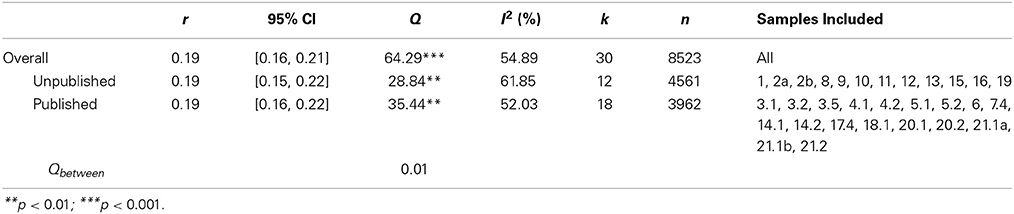
Research suggests that contact with nature can be beneficial, for example leading to improvements in mood, cognition, and health. A distinct but related idea is the personality construct of subjective nature connectedness, a stable individual difference in cognitive, affective, and experiential connection with the natural environment. Subjective nature connectedness is a strong predictor of pro-environmental attitudes and behaviors that may also be positively associated with subjective well-being. This meta-analysis was conducted to examine the relationship between nature connectedness and happiness. Based on 30 samples (n = 8523), a fixed-effect meta-analysis found a small but significant effect size (r = 0.19). Those who are more connected to nature tended to experience more positive affect, vitality, and life satisfaction compared to those less connected to nature. Publication status, year, average age, and percentage of females in the sample were not significant moderators. Vitality had the strongest relationship with nature connectedness (r = 0.24), followed by positive affect (r = 0.22) and life satisfaction (r = 0.17). In terms of specific nature connectedness measures, associations were the strongest between happiness and inclusion of nature in self (r = 0.27), compared to nature relatedness (r = 0.18) and connectedness to nature (r = 0.18). This research highlights the importance of considering personality when examining the psychological benefits of nature. The results suggest that closer human-nature relationships do not have to come at the expense of happiness. Rather, this meta-analysis shows that being connected to nature and feeling happy are, in fact, connected.


Introduction


Wilson (1984) posits that humans have an inborn tendency to focus on and affiliate with other living things. Termed the biophilia hypothesis by Kellert and Wilson (1993), this attraction to life and lifelike processes can be understood through an evolutionary perspective. Because humans have spent almost all of our evolutionary history in the natural environment and have only migrated to urban living in relatively recent times, this attraction, identification, and need to connect to nature is thought to remain in our modern psychology (Kellert and Wilson, 1993). More specifically, it would have been evolutionarily adaptive for our ancestors to be connected to nature in order to survive and thrive in their immediate environmental circumstances. The everyday behaviors of our ancestors such as successfully finding suitable food, water, and shelter, effectively monitoring time and one's spatial location, and avoiding and reacting to predators all heavily relied on paying attention to cues in nature. Thus, individuals who were more connected to the natural world would have had a significant evolutionary advantage over those who were not as connected. To be clear, not all aspects of nature are beneficial and life supporting. For example, Ulrich (1993) reviews instances of biophobia, or a biological preparedness to acquire fear of persistently threatening things such as snakes and spiders. Nonetheless, he argues that evidence of biophobia simultaneously suggests the viability of evolved positive responses to the natural world. Evolutionary psychology more generally suggests that modern environments are not optimally suited to minds that evolved in different (more natural) environments (e.g., Barkow et al., 1992; Buss, 2000). Thus, the specific biophilia hypothesis is not needed to retain the more general evolutionary idea of modern gaps in optimal human-environment fit.

The gap in nature exposure between our early evolutionary environments and modern life is clear, and appears to be growing. For instance, children are spending less time playing in natural environments compared to previous generations (Clements, 2004; Louv, 2005; England Marketing, 2009) and, in general, individuals from developed nations are spending almost all of their time indoors (Evans and McCoy, 1998; MacKerron and Mourato, 2013). On a broader scale, for the first time in human history, more of the world's population now lives in urban instead of rural areas (United Nations Population Division, 2002). This physical disconnection from the environments in which we evolved in may be having a detrimental impact on our emotional well-being as exposure to nature is associated with increased happiness (Berman et al., 2008, 2012; Mayer et al., 2009; Nisbet and Zelenski, 2011; MacKerron and Mourato, 2013; White et al., 2013).

Beyond these trends, individuals vary along a continuum in their subjective connection to nature (e.g., Mayer and Frantz, 2004). This individual difference, which will be referred to as nature connectedness, can be thought of as trait-like in that it is relatively stable across time and situations (Nisbet et al., 2009). Nevertheless, one's subjective connection to nature can fluctuate (e.g., compare taking a walk outside in nature vs. indoors through tunnels) and be measured at the state level as well (Schultz, 2002; Nisbet and Zelenski, 2011). For the purposes of this paper, nature connectedness will be primarily conceptualized as a trait-like between-person difference.

Consistent personality, attitudinal, behavioral, and well-being differences are found between those who strongly identify with and feel connected to the natural world compared to those who do not. Individuals higher in nature connectedness tend to be more conscientious, extraverted, agreeable, and open (Nisbet et al., 2009; Tam, 2013a). Beyond personality traits, a greater connection to nature is also associated with more pro-environmental attitudes, a greater willingness to engage in sustainable actions, and increased concern about the negative impact of human behavior on the environment (Mayer and Frantz, 2004; Leary et al., 2008; Nisbet et al., 2009; Tam, 2013a). Behaviorally, individuals higher in nature connectedness are more likely to spend time outdoors in nature and engage in a variety of pro-environmental behaviors (e.g., buy “green” products; Mayer and Frantz, 2004; Nisbet et al., 2009; Tam, 2013a). Most relevant to this article, nature connectedness has also been correlated with emotional and psychological well-being (e.g., Nisbet and Zelenski, 2013). The purpose of the current research was to examine the relationship between nature connectedness and happiness in particular by conducting a meta-analysis. The meta-analysis was completed by using correlations to examine the strength of the relationship but not necessarily if one variable causes the other.

An evolutionary history where it was apparently advantageous for our ancestors to be connected to nature and present day variability in nature connectedness appear to be contradictory ideas at first glance, but multiple explanations exist for how both can co-exist. First, similar to how variability in other personality traits can be understood as being the result of cost and benefit trade-offs for fitness (Nettle, 2006), so too can nature connectedness. For example, although conscientiousness is often thought of as a desirable and beneficial personality trait (e.g., it is positively associated with longevity; Friedman et al., 1995), there are certain circumstances where being high in conscientious would be evolutionarily disadvantageous (e.g., missing out on unexpected short-term opportunities; Nettle, 2006). Relatedly, there may have been ways in which being high in nature connectedness was not evolutionarily advantageous (e.g., refusing to kill/eat an animal for sustenance or being too comfortable and not having a reasonable amount of fear of a dangerous predator).

Taking another perspective, although we might have an innate predisposition to connect and identify with the natural world, it may be shaped by early childhood experiences and culture. Orr (1993) raised the idea that there may be a critical period during development where one must have positive experiences in nature in order to develop biophilic beliefs, feelings, and tendencies. In addition, Kellert (1997) believed that biophilia could also be shaped by culture and experiences despite it being inborn. Supporting this, individuals who are higher in nature connectedness as adults recall spending more time in nature during their childhood compared to those who are not as connected to nature (Tam, 2013a). In addition, researchers have found that some groups (e.g., Menominee Native Americans) are more likely to view humans as a part of nature and feel psychologically closer to nature compared to other groups (e.g., European Americans), even at relatively early stages in development (e.g., Bang et al., 2007; Unsworth et al., 2012). This research illustrates that developmental experiences and cultural context can have an influence on our evolved tendency to connect with nature. In sum, the biophilia hypothesis and individual differences in nature connectedness are not contradictory and can logically co-exist to examine and explain the human-nature relationship.

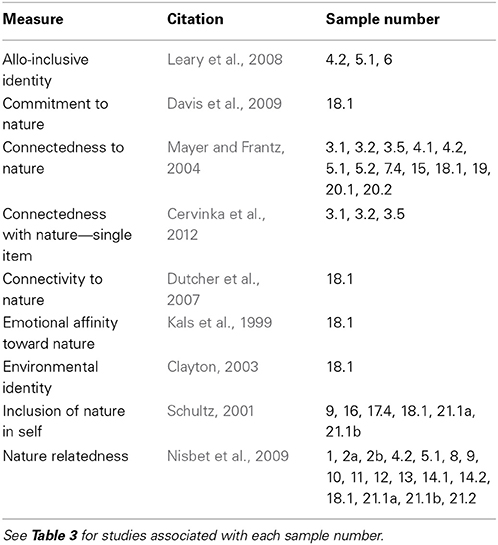
A variety of concepts and measures have been developed in order to assess the human-nature relationship, including commitment to nature (Davis et al., 2009), connectedness to nature (Mayer and Frantz, 2004), connectivity with nature (Dutcher et al., 2007), emotional affinity toward nature (Kals et al., 1999), environmental identity (Clayton, 2003), inclusion of nature in self (Schultz, 2001), and nature relatedness (Nisbet et al., 2009). Through the lens of interdependence theory (Rusbult and Arriaga, 2000), Davis et al. (2009) defined commitment to nature as a “psychological attachment to and long-term orientation toward the natural world” (p. 174) and adapted the commitment scale by Rusbult et al. (1998) which originally assessed commitment to a close partner. Mayer and Frantz (2004) described connectedness to nature as a “measure of an individuals' trait levels of feeling emotionally connected to the natural world” (p. 503) and is explicitly conceptualized as assessing the affective component of the human-nature connection. Another clearly affective nature connectedness construct is emotional affinity toward nature, which was developed by Kals et al. (1999) and involves pleasant feelings of inclination toward nature such as oneness and love. Inclusion of nature in self was developed by Schultz (2001) who adapted the Inclusion of Other in Self scale (Aron et al., 1992) in order “to measure the extent to which an individual includes nature within his or her cognitive representative of self” (Schultz and Tabanico, 2007, p. 1221). With one of its items being the Inclusion of Nature in Self scale, connectivity with nature is defined by Dutcher et al. (2007) as “a sense of sameness between the self, others, and nature” (p. 474). The multidimensional construct of environmental identity, which Clayton (2003) likens to other collective identities that people have, is conceptualized as a feeling of connection to the natural environment and the belief that the environment is an important part of one's self-concept. Lastly, nature relatedness is another multidimensional construct that involves one's “affective, cognitive, and physical relationship with the natural world” (Nisbet et al., 2009, p. 719).

Despite these different concepts and measures, they all appear to be assessing slightly different expressions of the same underlying construct (i.e., one's subjective connection to nature). To support this, they are all highly correlated with one another and associated with other personality characteristics, measures of well-being, and environmental attitudes and behaviors in a relatively similar manner (see Tam, 2013a). For these reasons, no distinctions will be made between these concepts in this paper and nature connectedness will be used as an umbrella term for all of them.

A common line of research for many in this area is the investigation of the relationship between nature connectedness and well-being (e.g., Mayer and Frantz, 2004; Howell et al., 2011; Nisbet and Zelenski, 2011). Well-being and the path to its attainment have traditionally and typically been conceptualized in one of two ways by philosophers and psychologists (Grinde, 2012). From a hedonic perspective, well-being consists of the pleasantness of an individual's experiences and is achieved through the maximization of pleasure and the satisfaction of desires (Kahneman, 1999; Fredrickson, 2001). Subjective well-being, another term for happiness in the hedonic approach, consists of an affective component (i.e., the presence of positive emotional experiences and the absence of negative ones) and a cognitive component (i.e., the evaluation of one's life as satisfying; Diener and Lucas, 1999; Diener, 2009). Specific measures used to assess hedonic well-being include the Positive and Negative Affect Schedule (Watson et al., 1988), the Subjective Happiness Scale (Lyubomirsky and Lepper, 1999), and the Satisfaction with Life Scale (Diener et al., 1985). In contrast, from a eudaimonic perspective, well-being is more about following one's deeply held values and realizing one's fullest potential (Waterman, 1993; Ryff, 1995). As an example, psychological well-being is a construct that is thought to constitute eudaimonic well-being and consists of six facets of actualization including mastery, life purpose, autonomy, self-acceptance, positive relatedness, and personal growth (Ryff and Keyes, 1995). Despite the contentious history between these two perspectives, hedonic and eudaimonic well-being indicators tend to be positively correlated and can influence one another implying that they are not mutually exclusive but overlapping and distinct (King et al., 2006; Waterman, 2008; Huta and Ryan, 2010). Furthermore, individuals high in hedonic and eudaimonic motives tend to experience the greatest amount of overall well-being and are considered to be flourishing (Huta and Ryan, 2010; Forgeard et al., 2011). Nonetheless, due to its more targeted definition, established assessment tools, and common usage compared to the eudaimonic approach (Kashdan et al., 2008), this meta-analysis primarily focused on hedonic measures of well-being.

Although events can influence an individual's present mood state, most have only a limited long-term impact on one's happiness (Steel et al., 2008, but see Diener et al., 2006 for exceptions). In fact, subjective well-being tends to be relatively stable over time (Diener and Lucas, 1999; Lyubomirsky et al., 2005; Nes et al., 2006). Relatedly, subjective well-being is associated with particular personality traits. Similar to nature connectedness, subjective well-being is consistently positively associated with extraversion, agreeableness, and conscientiousness, but unlike nature connectedness it is also negatively correlated with neuroticism (Steel et al., 2008). Lastly, subjective well-being can predict important life outcomes such as health, longevity, and disease (Williams and Schneiderman, 2002; Lyubomirsky et al., 2005; Chida and Steptoe, 2008).

There are several reasons why one would expect nature connectedness to be positively associated with subjective well-being. First, being and feeling connected in general consistently predicts well-being (Ryan and Deci, 2001). For instance, consider social connectedness. A rich and fulfilling social life is a commonality found in the lives of very happy people (Diener and Seligman, 2002). Relatedly, those who are higher in the personality traits of extraversion and agreeableness tend to experience more positive emotions compared to those who are lower in these characteristics (Steel et al., 2008). Within individuals, daily fluctuations in feelings of social relatedness predict changes in subjective well-being (Reis et al., 2000). In contrast, loneliness and shyness are negatively correlated with happiness (Booth et al., 1992) and social exclusion has been found to activate similar brain regions as physical pain (Eisenberg et al., 2003). These findings have led some to argue that social connectedness is a prerequisite for happiness and a basic human need (Baumeister and Leary, 1995). Having a connection with nature may function similarly and also promote well-being. It is important to note that there appears to be something else beyond mere general subjective connectedness which explains nature connectedness' relationship with happiness. When one controls for other connections (e.g., family or culture), nature connectedness still significantly predicts happiness (Zelenski and Nisbet, 2014).

Additionally, individuals who are higher in nature connectedness may seek out more opportunities to reap the psychological benefits associated with nature exposure, or, from a biophilia perspective, satisfy the need to affiliate with other living things. In support of this, nature connectedness is positively associated with nature contact (e.g., frequency of time spent outdoors and in nature) and interaction with other living things (e.g., pet ownership; Nisbet et al., 2009), and there is a substantial amount of evidence that shows that exposure to nature leads to increased happiness (Berman et al., 2008, 2012; Mayer et al., 2009; Nisbet and Zelenski, 2011; White et al., 2013).

There are also plausible reasons to expect an effect in the opposite direction. As previously mentioned, nature connectedness consistently predicts pro-environmental attitudes and concern about the environment (Mayer and Frantz, 2004; Leary et al., 2008; Nisbet et al., 2009; Tam, 2013a). Individuals who incorporate nature into their sense of self may view harm done to nature as harm done to themselves (Mayer and Frantz, 2004). As knowledge, awareness, certainty, and salience concerning the negative impacts that climate change will have on the environment and life on Earth increase, being more connected to nature could conceivably hamper happiness instead of promoting it (Doherty and Clayton, 2011). In fact, a quarter of Americans feel depressed or guilty about the issue of global warming and those who are most alarmed about climate change are more likely to feel afraid, angry, sad, and disgusted (Maibach et al., 2009). The term eco-anxiety has even been used by some in the media to reflect the worry and concern about global warming that some individuals have, along with self-reported symptoms of sleeplessness, loss of appetite, weakness, irritability, and panic attacks (Nobel, 2007). Furthermore, models of grieving and mourning following a loss have been applied to individuals' reaction to learning about and accepting global warming and making changes in lifestyle to minimize one's carbon footprint (Randall, 2009). Given the greater environmental concern that seems to accompany a subjective connection to nature, negative emotions and distress may be more frequently experienced by those higher in nature connectedness. From this perspective, one might predict that nature connectedness might be negatively associated with happiness. It is also possible that there is no relationship between one's subjective connection to nature and subjective well-being (e.g., because the positive and negative processes cancel each other, on average).

Although a previous meta-analysis has been published that examined whether exposure to natural environments has a positive impact on health and well-being (Bowler et al., 2010), no meta-analyses have been conducted that have comprehensively investigated whether the trait of nature connectedness is associated with happiness. The purpose of this study was to test whether the relationship between these two constructs was significant, to provide an estimate of its effect, and to determine whether there was significant variability across samples. This is necessary as the association between measures of nature connectedness and happiness appear to vary considerably, with correlation coefficients ranging from −0.01 (Nisbet et al., 2011) to 0.42 (Zelenski and Nisbet, 2014) in the published research literature. We hypothesized that there would be a small but significant relationship between nature connectedness and happiness. This was a realistic estimate as it tends to be the average or median effect size in many areas of psychology (Sarason et al., 1975; Lipsey and Wilson, 1993; Richard et al., 2003).

In addition, moderator analyses were conducted on publication status, year, age, gender, type of happiness, and measure of nature connectedness. Publication status was analyzed as a moderator in order to determine if there is a publication bias in this area of research (i.e., published studies reporting a stronger relationship between nature connectedness and happiness compared to unpublished ones). Year was analyzed as a moderator because of the recent attention given to the decline effect—the observation that many scientific findings diminish with time (Schooler, 2011). Age and gender were analyzed as moderators because being older and being female tend to be associated with higher environmental concern, attitudes, and behaviors (e.g., Grønhøj and Thøgersen, 2009; Scannell and Gifford, 2013). In order to examine whether the different measures of well-being and nature connectedness accounted for any of the variability across samples, separate meta-analyses were run for the most common types of happiness (i.e., positive affect, life satisfaction, and vitality) and nature connectedness (i.e., connectedness to nature, inclusion of nature in self, and nature relatedness).


Methods

Inclusion and Exclusion Criteria


To be included in this meta-analysis, studies had to employ at least one measure of nature connectedness and at least one measure of happiness, and report on their relationship. Only explicit self-report trait measures of identification with nature were included (see Table 1). In contrast, implicit or state measures of nature connectedness were excluded in order to minimize commensurability (i.e., grouping substantially different measures together; Sharpe, 1997; Cortina, 2003). For instance, the average correlation between explicit self-report measures and the implicit association task is 0.24, which is substantially lower than the correlations found between explicit measures of nature connectedness (Hofmann et al., 2005; Tam, 2013a). In addition, state nature connectedness was excluded because a previous meta-analysis has already examined the impacts of nature exposure on emotional functioning (Bowler et al., 2010). Studies that artificially dichotomized nature connectedness were excluded as well to avoid all the problems that are associated with the dichotomization of quantitative variables (see MacCallum et al., 2002).

TABLE 1
Table 1. Nature connectedness measures included in meta-analysis.
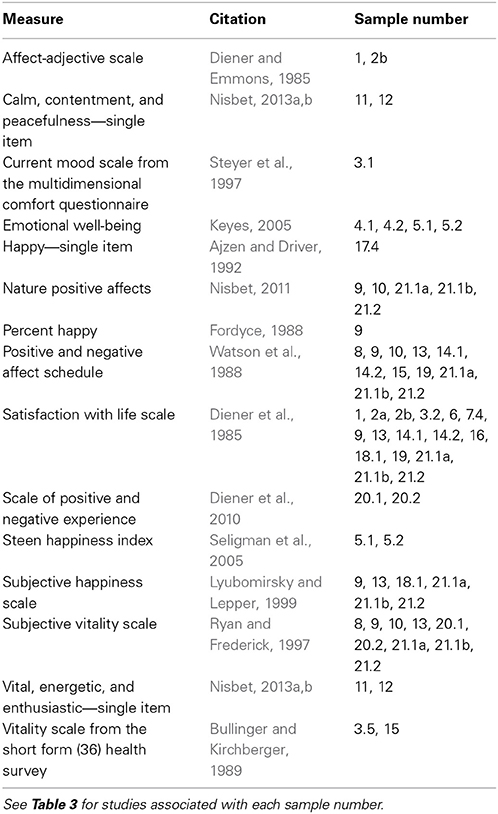
Regarding the second construct of interest, studies that employed either explicit self-report state or trait measures of subjective well-being were included in the meta-analysis (see Table 2). Studies that measured eudaimonic well-being (e.g., self-acceptance), hedonistic values, or implicit measures of happiness were excluded in order to reduce commensurability and maintain a targeted focus on hedonic well-being. Nevertheless, vitality, which is defined as the positive feeling of being alive, alert, and energetic (Ryan and Frederick, 1997), was included in the current meta-analysis. Although it is theoretically conceptualized as a eudaimonic construct and is associated with other measures of eudaimonic well-being (e.g., self-actualization; Ryan and Frederick, 1997), subjective vitality is predicted by both hedonic and eudaimonic motives (Huta and Ryan, 2010), as well as hedonic behaviors (but not eudaimonic ones; Henderson et al., 2013). Furthermore, there appears to be similar conceptual overlap between vitality and some of the other high arousal positive emotions included in measures such as the Positive Affect and Negative Affect Scale (e.g., excited, enthusiastic, alert, attentive, and active; Watson et al., 1988). For these reasons, measures of vitality were included in this meta-analysis. As the focus of this meta-analysis is on positive emotional functioning, measures of negative affect were excluded. Studies that artificially dichotomized happiness were excluded as well due to the dichotomization problems that were previously alluded to.
TABLE 2
Table 2. Happiness measures included in meta-analysis.

All age groups were included as eligible samples because there was no theoretical or practical reason to exclude any in particular. For this same reason, no exclusions were made based on the country where the study was conducted, the language it was written in, or the time when it was conducted. Relatedly, the study had to provide sufficient information to code an effect size and its variance (i.e., correlation coefficient and sample size) to be included. Qualitative studies were excluded and samples sizes had to be above 10 to be included. Lastly, experimental designs were included only if they provided a baseline measure of the relationship between connectedness to nature and happiness prior to any experimental manipulations.

Search Strategies


Numerous methods were used to identify studies. Abstracts were searched in the PsycINFO and Dissertation and Theses Full Text electronic databases using the various names given for nature connectedness as the search terms: commitment to nature, connectedness to nature, connectivity with nature, emotional affinity toward nature, environmental identity, inclusion of nature in self, and nature relatedness. Reference lists of studies that met the inclusion/exclusion criteria were investigated, as well as the studies that cited them. Authors who conducted studies that measured nature connectedness and happiness but did not report on their relationship were contacted to obtain the necessary statistical information. Requests for additional findings were sent out in May 2013 using the email listserv for Division 34 of the American Psychological Association and in June 2013 using the Conservation Psychology email listserv.

Coding Procedure


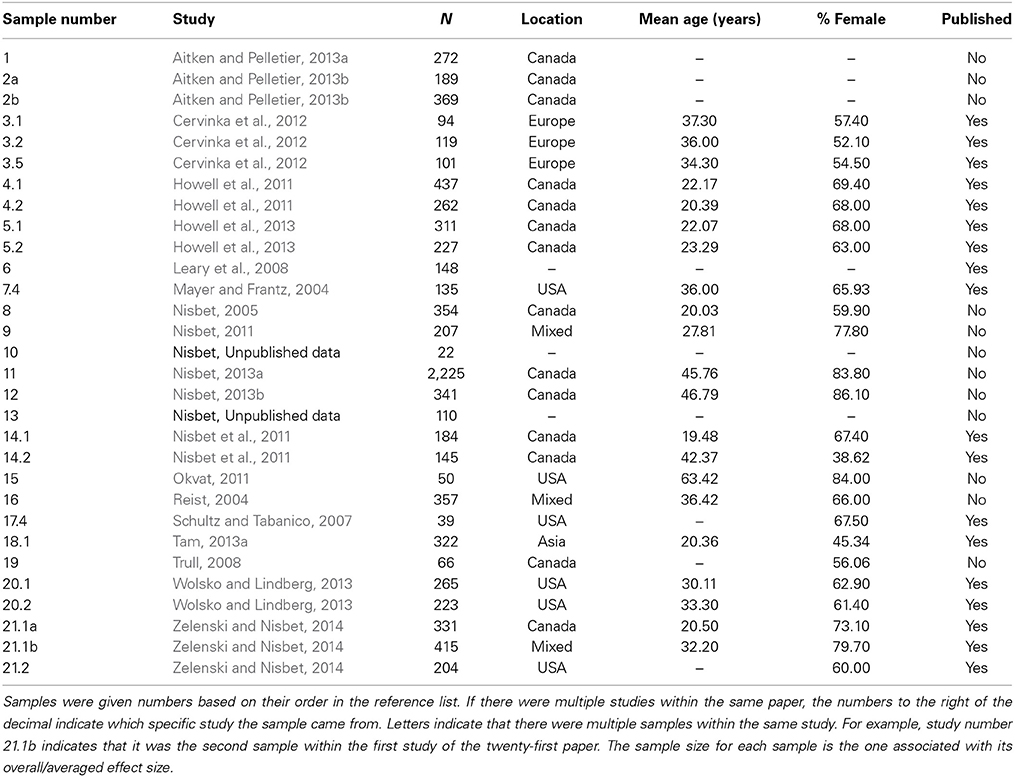
A standard coding form and explicit rules outlined in a coding manual that was developed for the current meta-analysis were used for each sample (see Supplementary Material). The standard coding forms contained a cover sheet that was completed for each non-overlapping sample, along with a basic study descriptives form and a sample information form. Specific effect sizes were coded on individual effect size forms. If a sample had multiple measures of nature connectedness and/or happiness, a weighted average of the effect sizes was calculated for that sample. In total, 140 effect sizes were coded from the 30 unique samples with each sample having its own overall effect size. These were used in subsequent analyses in order to ensure that the independence of observations principle was maintained.

Interrater reliability analyses were conducted on all of the non-overlapping samples by the first and second authors. The first author developed the coding manual and coded all of the studies, and then trained the second author as the secondary coder. Minor clarifications and updates were made to the coding manual after the two coders compared their coding of the first couple of studies. The raters coded all of the studies separately and then had multiple meetings where disagreements were identified and consensus ratings were reached.

The two raters coded 124 common effect sizes with high levels of agreement (absolute intraclass correlation [ICC] based on single rater = 0.99). Eleven effect sizes were coded by the first author but not the second and an additional five effect sizes were coded by the second author but not the first. Out of the 140 effect sizes coded by the raters, a consensus was reached that 127 of them should be included in the meta-analysis. High levels of agreement were also found for the other continuous variables that were coded (i.e., year, sample size, percentage of females, and average age of sample), with ICC values ranging from 0.98 to 1.0. When possible, Cohen's Kappa was computed for the categorical variables (n = 28) and were found to range from 0.21 to 1 (M = 0.91). Following conventions outlined in Landis and Koch (1977), the strength of agreement was almost perfect (i.e., above 0.80) for the vast majority of the categorical variables (n = 24) and substantial (i.e., between 0.60 and 0.80) for all the rest of them excluding one. The coding of the happiness measure as state, trait, or mixed had the uniquely low interrater reliability of 0.21. Nonetheless, the overall percent agreement for the coding of this variable was 87.90% and the majority of disagreements occurred early on in the coding process before clarifications were made to the coding manual or due to a rater forgetting to code this variable and leaving it blank. In general, the interrater reliability was relatively high which supports the notion that other raters who followed the same coding manual would code the samples in a consistent manner and end up with similar results.

Statistical Methods

Effect size

Because the relationship between two continuous variables was being examined, correlation coefficients were the effect size used to summarize the relationship between nature connectedness and happiness in this meta-analysis. Because some of the correlation coefficients were expected to be above 0.30, correlation coefficients were transformed into Fisher's Z values before being meta-analyzed. This transformation ensured that the variance of the effect size would be solely based on the sample size and not the magnitude of the effect size as well (Borenstein et al., 2009). For ease of interpretation, all the results involving Fisher's Z values have been retransformed into correlation coefficients. Following the conventions outlined in Cohen (1988), correlation coefficients of 0.10 were considered small, 0.30 were considered moderate, and 0.50 were considered large.

Aggregation of findings


Both fixed-effect and random-effects meta-analyses were conducted (Borenstein et al., 2009). The fixed-effect model assumes that there is one true effect size and that variability across samples is sampling error. The random-effects model assumes that there is no one true effect size, but a distribution of effect sizes, and variability across samples is real and not just sampling error. The random-effects model allows one to generalize beyond the samples included in the meta-analysis, while the fixed-effect model does not. Despite its advantages, the random-effects model is a more conservative test and unstable when the number of samples is smaller than 30 (Overton, 1998; Schulze, 2007). Both fixed-effect and random-effects meta-analyses were conducted in order to account for the advantages and disadvantages of each and increase confidence in consistent results. Regardless of the model, the effect size of each sample was weighted by the inverse of its variance.

Cochran's Q statistic was computed to determine whether there was significantly more variability across samples than what one would expect by chance (Borenstein et al., 2009). To determine the percentage of variability across samples that is beyond what one would expect by chance, I2 was obtained. Following recommendations outlined in Higgins et al. (2003), an I2 value of 25% was considered low variability, 50% was considered moderate, and 75% was considered high.

Because outliers can distort the results of a meta-analysis, extreme effect sizes were identified by following the rules developed in Hanson and Bussière (1998). First, the effect size must be either the highest or lowest in magnitude. Second, Cochran's Q statistic must be significant. Third, the effect size must account for more than half of Q. Fourth, there must be more than three samples. If a potential outlier was found, the results with and without that sample were reported but interpretations were based on the latter. A sample with an extremely large sample size relative to the rest of the samples can also have a large impact on the results of a meta-analysis. Following the rule used in other meta-analyses (e.g., Helmus et al., 2013), the weight of the largest sample was reduced to be only 50% larger than the weight of the second largest sample if the variability across samples was found to be significant.

Moderator analyses


For categorical moderators, fixed-effect between-level Q moderator analyses were conducted (Borenstein et al., 2009). The between-level Q was obtained to determine whether the moderator significantly accounted for the unexplained variability across samples. Fixed-effect was chosen because moderator analyses tend to have low power and fixed-effect moderator analyses provide more power than random-effects. In addition, the Q statistic is easier to interpret in fixed-effect models. For continuous moderators, fixed-effect meta-regression was conducted (Borenstein et al., 2009). Meta-regression was conducted to determine whether the moderator is a significant predictor of effect size. Fixed-effect assumes that the moderators completely explain the effect size of the samples and that there is no residual heterogeneity. It was chosen over random-effects because of its higher power.


Results

Overview of Included Studies


As of August 2nd, 2013, 30 non-overlapping samples from 21 studies were identified. Descriptive information for each of the included samples can be found in Table 3. The total sample size was 8523. The sample sizes ranged from 22 to 2224 (M = 284.10, SD = 384.47, Mdn = 215). Many of the samples came from Canada (46.7%), followed by the United States (20%), Europe (10%), Asia (3.3%), and mixed locations (10%). All the studies were written in English. The samples ranged in average age from 19.48 years to 63.42 years (M = 31.91, SD = 11.37). The percentage of females in each sample ranged from 38.62 to 86.10% (M = 65.33, SD = 11.84). University/college students made up 33.3% of the samples, while 40% of samples were community members and 6.7% of samples contained a mix. The years of the studies ranged from 2004 to 2014. Samples were coded as published if they came from a journal article or book chapter. Using this criterion, 60% of the samples were published and 40% were unpublished. Samples were coded as peer reviewed if they came from a dissertation/thesis or journal article. Using this criterion, 73.3% of the samples were peer-reviewed and 26.7% were not.

TABLE 3
Table 3. Descriptive information for included samples.


Overall Effect Size and Statistical Significance


Figure 1 is a forest plot which shows the effect size and confidence interval associated with each sample and the meta-analytic average from the fixed-effect meta-analysis. Table 4 shows the results of both the fixed-effect and random-effects meta-analysis. As one can see, both models produced relatively consistent results. More specifically, a small mean weighted effect size was found between nature connectedness and happiness in the fixed-effect [r = 0.19, 95% CI (0.16, 0.21), k = 30, n = 8523] and random-effects models [r = 0.18, 95% CI (0.15, 0.22), k = 30, n = 8523]. Because both of the 95% confidence intervals did not include zero, one can conclude that this small mean weighted effect size was significant at the p < 0.05 level.

FIGURE 1
Figure 1. Forest plot.
TABLE 4
http://www.frontiersin.org/files/Articles/92737/fpsyg-05-00976-HTML/image_m/fpsyg-05-00976-t004.jpg
Table 4. Meta-analysis results.

Analysis of Heterogeneity


The variability across samples was significant (Q = 64.29, df = 29, p < 0.001) and the I2 indicated that 54.89% of the observed variability was beyond what would be expected by chance. In other words, it would be reasonable to conclude that there was a moderate amount of variability across samples. This implies that there may be some variables moderating the magnitude of the effect size.

Outliers and Extremely Large Samples


Following the rules developed in Hanson and Bussière (1998), no outliers were identified. Although Cochran's Q was significant and there were more than three samples, the samples with the highest and lowest effect sizes did not account for more than half of the Q statistic. When the sample with the lowest effect size (Schultz and Tabanico, 2007; r = −0.13) was removed from the meta-analysis, the Q statistic did not decrease by 50% (Q = 60.76). Relatedly, when the sample with the highest effect size (Nisbet, Unpublished data; r = 0.50) was removed from the meta-analysis, the Q statistic did not decrease by 50% (Q = 61.83). For these reasons, all the samples identified were included in the overall meta-analysis.

Nisbet (2013a) can be considered an extremely large sample as it contributed over a quarter of the total participants in this meta-analysis and its sample weight was more than five times the size of the second largest weight (2221 vs. 434). Following the rules outlined in the methods section, the sample weight of Nisbet (2013a) was artificially reduced to be only 50% larger than the second largest sample weight (i.e., 651). This is what was used in the overall meta-analysis and the moderator analyses.

Investigation of Potential Moderators


Moderator analyses were conducted to examine whether publication status, gender, year, age, type of happiness, and measure of nature connectedness accounted for the significant variability across samples.

Publication status


To examine whether there was a publication bias, fixed-effect between-level Q moderator analyses were run with publication status (i.e., published vs. unpublished) as the categorical moderator. Table 5 shows the results of this moderator analysis. Because the between-level Q statistic is distributed as a chi-square with the degrees of freedom being the number of levels of the categorical variable minus one, the critical value for this moderator analysis is 3.84 for p < 0.05 at a degrees of freedom of 1. As the between-level Q did not exceed the critical value (between-level Q = 0.01, df = 1, p = 0.92), one can conclude that publication bias is probably not an issue for this research topic.
TABLE 5
http://www.frontiersin.org/files/Articles/92737/fpsyg-05-00976-HTML/image_m/fpsyg-05-00976-t005.jpg
Table 5. Fixed-effect between-level Q moderator analysis for publication bias.
Gender

In order to investigate whether gender moderates the relationship between nature connectedness and happiness, a fixed-effect meta-regression was conducted with percentage of females in the sample as the predictor variable. Percentage of females in the sample was not a significant predictor of effect size (slope = 0.0004, SE = 0.00113, Z = 0.35, p = 0.73, k = 24, n = 7413).

Year

In order to investigate whether the relationship between nature connectedness and happiness is influenced by the year, fixed-effect meta-regressions were conducted with year as the predictor variable. Year was not a significant predictor of effect size (slope = −0.00479, SE = 0.00412, Z = −1.16, p = 0.25, k = 30, n = 8523). Thus, one can conclude that the decline effect is probably not an issue for this research topic.

Age

In order to examine whether the relationship between nature connectedness and happiness stays the same throughout the lifespan, fixed-effect meta-regressions were conducted with average age of the sample as the predictor variable. Average age was not a significant predictor of effect size (slope = 0.00064, SE = 0.00134, Z = 0.48, p = 0.63, k = 21, n = 7104).

Type of happiness

The relationship between nature connectedness and happiness may depend on how happiness is defined and measured. Because some of the samples used multiple measures of happiness, conducting moderator analyses on this variable would violate the principle of independence. For this reason, general patterns were observed by conducting separate meta-analyses for the three main types of happiness in this study: positive affect, life satisfaction, and vitality. Samples that did not contain a particular type of happiness measure were excluded from that respective meta-analysis and overall effect sizes for each type were calculated for the remaining samples. Both fixed-effect and random-effects meta-analyses were conducted.

Positive affect. A small mean weighted effect size was found between nature connectedness and positive affect in the fixed-effect [r = 0.22, 95% CI (0.19, 0.25), k = 19, n = 5926] and random-effects models [r = 0.22, 95% CI (0.17, 0.26), k = 19, n = 5926]. The variability across samples was significant (Q = 40.69, df = 18, p = 0.002) and moderate as the I2 indicated that 55.77% of the observed variability was beyond what would be expected by chance.

Life satisfaction. A small mean weighted effect size was found between nature connectedness and life satisfaction in the fixed-effect [r = 0.17, 95% CI (0.14, 0.20), k = 16, n = 3575] and random-effects models [r = 0.16, 95% CI (0.11, 0.20), k = 16, n = 3575]. The variability across samples was significant (Q = 32.17, df = 15, p = 0.006) and moderate as the I2 indicated that 53.37% of the observed variability was beyond what would be expected by chance.

Vitality. A small mean weighted effect size was found between nature connectedness and vitality in the fixed-effect [r = 0.24, 95% CI (0.21, 0.27), k = 13, n = 4824] and random-effects models [r = 0.24, 95% CI (0.19, 0.29), k = 13, n = 4824]. The variability across samples was significant (Q = 23.77, df = 12, p = 0.02) and moderate as the I2 indicated that 49.51% of the observed variability was beyond what would be expected by chance.

Measure of nature connectedness


The relationship between nature connectedness and happiness may depend on the measure used to assess one's connection to nature. Because some of the samples used multiple measures of nature connectedness, conducting moderator analyses on this variable would violate the principle of independence. For this reason, general patterns were observed by conducting separate meta-analyses for the three most commonly used measures of nature connectedness: the connectedness to nature scale (Mayer and Frantz, 2004), the inclusion of nature in self-scale (Schultz, 2001), and the nature relatedness scale (Nisbet et al., 2009). Samples that did not contain a particular type of nature connectedness measure were excluded from that respective meta-analysis and overall effect sizes for each were calculated for the remaining samples. Both fixed-effect and random-effects meta-analyses were conducted.

Connectedness to nature. A small mean weighted effect size was found between happiness and connectedness to nature in the fixed-effect [r = 0.18, 95% CI (0.14, 0.22), k = 13, n = 2615] and random-effects models (r = 0.18, 95% CI (0.13, 0.24), k = 13, n = 2615]. The variability across samples was significant (Q = 23.80, df = 12, p = 0.02) and moderate as the I2 indicated that 49.59% of the observed variability was beyond what would be expected by chance.

Inclusion of nature in self. A small mean weighted effect size was found between happiness and inclusion of nature in self in the fixed-effect [r = 0.27, 95% CI (0.23, 0.32), k = 6, n = 1671] and random-effects models [r = 0.25, 95% CI (0.15, 0.35), k = 6, n = 1671]. The variability across samples was significant (Q = 21.59, df = 5, p < 0.001) and high as the I2 indicated that 76.84% of the observed variability was beyond what would be expected by chance.

Nature relatedness. A small mean weighted effect size was found between happiness and nature relatedness in the fixed-effect [r = 0.18, 95% CI (0.16, 0.21), k = 17, n = 6255] and random-effects models [r = 0.18, 95% CI (0.14, 0.22), k = 17, n = 6255]. The variability across samples was significant (Q = 28.63, df = 16, p = 0.03) and moderate as the I2 indicated that 44.12% of the observed variability was beyond what would be expected by chance.


Discussion


The purpose of this study was to provide a quantitative summary of the literature on the link between nature connectedness and happiness. Auspiciously, a fairly clear picture emerged. The relationship between nature connectedness and happiness appears to be positive and significant. In general, individuals who are more connected to nature tend to be happier.

Demographic characteristics, such as gender and age, did not moderate this relationship despite previous research finding that being older and female tends to be associated with increased pro-environmental concern, attitudes, and behaviors (e.g., Grønhøj and Thøgersen, 2009; Scannell and Gifford, 2013). It appears that possible age or gender differences in nature connectedness or well-being did not impact the association between the two. Publication bias did not appear to be an issue, nor was any evidence for the decline effect found—thus increasing confidence in the current meta-analytic summary effect.

How happiness was defined and measured did appear to have an influence on the magnitude of the effect size, with vitality being the most strongly associated with nature connectedness, followed by positive affect and life satisfaction. Nature's restorative effects might explain why vitality has the strongest relationship with nature connectedness (Kaplan, 1995). Beyond its ability to improve emotional functioning, exposure to natural environments has also been shown to alleviate cognitive fatigue, improve attention, and increase feelings of vitality (Berman et al., 2008; Ryan et al., 2010; Nisbet et al., 2011). As those who are higher in nature connectedness are more likely to spend time in nature, they may be beneficiaries of both the affective and revitalizing effects of natural environments, which is reflected by nature connectedness' even stronger association with vitality compared to the other measures of happiness. Vitality being a traditionally eudaimonic measure of well-being might also explain its higher mean weighted effect size. Increased concern for the environment and engagement in sustainable behaviors might carry more hedonic than eudaimonic costs to well-being (Venhoeven et al., 2013) and this may manifest in slightly lower correlations with the more classically hedonic measures of well-being (i.e., positive affect and life satisfaction). The variability in mean weighted effect sizes may be partially due to vitality and positive affect being affective components of well-being, while life satisfaction is more of a cognitive component (Diener and Lucas, 1999; Diener, 2009). Although the different measures of subjective well-being are typically conceived of as assessing the same underlying construct and factor analysis supports this (Sandvik et al., 1993), correlations between different measures of subjective well-being (e.g., recalled positive affect and life satisfaction) tend to be moderate in magnitude (Lucas et al., 1996) indicating that the constructs are not identical (Kim-Prieto et al., 2005). The non-shared variance between measures of subjective well-being might partly explain some of the varying results. Lastly, different proportions of the nature connectedness measures included within each of the meta-analyses could have conceivably influenced or confounded the results. This is unlikely as the percentages of nature connectedness measures within each type of happiness meta-analysis remained fairly consistent, with nature relatedness being the most common (ranging from being in 69.2% of the samples in the vitality meta-analysis to 68.4% of the samples in the positive affect meta-analysis), followed by inclusion of nature in self (ranging from being in 31.3% of the samples in the life satisfaction meta-analysis to 21.1% of the samples in the positive affect meta-analysis), and connectedness to nature (ranging from being in 30.8% of the samples in the vitality meta-analysis to 25% of the samples in the life satisfaction meta-analysis) Regardless of all these explanations, the effect size from each of the meta-analyses examining type of happiness remained relatively similar in magnitude (i.e., small) and all of the fixed-effect confidence intervals either almost overlapped (i.e., vitality and life satisfaction) or did overlap (i.e., vitality and positive affect, as well as positive affect and life satisfaction).

How nature connectedness was defined and measured also appeared to have an influence on the magnitude of the effect size, with inclusion of nature in self-having a particularly stronger relationship with happiness compared to nature relatedness and nature connectedness. This is consistent with the pattern of results found in Zelenski and Nisbet (2014) where zero-order correlations between measures of happiness and nature connectedness were larger for inclusion of nature in self than nature relatedness. One possible explanation for this difference is that inclusion of nature in self may also assess general connectedness more than other measures of nature connectedness which might more precisely tap individuals' subjective connection to nature (Zelenski and Nisbet, 2014). Considering the aforementioned well-being benefits associated with social connection (Ryan and Deci, 2001), more overlap between the general construct of connectedness and inclusion of nature in self could increase the latter's relationship with happiness. In fact, inclusion of nature in self, compared to nature relatedness, has been found to correlate substantially more with general connectedness (Zelenski and Nisbet, 2014). In contrast to these patterns of results, Tam (2013a) found that inclusion of nature in self consistently shared the weakest association with subjective well-being out of all the nature connectedness measures. As Tam (2013a) was the one study on this topic that was conducted in Asia, cross-cultural differences may account for these inconsistencies. Related to this point, researchers in this area should attempt to recruit participants from more diverse backgrounds beyond western, educated, industrialized, rich, and democratic societies (Henrich et al., 2010), as the majority of samples in this meta-analysis came from Canada and the USA. This is especially pertinent given the cultural differences that have been observed in how people conceptualize the relationship between humans and nature (e.g., Bang et al., 2007; Unsworth et al., 2012). The differential distribution of happiness measures is an unlikely explanation for the varying effect sizes found in the separate nature connectedness meta-analyses as the majority of overall/averaged effect sizes within each were based on mixed measures of positive affect, vitality, and/or life satisfaction. Regardless of these explanations, the confidence intervals either almost overlapped (i.e., in the fixed-effect meta-analyses) or did overlap (i.e., in the random-effects meta-analyses). It should also be noted that the number of samples was fairly low (k = 6) and the variability between samples was high in the inclusion of nature in self meta-analysis.

Although the overall effect size from this meta-analysis can be considered small when one follows conventions (Cohen, 1988), as was first noted by Mayer and Frantz (2004), it is similar in size to other variables widely thought to have a positive relationship with happiness, such as personal income within countries (Haring et al., 1984; Diener et al., 1993), education (Witter et al., 1984; Diener et al., 1993), religiosity (Witter et al., 1985; Hackney and Sanders, 2003; Diener et al., 2011), marital status (Haring-Hidore et al., 1985; Diener et al., 2000), volunteering (Thoits and Hewitt, 2001), and physical attractiveness (Diener et al., 1995; Plaut et al., 2009). Furthermore, it is similar in magnitude to the association between subjective well-being and some personality traits such as conscientiousness and agreeableness (DeNeve and Cooper, 1998; Steel et al., 2008). More generally, the overall effect size between nature connectedness and happiness is similar to the average result found in social psychology (i.e., r = 0.21; Richard et al., 2003). Thus, a person's connection to nature should be considered an important construct when discussing happiness and vice versa.

It should be noted that correlation does not equal causation. Higher nature connectedness may cause increased happiness, higher happiness may cause increased nature connectedness, or a third variable might be leading to changes in both variables. Studies have been conducted that employ experimental designs and attempt to manipulate nature connectedness and/or happiness (e.g., Nisbet, 2011). Using statistical mediation analyses, some studies have found that exposure to nature increases nature connectedness because it promotes positive affect (Nisbet and Zelenski, 2011), while other studies have found that nature exposure increases people's emotional well-being partially due to increased nature connectedness (Mayer et al., 2009). Due to the problems associated with meditation analyses (see Bullock et al., 2010) and the fact that these studies confound nature exposure and positive emotions, future research is needed to determine the directionality of this relationship. To our knowledge, no studies have experimentally manipulated happiness (without nature) to examine whether it would lead to a greater sense of connection to the natural world, above and beyond other subjective connections (cf. Zelenski and Nisbet, 2014). This could offer a valuable extension to Fredrickson's (2004) broaden-and-build theory of positive emotions beyond social bonds to connections with nature as well.

Strong subjective connections to nature may begin in childhood. However, the association between childhood experiences and an individual's level of nature connectedness as an adult has only been established through recall in self-reports (Tam, 2013a) thus far. Conducting longitudinal studies that follow individuals across the lifespan would allow researchers to more accurately answer whether childhood contact with nature predicts nature connectedness years later. This could test Orr's (1993) idea of a critical period for developing biophilia and could help explain individual differences in people's subjective connection to nature. The relationship that nature connectedness has with negative emotional functioning, physical health, and cognitive abilities are also promising areas of investigation (cf. Bowler et al., 2010).

Although vitality was included in the operational definition of happiness in this paper, an examination of the relationship between nature connectedness and other constructs that are commonly thought of as eudaimonic well-being such as autonomy, personal growth, self-acceptance, purpose in life, environmental mastery, and positive relations (Ryff, 1989), would provide a fruitful avenue for future research and meta-analysis in and of itself. Of the fewer studies that have looked at this relationship, they tend to find a positive association between nature connectedness and measures of eudaimonic well-being as well (Howell et al., 2011, 2013; Nisbet et al., 2011; Zelenski and Nisbet, 2014). It would be interesting to examine whether this relationship differs significantly in strength from the association found between nature connectedness and hedonic well-being. A review of how pro-environmental behaviors can influence well-being in both positive and negatives ways by Venhoeven et al. (2013) hints that it might as research “suggests that engaging in pro-environmental behavior may have especially negative consequences for hedonic well-being, but mainly positive consequences for eudaimonic well-being” (p. 1380). Although there are circumstances where this may not hold true, the eudaimonic motive of “doing something good” like engaging in pro-environmental behaviors, even when it is difficult, costly, or time-consuming, logically may lead to eudaimonic but not hedonic well-being. As nature connectedness predicts sustainable attitudes and behaviors (Mayer and Frantz, 2004; Leary et al., 2008; Nisbet et al., 2009; Tam, 2013a), this suggests that the relationship between nature connectedness and eudaimonic well-being may be even stronger. That nature connectedness was most strongly associated with vitality also seems to offer preliminary support for this prediction.

Nevertheless, this meta-analysis provides results that run somewhat counter to what one would predict based on Venhoeven's (2013) review as subjective connection to nature is associated with greater hedonic well-being, not less. This suggests that although some aspects of the human-nature relationship have the potential to detract from our happiness (e.g., some pro-environmental behaviors), other aspects may compensate and result in a net increase (e.g., a subjective connection to and contact with nature). Instead of potentially difficult, time-consuming, and costly pro-environmental behaviors coming at an expense to our subjective well-being, sustainable behaviors might be a pleasant expression of a trait (i.e., nature connectedness) that promotes overall positive emotional functioning. This has important implications as we attempt find solutions to many of the problems we face in the twenty-first century, such as climate change and the rising burden of disease of mental illness (World Health Organization, 2001).

Similar to how all the different conceptualizations of well-being were not included in this meta-analysis, other constructs relating to the human-nature relationship (e.g., dispositional empathy with nature; Tam, 2013b) may have been overlooked that warrant further investigation. Moreover, opportunities to develop novel constructs beyond nature connectedness could be expanded by applying existing psychological theories and concepts about human interpersonal relations to the human-nature domain (Tam, 2014). For instance, attachment theory could be extended to a person's attachment to nature, with different attachment styles (i.e., secure, anxious-preoccupied, dismissive-avoidant, and fearful-avoidant; Bartholomew and Horowitz, 1991) potentially being assessed and used to predict variables like connection to nature, environmental attitudes, and likelihood of engaging in sustainable behaviors.

Despite the unambiguous findings of the current meta-analysis and the preferences for nature that people commonly hold (Frumkin, 2001), research suggests that individuals tend to commit affective forecasting errors and underestimate the hedonic benefits that being in nature will bring them (Nisbet and Zelenski, 2011). Given that people are spending the vast majority of their time indoors (Evans and McCoy, 1998; MacKerron and Mourato, 2013) and the increasing urbanization of the world's population (United Nations Population Division, 2002), many of us may be missing out on the beneficial effects of connecting to nature in the moment and in general. This could be contributing to a decrease in not only our own well-being, but that of our planet as well. The current meta-analysis provides further evidence that a sustainable future and a happy future are compatible and symbiotic, not mutually exclusive.

Conflict of Interest Statement

The authors declare that the research was conducted in the absence of any commercial or financial relationships that could be construed as a potential conflict of interest.

Acknowledgments

We thank Leslie Helmus and Kelly Babchishin for providing the advanced statistics course on meta-analysis which was the catalyst for this research project and for their advice on analyses. We also thank all the researchers who graciously shared their findings with us which allowed this meta-analysis to be more comprehensive than it would have been without their help. This research was supported by the Social Sciences and Humanities Research Council, Carleton University, and the Ontario Government.

Supplementary Material


The Supplementary Material for this article can be found online at: http://www.frontiersin.org/journal/10.3389/fpsyg.2014.00976/abstract


References at the Frontiers site