
I liked this post from Lauren Cahn over at Huffington Post. Because there are different types of people, there needs to be different types of meditation, especially for the kinesthetic folks who can't focus while sitting still.
The upside is that even if it is a "bad" meditation session (which there really never is, other than our judging of it), you get in a walk for you health - and get to spend some time outside.
Walking: Meditation for Non-Meditators
Lauren CahnPosted December 7, 2008 | 07:39 PM (EST)You know who you are. You never do less than two things at once. You read while you eat. You check your email while you're on a conference call. You're restless, and it works for you because you get things done. And when it comes to calming your mind, you have no interest in meditating because that would require you to sit still and do nothing.
Right?
Not right.
You don't have to sit to meditate.
To meditate, you only need to focus the mind. In some forms of meditation, the focus is on NOT focusing on any one thought. When the mind realizes that it has attached itself to a thought, the meditator tries to "let go" of the thought and allow it to drift away. In other forms of meditation, the focus is one one thought, a mantra (such as "relax" or "let go" ). When the mind realizes that it has drifted from the mantra, the meditator tries to come back to the mantra.
Meditation is used as a relaxation technique because it helps the mind to rest from its usual state of frenzied thought. It doesn't make life's problems disappear, but it gives us time away. Meditation is like a vacation from our thoughts. Taking time out for meditation can make us more productive in the long run in the same way that taking a vacation from work can make us more productive when we return: time away allows us to come back refreshed. Distance from our thoughts -- our worries, our planning, our soul-searching -- affords us more clarity when we return from our mental vacation.
For some, knitting is a form of meditation. For some, gardening. Many people find that practicing yoga brings them into a meditative state. Personally, I garden throughout the spring and summer and practice yoga on a daily basis, and generally speaking, I find myself calmer for having done so; however, I feel that both of these avocations are flawed as reliable platforms for meditation (and I would imagine that knitting would have the same flaw). The trouble is that inherent in these activities are goals and desired results, which can make a meditative state elusive, if not impossible.
So then what activity can we do that doesn't require analytical thought, that doesn't require us to judge our progress, that doesn't contain a built-in goal?
Walking.
If you can walk, then you can meditate.
For me, there is no better tool for meditation than walking in the woods. I don't have to worry about crossing the street or bumping into anyone I know. I don't have to dress for the occasion. In the colder months, I simply have to dress warmly and wear comfortable shoes. I don't take music with me on my walks because that would take me out of my focus, "nothing".
So, how do I do it?
I park my car, I set a timer for 15 minutes, and I walk. When the timer goes off, I turn and walk back exactly the way I came. All the while, I'm listening to the leaves crunching under my feet, to the trees rustling, to water flowing over rocks. My eyes are observing my surroundings, and watching for trail markers to make sure that I stay on a marked trail. Other than that, my mind tends to go blank. I don't have to force it to do so. It just does.
You see, I don't specifically set out to not think about whatever it was I was thinking about on the ride over. But within moments of my feet hitting the ground, my mind is seduced by the rhythm of the walking, by the relative consistency of my surroundings, by the general lack of stimuli. When the timer sounds, I'm usually amazed that 15 minutes has passed so quickly. The second half of my walk often passes even more quickly.
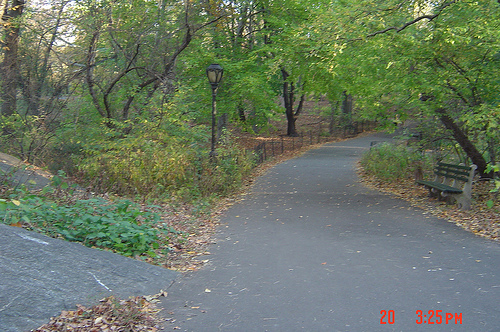
If you'd like to try walking as a tool for meditation, you can do it on a well-marked trail in a nature preserve, like I do now that I live in the country. Or a winding path through a public park, like I used to do when I lived near Central Park (I think that it goes without saying that you should walk only where you feel that your personal safety is not in question, and that you should carry a cell phone and identification):
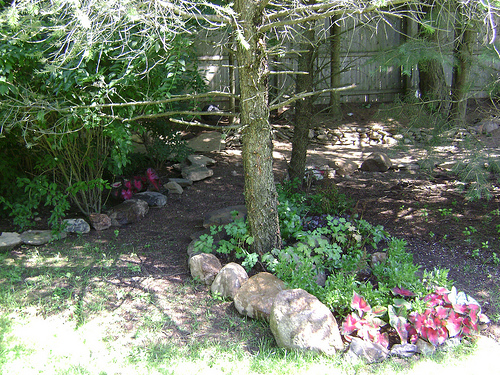
Or you can do it in your own yard, as I have done when it's too dark to go walking in the woods. In those cases, I have simply walked around the perimeter of my property or through the paths that I carved out of the woods along the edge of my property this summer:
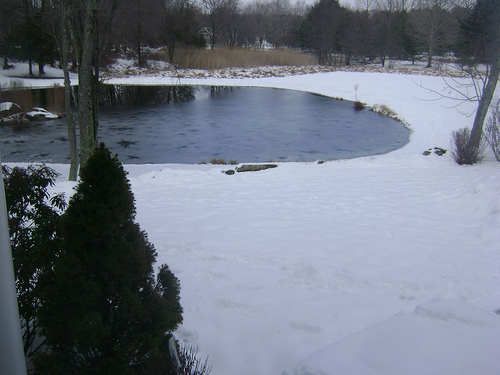
If you live in a city, or the weather is bad, you can walk around your home. You can walk around your living room, your kitchen, your bedroom. It doesn't matter how far you go. I've even walked loops around this frozen pond when time or weather has mandated it:
All you have to do is walk. Walk, and focus on the action of walking. Don't make it about exercise, even though it IS exercise. Just make it about walking. If you need a specific focus to get you going, then think, "I'm walking". Or perhaps, "Walk....walk....walk...."
I don't set out to use a mantra, myself, but I have noticed that sometimes I'm humming the same few bars of a song, over and over in my mind. Today, I found myself repeating the names of the trails over which my walk was going to carry me: "birch to blueberry to maple, birch to blueberry to maple"...and so on.
If you don't have 30 minutes, try 15. Or five. Or two. If you find it difficult to be alone with your thoughts, try not to judge yourself harshly. Simply acknowledge that fact and see if you can redirect your thoughts. If you catch yourself getting caught up in a vortex of thought, you can stop anytime and say, "just a thought, let it go, just a thought, let it go" until you really do let it go. And if that doesn't work the first time you get boggled up in your own thoughts, then maybe the next time. Or the next time.
And if all else fails, at least you've walked.


 The idea that when humans are at their worst they behave like wolves has been around a long time. Hobbes used the Latin tag homo homini lupus - man is a wolf to man - to illustrate his belief that unless they are restrained by government, people prey upon one another ruthlessly, while descriptions of rapacious or amoral behaviour as wolfish can be found throughout literature. The notion that evil is the expression of bestial instincts is deeply ingrained, and for the average philosopher as for the average person there is nothing more bestial than the wolf. More generally, a belief in the innate superiority of humans over other animals is part of the Western tradition. Christians tell us that only humans have souls, and though they speak in a different language secular thinkers mostly believe much the same. There are innumerable secular rationalists who, while congratulating themselves on their scepticism, never doubt that the universe is improved by the presence in it of humans like themselves.


 • Meditate. Meditating is nothing more than focusing on the present moment. The easiest way to meditate is to simply focus on your breath—not because your breath has some magical quality, but because it's always there with you. The challenge is to keep your attention on your breathing. Inevitably, your mind will wander and thoughts will arise—and that's fine. When it happens, just let go of the thought and bring your attention back to the present by focusing once again on your breath.
![[balloon burst]](http://blogs.psychologytoday.com/files/u8/balloonburst.jpg) • Practice slowing down time by attending to the subtleties of experience in the here and now. Take a minute and go get a handful of raisins. Now eat one—but don't just pop it in your mouth. Instead, imagine you've never seen a raisin before. Look it over carefully. Consider its shape, weight, color, and texture. Rub the raisin gently across your lips, noticing how it feels. Now put the raisin in your mouth, and roll it around slowly with your tongue. Notice how it feels in your mouth. Take a small bite, noting the flavor. Next, chew the raisin slowly, focusing on its taste and texture. Then swallow, and follow its path down your throat as far as you can. You can have a few more—but remember to focus on what each one looks, tastes, and feels like on your lips, in your mouth, and down your throat.
• Practice slowing down time by attending to the subtleties of experience in the here and now. Take a minute and go get a handful of raisins. Now eat one—but don't just pop it in your mouth. Instead, imagine you've never seen a raisin before. Look it over carefully. Consider its shape, weight, color, and texture. Rub the raisin gently across your lips, noticing how it feels. Now put the raisin in your mouth, and roll it around slowly with your tongue. Notice how it feels in your mouth. Take a small bite, noting the flavor. Next, chew the raisin slowly, focusing on its taste and texture. Then swallow, and follow its path down your throat as far as you can. You can have a few more—but remember to focus on what each one looks, tastes, and feels like on your lips, in your mouth, and down your throat.  • Mind the gap. Whenever you find yourself waiting—for the checkout line to move, for the traffic light to change, for the Web page to load—get present. Instead of being impatient and wishing things would go faster, be grateful for the gift of a respite—for the 30 seconds or a minute or two minutes during which you have no obligations. Take the opportunity to mindfully breathe in, breathe out, and savor the moment.
 • Focus on your senses. When you observe your surroundings without judging them good or bad, you naturally nudge your awareness into the present moment. Close your eyes and focus on your sense of scent and mentally list all the smells you're aware of—the restaurant downstairs, the wet pavement outside, the perfume of a nearby co-worker. Next, list all the different sounds you can hear—the ventilation system, cars in the distance, the hum of your computer, typing, footsteps. Then open your eyes and list all the things you see—the rustling of the trees, the faces in the crowd, the wrinkles on your palm. Finally, list all the things you can sense that you appreciate—the way a beam of sunlight hits the brick building across the street, the welcome sight of a friend's smile, the smell of cookies baking. Remember, you're not looking for things to appreciate—you're appreciating the things you sense. With luck, this exercise will put you in a state of relaxed attention that reduces anxiety and makes you feel more fully alive.