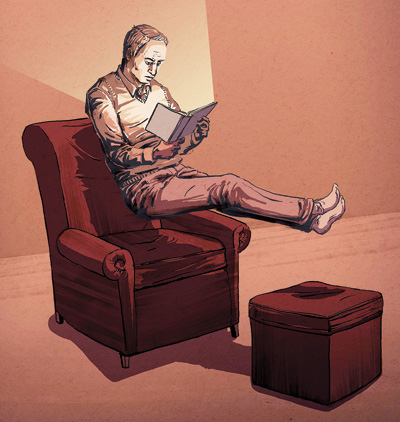
As a former English major, minor expert in 20th Century American poetry, and a one-time poet myself, I can assure you this is true.
Poetry Makes You WeirdGo read the second half of the article.
By Eric G. Wilson
December 10, 2012
Pat Kinsella for The Chronicle Review
In my first semester as a tenure-track English professor, my chairman asked me to represent our department at a weekend recruiting fair for high-school seniors. My job would be to court prospective majors. Knowing that "yes" was the right pre-tenure answer, I agreed, and so found myself that next Saturday morning standing behind a folding table, cheap brochures littered on its brown surface. I was irritable, hung over, and resentful.
A father and son immediately appeared, in virginal Wake Forest T-shirts and blond crew cuts. They smiled at me as if I had just praised their promptness. The younger looked up at dad, and father nodded to son, and son blurted: "Sell me the English major!" Through my brain's murk, I searched for the hype. Failing to find it, I confessed: "It makes you weird."
After a confused "OK," the two looked down, backed away, and were gone. They shouldn't have been so hasty. I had revealed to them, though I didn't know it then, the great payoff of literary study: It estranges us from our normal habits of thought and perception, nullifies old conceptual maps, and so propels us into uncharted regions, outlandish and bracing, where we must create, if we are to thrive, coordinates more capacious, more sublime than the ones we already know. The uncanny—not truth, beauty, or goodness—is literature's boon.
Like most English professors, I endure the grumbling of undergraduates subjected to literature requirements. "What's the use?" they ask. "Why must I study complicated, densely worded fictions that have little to do with the real world?" In the past, I had my elevated answers ready. What Aristotle says of poetry is true of all great literature. It is "more philosophical and a higher thing than history: for poetry tends to express the universal, history the particular." Wordsworth believes that the literary—which is mainly, for him, verse—also invigorates our emotions, issuing from the "spontaneous overflow of powerful feelings," thus arousing us from "savage torpor." He would have heartily concurred with Matthew Arnold: Poetry teaches us "how to live."
The students I pelted with this rhetoric would squint into the "I'm thinking" expression, and, brown-nosing, say, "I see." If they'd read Plato, they could have countered that poetry is an irrational fomenting of lies. Or they could have invoked Auden, who admitted that poetry "makes nothing happen."
But I now no longer unleash the literary giants. I simply tell my disgruntled students about the first time I read, as an undergraduate, these lines:
There's a certain Slant of light,
Winter Afternoons—
That oppresses, like the Heft
Of Cathedral Tunes—
I had often witnessed beams of dull December light with a melancholy I didn't understand. Dickinson's flash clarified my feelings: In the impoverished glow of the cold time were heavy reminders of brightness I desired but couldn't possess. But this affliction had fever, intimations of future heat that was luminous, like hymns.
Dickinson's verse spelled out the abstruse, made the strange familiar. In this new intimacy, however, was a novel astonishment: The chilly light from that day onward exposed the enigmas of longing, both tormenting and radiant. Her poetry left me amazed—caught in wonderment as well as labyrinth.
Other epiphanies followed. What I had taken for granted was shattered; the marvelous erupted amid the fragments. In Whitman I saw ordinary grass morph into the "uncut hair of graves." In Eliot's "Prufrock," I watched twilight transmogrify into "a patient etherized upon a table." The grass, the evening—in these metaphors, they grew more lucid than before, and more cryptic.
Shelley articulates literature's invigorating disorientation: "Poetry lifts the veil from the hidden beauty of the world, and makes familiar objects be as if they were not familiar." But the result of that alienation is not only an aesthetic rush; it is also a moral life. In shocking us into awareness, poetry urges us to relate to the world in fresh ways. The problem is, How do I connect my own mind, relatively familiar, with what is before me, enticingly bizarre?
Shelley answers: Imagine what it's like to be what you perceive. To accomplish that connection requires "a going out of our nature, and an identification of ourselves with the beautiful which exists in thought, action, or person, not our own." I take that to mean that the more distinctly we imagine the plight of another, the more empathy we feel, and the more beauty we appreciate. As Shelley put it, "The great instrument of moral good is the imagination; and poetry administers to the effect by acting upon the cause."