Offering multiple perspectives from many fields of human inquiry that may move all of us toward a more integrated understanding of who we are as conscious beings.
#IATE: Insights At The Edge, is Tami Simon's in-depth audio podcast filled with interviews of leading spiritual teachers and luminaries. Listen in as they explore their latest challenges and breakthroughs—the "leading edge" of their work. In this episode, Tami speaks with Dr. Brené Brown, a research professor at the University of Houston’s graduate college of social work who has spent the past decade studying vulnerability, courage, authenticity, and shame. Brené is the author of the #1 New York Times bestseller Daring Greatly, and with Sounds True she has created the audio learning course The Power of Vulnerability: Teachings on Authenticity, Courage, and Connection. In this episode, Tami speaks with Brené about the cultural myth that equates vulnerability as weakness instead of recognizing it as the greatest measure of our courage. They also examine Brené’s research about the qualities that allow someone to live in a wholehearted way. (66 minutes)
Fundamental forces of physics somehow determine everything that happens, as physicist Leonard Mlodinow has written, “from the birth of a child to the birth of a galaxy.” Yet he has intriguing perspective on the gap between theory and reality — and the fascinating interplay between a life in science and life in the world. As the child of two Holocaust survivors, he asks questions about our capacity to create our lives, while reflecting on extreme human cruelty — and courage.
Leonard Mlodinow is a physicist, and the author of several books including The Drunkard’s Walk: How Randomness Rules Our Lives and Feynman’s Rainbow: A Search for Beauty in Physics and in Life. He's also written for television, including "Star Trek: The Next Generation."
Production Credits
Host/Executive Producer: Krista Tippett Executive Editor: Trent Gilliss Senior Producer: Lily Percy Technical Director: Chris Heagle Associate Producer: Mariah Helgeson
• Discover how small, individual acts of courage, kindness, and self-trust can change our culture's guiding narrative of separation. • Learn how to overcome cynicism, frustration, and paralysis in the face of our current planetary crisis. • Become a more effective agent of positive change through increased awareness of interconnectedness and interbeing.
This is an encore presentation of Brené Brown's appearance on the NPR program, On Being, originally aired in November of 2012 - and I'm pretty sure I posted it then. But this is good, and there are a lot of additional resources provided by the On Being staff, so here it is again.
Courage is borne out of vulnerability, not strength. This finding of Brené Brown’s research on shame and "wholeheartedness" shook the perfectionist ground beneath her own feet. And now it’s inspiring millions to reconsider the way they live, parent, and navigate relations with members of the opposite gender.
Brené Brown Brené Brown is Research Professor at the University of Houston Graduate College of Social Work. Her books include: The Gifts of Imperfection and Daring Greatly: How the Courage to Be Vulnerable Transforms the Way We Live, Love, Parent, and Lead.
Host/Producer: Krista Tippett Executive Editor/Chief Curator: Trent Gilliss Technical Director/Producer: Chris Heagle Senior Producer: Lily Percy
Like-Minded Conversations
Investigating Healthy Minds with Richard Davidson Neuroscientist Richard Davidson is revealing that the choices we make can actually “rewire” our brains. He’s studied the brains of meditating Buddhist monks, and now he’s using his research with children and adolescents to look at things like ADHD, autism, and kindness. Getting Revenge and Forgiveness Michael McCullough describes science that helps us comprehend how revenge came to have a purpose in human life. At the same time, he stresses, science is also revealing that human beings are more instinctively equipped for forgiveness than we've perhaps given ourselves credit for. Knowing this suggests ways to calm the revenge instinct in ourselves and others and embolden the forgiveness intuition.
Art evolves in its iterations, and it's fascinating to see how Doug Neill's graphic recording session of our show with Brené Brown progresses before our very eyes. Human Connections Matter, Discover Israeli and Pakistani Peers What do Israeli and Pakistani peers have in common? A Jewish American journalist looks beyond Western media's portrayal of Pakistan and discovers universal values. It Gets Better Project Another kind of contribution to civility, an act of care for "despairing LGBT kids who are being bullied and harassed, kids who don't think they have a future" from syndicated columnist Dan Savage. Brené Brown: A Twitterscript A compilation of time-shift tweets of Krista's interview with Dr. Brené Brown. Was this an interview or therapy session? Finding an Image for Vulnerability The story behind this one powerful shot of "vulnerability and shame" from Segovia, Columbia.
By now, most people have seen at least parts of these videos and/or read excerpts of Malala Yousafzai's comments to Jon Stewart (who is genuinely humbled by the wisdom and courage of this 16-year-old girl) about her experiences as an advocate for education in Pakistan and the assassination attempt that brought her international attention - and got her out of Pakistan to continue sharing her message of peace and hope.
Here is the full, unedited interview she did with Jon Stewart a few days ago on The Daily Show. She is an amazing and inspiring human being.
Exclusive - Malala Yousafzai Extended Interview Pt. 1
Tuesday October 8, 2013 In this exclusive, unedited interview, "I Am Malala" author Malala Yousafzai remembers the Taliban's rise to power in her Pakistani hometown. (06:17)
Exclusive - Malala Yousafzai Extended Interview Pt. 2
Tuesday October 8, 2013 In this exclusive, unedited interview, Malala Yousafzai describes the beauty of her homeland and the cruelty of the Taliban. (05:29)
Exclusive - Malala Yousafzai Extended Interview Pt. 3
Tuesday October 8, 2013 In this exclusive, unedited interview, Malala Yousafzai offers suggestions for Americans looking to help out overseas and stresses the importance of education. (04:10)
(full recording including audience Q&A) Please right-click link and choose "Save Link As..." to download audio file onto your computer. Watch this event as a RSA Replay (below).
RSA Thursday
Dr Brené Brown has spent the past twelve years carrying out ground-breaking research into vulnerability, courage, worthiness, and shame. A best-selling author and award-winning educator, Dr Brown’s books and talks have been hugely influential in tackling the myth that vulnerability is a weakness. She argues that it is only by embracing vulnerability and imperfection that we can live life with courage and authenticity. Recognising and acting on this insight has the power to transform the way we engage in our families, organisations, schools and communities. Speaker: Dr Brené Brown, best-selling author, speaker and research professor, University of Houston Graduate College of Social Work Chair: Tim Lott is a renowned and award-winning journalist and writer.
In the TED Weekend show from NPR a couple of weeks ago, she was one of the guests for the show themed on Making Mistakes - and she is the perfect person to speak to this topic, since her work is in part about daring to mistakes and NOT beating ourselves up (self-shaming) if we fail or make a mistake. As the Japanese proverb teaches, "Fall down seven times, get up eight."
This segment from NPR contains both of Brown's best known TED Talks - "Listening to Shame" and "The Power of Vulnerability" (see below).
“Vulnerability is the birthplace of every meaningful experience we have. - Brené Brown
About Brené Brown's TED Talk Shame is an unspoken epidemic, the secret behind many forms of broken behavior. Brené Brown studies vulnerability, courage, authenticity and shame. She discusses what can happen when people confront their shame head-on. About Brené Brown Brené Brown has spent the last 10 years studying vulnerability, courage, authenticity and shame. She spent the first five years of her decade-long study focusing on shame and empathy, and is now using that work to explore a concept that she calls "Wholeheartedness." She's a research professor at the University of Houston Graduate College of Social Work, and the author of Daring Greatly! Brown poses the questions: How do we learn to embrace our vulnerabilities and imperfections so that we can engage in our lives from a place of authenticity and worthiness? How do we cultivate the courage, compassion and connection that we need to recognize that we are enough — that we are worthy of love, belonging and joy?
Tami Simon speaks with Dr. Brené Brown, a research professor at the University of Houston’s graduate college of social work who has spent the past decade studying vulnerability, courage, authenticity, and shame. Brené is the author of the #1 New York Times bestseller Daring Greatly, and with Sounds True she has created the audio learning course The Power of Vulnerability: Teachings on Authenticity, Courage, and Connection. In this episode, Tami speaks with Brené about the cultural myth that equates vulnerability as weakness instead of recognizing it as the greatest measure of our courage. They also examine Brené’s research about the qualities that allow someone to live in a wholehearted way. (66 minutes)
What if the thing most people perceive as a source of weakness to be eliminated was actually the master key to a better life? This very awakening shook my guest on this week’s show — professor, researcher, New York Times bestselling author and all-around super-cool human Brene Brown — to the very core. It led to not only a series of extraordinary realizations in her research and professional life, but to changes in the way she looked at herself and the world that would leave her profoundly changed.
She writes about this process, and her discoveries around the V word – vulnerability – in her new book, Daring Greatly, which is already a huge New York Times bestseller. And for good reason. Turns out… Within vulnerability lie the seeds of greatness.
But, as always, the conversation doesn’t stop there. We wind through the personal experiences in her own live that have led to powerful changes in outlook and focus, to what happens when faith meets science, to the intersection between vulnerability, uncertainty, risk, shame and success in business and entrepreneurship and so much more. And be sure to watch til the end, where Brene shares her answer to the question “what does it mean to live a good life?” Truly inspiring. Be sure to subscribe, so you don’t miss any future shows and you’ll also get access to the mp3 vault so you can take the shows on the road and listen while you’re cruising around. Just enter your email right below the video above. And, be sure to share this episode. Go ahead and click on the share buttons under the video, then email three friends. They’ll thank you and you’ll all have great conversations around the ideas in the show. With gratitude, Jonathan
From Yes! Magazine - an excellent interview with author, poet, activist, and multiple award winning novelist Alice Walker, an American icon. She is known for her magic realism, but more important perhaps is her commitment to social justice.
Alice Walker is a poet, essayist, and commentator, but she’s best
known for her prodigious accomplishments as a writer of literary
fiction. Her novel The Color Purple won the Pulitzer Prize and
National Book Award in 1983 and quickly became a classic of world
literature. Set in an African-American community in the rural South
during the decades before World War II, the novel is told in letters
written by Celie, a woman who survives oppression and abuse with her
spirit not only intact, but transcendent.
Walker’s writing is characterized by an ever-present awareness of
injustice and inequality. But whether describing political struggle—as
in Meridian, which deals with the civil rights movement—or
meditating on the human relationship to nature and animals, as in her
latest book, The Chicken Chronicles, her work conveys the
possibility of change. In Walker’s vision, grace is available through
love and a deep connection to the beauty of the world.
Walker was born in the segregated South, the eighth child in a family
who made their living as sharecroppers in Georgia. She came of age
during the civil rights movement, and emerged early in her career as a
defining voice in feminism and an advocate for African-American women
writers. She is a prominent activist who has worked, marched, traveled,
and spoken out to support the causes of justice, peace, and the welfare
of the earth.
Alice Walker spoke to YES! about the challenges of working for change, and the possibility of living with awareness—and joy.
Valerie Schloredt: Over the past few days I’ve been
immersed in your work, and I’ve been wondering how you do it. Being able
to move someone to tears with a few words on a page is extraordinary to
me.
Alice Walker: I want very much for you to feel for
whoever I’m talking about, or whatever I’m talking about. Because it is
only by empathy being aroused that we change. That is the power of
writing. I’ve experienced exactly what you’re saying, reading other
writers. I remember the book I first had that experience with was Jane Eyre,
being right there with Jane, and understanding, yes, we have to change
these horrible institutions where they abuse children. Today, I’m the
supporter of an orphanage in Kenya. And one of the reasons comes from
having been so moved by reading about Jane at Lowood.
Schloredt: It’s interesting to hear about what you
read as a child, because some of your best-known work, like The Color
Purple, draws on the stories of your ancestors and your family and
aspects of the world you knew as a child.
Walker: I think the foundation of everything in my
life is wonder. We were way out in the country, and why wouldn’t you
just absolutely wonder at the splendor of nature? It’s true I had
various sufferings, but nothing really compares to understanding that
you live in a place that, moment by moment, is incredible. That your
mother could say, “I think we’ll have tea tonight,” pull up a sassafras
root, take it home, boil it, and you have sassafras tea. I mean, it’s
such a miraculous universe. For a child, this magic is something that
supports us, even through the hard times.
Schloredt: Do you go back to your childhood home?
Walker: It doesn’t exist.
Schloredt: No?
Walker: No. And there were many of them. We lived in
shacks. Each year the people who owned the land (that they had stolen
from the Indians), after they had taken the labor for the year, forced
us to another shack. How could people do that, to people that they
recognized as people? They did this to babies, they did this to small
children, they could look at the people they were exploiting and
actually see that they were working them into ill health and early
death. It didn’t stop them.
The most beautiful parts of the area that I lived in are now an
enclave of upper-class white housing tracts with a huge golf course.
They built a road that went right through the front yard of our church.
Most of the people moved to cities, they moved to projects. So, it
doesn’t exist.
Schloredt: Something I wanted to ask after listening
to you talk last night [at the YES! celebration in Seattle], is the
idea that some people don’t experience empathy, and don’t have a
conscience that bothers them when they’re treating people extremely
badly. Where can progressives go with that idea? How do we relate to
knowing that?
Walker: You relate to it by being honest. We’re
sitting back thinking that every single person has a conscience, if you
could just reach it. Why should we believe that? I mean, what would make
you actually believe that? Certainly not the history of the world as we
know it. So it’s about trying to understand the history of the world,
how it’s been shaped, and by whom, and for what purposes.
Understanding trumps compassion at this point. When people are
forcing you out of your home, starving your children, destroying your
planet—you should bring understanding of them to bear. Not everybody is
loving of children, not everybody cares about the ocean. I think if we
collectively decide that we are going to confront this, we have a
chance. Because humanity is very smart, and we’d like to survive. And
we’re not going to survive the way we’re going. I think we know that.
Schloredt: Your novels are among those books that
cause people to say, “This book changed my life,” or “This book changed
my way of thinking.” For me the book of yours that really did something
to my way of thinking was Meridian.
That is a very powerful book. One thing that really affected me was
the description of the cost of racism to the psyche, what a struggle it
is to fight such embedded injustice. I think I saw you as the character
Meridian. Are you—have you got some Meridian in you?
Walker: I think all people who struggle at the risk
of their lives have some Meridian in them. It’s an acceptance of a kind
of suffering. You hope that something will come of it, but there’s no
way of knowing. What I didn’t realize was so close to me was how
Meridian gets really sick as she encounters various struggles. She’s
using every ounce of her will, her intelligence, her heart, her soul. It
often leaves her debilitated. And that has certainly been true in my
life. And it’s something that I have to accept.
In Jackson, Mississippi, during the civil rights movement, the mayor
had a tank that the town bought just to use against us. So there’s the
possibility of the tank running over you, and you have to stand there.
So I understood that, well, this is probably going to mean a few weeks
of just being immobilized. And then you figure out ways to recuperate.
It’s learning to accept that the cost is great. It would have to be,
because we’re talking about emotional intelligence and growth and
stretching yourself, reaching for the sun, kind of as if you were a
plant. It’s a difficult thing to change the world, your neighborhood,
your family, your self.
Schloredt: Not only is Meridian risking her life,
like the other civil rights activists in the South, but there’s also
internal oppression, an inner struggle the characters deal with.
Walker: The inner struggle is extremely difficult
for all of us, because we all have faults, severe ones, that we will
struggle with forever. One of the things that I like about Meridian is
that it is about how we like to have almost a stereotype about leaders
and revolutionaries and world-changers, that they are always whole. It’s
wise to accept that [human faults] are inevitable. Factor that in and
keep going.
Schloredt: I love the passage where Meridian visits a
black church after the assassination of Martin Luther King and finds
that they’ve incorporated his rhetoric into the sermon.
Walker: This is the segment where B.B. King is in
the stained-glass window with a sword—where the people needed to
incorporate, as far as I was concerned at the time, a bit more
militancy. More awareness of what you’re up against, and confronting
that with real clarity. In some ways it’s the same issue that we’re
talking about. You have to go to the places that scare you so that you
can see: What do you really believe? Who are you really? Are you
prepared to take this all the way to wherever the truth leads you and
accept that you have to figure out different ways of confronting
reality?
Schloredt: I wanted to ask you about Occupy and
uprisings in the Middle East. You’ve been politically active over your
lifetime. Is there advice that you would give to people who are
organizing now in the United States?
Walker: If you want to have a life that is worth
living, a life that expresses your deepest feelings and emotions, and
cares and dreams, you have to fight for it. You have to go wherever you
need to go, and you have to be wherever you need to be, and place
yourself there against the forces that would distort you and destroy
you.
I love the uprisings, I love the Occupy movement, and I think the
young people especially are doing something that is very natural. It is
natural to want to have a future. It is very natural to want to live in
peace and joy. What is lovely about this time is the awareness that is
sweeping the planet. People are just waking up, every moment.
Schloredt: One thing that I worry about for
progressives is that we are often distracted from effective direct
action by the project of improving ourselves, of being good.
Walker: And also, “good” in that sense can sometimes
be very facile. And a good cover, you know, “I’m doing good, so I don’t
have to change very much.” But I think for most Americans, the change
that’s required is huge.
Schloredt: How do we make that change happen?
Walker: Well, you know, you’re doing it. I think
YES! Magazine is part of what’s changing people’s consciousness. And I
think the spread of Buddhism—the retreat centers, the meditation
practice—has had a huge impact on people’s consciousness. Americans
learning Buddhist tradition has helped a lot of people understand that
they actually have a power that is theirs. They have their own mind.
It’s not somebody else’s mind, and it’s not controllable, unless you
permit it. That’s a foundation for huge change.
Schloredt: Your writing has, I’m sure, also changed
consciousnesses. How does it feel to know that your work has in some way
changed the world?
Walker: Well, it’s a gift the universe has permitted
you to achieve—but it’s not just dropped in your lap, you have to
really work for it. For instance, years ago when I wrote Possessing the Secret of Joy,
the campaign against female genital mutilation [FGM] was a dangerous
subject. There was a great deal of flak about my wanting to address it.
I wrote the book, and then Pratibha Parmar and I made the film [Warrior Marks,
a documentary about FGM], and lugged it around Africa, and London, New
York, all over. It allowed women who had no voice about FGM to speak.
Progress is slow, and sometimes it’s discouraging. It’s like knocking on
doors in the South asking people to vote, and they’re terrified of
voting. And then seeing over the course of years that people started
understanding that they had a right to reject the practice of FGM, that
they had a voice. I feel grateful that I could be an instrument to stop
any kind of suffering. I mean, what a joy.
Schloredt: In your novels you describe profound
suffering and pain, but there is also often the potential for
reconciliation and healing. If you could create healing and
reconciliation for something that’s happening in our country today, what
would it be?
Walker: I think the War on Terror is really absurd,
especially coming from a country that is founded on terrorism. The
hypocrisy of that is corrosive, and we should not accept it. There is no
way to stop terrorism if you insist on making enemies of most of the
people on the planet. Why should they care about you? All they feel is
fear. So I would stop the War on Terror, and I would start making
peace with the peoples of the planet by trying to understand them. I
would like us to be able to say, “If that happened to me, I would feel
exactly the way you do. And what can we do from here, from this
understanding? What can we do together?”
Valerie Schloredt interviewed Alice Walker for It's Your Body, the Fall 2012 issue of YES! Magazine. Valerie is associate editor of YES! Magazine.
Since her first TED Talk more than a year (at TEDxHouston near the end of 2010), The Power of Vulnerability (this video has more then 3.5 million views), Brené Brown has become a favorite of the TED crowd. For TED 2012, she was invited to speak again, this time her subject is Listening to Shame.
One of her lessons that came up after her first TED talk, when she felt so vulnerable that scared her, is that vulnerability is NOT weakness. She asks the crowd how many of them feel that being vulnerable is being weak, and most raised their hands. She ten asked how many of them saw vulnerability on stage at the TED conference as pure courage, and most of them did. The lesson is that we see vulnerability in others as strength or courage, but as weakness in ourselves.
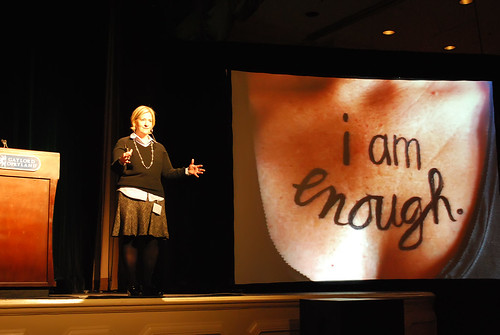
Shame is an unspoken epidemic, the secret behind many forms of broken behavior. Brené Brown, whose earlier talk on vulnerability became a viral hit, explores what can happen when people confront their shame head-on. Her own humor, humanity and vulnerability shine through every word.
Brené Brown is a research professor at the University of Houston Graduate College of Social Work. She has spent the past ten years studying vulnerability, courage, authenticity, and shame. She spent the first five years of her decade-long study focusing on shame and empathy, and is now using that work to explore a concept that she calls Wholeheartedness. She poses the questions:
How do we learn to embrace our vulnerabilities and imperfections so that we can engage in our lives from a place of authenticity and worthiness?
How do we cultivate the courage, compassion, and connection that we need to recognize that we are enough – that we are worthy of love, belonging, and joy?
The TED Blog also posted a question and answer session with Brown.
At the end of 2010, a reseacher named Brené Brown gave a talk at her
local TEDx event, TEDxHouston. That talk, “The Power of Vulnerability,”
has since become a web-video phenomenon — viewed and shared by millions
of people, who write us to say that her words — on shame, vulnerability
and honesty — moved them, inspired them, helped them make change in
their own lives. (It has also inspired at least two tattoos.) When we
invited Dr. Brown to speak at TED2012, she shared the impact her new
fame has had on her own life and how putting her words on this big stage
has caused her to reexamine what she knows about vulnerability. Before she spoke, our own Roxanne Hai sat down with Dr. Brown to ask her a few questions about the nature of vulnerability.
What’s the greatest lesson you have learned in your own life?
When you get to a place where you understand that love and belonging,
your worthiness, is a birthright and not something you have to earn,
anything is possible. Keep worthiness off the table. Your raise can be
on the table, your promotion can be on the table, your title can be on
the table, your grades can be on the table. But keep your worthiness for
love and belonging off the table. And then ironically everything else
just takes care of itself.
How has your own journey in vulnerability and authenticity
changed as you’ve become more well known and your work has become more
well known?
Oh, it’s been hard. I call 2010 the year of the vulnerability talk and
2011 the year of walking the talk, because I was very unprepared. I so
believe everything I said, and I really am trying to live that way, but
I’ve become very clear in the last year that it is more complicated and
more difficult than I thought.
One of the things I did when I discovered this huge importance of
being vulnerable is very happily moved away from the shame research,
because that’s such a downer, and people hate that topic. It’s not that
vulnerability is the upside, but it’s better than shame, I guess. And
what I realized over the last year is, if you don’t understand shame and
you don’t have some shame resilience and awareness, then you cannot be
vulnerable.
How did you come to realize that you needed to understand shame to be vulnerable?
It has been a great year, tons of support, tons of people saying, “God,
I’m with you, thank you,” and then also really hardcore mean-spirited,
cruel attacks. Which are just part of the process, right? And I think
the reason I’m still standing is not because the word got out there that
I was vulnerable, but I’m still standing because I understand shame.
I was very careful not to attach my worthiness to how well that talk
did, because when you do that, then those comments are devastating. It’s
not that they’re not devastating anyway — they hurt your feelings. I
would argue more than ever that vulnerability is still just absolutely
essential. That we can’t know things like love and belonging and
creativity and joy without vulnerability, but in this culture of
reflexive cynicism you better also really have an understanding of shame
if you’re going to put yourself out there.
You mentioned you have received attacks and negative feedback from your vulnerability work. Can you talk about those?
I got a lot of feedback that was constructive and hard to hear, things
like: “You shouldn’t be talking about vulnerability unless you’re going
to talk about the construct of trust, and what do you think about
trust?” And the truth is, I don’t understand it well enough to talk
about it yet. I’m really still researching. And “What about this image
that you used, I think it was hurtful.” It’s been a great debate. And
I’m not afraid of that. You’ve been a faculty person for thirteen years,
you’re used to some horrendous discussion and debate. I love that.
But the stuff which was really the most hurtful was just the
mean-spirited stuff like, “If I looked like you, I would embrace
imperfection too.” Or “Good mothers don’t unravel, and I feel sorry for
your kids.” Just really mean-spirited cruelty, which is rampant and is
really a part of our culture right now.
One of the things that I’ve learned, that I didn’t know before that
[TEDxHouston] talk exploded, is how hard I’d been working to keep my
career small. And that was a little bit heartbreaking for me, because I
usually thought of myself as being pissed off because I couldn’t get my
work out there enough. But really I think I was engineering that,
because I was afraid of these things that actually happened, like the
personal attacks.
For people to look at other folks who are trying to come up and share
their work with the world, or their art, their ideas, their writing,
their poetry, whatever, and say “You can’t care what other people think”
is bullshit. When you lose your capacity to care what other people
think, you’ve lost your ability to connect. But when you’re defined by
it, you’ve lost your ability to be vulnerable. That tightrope is what my
talk is about, and I think that balance bar we carry is shame
resilience. I think it’s the thing that keeps us steady. If we can
understand that: I’m not the best comment, I’m not the best accolade
I’ve received, and I’m not the worst. This is my work.
What have you learned from the critics?
One thing that they’ve taught me, that I’m grateful for, is that at the
end of every day, and at the end of every week, and at the end of my
life, I want to be able to say I contributed more than I criticized. So
they’ve taught me that I’m still standing.
What’s the one thing you really want to share, that didn’t make it into your talk?
I wish I could talk more about what I see going on in schools and
corporations and families and churches and organizations. I wish I could
talk more about why and how we’re losing people. The whole measurement
idea of good parenting versus bad parenting, good employees versus bad
employees — I don’t think it’s helpful and I don’t think it’s
illuminating. I think the best way to look at things is: Are people
engaged? Are people engaged parents, engaged employees, engaged leaders?
And I don’t think engagement can happen without vulnerability, and I
definitely don’t think it can happen in the midst of shame. If you think
dealing with issues like worthiness and authenticity and vulnerability
are not worthwhile because there are more pressing issues, like the
bottom line or attendance or standardized test scores, you are sadly,
sadly mistaken. It underpins everything.
There’s not a talk that I’ve seen since I’ve been here — and I’ve been in all the sessions, and I saw the TED Fellows talks
— there’s not a talk I’ve seen where people really touch lives and made
a huge difference where they were not excruciatingly vulnerable. The
results that we see at TED, and the innovation, and the incredible music
and the art is an expected outcome, in my opinion, of human potential
when people are willing to be brave and vulnerable. The reason why this
is so rare is not because of the human potential that’s here. It’s
because of the willingness of the people who are here to be brave and
vulnerable. We all have this capacity; it’s a bravery conference.
There’s no one who’s up there, including myself, who hasn’t failed. And I
seriously doubt there’s many people up there who haven’t been the
subject of major, heartbreaking criticism.
What group of people do you feel has been most impacted by your talk?
Across the board, I would say. If you want to ask me who needs it the
most, I think we all need it. But the people who are really grappling
with it the most are in the corporate sector. Veterans are a population
that I’m really interested in, and police officers and firefighters, and
people who we basically pay to be invulnerable. Then, when they return
back to their lives, whether it’s at night when they come home or when
they come back from a tour, they have no capacity for vulnerability and
their lives are falling apart. We’ve seen a lot of research showing that
for the veterans coming back from the Middle East right now, they’re
more likely to die when they get home than over there, because of drugs,
alcohol and violence. So I think all of us need this lesson, and all of
us need this work. It’s not easy for any of us.
I asked my girlfriends (who are also big fans of your work)
what they would ask you if they had the chance, and they all came back
with this: What advice would you give to someone who feels like they are
not [blank] enough to go about living more authentically and vulnerably?
Well, the idea of “I’m never enough” — beautiful enough, successful
enough, thin enough, popular enough, loved enough, worthy enough —
that’s shame and scarcity, and I’ve seen people overcome that every
single day. I’ve gone through the process myself. I’ve interviewed
people over the course of four years who’ve done a lot of this work. You
have to understand shame. You have to understand where the message
comes from, what drove it, how has it protected you in the past, and are
you willing to look it in the eye and say, “Thanks, I appreciate it,
but I’m not subscribing anymore. I’ve got a new way of doing things, and
maybe you kept me safe and small in the past, but I’m not doing that.”
The answer is absolutely that I’m not enough. You can overcome that, but
you can’t overcome it without an understanding of shame. If you are not
willing to have that conversation, there’s no way to the other side of
it. You have to know what shame is.
How has understanding shame and vulnerability changed you as a parent?
Oh, it’s changed everything. My husband’s a pediatrician, so he and I
talk about parenting all the time. You can’t raise children who have
more shame resilience than you do. Because even if you don’t shame them,
and even if you are actively trying to raise them feeling good about
who they are, they’re never going to treat themselves better than you
treat yourself. So that’s the bad news and the good news, but mostly the
sucky news. If you want to raise a daughter with a really healthy body
image, you better love your body as a mother, because that counts way
more than looking at your daughter and saying “You’re beautiful and your
body is beautiful.” All that matters to her is how she sees you acting
with your own body. Which sucks. We can’t give children what we don’t
have. We just have to be the adults we hope they grow up to be.
In addition to being the founder of Sounds True, Tami Simon also produces a number of our audio programs. One of the programs that stood out to Tami was Pema Chödrön’s Unconditional Confidence: Instructions for Meeting Any Experience with Trust and Courage. As Tami says, “When it comes to delivering heart instructions on how to work with what feels unworkable, perhaps no one hits the bulls-eye with as much warmth and accessibility as Pema Chödrön.” This week’s excerpt comes from Tami’s interview with Pema included on Unconditional Confidence, in which Pema talks about how we can puncture and aerate any difficult experience with spaciousness.