The Quest for the Self or Searching for Selfies?
by Derek Beres
June 24, 2014
The selfie continues its trajectory as a major form of communication in today’s social media universe. Named the Oxford Dictionary Online Word of the Year in 2013 the selfie has continued its meteoric rise ever since smartphones flipped the camera view. Yet what exactly is it communicating?
To fans of selfies they are something to post every day, a means of saying, ‘Hey, I’m here right now’ or ‘I’m doing this,’ which essentially translates as ‘I’m doing this,’ ‘this’ taking backseat to ‘I.’ Critics take a harsher view: the self-congratulating behavior is seen as obnoxious and egotistic.
Conjuring a neatly bundled set of psychological drives for selfies is not easy. As Psychology Today points out, there is a sense of exploration and identification embedded in the process: you are constantly editing, refining and understanding yourself through the photographic journey. Viewers’ mirror neurons are activated through your lens, creating either a sense of kinship or disgust (both of which are expressed on blogs like ‘The Rich Kids of Instagram.’)
One of the more popular trends that has been the subject of debate is the ‘yoga selfie,’ which received its own NY Times column last year. Bendable women (and a few men) have amassed hundreds of thousands of followers for wearing little clothing while performing acrobatic positions. While the curvaceous lines are appreciated by oglers, some yogis see it in a different light: “If you don’t post a beautiful picture of your yoga, it didn’t happen.”
A particularly astute commenter mentioned the following after I posted criticism of the yoga selfie: looking at others in beautiful postures inspires me and gives me something to aspire to. Another mentioned that it had to do with checking form, that they could then see how their alignment looked after snapping the shot. I replied that if that was the case, why post the photo online? If it were all about ensuring that your lower back wasn’t overarching, why would the rest of the world need to know about it? I never heard back.
Science writer Jennifer Ouellette investigated the psychological (among other) mechanisms for creating one’s sense of self in her book, Me, Myself, and Why: Searching for the Science of Self. One day a friend noticed her keychain featured the astrological symbol for Taurus. While she has no deep affiliation with astrology, the friend questioned her beliefs in the stars.
She then wrote about how we position objects in our home or office. If someone points a photo outward so that visitors approaching their desk can see it, the picture serves as an ‘identity claim.’ The photo becomes a testament to who the person is and how they want to be represented. This was not the purpose of Ouellette’s keychain.
If the photo is turned inward, not intended for public display, it is a ‘feeling regulator.’ As it turned out, Ouellette’s close friend died at the heights of the AIDS epidemic in the late ‘80s. It was a keepsake from their time together. Feeling regulators are reminders, personal keepsakes. Public display is not the point, even if it’s a byproduct.
This would explain my commenter’s lack of response. If the photo truly served as personal inspiration or alignment tutorial, there would be no reason to post it publicly. It could be saved on the phone, posted on their desktop, or printed and displayed prominently where they practice. Selfie as feeling regulator.
That’s not what happens when selfies are thrown onto social media. They become identity claims: this is who I am. As the Psychology Today article points out, this process is fluid. Selfies shift as the human behind the camera changes, representing stages of development. Feeling regulation, however, will arise from the amount of comments and likes garnered. The pure satisfaction of posting a picture is ultimately a shallow endeavor—it no longer has any personal meaning and becomes all about public response.
In this sense, a 2013 study on happiness and meaning might offer some clues. While happiness is hard to define, researchers “found that happiness is associated with selfish ‘taking’ behavior and that having a sense of meaning in life is associated with selfless ‘giving’ behavior.” It’s the difference between feeling personally satisfied and believing yourself to be dedicated to a cause larger than yourself.
Researchers found that people devoted purely to the pursuit of happiness exhibit the same gene expression patterns as humans struggling with chronic adversity. Their bodies activate a pro-inflammatory response as if a bacterial threat was about to strike. Their constant state of heightened inflammation leads to sickness. Those with a sense of meaning showed no such symptoms.
This makes sense as we often pursue happiness as a means of avoiding loneliness or other threats to our existence. This constant avoidance of darker emotions will be represented in our bodies, as such pursuers are constantly on edge. A lack of happiness implies its opposite, whereas those on a quest for meaning are more likely to accept and endure adversities.
It’s the difference, in yoga parlance, between needing external verification of one’s body rather than moving onto the deeper self-reflective stages where physical representation is nowhere near as important as the emotions and thoughts dealt with during meditation.
I would guess this applies to all selfie taking, although repetition is key. I know few people that haven’t posted a selfie on occasion. It’s a modern extension of the Polaroid: immediate gratification capturing a place in time. If you’re chasing that on a daily basis, however, it’s going to be challenging to know where you ever really are. The quest for public display has trumped the quietude of personal satisfaction.
Photo: Vladimir Gjorgiev/shutterstock.com
Showing posts with label popular culture. Show all posts
Showing posts with label popular culture. Show all posts
Friday, June 27, 2014
Big Think - The Quest for the Self or Searching for Selfies?
Selfies are becoming more pervasive and ubiquitous, but what is driving their proliferation? It's not so easy to take the impulse to photograph and share oneself all over social media and narrow it down to a Freudian drive or two.


Monday, June 09, 2014
Reflecting on the 50th Anniversary of "I Never Promised You a Rose Garden"

Kelsey Osgood is the author of How to Disappear Completely: On Modern Anorexia (2013), and in this article for The New Republic she takes a look back at 50 years since the publication of I Never Promised You a Rose Garden, written by Joanne Greenberg.
One of the issues raised about the book since it first became widely known about 5-6 years after it was published, is that the heroine gets well ... from schizophrenia. The argument since then is that she must have been misdiagnosed, since it's well-known that no one recovers from schizophrenia. The fact that she did, and has gone on to lead a productive and drug-free life runs counter to the disease model of mental illness that has become so popular over the last 60+ years.
However, the fact that she got well fits perfectly with a trauma model of psychological difficulties. In the trauma model, the "symptoms" are seen as survival adaptations to intolerable pain or circumstances. Deal with the trauma and the adaptations (symptoms) are no longer necessary. That is what Frieda Fromm-Reichmann did for Joanne Greenberg. It's what all therapists working with clients expressing symptoms of psychosis should be doing.
Why We Don’t Like Stories in Which the Mentally Ill Heroine Recovers
The surprisingly stable afterlife of the author of 'I Never Promised You a Rose Garden'
By Kelsey Osgood | The New Republic
June 3, 2014
THIS YEAR MARKS the fiftieth anniversary of the publication of I Never Promised You a Rose Garden, the YA classic written by Joanne Greenberg based on the years she spent committed to a psychiatric ward as a schizophrenic teenager. The impact I Never Promised You a Rose Garden made upon its release in 1964 was fairly quiet. No excerpts were placed in periodicals; reviews, though complimentary, were printed on back pages. The book sold slowly until around 1969, when high schools and colleges began incorporating it into curricula.
Librarians and high school teachers and parents were all justifiably nervous that American youth were willfully courting madness as a means of rebellion. Charismatic figures like R.D. Laing and Timothy Leary preached a version of lunacy-as-transcendence, and educators and parents wanted to offer vulnerable young students a more realistic tale of insanity—one that took place in a locked ward rather than a field of flowers. Sales of the books shot up. It became a particular kind of classic, embraced not primarily for its prose, but for putting its finger on the pulse of a certain set of collective anxieties. Greenberg, who, by the mid-’60s was living symptom-free in Colorado, watched her sales rise. This year it sold nearly six million copies.
But not long after I Never Promised You a Rose Garden became canonical, it also became a lightning rod, and it is the contours of that controversy that make the novel still relevant today. Greenberg claimed full recovery, and many psychiatric professionals worried that this would inspire a false and dangerous hope. Schizophrenics, they said, simply cannot recover. German psychiatrist Emil Kraeplin, who coined the early version of the diagnosis “dementia praecox,” described the disease as “terminal.” The introduction of Thorazine in the 1950s offered some reprieve from the symptoms, but the best a schizophrenic could hope for was what Swiss psychiatrist Eugene Bleuler called “recovery with defect.” Doctors wrote articles that evaluated the novel as if it were a case history and re-diagnosed her autobiographical protagonist as a hysteric. In The New York Times an article headline read: “Schizophrenia in Popular Books: A Study Finds Too Much Hope.” One psychiatrist even repeatedly called Greenberg at her home to try to force her to admit she had been misdiagnosed.
It would be difficult to imagine mental health professionals going to such lengths to put Virginia Woolf’s corpse on the couch, or to attempt to determine a DSM code for Diane Arbus. Even Anne Sexton, whose laundry list of symptoms baffled her caretakers, didn’t inspire such heated speculation. In many ways, this is because these women reaffirm our modern belief about mental illness, namely, that it is biologically innate, all-consuming, and only in the best cases, manageable. Greenberg, by contrast, refutes the disease-centric model; her life continues to be full and stable—without the use of psychotropics. And while we tend to think of the disease-centric model as more humanitarian at its core—the aberrant behavior is not the fault of the sick person—one could easily see how it might actually contribute to, rather than negate, stigma against the mentally ill: a brain endemically miswired cannot be controlled, and the mentally ill, therefore, are bound to their labels for life.
THE STORY OF MODERN psychiatry, for many, is triumphant one. The quick-and-dirty history goes like this: Human ingenuity and scientific advances led us from the dark ages of hydrotherapy and solitary confinement to cognitive-behavioral therapy and expertly prescribed medications. While we used to believe the mentally ill were unwell as a result of wayward behavior or demonic possession, we now know that psychic anguish is the result of brain chemistry and nurture, and we’re working harder to analyze the former. We moved, in other words, from mental illness as a moral failure to mental illness as a medical condition.
But if you zoom in on the late 1940s through the early ’60s, a different battle is being waged—a battle between those who believed mental illness was biologically located in the brain, and those who thought mental illness was a matter of emotional disturbance. Back then, those intent upon transforming psychiatry into a reputable science (as opposed to a touchy-feely art) worked tirelessly to develop new methods of medical intervention for the mentally ill. The best-known method was “psychosurgery” (aka lobotomy), which was introduced by neurologist Egas Moniz in 1936. In 1949, Moniz won the Nobel Prize for his work on psychosurgery, and by 1951, the operation had been performed close to 20,000 times.[1]
Contrast this obsession with the physical brain—slicing it, shocking it, or tranquilizing it—with the ethos held by Chestnut Lodge, the elite private institution where Joanne Greenberg began treatment in 1948. The clinicians at Chestnut Lodge fervently believed that no patient, however psychotic, was impervious to psychotherapy. The champion of this viewpoint was the Lodge’s most famous employee, the gifted psychoanalyst Frieda Fromm-Reichmann. Fromm-Reichmann was Greenberg’s primary analyst and, in both the novel and in real life, led her from insanity to wellness. In the book, Fromm-Reichmann is “Dr. Fried,” and Greenberg so positively depicted the humble German that for years she received letters from struggling fans desperate to track down Dr. Fried and undergo analysis with her.
Fromm-Reichmann immediately recognized something special in her teenaged patient: Greenberg was quick-witted, well-read, and seemed to retain an appetite for life that many of the doctor’s older, chronically ill patients had lost long ago. Greenberg’s symptoms were often referred to as “florid”—interpretable, extravagant, and suffused with meaning, like a story. When Joanne was struggling, Fromm-Reichmann openly empathized. When she began to retreat, the doctor begged to follow. “Take me along with you,” Dr. Fried tells Deborah during a session. She insisted to her young patient that they must pose a united front. “I believe that you and I,” Greenberg has her say in Rose Garden, “can beat this thing.” And, together, that’s just what they did.
This narrative is a little too pat for our contemporary sensibilities. Perhaps that’s why the book is not as well known as, say, Sylvia Plath’s The Bell Jar. (The Bell Jar still sells briskly; the fiftieth-anniversary paperback edition is ranked 1,730 on Amazon, compared to Rose Garden’s 21,792[.2]) But Rose Garden does not appeal for another reason: It’s easier to think of the psychiatry of yore as entirely backward and as the poetic casualties of it—Plath, Arbus, Sexton—as victims of that ignorance. Their tragic stories, paradoxically, make us feel more secure in the march of psychiatric progress.
The demise of these women—and the subsequent autopsy of past mental healthcare failures that their paper trails encourages—permits us to rest serenely in the knowledge that the world is moving steadily toward a more scientific, humane psychiatry. But, one has to wonder if this is entirely the case. Frieda Fromm-Reichmann spent four years with Joanne Greenberg; she hiked up to the Disturbed Ward to see patients when they were lying limp in restraints. Now, psychiatrists evaluate patients for 45 minutes before diagnosing them and sending them off to fill prescriptions, and many patients go months between appointments. Efficiency is the goal here; medication the cure, meaningful human connection a distant second priority. It is increasingly rare to find a psychiatrist who also performs talk therapy, despite its many proven benefits.
This might be an even greater tragedy with regard to treatment of schizophrenia, where holistic treatment—that is, one that recognizes both the medical and the emotional components and allows for feedback between the two—might hold particular promise. According to Dr. Allen J. Frances of Duke Medical School and the author of Saving Normal: An Insider's Revolt Against Out-of-Control Psychiatric Diagnosis, DSM-5, Big Pharma, and the Medicalization of Ordinary Life, “Cognitive therapy and social skills therapy are very valuable in treating schizophrenia, but they are rarely available.” And the idea of “complete recovery” is downplayed.
I don’t know what Greenberg’s “actual” diagnosis should be—perhaps she was not a schizophrenic—but I was so interested in her success story that, one day, three years ago, when I was about to release my own, highly personal memoir about my teenage effort to become anorexic (which I “succeeded” at, and then recovered from completely), I decided to write her a letter—an old-fashioned one that I sent in the mail. It wasn’t terribly difficult to track her down. Within weeks, a reply arrived, typewritten on textured, sky-blue paper. Her words to me were kind, smart, and so obviously honest. We struck up a correspondence. We’ve written letters to each other now for nearly two years. She was unabashed but not militant in her views on psychiatry. She told me about her experience writing Rose Garden, but also her daily life, which is filled with events at her synagogue, teaching at the Colorado School of Mines, dealing with the problems endemic to being eighty-something and an active EMT. She is a living example of someone who refused the fate prescribed to her and chose instead to be many other things: clever, attentive, kind, iconoclastic, and the author of more than fifteen books on wildly varying topics. Her life as a recovered patient is not a glamorous or a tragic or a particularly scary one—but it might be a truer one.
1. Gail Hornstein, Professor of Psychology at Mount Holyoke and author of Agnes’s Jacket: A Psychologist’s Search for the Meanings of Madness, wrote that lobotomy was “a lucrative sideline for many physicians,” which gives me an icky feeling similar to the one I have when I walk into my gynecologist’s office and see the walls plastered with advertisements reminding patients that Botox Available Here.
2. Plath’s death even spawned a theory that young female poets are more likely than other populations to suffer from mental illness, called, naturally, The Sylvia Plath Effect. (The existence of such a thing begs the question: The Joyce Carol Oates Effect? The Adrienne Rich Effect?)
~ Kelsey Osgood is the author of How to Disappear Completely: On Modern Anorexia.

Saturday, May 24, 2014
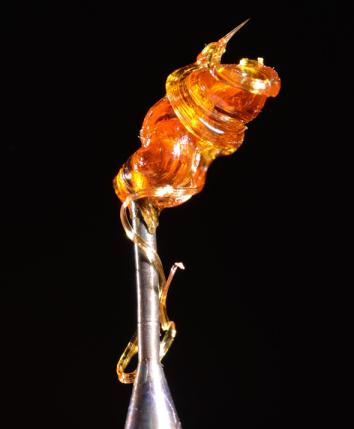
Vape Pens and Budder - Marijuana's Drift from Plant to Ultra-Potent Drug
Users of marijuana have long known and sometimes favored a marijuana extract called hashish (hash for short). It tends to be cleaner and more potent than the plant - the best marijuana buds are averaging 25-30% THC, while hash can be in the neighborhood of 45-55%. [1]
Apparently these already highly potent options are not enough (for reference, the best marijuana in the 1960s and 1970s averaged around 3-8% THC). New butane extraction methods are creating a drug that can be as high as 99% cannabinoids (of which 80-90% is THC), often known as budder.
The mainstream media seems not to be aware of "budder" at this point, but the lower quality extracts (often produced at home by amateur chemists - two words which should never go together) are beginning to register with the media over the last year or two.
In December, 2013, The Daily Beast ran an article called "Hey Buddy, Wanna Dab? Inside The Mainstream Explosion of Cannabis Concentrates," which examined the rise of dab and the lack of purity in most street products (along with info on how to know if it's a clean product or not).
In March, 2014, Mother Jones ran a more in-depth article (produced below) on how these new extracts may impact legalization efforts around the country. Below that article is another from Slate, from February, 2014.
References
Here is another article, this one from Slate:
Apparently these already highly potent options are not enough (for reference, the best marijuana in the 1960s and 1970s averaged around 3-8% THC). New butane extraction methods are creating a drug that can be as high as 99% cannabinoids (of which 80-90% is THC), often known as budder.
- "The top Budder sample was 99.6% pure," Dr Paul Hornby [a chemist and plant analyst] explained, "which means if you had an ounce of it, only a tiny fraction of a gram would be anything other than cannabinoids. We also tested Budder for toxins, solvents, molds, diseases, heavy metals and other contaminants. There were none. It's essentially just pure cannabinoids. I've tested a lot of cannabis materials, but this is the most impressive."
Hornby's tests also found Budder contains 80 to 90% of its cannabinoids as THC. It contains much smaller percentages of two other cannabinoids: cannabidiol and cannabinol. Of these two, cannabidiol (CBD) is most important because it has medicinal effects and moderates the stimulative effects of THC. [1]This seems to create a drug with much higher chance of adverse effects. Cannabidiol (CBD), which has no psychotropic effects by itself [2], attenuates, or reduces [3] the higher anxiety levels caused by THC alone [4]. Consequently, the plant material used to create budder (or other extract forms, including the more mainstream use of "dab" with vape pens), will greatly impact the type of high the extract creates. Cannabis sativa has a much higher THC:CBD ration, and causes more of a "high, including the stimulation of hunger and a more energetic feeling. On the other hand, Cannabis indica has a higher CBD:THC ratio, producing more of a "stoned" or meditative feeling [5].
The mainstream media seems not to be aware of "budder" at this point, but the lower quality extracts (often produced at home by amateur chemists - two words which should never go together) are beginning to register with the media over the last year or two.
In December, 2013, The Daily Beast ran an article called "Hey Buddy, Wanna Dab? Inside The Mainstream Explosion of Cannabis Concentrates," which examined the rise of dab and the lack of purity in most street products (along with info on how to know if it's a clean product or not).
In March, 2014, Mother Jones ran a more in-depth article (produced below) on how these new extracts may impact legalization efforts around the country. Below that article is another from Slate, from February, 2014.
References
- Brady, P. (5005, Jan 19). "Beautiful budder". Cannabis Culture Magazine.
- Ahrens, J., Demir, R., Leuwer, M., et al. (2009). The nonpsychotropic cannabinoid cannabidiol modulates and directly activates alpha-1 and alpha-1-Beta glycine receptor function. Pharmacology 83 (4): 217–222. doi:10.1159/000201556. PMID 19204413.
- Zuardi, A.W., Shirakawa, I., Finkelfarb, E., Karniol, I.G. (1982). Action of cannabidiol on the anxiety and other effects produced by ?9-THC in normal subjects. Psychopharmacology 76 (3): 245–50. doi:10.1007/BF00432554. PMID 6285406.
- Fusar-Poli, P., Crippa, J.A., Bhattacharyya, S., Borgwardt, S,J., Allen, P., Martin-Santos, R., et al. (2009). Distinct Effects of Δ9-Tetrahydrocannabinol and Cannabidiol on Neural Activation During Emotional Processing. Archives of General Psychiatry 66 (1): 95–105. doi:10.1001/archgenpsychiatry.2008.519. PMID 19124693.
- Holtzman, A.L. (2011, Mar 28). Cannabis Indica vs Sativa: A response to Continued cannabis use and risk of incidence and persistence of psychotic symptoms: 10 year follow-up cohort study. British Medical Journal, 342:d738. doi: http://dx.doi.org/10.1136/bmj.d738
* * * * *
How Vape Pens Could Threaten the Pot Legalization Movement
Not everyone is going to welcome an innovation that facilitates getting high in public places—like high school hallways.
—By Josh Harkinson | Thu Mar. 20, 2014
One of many models of vape pens that can be used to discretely smoke marijuana concentrates. [SIK-photo]/Flickr

Last year, I joined some parents from my son's preschool for their semiregular "Dad's Night Out." We were at a crowded bar in Oakland, and somehow it emerged that I'd done some stories about marijuana. A dad immediately asked if I'd written about hash oil. Within a few minutes (for the sake of journalism, of course), I was trying a hit of nearly odorless vapor from what looked like a miniature flashlight. A single puff, and I was too high to order a second beer.
It might be an understatement to say that marijuana concentrates smoked from so-called vape pens—the pot version of e-cigarettes—accomplish for stoners what flasks full of moonshine do for lushes: Portable, discreet, and fantastically potent, they're revolutionizing the logistics of getting high, and minimizing the risk of discovery. Stories abound of people using vape pens to blaze away undetected at baseball games, city council meetings, kids' soccer matches, and, of most concern to parents and educators, high schools. Even if pot brownies have been around forever, this is probably not what your average Colorado or Washington voter had in mind when they cast a ballot to legalize recreational marijuana.
The concentrates typically used in vape pens are made by extracting THC from pot with water ("bubble hash"), transferring it into butter ("budder"), or refining it into what's known as butane hash oil (BHO, or "errrl," since stoners need a slang term for everything pot-related). From there, it can be refined further into a wax or an amber-like solid ("shatter"). These products are up to three times stronger than the most mind-bending buds. In short, it ain't your father's schwag, and its snowballing popularity among young people is reshaping the culture of the pot scene: One customarily smokes (or "dabs") BHO from specially designed bongs known as "oil rigs," and not at the designated hour of 4:20, but rather at 7:10—which, in case you're wondering, is "OIL" upside down and backwards.
"Baking Bad," the headline of a recent Slate piece on the concentrates scene, aptly sums up how the trend could become a PR nightmare for the legalization movement. As the name implies, making butane hash oil involves extracting THC from cannabis using butane—you know, lighter fluid. The growing rash of butane lab fires and explosions could suggest that potheads are going the way of meth tweakers. And when BHO is improperly made, it can be tainted with toxins.
But perhaps the biggest emerging concern with concentrates is how they may enable minors to abuse pot. Though many high schoolers use vape pens to inhale candy-flavored oils that don't contain psychoactive substances, a study by the Centers for Disease Control and Prevention found that 10 percent had used the devices in 2012 to consume nicotine concentrates (i.e., they'd tried "e-cigarettes"), double the number from the previous year—and that number is likely an underestimate. Emily Anne McDonald, an anthropologist at the University of California-San Francisco, told me her interviews with teens and young adults in New York suggest that the use of vape pens for pot is gaining steam—"especially for getting around the rules and smoking marijuana in places that are more public." She's currently applying for a grant to study the use of pot-concentrate vape pens by young people in Colorado.
Not surprisingly, some cities and states that allow medical marijuana don't look kindly on concentrates. In July, an appeals court in Michigan, where pot is legal for medical use and decriminalized for recreational use in many cities, ruled that concentrates aren't allowed under the state's medical marijuana law. In 2012, the Department of Public Health in pot-friendly San Francisco asked the city's dispensaries to stop carrying concentrates. (It later reversed itself in the face of a backlash.) A recently introduced California bill supported by law enforcement interests would revise its medical pot rules to ban pot concentrates statewide.
The rising popularity of BHO "certainly is a safety issue," acknowledges Bill Panzer, a member of the board of directors of the California chapter of the National Organization for the Reform of Marijuana Laws (NORML). Yet Panzer doesn't see prohibition as the solution. "You can either tell people to stop using concentrates, which they won't," he says, "or you can say, 'Let's regulate it and make sure it's done safely."
After some fierce debates, lawmakers in Colorado and Washington have ultimately decided to permit and regulate concentrates. Colorado requires anyone who makes BHO to operate out of a facility that is separate from a grow operation and that has been certified by an industrial hygienist or professional engineer. Washington state's Legislature last week passed a bill allowing state-licensed pot shops to sell concentrates, as long as the amount sold to any one customer doesn't exceed seven grams. But there are plenty of do-it-yourself recipes online.
Although more states may decide to regulate the production and sale of concentrates (see our maps of the pot regulation landscape), they'll have a much harder time preventing people from toking from vape pens on the sly. NORML's Panzer isn't worried. He brings up the example of an obnoxiously drunk baseball fan who sat next to his son at a recent Oakland A's game. "I have never seen anybody on weed doing that," he says. "Anytime you are replacing alcohol with cannabis, that's positive."
* * * * *
Here is another article, this one from Slate:
Baking Bad
How dabbing—smoking potent, highly processed hash oil—could blow up Colorado’s legalization experiment.
By Sam Kamin and Joel Warner
February 5, 2014
Darkside shatter dab, made by TC Labs for Natural Remedies in Denver. Courtesy of Ry Prichard/CannabisEncyclopedia.com
Brad Melshenker, owner of the Boulder, Colo.-based 710 Labs, knows his operation, with its extensive ventilation systems, industrial hygienist–approved extraction machine, vacuum ovens, and workers wearing respirator masks looks like something out of a marijuana version of Breaking Bad. It’s why he calls his lab manager, Wade Sanders, “Walter,” after the show’s protagonist, Walter White.
And like the famously pure and powerful blue meth White cooked up on Breaking Bad, the product produced by 710 Labs’ fancy equipment is extremely concentrated, powerful, and coveted: butane-extracted hash oil (BHO). The lab’s finished BHO might not look like much—a thin, hard, and shiny brown slab, like peanut brittle without the peanuts—but when a piece of this “shatter,” as it’s called, is placed on the nail of a specially designed pipe that’s been superheated by a blowtorch, it vaporizes and delivers a direct hit of 70 to 90 percent THC, three times the potency of the strongest marijuana strains. As Melshenker puts it, if smoking regular pot is like drinking a beer, “dabbing,” as this process is known, is a shot of hard liquor. Vice calls the result, “The smoothest slow-motion smack in the face of clean, serene stonedness that you’ve ever experienced.” Rolling Stone reports, “Your head spins, your eyes get fluttery, a few beads of sweat surface on your forehead and, suddenly, you're cosmically baked.” Some pot aficionados vow to never smoke the old way again.
Gucci Earwax, a butane extraction, made by Mahatma Extreme Concentrates for Karmaceuticals in Denver. It won the first-place medical concentrate trophy at the High Times 2013 Denver U.S. Cannabis Cup. Courtesy of Ry Prichard / CannabisEncyclopedia.com
Hash, in other words, is no longer just a way to make use of leftover marijuana trim. It’s now becoming the main attraction. (Butane isn’t the only way to extract hash oil from marijuana, either; some concentrate-makers use carbon dioxide– or water-based extraction methods.) At Greenest Green, Melshenker’s Boulder dispensary, the inventory used to be 60 percent marijuana flower, 30 percent BHO, and 10 percent edibles. Now it’s the opposite: 60 percent BHO, 30 percent flower, and 10 percent edibles. And roughly 40 dispensaries statewide contract with 710 Labs to turn their marijuana into shatter or “budder,” a gloopier version. (Because of delays in Boulder’s regulation process, 710 Labs won’t be able to produce recreational BHO until Feb. 17.)
Hash oil is even fueling its own subculture. Forget 4:20; “dab heads” or “oil kids” light up at 7:10. (Turn the digits upside down and you have “OIL.”) Connoisseurs sport specially designed blowtorches and incredibly pricey “oil rig” pipes; a top-of-the-line rig from Melshenker’s Faulty Pelican glass company sets you back $14,000. There’s even dab gear, made by companies like Grassroots.
“There’s a whole industry here,” says Melshenker, whose business card doubles as a stainless-steel dabber, the tool used to apply BHO to an oil rig’s superheated nail.
Colorado’s thriving dabbing scene could just be one more bit of proof that the state is becoming a global mecca for marijuana. After all, the state’s legalized marijuana experiment has so far been an unqualified success. Despite the surprisingly limited number of recreational pot shops that opened their doors on Jan. 1—and the hefty crowds waiting in line to patronize them—the state hasn’t experienced widespread product shortages or weed prices high enough to trigger an Uber-style backlash. Yes, there was that story about 37 deadly marijuana overdoses on the first day of sales, but it turned out to be an obvious hoax. The few pundits who’ve complained about Colorado’s legalized pot, like David Brooks and Nancy Grace, have found their arguments blasted full of holes, not to mention lambasted on Saturday Night Live. The Justice Department is looking into ways to help banks play nice with marijuana businesses—a very serious problem—and even President Obama in a recent New Yorker profile conceded it’s important for the experiment to go forward.
Soon enough, then, Colorado’s small-scale experiment should spread far and wide, with controversial drug laws getting the boot, millions of clandestine tokers coming out of the closet, and governments reaping the benefits in taxes and fees. That is unless something goes terribly wrong, derailing the whole legalization movement.
Such a gloomy outcome isn’t out of the question. The only reason that Colorado is enjoying fame as the first place to legalize pot is thanks to a combination of fortunate timing, plucky advocates, forward-thinking lawmakers, and a remarkable lack of snafus. Colorado’s 2012 legalization attempt very well could have floundered if the effort hadn’t enjoyed remarkably positive media coverage. Considering the precipitous rise of the state’s medical marijuana industry and lawmakers’ keen efforts to moderate it, all it could have taken was the right bad headline—a high-profile crime or a boneheaded political move—to set the endeavor back considerably. Recall that alcohol prohibition was built on the temperance movement’s carefully crafted tales of woe and violence. As Salvation Army Commander Evangeline Booth once put it:
Drink has drained more blood …
Dishonored more womanhood,
Broken more hearts,
Blasted more lives,
Driven more to suicide, and
Dug more graves than any other poisoned scourge that ever swept its death-dealing waves across the world.
Mixed shatter slab by TC Labs. The product is broken prior to packaging to fit into the 1 gram or less packaging requirements. Courtesy of Ry Prichard / CannabisEncyclopedia.com
In Colorado, however, there have been very few sordid marijuana tales that could be used to demonize the drug—so far. Weed-fueled horror stories could still emerge in the state—and with the world watching, such calamities could have an international impact. So what are the biggest potential risks? A major concern is diversion, taking Colorado’s legal pot and offloading it to the black market or selling it out of state. While Colorado has established an extensive tracking system to prevent this from happening, there will always be tourists trying to take home a pot-infused souvenir. Beyond diversion, there’s the menace of crime—not just the threat of burglaries and organized crime in a largely cash-based industry, but also the distant possibility of banks or other financial institutions getting slapped with federal money laundering charges if they accept any of that free-flowing marijuana cash. Finally, there’s the prospective collateral damage, such as kids accidentally eating pot brownies—something that’s already in the news—or a violent pot-related car crash.
If any of these calamities do occur, Colorado’s red-hot dabbing scene could in fact be the source of the problem. Dabbing certainly appears on the surface to be dangerous: Kids are freebasing marijuana! It looks like they’re smoking crack! But it’s important to remember that there’s no evidence that it’s possible to overdose on pot. (Compared to say, acetaminophen, overdoses of which killed more than 1,500 Americans during the past decade.) So you can smoke the strongest dab imaginable—or even, if you’re a showboat, smoke 50 dabs in a row—and science says it won’t kill you. It will just get you really, really high.
Mars OG ISO dab, an isopropyl alcohol extraction made by Pink House Labs in Denver. Courtesy of Ry Prichard/CannabisEncyclopedia.com
But just because something won’t poison you the way alcohol can doesn’t mean it can’t lead you to do something stupid enough that will kill you. And there seem to be enough disconcerting variables associated with dabbing culture—a production process laden with volatile chemicals; a highly concentrated, easily transportable final product; and incredibly stoned kids with blowtorches—it seems only a matter of time until somebody in the scene does something very stupid and possibly fatal.
Yes, dabbing might not be as inherently dangerous as, say, a bar full of binge-drinkers. But it’s important to remember that recreational marijuana isn’t necessarily replacing alcohol use—it’s just adding a new legal vice to the options people already have. While some researchers predict legalized marijuana will decrease alcohol use, others predict it could lead to “heavy drinking” and “carnage on our highways.” So will folks really reach for a dabbing pipe instead of a shot glass—or will they reach for both?
Questions like this have led California and Washington to outlaw the production of smokeable marijuana concentrates. Colorado, however, has gone the opposite route: In November it released a draft of proposed concentrate production rules, positioning itself to become the only place in the world where marijuana concentrate production is both legal and regulated. The idea is to police the blooming subculture, to stay on top of it, so it ends up more akin to tattooing than meth. “If we outlaw concentrates, people will make them in their basements and blow themselves up,” says Norton Arbelaez, co-owner of the Denver dispensary RiverRock Wellness, which operates a concentrate production facility. But just because a concentrate extraction system is certified by a third-party industrial hygienist, as will likely be required by Colorado’s concentrate rules, doesn’t mean that system can’t still accidentally blow up.
It makes sense that Colorado is at the vanguard of legalized dabbing. It’s made a habit of taking risks when it comes to marijuana. Colorado can’t regulate away the chance that dabbing or some other marijuana-related endeavor will lead to a spectacular accident, either industrial or personal. But so far its legalization effort has taken pains to thoughtfully minimize such risks—and so far, it’s working.
~ Sam Kamin is professor and director of the Constitutional Rights and Remedies program at the University of Denver Sturm College of Law.
~ Joel Warner is a former Westword staff writer.



Sunday, April 27, 2014
Can Thomas Piketty's "Capital in the Twenty-First Century" Inspire Real Change?
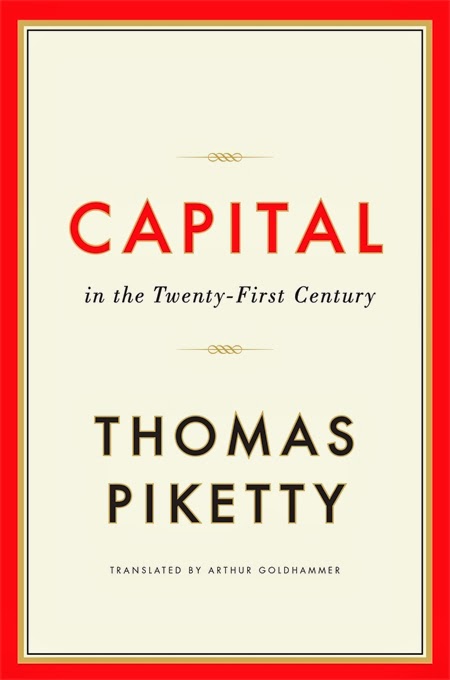
Everywhere I look lately there is someone offering commentary on and support of this "revolutionary" book. Here is a selection of recent articles/videos about the book, including a talk by the author.
Here are the questions he's trying to answer in Capital:
The distribution of wealth is one of today’s most widely discussed and controversial issues. But what do we really know about its evolution over the long term? Do the dynamics of private capital accumulation inevitably lead to the concentration of wealth in ever fewer hands, as Karl Marx believed in the nineteenth century? Or do the balancing forces of growth, competition, and technological progress lead in later stages of development to reduced inequality and greater harmony among the classes, as Simon Kuznets thought in the twentieth century? What do we really know about how wealth and income have evolved since the eighteenth century, and what lessons can we derive from that knowledge for the century now under way?To begin, here is Piketty himself talking about the thesis of his book, followed by Elizabeth Warren offering her well-educated perspective, then a LOT of article teasers to offer a variety of perspectives.
Thomas Piketty on Wealth, Income, and Inequality
Elizabeth Warren Weighs In On The Thomas Piketty Phenomenon
* * * * *
Will Hutton from The Guardian:
Suddenly, there is a new economist making waves – and he is not on the right. At the conference of the Institute of New Economic Thinking in Toronto last week, Thomas Piketty's book Capital in the Twenty-First Century got at least one mention at every session I attended. You have to go back to the 1970s and Milton Friedman for a single economist to have had such an impact.Capitalism simply isn't working and here are the reasons why
Economist Thomas Piketty's message is bleak: the gap between rich and poor threatens to destroy us
Like Friedman, Piketty is a man for the times. For 1970s anxieties about inflation substitute today's concerns about the emergence of the plutocratic rich and their impact on economy and society. Piketty is in no doubt, as he indicates in an interview in today's Observer New Review, that the current level of rising wealth inequality, set to grow still further, now imperils the very future of capitalism. He has proved it.
* * * * *
Heidi Moore at Common Dreams (via The Guardian):
Can Thomas Piketty Re-Write the American Dream?
by Heidi Moore
Published on Sunday, April 27, 2014 by The Guardian
Piketty's immaculate research establishes that the American dream – and more broadly, the egalitarian promise of Western-style capitalism – does not, and maybe cannot, deliver on its promises. Photo: Ed Alcock for the Observer
When the movie is made about the fall of Western capitalism, Thomas Piketty will be played by Colin Firth. Piketty, whom the Financial Times called a "rock-star economist", isn't a household name – but he should be, and he has a better shot than any other economist. He is the author and researcher behind a 700-page economic manifesto, titled Capital in the 21st Century, that details the path of income inequality over several hundred years.
This sublime nerdishness is, somehow, a huge hit. It is now No 1 on Amazon's bestseller list and sold out in many bookstores. When Piketty spoke on a panel this month at New York's CUNY with three other economists – two of them Nobel-prize winners, Joseph Stiglitz and Paul Krugman – the Frenchman was the headliner. The event was so packed that the organizers had to create three overflow rooms. Weeks after the release of Capital, intellectuals are still salivating, even calling Piketty the new de Tocqueville.
* * * * *
Justin Fox at the Harvard Business Review:
Piketty’s “Capital,” in a Lot Less than 696 Pages
by Justin Fox | April 24, 2014
It was only published in English a few weeks ago, but French economist Thomas Piketty’s Capital in the Twenty-First Century has already become inescapable. The reasons start with the confluence of subject matter and author. There’s a lot of interest in economic inequality these days, and research conducted over the past 15 years by Piketty, a professor at the Paris School of Economics, is a big reason why. In the U.S., Piketty and UC Berkeley’s Emmanuel Saez transformed a tame discussion of income quintiles and deciles into a sharp debate about the skyrocketing incomes of the 1% — and the mind-boggling gains of the 0.1% and 0.01% — by gathering and publishing income tax data that nobody had bothered with before. Piketty was behind similar projects in France, Britain, Japan, and other countries.
And now this book. It is massive (696 pages) and massively ambitious (the title is a very conscious echo of Karl Marx’s Das Kapital). It came out in France last year to great acclaim, which meant that those in the English-speaking world who pay attention to such matters knew that something big was coming. Over the past few weeks it has become one of those things that everybody’s talking about just because everybody’s talking about it. That, and it really is important.
* * * * *
Sean McElwee at Salon:
Welcome to the Piketty revolution: “Capital in the 21st Century” is a game-changer (even if you never read it)
"Capital in the 21st Century" is an unexpected bestseller that could actually change the world
Sean McElwee | Sunday, Apr 27, 2014
 Thomas Piketty (Credit: Reuters/Charles Platiau/Salon)Anyone who’s anyone (and many more who aren’t) has written something this week about “Capital in the 21st Century,” the new treatise on income inequality by French economist Thomas Piketty.

The book was actually published early last month by Harvard University Press, but arrived to fanfare only within the insular, if august, community of economic policy researchers. So, on arrival, it might have seemed like the 700-page tome, with its academic tone and laboriously documented historical analyses, was destined to a life of obscurity. But then something strange happened. People — regular people — started to buy it in droves. By the time “Capital” surged to the top of the charts this week — so many physical copies of the book were sold that Amazon actually ran out of inventory — Thomas Piketty had become the most famous economist this side of Paul Krugman, celebrated on the left and reviled on the right.
At this point, a review or discussion of “Capital” is almost a rite of passage for an aspiring wonk. (You can read this writer’s here.) But the one question that hangs over Piketty’s meteoric rise is, in a way, the most obvious one: What does any of this actually mean?
* * * * *
From at Updated Priors:
Capital in partial equilibrium
Tuesday, March 25, 2014
Review: Thomas Piketty, Capital in the Twenty-First Century
Piketty's primary contribution is to provide an impressive array of data on wealth and income, for several countries, beginning as early as the 1700s in some cases. Note that he does not examine consumption data. The book is an impressive feat and certainly deserves attention, as the facts Piketty provides are crucial to discussions of the evolution of capital and economic inequality in the rich countries. Many reviews have been very positive; there are a lot of positive things I could say about it, but I will leave that to others. The book suffers from some fundamental flaws; in short, while it is heavy on data it is light on serious economics. Readers will find themselves wading through hundreds of pages of opinion and ideological quips, not economic analysis, with interesting charts scattered throughout. The firehose of data can be overwhelming, which may explain why some reviewers internalized his arguments uncritically. Piketty's accomplishments with data collection are admirable. But a book of this size, with the title Capital, should include some economics.
Piketty's data on inheritance are the most interesting and persuasive to me. Inheritance still matters and plays a nontrivial role in the wealth and income distribution. Reducing wealth inequality over time, should we decide to do so, will require serious attention to the issue of inheritance, which more than any other issue lacks a tie to meritocracy (but that does not mean incentives stop mattering!). There may be other arguments, not based solely on inequality, for thinking about inheritance. That said, not all capital is created equal, and the book could have benefited from some focus on distinctions between capital types--particularly in the context of inheritance.
Thursday, March 27, 2014
J Hoberman Reviews Lars von Trier’s "Nymphomaniac" (New York Review of Books)
Lars von Trier has created yet another strange and sexually outrageous film. And yes, as you have no doubt read, the sex IS real, but there are body doubles (porn stars) and prosthetics to protect the big-name talent in this film.
Making return engagements to von Trier's sexual wonderland is Charlotte Gainsbourg and Willem Dafoe, both of 2009's Antichrist, a very strange and mesmerizing film.
 Christian Geisnaes/Magnolia Pictures Charlotte Gainsbourg in Nymphomaniac
Making return engagements to von Trier's sexual wonderland is Charlotte Gainsbourg and Willem Dafoe, both of 2009's Antichrist, a very strange and mesmerizing film.
Sex: The Terror and the Boredom
By J. Hoberman
March 26, 2014 | New York Review of Books
Christian Geisnaes/Magnolia Pictures | A scene from Lars von Trier’s Nymphomaniac

The Danish director Lars von Trier has made several great films (Dogville, Melancholia). He has also orchestrated a number of provocations, the strongest of which is The Idiots (1998), a movie that anticipates Borat, Jackass, and other recent movies in pushing regressive behavior beyond all acceptable limits. His newest film, Nymphomaniac, belongs with these audience-baiters—it’s similar, but less ghastly in its various affronts than Antichrist (2009), which also centered on the dour, ascetic Charlotte Gainsbourg.
In Antichrist (2011), Gainsbourg played a woman driven mad by grief; in Nymphomaniac she is the eponymous case study, known simply as Joe. A middle-aged good Samaritan named Seligman (Stellan Skarsgård) finds her lying beaten and bleeding in a back alley and, as she refuses his offer to call the police or get an ambulance, brings her back to recover in his monastic apartment. There she lies on a narrow bed, he sits by her side and, after describing herself as “bad person” (a category that he reflexively rejects), she proceeds to tell him her story from the very beginning: “I discovered my cunt as a two-year-old.”
For a child, as we know, all is sex. Joe’s colorful (if gravely recounted) picaresque career as a sexual being and a sexual adventuress—set in an abstract, unidentified region of England—is punctuated by Seligman’s well-meaning, post-Freudian comments and woolly digressions. Joe’s tale also features a vast array of sex acts, both simulated and actual. (The credits list a half dozen “sex doubles.”) The movie is, then, a two-handed version of the Marquis de Sade’s Philosophy in the Bedroom with Seligman, the erudite lover of the arts and stereotypical liberal—tolerant, secular, feminist, hypocritical—attempting to understand Joe’s self-identified nymphomania as she oscillates between pride and self-loathing and also between present-day battered Joe and her dewy younger self (Stacy Martin).
Like Joe or the sadist she solicits in the movie’s second half, Nymphomaniac is at once excessive and withholding. Although the film is said to exist in a five-and-a-half-hour director’s cut, its distributor has released a shorter “international version” in two parts of 117 and 123 minutes each; the film is further subdivided into eight more-or-less chronological chapters. This two-stage delivery may or may not be a valid economic strategy, but it is a dubious aesthetic one. For what it’s worth, Nymphomaniac demands to be endured in a single sitting. As with Melancholia (2011), which represented the run-up to the end of the world, it’s experiential.
Although too capricious (or should we say promiscuous?) to be a taxonomy, the movie is designed to illustrate and exhaust every popular theory of nymphomania, including, of course, the idea that the condition exists only as a male fantasy—My Secret Garden or The Sexual Life of Catherine M notwithstanding. In various chapters, Joe’s motivations are variously ascribed to her sexual curiosity, desire to exercise traditional male sexual prerogatives, rejection of love, unresolved oedipal feelings, narcissism, loneliness, pathological low self-esteem, depression, frigidity, guilt, and masochism.
At least initially, Joe subscribes to the Sadean notion that she is simply “selfish”—that is, motivated by absolute egotism and a desire for absolute pleasure—although, unlike the Marquis, she does not see this as a virtue. Nor is she bound by logic, explaining at one point that she became a nymphomaniac by choice (“I was an addict of lust rather than need”) and refusing at another, in a memorable set piece, to accept the label “sex addict.”
Von Trier declines to judge his protagonist. Unlike Steve McQueen, whose hellish portrait of a male sex addict was called Shame, or the didactic moralist Michael Haneke (who, in his adaptation of The Piano Teacher, completely missed the comic elements in Elfriede Jelinek’s novel of nymphomaniacal compulsion), von Trier has a sense of humor. However lumpy and tasteless it may be, his gruel is not without its raisins. There is a very funny montage in which young Joe tells a succession of lovers that they have given her her first orgasm; a tumultuous sequence in which an abandoned wife (Uma Thurman), accompanied by her young children, confronts the home-wrecking young Joe, volubly and at great length; a charming religious vision that, among other things, satirizes von Trier’s erstwhile model, Andrei Tarkovsky; and a scurrilously farcical scene in which mature Joe is sandwiched between two squabbling slices of male bread.
Much of the time, however, Nymphomaniac is dogged in its pursuit of what the academic film theorists of the 1970s used to call “unpleasure.” Or at least, that is how it seemed to me. Writing in The New Yorker, David Denby, not hitherto an admirer of von Trier, praised the movie as a “pornographic work of art” which means, I suppose, that it was some sort of turn-on.
Alienation, or the absence of feelings, is for von Trier a source of anxiety. But so is empathy. Antichrist which, above all, strove to make pain visceral, was ultimately only numbing; Grace, the scapegoat protagonist of Dogville (2003), suffered in part because of her generosity: she felt too deeply and wreaked a terrible vengeance as a result. Nymphomaniac’s most graphic sequence is not sexual but rather the miserable circumstances in which Joe’s father, hospitalized, delirious, and incontinent, meets his end. “When he died, I had no feelings left,” she tells Seligman—and not for the last time. The movie’s first part concludes with her loss of sexual sensation. “I can’t feel anything,” she wails after a long, unsatisfying bout of intercourse with her ardent and loving husband (Shia LeBeouf).
Von Trier is frequently accused of abusing his female protagonists. Joe gets more than her share, not least in a particularly graphic form of self-abuse, but essentially von Trier respects her as an enemy of society—her punishment, as well as her philosophy, is really a way of punishing the spectator. Like Alfred Hitchcock, von Trier enjoys directing his audience. He is however far less efficient and far more fretful than Hitch; rather than manipulate viewers he pranks them, as when, in one sequence of Nymphomaniac, he teases fans by threatening to restage a catastrophe out of Antichrist complete with Handel aria.
Despite a common monotony, Nymphomaniac’s two halves are quite different. With one large exception, the first part is consecrated to spectator enjoyment—derived either from the spectacle of the sexual antics involving the beautiful, frequently naked Stacy Martin (a twenty-four-year-old Franco-English actress who has the great good fortune or catastrophic luck of making her debut as a featured act in the von Trier circus) or else from the spectacle of Joe successfully defending her erotic rights in a man’s world or, possibly, from both. But the fun is paid for with interest in the movie’s second half by the debasing sexual escapades endured by the more mature and less conventionally appealing Gainsbourg.
Although variously a parody of Freudian analysis or a gloss on the Arabian Nights, Nymphomaniac most closely resembles an eighteenth-century novel about a young woman’s sexually-driven rise and fall or fall and rise; indeed, the first scientific study of female hypersexuality, Nymphomania, or a Dissertation Concerning the Furor Uterinus, was published by a French doctor in the late eighteenth century. Joe, however, is neither De Sade’s oft-violated Justine (for whom the protagonist of Melancholia is named) nor her sister, the sexual terrorist Juliette (although she shares some of her traits). Neither is she Pamela, Clarissa, or Moll Flanders.
In the end, she is the artist. Von Trier is proud of his provocations yet concerned that the audience may too easily indulge him or, pace David Denby, actually become aroused. Indeed, that, in a sense, is the movie’s punchline. Anxious that he will no longer be able to top himself, von Trier is willing to end Nymphomaniac—if not his career—with a cheap stunt meant to rebuke his admirers, as if to prove that he still can.
Wednesday, February 26, 2014
David Wallis - Is it Normal to Hoard?
Randy Frost's Stuff: Compulsive Hoarding and the Meaning of Things (2010) is one of the best books on hoarding I have read. It's not a treatment guide so much as an explanation for how hoarding develops and how it impacts the lives of those afflicted with it. This article from Nautilus mentions Frost's work and offers a nice overview of the hoarding phenomenon and our culture's fascination with it (there are two different reality shows about hoarders).
Is It Normal to Hoard?
Hoarding shows us at our best, and worst.
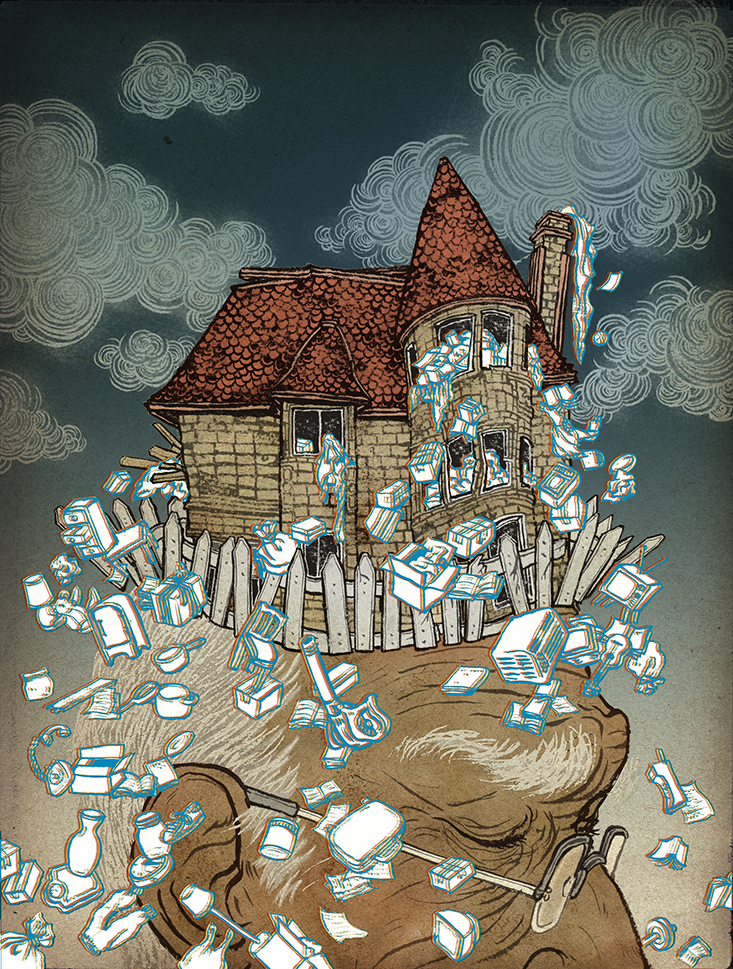
By David Wallis Illustration by Yuko Shimizu February 20, 2014
ANIMALS like to hoard. Christopher E. Overtree, director of the Psychological Services Center at the University of Massachusetts, Amherst and a specialist in treating hoarding, says that “the mechanisms triggering this kind of biological reflex are present in all of us.” A friend of his in Minnesota had an eagle’s nest on his property fall from a tree. This led to a surprising discovery: 23 dog and cat collars. “The eagle ate the animals but saved the collars,” says Overtree. His own cat, Gus, wasn’t much better. Overtree recently tailed his cat sneaking off with his wife’s costume jewelry, dragging the trinkets into the attic and stashing them in a hole in the floor. “I realized he must be saving it,” says Overtree. “I think it is interesting to see a behavior that has no practical value in an animal.”
Hoarding, some scientists suggest, is a sensible action to take in an uncertain world. “We have been shaped by evolutionary pressures in the past to deal with resource scarcity, and hoarding is one of those possible strategies,” says John L. Koprowski, professor of wildlife conservation and management at the University of Arizona and an authority on squirrels. He refutes the conventional wisdom that squirrels only gather what they need to survive winters. Studies of eastern gray squirrels, for instance, suggest that up to 74 percent of buried acorns are never recovered. They could be lost—or simply stored, just in case.
While saving up in this manner seems both sensible and prevalent among animals, it is a bona fide disease among humans. This year, for the first time, the fifth edition of the Diagnostic and Statistical Manual of Mental Disorders, or DSM—the bible of psychiatrists and insurers—listed it as a distinct disorder. It is also one with serious consequences, with the potential to ruin relationships, result in evictions, and fuel lethal fires. And according to the American Psychiatric Association, 2 to 5 percent of the United States population suffers from it.
After all, we are being pushed to consume. “Contemporary U.S. households have more possessions per household than any society in global history,” explains Jeanne E. Arnold, professor of anthropology at the University of California, Los Angeles (UCLA). In 2012, Arnold and a team of sociologists and anthropologists published a book, Life at Home in the Twenty-First Century, based on a four-year study of 32 middle class, dual-income families in Los Angeles. The authors found that 75 percent of families banished their cars from garages “to make way for rejected furniture and cascading bins and boxes of mostly forgotten household goods.” Superstores like Costco, they argued, have increased our tendency to stockpile food and cleaning supplies—and the result at home is stress. Women who described their homes as cluttered had higher cortisol levels—a sign of stress—than those who didn’t.
The line between hoarding, the mental disorder, and hoarding, the bad habit (or natural tendency), is worth considering. Does saving your children’s finger paintings from 1982 mean you have a de-acquisitioning problem? What about those boxes of clothes sized 30 pounds ago in your closet instead of at Goodwill? The popularity of hit reality shows like Hoarders and Hoarding: Buried Alive is surely due in part to the fact that we see ourselves in even the most extreme cases. The boundaries of this debate reveal something about who we are as people.
ON A TIDY street in a resurgent New England mill town, where the trimmed bushes look like green thimbles mounted in mulch, Melvin’s large Victorian house sticks out. Two bicycles, one missing the front wheel, lean against threadbare front steps; stacks of two-by-fours, rakes, and bicycle tires piled up on a desk surround the front door. Melvin, an erudite lawyer in his late 60s who requested a pseudonym, wears khakis and a pressed blue-and-white shirt with neatly rolled up cuffs, looking a bit like the late Canadian actor Conrad Bain. He speaks fluent French and can get by in Russian. He nimbly chats about Robert Pinsky one minute and Oriana Fallaci the next. The divorced father of two is quick with a joke or a boast about his children. He loves to bake, particularly Linzer tortes.
Melvin hasn’t invited anyone into his home in more than a year; he reveals this while leading me, single file, through piles of possessions on narrow paths, known in hoarder parlance as “goat trails.” Cans, dishes, and mugs blanket kitchen countertops. He hands me a laser pointer so I can ask about his many inaccessible items as we stroll through the house. We encounter roughly 200 musical instruments in various states of repair, scores of VHS tapes, racks of dress shirts, vintage radios, several skis, a dozen or so motorcycle helmets, and countless books—some in barrister bookcases, others in boxes. He owns a valuable watercolor by Whistler as well as a worthless stuffed blue parrot that looks like a carnival prize.
Melvin says he can remember a time before the clutter crept up on him and the house was “light and airy.” He bought his place about 20 years ago after a bitter divorce and soon found a housemate he enjoyed socializing with. He hosted home-cooked dinners and raucous dance parties, but after his housemate moved out, stuff moved in. “Slowly it got filled up floor to ceiling,” he says. Melvin, however, insists that he is not a hoarder. “I don’t think of it as hoarding at all,” he says. “That implies greed, one of the medieval sins. It’s really an accumulation of stuff, and it happens because I have an eye for everything under history.” But, I ask, wouldn’t he admit his collecting has gotten out of hand? He thinks about it and responds, gently, “I have a problem de-acquisitioning things.”
Is Melvin’s self-diagnosis right? Is he really a quirky, but normal, collecting enthusiast with a particularly strong attachment to what he judges as treasures? Probably not. In fact, it is this very human feeling of attachment which is the first step in a hoarding disorder. Randy O. Frost, a professor of psychology at Smith College, and coauthor of Stuff: Compulsive Hoarding and the Meaning of Things, saw this extreme attachment form in real time, in a set of psychology experiments involving a rather unexciting collectible: Key chains. He distributed key chains to both hoarders and non-hoarders, asking each group to rate their attachment to the trinket during the course of a week. He expected the connection to grow gradually. “That didn’t happen,” he recounts. “[Hoarders] had it immediately. It told me something about the way in which attachment occurs, that it happens immediately on ownership.”
Attachment becomes strengthened by forgetting that the object is just an object. Carolyn Rodriguez, who directs the Hoarding Disorder Research Program at Columbia University, says some of her clients assign human qualities to objects. “For many patients, the main relationship in their lives is not with another person,” she observes. “Instead, it’s a relationship they have with their stuff—and their stuff is what they turn to for companionship and comfort.” The objects can serve as a stand-in for a person. “People will pull a calendar from 2002 out of a box and cry at how deeply that calendar connects them to the things they did in 2002, or the people they loved in 2002,” says Overtree, the Amherst psychologist. Discarding something stops being a simple or rational act.
Those with hoarding disorders, then, have an amplified sense of something that all of us cherish: Our deepest feelings for our families and close friends, and our artistic sensibilities. On the second floor of Melvin’s house, he has half-a-dozen pairs of cowboy boots in boxes, but he owns many more. “This isn’t my Western boot room,” he jokes. He has a thing for the Luccese brand—“the best American cowboy boots” in his opinion—so he buys them at yard sales, flea markets, and thrift shops. “I’ll pick them up for any friends I have that might be that size,” he says. Melvin’s daughter says that her father is one of the most generous people she knows, but he obviously amasses more gifts than he has potential recipients.
While Melvin’s house is overstuffed, many of his books, vintage radios, and musical instruments mean the world to him. “I appreciate the craftsmanship and the beauty that goes into them,” he says. “Everybody else has an iPhone and walks around being governed by an iPhone. For me it’s objects, and I love them.”
Overtree says people who can’t part with their possessions often see an inherent beauty in them. And that’s a quality he doesn’t want to tarnish. “I have been trying to figure out where is the sweet spot between curing somebody and helping them live a happy and productive life,” he says. Beauty is a dangerous thing, another psychologist told me. How do we hold onto the things that we love and cherish without being overwhelmed by them? How do we learn to let go?
THERE IS, however, a second component to hoarding disorders that has less to do with an amplification of what makes us human, and more to do with a diminishment. Psychiatrist Sanjaya Saxena of the University of California, San Diego, found that patients with compulsive hoarding syndrome showed “diminished activity in several parts of the cingulate cortex,” the part of the brain that governs motivation, executive control, and response to conflict. Phil Wolfson, a psychiatrist based in San Francisco, told me patients with hoarding problems “are often depressed, they are often isolated socially or socially phobic, or they are obsessive-compulsive people; they have all kinds of other habits, difficulties, and anxieties.”
But some of the same brain areas that are underactive under normal circumstances become hyperactive when hoarders are confronted with their possessions. David F. Tolin of the Yale University School of Medicine asked participants in a study to decide whether their old papers can be shredded, while monitoring their brain activity. He found that hoarders’ brains zoomed into overdrive like a seismograph measuring an earthquake—compared to healthy controls. (That didn’t happen when they watched someone else’s papers being ditched.) “The parts of the brain involved in helping you gauge that something is important are kicked into such overdrive that they are maxed out, so everything seems important,” Tolin explains.
Monika Eckfield, a professor of physiological nursing at California State University, San Francisco, concurs that many hoarding patients struggle with processing information. To avoid the anxiety of throwing something away, they simply put off the decision to do so. “This is common to all of us,” Eckfield says. Like the neuroscientists, she believes hoarding becomes abnormal as a result of “mis-wiring” in the brain’s executive functions. Chronic hoarders “have a much harder time following through,” she says. “They get distracted. They get disorganized. They end up adding to the pile, and the idea of sorting through those piles is very overwhelming.”
MODERN science has clearly revealed why hoarding deserves the designation of “disorder”: It is reflected in physical differences in how the brain is wired. At the same time, it is something that reflects to us some of the qualities and decisions with which we all struggle: Consumerism, attachment, decision-making, time management—and, at some level, survival. I’m left wondering if it is any coincidence that it was in 2013, when society demands so much from us in each of these capacities, that hoarding has taken on full-fledged disorder status in the DSM-V handbook.
~ David Wallis has contributed to The New Yorker, Wired, Esquire, The New York Times, and other publications. He is also the editor of Killed: Great Journalism Too Hot To Print, and Killed Cartoons: Casualties from the War on Free Expression.

Subscribe to:
Posts (Atom)