Showing posts with label education. Show all posts

Wednesday, October 29, 2014

Understand Neuroscience with Cool Animations from Harvard University

These are pretty excellent - animations running between 2 and 1/2 and 5 minutes that explain some of the basic concepts of neuroscience.

Understand neuroscience with these neat animations by Harvard University


Omar Kardoudi
10/23/14 - Thursday


When I first heard of Harvard's Fundamentals of Neuroscience online course, I thought it was going to be so hard to understand that I would have a seizure before the end of the first video. But no, thanks to the cool and straightforward animation it is actually very easy to get it.


SPLOID is a new blog about awesome stuff. Join us on Facebook

Monday, July 14, 2014

Inequality Begins at Birth by Jeff Madrick (NYRB)

Yes. Yes, it does.

This article comes from The New York Review of Books - in essence, this article is about the battle for universal early education in America, and an argument in its favor. The argument is based on relatively recent "biological evidence that a high-stress environment for very young children does not simply affect cultural and psychological conditions that predispose the poor to failure; it can also affect the architecture of the brain, changing the actual neurological functioning and quantity of brain matter."

If we want to reduce poverty and violence in this country, it starts with early education and improved conditions for our children.

Inequality Begins at Birth

Jeff Madrick
June 26, 2014


Alex Webb/Magnum Photos - Mound Bayou, Mississippi, 1976

Over the past year, the lack of universal pre-kindergarten for American four-year-olds has become a national issue. In 2013, President Obama proposed to fund an ambitious new nationwide pre-kindergarten program through a new cigarette tax. That plan failed to gain support, but Bill de Blasio gave new urgency to the issue when he swept into the New York mayor’s office promising universal pre-K for all city children—which will begin in the fall. Even as these efforts are being made, however, new research is making it increasingly clear that educational disparities start much earlier.

The value of universal access to early education has long been recognized: it improves the life chances of disadvantaged children and is crucial to keeping a level playing field for all. The United States has fallen well short of this goal. In most of Europe there is universal, good-quality preschool for three- and four-year-olds. In America, recent data show that fewer than half of all three- and four-year olds are enrolled in some form of preschool. Head Start, the main federal program, provides preschool funding for only about two fifths of poor children in this group.

Moreover, America has the second highest child poverty rate out of the thirty-five nations measured by the United Nation Children’s Fund (only Romania is worse). Twenty-three percent of American kids are poor by international standards, compared to 10 percent in the UK and 7 or 8 percent in the Nordic countries. According to studies on the US population, the poorest children are those five and under—indeed, they are the poorest demographic group in the nation. Many of these kids live in deep poverty, with family income less than half of the poverty line. Poverty rates for black and Latino children are especially high.

Scholars have long documented that children who grow up poor face greater obstacles to social development and good health, obstacles that often remain with them the rest of their lives. They are more likely to have chronic diseases like asthma or attention deficit disorder, few of them graduate from high school, their wages are lower, and they often end up on welfare. Poor teenage women have more unwanted births.

But neurological evidence from recent years strongly suggests that the causes of these poor outcomes are neither solely cultural nor a function of a weak gene pool, as commentators like Charles Murray, author of The Bell Curve, once claimed. As Dr. David Keller made clear at a recent conference on child poverty in Washington, D.C. called “Inequality Begins at Birth” (primarily sponsored by the think tank I direct, The Bernard L. Schwartz Rediscovering Government Initiative at the Century Foundation), there is new biological evidence that a high-stress environment for very young children does not simply affect cultural and psychological conditions that predispose the poor to failure; it can also affect the architecture of the brain, changing the actual neurological functioning and quantity of brain matter.

In other words, pre-K is not enough. What is concerning, moreover, is that these findings have been known for some time but are not getting adequate attention. In fact, the original documentation was published back in 2000 in a vanguard article by Harvard’s Center on the Development of the Child, and corroborating studies have multiplied since then.

Indeed, two studies completed in 2013 relate neural deterioration directly to poverty. A group of researchers from six universities measured the brain activity of adults who had been poor at age nine and found that the areas that control emotions were physically underdeveloped. A Washington University study found that poor children who are nurtured adequately, thus avoiding constant stress, usually have normally developed brain tissue, while those with less nurturing have less white and grey matter and smaller control centers, such as the hippocampus.

What’s been discovered is that human beings have a chemical reaction to stress that at first protects them from damage. But the defense is limited. Should a young child, whose brain is still forming, be bombarded by constant stress—from violence at home, lack of food, parental drug abuse, and, not least, chronic lack of attention or nurturing—the overloaded mechanism fails and the brain is adversely affected.

Dr. Jack P. Shonkoff, who runs Harvard’s Center on the Developing Child, has produced numerous articles with colleagues describing the result of studies on animals and, increasingly, on children. Under stress, the body produces two hormones that are protective, adrenaline and cortisol. But when stress becomes excessive—what the field now describes as “toxic stress”—the excessive hormonal activity damages neural connections, undermines immune responses, and changes the parts of the brain that directly affect memory, learning, and emotional control.

These studies generally concur that persistent neglect and inadequate nurturing are primary causes of brain deterioration. Evidence based on a wide variety of studies of children, including children in foster care around the world, clearly shows, usually with the use of MRIs, the detrimental consequences for neural connections and brain size of seriously inadequate nurturing.

Sociological research, in turn, shows how common child neglect is among the poor. Poor parents are fraught with anxieties about providing adequate food and transportation, and often the safety of their communities and the stability of their families. Some may simply be irresponsible, or use drugs, but numerous ethnographies of the poor, by the Children’s Defense Fund, independent scholars, and others, show that these parents, including single mothers, care about their children as much as parents of greater means. The issue is rather that they often can’t get jobs that allow time for them to spend with their children and lack the resources, time, or freedom from anxieties to cope. Studies also show that the quality of prenatal care can affect early childhood development and that pregnant women on drugs or in depression can also affect the newborn child’s neurological growth.

What is most fascinating about the recent discoveries is that they split the difference between those who put the onus on the gene pool, like disciples of Murray, and those who put it on culture. Genes do in fact matter, it turns out, but the parental and cultural environment, researchers find, can improve neural capacities or prevent deterioration. Dr. Keller, an MD and researcher, is president of the Academic Pediatric Association. As he puts it, “the new research is not pure Darwin, there is a bit of Lamarck here.”

Medical and science professionals now virtually all agree that the earlier a positive intervention is made in a child’s life—including home visitations by professionals, parent counseling, treatment for substance abuse, and relatively new programs, such as reading to toddlers even before they have language skills—the better. Pediatricians, including the giant American Academy of Pediatrics, are developing plans to use pediatric visits as a platform for more extensive intervention when undue stress is evident. One favorite program is a free book with every shot.

What concerns me most, however, is that our political leaders and legislators have until now largely overlooked the connection between poverty, poor educational attainment, and even neural malfunctions—and the extent to which effective poverty reduction itself can correct the problem. Economists Janet Gornick and Markus Jantii analyzed data across nations and concluded that child poverty is far lower in European nations, not because their economy produces higher wages for lower income workers, but because of more robust social programs. Most of these nations, and many in Latin America, for example, provide direct cash allowances for parents with children.

More and better paying jobs are vital to combating child poverty and the problems it leads to. A full employment economy, with good jobs, is still possible with substantial fiscal stimulus, especially including public investment in infrastructure.

But social programs are critical. Contrary to the widespread cynicism about social programs and welfare, the US knows how to reduce poverty. As Robert Greenstein of the Center for Budget and Policy Priorities notes, the federal safety net, including Medicaid, Food Stamps, the Earned Income Tax Credit, and the Child Tax Credit, kept 41 million people out of poverty in 2012, including 9 million children. Without government benefits, today’s poverty rate would be 29 percent. Instead, using the best measures of poverty, which include government transfers and tax credits, the rate has dropped from about 26 percent in the late 1960s to 16 percent today. In other words, the War on Poverty begun in the 1960s worked.

But amid growing inequality between the very rich and the rest of society and decreasing social mobility at all levels, the challenge for low-income Americans is great. Our current general poverty rates—especially among young children—are still dangerously high. Particularly disturbing, child poverty rates, after rising during the recession, have not fallen in the recent economic recovery.

I’d begin a new war on child poverty by developing a federal system of cash allowance to poor families with children, as so much of the world now does. Now, aid is mostly limited to purchases of food or dependent on getting a job, which for many in this group these days is especially hard. But in a political environment in which Congress seeks even to cut back food stamps, persuading our legislators of the moral and economic good sense of direct cash outlays will take a great deal of work.

The research is now undeniable. Inequality in America begins at birth, or, for those born to women who are ill during pregnancy or do not have adequate prenatal care, even before. Through no fault of their own, up to one quarter of American children start off well behind, and another quarter live in families that earn only twice the poverty line—about $48,000 a year for a family of four. Armed with the unambiguous findings of twenty-first-century neuroscience, we can no longer just tell children raised poor to study harder and find jobs as they grow up. A nation that needs all its citizens to be productive workers, and that promises a fair and dignified life to all, regardless of race or color, must now turn its attention to its enormous pool of poor children.

Wednesday, June 18, 2014

Claude Steele - Stereotype Threat: How It Affects Us and What We Can Do About It


Claude Steele is the author of Whistling Vivaldi: How Stereotypes Affect Us and What We Can Do (Issues of Our Time) (2010), a book that escaped my attention but seems to offer some important insights into how stereotypes narrow our experience of the world.
The acclaimed social psychologist offers an insider’s look at his research and groundbreaking findings on stereotypes and identity.

Claude M. Steele, who has been called “one of the few great social psychologists,” offers a vivid first-person account of the research that supports his groundbreaking conclusions on stereotypes and identity. He sheds new light on American social phenomena from racial and gender gaps in test scores to the belief in the superior athletic prowess of black men, and lays out a plan for mitigating these “stereotype threats” and reshaping American identities.
Below the talk given at UC Berkeley is a longer review of the book from the Harvard Education Review.

Claude Steele - Stereotype Threat: How It Affects Us and What We Can Do About It

Published on June 17, 2014


Claude Steele, internationally renowned social scientist and Executive Vice Chancellor and Provost, will discuss his theory of stereotype threat, which has been the focus of much of his research and writing throughout his academic career. The theory examines how people from different groups, being threatened by different stereotypes, can have quite different experiences in the same situation. It has also been used to understand group differences in performance ranging from the intellectual to the athletic. Steele's recent book, "Whistling Vivaldi: And Other Clues to How Stereotypes Affect Us and what we Can Do," published in 2010, was based on this research and lays out a plan to mitigate the negative effects of "stereotype threat."
* * * * *

 From the Harvard Education Review:

Whistling Vivaldi: And Other Clues to How Stereotypes Affect Us

Claude M. Steele
New York: W. W. Norton, 2010. 

242 pp. $25.95. 
 
Why are students of color not graduating from college at the same rate as white students? Why might white students be reluctant to take courses with a substantial number of students of color in them? What can educators do to address these problems?
In his new book, Whistling Vivaldi: And Other Clues to How Stereotypes Affect Us, social psychologist Claude Steele helps us find answers to these questions based on findings from social psychology experiments. Steele’s book sets forth an argument for understanding how contextual factors—not individual characteristics or personal beliefs motivated by prejudice or malice—help explain so-termed “racial achievement gaps” in education and ongoing societal racial and ethnic segregation.

In an accessible, page-turning account written for a general audience, Steele explains how identity contingencies—the conditions that a given social identity forces us to face and overcome in a particular setting—affect our everyday behavior and perpetuate broader societal problems. Expanding on his prior work, he focuses on a specific type of identity contingency: stereotype threat, or the fear of what people could think about us solely because of our race, gender, age, etc. An African American male walking down the street at night, for example, faces the threat of being seen as potentially violent. Steele recounts how, to deflect this stereotype threat, African American New York Times writer Brent Staples whistled Vivaldi while walking the streets of Hyde Park at night to signal to white people that he was educated and nonviolent. Another example of stereotype threat would be a white student in a class that is predominantly nonwhite facing the threat of being perceived as racist. Steele explains how such threats follow us like a “cloud.”

Steele summarizes research findings that show how the concerns students face as a result of these stereotype threats affect a wide range of educational outcomes. He explains how the threat of a stereotype and the extra efforts required of students who try to dispel it interfere with academic performance. The additional stress and anxiety, which can operate without awareness, can lead to underperformance in the classroom or on standardized tests relative to ability. Stereotype threat can also undermine feelings of belonging, competence, and aspiration. Importantly, Steele explains how contextual cues, such as being in an environment where there are few students or faculty of color, or where the curriculum marginalizes the experiences of students of color, are enough to trigger a stereotype threat that undermines performance.

Steele offers practices educators can use to help counteract these messages. For instance, self-affirmation exercises in the classroom, particularly for students of color, can be enough to counter negative messages that trigger stereotype threat. Some other practices include emphasizing incremental views of intelligence (i.e., intelligence as an expandable as opposed to fixed characteristic) and facilitating faculty-to-student or student-to-student mentoring and cross-racial interactions. Steele’s insights are so helpful that I was disappointed when he relegated some other important discussions to footnotes, such as when he outlines how findings about the effects of stereotype threat call into question past research that suggests families, not schools, are responsible for the achievement gap.

In the later chapters of the book, Steele focuses on how identity threats influence interracial interactions more broadly. He explains how our actions, conscious or not, contribute to persistent racial segregation as, understandably, each of us may retreat to the safety of a more homogeneous environment that does not trigger the risk of a stereotype threat. But Steele’s outlook is hopeful: the factors that contribute to our living segregated lives also have the potential to help us bridge our differences. We are all affected by identity threats, and awareness of this commonality should help us empathize with the experience of others.

Overall, Steele provides strong evidence demonstrating how situational cues affect student performance, and educators can benefit from the practical implications of his research in their efforts to remedy racial inequities in education. While the importance of addressing structural factors should not be overlooked, simple institutional practices can counter the otherwise powerful cues that trigger stereotype threat for students of color. The findings presented in this book unearth the powerful and prevalent ways in which group identity affects us all and demonstrate the need to acknowledge this fact: we need to be “identity conscious” if we are going to improve race relations across
our society.

l.m.g.

Monday, June 16, 2014

How Trauma Affects The Brain Of A Learner (NPR)

From NPR and KPCC Public Radio in Southern California, this is an excellent set of articles on how to change the way we teach children such that we acknowledge the impact trauma has on learning.

It's great to see that happening - it needs to be something that happens everywhere there is poverty and violence - it's the children in those communities who suffer most.


Chronic stress can cause deficiencies in the pre-frontal cortex, which is essential for learning.
  
Our public media colleagues over at KPCC, Southern California Public Radio, have a fascinating  two-part report on the efforts of schools in the Los Angeles area to address the effects of "toxic stress" on student learning.
"As researchers work to solve one of the most persistent problems in public education – why kids in poor neighborhoods fail so much more often than their upper-income peers – more and more they're pointing the finger at what happens outside the classroom.
Shootings. Food insecurity. Sirens and fights in the night. Experts are finding that those stressors build up, creating emotional problems and changes in the brain that can undermine even the clearest lessons."
Eighty percent of the students in the Los Angeles Unified School District are in poverty. Scientists are zeroing in on how it can affect their developing brains.
"Studies show chronic stress can change the chemical and physical structures of the brain.
'You see deficits in your ability to regulate emotions in adaptive ways as a result of stress,'said Dr. Cara Wellman, a professor of neuroscience and psychology at Indiana University.
Dendrites, which look like microscopic fingers, stretch off each brain cell to catch information. Wellman's studies in mice show that chronic stress causes these fingers to shrink, changing the way the brain works. She found deficiencies in the pre-frontal cortex – the part of the brain needed to solve problems, which is crucial to learning.
Other researchers link chronic stress to a host of cognitive effects, including trouble with attention, concentration, memory and creativity."
Responding in part to this research, Camino Nuevo, a network of eight charter schools, dedicates resources to creating what it calls a "continuum of integrated support" for students. One fourth of students at the schools see counselors to help them build social and emotional skills. The schools hold group sessions for parents to help them deal with stress in their lives too, and employ full-time parent liasions to help families access health care, mental health, housing, legal, or immigration services. To pay for all this, the schools privately raise about $1.6 million in outside funds. They also tap into MediCal and work with private providers to integrate services right within the school.
Blanca Ruiz is a Mexican immigrant and single mother with a child, Luis, at a Camino Nuevo middle school.
"Since she started counseling at the school, Ruiz lost fifty pounds and saved money to buy a reliable car.
Last year, Ruiz moved her kids 15 miles east to a house in El Monte with a tiny porch and big lemon tree. But there was no way she was changing schools.
She still drives Luis to Camino Nuevo in MacArthur Park every day on her way to work. Sometimes she'll bring him a special treat of KFC for lunch...
Luis's sixth grade teacher, Sarah Wechsler, keeps a close eye on him. She tracks even the smallest details, like how often she encourages him. She wants to make sure positive reinforcements far outpace stern talk.
Wechsler said in the last year, she's seen Luis completely turn around and take ownership of his schoolwork."
At LAUSD public schools, it's a different story. Resource constraints mean just one percent of the school population can access mental health services. Read the rest of the series here.

Here is the remainder of the story linked to at the end of the NPR piece.


Teaching Through Trauma: How poverty affects kids' brains


Camino Nuevo Charter Academy
Maya Sugarman/KPCC

Training in self control starts early at Camino Nuevo. Karina Rodriguez leads preschoolers through a motor skills exercise, asking them to start and stop based on musical cues. Students will be exposed to 14 years of curriculum designed to address academic and soft skills.
Teaching Through Trauma: the first in a series of stories on poverty in Los Angeles schools. Read Part Two here.
New research shows the mere fact of being poor can affect kids' brains, making it difficult for them to succeed in school.

Los Angeles public schools — where more than 80 percent of students live in poverty — illustrate the challenges for these students. Less than half of third graders in L.A. Unified read at grade level and 20 percent of students will have dropped out by senior year.

But researchers also offer hope. They said the right interventions can make a difference. And one school in MacArthur Park is battling biology by helping children with life as well as school — to growing success.

Children living in poor neighborhoods are more likely to suffer traumatic incidents, like witnessing or being the victims of shootings, parental neglect or abuse. They also struggle with pernicious daily stressors, including food or housing insecurity, overcrowding and overworked or underemployed, stressed-out parents.

Untreated, researchers have found these events compound, affecting many parts of the body. Studies show chronic stress can change the chemical and physical structures of the brain.

“You see deficits in your ability to regulate emotions in adaptive ways as a result of stress,” said Dr. Cara Wellman, a professor of neuroscience and psychology at Indiana University.

Dendrites, which look like microscopic fingers, stretch off each brain cell to catch information. Wellman’s studies in mice show that chronic stress causes these fingers to shrink, changing the way the brain works. She found deficiencies in the pre-frontal cortex – the part of the brain needed to solve problems, which is crucial to learning.

Other researchers link chronic stress to a host of cognitive effects, including trouble with attention, concentration, memory and creativity.

For students in many Los Angeles public schools, those chronic stressors are everywhere.

Growing up hearing gunshots


Take MacArthur Park, where Census surveys show the child poverty rate is double the California average. The neighborhood’s namesake grassy square is so crime-ridden that many parents refuse to let their children play outside.

The Los Angeles Police Department arrested 3,000 juveniles in the neighborhood in 2011 alone, the most recent data available. Most were for theft — but 14 were taken in on suspicion of homicide.

Kids here deal with parents being deported, siblings being locked up or social workers being called in to take kids away from neglectful or abusive parents. They often live in cramped, crowded apartments with two or more families.

Ana Ponce herself grew up an immigrant in MacArthur Park and thought: it’s time to change how a school tries to reach students.

“We had this understanding that we can not teach kids that are not ready to learn because they were preoccupied with all of the barriers they encountered on their way to school - or all of their fears they had leaving school,” she said.

In the early 2000s, Ponce joined the leadership of a small charter school called Camino Nuevo in her neighborhood. It has since grown to a network of eight schools.

A different approach


At a recent 7 a.m. meeting, Camino Nuevo elementary and middle school teachers clustered into groups, sounding a lot like social workers. Their task: to figure out how to “use positivity and relationships to reverse some of the negative effects of poverty.”

Sarah Wechsler reported a dramatic improvement in one of her students, whose mother was recently deported.

“We’ve loved him, and we’ve replaced his mom the best we can,” she said. “And he’s done all his work this week.”

Ponce said she sees the school’s job as improving the lives of students’ entire families.

Staff helps parents enroll younger siblings in preschool and hooks parents up with healthcare providers. School sites have a full-time parent liaison to provide referrals for those struggling with housing, employment or legal problems.

In group sessions, parents are taught how to participate in their children’s education and relate better to them.


Tracking wellbeing


Camino Nuevo’s teachers are trained to track not just academic progress but also overall wellbeing.

If academics slip, they offer reading or math tutoring. In the same way, when emotional or behavior issues bubble-up, a student is referred to a counselor to develop those equally vital emotional skills.

Most schools in L.A. Unified only provide counseling for the most serious mental disorders, targeting resources to the less than 1 percent of the student population – those diagnosed with a serious emotional disturbance. (Read more on this in the second part of our series.)

At Camino Nuevo, about one in four students receives one-on-one counseling or group interventions. They don’t just talk about their problems at home, but also learn how to process emotions and make better decisions.

“They need the place to - you know – detox, so to speak. To let go. To get all this out, and to learn about themselves,” said Gloria Delacruz-Quiroz, head of mental health at Camino Nuevo.

Research shows that not all children who experience trauma will struggle emotionally. Those who feel they have support from an adult seem to do better.

Ninety-seven percent of students at Camino graduate high school, compared to 68 percent district-wide, where the rate slips even further for Latino and low-income students.

To pay for it, the school taps MediCal, California’s version of Medicaid.

The charter school created a system where its own staff works alongside private counseling service providers - including the Los Angeles Childhood Development Center and Didi Hirsch Mental Health Services – right at the schools.

The services aren’t free. Camino Nuevo scrapes together $1.6 million to cover what the providers cannot, plus a smattering of other services school leaders term their "continuum of care," which include not just counseling but things like after school programs and field trips.

A single mother


Camino Nuevo’s Burlington middle school campus is around the corner from where Blanca Ruiz works long hours at a nail salon.

Since she came here from Mexico years ago, she often felt she was barely keeping it together. She was sharing an apartment with her two kids and several roommates. Sometimes the stress would overwhelm her kids.

“I’m a single mother who came here with very low self-esteem, very unfocused, and with severe economic problems,” she said in Spanish. “If I was insecure, my kids would feel the same way.”

Her son Luis acted out. He got bad grades. He refused to do what his mom said and that enraged her.

“She screams because I don’t want to listen to her,” he said.

In class, sometimes Luis would stare off at his desk, checked out; other times he’d become disruptive, start talking, get up and walk around. He expressed no interest in learning and made it difficult for other students in class to stay on task.

“Sometimes I forgot, or sometimes I would decide not to do my work,” he said flatly.

In fifth grade, he was sent to the principal’s office for ignoring his teacher’s instructions. The principal suspended him from school.

Written off?


Rather than write him off, the staff at Camino Nuevo got him to meet with a mental health counselor at the school. He also received tutoring everyday to catch up in math.

His mom went to the school’s group sessions for parents.

“I think it helped me because if you want to help your kid, you have to be emotionally stable, a clear mind and more positive,” she said.

Since she started counseling at the school, Ruiz lost fifty pounds and saved money to buy a reliable car.

Last year, Ruiz moved her kids 15 miles east to a house in El Monte with a tiny porch and big lemon tree. But there was no way she was changing schools.

She still drives Luis to Camino Nuevo in MacArthur Park every day on her way to work. Sometimes she’ll bring him a special treat of KFC for lunch.

A turnaround


Luis’s sixth grade teacher, Sarah Wechsler, keeps a close eye on him. She tracks even the smallest details, like how often she encourages him. She wants to make sure positive reinforcements far outpace stern talk.

Wechsler said in the last year, she’s seen Luis completely turn around and take ownership of his schoolwork.

“You want to be your own man, don’t you?” she said, smiling at Luis with encouragement.

Luis still has days where he feels unfocused, and Wechsler allows him to take breaks or move to another desk. On a recent school day, Luis chose the table facing a wall. Without distraction, he hunkered down to divide fractions.

As the school year was drawing to a close, evidence of Camino Nuevo’s work – and Luis’s - became evident in one unmistakable way: He finally reached grade level in math.

How does that make him feel?

“Proud,” he said.


Annie Gilbertson, Education Reporter
Follow @AnnieGilbertson on Twitter
More from Annie Gilbertson

CORRECTION: An earlier version of this story misidentified Ana Ponce as a founder of Camino Nuevo and misstated its current number of campuses. KPCC regrets the errors.


Sunday, April 20, 2014

Date and Acquaintance Rape - Presentation Version and Full Version


Here is the presentation (shorter version as presented and a longer version) I gave at the Tucson YWCA yesterday as part of Sexual Assault Awareness Month. These are hosted by SlideShare.


Full presentation:


Presentation as given at the YWCA:

Friday, January 17, 2014

Omnivore - Philosophers Gonna Philosophize

From Bookforum's Omnivore blog, here is another quirky collection of philosophy links from around the interwebs.

Philosophers gonna philosophize

Jan 15 2014
9:00AM

Tuesday, November 12, 2013

Transdiciplinarity, Interdisciplinarity, Reductive Disciplinarity, and Deep Disciplinarity

Dr. Robert Pippin, who is the Evelyn Stefansson Nef Distinguished Service Professor, Committee on Social Thought, University of Chicago, gave the keynote talk at the Interdisciplinary Futures Symposium, held in honor of Emory's Institute of Liberal Arts 60th anniversary celebration on October 24, 2013.


Transdiciplinarity, Interdisciplinarity, Reductive Disciplinarity, and Deep Disciplinarity


Sunday, October 13, 2013

The Daily Show Exclusive - Malala Yousafzai Extended Interview


By now, most people have seen at least parts of these videos and/or read excerpts of Malala Yousafzai's comments to Jon Stewart (who is genuinely humbled by the wisdom and courage of this 16-year-old girl) about her experiences as an advocate for education in Pakistan and the assassination attempt that brought her international attention - and got her out of Pakistan to continue sharing her message of peace and hope.

Her new book is called, I Am Malala: The Girl Who Stood Up for Education and Was Shot by the Taliban.

Here is the full, unedited interview she did with Jon Stewart a few days ago on The Daily Show. She is an amazing and inspiring human being.

Exclusive - Malala Yousafzai Extended Interview Pt. 1

Tuesday October 8, 2013

In this exclusive, unedited interview, "I Am Malala" author Malala Yousafzai remembers the Taliban's rise to power in her Pakistani hometown. (06:17)


Exclusive - Malala Yousafzai Extended Interview Pt. 2

Tuesday October 8, 2013

In this exclusive, unedited interview, Malala Yousafzai describes the beauty of her homeland and the cruelty of the Taliban. (05:29)


Exclusive - Malala Yousafzai Extended Interview Pt. 3

Tuesday October 8, 2013

In this exclusive, unedited interview, Malala Yousafzai offers suggestions for Americans looking to help out overseas and stresses the importance of education. (04:10)

Sunday, October 06, 2013

James Lenman: HOW TO WRITE A CRAP PHILOSOPHY ESSAY

Brilliant . . . .


HOW TO WRITE A CRAP PHILOSOPHY ESSAY: A BRIEF GUIDE FOR STUDENTS

James Lenman
(Sheffield University)

Always begin your essay along these lines: “Since the very dawn of time the problem of free will has been considered by many of the greatest and deepest thinkers in history.”

Always end your essay along these lines: “So it can be seen from the above arguments that there are many different points of view about the free will problem.”

Whenever in any doubt as to what to say about X, say, apropos of nothing in particular and without explanation, that X is extremely subjective.

When that gets boring, try saying that X is all very relative. Never say what it is relative to.

Use language with as little precision as possible. Engage heavily in malapropism and category mistakes. Refer to claims as “arguments” and to arguments as “claims”.

Frequently describe sentences as “valid” and arguments as “true”. Use the word “logical” to mean plausible or true. Use “infer” when you mean “imply”. Never use the expression “begging the question” with its correct meaning but use it incorrectly as often as possible.

“Argument” is perhaps the most important word in philosophy. So why not impress the marker by spelling it with two “e”s?

Get into the habit of inserting words like “so” and “therefore” between sentences that are entirely irrelevant to one another. This, all by itself, will bring into being a mutual relevance that previously did not exist.

Be careful always assiduously to avoid answering the question asked. There are so many other more interesting things for you to discuss.

Put “quotation marks” round words “entirely” at random.

Be completely defeated by apostrophes. Systematically confuse “its” and “it’s”.

At some point in every essay, treat the marker to a brief Dr McCoy style sermon about the dangers of being too “logical” when trying to think about the existence of God/moral obligation/free will/the theory of knowledge/any subject matter whatever. To reinforce the point it always helps to point out how once again how very subjective the subject matter in question is.

Avoid clarity at all costs. Remember: nothing that is clear can possibly be really deep. If as a result the marker gives you a third that just shows that your wisdom is going straight over his/her head.

(Don’t, whatever you do, heed the words of Peter Medawar: “No one who has something original or important to say will willingly run the risk of being misunderstood; people who write obscurely are either unskilled in writing or up to mischief.” – What a silly man!)

Remember. Paragraphs are for sissies. So are headings.

Only little people use examples. Avoid them strenuously. If you must insist on using some, be sure to do so with studied irrelevance.

Saturday, September 28, 2013

What If the Best Remedy for a Broken Family Is No Family at All?


This excellent article from Pacific Standard Magazine looks at the San Pasqual Academy, a non-profit group home that can serve about 180 kids, located in the San Diego area of Southern California. This facility exists because families fail - and when teenagers are involved, families tend to fail in violence, neglect, and suffering, especially for the kids.
The academy believes teenagers should bond with a community of their peers and a group of adults rather than be folded into a series of potentially dysfunctional families. The concept can be reduced to a simple truth: There is no time. There are more than 60,000 foster children in California alone, and it can take years even to try to rehabilitate troubled biological parents or family members, or find stable adoptive parents.
On average, foster children will have three family placements, but for teenagers it's not uncommon for teenagers to end up living in 10 to 12 different homes. By the time a kid is 12, if s/he is still living in foster care you have a single-digit chance of being adopted (if you want to be - and not all kids do).
In fact, a teenage girl in foster care is more likely to get pregnant than to get adopted. Somewhere near 25 percent of foster care kids become homeless.
The way they have structured San Pasqual is highly unique and represents a new model with traditional values.
[Situated on] 238-acre parcel of land, San Pasqual Academy’s $14 million campus includes a small public high school, an organic farm, a fire station, a colony of subsidized housing for seniors (who serve as surrogate grandparents), a swimming pool, a technology center, and a manicured football field. Up to eight students live in each cottage with one or two adults, who cook meals, help with homework, and enforce bedtime. The adults are there to offer an approximation of parental support when needed, but the main focus of San Pasqual is to establish a structure whereby the kids can create their own community—and bond with it.
They have a graduation rate twice that of foster kids in California. Their students are required to participate in extracurricular activities, in job training, get summer internships, and apply for college (the Friends of San Pasqual non-profit helps raise money for tuition).

Granted, this program does not accept kids with a background in violence or serious chemical addiction. And the kids have to show some desire to be there and to get an education. Still, we need more schools set up on this kind of model.

What If the Best Remedy for a Broken Family Is No Family at All?

The San Pasqual Academy argues we should let foster teenagers create their own tribe.


September 16, 2013 • By Natasha Vargas-Cooper


(ILLUSTRATION: MARK MCGINNIS)

Between the ages of eight and 16, Nora lived in 32 foster-care settings. She lived in emergency shelters for children, in the homes of well-intentioned short-stay foster parents, and at home during her mother’s brief bouts of sobriety. One of her foster families would not allow Nora (not her real name) to bring her belongings inside; she had to change her clothes in the garage. She was in her last placement for four months when her foster family decided to move—and leave her behind.

Foster children have a median number of three family placements, but many teenagers end up living in 10 to 12 different homes. If you’re still in foster care by the time you’re 12, you have a single-digit chance of being adopted if you want to be. In fact, a teenage girl in foster care is more likely to get pregnant than to get adopted. Somewhere near 25 percent of foster care kids become homeless. So, even though Nora was non-violent, sober, and free of physical and emotional disorders, her prospects were grim. The surest way for Nora to have had a fixed address, attend the same school, and establish some routine would have been placement in a group home, a highly restrictive setting usually reserved for teenagers with behavioral problems—and one of the lowest rungs on the ladder of foster-care placements.

What was unusual about Nora was her ambition. “I wanted two things more than anything,” Nora says. “I wanted to make sure my mom took better care of my younger sister than she did of me, and I wanted to go to college.” And Nora had great grades. So her social worker recommended she enroll in San Pasqual Academy, an unorthodox—some would say controversial—group home and boarding school for foster kids near San Diego, California.

What happened after that wasn’t what society has come to expect from kids who’ve lived in group homes. Nora graduated from high school, then college, and is now in her final year of graduate school. Census data reveals that about three percent of foster children earn college degrees, a tenth of the national average, but Nora’s story isn’t uncommon for San Pasqual.

TODAY, FOSTER-CARE POLICY tends to be leveraged on the assumption that a family structure best serves a child’s interests. Ideally, that would mean biological parents or relatives. But even a substitute family is considered preferable to (and more cost effective than) a group home. To be sure, research shows this is true for very young children.

San Pasqual, a non-profit that can serve about 180 kids, exists because families fail. And when teenagers are involved, families tend to fail most spectacularly. The academy believes teenagers should bond with a community of their peers and a group of adults rather than be folded into a series of potentially dysfunctional families. The concept can be reduced to a simple truth: There is no time. There are more than 60,000 foster children in California alone, and it can take years even to try to rehabilitate troubled biological parents or family members, or find stable adoptive parents.

For kids stuck in the churn of the national foster-care system through their teens, prospects for adulthood are bleak. Almost 60 percent of those who age out of the national foster-care system wind up unemployed, and more than 20 percent of young people who arrive at homeless shelters come directly from foster care. According to the Brookings Institution, 80 percent of males who have been in long-term foster care, and 57 percent of females, have been arrested at some point (compare that to 17 and four percent in the general population).

“The foster-care system is pernicious,” says retired family court judge Jim Milliken, one of the founders of San Pasqual Academy. “It’s damaging for the kids that stay too long. The vast majority of them end up with bonding disorders. They get psychological damage from never having a secure, permanent place.”

Milliken, at almost 70, is a pink-faced man with a white mop and glassy blue eyes who served for eight years as the presiding judge over San Diego County’s juvenile court. When he began his tenure in 1996, he was appalled that the average time between a child’s removal from home and landing a long-term placement was 34 months (22 more months than it’s supposed to take). Milliken instituted reforms, and family reunification rates tripled under his watch. But for all that he accomplished, he was acutely aware of the courts’ continuing failures.

“I looked around and we had all these kids who were turning 13 and 14 years old and have been in the system for years. They were being sent off to group homes because they didn’t want to go to another stranger’s house,” Milliken says. “They want to go to the same school and claim some independence.”

San Pasqual’s public school boasts a graduation rate twice that of foster kids statewide. (PHOTO: COURTESY OF SAN PASQUAL ACADEMY)

NESTLED IN ONE OF San Diego’s lush coastal canyons, on a 238-acre parcel of land, San Pasqual Academy’s $14 million campus includes a small public high school, an organic farm, a fire station, a colony of subsidized housing for seniors (who serve as surrogate grandparents), a swimming pool, a technology center, and a manicured football field. Up to eight students live in each cottage with one or two adults, who cook meals, help with homework, and enforce bedtime. The adults are there to offer an approximation of parental support when needed, but the main focus of San Pasqual is to establish a structure whereby the kids can create their own community—and bond with it.

San Pasqual, modeled after a similar academy in Israel, is the only home of its kind in the United States. And Milliken says its graduation rate is near 90 percent, as compared to 45 percent for foster youth statewide.

“I only believed half the things I read about the school,” Nora tells me over the phone from her apartment in Northern California. She was accepted into one of the school’s first graduating classes. Her San Pasqual college counselors helped her apply for grants, scholarships, and loans for her undergraduate and graduate education. Any gaps in Nora’s university funding, San Pasqual filled. “I mean, that’s more than a lot of families can do, so I’m pretty grateful,” Nora says. She has a polite lilt to her voice and adds, “I also got here because of me.”

To be accepted at San Pasqual, for the most part, students can’t have a bad history of violence or substance addiction (the state licenses schools to house various “classifications” of foster kids, but San Pasqual has some discretion and flexibility). They don’t have to be strong academically, but they do have to demonstrate that they want to be there, which means they have to request admission, even if a court recommends them. Students are required to take on extracurricular activities, undergo job training, get summer internships, and apply for college (the Friends of San Pasqual non-profit helps raise money for tuition).

RIGHT OUTSIDE HAIFA, ISRAEL, surrounded by the Mount Carmel forest, is the Yemin Orde Youth Village, a school for at-risk youth. Originally built in 1953 to shelter adult immigrants and orphans rendered homeless by the Holocaust, it now shelters mostly abandoned immigrant teens ages 12 to 19.

In 1998, Milliken took a research trip to see Israel’s extensive network of youth villages, modeled partly on the European boarding school and partly on the Israeli kibbutz. At Yemin Orde, Milliken met Chaim Peri, the philosophical father of the Israeli group-home model.

“You have a painfully short period of time to heal adolescents,” Peri says in an interview during a recent visit to the United States. “If you want to heal a family, with its own long-staying pathologies, then forget about healing the child.” Peri is in his 70s and has a thick silver mustache and a baldpate covered by a yarmulke. At Yemin Orde, he says, they tell “neglected, abused, and parentless children, half of them immigrants and half from abusive homes, ‘What your family cannot do for you, your community will.’”

Peri’s thinking is inspired in part, he says, by the pioneering writings of the British psychoanalyst John Bowlby. Bowlby’s work is, in a way, a surprising source for Peri. In his book Attachment and Loss, Bowlby argues that infants and young children need to have one secure primary caregiver, usually a biological mother, in their lives in order to form secure attachment to the outside world. This primary caregiver becomes a base from which the child can then explore the world. The thinking is, if children perceive this attachment figure to be nearby, accessible, and attentive, they will feel loved, secure, and confident. If they don’t, Bowlby posited, the child will be wracked with insecurity and emotional disorders that persist past infancy. Peri, though, understands that it’s not enough to simply place blind faith in the family unit. So he has adapted the idea of secure attachment for the realities of adolescent foster care.

“You can’t just leave a child in a pathological environment and expect them to be a part of a culture that is value laden and reveres life. The time slot is too short,” Peri says. For those who’ve had a destructive childhood, adolescence, Peri holds, is a time to recover—and find bonding and security elsewhere. “I sometimes refer to our village as a garden of late bloomers,” Peri writes in his book The Village Way, “because so many of our teenagers—like teenagers the world over—are wrapped in cocoons, dealing with traumatic childhood experiences and healing from them during the early years of adolescence. Only later are they capable of devoting themselves to building their futures. The trick is to be there for these teenagers when they are ready to bloom.” And not to leave them. No one is expelled from Yemin Orde: Everyone is told that they’ll always belong. Like a family.

The most direct inspiration for Peri’s model was the counseling work he did starting in the early ’60s, organizing schools for waves of immigrant children from countries like Ethiopia and Yemen. Given that Israel was a young nation with few people and few developed institutions, and with citizens steeped in the European boarding-school and Kibbutz models—and that many orphans were adrift in the world, with no expectation of reunifying with their families—the “village” model was a natural fit. By circumstance, the best option available, Peri says, was to create mutually collaborative and supportive communities among the children themselves, with adult supervision.

Peri’s approach was prescient. According to Cambridge researcher Michael Lamb’s review of hundreds of psychology studies, whether or not a child is related to a guardian has no impact on that child’s social and mental adjustment. More importantly, the social science and medical establishments now widely agree that the composition of a kid’s family is secondary to the family unit’s style of parenting. Peri’s model prioritizes that idea, and that approach let Milliken liberate San Pasqual from the conventional wisdom that continues to dominate foster-care policy: that family reunification always comes first.


Yemin Orde, in Israel, gives abandoned immigrant teenagers a stable place to create family. (PHOTO: COURTESY OF YEMIN ORDE)

STUDENTS AROUND SAN PASQUAL affectionately refer to Milliken as the Judge. Boys in dark baggy denim and loose white T-shirts high-five him as we enter the lunchroom. The Judge proudly talks about the record of relative success that San Pasqual has racked up during the decade it has existed. San Pasqual is no utopia and there are still plenty of shortcomings, but its statistics are much better than the national average for foster kids: None of the kids become homeless when they age out of the system since the academy provides them housing; there’s that 90 percent graduation rate from high school, with one-fourth entering college; and they have the best football team in their public-school division. That last point is not a minor one. The team has proven to be a key factor of the community. “The kids have a mascot, a silver-and-blue fire-breathing dragon—an identity, and a sense of pride,” Milliken says.

THE RESEARCH ON SAN PASQUAL is promising enough that it has renewed debate among researchers as to whether certain group home models can outperform other types of foster care. But the program is still too young and small to have a large body of data behind it. Building more campuses is an uphill slog. While San Pasqual is in part supported with public money, a number of the school’s programs depend on private fundraising; and the academy is legally classified as a group home, the least desirable form of foster care in the eyes of academia, the public, and the legislature—a technicality that makes mustering funding difficult.

And despite its impressive track record with graduation rates and retention, San Pasqual is also struggling to keep enrollment up. At times there are as many as 50 unfilled slots. Again, legal and structural problems are partly to blame: The state discourages the use of group homes as they are more expensive than private foster homes, and California puts a financial cap on the length of time a child can stay in a group home—sometimes making it hard to keep a kid at San Pasqual for all his or her high-school years.

But some of the hindrances have to do with how much San Pasqual asks of its students, and how radical its basic idea really is. On a recent afternoon, Milliken is watching students give a tour to a prospective enrollee. “We want the kids to be honest about their experience here. Potential students don’t need one more adult making them empty promises,” he says as the tour approaches.

Today’s potential student is a 14-year-old African American girl, apparently unenthusiastic. Milliken introduces himself with a hearty smile and gives some well-wishes.

“She’s not going to come here,” Milliken tells me with quiet despondency. “She doesn’t believe what we’re telling her.”

Americans often have a deep-seated suspicion of institutions, especially ones that play roles traditionally reserved for the family. And San Pasqual is a particularly pointed challenge to that sense of the family’s sanctity. Not long ago, the academy built a cluster of spacious apartments for recent alumni who have nowhere to spend holidays and breaks during college or to live after graduation. If home, as the saying goes, is the place that will always take you back, San Pasqual is an approximation of just that.

Sunday, September 15, 2013

The Famous Feynman Lectures on Physics: The New Online Edition


Most of the material in the "famous Feynman lectures" is way beyond ability in the realms of mathematics and physics. However, I am sharing this anyway because Richard Feynman was simply a cool human being.

CalTech has converted all of his lectures into HTML5 format, and I'm sure there is a reason for that (and I suspect it has to do with readability on tablets and smart phones), and made them all available for free.

For those who would rather watch the lectures, that too is an option (a series of lectures at Cornell).

The Famous Feynman Lectures on Physics: The New Online Edition (in HTML5)


September 14th, 2013


Caltech and The Feynman Lectures Website have joined forces to create an online edition of Richard Feynman’s famous lectures on physics. First presented in the early 1960s as part of a two-year introductory physics course given at Caltech, the lectures were eventually turned into a book that became a classic reference work for physics students, teachers and researchers. You can still purchase the 560 page book online, or enjoy a new web edition for free.

Created with HTML5, the new site gives readers access to “a high-quality up-to-date copy” of Feynman’s lectures.” The text “has been designed for ease of reading on devices of any size or shape,” and you can zoom into text, figures and equations without degradation. Dive right into the lectures here. And if you’d prefer to see Feynman (as opposed to read Feynman), we would encourage you to watch ‘The Character of Physical Law,’ Feynman’s seven-part lecture series recorded at Cornell in 1964. Another 37 physics courses, most in video, can be found in our collection of Free Online Courses.

Feynman’s lecture are now listed in our collections of Free eBooks and Free Textbooks.

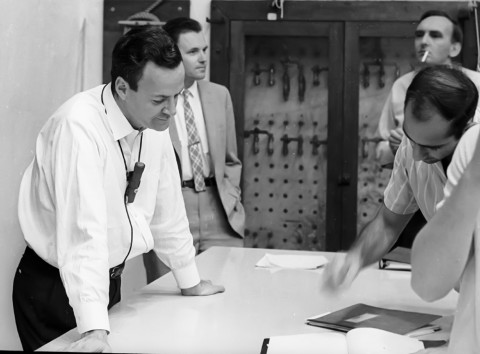
Photograph by Tom Harvey. Copyright © California Institute of Technology.
via Boing Boing

Related Content:

Tuesday, August 06, 2013

Only 21% Of Americans Believe Humans Evolved Without Divine Guidance

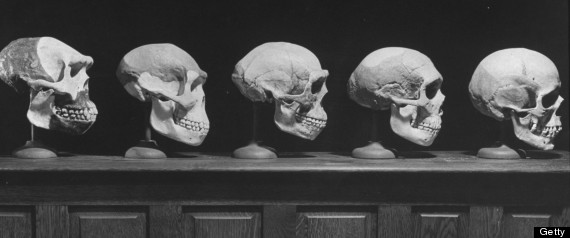
From Huffington Post, a new YouGov poll suggests that only 21% of Americans believe in the scientific model of evolution, meaning 79% believe that evolution (or creation) was guided by some type of god. This is actually an increase since 2004, when only 13% of Americans said that human beings evolved without god's guidance.

Yet 40% of those polled believe creationism and/or intelligent design should be taught in our schools and only 32% oppose bringing religion into the science classroom (28% are somehow unsure).

Evolution And God: Only 21% Of Americans Believe Humans Evolved Without Divine Guidance


The Huffington Post | By Yasmine Hafiz 
Posted: 07/23/2013 | Updated: 07/26/2013


Though the number of Americans who believe that human beings evolved without God's influence has increased since 2004, the percentage may still prove surprising to some.

According to a YouGov poll, only 21% of Americans believe that human beings evolved without the involvement of God, and 25% of those surveyed said, "Human beings evolved but God guided this process."

37% of respondents answered that "God created human beings in their present form," in response to the question "Which of the following comes closest to your views on the origin of human beings?"

The research shows a slow change in the national acceptance of evolution, as in 2004 only 13% of Americans said that human beings evolved without God's guidance.

However, the country remains divided on the issue of what to teach in schools, as 40% favor teaching creationism and intelligent design in schools while 32% oppose it and 29% are unsure.

June 21st marked the 88th anniversary of the Scopes Trial, when a Tennessee high school teacher, John Scopes, was tried in 1925 for teaching evolution. The practice was at that time illegal under the Butler Act, which made it unlawful to teach evolution in any state-funded school, but the trial attracted intense national attention and publicized the debate between religious "modernists" and "fundamentalists."

Scopes lost the trial, but it was a watershed moment for America, and teaching evolution in schools became the national norm. More recently the debate has been couched in the terms of the role of religion in the government, with many arguing that the teaching of creationism and intelligent design violates the separation of church and state.

Wednesday, May 15, 2013

Ken Robinson Explains How to Escape the Death Valley of American Education


From Open Culture, the collectors of cool on the internets, this is an excellent TED Talk by Sir Ken Robinson on the incredible dysfunction of the American, test-centric educational quagmire.

He is the author of The Element: How Finding Your Passion Changes Everything (2009), a New York Times bestseller, as well as his classic work on creativity and innovation, Out of Our Minds: Learning to be Creative (2011, 10th anniversary edition), and his latest book, Finding Your Element: How to Discover Your Talents and Passions and Transform Your Life, which will be published by Viking, May 21, 2013.

Ken Robinson Explains How to Escape the Death Valley of American Education


May 15th, 2013


Right now, you can find 1,520 TED Talks compiled into a neat online spreadsheet. That’s a lot of TED Talks. And the most popular one (in case you’re wondering) was delivered by Sir Ken Robinson in 2006. If you regularly visit our site, then chances are you’re among the 20 million people who have viewed Robinson’s talk on why Schools Kill Creativity. There’s also a good chance that you’ll want to watch his newly-released TED Talk, How to Escape Education’s Death Valley. Filmed just last month, this talk takes aim at America’s test-centric educational system, a system that increasingly treats education as an industrial process and bleeds creativity and curiosity out of our classrooms. You get that problem when you put technocrats and politicians, not teachers, in charge of things. And you’re only going to get more of it (sorry to say) as computer scientists start putting their stamp on America’s educational future.

Follow us on Facebook, Twitter and Google Plus and share intelligent media with your friends! They’ll thank you for it.
Robinson's TED bio:

Why you should listen to him:

Why don't we get the best out of people? Sir Ken Robinson argues that it's because we've been educated to become good workers, rather than creative thinkers. Students with restless minds and bodies -- far from being cultivated for their energy and curiosity -- are ignored or even stigmatized, with terrible consequences. "We are educating people out of their creativity," Robinson says. It's a message with deep resonance. Robinson's TEDTalk has been distributed widely around the Web since its release in June 2006. The most popular words framing blog posts on his talk? "Everyone should watch this."

A visionary cultural leader, Sir Ken led the British government's 1998 advisory committee on creative and cultural education, a massive inquiry into the significance of creativity in the educational system and the economy, and was knighted in 2003 for his achievements. His 2009 book, The Element: How Finding Your Passion Changes Everything, is a New York Times bestseller and has been translated into 21 languages. A 10th anniversary edition of his classic work on creativity and innovation, Out of Our Minds: Learning to be Creative, was published in 2011. His latest book, Finding Your Element: How to Discover Your Talents and Passions and Transform Your Life, will be published by Viking in May 2013.

"Ken's vision and expertise is sought by public and commercial organizations throughout the world."
~ BBC Radio 4

Quotes by Ken Robinson
“If you’re not prepared to be wrong, you’ll never come up with anything original.”