Showing posts with label Enlightenment. Show all posts

Thursday, July 31, 2014

Buddhist Geeks 330: Quantifying Mindfulness


Vince Horn speaks with neuroscientist David Vago and philosopher Jake Davis in part two of this two-part Buddhist Geeks Podcast. Part one is here. Good stuff.

BG 330: Quantifying Mindfulness
by Jake Davis


Podcast: Download

Episode Description:

Jake Davis is a philosopher and Buddhist practitioner and David Vago is a Contemplative neuroscientist. Together they are at the forefront of the scientific investigation of Enlightenment.

In this episode David and Jake conclude a conversation with host Vincent Horn concerning the scientific investigation of states of Enlightenment. They elaborate on the methods and motivations involved when attempting to quantify Enlightenment, discuss the pitfalls of spiritual materialism, and invite criticism and discussion to help inform and guide this scientific inquiry.

This is part two of a two part series.

Listen to part one – BG 329: A Neuroscience of Enlightenment.

Episode Links:


Jake Davis is a long-time practitioner. He spent time as a translator and monk in Burma, is currently focused on philosophical and cognitive science, and is specializing in philosophy of mind and ethics.

Website: Jake Davis – PhD

Wednesday, July 30, 2014

Buddhist Geeks 329: A Neuroscience of Enlightenment


Vince Horn speaks with neuroscientist David Vago in part one of this two-part Buddhist Geeks Podcast. Good stuff.

BG 329: A Neuroscience of Enlightenment

by David Vago


Podcast: Download

Episode Description:

David Vago is a contemplative neuroscientist and Jake Davis is a philosopher and Buddhist practitioner. Together they have authored an article proposing the question of whether Enlightenment can be traced to specific neural, cognitive, or behavioral correlates–and if so what those might be.

In this episode David and Jake join host Vincent Horn to discuss the article titled “Can enlightenment be traced to specific neural correlates, cognition, or behavior? No, and (a qualified) Yes”. Jake and David describe the genesis of the article, the conflict and opportunity provided by using the word “enlightenment” in the title, and the important role first person subjective experience plays in scientific inquiry.

This is part one of a two part series.

Episode Links:


Speaker Biography

David Vago is an instructor of psychology in the Functional Neuroimaging Laboratory (FNL), Brigham and Women’s Hospital, Harvard Medical School. He has completed a post-doctoral fellowship in the department of Psychiatry at BWH, the Utah Center for Mind-Body Interactions within the University of Utah Medical School, and is currently auditing the Stuart T. Hauser Research Training Program in Biological and Social Psychiatry. David has held the position of Senior Research Coordinator for the Mind & Life Institute, a non-for-profit organization dedicated to fostering dialogue and research at the highest possible level between modern science and the great living contemplative traditions. He received his Bachelors Degree in Brain and Cognitive Sciences in 1997 from the University of Rochester. In 2005, David received his Ph.D. in Cognitive and Neural Sciences with a specialization in learning and memory from the department of Psychology, University of Utah.

Website: www.ContemplativeNeurosciences.com

Thursday, September 05, 2013

The Dalai Lama - Stages of the Path to Enlightenment & An Overview of Tantra

Tibetan spiritual leader the Dalai Lama gestures as he gives a teaching at Tsuglakhang temple in McLeod Ganj, India, on 25 August 2013.

This is a 3-part series of lectures from the Dalai Lama on the Stages of the Path to Enlightenment and an Overview of Tantra, both of which are based on texts by Tsongkhapa (ce: 1357–1419). Tsongkhapa is one of the primary philosophers of Buddhist Mahāyāna, and there is a meta-Buddhist aspect to his teachings, as reflected in this section from the Stanford Encyclopedia of Philosophy:
Tsongkhapa's particular hermeneutics, the primary means he employs to lead readers to his philosophical insight, allows him to characterize particular, authentic, Buddhist philosophies as wrong (because they are wrong from a Prāsaṅgika perspective), yet right from the perspective of those particular systems. They are right because the philosophies have particular roles to play in a larger, grander scheme. This scheme is part of the larger philosophy of a perfect person whose views are in perfect accord (Sk. tathāgata) with the way things are, i.e., dependent origination, and whose statements are motivated solely by the benefit they have to those who hear them.

In this way, Tsongkhapa's hermeneutics lead to, or incorporate, a second principle, namely, bodhicitta (Sk.). The word bodhicitta has at least six different, but interrelated meanings in different contexts (Wangchuk 2007). In his philosophical works Tsongkhapa uses it to mean a universal, altruistic principle (not unlike the logos) that explains, primarily, the genesis of the Buddha's diverse statements, i.e., explains why a person with perfect intellect and powers of expression would make statements that seem to contain contradictions.

This principle plays a central role in Tsongkhapa's assertion that all authentic attainments, without distinction, are based on an authentic insight into emptiness (the seventh of the eight difficult points listed above), and it leads him to assert that the “origin” of the Mahāyāna is located in bodhicitta, and bodhicitta alone.
Anyway, apparently in the days and weeks leading up to this August event, there had been "serial bomb blasts in Bodhgaya and terrorists' threat to liberate Tibetan monasteries."
"As a result of new security measures, no outside electronic gadgets, including FM radios, will be allowed in the temple premises. We apologize for the inconvenience and ask for your understanding while we work out a new method for translation services for future teachings," it said. 
Dalai Lama will give teachings on Tsongkhapa's Concise Treatises on the stages of the path to enlightenment and an overview of Tantra from Tsongkhapa's stages of the path of Mantrayana at the request of a group of Koreans at Tsuglagkhang from August 25-27. His office said it would provide English translation for participants who can understand the language in a designated area.

Here is the promotion for the teachings:
His Holiness will give a two and a half-day teaching on Tsongkhapa’s Concise Treatises on the Stages of the Path to Enlightenment (lamrim dudon) and "An Overview of Tantra" from Tsongkhapa’s Stages of the Path of Mantrayana (ngakrim chenmo chishe) at the request of a group of Koreans at the Main Tibetan Temple.
Enjoy!

Day One:

Published on Aug 25, 2013

The first day of His Holiness the Dalai Lama's three day teaching on Tsongkhapa's "Concise Treatises on the Stages of the Path to Enlightenment" and An Overview of Tantra from Tsongkhapa's "Stages of the Path of Mantrayana" at the request of a group of Koreans at the Main Tibetan Temple in Dharamsala, India on August 25-27, 2013. His Holinesss speaks in Tibetan followed by an English translation.

Day Two:

Published on Aug 27, 2013

The second day of His Holiness the Dalai Lama's three day teaching on Tsongkhapa's "Concise Treatises on the Stages of the Path to Enlightenment" and An Overview of Tantra from Tsongkhapa's "Stages of the Path of Mantrayana" at the request of a group of Koreans at the Main Tibetan Temple in Dharamsala, India on August 25-27, 2013. His Holinesss speaks in Tibetan followed by an English translation.

Day Three:

Published on Aug 28, 2013

The third day of His Holiness the Dalai Lama's three day teaching on Tsongkhapa's "Concise Treatises on the Stages of the Path to Enlightenment" and An Overview of Tantra from Tsongkhapa's "Stages of the Path of Mantrayana" at the request of a group of Koreans at the Main Tibetan Temple in Dharamsala, India on August 25-27, 2013. His Holinesss speaks in Tibetan followed by an English translation.

Monday, July 29, 2013

The Wright Show - Robert Wright and Shinzen Young: Meditation as Pumping Iron . . .


On this week's episode of The Wright Show, Robert Wright speaks with Buddhist author and teacher Shinzen Young about meditation as pumping iron, synthesizing Buddhism and Western science, technologically-enhanced enlightenment, and a whole lot more. Cool conversation between two interesting scholars.

Wright is the author of several excellent books, including The Evolution of God (2010), Nonzero: The Logic of Human Destiny (2001), and The Moral Animal: Why We Are, the Way We Are: The New Science of Evolutionary Psychology (1995).

Shinzen Young has recorded a lot of his teachings through Sounds True, including Break Through Difficult Emotions: How to Transform Painful Feelings with Mindfulness Meditation, Working with Thoughts, and The Science of Enlightenment: Teachings and Meditations for Awakening Through Self-Investigation (CEUs available for this course).

The Wright Show

Jul 28, 2013 | Robert Wright & Shinzen Young


FOLLOW:  
Recorded: Jul 25 Posted: Jul 28, 2013
Download: wmv | mp4 | mp3 | fast mp3

LINKS MENTIONED

What is Equanimity? (PDF)
Shinzen's website

Friday, December 07, 2012

Henrik Juel - Social Media and the Dialectic of Enlightenment


This intriguing article comes from Triple C (cognition, communication, co-operation), an open access journal for a global sustainable information society - Vol 10, No 2 (2012).

Henrik Juel 

Abstract 

My reflections in this paper concern revitalizing the critical potential of certain core concepts of Max Horkheimer and Theodor W. Adorno's Dialectic of Enlightenment (first published 1944) and bringing it to bear on the digital era in general and in particular on the phenomenon of modern social media. I find that the central philosophical critique of Dialectic of Enlightenment runs deeper than just a critique of contemporary (and perhaps now out-dated) media technique and cultural habits. It is a critical view of the process of civilization, economy and enlightenment as such, a critical view of the seemingly self-evident notion of pure reason, science and technology. What Horkheimer and Adorno are trying to capture and reflect is the very process of rationality backlashing into irrationality. We seem to have reached the era of mathematics and exact calculation, but this leaves us with no sense of control or meaningfulness, and in the face of crisis and systemic contradictions in the now global society we tend to regress and rely on older, more primitive forms of sense-making and coping: magic, mythology and metaphysics - even ritual behaviour. But these philosophical reflections, can they help us evaluate the role of today's social media?

Full Text: PDF

Here is a brief excerpt from the article:
For me as a young student of philosophy even that strange notion of dialectic began to make some sense, once I got well into the book and the worst of the Hegelian fog lifted. Thus while it was invigorating and enlightening, I also felt the dialectic of it and I found its account of history, civilization, and rationality to be both quite captivating and disturbing. And certainly it was a very, very critical philosophy. So what would happen if I tried to let the critical theory of that book meet with the phenomenon of modern social media?

On the face of it that did not seem likely to turn out as a peaceful encounter. It is well known that The Dialectic of Enlightenment features a very pessimistic and condemning section devoted to "The Culture Industry". Horkheimer and Adorno wrote the book during the Second World War while they were refugees in America (the first version appeared in 1944), and they seem to have been rather disappointed or even shocked in meeting there the pop-culture and mass media of the day. To them the magazines, the cinema, the radio shows, the emerging TV-shows, and even the jazz music, seemed to be in the poorest of taste; stupefying in its effect; a prolongation of the production rhythm of the industry; and certainly not enlightenment. Some have objected that on the other hand they were simply displaying their elitist taste, favouring high art, the avant-garde and the obscure notion of authenticity. But as I see it, simplifying this to be a question of taste or of different modes of reception within different consumer groups would be to seriously reduce the scope of the problems they were trying to address.

Tuesday, July 24, 2012

Russ Volckmann & Jeff Klein - Understanding Conscious Capitalism

This is a preview audio of a discussion that will featured in the October issue of Integral Leadership Review. The ILR is one of the sponsors of The Enlightenment Conference, a 3-week online shin-dig of Big Thinkers and wanna-be big thinkers, mostly from the integral world - or as they bill it, "A Virtual Gathering to Birth a New Conscious Culture." The whole thing is a modest $95.

Please note - I do not necessarily endorse this conference, nor do I get compensation for posting this in any way. However, I do endorse Russ Volckmann. If he says Jeff Klein is an important voice, I believe him, so I'm sharing this here.

Jeff Klein
Russ Volckmann 
It may seem that 'Conscious Capitalism' is a contradiction in terms. But in this dialogue, Russ Volckmann, editor of Integral Leadership Review, gets the low-down from Jeff Klein on what capitalism and business looks like when created from a conscious intention.

Jeff is a businessman and author who has been heavily involved in the Conscious Capitalism movement, and he brings his full weight to bear on this inspiring and integrative new approach to commerce and collaborating.

In this Dialogue Jeff and Russ Discuss...
  • The meaning of "conscious capitalism".
  • The role conscious capitalism plays in the evolution of culture.
  • Four defining elements of a business that is practicing conscious capitalism.
  • The relationship between conscious business and community, and a positive vision for the future.

About Jeff and Russ
 
Jeff Klein, CEO of Working for Good, activates, produces and facilitates mission-based, Stakeholder Engagement Marketing™ campaigns and Conscious Culture development programs. Jeff is a trustee and member of the Executive Committee of Conscious Capitalism, Inc. and co-produces the Annual Conscious Capitalism CEO Summit. He authored the award-winning book, Working for Good: Making a Difference While Making a Living, to support conscious entrepreneurs, intrapreneurs, leaders and change agents at work and hosts a weekly radio program called It’s Just Good Business, in which he engages in conversation with pioneering CEOs and though leaders in the Conscious Capitalism Movement. He also serves as Executive Director of Being Human.org a project of the Baumann Foundation, and is producing Being Human 2012, in San Francisco, March 24, 2012. In collaboration with the VP of Marketing and management team of O.N.E. Coconut Water, Jeff is activating the Liquid Revolution.

Russ Volckmann, Ph.D., has worked for over thirty years as an organization development consultant and executive coach. He is the publisher and editor of The Integral Leadership Review and LeadingDigest and the founder of Integral Publishers. As an educator he has taught at U.C., Berkeley; the University of Arizona; the United States Army Intelligence School at Ft. Juachuca, Arizona; Sonoma State University; Golden Gate University; John F. Kennedy University; Leadership University; and the Institute for Transpersonal Psychology. He has authored two books and is currently working on his third with co-author Brett Thomas on the topic of Integral Leadership.


Want More Dialogues Like This? Join our Mailing List
This talk is part of a series of free dialogues exploring the wide reaching nature of Enlightenment and how we as a movement can create new Conscious Culture.

If you would like more free talks like this, then click the button on the right and join our mailing list.

We'll keep you up to date with everything that's happening, and we'll also let you know as soon as registration opens for the full Enlightenment Conference on July 27th!

Downloads

You may need to right-click the following links and select "Save Link As" to download the file to your computer.

Wednesday, February 01, 2012

Kenneth Folk - Enlightenment for the Rest of Us


Enlightenment for the Rest of Us


This video is from last year's Buddhist Geeks conference - Kenneth Folk talks here about enlightenment (or its pursuit) by people who have lives and families. You can read the transcript at the site if you's prefer not to watch/listen.

Enlightenment for the Rest of Us


The following video took place at the Buddhist Geeks Conference in 2011, and was part of a series of live talks, each 20 minutes in length.

Talk Description: Drawing from Buddhism, neuroscience, and personal experience, Kenneth Folk explains that enlightenment is a natural aspect of human development that is available to everyone.


Tuesday, December 27, 2011

Upaya Dharma Podcasts - Rohatsu Sesshin: Exploring the Heart Sutra


Yesterday morning I posted the podcasts from the Thanksgiving retreat at Upaya on the Heart Sutra. This six-part Rohatsu Sesshin (in honor of the enlightenment of the Buddha) explores even deeper into the Heart Sutra - a nice series of talks.

Rohatsu Annual Retreat 2011: All 6 Parts


The 6 part series  Rohatsu Sesshin: Exploring the Heart Sutra is now published. You can access the desired part of the series by clicking on its link below.

Beate Stolte & Enkyo O'Hara & Joan Halifax: 12-01-2011: Rohatsu Sesshin: Exploring the Heart Sutra (Part 1 of 6)

Recorded: Thursday Dec 1, 2011

Series Summary Description:
Rohatsu Sesshin marks the enlightenment of the Buddha. It is a powerful gathering of practitioners and friends who are dedicated to realizing the way. Roshis Joan Halifax and Enkyo O’Hara, and Senseis Kaz Tanahashi and Beate Stolte explore the enlightenment of the Buddha, the story and its meaning in our lives today, during this powerful annual retreat.

Roshi Joan Halifax is Co-abbot of Upaya Zen Center with Sensei Beate Stolte. Roshi Enkyo O’Hara is Abbot of Village Zendo, and Sensei Kaz Tanahashi is a Dogen Scholar.

Play
Podcast: Play in new window | Download

Saturday, December 10, 2011

Monday, December 05, 2011

Adyashanti: The Inner Revolution of Spiritual Awakening

Another nice talk from the Science and Nonduality Conference hosted by FORA.tv, except that this is a flashback to the 2010 keynote by Adyashanti.


Adyashanti: The Inner Revolution of Spiritual Awakening from Science and Nonduality on FORA.tv


Adyashanti: The Inner Revolution of Spiritual Awakening

Adyashanti dares all seekers of peace and freedom to take the possibility of liberation in this life seriously. He began teaching in 1996, at the request of his Zen teacher with whom he had been studying for 14 years. Since then many spiritual seekers have awakened to their true nature while spending time with Adyashanti.

The author of The End of Your World, Emptiness Dancing, and True Meditation, Adyashanti offers spontaneous and direct nondual teachings that have been compared to those of the early Zen masters and Advaita Vedanta sages. However, Adya says, "If you filter my words through any tradition or-ism, you will miss altogether what I am saying. The liberating truth is not static; it is alive. It cannot be put into concepts and be understood by the mind. The truth lies beyond all forms of conceptual fundamentalism. What you are is the beyond -- awake and present, here and now already. I am simply helping you to realize that."

Monday, October 24, 2011

Upaya Dharma Podcasts - Stephen Batchelor: 10-19-11: Truth And Violence

A lot of Buddhists seriously dislike Stephen Batchelor, but I am not one of those people. His perspective on Buddhist philosophy and psychology is a lot more 21st century than some people are comfortable with - in fact, I suspect he and Sam Harris would get along quite well.

Upaya Zen Center

Stephen Batchelor: 10-19-11: Truth And Violence

Speaker: Stephen Batchelor
Recorded: Wednesday Oct 19, 2011

Stephen Batchelor critiques the popular conceptions of the Buddha’s enlightenment and the four noble truths. He proposes that the “truths” may not be truths at all, but are tasks we undergo on the path to awakening. Additionally, he describes the relationship between the belief in truths and violence.

Stephen Batchelor is a British author, teacher, and scholar, writing books and articles on Buddhist topics and leading meditation retreats throughout the world. He is a noted proponent of agnostic or secular Buddhism. A former Tibetan and Zen monk, Stephen disrobed in 1985 and married fellow practitioner Martine Fages. Stephen and Martine now live in Aquitaine, France.

Sunday, October 23, 2011

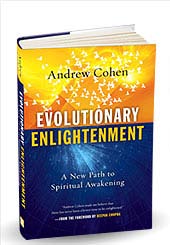
Two Views on Andrew Cohen's "Evolutionary Enlightenment" - Marilyn Hamilton vs. John Landon

Marilyn Hamilton is well-known in integral circles for her excellent book, Integral City: Evolutionary Intelligences for the Human Hive. John Landon, as far as I know, is completely unknown and has nothing to do with integral theory. He is the author of World History And The Eonic Effect - in fact, I suspect he could dismantle Ken Wilber's conjecture on evolution better than most of the integral critics.

Anyway, they both have reviewed Andrew Cohen's new book, Evolutionary Enlightenment: A New Path to Spiritual. Needless to say, they each have very different perspectives on the book - and I am not against the idea that each is partially true.

Evolutionary Enlightenment: 5 Tenets for the Human Hive

October 23, 2011 by Marilyn Hamilton


Evolutionary Enlightenment, by Andrew Cohen is a refreshingly enlivening read that aligns well with the Evolutionary Intelligences of Integral City.


Cohen, starts with the traditional path of enlightenment as the starting place for practitioners to achieve a deep knowing of the evolutionary experience of the “Big Bang”. His description of this as not only a scientific proposition, but a spiritual reality, underlies a deep and abiding recognition that all Life started as ONE. That as living systems, humans – both in their manifest form and their inner consciousness – arose from a singularity. As Cohen, reiterates, “something came from nothing”. This is both the greatest discovery and the greatest mystery of our 14 billion year old universe.


And yet, in his own path as a spiritual teacher, Cohen has come to the conclusion, that as profound as the traditional experience and teaching of enlightenment is, it is not the end of the story. For the impulse to evolve that sparked the journey of emergence in the universe, is still alive and emerging. In fact it is alive and emerging as humans. We are not only human ”beings” but we are human ”becomings”, and as such humans represent the evolutionary impulse’s leading edge (at least on this planet).


Cohen, conveys his deep inspiration and commitment to all that this evolutionary impulse demands. In fact, he proposes that as we realize the implications of our relationship with the evolutionary impulse, we are obligated to grow up from our egocentric, ethnocentric and even worldcentric preoccupations and mature into a cosmocentric collaboration with it.
Read the whole review.

The muddle over evolution

September 28, 2011
By John C. Landon


The idea of evolution suffers from a certain incoherence due to the multiple almost predatory efforts to close in and control the idea for a certain agenda. The social Darwinist and economic ideologies claiming Darwinism are apparent from the study of cultural history. Beginning in the nineteenth century with Blavatsky, and a critique of Darwin, a new version of the attempt to control the evolutionary concept took off at the beginnings of the modern New Age movement. The figure Gurdjieff, in a rival but parallel equivalent, also adopted an unstated and crypto-social-darwinist version of the idea, not entirely distant (though not the same as) Nietzsche's take on the idea. The occulted aspect of this genocidal and fascist legacy is hard to untangle. Cohen's interpretation seems to resemble this second tradition in a deliberated innocence of the interpretation, but stating nothing about the complex and dangerous background to the muddle of evolutionary thought.


The usage of Cohen (which resembles various strains of 'conscious evolution' in several New Age figures, e.g. Barbara Hubbard) is as false as what it replaces, and leaves the reader somewhat nervous about what is omitted. We need more than New Age platitudes given the dark legacy of 'evolutionary enlightenment', e.g. the mass murder envisioned by the Nietschean on the way to the 'overman'. Nietzsche, as we can see, was hopelessly confused by Darwin, even in his critique of that figure. The idea of evolution has thus become almost schizophrenically muddled from different sides. The idea of 'spiritual evolution' is not necessarily a false one, but the attempt to make it into some kind of adjunct to spiritual practice, indeed, as here, the path of enlightenment,confuses the whole idea. The fact of evolution is visible in deep time in the progression of fossil forms. The dynamic behind this remains elusive and still unknown to us. The issue is not 'spiritual evolution', but the evolution, as Alfred Wallace sensed it, of the human potential to self-realization, in the complex instrument of consciousness that emerged with homo sapiens. The potential to 'enlightenment' so-called clearly became a difficult but marginally realizable possibility for this new 'chimpanzee' (the third, pace, Jared Diamond) who arises in the wake of homo erectus. Understanding this moment of organismic transformation (which looks awfully like the 'spiritual evolution' Cohen is striving to understand) is simply beyond our science, and beyond our New Age gurus. The dynamics of that potential and the 'how' of its evolution remain unknown to us. But to posit some 'evolutionary impulse' behind this is simply metaphysical speculation on Cohen's part.


Another line of analysis lies with J. G. Bennett's depiction in Vol 4 of The Dramatic Universe, where he distinguishes 'animal consciousness' and the 'cosmic' factor of universal conscious energy, the lowest energy in a larger framework. That speculative matrix is entirely up in the air, but it suggests a cogent solution to the riddle: consciousness doesn't evolve at all, rather, man evolved to the point where he experience a a new form of consciousness, the groundstate of a trans-natural cosmic energy. This consciouusness (which yogic treatises call self-consciousness) is built into the evolutionary emergence of homo sapiens. This is admittedly as speculative as the rest of it (I am not as such in agreement with Bennett), but Bennett suggests a number of clues to what is really a HARD problem, in the phrasing of the scientific psychologists studying consciousness: understanding how consciousness evolved, and its relationship to the different, but essential vital energies of 'life consciousness'. More generally the 'evolution' of man is a 'becoming into material realms', while the potential to endlightenment is a countermovement against evolution into enlightenment, liberation. Enlightenment is not the same as a higher state of consciousness.
Read the whole review.

Sunday, October 09, 2011

Buddhist Geeks Conference 2011: Towards a Science of Enlightenment w/ Shinzen Young

I really wish I could have been at this conference.

BG Conference 2011: Towards a Science of Enlightenment

BG Conference 2011: Towards a Science of Enlightenment

The following video took place at the Buddhist Geeks Conference in 2011, and was the opening Keynote of the event, delivered by Shinzen Young.
Talk Description: How the cross-fertilization of Classical Enlightenment and the Modern Mind could radically alter the course of human history.


Download Link

Thursday, October 06, 2011

Natural Enlightenment a Conversation with Peter Baumann

In this video from the Science and Nonduality Conference, Tami Simon (of Sounds True) interviews Peter Baumann, author of Ego: The Fall of the Twin Towers and the Rise of an Enlightened Humanity.

Natural Enlightenment a Conversation with Peter Baumann

A conversation on "Natural Enlightenment" with Peter Baumann (author of the new book "Ego") and Tami Simon (founder of Sounds True).


Tuesday, July 12, 2011

Buddhist Geeks 224: The Study of Non-Symbolic Consciousness (Jeffery Martin)

I saw Jeffrey Martin at the Toward a Science of Consciousness conference here in Tucson in 2010 - I blogged about it here. I like his effort to figure out exactly what people mean when they say they are enlightened or have attained non-dual consciousness (he prefers non-symbolic). If I remember correctly, he is trying to determine some form of objective criteria.

Buddhist G 224: The Study of Non-Symbolic Consciousness

BG 224: The Study of Non-Symbolic Consciousness

11. Jul, 2011 by Jeffery Martin


Download

Episode Description


We’re joined by Harvard trained social scientist Dr. Jeffery Martin to discuss some of the incredible research that he’s doing into the further reaches of human potential. He speaks about his initial research, done during his first PhD program, wherein he extensively studied the self-help and positive psychology literature. He explains how this research led him to see that where the further reaches of that literature–and the practices therein–left off was where non-symbolic consciousness begins. Jeffery then goes on to describe the extensive research that he’s done, while completing his PhD at Harvard, on the nature of awakened, or non-dual consciousness.

This is part 1 of a two-part series. Listen to part 2 [airing next week].

Episode Links:

Transcript:

Transcript coming soon…

Jeffery Martin is a Harvard trained social scientist who researches personal transformation. He specializes in bringing rigorous empirical research and testing to transformational techniques and theories that have previously been supported anecdotally. Jeffery is a leading expert on intentionality and non-symbolic consciousness. He holds graduate degrees in information technology, management, and transformative studies and has co-edited, authored, or co-authored over 20 books and numerous other publications; appeared in a wide variety of electronic media; and lectured widely in both academic and public forums. Jeffery is currently the director of the Center for the Study of Non-Symbolic Consciousness, and the Center for the Study of Intent. Portions of his research on power of thought and non-symbolic consciousness are also available in the popular fiction book, The Fourth Awakening.

Tuesday, January 11, 2011

The Path - Pema Sonam Tso

I found this cool little video over at Full Contact Enlightenment. Tanya McGinnity offered this summary:

This imagery “represents an aspiring meditator, who is following the path consisting of the stages of meditation that ends in the accomplishment of a calmly abiding mind and the beginning of the practice of insight meditation.”


Friday, November 05, 2010

Buddhist Geeks 193: The Lazy Path to Enlightenment (Glenn Mullin)

Passing along another good discussion on Buddhist Geeks.

Buddhist Geeks #193: The Lazy Path to Enlightenment

BG 193: The Lazy Path to Enlightenment

01. Nov, 2010 by Glenn Mullin

Episode Description:

We’re joined this week by author, teacher, and Tibetologist Glenn Mullin. During our conversation with Glenn we focus primarily on a system of teachings in the Tantric tradition called The Six Yogas of Naropa. He speaks about each aspect of the practice—including such practices as sexual yoga, dream yoga, and bardo yoga—and also explains why he thinks the 6 yogas are a perfect compliment for the modern lifestyle.

Episode Links:

Transcript


Friday, August 06, 2010

On the instantaneous enlightenment through recognition of the nature of the mind

Today's Dharma Quote from Snow Lion Publications . . . .


THE BUDDHA FROM DOLPO
A Study of the Life and Thought
of the Tibetan Master
Dolpopa Sherab Gyaltsen

by Cyrus Stearns
a Tsadra Foundation Series book

more...

Dharma Quote of the Week

The Tibetan controversies about instantaneous enlightenment through recognition of the nature of the mind have been studied by David Jackson. As he shows, it is mainly members of the Kagyu traditions in Tibet who have maintained this doctrine, although it is certainly common in Chinese Ch'an Buddhism and in the teachings of the Great Perfection in Tibet. Dolpopa quotes the position that is the object of his refutation: "Recognizing the very essence naturally purifies them, without rejection." This expresses the view that through recognition of the essence of the thoughts as the dharmakaya they are purified or dissolved into the dharmakaya, and also the idea that any affliction that arises is actually a manifestation or self-presencing of primordial awareness itself. Thus there is no need to reject thoughts or afflictions, which are naturally purified by means of the recognition. This type of viewpoint is widespread in Tibetan Buddhism.

In contrast to these views, Dolpopa claims that the definition of an ordinary sentient being or a buddha, and of samsara or nirvana, is determined by the presence or absence of the incidental and temporary obscurations that veil the true nature of reality. It is not determined solely by recognition of the nature of the mind or the thoughts.

...While the ground buddhahood of the dharmakaya and the resultant buddhahood of the dharmakaya have not the slightest difference in essence, they are distinguished as ground and result by means of the presence or absence of incidental stains.

--from The Buddha from Dolpo: A Study of the Life and Thought of the Tibetan Master Dolpopa Sherab Gyaltsen by Cyrus Stearns; a Tsadra Foundation Series book, published by Snow Lion Publications

The Buddha from Dolpo • Now at 5O% off
(Good until August 13th).

Discover great articles, new releases and dharma news
in the latest edition of
Snow Lion: The Buddhist Magazine and Catalog


Sunday, July 18, 2010

Change Surfer Radio - Mindfulness, Acid & Neuropolitics: B Alan Wallace

Very cool - nice listening for a Sunday morning. A wide ranging talk with prominent Buddhist teacher and author, B Alan Wallace.

Mindfulness, Acid & Neuropolitics


Alan Wallace of the Shamatha Project
Changesurfer Radio

Posted: Jul 17, 2010


What are we finding about the effects of meditation on the brain? Can software save us from digital distractions? Are psychdelics helpful on the road to Enlightenment? Is our innate empathic response to others’ pain suppressed by racism, classism and capitalist hyperindividualism? MP3

Thursday, July 08, 2010

Elephant Journal - Growing Up vs. Waking Up: Why Psychology and Buddhism Are Complementary

Check out my newest entry over at Elephant Journal and tell me what you think in the comments there.

Growing Up vs. Waking Up: Why Psychology and Buddhism Are Complementary

This is essentially a posting of Vince Horn's conversation with Dr. John Welwood at Buddhist Geeks - an excellent episode for anyone interested in the intersection of Buddhism and psychology. I want to hear what others think about Welwood's perspective.