Showing posts with label Buddha. Show all posts

Monday, August 17, 2015

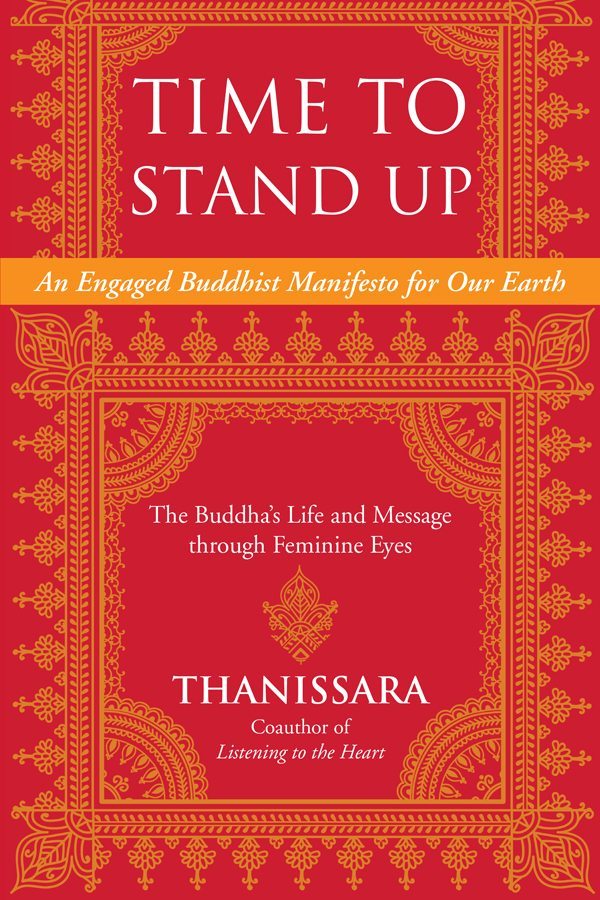
Thanissara - Time to Stand Up: An Engaged Buddhist Manifesto for Our Earth (A Review)

https://www.northatlanticbooks.com/wp-content/uploads/2015/08/TimeToStandUp_cover.jpg

Thanissara - Time to Stand Up: An Engaged Buddhist Manifesto for Our Earth -- The Buddha's Life and Message through Feminine Eyes

(To be published on August 18, 2015 - Pre-order at the Amazon link above for $7.47)

About the Author
Thanissara and her husband Kittisaro (Harry Randolph Weinberg) are the founders of Dharmagiri Hermitage in South Africa, from where they support several HIV/AIDS Outreach Programs and help guide and fund-raise for Kulungile Care Center for orphaned and vulnerable children and teenagers.  Thanisarra and Kittisaro are authors of Listening to the Heart: A Contemplative Journey to Engaged Buddhism (2014).

Thanissara grew up in an extended Anglo-Irish family in London, attending Southampton College of Art and traveling extensively in Asia in the 1970s. Also inspired by Ajahn Chah, she spent 12 years as a Buddhist nun in Thailand. She holds an MA in Mindfulness-Based Psychotherapy Practice from Middlesex University and the Karuna Institute in the U.K. and co-facilitates the Community Dharma Leader Program at Spirit Rock Meditation Center in California.
[NOTE: This book was sent to me by the publisher (free) with the hope that I would review it, favorably. I never make any promises in that regard. When I do review a book sent to me, it's because I think it is a good book.]

The life of the Buddha has been told so many times by so many people, and in so many different ways, from mythic and magical versions to a very secular version (from Stephen Batchelor), but never has it been told in the context of environmental change and from a feminine perspective.

In the Buddha's time, women were included among his followers and students, but in the following centuries, women were often excluded from those schools erected to perpetuate the Buddha's teachings.

From the Introduction:
This is a book I would have preferred not to write. I would have liked to write something lighter, happier, and more innocent. I would have liked to walk you through a serene wooded landscape, but instead I ask you to look with me at a burnt and tortured Earth and its polluted rivers, dying oceans, razed forests, devastated wastelands, and its litany of extinct species.
This is a book about awakening to the reality of the planet we live on, the pain, the suffering, the devastation, and not blinking, not looking away, not putting it off for the next generation to deal with. It is a book about reality.
The journey of awakening is not an incense-scented walk through a bed of roses--it wasn't for the Buddha, and it's not for us. It's a demanding look at reality. The reality we now face is climate chaos and devastation, an edge that is increasingly hard to move back from. (p. 45)
Buddhism has long had a reputation of being little more than navel gazing. Perhaps that has been fair, perhaps it has not been fully accurate. After all, the Bodhisattva Vow promises to save all beings.
Beings are numberless, I vow to save them
Desires are inexhaustible, I vow to end them
Dharma gates are boundless, I vow to enter them
Buddha's way is unsurpassable, I vow to become it.
In our time, we know that animals are also sentient beings, however great or small. For this reason, most Buddhists are vegetarian. In Seven Years in Tibet, we see Tibetan Buddhist Monks breaking ground for a building and they worry about harming the worms. They too are beings.

An engaged Buddhist approach to saving our planet may rightfully claim that vegetarianism is a necessary part of that agenda. Approximately 36 football fields worth of forest is cut down every minute, and we have lost 17% of the Amazonian Rainforest over the last 50 years, primarily to convert the land to cattle farming.

The meat industry, according to a 2006 report by the United Nations Food and Agriculture Organization (FAO), causes more greenhouse gases - carbon dioxide (CO2), methane, nitrous oxide, and the like - to spew into the atmosphere than either transportation or industry. According to the Environmental Protection Agency (EPA),
livestock burping, flatulence and manure was the source of more than 13 million tons of methane gas in 2004, compared with the EPA’s estimate of 9.7 million tons, according to a study published last month in the Journal of Geophysical Research: Atmospheres

SCIMACHY measurements showed oil and gas industries released 7 million tons of methane gas into the atmosphere, compared to the EPA’s estimate of 9.9 million tons.
Methane gas is the second most common gas that is associated with global warming, after CO2.

Not only does the meat industry destroy our environment but, as mentioned above, animals are sentient creatures. Buddhists vow to cause no suffering and, in fact, to alleviate suffering as much as we are able.
The most painful, the very worst of our madness, is the utterly sadistic and callous treatment of billions of animals and sea creatures caught in our consumer machinery. Animals are sentient, feeling beings with family structures, intelligence, emotions, memories, and needs, just like us. (p. 122)
I eat meat. I have struggle from time to time with this practice, but I have rationalized it in light of humans being omnivores. I have also rationalized it in terms of my protein needs as an active male who lifts weights seriously and often. I have tried to switch to grass-fed, organically raised, and locally sourced meat, in an effort to limit the damage my diet produces.

However, having read this book, and in light of who I feel I am becoming in my life, I am seriously questioning my lifestyle. Meat is a lifestyle choice, since there are many ways to get adequate protein without eating meat.

But, then, do I give up cottage cheese, Greek yogurt, eggs, and whey protein? Do I stop consuming all products sourced from animals? This is a much harder choice, but maybe it is the only moral choice.

To be fair, this is a First World problem, in as much as so many others in this world barely get enough food, let alone protein, to survive. It's easy to be blind to our own privilege. 
As practitioners and Sanghas following the great inclusiveness at the heart of the Buddha's Sangha, we must understand, particularly in the U.S. and Europe, how our colonial histories have set the stage for white privilege and class entitlement to permeate our communities and permit us to develop many blind spots. In making the invisible, visible, we can learn how we subtly perpetuate a dynamic that excludes or diminishes participation of people of color and those who are economically marginalized. (p. 156)
Thanisarra outlines four domains in which we must work together as one people to save our planet: (1) Keep carbon in the ground, (2) Sequester the remaining carbon in favor of alternative energy sources, (3) Massive investment in and education about renewable energy sources, and (4) Move toward a plant-based diet (p. 158-159).
We now need a collaborative global movement on a scale never before seen in the history of humankind to ensure these outcomes. We are not only advocating climate action, but also recognizing that this is the moment to actualize a truly more equitable and just society. ... The intensity of our times invites us to shift our way of thinking, the choices we make as "consumers," and the awareness we bring to each part of our personal lives. 
___

The Buddhist way isn't to tell people what they should do, but to lead by example. (p. 159)
This is a book that forced me to look at my choices, and quite possibly to make profound changes in my life. Perhaps it will do the same for you.

About the Book (from the publisher)

Time to Stand Up retells the story of the historical Buddha, one of the greatest sacred activists of all time, as a practical human being whose teachings of freedom from suffering are more relevant than ever in this time of global peril. Evolving onward from the patriarchal template of spiritual warriors and their quests, former nun Thanissara explores awakening from within a feminine view where the archetypes of lover and nurturer are placed as central and essential for a sustainable world.

Vital is an investigation into the pinnacle of Buddhist practice, the realization of the "liberated heart." Thanissara questions the narrative of "transcendence" and invites us into the lived reality of our deepest heart as it guides our journey of healing, reclamation, and redemption. As the book unfolds, the author examines traditional Buddhism--often fraught with gender discrimination--and asks the important question, "Can Buddhist schools, overly attached to hierarchal power structures, and often divorced from the radical and free inquiry exemplified by the Buddha, truly offer the ground for maturing awakening without undertaking a fundamental review of their own shadows?"

Chapter by chapter, the book relates Siddhartha Gautama's awakening to the sea-change occurring on Earth in present time as we as a civilization become aware of the ethical bankruptcy of the nuclear and fossil fuel industry and the psychopathic corporate and military abuse of power currently terrorizing our planet. Thanissara relates the Buddha's story to real-life individuals who are living through these transitional times, such as Iraq war veterans, First Nation People, and the Dalai Lama. Time to Stand Up gives examples of the Buddha's activism, such as challenging a racist caste system and violence against animals, stopping war, transforming a serial killer, and laying down a nonhierarchical structure of community governance, actions that would seem radical even today.

Thanissara explores ways forward, deepening our understanding of meditation and mindfulness, probing its use to pacify ourselves as the cogs in the corporate world by helping people be more functional in a dysfunctional systems--and shows how these core Buddhist practices can inspire a wake-up call for action for our sick and suffering planet Earth.
This book is part of the Scared Activism series from North Atlantic Books.

Tuesday, September 10, 2013

Pico Iyer - The Value of Suffering (New York Times)

Wonderful article by Pico Iyer in Saturday's New York Times. Iyer is a friend of the Dalai Lama and one of the better known Buddhist authors (who also writes about non-Buddhist topics, mostly travel) in the West. He is the author, most recently, of The Man Within My Head (2013), as well as Falling Off the Map: Some Lonely Places of The World (1994) and Sun After Dark: Flights Into the Foreign (2005), among many other books.

The Value of Suffering

By PICO IYER
Published: September 7, 2013


Daehyun Kim

NARA, Japan — Hundreds of Syrians are apparently killed by chemical weapons, and the attempt to protect others from that fate threatens to kill many more. A child perishes with her mother in a tornado in Oklahoma, the month after an 8-year-old is slain by a bomb in Boston. Runaway trains claim dozens of lives in otherwise placid Canada and Spain. At least 46 people are killed in a string of coordinated bombings aimed at an ice cream shop, bus station and famous restaurant in Baghdad. Does the torrent of suffering ever abate — and can one possibly find any point in suffering?

Wise men in every tradition tell us that suffering brings clarity, illumination; for the Buddha, suffering is the first rule of life, and insofar as some of it arises from our own wrongheadedness — our cherishing of self — we have the cure for it within. Thus in certain cases, suffering may be an effect, as well as a cause, of taking ourselves too seriously. I once met a Zen-trained painter in Japan, in his 90s, who told me that suffering is a privilege, it moves us toward thinking about essential things and shakes us out of shortsighted complacency; when he was a boy, he said, it was believed you should pay for suffering, it proves such a hidden blessing.

Yet none of that begins to apply to a child gassed to death (or born with AIDS or hit by a “limited strike”). Philosophy cannot cure a toothache, and the person who starts going on about its long-term benefits may induce a headache, too. Anyone who’s been close to a loved one suffering from depression knows that the vicious cycle behind her condition means that, by definition, she can’t hear the logic or reassurances we extend to her; if she could, she wouldn’t be suffering from depression.

Occasionally, it’s true, I’ll meet someone — call him myself — who makes the same mistake again and again, heedless of what friends and sense tell him, unable even to listen to himself. Then he crashes his car, or suffers a heart attack, and suddenly calamity works on him like an alarm clock; by packing a punch that no gentler means can summon, suffering breaks him open and moves him to change his ways.

Occasionally, too, I’ll see that suffering can be in the eye of the beholder, our ignorant projection. The quadriplegic asks you not to extend sympathy to her; she’s happy, even if her form of pain is more visible than yours. The man on the street in Calcutta, India, or Port-au-Prince, Haiti, overturns all our simple notions about the relation of terrible conditions to cheerfulness and energy and asks whether we haven’t just brought our ideas of poverty with us.

But does that change all the many times when suffering leaves us with no seeming benefit at all, and only a resentment of those who tell us to look on the bright side and count our blessings and recall that time heals all wounds (when we know it doesn’t)? None of us expects life to be easy; Job merely wants an explanation for his constant unease. To live, as Nietzsche (and Roberta Flack) had it, is to suffer; to survive is to make sense of the suffering.

That’s why survival is never guaranteed.

OR put it as Kobayashi Issa, a haiku master in the 18th century, did: “This world of dew is a world of dew,” he wrote in a short poem. “And yet, and yet. ...” Known for his words of constant affirmation, Issa had seen his mother die when he was 2, his first son die, his father contract typhoid fever, his next son and a beloved daughter die.

He knew that suffering was a fact of life, he might have been saying in his short verse; he knew that impermanence is our home and loss the law of the world. But how could he not wish, when his 1-year-old daughter contracted smallpox, and expired, that it be otherwise?

After his poem of reluctant grief, Issa saw another son die and his own body paralyzed. His wife died, giving birth to another child, and that child died, maybe because of a careless nurse. He married again and was separated within weeks. He married a third time and his house was destroyed by fire. Finally, his third wife bore him a healthy daughter — but Issa himself died, at 64, before he could see the little girl born.

My friend Richard, one of my closest pals in high school, upon receiving a diagnosis of prostate cancer three years ago, created a blog called “This world of dew.” I sent him some information about Issa — whose poems, till his death, express almost nothing but gratitude for the beauties of life — but Richard died quickly and in pain, barely able to walk the last time I saw him.

MY neighbors in Japan live in a culture that is based, at some invisible level, on the Buddhist precepts that Issa knew: that suffering is reality, even if unhappiness need not be our response to it. This makes for what comes across to us as uncomplaining hard work, stoicism and a constant sense of the ways difficulty binds us together — as Britain knew during the blitz, and other cultures at moments of stress, though doubly acute in a culture based on the idea of interdependence, whereby the suffering of one is the suffering of everyone.

“I’ll do my best!” and “I’ll stick it out!” and “It can’t be helped” are the phrases you hear every hour in Japan; when a tsunami claimed thousands of lives north of Tokyo two years ago, I heard much more lamentation and panic in California than among the people I know around Kyoto. My neighbors aren’t formal philosophers, but much in the texture of the lives they’re used to — the national worship of things falling away in autumn, the blaze of cherry blossoms followed by their very quick departure, the Issa-like poems on which they’re schooled — speaks for an old culture’s training in saying goodbye to things and putting delight and beauty within a frame. Death undoes us less, sometimes, than the hope that it will never come.

As a boy, I’d learned that it’s the Latin, and maybe a Greek, word for “suffering” that gives rise to our word “passion.” Etymologically, the opposite of “suffering” is, therefore, “apathy”; the Passion of the Christ, say, is a reminder, even a proof, that suffering is something that a few high souls embrace to try to lessen the pains of others. Passion with the plight of others makes for “compassion.”

Almost eight months after the Japanese tsunami, I accompanied the Dalai Lama to a fishing village, Ishinomaki, that had been laid waste by the natural disaster. Gravestones lay tilted at crazy angles when they had not collapsed altogether. What once, a year before, had been a thriving network of schools and homes was now just rubble. Three orphans barely out of kindergarten stood in their blue school uniforms to greet him, outside of a temple that had miraculously survived the catastrophe. Inside the wooden building, by its altar, were dozens of colored boxes containing the remains of those who had no surviving relatives to claim them, all lined up perfectly in a row, behind framed photographs, of young and old.

As the Dalai Lama got out of his car, he saw hundreds of citizens who had gathered on the street, behind ropes, to greet him. He went over and asked them how they were doing. Many collapsed into sobs. “Please change your hearts, be brave,” he said, while holding some and blessing others. “Please help everyone else and work hard; that is the best offering you can make to the dead.” When he turned round, however, I saw him brush away a tear himself.

Then he went into the temple and spoke to the crowds assembled on seats there. He couldn’t hope to give them anything other than his sympathy and presence, he said; as soon as he heard about the disaster, he knew he had to come here, if only to remind the people of Ishinomaki that they were not alone. He could understand a little of what they were feeling, he went on, because he, as a young man of 23 in his home in Lhasa had been told, one afternoon, to leave his homeland that evening, to try to prevent further fighting between Chinese troops and Tibetans around his palace.

He left his friends, his home, even one small dog, he said, and had never in 52 years been back. Two days after his departure, he heard that his friends were dead. He had tried to see loss as opportunity and to make many innovations in exile that would have been harder had he still been in old Tibet; for Buddhists like himself, he pointed out, inexplicable pains are the result of karma, sometimes incurred in previous lives, and for those who believe in God, everything is divinely ordained. And yet, his tear reminded me, we still live in Issa’s world of “And yet.”

The large Japanese audience listened silently and then turned, insofar as its members were able, to putting things back together again the next day. The only thing worse than assuming you could get the better of suffering, I began to think (though I’m no Buddhist), is imagining you could do nothing in its wake. And the tear I’d witnessed made me think that you could be strong enough to witness suffering, and yet human enough not to pretend to be master of it. Sometimes it’s those things we least understand that deserve our deepest trust. Isn’t that what love and wonder tell us, too?

~ Pico Iyer is the author, most recently, of “The Man Within My Head,” and a distinguished presidential fellow at Chapman University.

A version of this op-ed appears in print on September 8, 2013, on page SR1 of the New York edition with the headline: The Value of Suffering. 

Sunday, May 19, 2013

Stephen Batchelor - Buddhism: A Changing, Living Organism (Upaya Zen Podcasts)


Upaya Zen Center's monthly podcast features Stephen Batchelor this month, talking about the ever-evolving nature of Buddhism. They discuss a wide variety of topics:
“confession of a Buddhist atheist”; a Buddhist way of life; a middle road between religion and secularism; ethics & contemplation without metaphysical beliefs; the Dharma in a global culture; “Buddhism 2.0″; a plurality of discourses: the mythical and the historical; Keats and Zen.
Enjoy.

Stephen Batchelor: Buddhism: A Changing, Living Organism

Speaker: Stephen Batchelor

Upaya Conversations

This is Upaya’s monthly podcast series with our host Joanna Harcourt-Smith of Future Primitive. Today’s guest is Stephen Batchelor.

Stephen Batchelor is a contemporary Buddhist teacher and writer, best known for his secular or agnostic approach to Buddhism. Stephen considers Buddhism to be a constantly evolving culture of awakening rather than a religious system based on immutable dogmas and beliefs. Through his writings, translations and teaching, Stephen engages in a critical exploration of Buddhism’s role in the modern world. He is the translator and author of various books and articles on Buddhism, including the bestselling “Buddhism Without Beliefs” (Riverhead, 1997) and “Living with the Devil: A Meditation on Good and Evil” (Riverhead, 2004). His most recent publication is “Confession of a Buddhist Atheist” (Spiegel & Grau, 2010)

Stephen speaks with Joanna about “confession of a Buddhist atheist”; a Buddhist way of life; a middle road between religion and secularism; ethics & contemplation without metaphysical beliefs; the Dharma in a global culture; “Buddhism 2.0″; a plurality of discourses: the mythical and the historical; Keats and Zen.

Play

* * * * * * *
Roshi Joan and Upaya Zen Center launched a new Google+ Community on Engaged Buddhism. Please visit & join the community. 


Friday, June 01, 2012

Buddhist Geeks 256: Will the Real Buddha Please Stand Up? (with John Peacock)

Frequent Buddhist Geeks guest Hokai Sobol interviews Buddhist scholar John Peacock (Associate Director of the Oxford Mindfulness Center) in this episode of the Buddhist Geeks podcast. Their topic is one I have long been fascinated by - who was the Buddha, the man, the human being who was born a prince in wealth and opulence and who died a wandering teacher and enlightened being?

His background:

JOHN PEACOCK is both an academic and a Buddhist practitioner of nearly forty years. He was initially trained in the Tibetan Gelugpa tradition in India and subsequently spent time in Sri Lanka studying Theravada. He has lectured in Buddhist Studies at the University of Bristol, and at present he is Associate Director of the Oxford Mindfulness Centre and teaches on the Master of Studies programme in MBCT at Oxford University. He has been teaching meditation for over twenty five years and is a Gaia House guiding teacher.
Peacock has a lot of talks/lectures available (for purchase and free, I believe) at the Buddhist Publishing Group site.

Buddhist Geeks 256: Will the Real Buddha Please Stand Up?


 BG 256: Will the Real Buddha Please Stand Up?

by John Peacock


Play

Episode Description:

John Peacock is a scholar and Associate Director of The Oxford Mindfulness Centre. His studies of the earliest Buddhist writings have revealed to him a very human Buddha and a very different Buddhism than we know today.

In a conversation with Hokai Sobol, Peacock describes the historical Buddha as a very practical teacher and a radical social reformer. He cites passages of the earliest writings that describe a very human and emotional Buddha that enjoyed satire. He calls the Buddha the “First Psychologist” and relates to him as a teacher who was more interested in practical psychology than philosophy.

This is Part 1 of a 2 part series.

Tuesday, December 27, 2011

Upaya Dharma Podcasts - Rohatsu Sesshin: Exploring the Heart Sutra


Yesterday morning I posted the podcasts from the Thanksgiving retreat at Upaya on the Heart Sutra. This six-part Rohatsu Sesshin (in honor of the enlightenment of the Buddha) explores even deeper into the Heart Sutra - a nice series of talks.

Rohatsu Annual Retreat 2011: All 6 Parts


The 6 part series  Rohatsu Sesshin: Exploring the Heart Sutra is now published. You can access the desired part of the series by clicking on its link below.

Beate Stolte & Enkyo O'Hara & Joan Halifax: 12-01-2011: Rohatsu Sesshin: Exploring the Heart Sutra (Part 1 of 6)

Recorded: Thursday Dec 1, 2011

Series Summary Description:
Rohatsu Sesshin marks the enlightenment of the Buddha. It is a powerful gathering of practitioners and friends who are dedicated to realizing the way. Roshis Joan Halifax and Enkyo O’Hara, and Senseis Kaz Tanahashi and Beate Stolte explore the enlightenment of the Buddha, the story and its meaning in our lives today, during this powerful annual retreat.

Roshi Joan Halifax is Co-abbot of Upaya Zen Center with Sensei Beate Stolte. Roshi Enkyo O’Hara is Abbot of Village Zendo, and Sensei Kaz Tanahashi is a Dogen Scholar.

Play
Podcast: Play in new window | Download

Saturday, October 29, 2011

Documentary: The Life of the Buddha

I found this cool one hour documentary on the life of Gautama Buddha  at Archive Fire, a very cool blog for those who have never been there.

The Life Of The Buddha

"If there is any religion that would cope with modern scientific needs it would be Buddhism." -Albert Einstein
The following documentary (50mins) covers the life of Siddhartha Gautama, a young prince from India who went out to find the reason for Dukkha [suffering] of human life. He later found the reason of Dukkha and teached a way to live life. He was later known as the Buddha, the founder of "Buddhism". 


[ see also the short doc The Buddha (20mins) ]

Monday, October 24, 2011

Upaya Dharma Podcasts - Stephen Batchelor: 10-19-11: Truth And Violence

A lot of Buddhists seriously dislike Stephen Batchelor, but I am not one of those people. His perspective on Buddhist philosophy and psychology is a lot more 21st century than some people are comfortable with - in fact, I suspect he and Sam Harris would get along quite well.

Upaya Zen Center

Stephen Batchelor: 10-19-11: Truth And Violence

Speaker: Stephen Batchelor
Recorded: Wednesday Oct 19, 2011

Stephen Batchelor critiques the popular conceptions of the Buddha’s enlightenment and the four noble truths. He proposes that the “truths” may not be truths at all, but are tasks we undergo on the path to awakening. Additionally, he describes the relationship between the belief in truths and violence.

Stephen Batchelor is a British author, teacher, and scholar, writing books and articles on Buddhist topics and leading meditation retreats throughout the world. He is a noted proponent of agnostic or secular Buddhism. A former Tibetan and Zen monk, Stephen disrobed in 1985 and married fellow practitioner Martine Fages. Stephen and Martine now live in Aquitaine, France.