Showing posts with label Tibet. Show all posts

Thursday, June 20, 2013

Werner Herzog's "Wheel of Time" (Tibetan Buddhism)


Werner Herzog's Wheel of Time, a documentary film ostensibly about the two Kalachakra initiation ceremonies in 2002, has a 94% fresh rating on Rotten Tomatoes, and a 7.1 rating at IMDb . . . with good reason. The film is as quirky as are all of Herzog's documentaries, and beautifully filmed, as is also true of his work over the last 20 years.

Enjoy!

Wheel of Time (2003) - A Film by Werner Herzog


Wheel of Time is a 2003 documentary film by German director Werner Herzog about Tibetan Buddhism. The title refers to the Kalachakra sand mandala that provides a recurring image for the film.
The film documents the two Kalachakra initiations of 2002, presided over by the fourteenth Dalai Lama. The first, in Bodhgaya India, was disrupted by the Dalai Lama’s illness. Later that same year, the event was held again, this time without disruption, in Graz, Austria. The film’s first location is the Bodhgaya, the site of the Mahabodhi Temple and the Bodhi tree. Herzog then turns to the pilgrimage at Mount Kailash, after which the film then focuses on the second gathering in Graz.

Herzog includes a personal interview with the Dalai Lama, as well as Tibetan former political prisoner Takna Jigme Zangpo, who served 37 years in a Chinese prison for his support of the International Tibet Independence Movement.

Wednesday, March 27, 2013

His Holiness the Dalai Lama: In Conversation with the Dalai Lama

From Snag Films, a documentary about Western Buddhist teachers in conference with the His Holiness the Dalai Lama back in 1993.


H.H. Dalai Lama: In Conversation with the Dalai Lama

(2011) 165 mins

H.H. Dalai Lama: In Conversation with the Dalai Lama Synopsis

In March 1993 a group of western Buddhist teachers went to Dharamsala for a conference with H.H. the Dalai Lama. For the first time western Buddhists of all the major traditions and from several different countries met with one of the most highly revered spiritual leaders in the world today.

Film Credits

Presented by Gonzo Distribution

Sunday, March 03, 2013

The Tibetan Book of the Dead - Narration by Leonard Cohen


The Tibetan Book of the Dead: The Great Liberation Through Hearing In The Bardo (Shambhala Classics) [Chogyam Trungpa commentary] is one of the classic books of Tibetan culture and the Buddhist religion. The book is more properly known as the Bardo Thodol. There are many different translations and commentaries, as well as a public domain version.

This text is traditionally read aloud to the dying to help them attain liberation. During the counter-cultural 1960s, many users of hallucinogens read this book (at the urging of Timothy Leary) because it views death and rebirth as a process that provides an opportunity to recognize the true nature of mind. 

The narrator in this two-part video of the Tibetan Book of the Dead is none other than music icon and Zen monk (who keeps the Sabbath and is religiously Jewish), Leonard Cohen. You can purchase a DVD of these videos through Amazon.com.
Death is real, it comes without warning and it cannot be escaped. An ancient source of strength and guidance, The Tibetan Book of the Dead remains an essential teaching in the Buddhist cultures of the Himalayas. Narrated by Leonard Cohen, this enlightening two-part series explores the sacred text and boldly visualizes the afterlife according to its profound wisdom. 
Part 1: A Way of Life reveals the history of The Tibetan Book of the Dead and examines its traditional use in northern India, as well as its acceptance in Western hospices. Shot over a four-month period, the film contains footage of the rites and liturgies for a deceased Ladakhi elder and includes an interview with the Dalai Lama, who shares his views on the book's meaning and importance. 
Part 2: The Great Liberation follows an old lama and his novice monk as they guide a Himalayan villager into the afterlife using readings from The Tibetan Book of the Dead. The soul's 49-day journey towards rebirth is envisioned through actual photography of rarely seen Buddhist rituals, interwoven with groundbreaking animation by internationally acclaimed filmmaker Ishu Patel.

The Tibetan Book of the Dead Part 1: A Way of Life


The Tibetan Book of the Dead Part 2: The Great Liberation

Monday, September 24, 2012

Documentary - Mustang: A Kingdom on the Edge


This 2011 documentary about the tiny Buddhist kingdom of Mustang is very cool and also sad - the Chinese have gutted Tibet and they have been encroaching into Nepal for a long while now, with Maoist rebels forcing themselves into government and the Nepalese culture.

 The documentary is a little more 47 minutes and was created by al Jazeera.


Mustang: A Kingdom on the Edge

Mustang: A Kingdom on the EdgeWhile Tibetan Buddhism is squeezed inside of China’s borders, there is a place where it still survives intact: Upper Mustang – a once forbidden kingdom high in the Nepalese Himalayas.

Steve Chao travels there to document the fight to preserve an ancient culture, as China expands its influence into Nepal, and the modern world slowly creeps in.

There is a reason for China’s concern. In the 1960s, shortly after the Dalai Lama fled Tibet for India, a Tibetan resistance movement was formed in a place called Mustang.

Mustang, or Lo, as locals call it, is an ancient Tibetan kingdom that is now part of Nepal. Hidden in the Himalayas, the world’s highest mountain range, it is protected by its remoteness, and the fact the only way in and out for centuries was on horseback.

Thursday, March 29, 2012

Dalai Lama wins Templeton Prize as more than 'simple Buddhist monk'

As reported in the Christian Science Monitor . . .

Dalai Lama wins Templeton Prize as more than 'simple Buddhist monk'

The Dalai Lama has won the Templeton Prize for exceptional contributions to affirming life’s spiritual dimension by spreading his message of compassion worldwide.

By Ron Scherer, Staff writer / March 29, 2012


Tibetan spiritual leader the Dalai Lama greets a Tibetan on his way to deliver spiritual teachings to a gathering in New Delhi March 23. Manish Swarup/AP

He calls himself a “simple Buddhist monk.”

But his biographers and religion experts say the 14th Dalai Lama, Tenzin Gyatso, is way more than that. A monk, yes. But, also an exiled spiritual and temporal leader of 6 million Tibetan Buddhists, a philosopher-scientist, an author, and a Nobel Peace Prize winner.

And, on Thursday, the Dalai Lama received yet another honor: the 2012 Templeton Prize, which honors a living person who has made exceptional contributions to affirming life’s spiritual dimension.

“I think he has become the best known Buddhist in the world,” says John Berthrong, former academic dean at Boston University’s School of Theology.

The award has been given to other high-profile religious leaders in the past, such as Mother Teresa and the Rev. Billy Graham. The Dalai Lama’s story is compelling for its own reasons.

Monday, February 27, 2012

The Story of Milarepa - Milarepa Cave


Some nice visuals accompany this traditional biography of Milarepa, who is often considered the greatest Tibetan Buddhist yogi. His story maintains that he never started any monasteries, but rather, he lived in a cave and ate nettle soup, meditating, and composing the songs for which he is known.

Part One:


Part Two:


Part Three:


Saturday, February 25, 2012

Tucson - Crazy Wisdom (Life of Chogyam Trungpa) with Director Johanna Demetrakas

Very cool to have this film actually show in Tucson - more cool to have the director here for a question and answer session withe audience!

You can also read my brief review of the film.
Crazy Wisdom with Director Johanna Demetrakas in Person!
 
The Loft Cinema, Saturday, March 3, 2012 @ 7:00 P.M.
 
Crazy Wisdom Movie Poster

CRAZY WISDOM is the long-awaited feature documentary to explore the life, teachings, and "crazy wisdom" of Chogyam Trungpa, Rinpoche, a pivotal figure in bringing Tibetan Buddhism to the West. Called a genius, rascal, and social visionary; 'one of the greatest spiritual teachers of the 20th century,' and 'the bad boy of Buddhism,' Trungpa defied categorization.

Raised and trained in the rigorous Tibetan monastic tradition, Trungpa came to the West and shattered our preconceived notions about how an enlightened teacher should behave - he openly smoked, drank, and had intimate relations with students - yet his teachings are recognized as authentic, vast, and influential.

For 17 years in North America, Trungpa taught Buddhism as though it were a matter of life and death. He was committed to creating the foundation from which to build an enlightened society. Allen Ginsberg considered him his guru; Thomas Merton wanted to write a book with him; Joni Mitchell wrote a song about him.

Filmed in the UK, Tibet, Canada, & the US, twenty years after Trungpa’s death, with unprecedented access and exclusive archival material, CRAZY WISDOM looks at the man and the myths about him, and attempts to set the record straight. "It wasn't what he taught, it was how he taught," says Pema Chodron, author, teacher, former student of Trungpa.

So fasten your seat-belts and get ready to meet Chogyam Trungpa!
  • Meet CRAZY WISDOM director Johanna Demetrakas in person at a post-film Q&A on Saturday, March 3rd at 7:00 p.m.!
  • "The late Chogyam Trungpa's very colorful life makes for a most engaging narrative." - Dennis Harvey, VARIETY
  • "A provocative account of Trungpa's global odyssey ... insightful and often entertaining." - Justin Lowe, HOLLYWOOD REPORTER
  • "(Director) Demetrakas has decided to simply present the man in all his demanding complexities and let him and his encounters with associates speak for themselves." - Kenneth Turan, THE LOS ANGELES TIMES
VISIT THE OFFICIAL MOVIE WEBSITE:
http://www.crazywisdomthemovie.com/home
Read an interview with director Johanna Demetrakas:
http://www.buzzinefilm.com/interviews/film-interview-johanna-demetrakas-...
VISIT THE LOFT CINEMA WEBSITE:
http://www.loftcinema.com/node/2902

Sunday, January 29, 2012

Documentary - Unmistaken Child (2008)

This is an interesting documentary on the Tibetan Buddhist traditions around reincarnation. Depending on one's beliefs, it's possible to either see this as superstition or as enlightened understanding of trans-rational processes.
Unmistaken Child

Unmistaken ChildThe Buddhist concept of reincarnation, while both mysterious and enchanting, is hard for most westerners to grasp.

Unmistaken Child follows the 4-year search for the reincarnation of Lama Konchog, a world-renowned Tibetan master who passed away in 2001 at age 84.

The Dalai Lama charges the deceased monk’s devoted disciple, Tenzin Zopa (who had been in his service since the age of seven), to search for his master’s reincarnation.

Tenzin sets off on this unforgettable quest on foot, mule and even helicopter, through breathtaking landscapes and remote traditional Tibetan villages.

Along the way Tenzin listens to stories about young children with special characteristics, and performs rarely seen ritualistic tests designed to determine the likelihood of reincarnation. He eventually presents the child he believes to be his reincarnated master to the Dalai Lama so that he can make the final decision.

Stunningly shot, Unmistaken Child is a beguiling, surprising, touching, even humorous experience.

Watch the full documentary now. Buy the DVD at Amazon.com.

Sunday, December 18, 2011

Buddha in Suburbia - Lelung Rinpoche's Journey to Tibet


Very enlightening, so to speak - this originally aired on BBC2 in England. It's sad to think of how many of the Tibetan masters' teachings have been lost with the Chinese destruction of the monasteries.

Buddha in Suburbia

Buddha in SuburbiaBuddha in Suburbia tracks the extraordinary journey of 40 year old Lelung Rinpoche, one of Tibetan Buddhism’s three principal reincarnations, as he sets out to gather the lost teachings of his faith and to attempt a return to his homeland.

For the past seven years, Lelung Rinpoche has been living in Ruislip North London, in the garden shed of one of his students. He runs a dharma or teaching center locally, attended by British followers. Now a British passport holder, he embarks on a mission to find previous Lelungs’ teachings, and the teachers who hold the key to unlocking their secrets.

His odyssey takes him to India, Mongolia and China as he tries to find a way of getting back home to Tibet. He meets some of Tibetan Buddhism’s most senior teachers, including the Tibetan Prime Minister in exile.

Lelung is a young, modern lama, with relationships with many across the globe from teenagers in Rusilip to the Dalai Lama. The film includes an interview with Tibetan Buddhist expert Professor Robert Thurman, father of Uma Thurman. Lelung Rinpoche has a daunting task to complete on his quest to recover lost teachings before they disappear, and to try to take the right steps on his own path towards enlightenment.
 Watch the full documentary now


Friday, December 09, 2011

Review - Crazy Wisdom: The Life and Times of Chögyam Trungpa Rinpoche


I have been privileged to see a review copy of Crazy Wisdom, the new film about the life and teachings of Chögyam Trungpa Rinpoche (XI Trungpa Tulku). Among the many people interviewed for the film are Diana Mukpo, his widow, and Sakyong Jamgon Mipham Rinpoche, Jampal Trinley Dradul (born Osel Rangdrol Mukpo in 1962), his son and now the Shambhala lineage holder.

In addition, there are interviews with Robert Thurman, Pema Chodron, Judith Lief, Anne Waldman, Ram Dass (Dr. Richard Alpert,), as well as clips of Allen Ginsberg, Gregory Bateson, and many others. 

Most importantly, there are many, many clips of Rinpoche teaching and interacting with students.

Here is a brief trailer for the film:


"Chogyam Trungpa, the brilliant ‘bad boy of Buddhism,’ fled the invasion of Tibet, studied at Oxford, and shattered Westerners’ notions of how an enlightened teacher should behave."

The following is a synopsis provided at the film's official website:
FILM SUMMARY

Buddhism permeates popular culture worldwide - we speak casually of good parking karma, Samsara is a perfume, and Nirvana is a rock band.  A recent survey by Germany's Der Spiegel revealed that Germans like the Dalai Lama more than their native-born Pope Benedict XVI; the biggest Buddhist monastery outside of Asia is in France, and Tibetan Buddhism is doubling its numbers faster than any other religion in Australia and the U.S.A.  How did this happen?

Crazy Wisdom explores this through the story of Chogyam Trungpa, the brilliant "bad boy of Buddhism," who was pivotal in bringing Tibetan Buddhism to the West.  Trungpa shattered our preconceived notions about how an enlightened teacher should behave.  Born in Tibet, recognized as an exceptional reincarnate lama and trained in the rigorous monastic tradition, Trungpa fled his homeland during the Chinese Communist invasion.  In Britain, realizing a cultural gap prevented his students from any deep understanding of Buddhism, he renounced his vows, eloped with a sixteen year-old, and lived as a westerner.  In the U.S., he openly drank alcohol and had intimate relations with students. Was this crazy wisdom?

Trungpa landed in the U.S. in 1970 and legend has it that he said to his students: "Take me to your poets."    He drew a following of the country's prominent avant-garde artists, spiritual teachers, and intellectuals - including R.D. Laing, John Cage, Ram Dass, and Pema Chodron.  Poet Allen Ginsberg considered Trungpa his guru; Catholic priest Thomas Merton wanted to write a book with him; music icon Joni Mitchell wrote a song about him.  Trungpa became renowned for translating ancient Buddhist concepts into language and ideas that Westerners could understand. Humor was always a part of his teaching - "Enlightenment is better than Disneyland," he quipped, and he warned of the dangers of the "Western spiritual supermarket."

Trungpa's work contributed to a radical cultural shift that brought Tibetan Buddhism to hungry Western audiences, disillusioned with the violence and materialism in their own world.  How did Americans, dedicated to the relentless pursuit of success, come to embrace the philosophy of a teacher who taught them to meditate for hours at a time without expecting anything in return?

Initially judged harshly by the Tibetan establishment, Trungpa's teachings are now recognized by western philosophers and spiritual leaders, including the Dalai Lama, as authentic and profound. Today, twenty years after his death, Trungpa's books have been translated into thirty-one languages and sell worldwide in millions.  His organization thrives in thirty countries and five continents.  Yet Trungpa's name still evokes admiration and outrage.  What made him tick, and just what is crazy wisdom anyway?

Director Johanna Demetrakas uses archival footage, animation, interviews, and original imagery to build a film that mirrors Trungpa's challenging energy and invites viewers to go beyond fixed ideas about our teachers and leaders.

With unprecedented access to Trungpa's inner circle and exclusive never-before-seen archival material, Crazy Wisdom looks at the man and the myths about him, and attempts to set the record straight.
* * * * * * 

Before getting into the ethical issues that are raised in the film around Rinpoche's use of "crazy wisdom," especially his drinking, I want to focus on the physical human being who was born in Tibet (1940), educated in the Tibetan monastic tradition (1944-1959), escaped into India as a young man (1959-1960), left India for Oxford University (1963-1967), renounced his monastic vows (1970) then came to the United States (1970).

When Rinpoche came to the West, he apparently wanted to fully experience the Western lifestyle, including smoking, drinking, and having sex. Putting aside the idea that the Vajrayana allows and even encourages the exploration of the senses as a part of the path to enlightenment, this new diet and consumption of alcohol was experienced by a body unable to cope with the new surge in simple sugars and saturated fats.

Just as the native American cultures have become ill with diabetes and heart disease with these foods and alcohol, so too did Rinpoche. He died of heart failure, technically, but this was a function of the bad food, the alcoholism, and the smoking. His wife believes it was the diabetes that killed him.

I have to wonder what he could have accomplished with his obvious enlightenment had he not short-circuited its continued evolution through addiction and early death.


That said, the issue of his teachings, the use of crazy wisdom, is a big part of the film. Although there are no strong condemnations of his lifestyle, other than perhaps Robert Thurman's piece about the way the alcohol shortened his life, there is an honest assessment of his teaching style. Many students and close friends suggest that his drinking had no impact on his teachings - their assumption is that his consciousness or awareness was not affected by the alcohol.

The other issue that is brought up often is his "womanizing," about which he was fully open and transparent. Pema Chodron offers that most teachers (Western or Eastern) who are brought down by "improper" sexual relationships with students (and this is a serious issue to me) are brought down not because of the relationships themselves, but because of the lies or secrecy - the real issue is the sense of betrayal felt by the community as a result of the lies and secrets. Rinpoche was completely open (even with his wife) that he found himself drawn to attractive women and would sleep with them.

The point is also made that at that time in history there was nothing shocking about drinking and having sex. The move that shocked his students (and some even left him over this) was when he began wearing suits.

In an old interview, Rinpoche said that when he wore his monastic robes, no one listened to him or looked him in the eye - their attention was focused on the robes. For him, putting on a suit, the antithesis of spiritual men in that era, was his most profound act of crazy wisdom.

Another area that was touched on briefly (and I would like to know more about it) was Rinpoche's interest in maintaining a Tibetan Buddhist military. Many students did not understand how a man who was so much about peace could have such an interest in the military. Rinpoche argued that if we ever hope to transform the world, we need to penetrate the heart of aggression and transform it into a heart of peace.

I could keep going for a while here. There is no simple narrative about Rinpoche - he is presented in all his complexities and paradoxes, without which he would not have been the teacher he was.

From my perspective, it is impossible to overstate his impact on Western Buddhism. A simple list of his students reveals the power of his legacy: David Bowie, Pema Chödrön, Allen Ginsberg, Anne Waldman, Diane di Prima, Peter Lieberson, José Argüelles, David Nichtern, Ken Wilber, David Deida, Francisco Varela, and Joni Mitchell.And many thousands more who try each day in simple ways to embody the tender warrior heart of Shambhala.

If this film screens near you, be sure to see it.

Monday, September 26, 2011

Yongey Mingyur Rinpoche Leaves Life of Comfort to Become a Wandering Monk


Wisdom Quarterly ran this story about the well-known Tibetan Buddhist teacher Mingyur Rinpoche and his decision to leave his role as a "rock star" monk behind, returning to the old tradition of being a wandering monk. I had not heard about this, or if I had, it somehow did not register.

Yongey Mingyur Rinpoche (b. 1975) is a meditation teacher in the Kagyu tradition of Tibetan Buddhism. He is the youngest of three sons of Tulku Urgyen (a highly respected teacher). He had a bestselling book (The Joy of Living) a few years ago and last year he released Joyful Wisdom: Embracing Change and Finding Wisdom. He has a monastery in India and has established Tergar, an international teaching and sangha organization based in the United States.

Tergar has a "center" here in Tucson - and Rinpoche has been here to teach a few times I believe, at least one of which I was able to attend. I found him humble, very intelligent, and also quite funny. He exuded a calm that I would love to embody.

Here is an excerpt from the article:
Mingyur Rinpoche was living comfortably with a retinue of attendants. He was in high demand as a teacher and admired by developed world devotees in particular, for his interest in the scientific implications of meditation -- specifically its effect on brain function and the nervous system. He already had 10 years of solitary meditation retreat behind him and Tibetan Buddhist aficionados were impressed with his personal qualities.

But Mingyur Rinpoche was not content to rest on his laurels. Nor was he interested in becoming yet another celebrity guru, living in luxury and spoiled by the adulation accorded to important lamas. One morning in June this year his attendants knocked on the door of his room at his monastery in Bodhgaya, India, and when there was no response they went in to find it empty – except for a letter explaining that he had left for an indeterminate period to become a wandering yogi, meditating wherever he alighted in the Himalayas.

"He took no money, and no possessions," explained his brother Tsoknyi Rinpoche. "He didn't take his passport, his mobile phone, or even a toothbrush."

In his letter Mingyur Rinpoche said that from a young age he had "harbored the wish to stay in retreat and practice, wandering from place to place without any fixed location." He advised his followers not to worry about him, assuring them that in a few years they would meet again. To this day no one has any idea of his whereabouts and he has not been in touch with his family.

Sunday, July 24, 2011

Voice of America - Dalai Lama Feels 'More Free" Since Giving Up Political Role

The Dalai Lama speaks with VOA's Ning Xin in Washington

I can't even imagine what it has been like to be the Dalai Lama over the last 50 or 60 years - it must be a tremendous burden to balance all the roles and responsibilities of being him and still maintain his sense of joy and curiosity. The simple example of his being is the best endorsement for meditation and mindfulness one can imagine.

Dalai Lama Feels 'More Free" Since Giving Up Political Role

Sean Maroney

The Dalai Lama speaks with VOA's Xin Chen in Washington, D.C.

Tibet's exiled spiritual leader, the Dalai Lama, has been in Washington since last week, celebrating his birthday and guiding followers of Tibetan Buddhism in a multi-day prayer and meditation ritual. He sat down with VOA to discuss his first visit to the nation's capital since stepping down as the exiled Tibetan government's political leader.


The Dalai Lama says he feels "freer" since relinquishing his role as the exiled Tibetan government's political leader. Now, he says he can devote his energy to helping others live happier lives and to promoting religious harmony.

The Dalai Lama speaks with VOA's Xin Chen about his homeland and its future in relation to China.


The Tibetan spiritual leader spoke to VOA Tuesday in Washingon. He said it is up to the newly elected leadership of the exiled Tibetan government to pursue negotiations with China. But he added, he is willing to help if asked. "Now I am no longer sort of responsibilty. In case the elected leadership need some of my help, then I always available," he said.

The Dalai Lama's visit to Washington is his first since he stepped down from his political role in March. Last year, a meeting between the Dalai Lama and President Barack Obama at the White House angered China, even though the administration went to great lengths to keep it low-key by releasing a single still photo of the two together and a written statement.

With only a few days left in the Dalai Lama's visit, there has not been any public announcement from the White House that the president plans to meet with him.

The Dalai Lama told VOA that if he has an opportunity, he would meet with President Obama. But he said his main reason for being in the United States is for Buddhist teaching. "I know the president very well, so if there's opportunity meeting, I am very happy," he said.

Last week, the Dalai Lama met with several U.S. lawmakers in Washington to explain why he stepped down from political leadership. He shared his beliefs with VOA. "The world belongs to humanity, and each country belongs to the people - not one particular party or king or spiritual leaders," he said.

He said that was why he ended the four-century-old tradition of the Dalai Lama being in charge of both Tibet's spiritual and political affairs. He called the tradition "out-of-date."

The Tibetan spiritual leader also reflected on his six decades of dealing with officials in Beijing. He said that while he still supports Marxist ideas, he believes democracy is the only answer for the world.

He said he believes China needs reform, including more transparency and freedoms, and that he believes there is a growing voice for it there.

The 76-year-old Tibetan leader fled into exile after a failed uprising of his Tibetan people against the Chinese government in 1959. Beijing has accused the Dalai Lama of advocating Tibet's succession from China. But the Dalai Lama insists he just wants political autonomy for Tibet, not independence.

He told VOA that he believes it is only a question of time until both sides find a solution to the issue of Tibet through dialogue. He said ignoring the issue or forcing a deal would be, in his words, "short-sighted."

Watch VOA's interview with the Dalai Lama

Part 1


Part 2


Saturday, July 23, 2011

NPR - Gomo Tulku: The Rapping Lama

Interesting - another Tibetan lama has left the monastery for a more secular life - and there is not much that is more opposite of monastic life than life as a rapper. Admittedly, he was an American by birth, until being recognized at age 6 as the reincarnation of his grandfather, the high Tibetan Buddhist lama Goma Rimpoche.

Audio for this story from Weekend Edition Saturday will be available at approx. 12:00 p.m. ET

Gomo Tulku, on the set of the music video for "Photograph."
Enlarge Courtesy of the artist

Gomo Tulku, on the set of the music video for "Photograph."

July 23, 2011

Weekend Edition once did a story on a 6-year-old boy in Utah who was about to embark on a remarkable journey. Here's how that story began:

Among the rows of small cornsilk-blond and haystack-brown heads squirming through reading lessons in Mrs. Bigler's first-grade class at the Oak Hills Elementary School in Bountiful, Utah, one small boy stands out among all the Ashleys, Cassies, Laurens and Chrises.
Tenzin Dhongha's hair is as black as coal. His eyes are Asian. But in all important respects, he is one with his classmates, fidgeting if the classroom clock ticks too slowly towards recess.
But Tenzin Dhongha draws occasional visitors to Bountiful because he has been proclaimed by Tibet's spiritual and temporal leader, the Dalai Lama himself, as a tulku, a miracle being — the reincarnation of his grandfather, the high Tibetan Buddhist lama Goma Rimpoche.

That was 16 years ago. Tenzin Dhongha had just learned that he would soon be sent to a monastery in India to study and fulfill his destiny to become a Tibetan spiritual leader. Tenzin became a monk — Gomo Tulku, as he is now known — and settled in Italy among a community of his followers. He spent 12 years in a monastery, and finished the equivalent of a bachelor's degree.

But now, there's been a detour in Gomo Tulku's spiritual journey. He's about to release his first rap recording.

The single "Photograph" comes out this month. Gomo Tulku sat down with Weekend Edition Saturday host Scott Simon — whom he has no recollection of meeting 16 years ago — to talk about his new career.

"I decided to follow a different route," Tulku says. "Definitely, I have my religious side in me, and my whole — my past influence. But that's something personal, you know. And then I have this thing that I'm doing as a musician — or you can call it a business, you know."


Wednesday, April 27, 2011

NPR - Is The Dalai Lama Playing A Dangerous Game?

http://www.lostintibet.com/lostintibet-pics/dalailama.jpg

Interesting perspective - I don't think it feels like a game to the Dalai Lama, or to the Tibetan people. China has already shown that it will imprison (or kill?) the chosen successor in the important Tibetan leadership roles (the Panchen Lama is the prime example) and install their own puppet, so there is no reason to think they would not do this for the successor to the Dalai Lama.

By separating his political role from his spiritual leadership role, while he's still alive, the Dalai Lama may be able to prevent the Chinese from co-opting the government in exile through appointing their own Dalai Lama - better the have the political leadership as a separate entity.

Is The Dalai Lama Playing A Dangerous Game?

The Dalai Lama gives a religious talk at the Tsuglakhang temple in Dharmsala, India, on March 15.

The Dalai Lama gives a religious talk at the Tsuglakhang temple in Dharmsala, India, on March 15. - Ashwini Bhatia/AP

Just last month, the Dalai Lama sent a shockwave through the world of Buddhism when he announced that he was giving up his political powers as head of the Tibetan government in exile.

For more than 50 years, the Nobel peace laureate has been the public face of resistance to Chinese control of Tibet.

Some analysts say the aging leader is playing the opening moves of a risky strategy to preserve the spiritual leadership of Tibetan Buddhism in the event of his death.

'It Is Something That Is Unthinkable'

The Dalai Lama's headquarters is in Dharamshala, India, where Buddhist temples and monasteries cling to slopes that rise to the snow-capped mountains of the Himalayas. Tibetan exiles come to this temple to pray and walk counterclockwise around the sanctuary, turning the big brass cylinders that are believed to release prayers and mantras.

The Indian government allowed the 14th Dalai Lama to establish himself here when he and many of his followers escaped from Tibet after a failed uprising against the Chinese in 1959.

Many more Tibetan refugees live in settlements in South India, or are scattered across the globe, including in the United States.

Now, the Tibetan refugee community is trying to come to terms with the news that Tenzin Gyatso, the Dalai Lama, will pass his political powers to elected leaders of the Tibetan government in exile.

"From the point [of] view of his holiness, it is for the good of the Tibetans for the long haul," says Chhime Chhoekyapa, the Dalai Lama's secretary. "But from the Tibetan people's side, for many of them, it is something that is unthinkable."

Finding The Dalai Lama

Chhoekyapa says it's a hard development for people to digest when they have known no other political leader for more than 50 years.

Why do it now?

Tenzin Gyatso is 75 years old and, though he keeps a busy schedule of travel around the world, he has suffered bouts of ill health.

The choice of his successor is governed by the belief that when the Dalai Lama dies, he reincarnates himself in another body to continue his work.

"Reincarnation is a belief," says Thubten Samphel, secretary of international relations for the government in exile. "You either believe in it, or you laugh at it. We Tibetans believe human beings have the spiritual resources to reincarnate, especially [highly] realized beings, at a time and place of his choosing."

The tradition calls for senior Tibetan lamas to find the child who is determined to be the reincarnation of the leader who has died. That child is then brought up and educated to be the next Dalai Lama.

China, which claims Tibet as part of its territory, has intervened in the choosing of two other major Tibetan lamas.

The best-known case is that of the Panchen Lama.

The Threat Of An 'Impostor' Dalai Lama

In 1995, the Chinese government rejected a boy chosen by the Dalai Lama and other Tibetan leaders. They supervised the selection of a Panchen Lama of their own, who has never been accepted by most Tibetans.

The boy who was selected by the Dalai Lama is said to be alive, in Chinese government custody, but his whereabouts are unknown.

Brahma Chellaney, an Indian expert on Tibetan issues, says that's a situation the Dalai Lama is trying to avert.

"If the same situation were to happen after the present Dalai Lama were to pass away, then we will have two dueling Dalai Lama," says Chellaney, a professor at the Centre for Policy Research in New Delhi.

Chellaney thinks Tenzin Gyatso is trying to make the institution of the Dalai Lama less of a target by separating the political powers from the spiritual leadership while he's still alive.

"I think it's a smart move because once he passes away," Chellaney says, "there will be great opportunity for the Chinese to take advantage of the situation and impose their own impostor Dalai Lama on the world."

Choosing A Successor?

Officials of the Tibetan government in exile say there is precedent for the Dalai Lama to choose a successor while he is still alive — a person who would later become his reincarnation.

Editorial writers in the official Chinese media have already accused the Dalai Lama of trying to manipulate the reincarnation process to designate a successor during his lifetime.

A committee of Tibetan scholars and officials is working to change the charter of the government in exile to specify exactly how the Dalai Lama's powers will be handed over. The process of change will begin once a new government has been installed. The government in exile is about to announce the results of an election for a new parliament and chief minister.

In the meantime, life goes on for the exile community in Dharamshala known as Little Tibet.

People come to pray and turn the mantra wheels as they have done for 50 years.

Monks chant as they renew their vows.

Everyone here knows that change is coming, but no one is sure what that change will bring.


Friday, November 05, 2010

Buddhist Geeks 193: The Lazy Path to Enlightenment (Glenn Mullin)

Passing along another good discussion on Buddhist Geeks.

Buddhist Geeks #193: The Lazy Path to Enlightenment

BG 193: The Lazy Path to Enlightenment

01. Nov, 2010 by Glenn Mullin

Episode Description:

We’re joined this week by author, teacher, and Tibetologist Glenn Mullin. During our conversation with Glenn we focus primarily on a system of teachings in the Tantric tradition called The Six Yogas of Naropa. He speaks about each aspect of the practice—including such practices as sexual yoga, dream yoga, and bardo yoga—and also explains why he thinks the 6 yogas are a perfect compliment for the modern lifestyle.

Episode Links:

Transcript


Wednesday, September 01, 2010

TED Talks - His Holiness the Karmapa: The technology of the heart

Very cool.
His Holiness the Karmapa talks about how he was discovered to be the reincarnation of a revered figure in Tibetan Buddhism. In telling his story, he urges us to work on not just technology and design, but the technology and design of the heart. He is translated onstage by Tyler Dewar.

Ogyen Trinley Dorje is the 17th Gyalwang Karmapa, a revered figure in Tibetan Buddhism devoted to preserving and propagating Buddhist teachings. Full bio and more links

The name "Karmapa" means "the one who carries out Buddha-activity," and for seventeen lifetimes, a karmapa has embodied the teachings of Buddha in tibet. The 17th Gyalwang Karmapa, Ogyen Trinley Dorje, was born a nomad in Tibet in 1985 and recognized by the Dalai Lama in 1992 as the 17th Karmapa. The young boy was brought to the Tsurphu monastery to live and study for his life as a spiritual teacher and activist.

At age 14, he made a daring flight from Tibet, and now works from a temporary camp in Dharamsala, near his friend the Dalai Lama. (After the Dalai Lama, he's seen as Tibetan Buddhism's second-highest-ranking spiritual leader, though the two men lead different schools within the faith.) In 2008, he made a long visit to the United States, where he spoke and taught at Buddhist centers around the country. And in 2009 he toured Europe, speaking about faith -- but also about protecting the environment.

"The young Kamarpa is the most powerful Buddhist meditation teacher. His scholarship is excellent, and his youth and his presence makes a profound impact."
Dzochen Ponlop Rinpoche, quoted in Religion & Ethics Newsweekly, PBS.org


Saturday, August 07, 2010

The Dalai Lama on a Pure Refuge from Suffering


TANTRA IN TIBET
by H.H. the Dalai Lama, Tsong-ka-pa
and Jeffrey Hopkins
more...

Dalai Lama Quote of the Week

We live in an ocean of cyclic existence whose depth and extent cannot be measured. We are troubled again and again by the afflictions of desire and hatred as if repeatedly attacked by sharks.

Our mental and physical aggregates are impelled by former contaminated actions and afflictions and serve as a basis for present suffering as well as inducing future suffering. While such cyclic existence lasts, we have various thoughts of pleasure and displeasure: 'If I do this, what will people think? If I do not do this, I will be too late; I won't make any profit.' When we see something pleasant we think, 'Oh, if I could only have that!'

...Day and night, night and day we spend our lives in the company of the afflictions, generating desire for the pleasant and anger at the unpleasant, and continue thus even when dreaming, unable to remain relaxed, our minds completely and utterly mixed with thoughts of desire and hatred without interruption.

To what refuge should we go? A source of refuge must have completely overcome all defects forever; it must be free of all faults. It must also have all the attributes of altruism--those attainments which are necessary for achieving others' welfare. For it is doubtful that anyone lacking these two prerequisites can bestow refuge; it would be like falling into a ditch and asking another who is in it to help you out. You need to ask someone who is standing outside the ditch for help; it is senseless to ask another who is in the same predicament. A refuge capable of protecting from the frights of manifold sufferings cannot also be bound in this suffering but must be free and unflawed.

Furthermore, the complete attainments are necessary, for if you have fallen into a ditch, it is useless to seek help from someone standing outside it who does not wish to help or who wishes to help but has no means to do so.

Only a Buddha has extinguished all faults and gained all attainments. Therefore, one should mentally go for refuge to a Buddha, praise him with speech, and respect him physically. One should enter the teaching of such a being.

A Buddha's abandonment of defects is of three types: good, complete, and irreversible. Good abandonment involves overcoming obstructions through their antidotes, not just through withdrawing from those activities. Complete abandonment is not trifling, forsaking only some afflictions or just the manifest afflictions, but forsaking all obstructions. Irreversible abandonment overcomes the seeds of afflictions and other obstructions in such a way that defects will never arise again, even when conditions favourable to them are present.

--from Tantra in Tibet by H.H. the Dalai Lama, Tsong-ka-pa and Jeffrey Hopkins, published by Snow Lion Publications

Tantra in Tibet • 5O% off • for this week only
(Good through August 13th).


Discover great articles, new releases and dharma news
in the latest edition of
Snow Lion: The Buddhist Magazine and Catalog!


Tags: , , , , , , , , , ,

Brendan O'Neill - The Truth about Tibetan Buddhism

http://www.philborges.com/blog/wp-content/uploads/2010/06/aaa_0001-3.jpg

This is an interesting article to find in Reason Magazine - but it's also a look at what Tibetan Buddhism looks like when a rational scientific mind views some of the ritualistic prerational elements of Buddhist belief and practice. And it's also a look at the worst element of American spirituality and religious appropriation - spiritual materialism.

The piece has accumulated almost 300 comments, so this is another article on Buddhism that seems to have hit a nerve.

The author clearly has an agenda - and also knows little of the origins of Buddhism and why the Tibetan forms have developed the way they have. Despite the ignorance on display, some of the points are very valid.

The Truth About Tibetan Buddhism

There’s more to this ancient religion than Hollywood celebrities would have you believe

Many Westerners before me have visited Tibet, popped into some monastery on a mountainside, and decided to stay there forever, won over by the brutally frugal existence eked out by Tibetan Buddhists.

I have exactly the opposite reaction. I couldn’t wait to leave the temples and monasteries I visited during my recent sojourn to Shangri-La, with their garish statues of dancing demons, fat golden Buddhas surrounded by wads of cash, walls and ceilings painted in super-lavish colours, and such a stench of incense that it’s like being in a hippy student’s dorm room.

I know I’m not supposed to say this, but Tibetan Buddhism really freaked me out.

The most striking thing is how different real Tibetan Buddhism is from the re-branded, part-time version imported over here by the Dalai Lama’s army of celebrities.

Listening to Richard Gere, the first incarnation of the Hollywood Lama, you could be forgiven for thinking that Tibetan Buddhism involves sitting in the lotus position for 20 hours a day and thinking Bambi-style thoughts. Tibetan Buddhism has a “resonance and a sense of mystery,” says Gere, through which you can find “beingness” (whatever that means).

Watching Jennifer Aniston’s character Rachel read a collection of the Dalai Lama’s teachings in Central Perk on Friends a few years ago, you might also think that Tibetan Buddhism is something you can ingest while sipping on a skinny-milk, no-cream, hazelnut latte.

Or consider the answer given by one of Frank J. Korom’s students at Boston University when he asked her why she was wearing a Tibetan Buddhist necklace. “It keeps me healthy and happy,” she said, reducing Tibetan Buddhism, as so many Dalai Lama-loving undergrads do, to the religious equivalent of knocking back a vitamin pill.

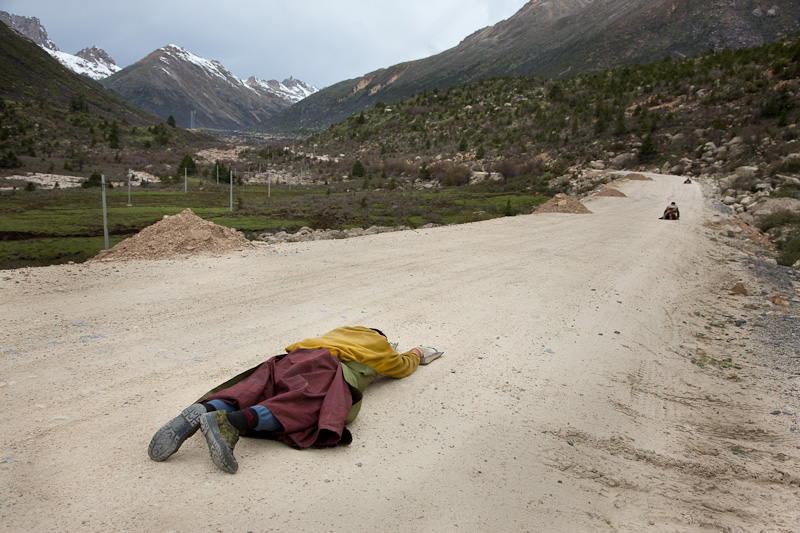
The reality couldn’t be more different. The first devout Buddhists I encountered looked neither healthy nor happy. They were walking from their villages in southern Tibet to Jokhang Temple in Lhasa, Tibetan Buddhism’s holiest site, and the journey had taken them nearly three months. Which isn’t surprising considering that with every third or fourth step they took, they got down on their knees and then fully prostrated themselves on the ground, lying flat on their bellies and burying their faces in the dirt, before getting back up, taking a few more steps, and doing the painful prostration thing again.

It looked life-zappingly exhausting. They moved at a snail’s pace. Their foreheads were stained grey from such frequent, unforgiving contact with the bruising earth. They wore wooden planks on their hands, which made a deathly clatter every time they hurled themselves downwards. I’d like to see Jennifer Aniston try this. Tibetan Buddhism sans latte.

You soon realize that no Tibetan Buddhist sits cross-legged on cushions all day long while staring into space and thinking about the universe. No, worshipping Buddha is a full-on physical workout. At the Lamaling Temple on a hillside in Nyingchi County in south-east Tibet, I saw women in their 50s doing the prostration thing, like an archaic version of a Jane Fonda workout.

The temple itself is packed with weird statues. Red demons with contorted faces. Smug-looking Buddhas smiling patronizingly at the poor, exhausted worshippers. There’s a statue of the “Living Buddha” (now deceased) who administered this temple in the 1950s and 60s and it is wearing sunglasses. Terrifyingly, it looks like a cross between the Buddha and Bono.

The Lamaling Temple, like others I visited, is painted in the most obscene colors. No inch of wall or centimeter of roof beam has been left untouched by the possibly colorblind decorators of Tibetan Buddhism’s sites of worship. Everywhere you look there’s a lashing of red or green or bright blue paint, a weirdly fitting backdrop to the frequently violent imagery of this religion: the statues of sword-wielding demons, the fiery paintings, the images of androgynous Buddhas, some with breasts, others with balls. “Peace” and “calm” are the last words that come to mind when you’re inside one of these senses-assaulting places.

The Lamaling Temple also brings home the fact that Tibetan Buddhism, like every other religion on Earth, is made up of various, sometimes horn-locking sects. 

I excitedly lined up an interview with one of the monks and asked if he’s looking forward to the day when the Dalai Lama returns from exile in northern India. He patiently told me—dumb Westerner that I am—that he doesn’t worship the Dalai Lama, because he is a member of the Nyingma school of Tibetan Buddhism while the Dalai Lama is head of the Gelug school. Then there’s the Kagyu school and the Sakya school—making four in total—which have hot-headed disagreements and have even come to blows in recent years over which deities should be worshipped and which should not. Religion of peace? Yeah, right.

Tibetan Buddhism has a whole lotta hang-ups about gays and girls, too. It says gay sex is “unnatural.” The Dalai Lama declared in a talk in Seattle in 1993, during one of his whistle stop, U2-style world tours, that “nature arranged male and female organs in such a manner that is very suitable… same-sex organs cannot manage well.” (Someone needs to explain to His Holiness how gay people get it on.)

And as Bernard Faure of Columbia University says: “Like most clerical discourses, Buddhism is… relentlessly misogynist.” So while Tibetan women can become nuns, they can’t advance nearly as far as men. Because according to Buddhist teachings it is impossible for women to become “the perfectly rightfully Enlightened One,” “the Universal Monarch,” “the King of Gods,” “the King of Death,” or “Brahmaa”—the five highest, holiest positions in Buddhism.

Of course, this only means that Tibetan Buddhism is the same as loads of other religions. Yet it is striking how much the backward elements of Tibetan Buddhism are forgiven or glossed over by its hippyish, celebrity, and middle-class followers over here. So if you’re a Catholic in Hollywood it is immediately assumed you’re a grumpy old git with demented views, but if you’re a “Tibetan” Buddhist you are looked upon as a super-cool, enlightened creature of good manners and taste. (Admittedly, Mel Gibson doesn’t help in this regard.)

I am well aware of the fact that I am not the first Westerner to be thrown by Tibet’s religious quirkiness. A snobby British visitor in 1895 denounced Tibetan Buddhism as “deep-rooted devil-worship and sorcery.” It’s no such thing. But what is striking, and what caused me to be so startled by the weirdness, is the way in which this religion has come to be viewed in Western New Age circles as a peaceful, pure, happy-clappy cult of softly-smiling, Buddha-like beings. Again, it’s no such thing. The modern view of Tibetan Buddhism as wondrous is at least as patronizingly reductive as the older view of Tibetan Buddhism as devil-worship.

Frank J. Korom describes it as “New Age orientalism,” where Westerners in search of some cheap and easy purpose in their empty lives “appropriate Tibet and portions of its religious culture for their own purposes.” They treat a very old, complex religion as a kind of buffet of ideas that they can pick morsels from, jettisoning the stranger, more demanding stuff—like the dancing demons and the prostration workout—but picking up the shiny things, like the sacred necklaces and bracelets and the BS about reincarnation.

It is all about them. They have bent and warped a religion to suit their own needs. As the Tibetan lama Dagyab Kyabgon Rinpoche puts it, “The concept of ‘Tibet’ becomes a symbol for all those qualities that Westerners feel lacking: joie de vivre, harmony, warmth and spirituality… Tibet thus becomes a utopia, and Tibetans become noble savages.” Western losers have ransacked Tibetan Buddhism in search of the holy grail of self-meaning.

Brendan O’Neill is editor of spiked in London.

Friday, August 06, 2010

On the instantaneous enlightenment through recognition of the nature of the mind

Today's Dharma Quote from Snow Lion Publications . . . .


THE BUDDHA FROM DOLPO
A Study of the Life and Thought
of the Tibetan Master
Dolpopa Sherab Gyaltsen

by Cyrus Stearns
a Tsadra Foundation Series book

more...

Dharma Quote of the Week

The Tibetan controversies about instantaneous enlightenment through recognition of the nature of the mind have been studied by David Jackson. As he shows, it is mainly members of the Kagyu traditions in Tibet who have maintained this doctrine, although it is certainly common in Chinese Ch'an Buddhism and in the teachings of the Great Perfection in Tibet. Dolpopa quotes the position that is the object of his refutation: "Recognizing the very essence naturally purifies them, without rejection." This expresses the view that through recognition of the essence of the thoughts as the dharmakaya they are purified or dissolved into the dharmakaya, and also the idea that any affliction that arises is actually a manifestation or self-presencing of primordial awareness itself. Thus there is no need to reject thoughts or afflictions, which are naturally purified by means of the recognition. This type of viewpoint is widespread in Tibetan Buddhism.

In contrast to these views, Dolpopa claims that the definition of an ordinary sentient being or a buddha, and of samsara or nirvana, is determined by the presence or absence of the incidental and temporary obscurations that veil the true nature of reality. It is not determined solely by recognition of the nature of the mind or the thoughts.

...While the ground buddhahood of the dharmakaya and the resultant buddhahood of the dharmakaya have not the slightest difference in essence, they are distinguished as ground and result by means of the presence or absence of incidental stains.

--from The Buddha from Dolpo: A Study of the Life and Thought of the Tibetan Master Dolpopa Sherab Gyaltsen by Cyrus Stearns; a Tsadra Foundation Series book, published by Snow Lion Publications

The Buddha from Dolpo • Now at 5O% off
(Good until August 13th).

Discover great articles, new releases and dharma news
in the latest edition of
Snow Lion: The Buddhist Magazine and Catalog