Saturday, January 12, 2013

Ezra Bayda - Willingly Residing in Our Distress

© Alfred Stieglitz

Ezra Bayda is the author of five books, most recently, Beyond Happiness: A Zen Way to True Contentment. This short article, which is one of the clearest and most useful teachings I have seen on working with difficult or distressing feelings, is excerpted from Being Zen: Bring Meditation to Life, and comes to you from Tricycle magazine's Wisdom Archives.

Bursting the Bubble of Fear

Haven't we always been afraid? So now we know it. Ezra Bayda walks us through age-old fear and shows us what it really is.

You are viewing an item from the Tricycle Wisdom Collection
SEARCH THE WISDOM COLLECTION

The feeling that things are out of sync and that there is too much to do is not new. As Buddha pointed out over 2,600 years ago, we'll always have to deal with the fact that life entails pain and suffering. Perhaps it's that we don't really want to have any problems that makes Our current time seem so full of distress.

Many people come to meditation practice with the expectation that it will calm them and relieve their stress. Certainly meditation can do this to some extent; even the most superficial meditation practices can induce feelings of calmness. However, when we're knee-deep in emotional distress, we're fortunate if we can remember to practice at all.

When the clarity of practice becomes obscured by the dark and swirling energy of emotional distress, it is useful to have some clear and concise reminders to bring us back to reality. The first reminder is to awaken aspiration. On an elementary level, to awaken aspiration means simply that we remember to practice. Once we remember to practice, to awaken aspiration means that we see our particular distress as our path. Instead of seeing our distress as the enemy, as something to get rid of; instead of giving it juice by solidifying the thoughts around it into the heaviness and drama of "me," we learn to view distress as our opportunity to see and to open. We relate to it as our path to awakening.

When we find ourselves in a mess, we might have the thought "This isn't how life is supposed to be." When life doesn't fit our picture, we usually feel that something is wrong. But it is not so much that something is wrong as it is that we're relating to life from the narrow, fear-based perspective of "I want." What we want is to feel good, and when our emotional distress does not feel good, we almost instinctively move away from it. Our discomfort generates fear, and in that fear there is even more discomfort. No wonder we tend to see distress as the enemy, as something to get rid of.

We have to turn our upside-down view right-side up to understand what it means to see difficulties as our path. The main issue is no longer just about whether we feel good, or whether we like what is happening. The main issue is to be more awake, to learn what we have to learn to stop holding back our hearts in fear. This doesn't mean that we have to like what is on our plate-what it means is that the willingness to open to life's difficulties is not dependent on having to like them.

The second reminder is to awaken curiosity, asking the practice question, "What is this?" This is not an expression of idle curiosity, nor is it an analytical exploration. It's awakening the desire to know the truth of the moment through experiencing the physical reality of our being. We cannot experience physical reality as long as we're blaming, wallowing in "poor me," trying to escape, or giving credence to powerful thoughts such as "This isn't fair" and "I can't do this." The thought realm is where we stay stuck; it's where things become solid, dark, and unworkable. In awakening curiosity, we retum over and over again to the bodily experience of the moment, to the physical "whatness" of our experience, which is movable, light, and workable.

Several years ago, I was faced with an alarming reading on a screening test for prostate cancer. After further testing, I felt a great deal of fear while waiting for the results. I practiced staying with the body, asking over and over, "What is this?" The combination of fear and self-pity was powerful, as was the desire to escape, but my continuous effort to return to the physical reality of the moment began to undercut the solidity of my fear. The question "What is this?" worked like a laser in focusing on the experience of fear itself. In a moment of insight, I realized that none of what I feared was happening now, nor had it ever happened! There was no real pain other than that generated by my thoughts. This realization effectively burst the bubble of my fears. The insight came not from thinking, but from staying with the "whatness" of the moment. It came from being curious about reality.

The third reminder in working with distress is to awaken humor, or at least some wider perspective. Any time we're obsessing over something that's happening mainly in our thoughts, it is helpful to remember Mark Twain's words: "I'm a very old man. I've had lots of problems. Most of them never happened."

One way to broaden our perspective is to see the difficulties as just another aspect of our conditioning playing itself out. When we remember this we can say to ourselves, "Here it comes again; what will it be like this time?" This is not a trick to avoid facing our issues; rather, it is a means of getting just enough perspective to be able to enter the difficulty without being overwhelmed by it. Once when my Pandora's box was opening wide, I went to my teacher, Joko Beck, to describe what was happening. I felt dark and grim, and was embarrassed to reveal that I was experiencing so much fear. She smiled at me and said, "That's pretty interesting. Let's look at this." I got the sense that it wasn't me we were talking about, but just "stuff." Here was a wider perspective. It's not that the fears were an illusion and could therefore be ignored, but that they were simply my particular conditioning. Putting them in this context allowed me to look more lightly at "my fears."

The fourth reminder is to awaken lovingkindness. This is the ability to bring nonjudgmental awareness from the heart to the unwanted aspects of "me." This reminder can't be overemphasized. It's so natural to want to confirm what is most negative about ourselves that we don't even think about activating compassion or kindness. In fact, much of the heaviness of our distress comes from the belief that we should be different. Especially after practicing for a few years, we think we shouldn't still be so reactive. We think we should be beyond our conditioning. But practice doesn't work that way. Yet when we soften our self-judgment with lovingkindness, the sense of drama and heaviness lightens considerably.

Sometimes when emotional distress is particularly powerful, nothing we've learned about practicing with distress seems pertinent. Dense and intense emotional reactions can leave us feeling confused and overwhelmed. In these darkest moments, the practice is to bring awareness to the center of the chest, breathing the painful emotions, via the in-breath, directly into the heartspace. It's as if we're breathing the swirling physical sensations right into the heart. Then, on the out-breath, we simply exhale. We're not trying to do or change anything; we're simply allowing our heart center to become a wider container of awareness within which to experience distress.

Fear takes us to that point beyond which we think we can't go. Breathing into the center of the chest, taking that one breath directly into the heartspace, opening to the pain that feels like it's going to do us in, teaches us that it won't do us in. We begin to experience the spaciousness of the heart, where our harshest self-judgments and our darkest moods lighten up. We begin to understand that awareness heals; and to open to this healing, one more breath into the heartspace is all that is required.

To willingly reside in our distress, no longer resisting what is, is the real key to transformation. As painful as it may be to face our deepest fears, we do reach the point where it's more painful not to face them. This is a pivotal point in the practice life.

Feeling the limitations of our fears and breathing them into the heartspace allows us to penetrate the protective barriers that close us off. As we begin to move beyond the artificial construct that we call a "self'—the seat of all of our emotional distress—we enter into a wider container of awareness. We see that our emotional drama, however distressful, is still just thoughts, just memories, just sensations. Who we really are—our basic connectedness-is so much bigger than just this body, just this personal drama.

Seeing this bigger picture one time, two times, or even a dozen times, doesn't mean we'll no longer have emotional reactions. But keeping the bigger picture in view does help us keep from getting lost in our distress as quickly, as intensely, or for as long a time. We finally begin to understand and even believe that all of our stuff is workable. ▼

~ Ezra Bayda has been a Zen student since 1970, receiving Dharma Transmission in 1998. He now lives, writes, and teaches at Zen Center San Diego. He is the author of five books, including his latest, Beyond Happiness: A Zen Way to True Contentment. "Bursting the Bubble of Fear" is excerpted from Being Zen, © March 2002 by Ezra Bayda. Reprinted by arrangement with Shambhala Publications, Inc.


Image: "Later Lake George: Storm Over the Hill, 1921" by Alfred Stieglitz, used with the permission of Philadelphia Museum of Art: Alfred Stieglitz Collection.

Friday, January 11, 2013

Compassion's Edge States: Roshi Joan Halifax on Caring Better (NPR's On Being)


From On Being, Krista Tippett's excellent NPR show (which frustratingly does not air locally as far as I know), an interview with Buddhist teacher, Zen priest, anthropologist, and author, Roshi Joan Halifax, the founder, Abbot, and head teacher of Upaya Zen Center in Sante Fe, New Mexico.

Roshi is one of my favorite Buddhist teachers (strange they are both female, the other being Pema Chodron), in part because she has actively sought to foster the conversation between Buddhism and its various practices and neuroscience research.

COMPASSION'S EDGE STATES: ROSHI JOAN HALIFAX ON CARING BETTER

January 10, 2013

Krista Tippett, host: 
It can be a stretch to summon buoyancy rather than burnout in how we work, live, and care — a thousand people soaked up Roshi Joan Halifax when I interviewed her at the Hall of Philosophy at the Chautauqua Institution. She has said: "I am not a 'nice' Buddhist. I'm much more interested in a kind of plain-rice, get-down-in-the-street Buddhism." Joan Halifax is a Zen teacher and medical anthropologist who's been formed by cultures from the Sahara Desert to the hallways of American prisons. She founded the Project on Being with Dying. Now she's taking on the problem of compassion fatigue, though she doesn't like that phrase. Whatever you call it, for all of us overwhelmed by bad news — and by the attention we want to pay to suffering in the world — Joan Halifax has wisdom.
Listen
Radio Show/Podcast (mp3, 51:06)
Unedited Interview: » Joan Halifax (mp3, 91:36) 
Learn
Books + MusicTranscript
Voices on the Radio


Joan Halifax

Halifax is the Founding Abbot of Upaya Zen Center in Santa Fe, New Mexico, and director of the Project on Being with Dying.

Selected Readings


Inside Compassion: Edge States, Contemplative Interventions, Neuroscience

Joan Halifax speaks about the challenge of caregivers who care for those who are seriously ill. Learn about basic research in neuroscience and psychology on mindfulness, compassion, and the effects of stress on the body.

Pertinent Posts from the On Being Blog


Encountering Grief: A 10-Minute Guided Meditation with Joan Halifax
The Zen abbot walks a live audience through this guided meditation on encountering grief. Download and share with your friends and family.


Roshi Joan Halifax Discusses the Painful Truths of Death and the Impermanence of Life (video)
“Another level of your life opens up when you recognize that you have a life that is inside.” ~Roshi Joan Halifax

The Zen Buddhist monk and medical anthropologist talks to Krista Tippett about her life, Buddhist faith, inspirations, and the vast concepts of death, compassion, grief — and neuroscience.


A Little Bit of Mindfulness Meditation Can Reduce a Lot of Pain
Even novice meditators are able to curb their pain after a few training sessions in mindfulness meditation.


End of Life Zen Care
The first Buddhist chaplaincy training program in the U.S. is featured in this beautiful short film about end of life care.

John R. Searle - Philosophy and the Habits of Critical Thinking (Conversations with History)


Nice lecture from one of our great living philosophers, John Searle, author of Making the Social World: The Structure of Human Civilization (2010), Mind, Language, and Society : Philosophy in the Real World (2000), and The Mystery of Consciousness (1990), among many other influential books.


John R. Searle (Conversations with History)
Published on Jan 9, 2013

UCTV - Conversations with History and Host Harry Kreisler welcome UC Berkeley Professor of Philosophy John R. Searle who talks about the work of a philosopher, critical thinking, and lessons of the Free Speech Movement. Series: "Conversations with History" [Public Affairs]

FORA.tv - Glenn Wilson: The Thin Line Between Genius and Madness


Glenn Wilson offers and entertaining and educational talk on the thin line between genius and madness, including such notable figures as Nikola Tesla, John Nash, and Galileo. Wilson is the author of Born Gay: The Psychobiology of Sex Orientation, as well as Psychology for Performing Artists, Your Personality & Potential: The Illustrated Guide to Self Discovery, and many other books.


Glenn Wilson: The Thin Line Between Genius and Madness

Glenn Wilson: The Thin Line Between Genius and Madness from Gresham College on FORA.tv
SUMMARY

"Great wits are sure to madness near allied, and thin partitions do their bounds divide" (Dryden). There often seems to be a link between creativity and mental illness. Many great poets, playwrights, artists and composers suffered from depression, alcoholism, obsessionality, bipolar or psychotic disorders at some time in their lives. How strong is the link and what might account for it? Are these disorders beneficial to the creative process or a drawback that must be overcome?

For transcript and download versions of this lecture, please visit the event's page on the Gresham College website: Genius or Madness?

BIO

Dr. Glenn Wilson
As well as being one of Britain's best-known psychologists, Glenn Wilson is the Visiting Gresham Professor of Psychology. He has appeared on numerous television and radio programs and has published more than 150 scientific articles and 33 books.

He is an expert on individual differences; social and political attitudes; sexual behavior, deviation and dysfunction; and psychology applied to the performing arts. Not one to shy away from contention, his most recent books include: Born Gay: The Psychobiology of Sex Orientation, The Secret of Lasting Love, and Psychology for Performing Artists. He has lectured widely abroad, having been a guest of the Italian Cultural Association, and a visiting professor at California State University, Los Angeles, San Francisco State University, Stanford University, the University of Nevada, Reno and Sierra Nevada College.

Apart from being a professional psychologist, Dr. Wilson trained as an opera singer at the Guildhall School of Music and Drama in London and still undertakes professional engagements as an actor, singer and director.
Additional information and resources:
This is a part of Glenn Wilson's series of lectures as Visiting Professor of Psychology, 2012/13. The other lectures are as follows:

Extra lecture materials

Transcript for "Genius or Madness?"
PowerPoint Presentation for "Genius of Madness?"

At their site, you also listen to or download the video and/or audio.

Thursday, January 10, 2013

George Dvorsky - The 12 Cognitive Biases that Prevent You from Being Rational

This is a cool article from the Institute for Ethics and Emerging Technologies (IEET), featuring George Dvorsky, the Chair of the IEET Board of Directors and who also heads their Rights of Non-Human Persons program. Dvorsky produces the Sentient Developments blog and podcast.

I have included the introduction and the list of the 12 cognitive biases - if this is interesting to you, please follow the title link to read about each of the biases.

The 12 cognitive biases that prevent you from being rational


George Dvorsky
io9.com

Posted: Jan 10, 2013

The human brain is capable of 1016 processes per second, which makes it far more powerful than any computer currently in existence. But that doesn't mean our brains don't have major limitations. The lowly calculator can do math thousands of times better than we can, and our memories are often less than useless — plus, we're subject to cognitive biases, those annoying glitches in our thinking that cause us to make questionable decisions and reach erroneous conclusions.


Here are a dozen of the most common and pernicious cognitive biases that you need to know about.

Before we start, it's important to distinguish between cognitive biases and logical fallacies. A logical fallacy is an error in logical argumentation (e.g. ad hominem attacks, slippery slopes, circular arguments, appeal to force, etc.). A cognitive bias, on the other hand, is a genuine deficiency or limitation in our thinking — a flaw in judgment that arises from errors of memory, social attribution, and miscalculations (such as statistical errors or a false sense of probability).

Some social psychologists believe our cognitive biases help us process information more efficiently, especially in dangerous situations. Still, they lead us to make grave mistakes. We may be prone to such errors in judgment, but at least we can be aware of them. Here are some important ones to keep in mind.
  • Confirmation Bias
  • In group Bias
  • Gambler's Fallacy
  • Post-Purchase Rationalization
  • Neglecting Probability
  • Observational Selection Bias
  • Status-Quo Bias
  • Negativity Bias
  • Bandwagon Effect
  • Projection Bias
  • The Current Moment Bias
  • Anchoring Effect

Ken Wilber and Roger Walsh: The Past, Present, and Future of the Integral Movement


This is from 2009, but the folks at Integral Life have made it available for free. It's an interesting discussion between (old friends, as the picture above indicates) Ken Wilber and Roger Walsh on, well, exactly what the title says: the past, present, and future of the integral movement. Personally, the only viable future I see for the "integral movement," whatever it is they mean by that, is the new MetaIntegral venture of Sean Hargins and his crew.

In my opinion, integral theory as a field has little future until or unless its basic tenets are put to the test by independent researchers through a peer-reviewed process. Right now, it's little more than a coaching technique at best, or another New Age "spirituality," and at worst it has a reputation for giving refuge to men who use their guru/teacher/leadership power positions to seduce and sleep with students.

But I digress (sort of).

Here are the bios they give for Wilber and Walsh:

Roger Walsh - Roger Walsh, M.D., Ph.D., has spent nearly a quarter century researching and practicing in the world’s great spiritual traditions. His critically acclaimed book, Essential Spirituality, is a summary of that wisdom, outlining the seven spiritual practices common to the world's major religions. Be sure to check out Roger's website at www.drrogerwalsh.com.


Ken Wilber - Ken Wilber is the founder of Integral Institute and the co-founder of Integral Life. He is an internationally acknowledged leader and the preeminent scholar of the Integral stage of human development. His many books, all of which are still in print, can be found at Amazon.com. Some of his more popular books include Integral Spirituality; No Boundary; Grace and Grit; Sex, Ecology, Spirituality; and the "everything" books: A Brief History of Everything (one of his largest selling books) and A Theory of Everything (probably the shortest introduction to his work).
And here is the text introducing and explaining the talks, including links to download all four talks (2 1/2 hours+) or each talk individually.

THE INTEGRAL MOVEMENT: PAST, PRESENT, AND FUTURE

October 7th, 2009

In this exhilarating dialogue, Roger Walsh offers one of the finest overviews of the integral movement that we have ever seen—where we're at, where we've been, and where we're going. Now more than ever, the integral movement is poised to make a tremendous impact upon the world. Listen as Roger describes the current status of the movement, identifies some potential traps that we may fall into, and suggests some of the key ideas that the integral approach has to offer the rest of the world. Most importantly, you will learn what you can do in your own life, work, and play to help bring integral perspectives and solutions to a world that so desperately needs them.

Download Links: Full Series (mp3 zip) | Full Series (m4b zip)

Topics:
Part 1 (mp3) Current Status
Part 2 (mp3) Potential Traps
Part 3 (mp3) Key Ideas
Part 4 (mp3) Global Crisis

Total running time: 2 hours 35 minutes 
Written by Corey W. deVos

This dialogue explores Roger Walsh’s keynote address at the 2008 Integral Theory Conference. At the conference, Roger was asked to provide some reflective comments that would help the field see itself, especially its blind spots and shadow. Roger delivered in spades! Not only were his points and illustrative stories poignant, but he also gave a dynamic and entertaining delivery. (It turns out he spent some time as a stand-up comic. Who would have guessed?). He covers topics that will interest the entire Integral Life community, including how we can optimize the impact of integral ideas, fighting developmental complacency, and the traps that await us at each stage.

READ THE FULL ARTICLES HERE:

Part I: Current Status and Potential Traps
Part II: Key Ideas for a World at Risk

One of the extraordinary qualities of integral consciousness is the ability to simultaneously challenge yourself to be something greater than who you are, while loving yourself exactly as you are. If we can muster the strength and compassion to be both completely honest with ourselves and kind to ourselves, not only can we overcome the many obstacles that we inevitably face throughout our journey, but these obstacles can be seen for what they actually are: stepping stones that can take us from our potential to our purpose, from our brokenness to our wholeness, from our fragile humanity to our unbreakable divinity.

In this fascinating dialogue, Roger gives a realistic summary of the condition of the Integral movement today. In short, his observation is this: it is still coalescing, still trying to find enough traction to grow from a "cognitive minority" to a viable force in the academic and cultural mainstream. Though we can already see signs of this occurring around us, it is a slow and organic process and cannot be hurried by any artificial means.

That said, there are certainly things you can do to help: learn the integral tools—like Integral Life Practice—that can help you live an extraordinary and whole life, while helping you take broader and more encompassing perspectives in every domain you touch.

Obviously this can be a sometimes painful path, beset with its own breed of lions and tigers and bears (oh my!). In the second installation, titled Potential Traps, Roger outlines some of the afflictions common to Integral living—including complacency and stagnation in our growth, shadow games and ego posturing, developmental allergies and aversions, and the dangers of when our knowledge and conceptual understanding begins to outpace our wisdom, experience, and insight.

(On a personal note, I have been working with Ken Wilber, Integral Institute, and Integral Life for just about 10 years, and have been a vigorous student of Integral theory and practice for almost than twice as long. As I was editing this dialogue and listening to Roger's laundry list of possible pathologies, it didn't take long for me to realize that I had fallen into almost every single trap at one point or another—many of which I continue to fall into today. As such, Roger's presentation offered a much-needed rallying call for my own growth, practice, and personal embodiment of the Integral vision—awakening me to many of my own missteps and misgivings, while provoking me to deepen my own practice and recommit myself to my work, my relationships, and my art.)

We live in a time of unprecedented challenges and opportunities. Never before have we had the power to imperil our species and our planet, and never before have we had the power to heal our species to the degree we can today—bringing people to new levels of prosperity, well-being, health, and maturity. The choices our generation makes will determine whether we leave behind us an evolving civilization and a fertile earth, or a failed species and a plundered planet. We have the power to do both. Part of the power available to us is the integral vision. It is our remarkable privilege to be able to realize this vision ourselves, to embody and express it in our lives, to use it to better understand the world, and to let it use us as willing instruments to help heal our world. What greater privilege could there be than to use this profound vision to play our role to serve, help, heal, and awaken all beings? Listen as Roger and Ken discuss how we can all do our part to make our world just a little more sane....

Integral Leadership Review - January 2013


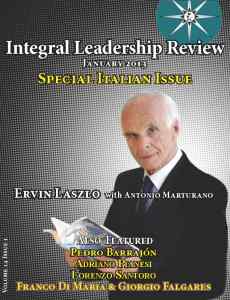
A new issue of the Integral Leadership Review is online and available for your reading pleasure - table of contents here. This is a special issue focusing on Leadership in Italy, with guest editor Antonio Marturano. If you want to read an overview of the essays in the new issue to help you decide which articles are best for you, be sure to check out Particles, edited by Jeannie Carlisle.

There are some excellent articles in this new issue, but I am slightly saddened to read Russ Volckmann's CODA to this issue. He is moving to an Executive Editor role and handing the day-to-day Editor reigns over to Mark McCaslin. I have no doubt Mark will continue the excellence that is ILR, but it's simply a little sad to see a friend "experience some little deaths in relation to this publication that started as an opportunity to share my early thinking about integral leadership."

One of his new directions is to keep ILR free, which means finding some funding. If you can afford to donate, please do so.

Coda: Transitions

Download article as PDF

How can we not think about transitions at this time of year? We have just gone through the transitions of the Mayan calendar to a new era. And we have transitioned into the beginning of a new year according to the Gregorian calendar. In a week from writing this we have a full moon in the United States, foreshadowing the entry into a new lunar cycle. According to the Hijri or Muslim calendar, the new year began in 2012 on November 15, 2012. Then the next will be November 4, 2013. So I missed that transition. Nevertheless, I like this graphic representing the lunar cycle for the 2013 Muslim New Year. Well, the point is… transitions.

Muslim New Year Poster

I remember when I attended a Bill Bridges workshop on “the journey.” He was transitioning out of his role as English professor at Mills College in the years before publishing his best selling book, Transitions. The highlight of the workshop was at the end. We rubbed each others feet with salt. This is apparently a tradition in the Middle East when a traveler arrives in your home.

Some transitions are full of hope and others feel like someone is rubbing salt into our wounds. When we get a new job that we wanted or start on a new educational program or a new relationship, we experience transitions that are usually full of hope for the future while we celebrate the joy of the present. Other transitions can induce fear as we feel we are about to step into a dark room with little assurance that there is a floor there. Too many people have these experiences when others seem to be in control of their destinies. Still other transitions can be filled with pain: a separation, an illness, a death.

Stanley Kellerman, the somatic therapist in Berkeley, California, wrote about little deaths in his wonderfully insightful book, Living Your Dying. It has been years since I have read it, but it has served to remind me that every transition involves a little death. We give up something in order to take on something new. We get lots of practice for dealing with “big” deaths.

My life has been full of little deaths. As I have gotten older I have felt the loss of grandparents, parents, friends, classmates, favorite entertainers, authors, even politicians, who have entered the big deaths. They are missed. Still, as I reflect on my life, the little deaths overwhelm the big ones in numbers and often in impact on how I realize my self and my life.

2012 and 2013 involve an important transition for Integral Leadership Review and for me. As we enter the 14th year of publishing, Mark McCaslin is moving into the role of Editor. While I will continue to play an active role for the foreseeable future as Executive Editor, I am having to let go, to experience some little deaths in relation to this publication that started as an opportunity to share my early thinking about integral leadership.

I welcome many of these little deaths, because they free me to focus my attention on other projects that are important to me. These other projects include aspects of publishing Integral Leadership Review. For example, in service of continuing to have ILR be free to all readers, I need to find some additional sponsors. I have issued pleas for gifts to ILR by the readers and their inclusion in “Friends of ILR”. Some have responded very generously and some have given modest amounts that I value as highly. Every gift is a message that what we are doing is important and worthwhile. If you are part of an organization that would be willing to help us finance this publication, we would welcome sponsorship and/or ads on our welcome page and in ILRPartices. If you are willing to give a gift to ILR you can do so on the Welcome page: “Support ILR”.

But this is not intended to be a fund raising plea. It is about transitions. While there are little deaths associated with passing a lot of responsibility over to Mark McCaslin, this is a transition that is also filled with joy for me. I am so grateful to Mark for bringing his knowledge, skill and wisdom to the task of perpetuating and growing the value of ILR and with being willing to put up with me in the little dying processes of the transition. Mark is an individual for whom I have huge respect. If you have been reading any of his material in the pages of ILR, you no doubt share this respect.

This transition is also filled with excitement. Mark has a solid understanding of integral and transdisciplinary. He is an academic, a researcher, an original thinker. He has a deep appreciation for the hard work and energy it takes to implement and address challenges in communities, organizations and in life. You will learn much more about him in the issues coming down the road.

For now, I am not quite ready for my feet to be rubbed with salt. But the time is coming. And I do hope you all find great value in ILR as it unfolds in the months and years to come.

Russ Volckmann

Wednesday, January 09, 2013

Handbook For Life 2013

This is an interesting list of things to do to make 2013 a healthy year, and to make the rest of your life pretty healthy as well. This comes from a site called Prana (Women, Men, Life).

I would love to read more books than I did in 2012, but I am not sure that is physically possible. However, I will try.


Wednesday, January 2nd, 2013


HEALTH:
1. Drink plenty of water.
2. Eat breakfast like a king, lunch like a prince and dinner like beggar.
3. Eat more foods that grow on trees and plants and eat less food that is manufactured in plants.
4. Live with the 3 E’s — Energy, Enthusiasm and Empathy.
5. Make time to meditate.
6. Breathe
7. Read more books than you did in 2012.
8. Sit in silence for at least 10 minutes each day.
9. Sleep for 7 hours.
10. Take a 10-30 minute walk daily. And while you walk, smile.


PERSONALITY:
11. Comparing our lives to others is fruitless. We have no idea what their journey is about.
12. Replace negative thoughts with positive ones especially about things out of our control. Invest energy in the positive present moment.
13. Try not to over do. Understand limits.
14. Why take ourselves so seriously. No one else does.
15. Gossip drains precious energy.
16. Dream more while we are awake.
17. Envy is a waste of time. We already have all we need.
18. Forget issues of the past. Let go of our partners mistakes of the past. Focus on our present/future happiness.
19. Life is too short to waste time hating anyone.
20. Make peace with our past so it won’t spoil the present.
21. No one is in charge of our happiness except us.
22. Realize that life is a school and we are here to learn. Problems are simply part of the curriculum that appear and fade away like algebra class but the lessons we learn will last a lifetime.
23. Smile and laugh more.
24. We don’t have to win arguments. It’s ok to agree to disagree.


SOCIETY:
25. Call your family often.
26. Each day give something good to others.
27. Forgive everyone for everything.
28. Spend time with people over the age of 70 & under the age of 6.
29. Try to make at least three people smile each day.
30. What other people think of you is insignificant compared to what you think of yourself.
31. Your job won’t take care of you when you are sick. Your friends & family will. Stay in touch.


LIFE:
32. Do the right thing!
33. Keep only things that are useful, beautiful or joyful.
34. Higher powers heal everything.
35. However good or bad a situation is, it will change.
36. No matter how we feel, get up, dress up, and show up.
37. The best is yet to come.
38. When we awake alive in the morning, be thankful.
39. Our Inner most is always happy. Release your “Inner Happy” on the world every day!


Research - The Role of the Self in Perspective-Taking and Empathy


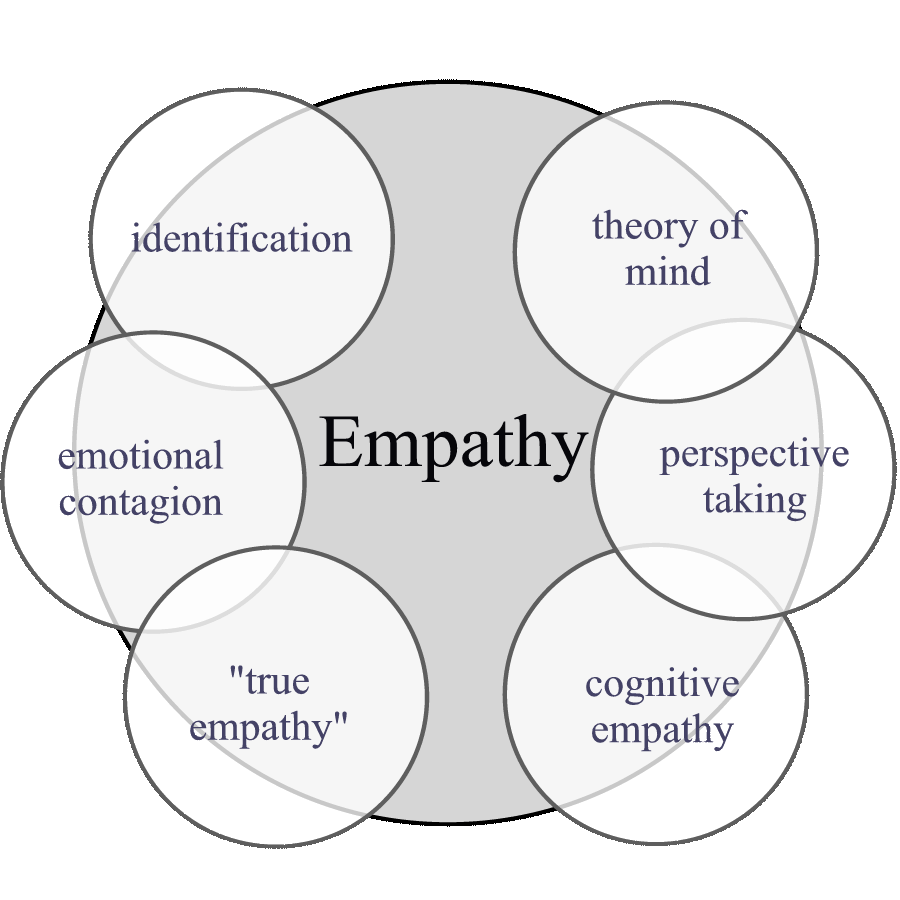
This is an interesting article on the role of the "self" in perspective-taking and empathy. The authors present four studies showing that observers are more empathic to the extent that they can easily imagine themselves in the target’s position, across a wide variety of need domains - i.e., being able to take the perspective of the other is essential to being more empathic.


University of Florida - Department of Psychology

Eckerd College

April 5, 2011
Social Cognition, Vol. 30, No. 2, pp. 153-180, 2012

Abstract:
When judging their empathic reactions for another person, people may rely on a relatively effortless, self-based heuristic: the ease with which they can imagine themselves in the other person’s position. We present four studies showing that observers are more empathic to the extent that they can easily imagine themselves in the target’s position, across a wide variety of need domains. Furthermore, we find that use of this “ease of self-simulation heuristic” (ESS), like other judgment heuristics, is conditioned by certain predictable factors: when deliberate attempts are made to take the perspective of the target person (Study 1), when the target’s needs are ambiguous (Study 2), and when the observer’s ability to engage in more effortful perspective-taking processes are constrained by performing a cognitively demanding second task (Study 3). In the discussion, we evaluate our findings in light of contemporary theorizing on the role of the self in perspective-taking and empathy.
Citation:
Chambers, John R. and Davis, Mark H. , The Role of the Self in Perspective-Taking and Empathy: Ease of Self-Simulation as a Heuristic for Inferring Empathic Feelings (April 5, 2011). Social Cognition, Vol. 30, No. 2, pp. 153-180, 2012. Available at SSRN: http://ssrn.com/abstract=2189421

Here is the introduction to the paper:
What is the role of the self in perspective-taking and empathy? This long-standing question has been addressed over the years by a variety of social theorists. Smith (1759), Mead (1934), and Piaget (1972) have all offered analyses that emphasize connections between self-awareness, self-knowledge, and our responses to others. In recent years, social psychologists have addressed this issue in a number of empirical ways. Davis and colleagues (Davis, Conklin, Smith, & Luce, 1996) found evidence that deliberate perspective-taking led observers to attribute more self related and primarily positive traits to targets—a “merging” of self and others.

They argued that perspective-taking activates self-knowledge, and the greater accessibility of such information then leads it to be used in characterizing others. In support of this interpretation, Davis et al. (2004) used a thought-listing procedure and found that perspective-taking observers reported more self-related thoughts. Epley, Keysar, Van Boven, and Gilovich (2004) implicate the self in perspective-taking via an “anchoring and adjustment” heuristic. That is, people infer others’ perspectives by starting from their own point of view and then making a series of adjustments to account for likely differences between the two. However, these adjustments require time, resources, and motivation, which are often in short supply. As a consequence, the adjustment process often stops short of where it should, and people’s estimates of others’ perspectives end up looking too much like their own.

Finally, Ames (2004) proposed a similarity-contingency model which argues that attempts to infer the internal states of others will often rely on one of two relatively effortless heuristics: projection and stereotyping. Perceived similarity to the target determines which heuristic is more likely to be used. People impute their own internal states to others who are perceived as similar (e.g., ingroup members), but employ stereotypes to infer the internal states of those who are perceived as dissimilar (e.g., outgroup members; see also Robbins & Krueger, 2005).

All of these approaches share a critical central feature: the assumption that the self is a template that observers apply to the target during perspective-taking. That is, all three approaches argue that aspects of self are in some way projected onto the target, and because such projection is relatively effortless, it constitutes a kind of inferential heuristic (e.g., Ames, 2004; Epley et al., 2004). However, this may not be the only role for the self. In this article, we argue for the operation of another self-related heuristic: ease of self-simulation. In brief, we argue that observers often use their own imagined experiences in the target’s situation as a heuristic for gauging their empathic reactions to the target, such that they will be more empathic if they can easily imagine themselves in that situation and less empathic if they cannot. We report the results of four experiments showing that observers employ this heuristic when judging their emotional and behavioral reactions to another person’s misfortunes, and we further illustrate some of the important situational variables moderating the use of this heuristic.

Kevin Dutton - Wisdom from Psychopaths?


Kevin Dutton has a new book out about psychopaths, The Wisdom of Psychopaths: What Saints, Spies, and Serial Killers Can Teach Us about Success, and Scientific American Mind recently posted an excerpt from this intriguing book. I think we can all name a few people we know who seem to fit the description given below.

Here is the publisher's description of the book:
In this engrossing journey into the lives of psychopaths and their infamously crafty behaviors, the renowned psychologist Kevin Dutton reveals that there is a scale of “madness” along which we all sit. Incorporating the latest advances in brain scanning and neuroscience, Dutton demonstrates that the brilliant neurosurgeon who lacks empathy has more in common with a Ted Bundy who kills for pleasure than we may wish to admit, and that a mugger in a dimly lit parking lot may well, in fact, have the same nerveless poise as a titan of industry. 
Dutton argues that there are indeed “functional psychopaths” among us—different from their murderous counterparts—who use their detached, unflinching, and charismatic personalities to succeed in mainstream society, and that shockingly, in some fields, the more “psychopathic” people are, the more likely they are to succeed. Dutton deconstructs this often misunderstood diagnosis through bold on-the-ground reporting and original scientific research as he mingles with the criminally insane in a high-security ward, shares a drink with one of the world’s most successful con artists, and undergoes transcranial magnetic stimulation to discover firsthand exactly how it feels to see through the eyes of a psychopath. 
As Dutton develops his theory that we all possess psychopathic tendencies, he puts forward the argument that society as a whole is more psychopathic than ever: after all, psychopaths tend to be fearless, confident, charming, ruthless, and focused—qualities that are tailor-made for success in the twenty-first century. Provocative at every turn, The Wisdom of Psychopaths is a riveting adventure that reveals that it’s our much-maligned dark side that often conceals the trump cards of success.
Interesting thesis. However, I would argue that being "fearless, confident, charming, ruthless, and focused" were the qualities of success in the 1980s and 1990s, but that we are moving more toward a success blueprint that requires focus, confidence, kindness, authenticity, and empathy (a quality present in many psychopaths that makes them extremely hard to identify at first).
Anyway, here is the except from Scientific American Mind.

Wisdom from Psychopaths?


A scientist enters a high-security psychiatric hospital to extract tips and advice from a crowd without a conscience

By Kevin Dutton | Friday, January 4, 2013


Image: Niklas Asker

Adapted from The Wisdom of Psychopaths: What Saints, Spies, and Serial Killers Can Teach Us about Success, by Kevin Dutton, by arrangement with Scientific American/Farrar, Straus and Giroux, LLC (US), Doubleday Canada (Canada), Heinemann (UK), Record (Brazil), DTV (Germany), De Bezige Bij (Netherlands), NHK (Japan), Miraebook (Korea) and Lua de Papel (Portugal). Copyright © 2012 Kevin Dutton

“Got anything sharp?” the woman at reception barks, as I deposit the entire contents of my briefcase—laptop, phone, pens—into a clear, shatter-resistant locker in the entrance hall. “Now place the index finger of your right hand here and look up at the camera.”

Once you pass through border control at Broadmoor, the best-known high-security psychiatric hospital in England, you are immediately ushered into a tiny air lock, a glass-walled temporary holding cell between reception and the hospital building proper, while the person you are visiting—in my case, a psychologist assigned to escort me to my destination—gets buzzed by reception and makes his way over to meet you.

It's a nervy, claustrophobic wait. As I sit flicking through magazines, I remind myself why I'm here—an e-mail I had received a couple of weeks after launching the Great British Psychopath Survey, in which I tested people in different professions for psychopathic traits. One of the survey's respondents, a barrister by trade, had written to me. He had posted a score that certainly got my attention.

“I realized from quite early on in my childhood that I saw things differently than other people,” he wrote. “But more often than not, it's helped me in my life. Psychopathy (if that's what you want to call it) is like a medicine for modern times. If you take it in moderation, it can prove extremely beneficial. It can alleviate a lot of existential ailments that we would otherwise fall victim to because our fragile psychological immune systems just aren't up to the job of protecting us. But if you take too much of it, if you overdose on it, then there can, as is the case with all medicines, be some rather unpleasant side effects.”

The e-mail had got me thinking. Might this eminent criminal defense lawyer have a point? Was psychopathy a “medicine for modern times”? The typical traits of a psychopath are ruthlessness, charm, focus, mental toughness, fearlessness, mindfulness and action. Who wouldn't at certain points in their lives benefit from kicking one or two of these up a notch?

I decided to put the theory to the test. As well as meeting the doctors in Broadmoor, I would talk with some of the patients. I would present them with problems from normal, everyday life, the usual stuff we moan about at happy hour, and see what their take on it was. Up until now it had seemed like a good idea.

“Professor Dutton?” I look up to see a blond guy in his mid-30s peering around the door at me. “Hi, I'm one of the clinical leads at the Paddock Center. Welcome to Broadmoor! Shall I take you over?”

The Paddock Center is an enclosed, highly specialized personality disorder directorate comprising six 12-bedded wards. Around 20 percent of the patients housed there at any one time are what you might call “pure” psychopaths. These are confined to the two Dangerous and Severe Personality Disorder (DSPD) wards. The rest present with so-called cluster disorders: clinically significant psychopathic traits, accompanied by traits typically associated with other personality disorders—borderline, paranoid and narcissistic, for example. Or they may have symptoms such as delusions and hallucinations indicative of psychosis.

Suddenly, reality dawns. This is no drop-in center for the mocha-sipping worried well. This is the conscienceless inner sanctum of the Chianti-swilling unworried unwell—the preserve of some of the most sinister neurochemistry in the business. The Yorkshire Ripper is in here. So is the Stockwell Strangler. It's one of the most dangerous buildings on earth.

We emerge from the mazy, medicinal bowels of the hospital to the right of a large, open-air enclosure, topped off with some distinctly uncooperative razor wire. “Er … I am going to be all right, aren't I?” I squeak.

My guide grins. “You'll be fine,” he says. “Actually trouble on the DSPD wards is relatively rare. Psychopathic violence is predominantly instrumental, a direct means to a specific end. Which means, in an environment like this, that it's largely preventable. And in the event that something does kick off, easily contained.

“Besides,” he adds, “it's a bit late to turn back now, isn't it?”

Getting to Know the Locals

We enter one of Broadmoor's ultrasequestered DSPD wards. My first impression is of an extremely well appointed student residence hall. All blond, clean-shaven wood. Voluminous, freshly squeezed light. There's even a pool table, I notice. A man named Danny shoots me a glance from behind his Nintendo Wii. Chelsea are 2–0 up against Manchester United. “We are the evil elite,” Danny says. “Don't glamorize us. But at the same time, don't go the other way and start dehumanizing us, either.”

Larry, a gray, bewhiskered, roly-poly kind of guy, takes a shine to me. Dressed in a Fair Isle sweater and beige, elasticized slacks, he looks like everyone's favorite uncle. “You know,” he says, as he shakes my hand, “they say I'm one of the most dangerous men in Broadmoor. Can you believe that? But I promise you, I won't kill you. Here, let me show you around.”

Larry escorts me to the far end of the ward, where we stop to take a peek inside his room. It looks like a typical single-occupancy hospital room, though with a few more creature comforts such as a computer, desk space, and a raft of books and papers on the bed. Next is the garden: a sunken, gray-bricked patio affair, about the size of a tennis court, interspersed with benches and conifers. We then drop in on Jamie.

“This guy's from Cambridge University,” announces Larry, “and he's in the middle of writing a book on us.”

Jamie stands up and heads us off at the door. A monster of a man at around 6′2″, with char-grilled stubble and a piercing cobalt stare, he has the brooding, subsatanic presence of the lone, ultraviolent killer. The lumberjack shirt and shaven, wrecking-ball head don't exactly help matters.

“So what's this book about, then?” he growls, in a gangsterish Cockney whisper, arms folded in front of him, left fist jammed under his chin. “Same old bollocks, I suppose? Lock 'em up and throw away the key? You know, you've got no idea how vindictive that can sound at times. And, might I add, downright hurtful. Has he, Larry?”

Larry guffaws theatrically and clasps his hands to his heart in a Shakespearean display of angst. Jamie, meanwhile, dabs at imaginary tears.

“I happen to think that you guys have got something to teach us,” I say. “A certain personality style that the rest of us can learn from. In moderation, of course. That's important. Like the way, just now, you shrugged off what people might think of you. In everyday life, there's a level on which that's actually quite healthy.”

Jamie seems quite amused by the idea that I might be soliciting his advice. “Are you saying that me and Larry here have just got too much of a good thing?”

Back at other end of the ward, Danny has just been named Man of the Match. “I see he hasn't killed you, then,” he says casually. “You going soft in your old age, Larry?”

I laugh. More than a little nervously, I realize. But Larry is deadly serious.

“Hey,” he says insistently. “You don't get it, do you, boy?” He looks at me. “I said I wouldn't kill you. And I didn't, right?”

And it hits me that Larry may not have been bluffing. The curtain comes down on the football game. Danny zaps it off. He leans back in his chair.

“So a book, eh?” he says.

“Yes,” I say. “I'm interested in the way you guys solve problems.”

Danny eyes me quizzically. “What kind of problems?” he asks.

“Everyday problems,” I say, and I tell him about some friends of mine who were trying to sell their house.

Ruthless People

How to get rid of an unwanted tenant? That was the question for Don and his wife, Fran, whose elderly mother, Flo, had just moved in with them. Flo had lived in her previous house for 47 years, and now that she no longer needed it, Don and Fran had put it on the market. Being in an up-and-coming area of London, the house had drawn quite a bit of interest. But there was also a problem. The tenant. Who wasn't exactly ecstatic at the prospect of hitting the road.

Don and Fran had already lost out on one potential sale because he couldn't, or wouldn't, pack his bags. But how to get him out?

“I'm presuming we're not talking violence here,” inquires Danny. “Right?”

“Right,” I say. “We wouldn't want to end up inside now, would we?”

Danny gives me the finger. But the very fact that he asks such a question at all debunks the myth that violence, for psychopaths, is the only club in the bag.

“How about this, then?” rumbles Jamie. “With the old girl up at her in-laws, chances are the geezer's going to be alone in the house, yeah? So you pose as some bloke from the council, turn up at the door and ask to speak to the owner. He answers and tells you the old dear ain't in. Okay, you say. Not a problem. But have you got a forwarding contact number for her, cuz you need to speak to her urgently?

“By this stage he's getting kind of curious. What's up? he asks, a bit wary, like. Actually, you say, quite a lot. You've just been out front and taken a routine asbestos reading. And guess what? The level's so high it makes Chernobyl look like a health spa. The owner of the property needs to be contacted immediately. A structural survey has to be carried out. And anyone currently living at the address needs to vacate the premises until the council can give the all clear.

“That should do the trick. With a bit of luck, before you can say ‘slow, tortuous death from lung cancer,’ the wanker will be straight out the door.”

Jamie's elegant, if rather unorthodox, solution to Don and Fran's stay-at-home tenant conundrum certainly had me beat. The idea of getting the guy out so sharpish as to render him homeless and on the streets just simply hadn't occurred to me. And yet, as Jamie quite rightly pointed out, there are times in life when it's a case of the “least worst option.” Interestingly, he argues that it's actually the right thing to do.

“Why not turf the bastard out?” he asks. “I mean, think about it. You talk about ‘doing the right thing.’ But what's worse, from a moral perspective? Beating someone up who deserves it? Or beating yourself up who doesn't? If you're a boxer, you do everything in your power to put the other guy away as soon as possible, right? So why are people prepared to tolerate ruthlessness in sport but not in everyday life? What's the difference?”

Winning Smiles

Jamie's solution to Don and Fran's tenant problem carries undertones of ruthlessness. Yet as Danny's initial qualification of the dilemma quite clearly demonstrates—“I'm presuming we're not talking violence here, right?”—such ruthlessness need not be conspicuous. The dagger of hard-nosed self-interest may be concealed, rather deftly, under a benevolent cloak of opaque, obfuscatory charm.

Psychopaths' capacity for charm is, needless to say, well documented. As is their ability to focus and “get the job done.” It's a powerful, and smart, combination.

Leslie, another inmate, has joined us and has a rather nice take on charm: “The ability to roll out a red carpet for those you cannot stand in order to fast-track them, as smoothly and efficiently as possible, in the direction you want them to go.”

With his coiffured blond locks and his impeccable cut-glass accent, he looks, and sounds, like a dab hand. He also has a good take on focus, especially when it comes to getting what you want. Leslie realized from a rather young age that what went on in his head obeyed a different set of operating principles than most.

“When I was a kid at school, I tended to avoid fisticuffs,” he tells me. “You see, I figured out pretty early on that, actually, the reason why people don't get their own way is because they often don't know themselves where that way leads. They get too caught up in the heat of the moment and temporarily go off track.

“Jamie was talking about boxing there a minute ago. Well, I once heard a great quote from one of the top trainers. He said that if you climb into the ring hell-bent on knocking the other chap into the middle of next week, chances are you're going to come unstuck. But if, on the other hand, you concentrate on winning the fight, simply focus on doing your job, well, you might just knock him into the middle of next week anyway.”

The triumvirate of charm, focus and ruthlessness can predispose someone for long-term life success. Take Steve Jobs. Jobs, commented journalist John Arlidge shortly after the Apple chief's death in 2011, achieved his cult leader status “not just by being single-minded, driven, focused … perfectionistic, uncompromising, and a total ball-breaker.” In addition, Arlidge noted, he had charisma. He would, as technology writer Walt Mossberg revealed, drape a cloth over a product—some pristine creation on a shiny boardroom table—and uncover it with a flourish.

Apple isn't the world's greatest techno innovator. Far from it. It wasn't the first outfit to introduce a personal computer (IBM), nor the first to introduce a smartphone (Nokia). What Jobs brought to the table was style. Sophistication. And timeless, technological charm.

Apple's setbacks along the road to world domination serve as a cogent reminder of the pitfalls and stumbling blocks that await all of us in life. Everyone, at some point or other, leaves someone on the floor, so to speak, and there's a pretty good chance that that someone, today, tomorrow or at some other auspicious juncture down the line, is going to turn out to be you.

Neural Steel

Psychopaths, lest Jamie and the boys have yet to disabuse you, have no problem whatsoever facilitating others' relationships with the floor. But they're also pretty handy when they find themselves on the receiving end. And such inner neural steel, such inestimable indifference in the face of life's misfortunes, is something that all of us, perhaps, could do with a little bit more of.

Studies of psychopaths have even revealed a brain signature for this relative indifference to setbacks. Anthropologist James Rilling of Emory University and his co-workers scanned the brains of those scoring high in psychopathy after these individuals experienced having their own attempts to cooperate unreciprocated. The scientists discovered that, compared with “nicer,” more equitable participants, the psychopaths exhibited significantly reduced activity in the brain's emotion hub, the amygdala. This diminished activity, suggestive of a muted emotional reaction, could be considered a neural trademark of “turning the other cheek,” a response that can sometimes manifest itself in rather unusual ways.

“When we were kids,” Jamie chimes in, “we'd have a competition. See who could get the most elbows (rejections) on a night out. You know, from girls, like. The bloke who'd got the most by the time the lights came on would get the next night out for free.

“Course, it was in your interest to rack up as many as possible, right? A night on the piss with everything taken care of by your mates? Sorted! But the funny thing was, soon as you started to get a few under your belt, it actually got f— harder. Soon as you realize that it actually means jack, you start getting cocky. You start mouthing off. And some of the birds start to buy it!”

The Feel-Good Emergency

Mental toughness and fearlessness often go hand in hand. Of course, to many of us lesser mortals, fearlessness may seem quite foreign. But Leslie explains the rationale behind this state—and how he maintains it. “The thing about fear, or the way I understand fear, I suppose—because, to be honest, I don't think I've ever really felt it—is that most of the time it's completely unwarranted anyway. What is it they say? Ninety-nine percent of the things people worry about never happen. So what's the point?

“I think the problem is that people spend so much time worrying about what might happen, what might go wrong, that they completely lose sight of the present. They completely overlook the fact that, actually, right now, everything's perfectly fine.

“So the trick, whenever possible, I propose, is to stop your brain from running on ahead of you.”

Leslie's pragmatic endorsement of the principles and practices of what might otherwise be described as mindfulness is typical of the psychopath. A psychopath's rapacious proclivity to live in the moment, to “give tomorrow the slip and take today on a joyride” (as Larry, rather whimsically, puts it), is well documented—and at times can be stupendously beneficial. In fact, anchoring your thoughts unswervingly in the present is a discipline that psychopathy and spiritual enlightenment have in common. Clinical psychologist Mark Williams of the University of Oxford, for example, incorporates this principle of centering in his mindfulness-based cognitive-behavior therapy program for sufferers of anxiety and depression.

“Feeling good is an emergency for me,” Danny had commented as he'd slammed in his fourth goal for Chelsea on the Wii. Living in the moment, for him and many psychopaths, takes on a kind of urgency. “I like to ride the roller coaster of life, spin the roulette wheel of fortune, to terminal possibility.”

A desire to feel good in the here and now, shrugging off the future, can be taken to an extreme, of course. But it's a goal we could all perhaps do with taking onboard just a little bit more in our lives.

“Settle in okay?” my guide inquires as we jangle back to clinical psychology suburbia. I smile