Showing posts with label AQAL. Show all posts

Wednesday, February 05, 2014

Levevei - Episode 93: The emergence of integral consciousness in Europe

IEC_LOGO

From Levelei, this is an interesting podcast episode about the emergence of integral awareness and integral consciousness in Europe - where they seem to be quite ahead of America in exploring and adopting integral ideas. For example, the RSA in England has adopted Harvard professor Robert Kegan's developmental model and has also incorporated ideas from Spiral Dynamics in their social brain project and other endeavors.

This podcast also serves as a preview of the upcoming European Integral Conference which will be held 8 – 11 May in Budapest, Hungary

Episode 93: The emergence of integral consciousness in Europe

Posted by James Alexander Arnfinsen (redaktør) × February 2, 2014


Podcast: Play in new window | Download (Duration: 1:04:11 — 58.8MB) | Embed


In this episode I have the delight of connecting with Dennis Wittrock (left) from Germany and Bence Gánti from Hungary. Together they are leading the Integral Europe initiative, a community of knowledge and practice that aims to “embody, represent, teach, develop and give voice to integral consciousness and its resulting practical applications on a European basis” (from their website). In this regard they are currently in the process of organizing the first European Integral Conference which will be held 8 – 11 May in Budapest, Hungary. If you are totally new to the integral discourse I would highly recommend that you first read the introductory article by Sean Esbjörn-Hargens (see below). Dennis and Bence start of by sharing their background and the ways in which they became involved in the integral scene, before going into what they envision for the upcoming conference. For instance, how can the different projects, groups and initiatives that we see spread out in Europe come together and contribute something to the integral commons?

Bence goes on to explore what an actual integral conference would look and feel like. How can we transcend the constraints of traditional conferences and give space to different modalities of inquiry and holistic modes of exploration? Dennis follows up with emphasizing the value of creating a nurturing holding environment for these types of events, and he describes how the organizing group is working internally amongst themselves to strengthen their relationships and to deepen their own personal engagement. Another interesting theme that they point out is how we can truly integrate all the levels in the spiral (referring for instance to Spiral Dynamics, see chart below), and maybe especially the “green level” which is all about sharing, bonding and creating pathways between the minds and hearts of people involved. The integral movement has often criticized the “green meme”, but could it be that the integral movement is actually under green, and in this regard, truly in need of owning and growing into this level of psycho-social development? Further on we explore the fabric and potentials of a European identity, inquiring into how one could start to vivify a true European sense of soul. What does it actually entail to be European? Also, could it be that the labels and assumptions we attach to each other are creating unnecessary division? And how can we create a fertile ground for unification and coherence amongst all the people on the European continent? Following up on this theme we explore the possible unique voices and flavors of a European integral perspective. In what ways can the different European cultures contribute to the overall global commons of integral theory and practice? Towards the end we explore the potentials of the overall initiative through a little exercise where we let go of all our conceptualizations and just listen to what wants to emerge.

If you feel inspired or provoked by our conversation feel free to add your comments after the interview. You can also send in a written piece of work and get it published together with this episode. Further details can be found here.

Episode links:


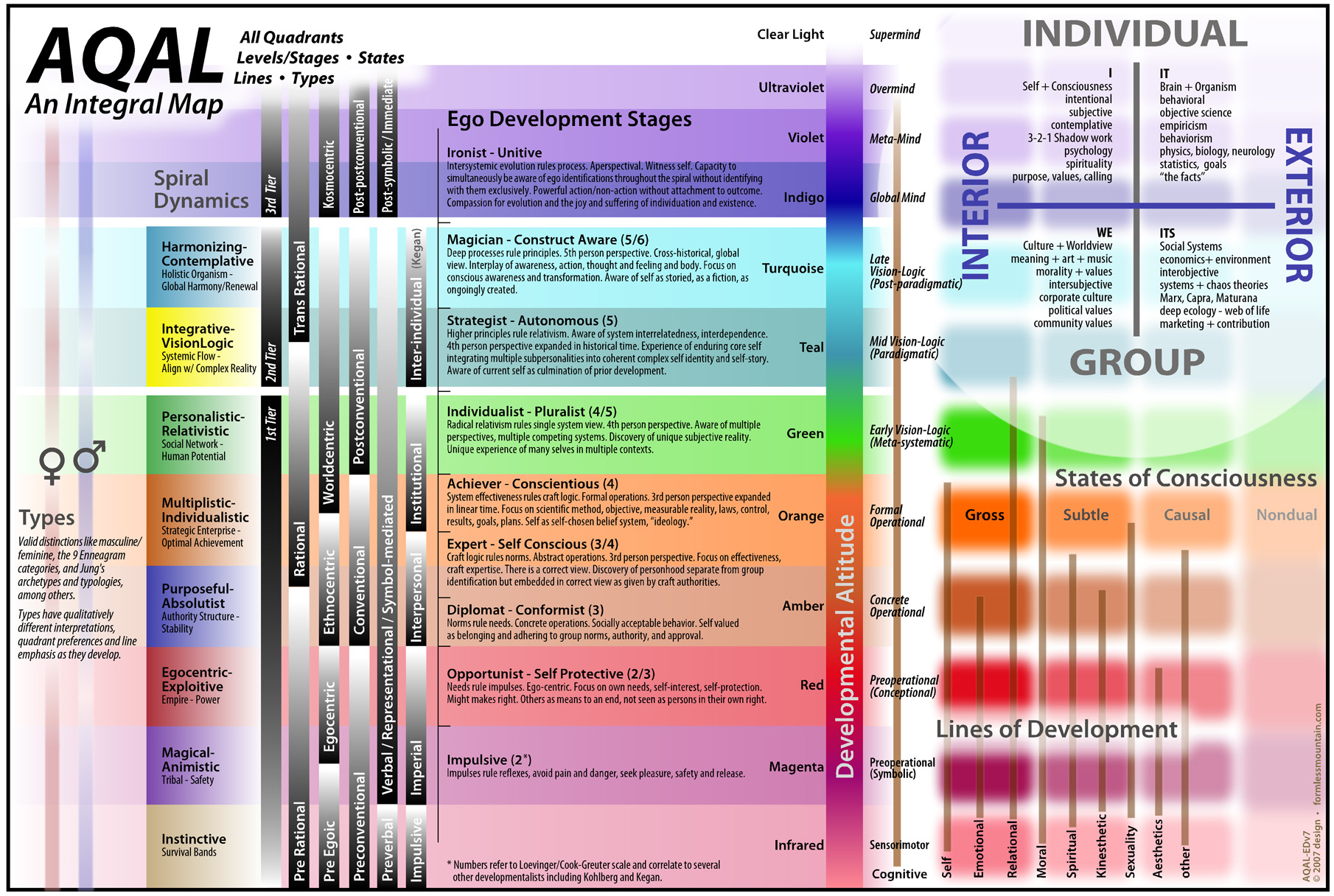
Comprehensive AQAL Chart by Steve Self – click to enlarge

Monday, October 07, 2013

Explore the Power of Collective Insight with Bonnitta Roy


I first became aware of Bonnitta Roy's brilliance at the 2010 ITC Conference - she was one of the presenters whose session I covered as part of my "official blogger" responsibilities. I knew she was an Associate Editor at the Integral Review, the best of the integral theory journals available (as well as being open access), but that was it.

Her presentation at the conference was titled, "AQAL 2210: A Tentative Cartology* of the FutureOr How do we Get from AQAL to A-perspectival?" Here is the abstract:

Abstract

As early as 1946 Jean Gebser predicted that Integral consciousness would have the capacity to render all the previous structures of cognition transparent. Today we have the AQAL map which identifies and contextualizes the 8 indigenous or native perspectives of cognition. What is the possibility that there are emergent perspectives beyond the eight indigenous perspectives included in the AQAL framework? What would these potentially “super integrative” perspectives look like? Can we anticipate future potentials by identifying those who seem to be operating at or near the edges of these integrative perspectives today? In addition, Gebser predicted that Integral consciousness would have the capacity to make new kinds of statements, by engaging new types of thinking that would go beyond perspectival thinking into the realm of the A-perspectival. According to Gebser, the hallmarks of this new consciousness would include, in addition to transparency and integrity, dynamics of the whole, space and time freedom, and spirituality. So the question is “How do We Get from AQAL to A-perspectivalfrom the ability to contextualize perspectives across the boundaries that delimitate them, to a realm of unbounded wholeness? Writing in No Boundary, Wilber tells us:
The ultimate metaphysical secret, if we dare state it so simply, is that there are no boundaries in the universe. Boundaries are illusions, products not of reality but of the way we map and edit reality. And while it is fine to map out the territory, it is fatal to confuse the two.
Integral theory is tricky. In many respects, it is a liberation theory – whether it addresses personal, spiritual or social concerns. At its best, integral theory enables us to dis-embed from limited perspectival frameworks, and open up into more integrated views. However, at its worst, integral theory is absorbed as a metaphysical reality, as a fixed and static limitation on how we perceive, what we can perceive, and how reality arises. When Wilber writes that AQAL is a map of the prison, the integral community should immediately understand that there is no prison except for the map. A-perspectivity is the unconditioned situation of living/being without the map. If we can learn to operate from that unconditioned place, then we can create new maps through which new worlds might arise with greater degrees of freedom and open up our choice field. If we operate from that unconditioned place we will avoid the mistakes of misplaced concreteness that weld ideas into the bars and barriers of our self-imposed prisons. If we operate from that unconditioned place we will have transmuted the prisons of our selves into the playgrounds of spirit. We will, in other words, enter into the ever-present process of enacting our future.
Bonnitta was presenting the first "trans-integral" model of integral inquiry I had seen. Her presentation was excellent. I have been following her work ever since.

Now she is fundraising for a new virtual community working toward collective insight on Indiegogo. It sounds to me that she is working with a model that would fall under the heading of  intersubjective systems theory, but collective insight sounds nicer.

Here are the details for this new venture, complete with an interview of Bonnitta by Steve Nickeson.

Explore the Power of Collective Insight

A collaborative exploration on the power of collective insight


Steven Nickeson interviews Bonnie on her life, writing, and collaborative insight. Bonnie asked Steven to "really grill me to make it more real for people" ... and Steven does an excellent job of doing just that.


Collective Insight is the experience of a group of people working together all having the same key insight at the same time. Although one or two individuals might speak it first, each person experiences the insight, the “ah ha” moment, spontaneously and at the same time, so there is very little impression that one or another individual came up with the idea. On the contrary, people report the feeling of already knowing what the person was going to say, or alternately, the feeling of having someone “take the words right out of my mouth.”

Collective Insight can be compared to a group of musicians from different bands and different styles coming together to play. At first they are each playing in their own sound, so it just sounds like an arbitrary mixture of competing riffs. As they search for a sound that is completely new, the result goes through phases of dissonance and experiment. Without any previous idea of what the result will be, and without needing anything like agreement or consensus on this form or that, the group can spontaneously settle into a completely new sound – something that surprises even them. Together, they begin to “hear” the form that is shaping, that is moving them toward an emergent new way of playing that has never been played before.


We already know quite a few things about collective insight. We know it is a special and rare outcome of group interaction. We know that collective Insight is emergent, embodied, creative, spontaneous, imaginative, playful and powerful. Although most people have difficulty describing it, every person knows it when they experience it. In fact, outside observers who come in after the fact can tell when a group has achieved collective insights. We know that collective insight is powerful because it taps into creativity that is greater than the sum total of the individuals in the group. We know that it depends upon people in the group having a sufficient orientation toward letting go of their individual patterns of behavior, thinking, doing, and saying, while also being willing to abandon what they know in lieu of what they might be surprised to learn, and able to allow themselves to flow with emotional, dialogic, conceptual and relational movements through all kinds of phases and in any and all directions.

We know that collective insight requires the ability to stick with the engagement during the oftentimes long process of working through the uncomfortable periods when nothing seems to be happening, or everything seems to be going wrong. We know that these are periods which are very similar to natural adaptive processes, in which many configurations of outcomes are tried, but few achieve the right “fit” or resonance. In these periods, a bright idea might fizzle out while deep silence or dark tension might spark a wave of inspiration. We know that the process depends strongly on relational dynamics, and that relational dynamics are non-linear and ride strong waves of emotional energy and subtle energetics. Finally, we know that it is impossible to determine what is a “beneficial” contribution and what is not, since everything that happens contributes to the adaptive process, which can benefit from contributions that can feel pleasant or unpleasant, and that therefore, the greatest potential for collective insights happens in groups where people learn to be equanimous with the process and happy to participate without expectation of outcome.

For a little more than 20 years small groups of people around the world have been experimenting with different versions of collective engagement. The earliest attempts at group alignment, such as world café, focus on forms of outward communication and forms of presentation. With the introduction of Otto Scharma’s U-theory the focus turned toward quality of the internal state or presence of the individuals participating in group activities. Ria Baeck has carried this into the practice of collective presencing. Bill Torbert introduced the system of action-logics and its role in leadership, while Terri O’Fallon’s GTC program focuses on the role of higher stages and states of awareness in facilitating transformative change. More recently Terry Patten coined the term “trans-rhetorical” and others have used the term “generative discourse” to signify a new type of discourse that leads to or arises within groups that practice what Dustin DiPerna has called transpersonal “inter-being.” Still, other practices rely on transpersonal states of spiritual arousal that open and deepen awareness toward a kind of trans-individual being, as reported by a core group of practitioners of Enlighten Next.

Almost all the practices we mentioned have taken place within groups that self-select based on community needs, shared values, or spiritual commitments. We can consider these practices as community-specific. Community-specific practices are in some sense “primed” by specialized language, shared memes, formal and sometimes rigorous rules of engagement – whether explicitly stated or operating implicitly. While these conditions maintain group cohesion, they can also intensify peer pressure and create false consciousness.

Despite this, and because of this, all the people participating in this symposium have been very careful to delineate specific approaches that steer clear of the conventional traps of collective practice. This symposium brings these traditions together for the first time to engage as peers – all on the same level, all in the same “soup” as it were – to practice collective insight. The practice we will perform will not be pre-stated, but must arise from the co-creative and emergent “fermentation process”, to use a tour from Bruno Latour – the form of the practice must arise from a kind of fermentation of what we bring, individually and collectively, to the engagement. We will be open to being surprised, and welcome what comes next.

This is both a challenging and exciting prospect. What will we find out about ourselves? What will we witness about the process of engaging as peers? What principles of collective practice will we discover? What significant insights will come, in the spontaneous co-creative relational dynamics that will course through our 4 days together.

If we can derive principles for generating collective insight in groups where there are few selection criteria, and where people represent a broad range of values and oftentimes “competing” worldviews – then we have a powerful practice for addressing 21 Century problems. How often our communities, our businesses, our organizations, our governments, stymied by dysfunctional means of discourse and pathological ways of being together. Relational dynamics are more often destructive than generative in groups, especially where the topics are complex and the stakes are very high.

If we can set out a rigorous set of principles for collective insight, that is not values or world-view specific, but is methodological in scope and processural in practice, then we have the possibility of bringing collective insight-training into a much larger context.


Your support is crucial to the outcome of the symposium. By helping us reach our goal, we will be able to develop a strong foundation and core curriculum for offering collective insight training. With additional funding, we can build a website that will host a collaborative college.

Because it is important to have a larger community be a part of this special event, we have designed the symposium so you can participate in many different ways. With a $ 40 donation you can join our social media site where you will receive real-time blog posts of what is happening "on the ground" so to speak, and participate with people like yourself who are enthusiastic and curious about collective insight. These will include photographs and short videos. You will meet and interact with others who, like you, are interested in building these emergent capacities.

At the $60 level you will receive private links to raw video footage of the symposium, which will include direct addresses and candid interviews. Up this to $80 and you will receive an Alderlore Insight Center T-shirt that will support our further work.

On Friday night and on Saturday night from 7-8:30 pm(Eastern), we will be live broadcasting two special events. Designed as a panel-on-panel "rapid fire" exchange, on all things arising -- these spontaneous discussions are sure to be extraordinarily fertile sessions. To participate, and add your voice to the fire, select Friday Night Lights or Saturday Night Fever (or both).

Those of you who will not be around to participate in real time, can opt to receive a dropbox of all the blog, video and livestream material in a post-production package by supporting us at the $ 200 level. Add an Alderlore T-Shirt, and you won't miss a beat.

For those who are interested in doing more, and be a part of the ongoing practice that emerges, there are three options. At the $ 400 level you can get started with a short training session which includes training material. At the $1200 level we offer customized coaching for facilitating collective insight. If you represent a team or group who could benefit from collective insight training, we offer a one-day on-site workshop given by Alderlore Insight Center faculty -- this for $ 3000 (travel and expenses not included). Your support at the $ 6000 level reserves the retreat studio at Alderlore Insight Center for you and up to 5 other people for a 4-day intensive that will immerse you in collective insight practice.


When similar events are held at convention centers, a greater percentage of the community's money is spent on outside products and services. Because the symposium is being held at Alderlore Insight Center, all the donations will go to benefit and further this work and sustain more initiatives like this.


Please spread the news about the symposium, about our work, and most importantly about this campaign for support. Tap into as many friends and family members as you can to donate even at the $ 25 level, because this work is important to you. As our communities of inquiry and practice grow larger and more distributed, it is crucial to keep investing in leading-edge research around topics and practices that are helping to create the future we hold in our hearts.

Wednesday, July 31, 2013

David Christopher Lane - Ken Wilber's Eye: Exploring the Dangers of Theological Reifications

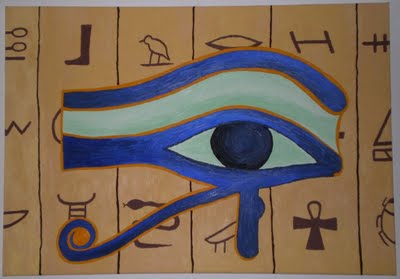
The Eye of Ra

From Integral World, David Lane recently posted an article in response to Wilber's new "Integral Semiotics." While he is slightly critical of Wilber's overgeneralizations in some areas - his reifications - Lane is overall much kinder to this new rewrite of old ideas than am I.

When Lane says, "Wilber wants to argue that reality is far more than mere sensorimotor referents," I want to say, "Well, duh!" He's been saying that for close to 35 years. And really, as I have mentioned previously, this is simply another iteration of his basic model with a few new terms.

Here is a sort of summary paragraph:
The fundamental problem, I would suggest, is not in the fact that there are many worldspaces (there are), but over how we interpret such experiences. The very reason we have confidence in the relative reality of an apple versus one person’s claim of seeing God is that the former can be socially mediated whereas the latter lacks such social verification. It is premature to say the least that such experiences can be properly adjudicated even if we have an idealized Wilber sangat of enlightened beings. David Blaine, the noted street magician, can easily trick onlookers with the most rudimentary of magic and all this even while we are well trained in our five senses. One can only imagine how easy it would be to trick someone into inflating their own meditative experiences into something far grander than it actually is. Furthermore, the term apple is much more specific than the word God which is far too abstract and too generalized a term to be useful in a discussion designed for specificity. 
Lane gets at, with less vigor than I would have, one of the major flaws that has been inherent in Wilber's work from the beginning - it is focused on individual subjectivity almost exclusively, while only paying obligatory lip-service to intersubjective and interpersonal experience.

Despite my nit-picking, this is an excellent opening response to Wilber - I wonder if he will also respond to the second part of Wilber's new work, the "Giga Glossary" proposal.


~ David Christopher Lane, Ph.D. Professor of Philosophy, Mt. San Antonio College Lecturer in Religious Studies, California State University, Long Beach Author of Exposing Cults: When the Skeptical Mind Confronts the Mystical (New York and London: Garland Publishers, 1994) and The Radhasoami Tradition: A Critical History of Guru Succession (New York and London: Garland Publishers, 1992).

Ken Wilber's Eye: Exploring the Dangers of Theological Reifications

David Christopher Lane, Ph.D.

I still vividly recall the night I first read Ken Wilber’s article, “Eye to eye: The relationship between science, reason, and religion and its effect on transpersonal psychology,” in the then new journal, ReVision (Winter/Spring, Vol. 2, No. 1.). It was 1980 and I was teaching full-time at Moreau Catholic High School and working on my M.A. in the History and Phenomenology of Religion at the Graduate Theological Union in Berkeley, California. For a number of months I had been undergoing a severe intellectual dilemma that was precipitated by my obsessive readings of all things scientific. Although I was deeply immersed in Indian philosophy (particularly the practice of shabd yoga and philosophically the purview of Advaita Vedanta), I felt a deep unease about how such an internal pursuit could hold up under rational scrutiny, particularly given the tremendous progress physics and neuropsychology had made over the past century.

At the time I was deeply into meditation and also deeply into skeptically analyzing my religious-spiritual outlook. I was having, more or less, an epistemological crisis. Reading Wilber’s essay was (and the pun is intended) an eye opener, since he very clearly explained three different levels of acquiring knowledge: sensory-empirical; mental-rational; spiritual-transcendental. Brad Reynolds gives a nice summary of Wilber’s tripartite schema:
“Eye to Eye introduces the notion of epistemological pluralism with the (Christian mystic) metaphor of the "three eyes of knowing," i.e., sensory/flesh (sensibilia), mind/reason (intelligibilia), spirit/contemplation (transcendelia). This multi-leveled understanding then brings to light a "category error," or when one "eye" (or realm) tries to usurp the roles of the other two, or is outright mistaken for another. Therefore the "problem of proof" can be solved since each domain provides their own particular validity claims for differentiating the principle spheres of human knowledge (respectively, science, psychology/philosophy, mysticism). The presentation thus contains an extended examination of the philosophical history of science and its reductionistic tendencies (known as scientism), yet it does so by offering a rational synthesis (or a vision-logic of mandalic reasoning) which can not only include science but also authentic spirituality and contemplative practices. Eye to Eye also contains the all-important essay "The Pre/Trans Fallacy," whose conception (a few years back) overturned the common Romantic error adopted by Wilber's earlier writings. This pre/trans fallacy clarifies a major (and disastrous) confusion in the modern world, which simply states that if we are to truly understand and accept the "form of development" (identify, transcend, integrate) at each stage of evolution in a pluridimensional universe, then we must always properly differentiate between pre- and trans- personal domains of consciousness. The book therefore offers not only a strong critique of scientific materialism, but it also brilliantly shines an illuminating light to help guide the "New Age" out of its dark cave of mythic thinking and its regressive (pre-rational) approaches to spirituality.”
I read Wilber’s article very closely several times late into the night and into the next morning. It was about 3 or so in the morning when I experienced an intellectual moment of satori, a flash of clarity about the pursuit of knowledge and its many pathways. I immediately became a Wilber convert, since he had by his clarity of thought provided me with an intellectually satisfying way to justify both my scientific and mystical pursuits. They were not, as I originally feared, mutually exclusive.

I say this is as a prefatory note to Ken Wilber’s latest essay Integral Semiotics (which is reportedly an excerpt from volume 2 of the “Kosmos Trilogy"), since it is in many ways a sophisticated, if still debatable, extension of Wilber’s "Eye to Eye" article which was originally penned nearly 35 years ago.

Given my earlier admiration of Wilber’s essay on methodological pluralism, I find there is much that I like in his new refinement, even though one has to be cautious not to fall prey to some of his unnecessary reifications. Wilber provides a clear overview of his thesis in paragraph three where he writes,
"But my point is that they all, in fact, exist in a specific worldspace that can itself be discovered and experienced—such as the causal or formless state of consciousness, particular stages of meditation, specific peak experiences or altered states. When one is in those worldspaces—and not simply staring at the sensorimotor worldspace—then the actual referents (the "real phenomena" of each referent)—can be clearly seen or experienced. And this changes the nature and meaning of semiotics altogether, by asserting that any given referent of a particular signifier exists in a specific worldspace, and in order to experience that referent appropriately (if it exists at all), the subject must get itself into that particular worldspace, and only then look around for the referent."
Wilber’s point, though obvious, is important in understanding that there are multiple states of awareness and to properly understand what is transpiring in any one of those states necessitates actually being within that particular stream of consciousness--what Wilber repeatedly calls “worldspace.” Otherwise, one cannot fully appreciate the inherent nuances that attend within that conscious space. I can draw on an obvious example from my own medical history to back up Wilber’s assertion here. For a number of years I completely lost my sense of smell and taste and thus an entire “worldspace” (what one may call an olfactory universe) was shut off from me, try as I might to imagine it once again. However, shortly after surgery (or a heavy dose of prednisone) my sense of smell comes back and I enter into the most wonderful galaxy of scents--from sea weed, to coffee, to Chiptole salsa! It is literally unimaginable (in terms of lived through experience) to conjure up such a sensual region unless one is immersed within that region. 
Importantly, and this goes to the very heart of why methodological pluralism is vital to Integral theory, Wilber wants to argue that reality is far more than mere sensorimotor referents:
“But in addition to the sensorimotor worldspace, there are the emotional, the magical, the mythical, the rational, the planetary, the holistic, the integral, the global, the transglobal, the visionary, the transcendental, and the transcendental-immanent worldspaces, to name a prominent handful. And all of those worldspaces have their own phenomenologically real objects or referents. A dog exists in the sensorimotor worldspace, and can be seen by any holon with physical eyes. The square root of a negative one exists in the rational worldspace, and can be seen by anyone who develops to the dimension of formal operations. And Buddha-nature exists in the causal worldspace, and can be easily seen by anybody who develops to that very real dimension of their own state possibilities. But neither the square root of a negative one nor Buddha-nature can be seen in the sensorimotor world—and all the philosophies that take the material realm or the sensorimotor realm as the prime reality (or that take consciousness-free ontology as the basic given), will not be able to locate either of those, and will hence conclude they both lack a fundamental reality (unless they go out of their way to make an exception, as, for example, positivism does when it says that all that is real are things and numbers—but too bad for Buddha-nature or Spirit: just can’t be found in the realm of dirt or numbers and thus is unceremoniously erased from the face of the Kosmos.) In other words, the real referent of a valid utterance exists in a specific worldspace. The empiricist theories have failed in general because they ultimately recognize only the sensorimotor worldspace (and thus cannot even account for the existence of their own theories, which do not exist in the sensorimotor worldspace but in the rational worldspace).”
While Wilber’s argument from a phenomenological perspective makes eminently good sense, the danger in his approach is that he tends to fall prey to premature reifications when he uses such words as “Buddha nature or Spirit” as if such terms have already been universally accepted by all and sundry . . . which they have not. Moreover, he tends to confuse experience with its causation-reality, forgetting in the process of how easy it is for anyone to be deceived or duped by how certain phenomena are produced.

Ironically, Wilber tends to invoke a naive realism when addressing a so-called shared reality. For example, he argues
“When we perceive an apple, and say “I see the apple,” and the brain lights up in a particular way, we do not conclude, “The apple only exists as a brainwave pattern; it otherwise has no reality.” No, we conclude that the apple is a real object in the real world, and as the brain perceives it, it lights up in various specific ways.”
While on the surface this seem evidential, the fact remains that what we could be mistaken about the perceived object and on closer inspection discover that it wasn’t an apple but a pear or perhaps a 3-D paper object which only “appears” to be a real fruit. I am belaboring this point because there is no absolute given even in the sensory-empirical world, which could not potentially be mislabeled or misinterpreted. This may seem like a trivial point, but I think it looms much larger than we might at first suspect when we enter into the mystical domain which doesn’t have the same overwhelming consensual feedback correctives (at least not yet).

This become readily apparent when right after his “apple example” Wilber writes,
“But what happens when we say the same type of sentence but a different referent, such as, when engaged in contemplation, “I see God,” and the brain again lights up in a specific way. Do we give to God the same reality we gave to the apple, and conclude that God is a real phenomenon in the real world, and the brain is lighting up as it sees this real item? No, in fact we don’t. In fact, we do just the opposite. We take whatever brainwave pattern we can find at the time—perhaps an increase in gamma waves—and we say, “When the brain produces excess gamma waves, then the subject will imagine that he or she is seeing God.” In other words, where with the apple the brainwaves are taken as extra proof that apples are real, with God, the brainwaves are taken as extra proof that God is just an imaginary object; it’s not real in the real world, but simply an imaginary product of certain brainwave patterns. What’s going on here?”
As I pointed out previously, we could potentially be wrong about an apple (and indeed this happens more than we realize), but the reason we might be doubly suspicious about a contemplator claiming “I see God” (versus him or her saying “I see an apple”) is that it doesn’t generally take a specialized skill for us to recognize an apple or something similar to it. In addition, the commonality of the experience is anything but extraordinary, which is not the case with someone claiming to see God (whatever such a nebulous term might mean and in what context). In addition, the subjective nature of meditation circumscribes how easy it is to share with others the content of what he or she encountered. For Wilber’s example to be equatable with seeing an apple necessitates a socially mediated worldview, not a purely subjective one, regardless of how real it may or may not be. 
Now this doesn’t mean that the contemplator’s worldspace is something that isn’t valuable or important; it simply means that the experience of an apple which others can see and share in the same time-space referent shouldn’t be conflated with what a contemplator sees or hears or experiences in the privacy of his own being. 
For instance, you cannot appreciate dreaming unless you too have dreamt. That seems obvious. But that doesn’t mean that the dreamer is somehow privileged because of that ability to know the causation or ontological status of that dream. Thus, while I applaud Wilber’s insistence that we should explore varying regions of consciousness (via mediation or otherwise), I think it is misleading to then pontificate about the “reality” or “truth-value” of such experiences by trying to equate seeing an apple in the sensorimotor arena with seeing God in contemplation and then lambasting those who argue that there may be a difference between them. 
The fundamental problem, I would suggest, is not in the fact that there are many worldspaces (there are), but over how we interpret such experiences. The very reason we have confidence in the relative reality of an apple versus one person’s claim of seeing God is that the former can be socially mediated whereas the latter lacks such social verification. It is premature to say the least that such experiences can be properly adjudicated even if we have an idealized Wilber sangat of enlightened beings. David Blaine, the noted street magician, can easily trick onlookers with the most rudimentary of magic and all this even while we are well trained in our five senses. One can only imagine how easy it would be to trick someone into inflating their own meditative experiences into something far grander than it actually is. Furthermore, the term apple is much more specific than the word God which is far too abstract and too generalized a term to be useful in a discussion designed for specificity. 
Later on in his essay, Wilber elaborates on the importance of knowing the correct “Kosmic Address” to enter into these worldspaces.
“This is also directly related to what is referred to as the “Kosmic Address” of a phenomenon. In order to locate a referent (e.g., a dog, the square root of a negative one, or Buddha-nature), one has to know the worldspace in which the referent exists. Simply giving a signifier or name to the object or event tells us nothing about whether that object or event is real (what about “unicorns,” or the “tooth fairy,” or “Santa Claus”? Turns out those are real, but only in the mythic worldspace. They cannot be found in the sensorimotor world, the rational world, the holistic world, etc., and are thus usually dismissed as fantasy, overlooking the genuine phenomenological reality those items have for those in the mythic worldspace, where those items are as real as any other object or event that can enter awareness at that level)."
I appreciate Wilber’s nice turn of phrase here about Kosmic addresses and how we need to access certain phenomena by correctly entering those domains. 
Phenomenologically speaking, yes we do live in a multiverse of differing states of awareness. But I think we should be cautious about how we use the word “real” when describing what these experiences ultimately mean and entail. 
For instance, I remember as a young kid walking on the beach in Santa Monica and my friends and I would see gold glittering on the wet sand. For part of the day we really thought we were going to be rich since we had discovered a precious metal! Of course, our parents quickly dampened our millionaire dreams when they explained that it was only “fool’s” gold since it was simply how the light reflected off the water and sand to give it that unique sparkle. 
Okay, so as a kid I had an experience of “gold” but it wasn’t really gold at all. What changed? My interpretation of the phenomenon. The thing “itself” remained the same, even though my experience was irrevocably altered. 
When it comes to subtler realms of consciousness, the difficulty in determining the relative reality (or permanence? or consensually share inputs?) of what arises is much more fraught with potential missteps, given the paucity of an overwhelming agreement on such matters. 
I can draw upon my own spiritual tradition to underline this epistemological conundrum. In shabd yoga circles (particularly within Radhasoami branches), it is almost axiomatic that when an initiate goes within during meditation he or she will see the radiant form of their guru who will guide them by light and sound to higher and higher regions of awareness and bliss. 
Within Radhasoami Satsang Beas, to give an example from the largest sect of the tradition, meditators almost universally believe that the radiant form is a vision created by their Master’s grace from the audible life stream. However, Faqir Chand, a longtime practitioner of shabd yoga and later an acknowledged adept, came to an entirely different realization. Due to a series of now famous events, Faqir realized that inner visions of his guru and other fantastic apparitions were projections of his own mind. I still remember when I gave a copy of Faqir’s life story and teachings (see The Unknowing Sage: The Life and Work of Baba Faqir Chand) to my satsangi friend who was also my local mail woman. I caught up with her a few days later and see looked slightly distraught. I inquired about why and she said, “I started crying after I read about Faqir Chand’s revelations. It made me doubt all that I believed before concerning meditation and the Master’s radiant form.” 
So let’s agree with Wilber that in order to access the inner sound current and explore subtler and subtler realms of consciousness one has to engage in some sort of meditation technique (or something similar to it). But what does that then mean in terms of “reality” or truth value? Isn’t the real issue not one of worldspaces (that is an obvious given) and not even Kosmic addresses (don’t we already know this from from drugs and dreaming?), but of competing interpretations of what such inner and outer states mean? 
Wilber does write about this, but I think he assumes far too much in his mandalic way of mapping things out as if the mystical cartography has already been settled upon by earlier pioneers. 
There is a sort of ontological hubris in Wilber’s writing that lacks the open ended sense of wonder that an adventurer in this field should have, particularly when even in this state of awareness we know so little, what to speak of realms yet to be explored.
This why I hesitate when he says “And Buddha-nature exists in the causal worldspace, and can be easily seen by anybody who develops to that very real dimension of their own state possibilities.” 
It would be one thing to say that in certain elevated states one can experience something that MAY be interpreted by contemplators to be akin to what some Buddhists have called Buddha-nature, but it is quite another to reify (as Wilber is prone to do) what a certain state provides. Perhaps if a Faqir Chand entered into that same realm he may doubt that interpretative nexus and argue for something quite different. Simply put, if we can be easily deceived within this world by sleight of hand, neural trickery, and more, then we should be much more wary when it comes to meditative states where deceptive illusions abound as well. 
I wish Wilber would stay within the bounds of reasonableness where he makes strong and believable arguments for exploring differing realms of consciousness. Where he loses me and where he sinks into spiritual platitudes is when he then moves beyond open exploration (with the operative word being “open”) and writes theological puffery such as,
“As you approach the causal, your Awareness will begin to profoundly unwind and uncoil in the vast expanse of All Space, and you will be opened to states of increasing Radiance, Freedom, Love, Consciousness, and Bliss or Happiness. Your separate-self sense will begin to dissolve in a pure feeling of I AMness, and your own highest Self will increasingly come to the fore, marked by being grounded in the timeless Now or pure Presence in the Present. As you break through into causal consciousness without an object, or Pure Subjectivity, you will recognize your True Condition as spaceless and infinite, timeless and eternal, Free and Transparent, Unborn and Undying. You will meet your own Original Face, or Divine Spirit itself, naked and spontaneous, all-pervading and all-embracing, a state from which you have never really deviated and could not possibly deviate, but one that has been there all along, in every moment, as the simple Feeling of Being. You will have a profound sense of “coming home,” met often with torrents of grateful tears and gales of endless laughter. You have, after all these painful years, arrived at your Native Condition, which does not recognize the name of suffering, is a stranger to the pain of existence, is alien to weeping, cannot pronounce agony. And then when somebody asks you, “Does God exist?,” you will be able to answer them based on direct personal experience. “Yes, and I have seen It myself.”
The problem with such statements as “I have seen It [God] myself” is that it lacks skepsis and tends by its very language to cut off further discussion or inquiry. Wilber’s continued use of such flowery descriptors as “Divine Spirit itself,” “naked and spontaneous, all pervading and all embracing”, “Buddha nature”, etc., suggests that his real goal is to bring us into his theological ballroom, but in order to accomplish this he misleadingly dresses us up with plausible personal and scientific possibilities. 
In this regard, I wish I could see eye to eye with Wilber since I agree with him on a number of issues, but when he succumbs to prematurely theologizing the inner quest with unnecessary reifications, I end up cross eyed. 
Perhaps if Wilber spent more time with critics of his work like Visser, Falk, Meyerhoff, [Lane] and others, than with questionable sycophants such as the now disgraced Andrew Cohen, he could better understand why erstwhile admirers of his work are not rushing into his peculiar worldspace. 
I say all of this because Wilber has given us many valuable insights, but they seem hamstrung by his apparent conceit to prefigure and finalize that which is still open for vigorous debate and refutation. As Scott London tellingly explained in his review of Ken Wilber’s book, One Taste:
“Someone once observed that there are at bottom two kinds of writers, those who write what they know and those who write in order to know. Wilber clearly belongs to the former camp. His instincts are always explanatory rather than exploratory. His goal is always to reveal rather than discover.”
One yearns for more of Wilber as the explorer and less of Wilber as the pontificator. Perhaps the recent downfall of Andrew Cohen will be the necessary lesson to shock Wilber into realizing this.

Friday, July 26, 2013

Ken Wilber - Integral Semiotics, Part 2: The Giga Glossary (Say What!?!)


I'm glad to see I am not the only blogger/reader (thank you Daniel Gustav Anderson) who has issues with Wilber's newest post on "integral semiotics," in which he argues for a "Giga glossary" (emphasis added):
What is required, at this point in evolution, is a “Giga glossary”—a comprehensive listing of the various phenomena (and hence various referents) found in each and every aspect of each and every dimension of the AQAL Matrix—listings of the phenomena found in all the quadrants, all the quadrivia, all the levels and Views, all the lines, all the states, and the types of existence and being-in-the-world that are presently arising. This would give us the Kosmic Address of every major phenomenon in the Kosmos (at least as now understood).
This is required? Really? By whom, and for what? 

Do we really need the "Kosmic Address" of "every major phenomenon in the Kosmos"? [For readers new to Wilberese, Kosmos is his term for the whole damn universe, from quarks to consciousness.]

"At this point in evolution," what it seems to me we need is a solution to climate change, a way to curb the obesity/diabetes epidemic that is no longer confined to the U.S. and Western Europe, free quality education for all, transparency in government, a viable P2P/Commons system to move us beyond capitalism, a cure for cancer, an end to the mass extinction of plants and animals . . . . I think you get my point.

Anderson has more philosophical issues with Wilber on this new proposal:
I find such categories as the possible, the emergent, and the novel to be of particular use; these are not yet accounted for here, insofar as the "Kosmic Address" described above concerns posited phenomena, the already realized, and not those presently articulating processes that are only now becoming. Further, I should hope that any competent semiotics would find ways to differentiate knowledge that is simply wrong (not just incomplete or partial but demonstrably false) from that which is merely incomplete, from that which is figurative (say, metaphoric or metonymic) and therefore not literally true but still bearing truth-value, and so on. (What counts as a phenomenon here?) I would like to know what the "Kosmic Address" of this concept of "Kosmic Address" is. Is it on Akashic Records lane?
Anderson suggests some other authors and books to read, so go see his recommendations (last paragraph). There is no doubt they are better than this, uh, new material.

*****

I kept reading Wilber's post after the section quoted above, which opens the article, but I became increasingly disheartened.

Wilber's whole project, from The Atman Project forward, seems to be an effort to explain his conception of God/Spirit/Ultimate Reality in a way that makes it seem more than faith in the validity of his subjective experience. In The Marriage of Sense and Soul, he outlines a kind of "reality testing," or "scientific method" for proving or disproving claims in the domain of spirituality. 
1. Instrumental injunction: The experiment, "If you want to know this, do this." The injunction might be, for example, if you want to experience nondual awareness, perform this meditation practice in just this way, for this length of time.
2. Direct apprehension: Here we get the experience, the apprehension, generated by the injunction. This step provides the data for the experiment.
3. Communal confirmation or rejection: At this final stage we compare our results with others who have performed the same injunction. We check our data against the data of others who have taken up that meditation practice for the prescribed length of time.
[Wilber, 1998, The Marriage of Sense and Soul, p. 155-56]
The assumption (a false assumption, in my opinion) is that if enough people perform the experiment and get similar results, then the results point to some form of transcendent truth. In my opinion, this model is constructed, at least in part, to support his own conjectures around Spirit and Kosmos. Prior to this model, there was only "faith" or "belief," but with this Wilber proposed a way to test the reality claims of a given spiritual idea or injunction.

So let's use a real example. 

DMT (N,N-Dimethyltryptamine) is a popular and potent hallucinogen found in nature (and in human beings). Alongside LSD, mescaline, and psilocybin (to which it is structurally similar), it is probably one of the most widely studied hallucinogens in use. Strangely, and unlike many other hallucinogens, there is amazing commonality in the experiences of people who smoke (or use other inhalation methods of) DMT:
The subjective effects of a good lungful of DMT are usually very intense, with consciousness usually overwhelmed by visual imagery. With eyes closed this may take the form of extremely complex, dynamic, geometric patterns, changing rapidly. Such a dose of DMT may produce a visual pattern consisting of overlapping annular patterns of small rhomboid elements all in saturated hues of red, yellow, green and blue. Gracie & Zarkov [44] refer to this, or something similar, as "the chrysanthemum pattern." The pattern itself seems to be charged with a Portentous energy.

The state of consciousness characterized by amazing visual patterns seems to be a prelude to a more Profound state, which subjects report as contact with entities described as discarnate, nonhuman or alien. A very articulate account of the subjective effects of smoking DMT is given by Terence McKenna in his talk Tryptamine Hallucinogens and Consciousness [72], in which he recounts his contact with what he calls "elves."
Does the fact that many (most?) users of DMT experience something similar to this description mean, then, that "the chrysanthemum pattern" is real in some sense, or that "elves" and other "discarnate, nonhuman" entities exist someplace outside of our normal consciousness?

According to Wilber's model, the answer would seem to be yes.

However, these are drug-induced subjective experiences - there is nothing inherent in these experiences that requires them to have any reality outside of the drug state.

It's worth noting that Wilber, as late as 1998, was still writing and conceptualizing about the "Great Nest of Being," his reframing of the more traditional "Great Chain of Being."
In Integral Theory, the Great Nest of Being is not a Platonic given but, in large measure, is constructed of evolutionary Kosmic habits.
In essence, Wilber's is a teleological model of the universe.
A thing, process, or action is teleological when it is for the sake of an end, i.e., a telos or final cause. In general, it may be said that there are two types of final causes, which may be called intrinsic finality and extrinsic finality.[1]
  • A thing or action has an extrinsic finality when it is for the sake of something external to itself. In a way, people exhibit extrinsic finality when they seek the happiness of a child. If the external thing had not existed that action would not display finality.
  • A thing or action has an intrinsic finality when it is for none other than its own sake. For example, one might try to be happy simply for the sake of being happy, and not for the sake of anything outside of that.
Since the Novum Organum of Francis Bacon teleological explanations in science tend to be deliberately avoided because whether they are true or false is argued to be beyond the ability of human perception and understanding to judge.[2] Some disciplines, in particular within evolutionary biology, are still prone to use language that appears teleological when they describe natural tendencies towards certain end conditions, but these arguments can almost always be rephrased in non-teleological forms.
I have no real issue with teleological models, and even Thomas Nagel (see Mind and Cosmos: Why the Materialist Neo-Darwinian Conception of Nature Is Almost Certainly False, 2012) has recently been supportive of such models, as long as they do not include supernatural causes or beings. Nagel offers a real and valid metaphysics, "the question of what exists." Wilber offers "supernatural" causes, "that which is not subject to the laws of physics, or more figuratively, that which is said to exist above and beyond nature."

To my reading, Wilber's new "integral semiotics" is simply another attempt to justify and support his AQAL model. Granted, I am not dismissing AQAL as a basic orienting map, nor am I claiming that it's basic organizational premises are false.

What I am claiming is that the metaphysics upon which much of the spiritual element in integral theory is little more than intelligent design dressed in New Age clothing. And in that respect, Wilber's "integral semiotics" is simply another defense of that paradigm.

Monday, July 15, 2013

Jeremy Johnson - “Everything that Rises…” or Synthetic Thought, Florilegium and the Networked Age: ITC 2013

Jeremy Johnson, who blogs at Evolutionary Landscapes, is the official blogger for the 2013 Integral Theory Conference, which begins later this week in San Francisco. I can't imagine a better choice than Jeremy, a man who is thoroughly educated in integral theory and is also an outspoken critic on some of its shortcomings.

Below is the beginning of his first post for the conference - an excellent piece of writing in my opinion.

“EVERYTHING THAT RISES…” OR SYNTHETIC THOUGHT, FLORILEGIUM AND THE NETWORKED AGE: ITC 2013


July 13, 2013
by Jeremy Johnson

I’m fast approaching my 5 A.M. flight on July 17th. The night before will likely consist of a heavy 9 P.M. dose of melatonin and meditation-unto-sleep. I had come up with a few clever titles and openings to my pre-conference blog, but, I think I’ll stick to the honest basics. Let’s start where I am: enthralled heartbeat, sweaty palms, swooning contemplation about what happens when you put more than one integral meta-theory practitioner in a room. Yes, this year’s theme is certainly “meta” (see urban dictionary for a proper definition). First thing’s first: this conference is hosted by proponents of a theoretical and philosophical system of “orienting generalizations,” a veritable theory of everything—Integral Theory, originally developed by American philosopher Ken Wilber. Next, we have Edgar Morin, a French sociologist and “integral” thinker in his own right, author of Homeland Earth and the developer of what he calls “complex thought.” Lastly we have Roy Bhaskar, the founder of the school of Critical Realism. Sean Esbjorn-Hargens, author of Integral Ecology: Uniting Multiple Perspectives on the Natural World and conference organizer, will be speaking on behalf of Integral Theory. So let’s talk about context.
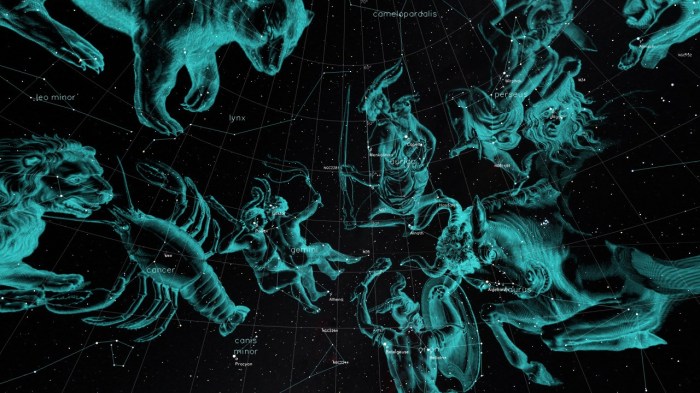
Each of these scholars claim to some degree that the human race is at the precipice of some major event—a global crisis at the edge (or some say, end) of history—where we need to bring our disparate modalities of thinking and being-in-the-world together. The notion of a “cosmopolitan,” according to Webster dictionary, means having a “worldwide rather than limited or provincial scope or bearing.” Now add the “K” to “Kosmopolitan,” and we’ve remixed it with the old Greek word, “Kosmos” which Wilber was so fond of in his seminal book, Sex, Ecology, Spirituality: The Spirit of Evolution.“Kosmos” originally meant “the universe” or “the starry firmament,” but went on to include our planet and all its denizens. While it’s certainly meant to be a play of meaning, I think it’s relevant to the meat and bones of this conference.


“Kosmopolitan” implies that the desire to look out at that starry abode is something we’ve inherited as a species. That no single theory really owns this impulse, any more than any religion truly holds captive the sense of the sacred. That East, West, Europe, America, and every nation and tribe has drawn constellations of synthesis into (perhaps, out from) the heavenly firmament. This is the “Integral Kosmopolitan.” A movement with no center, no periphery: articulated by all but owned by none. Integral thought—if there really is such a thing—is in fact a larger “epistemic impulse” as Trevor Malkinson articulates in his excellent essay, “The Rise of the Synthesizing Mind in the Planetary Age.” As we come into an awareness of planetary issues and human interdependence with the rest of the biosphere—so too do our “meta” theories gain the robustness of discovering they are co-initiators of planetary culture.

Jean Gebser—of whom I am a deep reader of his phenomenal text, The Ever-Present Origin—came to a similar realization after publishing the first installment of his tome, only to discover that in India, Sri Aurobindo had been writing and working on his own version of “integral consciousness” in The Life Divine.

Now, I am inclined to believe that a healthy embodiment of this integral impulse isn’t interested in assimilating another’s work, which I think degrades and diminishes the integrity of fellow authors and scholars, but instead, attempts to realize a form of “synthesis” that is more decentralized as its primary characteristic. As Trevor writes in his article, “what frustrates me… is that talk of integral or integrative thinking is often reduced—by adherents and critics alike—to simply being about the work of Ken Wilber.” Over the past few years, I think the Integral Theory community has gradually recognized this criticism, as Sean writes over at MetaIntegral: “Our approach recognizes that Integral Theory is not as integral as it could be, and so we continually strive to make Integral Theory more integral through respectful inquiry and debate with other streams of integrative thought.”


This is why I am eagerly anticipating the conversations in the conference halls as three autonomous theories—Critical Realism, Complexity Thinking, and Integral Theory—mesh and mate, exchange their memetic material and show up in a couple of months with a mutant baby or two. Yeah, something like that.
Read the whole article.

Monday, July 08, 2013

Søren Brier - Cybersemiotics: A New Foundation for Transdisciplinary Theory of Information, Cognition, Meaningful Communication and the Interaction Between Nature and Culture

This ambitious article by Søren Brier on the emerging field of cybersemiotics appeared in the new issue of Integral Review, a special issue on transdisciplinary models. Brier is the author of Cybersemiotics: Why Information Is Not Enough (Toronto Studies in Semiotics and Communication) [paper, 2013; Kindle, 2008].

Cybersemiotics: A New Foundation for Transdisciplinary Theory of Information, Cognition, Meaningful Communication and the Interaction Between Nature and Culture 

By Søren Brier [1]


Abstract: 

Cybersemiotics constructs a non-reductionist framework in order to integrate third person knowledge from the exact sciences and the life sciences with first person knowledge described as the qualities of feeling in humanities and second person intersubjective knowledge of the partly linguistic communicative interactions, on which the social and cultural aspects of reality are based. The modern view of the universe as made through evolution in irreversible time, forces us to view man as a product of evolution and therefore an observer from inside the universe. This changes the way we conceptualize the problem and the role of consciousness in nature and culture. The theory of evolution forces us to conceive the natural and social sciences as well as the humanities together in one theoretical framework of unrestricted or absolute naturalism, where consciousness as well as culture is part of nature. But the theories of the phenomenological life world and the hermeneutics of the meaning of communication seem to defy classical scientific explanations. The humanities therefore send another insight the opposite way down the evolutionary ladder, with questions like: What is the role of consciousness, signs and meaning in the development of our knowledge about evolution? Phenomenology and hermeneutics show the sciences that their prerequisites are embodied living conscious beings imbued with meaningful language and with a culture. One can see the world view that emerges from the work of the sciences as a reconstruction back into time of our present ecological and evolutionary self-understanding as semiotic intersubjective conscious cultural and historical creatures, but unable to handle the aspects of meaning and conscious awareness and therefore leaving it out of the story. Cybersemiotics proposes to solve the dualistic paradox by starting in the middle with semiotic cognition and communication as a basic sort of reality in which all our knowledge is created and then suggests that knowledge develops into four aspects of human reality: Our surrounding nature described by the physical and chemical natural sciences, our corporeality described by the life sciences such as biology and medicine, our inner world of subjective experience described by phenomenologically based investigations and our social world described by the social sciences. I call this alternative model to the positivistic hierarchy the cybersemiotic star. The article explains the new understanding of Wissenschaft that emerges from Peirce’s and Luhmann’s conceptions.
1. Søren Brier is Professor of Semiotics in the Information, Cognition and Communication Sciences  at the Department of International Business Communication at Copenhagen Business School. He is the creator of the transdisciplinary framework Cybersemiotics, founder and editor-in-chief of the journal Cybernetics & Human Knowing, co-founder of the International Association for Biosemiotic Studies and its journal Biosemiotics. sb.ibc@cbs.dk

An Overview of the Flow of the Argumentation in the Article 


I begin with a brief introduction to my view of scientific thinking on deep theories and a few words about the limitation of the word ‘science’ in the English language and my proposal to use the German transdisciplinary term ‘Wissenschaft’, which includes qualitative research into meaning. I argue that it is vital to include the meaning aspect of reality when we deal with information, cognition and communication research. I will then briefly introduce my cybersemiotic visual model for organizing the exact, the life and the social science as well as the humanities in a framework shaped as a star with four different arms, a framework which I propose as an alternative to the positivistic ‘unity of science’ idea based on physics as model science and its modern version found in E. O. Wilson’s ‘consilience’ model. Cybersemiotics is a vision of how to integrate truth and meaning as well as the empirical and the experiential aspects of knowing in one pragmatic and semiotic view of the collective production of knowledge. I will then explain the phenomenological model behind Peirce’s phaneroscopically based semiotics. I briefly introduce his three categories and his idea of a philosophical foundation for a reflected cenoscopic science. I then briefly explain Maturana and Varela’s idea of autopoiesis and after that try to show how Luhmann’s triple autopoietic systems view of socio-communication has a reflected pragmatic and realistic grounding that fits in with and supplements Peirce’s philosophy. I go on to explain the development of biosemiotics as an attempt to build a semiotic link from the life sciences to the social sciences and humanities through an evolutionary and ecological semiotic view. As the pan-informational and pan-computational philosophy tends to be more and more dominating, I find it necessary to explain how Peirce’s philosophy, which he calls pragmaticism, can be seen as an alternative. As Peirce lived a hundred years ago, my argument draws on modern American philosophers like Sellers, McDowell and Brandom.

Since Plato’s philosophy of a world of ideas and universal concepts was confronted by modern empiricism’s belief in material facts, the discussion on inter- and transdisciplinarity has been about what is most real: matter, forces, form or universal concepts. The possibility of transdisciplinarity therefore rests on our ability to define a reality that includes them all. Peirce’s suggestion of a scholastic realism inspired by Duns Scotus is such an attempt and I shall try to explain what it is all about. Peirce introduces time and possibility to enlarge our view of reality. What is, and what has been only cover the part of actuality, which is based on the past. There are, however, also would be’s dealing with probabilities. Peirce – like Popper and Prigogine – views possibilities as real and includes them in his category of Firstness. But they are also the basis for habits or what Peirce calls Thirdness. Peirce distinguishes between what is real and what exists. The only form of existence as such is what he calls ‘thisness’ (haeccity), which is his category of Secondness. It is this triadic processual understanding of semiotics that distinguishes Peirce’s semiotics from Saussurian semiology and makes the idea of biosemiotics possible. I then try to visualize how we may combine biosemiotics’ idea of endosemiotics creating the biological self and its exosemiotic communication theories with Luhmann’s triadic autopoiesis model of communication. This is done in order to give a first overview of the cybersemiotic idea and to explain how the integration of semiotics and system theory offers a more plausible model of evolution that can explain the emergence of mind. The article concludes by suggesting a new model of five ontological levels and a changed view of the reality of nature.

A New Foundation for the Sciences [2] and Humanities 


Cybersemiotics proposes a new transdisciplinary framework integrating Peirce’ triadic semiotics with a cybernetic view of information on the basis of an ontology of emptiness. It is an attempt to give a transdisciplinary solution to C.P. Snow’s two-culture problem. The proposed framework offers an integrative multi- and transdisciplinary approach, which uses meaning as the overarching principle for grasping the complex area of cybernetic information science for nature and machines AND the semiotics of all living system’s cognition, communication, and culture. Cybersemiotics is an integrated transdisciplinary philosophy of science allowing us to perform our multidisciplinary research, since it is concerned not only with cybernetics and Peircean semiotics, but also with informational, biological, psychological and social sciences. In order to incorporate the sociological disciplines and contributions from multiple areas of applied research cybersemiotics draws extensively on Luhmann’s theories.

We are thus immersed in conscious and unconscious communication forms, verbal as well as non-verbal. As the linguistic turn argues, we cannot escape language, nor culture and power. Even science becomes a social construction, which is historically true, since science is a relatively recent phenomenon in the history of man. Empirical and mathematically grounded science is a modern invention that started in the Renaissance. Scientific knowledge has formed our rationality and cultural outlook on the world since then and right up to the global discussion these days about the reality of global warming.

And yet science is still faced with the problem of meaning. The background of cybersemiotics is the recognition that Western philosophy of science is in a state of crisis. Western culture is at a turning point when it comes to taking the final step into a knowledge culture based on information and communication technology. Rather than basing our culture on the conception that the highest goal of knowledge is an abstract, non-embodied and globally available (artificial, impersonal) intelligence of information programs, I believe that we should ground our culture(s) on embodied human living (personal as well as interpersonal), i.e. on semiotic intelligence as part of both living nature and human culture, rather than only on the physical science and the worldview behind it.

The current dominant objectivist science, which to me includes physicalism, eliminative materialism, cognitive sciences based on the information processing paradigm, cannot encompass self-aware consciousness and social-communicative meaning as causal agents in nature. Current cognitive science attempts to explain human communication from the outside without recognizing the phenomenological and hermeneutical aspects of existence. Its conception of human (meaningful) language and communication as a sort of culturally developed program for social information processing between computational brains/ minds cannot explain the evolution of embodied consciousness and (meaningful) human language and communication. Cybersemiotics offers a new ontology that can encompass a moderate version of the ontologies of all four dimensions or spheres.

Inspired by the methodology of critical realism (Bhaskar, 1997, 1998) and Bourdieu (Bourdieu and Wacquant, 1992), I believe that our common sense only shows us the surface of reality, and that it is the task of the sciences to dig deeper and look further than our common sense assumptions. I agree with Gadamer (1989) that our cultural history is also a development of our knowledge about ourselves, society and nature forming a common knowledge horizon. Therefore I agree with Karl Popper that it is the role of scientists and philosophers to boldly invent new ways of looking at reality, knowledge and ourselves. Take for instance Einstein and Bohr, who forever changed the way we understand matter, energy, time, space and knowledge, or Norbert Wiener who introduced information as a basic ontological component in his transdisciplinary cybernetic worldview.

I see the semiotic philosopher C. S. Peirce (1839-1914, see his collected papers: Peirce 1931-1935) as such a bold inventor, one who had important and profound ideas about the development of human knowledge development long before Karl Popper (1960, 1962, 1972, 1974, and 1976) and Roy Bhaskar (1997, 1998) published their theories. Peirce created a whole structure of philosophy, science and humanities through his semiotic philosophy (inspired by Dons Scotus and Kant), which includes a transdisciplinary theory of meaning, signification and communication. In a somewhat supplementing vein Niklas Luhmann (1990, 1995) – originally inspired by Talcott Parsons’ (1902 –1979) structural functionalism – developed a social system theory that views social communication as the basic reality of society and integrates the psychic and the biological autopoietic systems. Luhmann borrows the concept of autopoiesis from the cybernetic biologists Humberto Maturana (1983, 1988a, 1988b) and Francisco Varela (1980, 1986).

It is my view that these two interdisciplinary theories may be combined into a transdisciplinary framework that I call cybersemiotics. I firmly believe that cybersemiotics constitutes a realistic foundation for a comprehensive understanding of the natural, life and social sciences as well as humanities and that it can provide a deeper understanding of the differences in the knowledge types they produce and show why each and every one is necessary. By establishing this new framework, I also hope to create a transdisciplinary approach which transcends the incommensurability between C.P. Snow's two cultures: science-technology versus the humanities and the social sciences. I am trying to draw up a map onto which a multitude of viewpoints can be plotted and their subject areas characterized and compared with other approaches. In doing so, I hope to expand the dialogue between the exact sciences, the humanities, the social sciences and philosophy. A more comprehensive and further argued version of cybersemiotics can be found in the foundational book Cybersemiotics: Why Information Is Not Enough [paper edition, Kindle edition] (Brier, 2006) as well as later articles on the subject (Brier, 2007, 2008a, 2008b, 2008c, 2008d, 2009a, 2009b, 2010, 2011).
2. For me the concept ‘sciences’ refer to natural, life, technical as well as social sciences. With a background in biology I consider the life sciences to assume a different ontology from that of physics and chemistry, which do not operate on the premise of life as biology does. 
 Read the whole article.

Thursday, June 20, 2013

Lexi Neale - The AQAL Cube for Dummies

In the current Integral Leadership Review, Lexi Neale was finally persuaded by Russ (Volckmann, owner and founder of the Review) to write a dumbed-down version of his AQAL Cube theory for the ILR.

It's a long article and very much worth your time to read. For the purposes of this post, I am only including the author's note at the beginning and the 2nd major section of the paper, on how the cube relates to individual human beings. I can see a potential use for this in Integral Psychotherapy.

I'm not a huge fan of the "quantum consciousness" piece (locality and nonlocality) he adds to the model, especially in light of using the Hameroff/Penrose model. Their theory is speculative at best, and simply wrong in the minds of many cognitive neuroscientists and quantum physicists.

About the Author

Lexi Neale has a varied background. He studied Zoology and Psychology in 1966-1969, B.Sc. , London University. In 1971 in Glastonbury he met his thirteen-year-old Master, Prem Rawat, just arrived from India. Prem Rawat teaches a time-honored integral practice that he calls Knowledge of the Self – as in Know the Knower. Lexi Neale is affiliated with The Prem Rawat Foundation, an award-winning charity providing aid for the relief of human suffering. Contact www.tprf.org and wordsofpeaceglobal.org (wopg.org). He is also a member of the Integral Research Center as an Integral Theorist. Contact Lexi Neale personally at lexneale.integral@gmail.com

The AQAL Cube for Dummies

Lexi Neale

Download article as PDF

Lexi Neale

Author’s Note: The above title is not intended to be demeaning, dear Reader, but more of an inside joke between Russ and I. Russ has twice approached me about an AQAL Cube article, and has twice shied away from what I sent him. His complaint? Too complex! So I have finally relented and taken his observation to heart. I sincerely hope that the following extension of Ken Wilber’s AQAL Square model is at least comprehensible, if not acceptable!

Since Ken introduced my AQAL Cube extension of his Integral model, the AQAL Square, on kenwilber.com, archived June 12th 2009, it has been “the best of times, and the worst of times” (A Tale of Two Cities) as in a tale of two models. In an introduction he wrote for Part 2, archived November 4th 2009, where I pitched the AQAL Cube as Wilber-6, he said “In my mind, of course, it is definitely not Wilber-6, just a thoughtful extension of Wilber-5.” And in my mind, of course, I am still challenging that!

It is true that the AQAL Cube vastly complicates the Integral model by introducing AQAL Non-locality into the mix, and also the liberal notion of Eight Fundamental Perspectives PER PERSON, but the complication has more to do with the effort of having to transcend/include establishment Integral concepts rather than complexity per se. I let you be the judge of that. Going back to Ken’s comment “a thoughtful extension of Wilber-5”, I decided that should be my guide in writing this article, by keeping to the aspects of the AQAL Cube that truly are extensions of the AQAL Square.


* * * * *

The AQAL Cube per Person


Now we go deeper into our Self-system. Ken’s AQAL Square affords the Self-system two First Person Quadrants (Upper and Lower Left). Ken himself has said that the AQAL Square is really a Third Person model describing First, Second and Third Person phenomena. We now reconsider that blatant admission of flat-land. This is where established Integral Theory gets taken for a really wild ride in a very powerful car!

Remembering how Ken’s Third Person “Inside”’, “Outside”, “Individual”, “Collective”, “Interior” and “Exterior” perspectives recombine to produce the Eight Fundamental Perspectives (Fig. 1), the same logic can be applied to our First Person: As well as our Consciousness Self and our Cognitive Self we also have a Singular Self, a Plural Self, a Subjective Self, and an Objective Self, which recombine in the same way to produce the Eight Fundamental First Person Perspectives. Suddenly our two-cylinder car becomes a V-8!

Since the beginning of language the First, Second and Third Person pronouns have defined our self and each other: Me Tarzan, You Jane. And it is in language that we express our intuitive knowledge of our own Self complexity. Fig.2. shows the First Person Cube and its eight First Person pronouns expanding through the Levels.


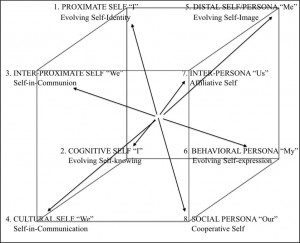
Figure 2. The First Person Cube

The Quadrants above, 1,3,5,7 are the Non-Possessive Personal Pronouns, and the Quadrants below, 2,4,6,8 are the Possessive Personal Pronouns. The first thing that is apparent is how the Non-Possessive Quadrants 1,3,5 and 7 are intangible First Person identities, and how the Possessive Quadrants 2,4,6 and 8 are tangible First Person experiential attributes of those identities. The differentiation is exactly the same as between Non-Local Consciousness and Local Body-Mind. In other words, our entire cultural history has endorsed the notion of a Four Quadrant “Experiencer-as-Consciousness”, and a correlated Four Quadrant “Experience-as-Mind”.

The second thing we notice about the First Person Cube is that there is no differentiation in English between the two “I’s” and ”We’s” as First Person pronouns in the Subjective Octants 1,2,3 and 4. Language is a two-way street: One the one hand it identifies pre-existing perspectives as a common experience, which then become cultural givens; but on the other hand, in naming them, it can culturally bias some perspectives at the expense of others. Cultures that are objective diminish the subjective; cultures that are collective diminish the individual; cultures that are materialistic diminish the non-material – by not differentiating them. In Russian there is a differentiation between an “inner We” and an “outer collective We” as in “We the people”. In Yiddish there is a differentiation between “I” as a spiritual identity and the “I” of everyday life.

In evaluating his “8 Zones”, Wilber encountered this anomaly himself in differentiating an Inside “I” from an Outside “I”; and an Inside “We” from an Outside “We”. I quote[7]:
‘ – for example, the experience of an “I” in the UL Quadrant. That “I” can be looked at from the inside or the outside. I can experience my own “I” from the inside [Octant 1], in this moment, as the felt experience of being a subject of my present experience, a 1st person having a 1st person experience. If I do so, the results include such things as introspection, meditation, phenomenology, contemplation, and so on (all simply summarized as phenomenology… But I can also approach this “I” from the outside [Octant 2], in the stance of an objective or “scientific” observer. I can so in my own awareness (when I try to be “objective” about myself, or try to “see myself as others see me”) …Likewise, I can approach the study of a “we” from its inside or its outside. From the inside [Octant 3], this includes the attempts that you and I make to understand each other right now. How is it that you and I can reach a mutual understanding about anything, including when we simply talk to each other? How do your “I” and my “I” come together in something you and I both call “we” (as in, “Do you and I – do we – understand each other?”). The art and science of we-interpretation is typically called hermeneutics. 
‘But I can also attempt to study this “we” from the outside [Octant 4], perhaps as a cultural anthropologist, or an ethnomethodologist, or a Foucauldian archaeologist…And so on around the quadrants. Thus, 8 basic perspectives and 8 basic methodologies.’ (The Octant designations in brackets are mine.)
In other words, Wilber completely endorses the Left Octants (1,2,3 and 4) of the First Person AQAL Cube, but he does not extend this argument to the First Person Right Hand Quadrants (5, 6, 7 and 8). He does, however, mention the objective-self issue:
‘If you get a sense of yourself right now – simply notice what it is that you call “you” – you might notice at least two parts to this self: one, there is some sort of observing self (an inner subject or watcher); and two, there is some sort of observed self (some objective things that you can see or know about yourself… The first is experienced as an “I”, the second as a “me”… I call the first the proximate self (since it is closer to “you”), and the second the distal self (since it is objective and “farther away”).’
The Proximate and Distal Selves are an Octant 1 and Octant 5 differentiation on the First Person AQAL Cube. Octant 5 is the Distal Self, or the way I formulate my Proximate Self as a Persona in its true etymological sense, as my mask, as how “I” want others to identify with “Me”. This is the All Level “Me” Inside. (Note: This differentiation of the Distal Self or Persona is not the persona of fulcrum 4.) And the correlated behavior of this Persona is “My” personality Outside, where Octant 6 pertains to “My” personality through “My” behavior. The Enneagram as elucidated by Riso[7] makes this differentiation very clearly.

Equally, the Social Persona or our identification with “Us” Inside, and the Social Personality-behavior in “Our” tribe Outside, follow the same First Person differentiations. These eight important First Person Self-differentiations have not yet been made in Integral Psychology, even though they are experientially self-evident to the point where Wilber himself identified six of them, with “Us”.

Integral Theory does in fact obliquely identify the Self-system as a First Person Octo-Dynamic. I noticed how the various Lines of the Self System in the AQAL Square Upper Left have an eerie correspondence with the First Person Eight Fundamental Perspectives. Naturally, this needs to be played out in Integral Research, but I propose that the correspondence self-evidently corroborates the First Person AQAL Cube:
Octant 1: Proximate Self as the Consciousness-as-experiencer “I”. Core self-identity witnessing through Levels of assumed identity states. Lines: Proximate Self-identity, spiritual identity. Representative Levels of Self-identity-as-witness are: Red – Id identity fused with the Lower Mind; Orange – Ego identity fused with the Lower Mind; Blue – Soul Consciousness differentiated from Mind. Violet – Non-Dual Supreme Witness.

Octant 2: Cognitive Self as the “I” Mind. Experiential identity through Fulcrum Levels of intelligence structures. Lines: All Intelligences, such as cognitive, affective, psychosexual, aesthetic, spiritual. Representative Levels of experiential intelligence are: Red – sensing, feeling, emoting; Orange – thinking; Blue – visioning; Violet – wisdom/Akashic experience.

Octant 3: Inter-Proximate Self as “We” Consciousness. Shared self through Levels of assumed identity states. Line: inter-proximate self. Representative Levels are: Red – Inter-Id as fused “I-We”; Orange – Inter-Ego “We”; Blue – Inter-Soul “We”; Violet – Non-Dual “We”.

Octant 4: Cultural Self as the “We” Mind. Interpretive shared or common experience as cultural intelligence. Lines: moral self, worldview self. Representative Levels are: Red – Tribal member (fused “I-We”); Orange – cultural independent; Blue – cultural visionary; Violet – spiritual iconoclast.

Octant 5: Distal Self (Persona) as “Me” Consciousness. Objectively differentiated from the Proximate Self of Octant 1, the Persona is self-referential as a Self-image. This is the intentional persona of the Enneagram, the objective evaluator of the Self-system and home of the Self-judging Super-Ego. After death existence or Bardo is a projection of this self-evaluation as our Non-Local All-Level Persona. Line: intentional persona. Representative Levels as State-stages are: Red – Id-centered, 4th Bardo; Orange – Ego-centered, 3rd Bardo; Blue – Soul-centered, 2nd Bardo; Violet – Pneumo-centered, 1st Bardo.

Octant 6: Behavioral Persona as “My” Mind. Objectively differentiated from the Cognitive Self of Octant 2, the Behavioral Persona is the objective expression of Mind as our Personality and its Enneatypes. Lines: behavioral personalities as applied to cognitive, affective, psychosexual, aesthetic, spiritual. Representative Levels as Structure-stages are: Red – magic; Orange – rational; Blue – integral; Violet – spiritually wise.

Octant 7: Inter-Distal Persona as “Us” Consciousness. The Social Self-image is a fused “Me-Us” until socio-centric, after which the Social Identity differentiates. Identification with family, organizations and affiliations. After-death identification with others is through the correlated Non-Local All-Level Social Persona. Line: interpersonal. Representative Levels as State-stages are: Red – symbiont; Orange – server-dominator; Blue – integrator; Violet – compassionate.

Octant 8: Social Persona as “Our” Mind. The Social Persona evolving as organized and cooperative behavior and experience of social situations. Lines: sociocultural, relational, ethical. Representative Levels as Structure-stages: Red – tribal member; Orange – nationalist; Blue – globalist; Violet – utopian.
In the interests of developing a fully Integral model, I suggest that Integral researchers of the Self-system identify their field of research as an Octant in each Person.