Showing posts with label Ken Wilber. Show all posts

Friday, September 04, 2015

Teleological Perspectives and the Pre/Trans Fallacy of Integral Theory

http://image.slidesharecdn.com/theolology-proper-intro-arguments-for-existence-of-god-etc-21444/95/theolology-proper-intro-arguments-for-existence-of-god-etc-26-728.jpg?cb=1250142478

Teleology is an account of a given thing's purpose. For example, Aristotle argued that the purpose of an acorn, its intrinsic telos, is to become an oak tree. This is intrinsic teleology. [A purpose imposed by human use, such as a fork’s extrinsic purpose is to make eating certain foods easier, is extrinsic teleology.] Natural teleology contends that natural entities have intrinsic purposes, irrespective of human use or opinion.

According to Wikipedia:
Though ancient atomists rejected the notion of natural teleology, teleological accounts of non-personal or non-human nature were explored and often endorsed in ancient and medieval philosophies, but fell into disfavor during the modern era (1600-1900). 
In the late 18th century, Immanuel Kant used the concept of telos as a regulative principle in his Critique of Judgment. Teleology was also fundamental to the speculative philosophy of Georg Wilhelm Friedrich Hegel.
A recent example of teleological science is Thomas Nagel’s 2012 book, Mind and Cosmos: Why the Materialist Neo-Darwinian Conception of Nature is Almost Certainly False, an argument that the emergence of life, and in particular conscious life, cannot be explained by materialist or mechanistic principles but, rather, the required principles may be teleological.

Integral theorist Ken Wilber has based his entire integral model on a teleological view of the universe (derived from Vedanta and Tibetan Buddhism), arguing that consciousness arose in the universe so that the universe could come to know itself. In one of his early books, Wilber says that the “Big Bang which was really the roaring laughter of God voluntarily getting lost for the millionth time” (Up From Eden, p. 328). Or this, from a later book:
Maybe the evolutionary sequence really is from matter to body to mind to soul to spirit, each transcending and including, each with a greater depth and greater consciousness and wider embrace. And in the highest reaches of evolution, maybe, just maybe, an individual's consciousness does indeed touch infinity - a total embrace of the entire Kosmos - a Kosmic consciousness that is Spirit awakened to its own true nature. (A Brief History of Everything, p. 38)
In Sex, Ecology, Spirituality, Wilber offers,
… these life forms were apparently not content to merely reproduce themselves, but instead began a long evolution that would eventually allow them to represent themselves, to produce sign and symbols and concepts, and thus out of life arose mind. Whatever this process of evolution was, it seems to have been incredibly driven from matter to life to mind. But stranger still, a mere few hundred years ago, on a small and indifferent planet around an insignificant star, evolution became conscious of itself. (p.3)
This is a purely teleological understanding of evolution, of the universe. And for Wilber, eros is the force that drives the evolution of the universe.

In this model of the universe, the intention, or even the purpose, can only be understood through actions. In essence, the result of an action (evolution is the seemingly obvious drive toward complexity in the universe as we know it) explains its intention (the purpose of evolution is for the universe to become conscious of itself).

Wilber’s model, like Nagel’s, posits directionality—an intent—in nature. Wilber goes further and claims that the universe has become conscious of itself through human beings and that this is the intention behind evolution, going all the way back to the Big Bang (let’s ignore the fact that the Big bang is still a questionable origin story).

But is this necessarily true?

Psychologically, this is the sensorimotor stage of mentalization (the ability to think about thinking). Mentalization, according to Peter Fonagy, is a left-brain, voluntary, and slow secondary affect regulating system. It is the ability to step back and consider our own cognitive processes as objects of thought or reflection (paraphrasing Mary Main).

According to Csibra and Gergely (1998), "infant's 'teleological stance' generates reality-based explanations for actions that are neither mentalistic nor causal." In essence, the teleological perspective is "reality-based," in that it attempts to make sense of an event within the available evidence (primitive though it is), but it lacks a truly causal explanation due to a lack of ability to mentalize (to take one's thoughts/beliefs as an object of awareness).

Wilber’s sensorimotor stage is very low on his developmental schema and, in fact, it is the bottom (beginning) stage of cognitive development. As mentioned above, teleology is the sensorimotor stage of mentalization, the reading of one’s own and others’ mental states. There is likely some discrepancy in stages here, and Wilber’s sensorimotor stage and pre-operational stage may well be equivalent to Fonagy’s sensorimotor stage.

We take for granted that intentions precede actions in our experiences of other people. The problem is when we extend this belief to non-human agents, such as animals, weather, or the universe. This is a form of anthropomorphism, the attribution of human intentions and feelings to non-human agents.

As such, this is a primitive state of consciousness. It is correlated strongly with Wilber’s impulsive (or magical/animistic) stage of development. Again, very low on the hierarchy of cognitive development—it’s pre-rational (mind), pre-egoic (identity), pre-operational/symbolic (cognitive), and pre-conventional (moral). It is also preverbal, relying on a very basic cause and effect schema that intuits cause based on effects.

How is it that a teleological perspective in philosophy (and the philosophy of consciousness) is not considered primitive and pre-rational?

What we are really discussing here is a subtle manifestation of the pre/trans fallacy that Wilber himself is credited with discovering. Here is how this distinction is defined at Integral Life:
Ken noticed a core confusion that made it very difficult to discern between the lower stages and the higher stages. Trans-rational mystical experiences were often being dismissed as pre-rational fantasy, postmodern values were being erroneously projected onto pre-modern cultures, and pre-modern impulsiveness and hedonism were being celebrated by the postmodern counterculture. Rather than viewing psychology as a developmental process running from pre-rational to rational to trans-rational (or pre-differentiated fusion to differentiation to post-differentiated integration), a person was seen as being either rational or not—resulting in the trans-rational baby getting thrown out with the pre-rational bathwater.
This is one of Wilber's most important theoretical contributions.

Despite this, Wilber's whole integral model falls into the pre/trans fallacy inherent in teleological perspectives. It's puzzling that Wilber never saw this issue in his own work, but it's often difficult to separate enough from our own beliefs to view them objectively.

On the other hand, he might argue that mystical perspectives are not subject to causal explanations. He has made such claims before.
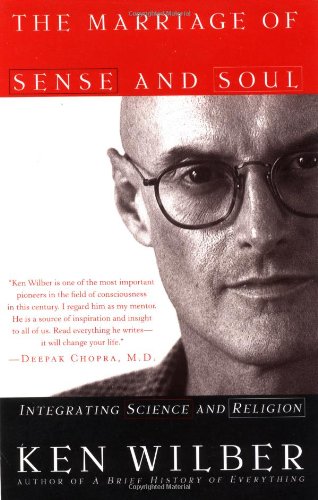
Neither sensory empiricism, nor pure reason, nor practical reason, nor any combination thereof can see into the realm of Spirit. In the smoking ruins left by Kant, the only possible conclusion is that all future metaphysics and authentic spirituality must offer direct experiential evidence. (The Marriage of Sense and Soul, p. 174)
According to this, we are to take as truth the "insights" of mystics who have seen into the realm of Spirit, whatever that may be. We are required to accept, in integral theory, a model of the evolution of the universe that is based on a teleological interpretation of why the universe is as it is.

And this does not even take into account the likelihood that the Big Bang is a false theory, or that rather than evolving toward greater complexity, the universe may well be evolving toward dissolution and entropy (space is expanding faster than previously believed).
As a result, it's suspected that receding galaxies will cross a type of cosmological event horizon, where any evidence of their existence, not even light, would ever be able to reach us, no matter how far into the future you went.

Would someone born in a future time when there are no other stars visible from Earth come up with the same models and explanations about the universe as people born during the previous centuries?

It seems unlikely.

We really lack any actual evidence for what is happening in other regions of the universe. We barely have a grip on what is happening on Earth.

Any person who believes that he or she can offer a cogent and comprehensive explanation for the universe and it's supposed evolution seems to me more than a little delusional.

Tuesday, August 05, 2014

Sarah Nicholson - The Evolutionary Journey of Woman: From the Goddess to Integral Feminism


The following is my review of Sarah Nicholson's recent book, The Evolutionary Journey of Woman: From the Goddess to Integral Feminism (Integral Publishers, 2013). Sass was kind enough to send me a PDF review copy of the book.

* * * * *

When I was 20 years old or so, I began reading the Collected Works of C.G. Jung on the recommendation of an art history professor who correctly intuited my affinity for Jung's approach to psycho-spirituality. As an adjunct, I also discovered (again) the work of Joesph Campbell, who was the editor of The Portable Jung, one of the better introductions to the writings of Jung, grouped thematically. I was previously familiar with Campbell's work from his PBS series with Bill Moyers (based on his, The Power of Myth) in the 1980s.

The parallels between Jung's model of psychological individuation and Campbell's model of the monomyth took me back to Campbell's work, especially The Hero with a Thousand Faces (Bollingen Series, No. 17), which then took me back to the work of Arnold van Gennep and Victor Turner.

In essence, the hero's myth, which Campbell called the monomyth, is a symbolic narrative of initiation, a process that can be broken down into three stages - separation (from family, community, previous identity), [crossing the threshold in answer to "the call"], initiation (physical and psychological trials, often involving a confrontation with the divine feminine and a need to find atonement with the father), [decision to take the gifts acquired back to the world or not], and return (bringing the "boon" bestowed or earned back to the world, sharing the gift with others, no longer fearing death).

Within those three larger movements, Campbell identified 17 individual stages for the whole process - stages that are common to many (if not most) of the world's best known hero's quests.

One thing you may have noticed, however, is that this model is distinctly masculine. While Campbell occasionally made reference to the monomyth applying to women as well, there is little evidence of this in his work.

The question is this: What does the evolutionary journey (individuation) of woman look like?  Can her story be framed within this same structure, or is there a unique path that women follow in their own trasnformational process?

These are the questions Nicholson addresses in her book.

* * * * *

From the Introduction:
"In the midst of a period of internal and external exploration, fueled by the desire to understand the significant disparity between my socio-cultural context and my inner calling - which insisted that life was deeper, wider and wilder than social norms and material goals suggested - I found the work of Joseph Campbell. This meeting was deeply affective. His exploration of the hero beautifully articulated the core purpose of human life as attunement to the path of awakening, and this spoke to me directly."
As she explored the areas of mythology, religion, and spirituality, she discovered the "deeply androcentric nature of these worlds." In her book, Nicholson seeks to find and follow the heroine, to discover and share her story and to "explore woman's evolving relationship with what it is to be human."

To outline the broader project of book, here is the table of contents (personally, I find the table of contents, the references, and the index to be good indicators of whether or not I want to read a given book):
ONE: HEARING THE CALL: THE HEROINE’S JOURNEY    1
Joseph Campbell and the hero’s journey
Mysticism and mythic symbol
The hero’s journey as perennial philosophy
The hero as ‘everyman’
Feminist critique of the hero
TWO: CROSSING THE THRESHOLD: CONFRONTING THE QUESTION OF WOMAN    17
Feminist approaches to the question of Woman
The First wave of feminism
The Second wave
Sex versus gender
Psychoanalytic and poststructural feminism
Woman, mythology and the religious symbolic
Feminist theology
Mary Daly: Reweaving the journey
Carol Christ: Thealogy
Goddess spirituality and the Great Mother
The God problem
Jungian archetypes
The archetype of the self for women
Towards the third wave and beyond
THREE: WHO IS WOMAN? THE THIRD WAVE AND BEYOND     43
Time and the evolution of feminist thought
The discourses of the Third wave
Subjectivities of inter-relation: corporeal feminism
Process philosophy and the Nomadic Feminist subject
Third wave religion: Buddhism’s nondual philosophy
Non-dual philosophy: Transontolog
Definition: The Name of Woman
Integral theory: New tools
Towards an Integral feminism
Woman - through the quadrants
Evolutionary consciousness
FOUR: THE ROAD OF TRIALS: EVOLUTIONARY PATHWAYS    65
The limits of evolutionary theory
Wilber’s evolutionary theory
Holonic theory
Developmental eras of consciousness
From Origin to Integral: The work of Gebser
Wilber’s Integral Theory of development
The Archaic Stage
The Magical Stage
Habermas: Social Labor and the father
Bacofen: Mother right – Father right
Pre-modern Gender: Wilber’s suppositions
Man the hunter
Foraging: woman the gatherer
Evolutionary continuity: sociobiology and sharing
Sexual dimorphism
The collective hunt
The sedentary woman
The father and the question of work
Feminist archaeology: Re-capitulating the evidence
FIVE: MEETING THE GODDESS: THE MYTHIC PLAINS   97
The Question of Venus
Symbolism of the Magical stage
The Mythic stage
Stages of consciousness: From Magic to Mythic
Gimbutas and the Great Goddess
Critique of the Goddess hypothesis
Remembering and inventing the Goddess
Re-reading the Mythic evidence
Epochal mutation: From Mythic to Mythic-Agrarian
The Metamorphosis of Myth: The Tales of Inanna
Inanna: The Great Death
Mythic-Imperial Stage
The Hero and the Warrior
Mythic-Agrarian: The Iron Age
SIX: THE RISE OF THE RATIONAL     123
The Mental Rational Stage
Formal Operational Cognition
From Monotheism to Globalism
Feminism: Emergence vs. Oppression
Gender Stratification: Coercion and Voluntarism
A rebuttal to Co-creative theory
Capacity Development
Woman and the cultural symbolic
From mythos to religion
The separative self
Pathological dominance
The rise of feminist consciousness
Integral answers
Towards the horizon
SEVEN: DIVINE HORIZONS: THE HEROINE’S PATH TO THE UNITIVE   151
Self abnegation: Women’s estrangement from the divine
Women’s divine horizons
Adult development theory
Critique of developmental theory
The first stages of development
Women in the conventional
Critique of gendered theories of development
Girls development and adolescence
The developmental journey of the hero/ine
A developmental junction: Achiever or Affliate
Differentiation and the separative self
The Post-conventional tier
Integrated vs. Construct Aware
The Post-Postconventional tier
The transcendent stage
The Unitive stage
Practising the sensible transcendental
Horizontal and vertical, terrestrial and heavenly
To be incarnated? Archi-ancient and forever future
EIGHT: CONCLUSION     175
Returning from the Journey with Gift Giving
Hands – the Discourse of Integral Feminism
Next Steps: Sacred Marriage
Her chapters (2 and 3) on the history of feminism are very instructive for readers who are not familiar with this material - and few of us outside of academic feminism read most of the authors she references. They also provide a solid foundation for her later explorations of a uniquely heroine-oriented myth and a critical framework for her deconstruction of gender in Ken Wilber's integral theory.

Inanna and the Descent to the Underworld

The myth she feels drawn toward is one of the oldest human myths, the Sumerian myth of Inanna, Queen of Heaven and goddess of lust, love, fertility, and warfare. However, it's important to note that she is not the goddess of marriage. Her domain is lust and she is associated with extramarital sex and affairs, and she can often be found in taverns seeking the adventure of new sexual partners. The Babylonian epic of Gilgamesh also makes reference to Inanna's well-known disregard for her lovers (after the act).

Nicholson understand's Inanna's narrative as a classic hero's tale, or heroine in this case. Her story was the genesis for her book, and even though she chose to expand the study beyond Inanna's myth, she felt pulled back to the myth.
For two years her story was the topic of this book, but the need to establish an Integral feminist philosophical and methodological position that could adequately contextualize her story in terms of stages of consciousness, the evolution of gender dynamics, and changing representations of the female divine, became increasingly clear to me. Thus this book is focused on the greater schema. Yet, no matter how much I put Inanna’s story aside it continued to return to the text. 
One of her best known myths is "Inanna's Descent to the Underworld." Staying true to her nature, when Inanna is rescued from the Underworld, she must choose someone to replace her there. The first few people they come upon are all mourning servants, but then they come upon her husband, Dumuzi, who is not mourning at all (far from it), and she chooses him to go with the demons and take her place in the Underworld.

Any effort to analyze the goddess figure in history requires discussing and critiquing the work of the archeologist Marija Gimbutas. Despite her popularity among lay readers (especially in New Age goddess movements), archeologists and anthropologists have offered harsh and thorough criticism of her Goddess Hypothesis. Gimbutas' main idea is that all of the world's variety of goddess figures can be traced back to a single neolithic goddess or divine feminine figure. Further, she contends that this period of "peaceful, matrilineal, agricultural and primarily sedentary culture of Mythic Old Europe" ended with the invasion of nomadic herders who brought with them domesticated horses and lethal weapons. According to Gimbutas, these invaders brought to Europe "myths of conquering warrior hero gods" (p. 105).

Aside from the vast criticism of her model in archeological and interpretive grounds (which Nicholson spends a couple of pages outlining), there is also the issue of the pre/trans fallacy (an idea developed by Ken Wilber) in assigning trans-rational capacities to a pre-rational culture. An additional issue is that many anthropologists and archeologists believe that it was agriculture that ushered in the patriarchal dominance from which modern goddess movements seek to extricate themselves [see references: 1, 2, 3], not nomadic herders.

Here is the stance Nicholson takes on Gimbutas' work:
While not absolutely explicit, it is clear that, in keeping with feminist methodology, Gimbutas’ archaeo-mythology is a liberally intuitive and creatively interpretive method. She moves her subject matter out of the realm of archaeology and into the realm of mythopoesis and in doing so blurs boundaries and distinctions, utilising but going beyond the scope of the material evidence. Yet despite these methodological problems, there is much rich material in Gimbutas’ extensive research that should not go unutilised.... (p. 107) 
* * * 

Integral Feminism

Nicholson uses Ken Wilber's model of integral theory to underpin her larger project in this book. For this reader, the time spent on Wilber is the weakest part of the book (but I suspect this is less about the book and more about the seeming need for every book using integral theory to spend a couple of chapters explaining Wilber's AQAL model, as if homage must be paid).

To be fair, Nicholson is perfectly willing to criticize the weaknesses in Wilber's theory, and when it comes to sex and gender, there is a lot of room for criticism. 
It is my intention, utilizing the philosophy and methodology of Integral feminism, to follow woman’s journey through the broad waves of human development, as Wilber presents them , to her arrival in feminist consciousness. Along the way I examine how Wilber positions woman and I make feminist incursions into this history where necessary. (p. 63)
Jean Gebser and Jurgen Habermas, primary sources for Wilber's integral model, also get their due from Nicholson. In chapter four, the author offers a thorough and cogent critique of Wilber's (via Habermas) views on the division of work and gender roles in the "Magical" stage of human evolution.

The evidence seems relatively clear that early horticultural societies were not terribly divided in work roles according to gender (as Wilber would have it). Wilber espouses somewhat of an essentialist position on gender and gender roles, and while there are essential differences in some respects, gender roles are (or were) more egalitarian and less rigidly divided.
Studies of contemporary horticultural societies show an equal distribution of productive work between men and women. Both women and men “plant, weed, harvest, and transport crops” after new areas of land have been cleared and prepared for cultivation, mostly by men (Huber 2006, 71). This is likely to have been the case in the Neolithic period also. (p. 109)
 

While moving towards the socially conventional ‘roles and rules’ of concrete operations and conventional morality, the early Mythic [13] period would not yet have the reified differentiations of gender roles and status divisions that are demonstrated in later stages. (p. 109)
 As horticulture became agriculture with the invention of metal tools, especially the hoe and later the sword, humanity moved from a early mythic worldview to a mythic-agrarian worldview. Kinship loyalties now played a lesser role in culture than did political/power loyalties. Dependence on and subservience to a king was now central in daily life.

By tracking these societal changes alongside changes in the Inanna story, the myth becomes reflective of the lives of its tellers.
The Sumerian mythologies of the goddess Inanna straddle the divide between the early Mythic and Mythic-Agrarian stages. Inanna is a particularly important case study. Encapsulated in the very first written mythic narratives, she is both a unique representation of the heroine and of the divine in female form. In this guise she represents the archetype of the Self as envisaged through the Mythic stage. The significant changes that occur in the manner of her representation as the Mythic stage transitions to Mythic-Agrarian demonstrate the shifts in consciousness that occur during this period. (p, 112)
Nicholson details some of the changes that occur in Inanna's myth over that period of time (roughly 2,000-3,000 BCE). This is how the author characterizes her subject:
 The Mythic Inanna embodied the values of adventure, curiosity, knowledge, sensuality and deeper self-knowledge through mysticism. As a spiritual hero she is both agentic and communal, transcendent and yet deeply immanent. As a goddess, Inanna fully represents the burgeoning consciousness of the Mythic Age. Fundamentally different to the mother Goddess espoused by Gimbutas [16], Inanna is a goddess of exploration and knowledge. (p. 113-114)
From here, Nicholson continues to trace the evolution of the archetypal feminine Self, the development of a heroine's myth, through Wilber's psycho-social stages of development.

Final Thoughts

This is a book I found to be educational, enlightening, thought-provoking, and with which I sometimes found myself arguing. Isn't that what good books should do? Being as familiar as I am with both Campbell and Wilber, however, it was easy to let Nicholson lead me on the "evolutionary journey of woman."

As a man who works with other men on issues around gender roles, this feels like an important book for men to read, at least as much so as it is for women. Perhaps nowhere is this so true as in the integral community, with its reliance on Warren Farrell and David Deida as essential leaders in masculinity.

The integral community, in particular, with so many of the primary authors being male and holding essentialist positions, dictated in part by Wilber, has alienated a lot of women. For example, here is a passage from the "Integral Operating System," based on the writings of Carol Gilligan:
Male logic, or a man’s voice, tends to be based on terms of autonomy, justice, and rights; whereas women’s logic or voice tends to be based on terms of relationship, care, and responsibility. Men tend toward agency; women tend toward communion. Men follow rules; women follow connections. Men look; women touch. Men tend toward individualism, women toward relationship. (Wilber, 2012)
Seriously? To define the feminine as communal, caring, and immanent and the masculine as agentic, rights-oriented, and transcendent is so painfully reductionist that both men and women should be turned off by this androcentric nonsense.

Now, we have Sarah Nicholson's book and voice to add some justice, autonomy, and individualism to the heroic journey of the integral feminine.

References:
  1. Hughes, SS & Hughes, B. (2001). "Women in Ancient Civilizations". In Adas, Michael. Agricultural and pastoral societies in ancient and classical history. Temple University Press. pp. 118–119.
  2. Eagly, AH, & Wood, W. (June 1999). "The Origins of Sex Differences in Human Behavior: Evolved Dispositions Versus Social Roles". American Psychologist; 54 (6): 408–423.
  3. Erdal, D. & Whiten, A. (1996). "Egalitarianism and Machiavellian Intelligence in Human Evolution" in Mellars, P. & Gibson, K. (eds) Modelling the Early Human Mind. Cambridge Macdonald Monograph Series.
  4. Wilber, K. (2012, Mar 11). The Integral Operating System. Part IV: What Type Are You? Retrieved on August, 4, 2014, from https://www.integrallife.com/member/ken-wilber/blog/integral-operating-system-part-iv-what-type-are-you

Monday, June 02, 2014

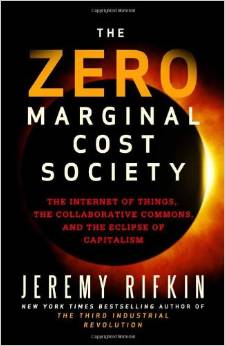
Edward Berge - Review of Jeremy Rifkin's "The Zero Marginal Cost Society"

The Zero Marginal Cost Society

Ed Berge has been reviewing the new book from Jeremy Rifkin, The Zero Marginal Cost Society: The Internet of Things, the Collaborative Commons, and the Eclipse of Capitalism, over at his Postmetaphysical Spirituality forum. All of the individual posts from that thread have been organized into a lengthy article that was posted at Integral World. It's an interesting book that will end up in my stack of things to read.

Review of Jeremy Rifkin's "The Zero Marginal Cost Society"

Edward Berge

This is a review of Jeremy Rifkin's new book, The Zero Marginal Cost Society: The Internet of Things, the Collaborative Commons, and the Eclipse of Capitalism (NY: Palgrave Macmillan, 2014). It is excerpted from the Integral Postmetaphysical Spirituality forum thread of the same name.
Granted the complete demise of capitalism is a long way off, it being mixed with the Commons for some time to come. 
In chapter 1 [The Great Paradigm Shift from Market Capitalism to the Collaborative Commons] he discusses how monopolies intentionally thwart competition and innovation so as to maintain their stranglehold. But he claims entrepreneurs will find a way around it and end up forcing competition with better tech and price reductions (6). Larry Summers 2001 paper acknowledges the emerging information economy was indeed moving to near marginal cost, but Summers didn't propose something like Rifkin, instead recommending “short-term natural monopolies” (8).

Recall Summers was Obama's pick for Director of the National Economic Council. His policy suggestions were well in line with his promotion of “natural monopolies,” as his resume attests. And we're seeing exactly this economic philosophy at play with FCC Chairman Wheeler's proposed pay-to-play rules, where the ISP monopolies will destroy internet neutrality. Recall that Wheeler was another Obama pick, and was a former, and will return to being, a cable and wireless lobbyist. While Obama claims to back income equality and net neutrality he appoints the likes of Summers and Wheeler who make no bones about their support of monopolies. And without net neutrality good bye to Rifkin's entire plan, which requires it to succeed.[1]

 
Chapter 2 [The European Enclosures and the Birth of the Market Economy] was about the transition from a feudal to market economy. The feudal system was based on the Great Chain of Being, a strict theological and hierarchical structure with God at the apex. Property was communally shared based on one's position in the chain. It was when property became 'enclosed' that it turned into private ownership. And with this the shift from a theological Great Chain to a more secular worldview of individual rights, at least for those that owned property. The hierarchy was retained on a societal level but now based on property instead of God. We might also say that these conditions led to the widespread emergence of egoic rationality for said individual property owners.

We can see that Wilber retains the Great Chain in its transcend and include philosophy.[2] Granted there is no longer pre-fixed Platonic forms but it does retain the morphogenetic gradient which involves from Spirit, or God by another name. Sure evolution plays its part, but it still must follow this gradient back up to Spirit. And we can directly experience Spirit via meditative techniques. We will then interpret Spirit through our evolutionary level, but given proper evolution through transcend-and-include, and proper meditative training, we can and do advance up the chain back toward God. This structure is feudal and theological to the core.

Wilber, like the transition to a market economy, retained the hierarchy but also included the shift to individual private property. Along with this came the notion that one was better than others based on their degree of private ownership, if not God. Granted those still into religion combined that into the belief that God favored those who owned more, even in secular circles this better than thou attitude prevailed. It was through one's hard work and merit that they earned a higher socio-economic status. And those without such status deserved their lot due to sloth and laziness.

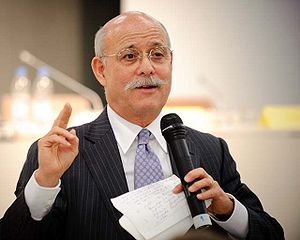
Jeremy Rifkin
Jeremy Rifkin 
 
Or in the case of Wilber, not evolving enough based on its own theological Great Chain structure, combined with its market-based private property rights. There too is a version of the “if you can manifest money and own more private property it's a sign of your spiritual progress.” There is no sign of evolving into the kind of commons Rifkin promotes, or the kind of consciousness that goes with it. Or any analysis of the energy-communication infrastructure that goes along with that. Wilber is still stuck in both the feudal and market economic and consciousness models.

Chapter 3 [The Courtship of Capitalism and Vertical Integration] is on the first two industrial revolutions, which required vast amounts of capital to build its infrastructure. It also required vertical integration of huge organizational structures with top-down hierarchical control which he calls not coincidentally “rationalization.” I suggest that this is the rationalized Great Chain hierarchy[3] we saw from the feudal era, where due to public education we entered the formal rational mode. All of which also saw the emergence of the legal rights of individuals.

On 55 Rifkin notes that while greed, deregulation and corruption certainly plays a part in what capitalism has become, he also asserts that this structure was a natural process for this sort of communication-energy-consciousness regime that provided a general increase in the standard of living for all. It's what Wilber calls the dignity and disaster of the era. For now I simply note that in the emerging Commons era the capitalist structure has reached the point where its disasters outweigh its dignities. And, as Rifkin said, its own impetus for ever-increasing productivity at lower marginal costs has made itself near obsolete.

Chapter 4 [Human Nature through a Capitalist Lens] is a quick run through of the accompanying worldviews from feudal to capitalism. He starts by noting that worldviews justify themselves as the ways things are, either by divine or natural order. The feudal Great Chain promised salvation by knowing one's place in the hierarchy and doing one's duty. In the transitional medieval market economy this shifted to one's hard labor, earnings and property as signs that one was favored by God, which shifted to a more secular notion of one's autonomy and worth as equivalent with one's property.

When the market economy transitioned into capitalism there arose much more vigorous defense of individualism tied with private property as inherent to human nature. Utilitarianism became the defining worldview justification. This led Herbert Spencer to twist Darwin's idea's into social Darwinism, a justification for “survival of the fittest.” Darwin was aghast at such a torturous distortion of his work.

Nonetheless Spencer saw the way of things thusly: “...all structures in the universe develop from a simple, undifferentiated state, to an every more complex and differentiated state, characterized by greater integration of the various parts” (64). Therefore only the most complex and vertically integrated business should survive, as this was natural to evolutionary development. All of which leads to oligopoly with its hierarchical and centralized command and control. This remains the dominant and regressive Republican view today in the US. And I might add the predominant spiritual, philosophical and economic Wilberian view as well.

Not to fret. At the end of the chapter Rifkin assures us that complexity is not synonymous with such a structure. As I've been saying, there is another kind of complexity as explored in this thread. That's where the emerging structure of the collaborative commons comes in, featured in the coming chapters.

On 71 of chapter 5 [Extreme Productivity, The Internet of Things, and Free Energy] he discusses energy as the missing factor in measuring productivity, in addition to the usual factors of machine capital and labor performance. Thermodynamic efficiencies accounted for 86% of productivity gains in the first two industrial revolutions. This figure is misleading though in that the aggregate energy efficiency at the height of the 2nd revolution was 13%, meaning “the ratio of useful to potential physical work that can be extracted from materials” (72). He asserts given the infrastructure and fossil fuel supplies involved, there will not likely be further efficiency increases.

He notes that renewable energy (RE) energy efficiency however will have dramatic increases over fossil fuels. This is because of the exponential growth in RE development, where production prices are dropping and efficiencies are increasing at an accelerating rate much like the PC industry. Plus RE resources are virtually infinite compared to fossil fuels. He estimates that RE can improve aggregate energy efficiency to 40% or more in the next 40 years (72).

There was an interesting discussion of privacy and transparency. Capitalism was the age of privacy and individual autonomy, whereas the collaborative commons there is much more sharing and openness. Throughout much of history humanity did things much more communally and publicly, like eating, sleeping and even excreting waste products. With capitalism we moved many of these functions indoors and in our own private rooms. “The enclosure and privatization of human life went hand-in-hand with the enclosure and privatization of the commons” (75).

While the Internet of Things (IoT) is opening us again to more communal sharing, it is not a return to the kind that was pre-capitalism. Instead it is a concern with the balance between individual and communal, so that one can still have control over what private information one shares in social networks. We want to collaborate and share more, be more transparent than the capitalistic individualist, but also retain our private autonomy and property to some degree. Hence having some control over what we choose to share or not is a key security issue in the emerging IoT, as well as reflecting a worldview shift.

Chapter 6 [3-D Printing: From Mass Production to Production by the Masses] on 3-D printing is astounding in the rapid developments being made. See the chapter for the voluminous details. My focus is on how it manifests in the emerging worldview. For one thing, it is based on open source software, not intellectual property. For another it is sustainable, give its additive construction process uses about one tenth the raw materials and wastes far less in the process. The materials used can also be local and re-used waste, thus eliminating high-end base materials manufactured from afar. They can even print out their own parts. The cost of 3-D printers is reducing rapidly so that the means of production will soon be in the hands of individuals and small collaborative groups. The entire process is P2P, democratic, lateral and based in local and regional communities, yet connected to the global community via the smart grid.

On 101 there are two anti-capitalist factions coming together. One is those who have been pushing for a return to more tribal culture using traditional, sustainable methods and reducing consumption. They are now merging with the high-tech nerds with the same values, but by implementing tech like 3-D printing. All of the above features of its infrastructure promote those values without regressing to a form of life that cannot change capitalism (107). Rather the new tech both transforms capitalism to the next wave and retains values from pre-capitalism, the latter also elevated in the process.

Chapter 7 [MOOC and a Zero Marginal Cost Education] on education is eye-opening. It is being transformed from the authoritarian top-down model where the teacher has all the answers to collaborative learning experiences with teachers as facilitators. Critical and holistic thinking[4] are encouraged over memorization. Previously learning was thought of as a private, autonomous experience where the knowledge was one's exclusive property, and that one had to hoard it to compete with others for grades and jobs, just as in the capitalist paradigm. In the collaborative era knowledge is something to be shared in a community of peers, thereby creating a public good for all.

Virtual, online classrooms are currently supplementing brick-and-mortar and may eventually replace them. Pedagogy is also having students provide services in their local communities, as well as engage in environmental projects. Again this encourages moving education from a private affair into seeing how one empathically relates to others, their communities and the world at large. Such online classes also cost considerably less than attending universities, sometimes even free, thereby making an education available to a much larger portion of society. One of the primary requisites for a functioning democracy is an educated, informed and active public, and this new model is 'paving the way'[5] toward that end.

Chapter 8 [The Last Worker Standing] on work highlights that automation, robotics and computer programs are taking over much of the workforce and replacing human labor at an accelerating pace. He gives countless examples which are all true. However I question when he dismisses that many job losses are due to relocation to cheaper labor markets like China (124). There is no question that it is valid. It's true that even China is slowly taking up the automation process, and that they will eventually replace their own cheap labor with such tech. But right now cheap human labor far outweigh it and is a direct reason for many US companies to ship manufacturing and textile jobs thereto. Most of Walmart's products come from China and why they make such huge profits.

Near the end of the chapter he talks about deep play replacing hard work, the former more concerned with social capital. He thinks this will come about when we are all empowered to be prosumers, both creating, consuming and sharing value as well as products. That may be, but in the meantime millions have lost their jobs and millions more will. We can social network all we want, and create/share intellectual/spiritual value all we want, but we might starve in the process without income. I guess that's one way to solve the current labor problem.

He also does not analyze another factor caused by both automation and shipping many jobs overseas. Big businesses like Walmart and McDonald's have driven wages down for what few existing jobs are still available. With 3 people for every job we take what we can get to feed our families, like it or not. Meanwhile those very same businesses are reaping record profits and just don't want to share the wealth. They'd rather see those hard-working folks have to get food stamps and other social welfare programs that cost society rather than pay them a living wage. Sure, things look rosy in Rifkin's future society but right now not so much. He doesn't deal with what we need to do now to address these problems of capitalism in the interim. I'll take Reich, Sanders, Warren and Krugman for that job.

Chapter 9 [The Ascent of the Prosumer and the Build-Out of the Smart Economy] is on the prosumer in a smart economy. A major question is how the IoT infrastructure will be financed. Should public goods be government or privately financed? Both sides agreed that public goods should maintain a natural monopoly, since competition for such services would generate waste. The US opted for the privately owned public utilities option. Now this battle is playing out over the internet, where mega-business wants to own it and everyone else wants the FCC to declare it a government owned public utility.

Rikfin argues that the internet and emerging IoT infrastructure are financed by consumers, not big business. Yes, the latter has invested large amounts in its infrastructure. But incentives like the governmental feed-in tariff guarantees a premium price above market value for early adopters of renewable energy production. When RE production's efficiency rivals traditional energy sources the tariff will phase out. Small prosumers dominate this transfer and thus finance the majority of the transition to RE through the tariff.

Which of course is coming to challenge the notion of dominant, private public utilities. And playing out with the FCC internet debate. A new generation like Yochai Benkler are promoting the Networked Commons, a third alternative to either strict government or market control. And that is just the lead-in to Part III of the book to come on its incipient rise.

Chapter 10 [The Comedy of the Commons] starts with a historical overview of commons governance structures. They have been criticized by conservatives due to the free rider syndrome. If property is held in common for grazing, for instance, the free riders will abuse the system and bring ruin to the land because of self-interest and overgrazing. Interesting argument for a capitalist. But a history of the commons shows that self-interest was indeed the exception rather than the rule, and obeying self-governing rules for the public good was the rule.

While such historical examples are generally from the feudal era, commons governance still exists in some communities today. These are democratically run in local communities where public resources are managed with definitive protocols including punishments. Since the members live in the communities they are keenly aware of the natural limitations to grazing, forestation, soil degradation and the like so manage their resources sustainably. From a wide survey of such commons governance 7 key principles were held in common (see 162 for the list).

Following are other examples of application to contemporary society. The public square was considered a shared resource for meeting, celebrating, sharing and the like. This now manifests in social media sites. The commons is also now expressing through the free genetics movement, which is trying to preserve our genetic heritage from being enclosed and privatized by big biotech. And which is just another addition to the emerging P2P meme in RE, 3-D printing, education, music and so on.

Also of note is that both Clinton in the US and Blair in the UK were part of a trend started by Reagan/Thatcher to sell off the commons to the highest private bidders via deregulation (163-64). Both of the former were held to be 'integral' leaders by Wilber.

Chapter 11 [The Collaboratists Prepare for Battle] is on the emerging ecological worldview of global consciousness, the democratization of everything. One of its expressions was the free software and open source movements, both dedicated to making information accessible to all for minimal to no cost. It was based on the notion that everyone could share, change, mix knowledge in a collaborative endeavor where no one person or company owned it. All of which transpired in the global commons of the internet beyond blood ties, religious affiliations and national boundaries, thus enacting global consciousness.

Cultural creation though is limited by the nature of the communication medium. The print revolution, and later tv and radio, favored individual authorship and copyright protection, the enclosure and privatization of knowledge. Previously in scribe cultures knowledge was shared and authorship was from divine inspiration. The internet reincorporates the sharing but replaces the theological underpinnings with global collaborative efforts. It also replaces the notion of scarcity with abundance.

This new commons needed a unifying narrative or worldview, heretofore having to navigate within the capitalist paradigm or regress to old notions of the commons. They found their theme in the ecological sciences, where the focus was not so much on individual species but how they interacted within environments. And most importantly, how all the environmental niches interacted with the biosphere as a whole.

It replaced the capitalist invisible hand, which was itself a holdover from a theological God in control to rational, self-interested individuals in control. Lacking a systems view it replaced God with the invisible force of a marginally less superstitious autonomous Market. Backed by ecological and other scientific advances, it is being replaced with the visible systems view of the global eco-social commons and redefining our place within it.

Note that the invisible hand of the market is still metaphysical in that it must posit some supernatural agency that operates on its own if we but focus on our self-interest, i.e. the market will take care of itself. Moving into systems science and ecological consciousness thus naturalizes this process, making previously supernatural agencies like Gods or markets 'visible' and understandable, and reconnecting us with ourselves, our peers and our environments, but in a postmetaphysical framework. This also applies to the sort of instrumental rationality inherent to 'enclosure' of disciplines of study rather than to interdisciplinary cross-sharing more indicative of Habermas' collaborative, communicative action. It is not by chance that Habermas' calls this latter form of rationality postmetaphysical.[6]

Chapter 12 [The Struggle to Define and Control the Intelligent Infrastructure] is on defining and controlling the IoT. The problem is that the capitalists of the earlier industrial revolutions want to own and control the new infrastructure with their centralized, top-down command and control methodology. And yet the IoT is itself structured for distributed, collaborative, lateral, peer-to-peer modes. The latter is also more ideally suited for management of renewable energies, as they also exemplify the same qualities.

Focusing on the 3 parts of the IoT Rifkin starts with the communications internet. We see the dominant ISPs wanting to use the capitalist model to end net neutrality so they can create fast and slow lanes on different fee scales. While they won't admit it, this will also create content interference as those with less money will be relegated to slower connection speeds. And likely some content providers might be eliminated access altogether if they espouse philosophies contrary to the kind of capitalist paradigm of the owners of access. The ISPs use capitalist justification that they need to continually feed the beast of ever-growing profits when in fact they already make a shitload of money selling neutral access. They are under the spell of capitalist winner take all mentality that leads inevitably to greed.

It's not just the ISPs that want to dominate the internet. Social networking sites like Facebook also have a capitalist model in which they want to dominate all member personal information as proprietarily enclosed to do with as they please. This includes selling it to third parties for advertising lists, as well as forking it over to the NSA on 'national security' grounds. It also includes the very real possibility of selling it to insurance companies which could affect one's coverage and premiums with private information not typically available. This is also a concern when employers track your personal information in making hiring or firing decisions. I've read that some employers will not even consider a candidate unless they have a comprehensive personal profile obtained from the internet.

Other areas of internet enclosure are also of concern. Google has a 66% market share in the US (much higher in other countries), Amazon 33%, eBay 99%, Facebook 72%. Twitter has 500 million registered users. They thus control access to, and the content of, information in ways conducive to their own capitalistic motives. These companies constitute an oligopoly in direct opposition to the very nature and structure of the internet. To “just hope that corporate goodwill will be sufficient to preserve the integrity of the process is at best naïve and at worst foolhardy” (203).

Big energy companies want to control the energy internet, again dominating with their capitalist structure. In some cases they are blocking the emergence of a smart grid altogether. Fortunately the EU has instituted regulations to keep it an open format, requiring them to unbundle energy production from transmission. Feed-in tariffs are also promoting local and regional green energy production. He cites the huge success story of the Tennessee Valley Authority, where the government invested in creating a huge hydroelectric plant for these rural areas previously without electricity. They empowered local electricity cooperatives through low-interest loans to build the infrastructure. And they did so much more efficiently and at lower cost than the big private companies could. The results were a boom to not only the local but the national economy.

He then devotes a section to cooperatives generally, with impressive statistics on their successes. He concludes that “cooperatives are the only business model that will work in a near zero marginal cost society” (214).

In terms of logistics, the capitalist way of handling this is incredibly inefficient and costly. Companies only have so many distribution centers, each of which must cover large areas. Thus when it comes to shipping goods drivers must take circuitous routes adding to fuel costs. Also the goods often stay in these isolated centers for far too long thus causing spoilage and/or backlogs, not being delivered in a timely fashion causing shortages on store shelves. Whereas if logistics were managed on the commons model, all of the 535,000 existing distribution centers and warehouses could be shared. This would allow the drivers to just do one leg of the journey with a full load instead of cross-regional or cross-country journeys with diminishing loads to limited distribution centers. This of course will require the logistics internet to track all the trucks and goods, and time the exchanges at the centers to arrive at their end destinations efficiently. There is considerable savings on cargo space, fuel costs and quicker delivery via these shared and distributed logistics.

Chapter 13 [The Transfer from Ownership to Access] is on the transfer of ownership to access. The automobile is the perfect metaphor for the capitalist paradigm. Therein freedom is defined as being enclosed in one's autonomy with the ability to move about at will. But this is being replaced in the sharing economy of the Commons, as car sharing is becoming increasingly common. Here freedom is defined as the right to include others. He cites voluminous statistics on the growing use of sharing which in turn if drastically reducing car ownership, thus reducing inefficient use, emissions and traffic congestion.

Sharing is also extending to other good and services, including clothing, housing, tools, toys and skills. It turns out with the economic downturn many are questioning why they needed so much stuff in the first place. It lies dormant most of the time and has put them in dire debt. People are becoming aware that they can reduce their debt while making use of their possessions by sharing, which in turn makes them feel part of a community instead of locked away in their enclosed spaces of home and car. They realize the were “sold a bill of goods” (233) that does not add to their happiness. “Reducing addictive consumption, optimizing frugality, and fostering a more sustainable way of life is not only laudable, but essential if we are to ensure our survival” (237).

The change to a Commons is seriously affecting advertising. This is the industry that got us to buy into over-consumption in the first place, equating it with success. The industrial revolution's increased production and wages led to surplus goods and disposable income, so advertising quickly set about to mate the two in a happy marriage of accumulating stuff to feed our enclosed egos. But per above we are shifting away from this and sharing our stuff and reconnecting with each other. Communicating about our stuff directly with one another has reduced the need for depending on advertisers. We now depend far more on each others review of goods and services, since we trust the opinions of peers not bent on selling us something. The rise of Craigslist and Angie's List are examples of this growing trend. And indicative of people taking responsibility to do their own fact checking and peer review on information instead of just accepting an ad on corporate media.

There was also a section on how the Commons is affecting medicine. Therein is 3-D printing's ability to 'grow' human tissue using one's own living cells to prevent rejection. So far they've achieved the creation of some liver tissue and a human kidney. They expect that growing organs and specialized tissues will be commonplace within 10 years.[7]

Chapter 14 [Crowdfunding Social Capital, Democratizing Currency, Humanizing Entrepreneurship and Rethinking Work] addresses how the Commons applies to other paradigms. After the financial crises other means of banking have been explored, crowdfunding being one. Capital is raised from the general public for one's project and a specified minimal amount must be raised for the funds to be collected. Companies like Kickstarter that organize the funding get a small cut, as does Amazon for collecting it. There are different forms of investor compensation, from future goods by the provider to shares in the profits to interest on the loan. It eliminates the banks with their usurious interest rates.

Alternative currencies is another expression. Instead of monetary exchange there is social exchange. Goods and services can be exchanged in labor time banks. One provides a good or service to another and his time is updated to a database. When that provider needs a good or service he can look up another provider and use his stored labor to obtain that service. Some of these banks do not differentiate the type of service or expertise level but others do, so not all types of time deposits are equivalent. Some even keep the time banks confined to their local or regional community, thereby keeping it 'in the family.'

The build-out of the IoT infrastructure will create a lot of new jobs in the short to mid-term. Granted when fully implemented it will have little need of jobs to maintain it, but in the interim there will be plenty. Of course many will need to be retrained to tackle the new tech, but that of course can be handled by the sort of commons education previously discussed. All of which will “give birth to a new economic order whose life force is as different from market capitalism as the latter was from the feudal and medieval systems from which it emerged” (269).

Chapter 15 [The Sustainable Cornucopia] is on the tension between scarcity and abundance. Capitalism is based on scarcity due to the limited sources used to maintain it, like fossil fuels. Whereas renewal energies are abundant. Therefore the former uses exchange value and the latter share value. The former depletes our environmental stores, the latter sustains it. It depends though on how we define abundance. It is not the sort of over consumption inherent to capitalism. Biologically humans need 2000 – 2500 calories of food per day. The average American consumes about 3700, while much of humanity on far less than what's needed. We are consuming far to much to sustain our biospheric ecology.

Part of the solution is finding the balance of what is enough to make us happy. Studies indicate that we are happiest when we have enough income, about $20,000[8] in the US, to buy the necessities. More than that has an inverse relationship on happiness. Buying more stuff feeds off of capitalism's inherent scarcity, in that we can never have enough. Focusing on individual material surplus only reinforces our dysfunctional autonomy and represses our empathy. Whereas when our focus is more on sharing surplus with each other we feel not only more connected but that enough is enough. We consume only the resources needed, transform our wants into sharing social goods, and are far happier in the process. And greatly reduces our ecological footprint in the process.

Another issue is that if we create a society of shared abundance won't we thereby continue to consume much more than is sustainable? Yes, if we were to remain in a individualistic mindset beset with scarcity. The whole point though is that the reason a commons mindset is emerging is due to the commons lifestyle. He cites studies that show youth growing up in this milieu are much more socially and environmentally conscious, thus reducing their consumption of material goods and increasing their sharing of those goods. If we implement a commons economy on a global scale, thus producing material abundance, any surplus will not be transferred into more material stuff but a better and fuller life for everyone, including sustainable environmental practices based on RE.

However two key elements can derail the entire transition into the commons era. One is climate change, the other cyberterrorism. 
However two key elements can derail the entire transition into the commons era. One is climate change, the other cyberterrorism. Already the overall global warming is disrupting the water cycle causing increasingly disastrous events. Agricultural food losses due to flooding and drought are bad and will only get worse, causing severe scarcity. Vital infrastructure is being decimated by extreme weather events. Hence we need a quick, effective transition to RE to curtail climate change. Cyberterrorism's prime target is the current centralized energy grid. Take that out and you virtually destroy society. This too requires a quick transition to a distributed smart grid system that cannot incapacitate the entire society. All of which will require “a fundamental change in human consciousness” (296) from capitalism to the commons.

Chapter 16 [A Biosphere Lifestyle] is a recap of the historical eras. In forager/hunter societies our empathic drive was limited to one's family and tribe in mythological consciousness. We then moved into agricultural civilization where empathy was extended to one's religious family in theological consciousness. Next up was a steam-powered civilization that extended our empathy to those in our nation states and an ideological consciousness. Next was mass electrification and an extension of empathy to larger associations based on cultural, professional and technical affiliation via psychological consciousness. And now we are entering the commons via the internet and emerging IoT, our empathy extending to all humanity as well as the environment via biospheric consciousness.
He notes that all of the above still exist in each of us with different emphases as well as culturally is various degrees depending on context. There are also regressions and progressions depending on a variety of factors. But overall there is an unmistakable trajectory of greater empathetic embrace. And this is not some transcendent, ever-more abstract worldview detached from our basic empathetic connections. Empathy is what keeps us grounded in this body and this world as we acknowledge that this life is finite and we all die.

Somewhere around the shift from ideological to psychological consciousness we realized this via our existential crises. As we move into biospheric consciousness we use death to remind us of how precious and fragile life is in all its manifestations and take responsibility for better stewardship of that life knowing it will end. Whatever relative immortality there is lies in our contributions to a progressive biospheric culture in which we participate. And if that shift reaches enough of us in enough time then that culture just might survive the environmental devastation wrought by capitalist consciousness. That of course remains uncertain. The path ahead is being laid and it's now up to us to walk the talk, or more than just individuals will die.

In the Afterword Rifkin expresses mixed feelings for the end of capitalism. He appreciates the entrepreneurial spirit that animated it. He thinks that it is in fact the so-called 'invisible hand' and disagrees with Adam Smith that it involves pure self interest devoid of public concern. Such a spirit is driven by a need to create newer and better products and services to serve the public, which of course also serves one's own financial interests. And that capitalism was an appropriate and efficient response to the energy-communication regime of the times.

The irony is that the entrepreneurial spirit played out to its logical conclusion in creating products approaching near zero marginal cost. This Trojan horse was inherent to the system all along and created its own downward spiral toward extinction. That along with the other downsides inherent to the system, like creating monopolies, not sharing the wealth with workers and exploiting natural resources to the point of possibly disastrous climate change.

Granted the complete demise of capitalism is a long way off, it being mixed with the Commons for some time to come. The former will slowly subside as the latter rises. The second industrial revolution emerged when the first was in full swing. It took 50 years for the second to be the major economic system. It will likely take another 50 for the third revolution to be the dominant player. But the writing is already on the wall. It's here now and here to stay, so perhaps it's time to get with the program?

NOTES

[1] If you haven't yet, please take action to preserve it. Here's one place and you can find several others if you but look. 

[2] I certainly accept progress, which is tied to a kind of 'complexity.' But of a different kind than Wilber's transcend-and-include. We discussed this at length in several threads but this one ["Complexity and Postmodernism"] is a good place to start, bringing in Cilliars, Morin, Prigogine, Bryant, DeLanda, Deleuze, Bhaskar and others. All of which, not surprisingly, are completely absent from the work of Ken Wilber. 

And, btw, Rifkin addresses this other form of complexity science by bringing in thermodynamics. His apt analysis shows how economics was stuck in Newtonian science sans such thermodynamic considerations. The same is true of certain kinds of complexity, chaos and quantum science as well, explored in the link. All of which stems from certain kinds of worldviews. 

Rifkin is also good at showing the relation of worldviews to modes of production and communication. It is no coincidence that Wilber has yet to embrace the emerging Commons, or its concomitant p2p structural dynamics. 

[3] This mode is still metaphysical in moving from theological to rational justification. How this process goes postmetaphysical will be explored with the emergence of the Commons era, forthcoming. 

[4] By holistic thinking Rifkin means “to tear down the walls that separate academic disciplines and to think in a more integrated fashion. Interdisciplinary and multicultural studies prepare students to become comfortable entertaining different perspectives and more adept as searching out synergies between phenomena” (110). The strict placement of academic disciplines into myopically focused areas is indicative of the capitalist and “reductionist approach to learning that characterized an industrial era based on isolating and privatizing phenomena” (113). This is maintained in Wilber's quadrant and zone fetishism, with little said about how disciplines interrelate. Aside from indexing (giga-glossing), which is itself just more of the same. Most specialists in particular disciplines are now getting with the newer trend of cross-pollinating their work with other disciplines, thus expanding their specializations while still retaining its boundaries, though now much more porous. 

[5] As an aside, that is more than a metaphor. In object-oriented ontology terms, this model is actually creating infrastructural educational pathways which enact an entirely different worldview. And again, it is not a regressive worldview due to the advanced technological and educational infrastructure being used, thereby creating a progressively better and more integrative view. 

[6] Speaking of Habermas, he devotes a chapter to Mead in PT. See this old Gaia thread on Mead for how it relates to postmetaphysicality. Also see this blog post, where he argues that while Habermas accepts Weber's disenchantment of the world, Habermas nonetheless still sees a means for reenchantment. The disenchantment came from instrumental rationality necessarily having to refute the magical worldview, thereby causing a rift with reason and nature. It did so by a differentiation of the value spheres than eventually went into dissociation, as Wilber phrases it. Habermas finds the reenchantment of nature with reason not by returning to a transcendent God, or even through the “metaphysical conception of objective reason,” but through a form of reason grounded in pragmatic, this worldly (natural) communication. 

[7] Which reminds me of the movie Transcendence (see this discussion). Recall that was one of the AI's projects, at first making plants, then human tissues, then organs, then people. That part of the movie at least is barely science fiction. (Well, human cloning production is a bit further off.) Also the people who were connected to, and enhanced by, the AI still maintained their individuality but were all connected to each other like the Commons. The movie may very well be a metaphor for the Commons and the emerging IoT smart grid. 

[8] I'm guessing $20,000 is a bit high due to likely including a range of types, from commoners to capitalists. I personally am getting by nicely on far less since I retired. Yes, I reduce rent by living with others in a home share. And I've drastically reduced the amount of owned stuff, even books, sharing them via the library. I have enough to eat and my health care is covered by the VA since I'm a vet. Even if I weren't I'd likely qualify for very low-cost to free care with Obamacare. And I'm happier than when I made a shitload of money working for a company that had little to no ethics or social concern.

Saturday, October 12, 2013

Jonathan Rowson - The Brains Behind Spirituality (The RSA)


This essay from Dr Jonathan Rowson, Director, RSA Social Brain Centre, was published back in July on the RSA site. Somehow I missed it then. In essence, this essay states the problem and offers a solution - from which they will develop workshops and other events through to test their model. And for what it's worth, it is a very Wilberian model. although his name is not mentioned at all in this essay (from The Marriage of Sense and Soul: Integrating Science and Religion, 1998). Here is a passage:
The spiritual injunction is principally an experiential one, namely to know oneself as fully as possible. For many, that means beginning to see beyond the ego and recognise oneself as being part of a totality, or at least something bigger than oneself.

Such self-knowledge is a deeply reflexive matter. The point is not to casually introspect, but rather to strive to connect our advanced third-person understanding of human nature with a growing skill in observing how one’s first-person nature manifests in practice, and to test the validity and relevance of this experience and understanding in second-person contexts. In this sense, spirituality is about I, we and it, and this process of trying to know oneself more fully, both in understanding and experience, is therefore no mere prelude to meaningful social change, but the thing itself.
These sentences resemble similar lines one might find in Ken Wilber's The Marriage of Sense and Soul, so it would be nice to credit the source, even if only in passing.

It will be interesting to see how they implement these ideas in practice over the coming year.

The Brains Behind Spirituality

July 22, 2013 by Jonathan Rowson
Filed under: Social Brain

The Summer issue of the RSA Journal features the following essay outlining the intellectual context for a new project by the Social Brain Centre. We are examining how new scientific understandings of human nature might help us reconceive the nature and value of spiritual perspectives, practices and experiences. Our aim is to move public discussions on such fundamental matters beyond the common reference points of atheism and religion, and do so in a way that informs non-material aspirations for individuals, communities of interest and practice, and the world at large.

We are currently completing our background research for a series of forthcoming workshops and public events, culminating in a final report in 2014.


The Brains Behind Spirituality


Immanuel Kant said that the impact of liberal enlightenment on our spiritual life was such that if somebody were to walk in on you while you were on your knees praying, you would be profoundly embarrassed. That imagined experience of embarrassment is still widely felt in much of the modern western world, not merely for religious believers, but for the silent majority who consider themselves in some sense ‘spiritual’ without quite knowing what that means. This sense of equivocation is felt when we hear the term ‘spiritual’ referred to apologetically in intellectual contexts. Consider, for instance, ‘the mental, emotional or even spiritual qualities of the work’, or ‘the experience was almost spiritual in its depth and intensity’.

This unease with public discussions of spirituality is not universal and clearly varies within and between countries. Perhaps the embarrassment is a peculiar affliction of western intellectuals, since ‘spiritual’ appears to convey shared meaning perfectly well in ordinary language throughout most of the world. This intellectual unease matters because spiritual expression and identification is an important part of life for millions of people. But it currently remains ignored because it struggles to find coherent expression and, therefore, lacks credibility in the public domain.
“many, perhaps most people, live their lives in a tepid confusing middle ground between strong belief and strong disbelief” – Andrew Marr
Andrew Marr astutely opened a recent BBC discussion by referring to the “increasingly hot-tempered public struggle between religious believers and so-called militant atheists, and yet many, perhaps most people, live their lives in a tepid confusing middle ground between strong belief and strong disbelief”. There is some empirical backing for this claim. Post-Religious Britain: The Faith of the Faithless, a 2012 meta-analysis of attitude surveys by the thinktank Theos, revealed that about 70% of the British population is neither strictly religious nor strictly non-religious, but rather moving in and out of the undesignated spaces in between. While the power of organised Christian religion may be in decline, only about 9% are resolutely atheistic, and it is more accurate to think of an amorphous spiritual pluralism that needs our help to find its form.

The point of rethinking spirituality is not so much to challenge these boundaries, but to clarify what it means to say that the world’s main policy challenges may be ultimately spiritual in nature. When you consider how we might, for instance, become less vulnerable to terrorism, care for an ageing population, address the rise in obesity or face up to climate change, you see that we are – individually and collectively – deeply conflicted by competing commitments and struggling to align our actions with our values. In this respect, we are relatively starved for forms of practice or experience that might help to clarify our priorities and uncover what Harvard psychologist Robert Kegan calls our immunity to change. The best way to characterise problems at that level is spiritual.

There are so many dimensions to spirituality that it is necessary to qualify what we are talking about. Personally, I think of it principally as the lifelong challenge to embody one’s vision of human existence and purpose, expressed most evocatively in Gandhi’s call to be the change you want to see in the world. Others may place greater emphasis on the forms of experience that inspire the changes we want to see, or the realities we need to accept.
Personally, I think of the spiritual principally in terms of the lifelong challenge to embody one’s vision of human existence and purpose, expressed most evocatively in Gandhi’s call to be the change you want to see in the world.
Being spiritual can mean safeguarding our sense of the sacred, valuing the feeling of belonging or savouring the rapture of intense absorption. And then there is the quintessential gratitude we feel when we periodically notice, as gift and revelation, that we are alive.

Such experiences do not depend upon doctrine or on institutional endorsement or support. They are as likely to arise listening to music, walking in nature, celebrating the birth of a child, reflecting on a life that is about to end, or losing oneself – in a good sense – in the crowd. With such a rich range of dimensions, it is regrettable that spirituality is still framed principally through the prism of organised religion. But it is perhaps no less unfortunate that those who value spiritual experience and practice are often suspiciously quick to disassociate themselves from belief in God and religion, as if such things were unbearably unfashionable and awkward, rather than perhaps the richest place to understand the nature of spiritual need.

Spiritual but not religious


While there has been a growing normalisation of the idea that a person can be ‘spiritual but not religious’, this designation may actually compound the problem of intellectual embarrassment. It does nothing to clarify what spirituality might mean outside of religious contexts, nor how religion might valuably support and inform non-believers. People in this category get attacked from both sides; from atheists for their perceived irrationality and wishful thinking, and from organised religion for their rootless self-indulgence and lack of commitment. And the category of spiritual but not religious hardly does justice to the myriad shades of identification and longing within it and outside it. What are we to make, for instance, of the fact disclosed in the same Theos report, that about a quarter of British atheists believe in human souls?

Such findings highlight that spiritual embarrassment is grounded in confusion about human nature and human needs. We struggle to speak of the spiritual with coherence mostly because it has been subsumed by historical and cultural contingency, and is now smothered in an uncomfortable space between religion and the rejection of religion. Surely religions are the particular cultural, doctrinal and institutional expressions of human spiritual needs, which are universal? In this respect, is it not the sign of a spiritually degenerate society that many feel obliged to define their fundamental outlook on the world in such relativist and defensive terms? Compare the designations: ‘educated, but not due to schooling’ or ‘healthy, but not because of medicine’.

There must be a better place to begin the inquiry. The categorisation spiritual but not religious still tacitly assumes the most important question to interrogate is which version of reality we should subscribe to, rather than what it might mean to grow spiritually in a societal context where for most people belief in God need feel neither axiomatic nor problematic. The writer Jonathan Safran Foer highlighted the depth of this point on BBC Radio 4’s Start the Week programme when he responded to the question of what he believed by saying: “I’m not only agnostic about the answer, I’m agnostic about the question.”

Reconceiving spirituality 


One major challenge in making the spiritual more tangible and tractable is, therefore, to enrich our currently impoverished idea of what it means to believe. To believe something is often assumed to mean endorsing a statement of fact about how things are, but that is both outdated and unhelpful.

Consider the story of two rabbis debating the existence of God through a long night and jointly reaching the conclusion that he or she did not exist. The next morning, one observed the other deep in prayer and took him to task. “What are you doing? Last night we established that God does not exist.” To which the other rabbi replied, “What’s that got to do with it?”

The praying non-believer illustrates that belief may be much closer to what the sociologist of religion William Morgan described as “a shared imaginary, a communal set of practices that structure life in powerfully aesthetic terms”. Within the same discipline Gordon Lynch suggests this point needs deepening: “The unquestioned status of propositional models of belief within the sociology of religion arguably reflects 
a lack of theoretical discussion… about the nature of the person as a social agent.”

It is therefore time to question the common default position that emphasises the autonomous individual striving to consciously construct their own religious belief system as a guide to how they should act in the world. It is not just about sociality. The emerging early 21st century view of human nature indicates we are fundamentally embodied, constituted by evolutionary biology, embedded in complex online and offline networks, largely habitual creatures, highly sensitive to social and cultural norms, riddled with cognitive quirks and biases, and much more rationalising than rational.
It is time to question the common default position that emphasizes the autonomous individual striving to consciously construct their own religious belief system as a guide to how they should act in the world.
Such a shift in perspective is important because every culturally sanctioned form of knowledge contains an implicit injunction. The injunction of science is to do the experiment and analyse the data. The injunction of history is to critically engage with primary and secondary sources of evidence. The injunction of philosophy is to question assumptions, make distinctions and be logical. If spirituality is to be recognised as something with ontological weight and social standing, it also needs an injunction that is culturally recognised, as it was for centuries in the Christian west and still is in many societies worldwide.

The spiritual injunction is principally an experiential one, namely to know oneself as fully as possible. For many, that means beginning to see beyond the ego and recognise oneself as being part of a totality, or at least something bigger than oneself.

Such self-knowledge is a deeply reflexive matter. The point is not to casually introspect, but rather to strive to connect our advanced third-person understanding of human nature with a growing skill in observing how one’s first-person nature manifests in practice, and to test the validity and relevance of this experience and understanding in second-person contexts. In this sense, spirituality is about I, we and it, and this process of trying to know oneself more fully, both in understanding and experience, is therefore no mere prelude to meaningful social change, but the thing itself.
The spiritual injunction is principally an experiential one, namely to know oneself as fully as possible.
There are many ways to illustrate how new conceptions of human nature might revitalise our appreciation for the spiritual. The psychiatrist Iain McGilchrist’s work on the competing worldviews of the two brain hemispheres offers a new perspective on the challenge of creating balance in one’s thought and life. Daniel Kahneman, the Israeli-American psychologist, has suggested that we can’t really do anything about our innumerable cognitive frailties, but this questionable claim is challenged by mindfulness practices, where we can see and feel the root cause of some of our mental tendencies and biases more viscerally. And cognitive scientists George Lakoff and Mark Johnson’s idea that thinking is fundamentally grounded in bodily metaphors gives us new appreciation for our need to be touched, moved or inspired on a regular basis.

The point of reconsidering spirituality through such lenses is not to explain away spiritual content. We do not want to collapse our deliciously difficult existential and ethical issues into psychological and sociological concepts. The point is rather to explore the provenance of those questions and experiences with fresh intellectual resources.

Returning to Kant, if enlightenment in his view was about humanity emerging into adulthood, one corollary is that unquestioning subservience to organised religion may now be condemned as immature. However, the deeper implication is that we need to rediscover or develop mature forms of spirituality, grounded both in what we can never really know about our place in the universe, and what we can know – and experience – about ourselves.

By Dr Jonathan Rowson, Director, RSA Social Brain Centre. Follow @Jonathan_Rowson