Showing posts with label Transdiciplinarity. Show all posts

Monday, March 17, 2014

Søren Brier - Cyber[bio]semiotics: Through Bateson, Luhmann, & Peirce


In this talk from University of Oregon Conference on Biosemiotics and Culture, Søren Brier, Professor of Culture and Communication Studies, Copenhagen Business School, gives a presentation on the development of cyber(bio)semiotics. You can read more of his papers on Academia.edu.


What is Cybersemiotics? 
What makes Cybersemiotics different than other approaches attempting to make a transdisciplinary theory of information, cognition, and communication, is its combination of four approaches:
1. A physic-chemical scientific paradigm based on third person objective empirical truth and mathematical theory but with no conceptions of experiental life, meaning and first person embodies consciousness and therefore meaningful linguistic intersubjectivity. 
2. A biological and natural historical science approach understood as the combination of genetic evolutionary theory with an ecological and thermodynamic view based on the evolution of experiental living systems as the ground fact, engaged in a search for empirical truth, but with no theory of meaning and first person embodied consciousness and thereby linguistic meaningful intersubjectivity.  
3. A linguistic-cultural-social structuralist constructivism that sees all knowledge as constructions of meaning produced by the intersubjective web of language, cultural mentality and power, but with no concept of empirical truth, life, evolution, ecology and a very weak concept of subjective embodied first person consciousness, but taken conscious intersubjective communication and knowledge processes as the basic fact to study (the linguistic turn).
4. A phenomenological (Husserl) or actually phaneroscopic (Peirce) first person point of view taking conscious meaningful experiences before any distinction between subject and object as the ground fact, on which all meaningful knowledge is based, considering all result of the sciences including linguistics and embodiment of consciousness as secondary knowledge. This includes an intersubjective base in that Peirce considers all knowledge as intersubjectively produced through signs only emotions are Firstness.
The integrative transdisciplinary synthesis is done in two steps: The first one is to accept two major but insufficient and very different transdisciplinary paradigms as both legitimate:
1. The second order cybernetic and autopoietic approach of Luhmann’s triple autopoietic system theory of social communication  
2. The Peircean phaneroscopic, triadic, pragmaticistic, evolutionary, semiotic approach to meaning, which is leading to modern biosemiotics, based in a phenomenological intersubjective world of partly self-organizing triadic sign processes in an experiental meaningful world.
In the final step the two are integrated in the Peircean framework by inserting the modern development of information theory and self-organizing emergent chemo- biological phenomena as an aspect of semiotic evolution creating the Cybersemiotic framework, where sign process and evolution become the ground reality, on which our conceptions of ourselves, action, meaning and the word are built.
Interesting stuff . . . .

Cyber[bio]semiotics: through Bateson, Luhmann, & Peirce


Søren Brier, Professor of Culture and Communication Studies, Copenhagen Business School, gives a presentation as part of the University of Oregon Conference on Biosemiotics and Culture. This conference, organized by Visiting Professor Wendy Wheeler and Molly Westling, focuses on the cultural dimensions of this new interdisciplinary field that explores meaningful relationships and communication throughout the living world. This communication includes the whole range of behaviors from intracellular code exchanges to interspecies communication and human language and culture. This new field has enormous potential for reintegrating cultural studies with the life sciences and opening new perspectives on the evolution of language and the arts.

Tuesday, November 12, 2013

Transdiciplinarity, Interdisciplinarity, Reductive Disciplinarity, and Deep Disciplinarity

Dr. Robert Pippin, who is the Evelyn Stefansson Nef Distinguished Service Professor, Committee on Social Thought, University of Chicago, gave the keynote talk at the Interdisciplinary Futures Symposium, held in honor of Emory's Institute of Liberal Arts 60th anniversary celebration on October 24, 2013.


Transdiciplinarity, Interdisciplinarity, Reductive Disciplinarity, and Deep Disciplinarity


Monday, November 11, 2013

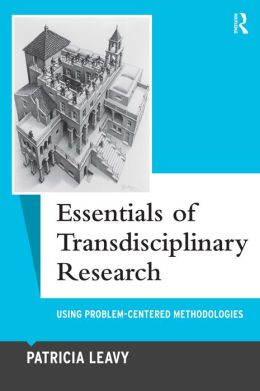
A New Introductory Transdisciplinary Research Text - An Interview with Dr. Patricia Leavy

This looks like an interesting book - despite being a textbook for college course - for anyone interested in the "how-to" of transdisciplinary research.

The first introductory transdisciplinary research text with Dr. Patricia Leavy

November 10, 2013


Title: Essentials of Transdisciplinary Research: Using Problem-Centered Methodologies
Author: Patricia Leavy, Ph.D.
Publisher: Left Coast Press
Year Published: 2011
ISBN: 978-1-59874-593-1

Who is the author?

Patricia Leavy earned her Ph.D. in Sociology from Boston College. After earning her Ph.D., she taught at Stonehill College for ten years while also serving as the Department Chairperson and even the Founding Director of the Gender Studies Program. Shortly after her tenth year of teaching and conducting research at Stonehill, Patricia decided to leave the academic world and pursue a career as a full time writer. Not only is she a full time published writer now, but she is also a Book Series Editor, Commentator, Speaker, Blogger for the Huffington Post, and Co-Author. She has appeared on television and radio including The Glenn Beck Show, and Lou Dobbs Tonight.

What is your book about?

PL: Essentials of Transdisciplinary Research: Using Problem-Centered Methodologies is the first introductory text on transdisciplinary research. Universities and research institutes are organized around a disciplinary model of knowledge-building. This means that different fields are separated from each other—biology, business, literature, health studies, history, psychology, sociology, etc.—and researchers are housed within one of those fields. When they conduct research, they select topics and methods (the strategies they will use to do their research) based on their discipline. This is a very narrow conception of how we can learn about the world. Most contemporary problems and issues do not fit into the domain of only one discipline. From sustainability to health care to violence to school bullying, most contemporary issues of import have multiple dimensions and require researchers from different disciplines to come together, share their expertise and develop new ways of studying the topic at hand. Further, there are many stakeholders who are not researchers who may also be invested in the topic and have valuable knowledge and expertise and they should also be included in the research process. Transdisciplinary research brings different researchers, non-academic stakeholders and different bodies of knowledge together in order to build new and comprehensive ways of addressing contemporary crises. It is a problem-centered approach to research, instead of a discipline centered approach. Transdisciplinary research is needed in order to meet contemporary challenges; in order to do research effectively in the modern age. This book details how researchers and non-researchers can come together to design effective, useful studies and why they should, and it is the first introductory text to do so.

Who should read your book?

PL: Researchers in any field, undergraduate students, graduate students developing their thesis projects, community-based researchers and organizers, researchers at non-profits and others interested in how we can effectively confront contemporary challenges by pooling our resources and expertise.

What was your inspiration to write a book on this topic?

PL: When I became a sociologist I thought I would have an opportunity to do work that was of some use to people, even if only a small group of people. But the structure of academic life and publishing really does not facilitate that. I became disheartened and started seeking out ways that people were doing work with the potential to reach the public and be of some value. I believe in public scholarship. In other words, I don’t think that researchers should exclusively spend lots of time and money doing work that is of little value or interest to anyone else, and never reaches anyone else. We often hear things like, “Academics are out of touch and in ivory towers.” While of course that’s not entirely fair, there is some deep truth in it. By and large academic research never leaves the academy. It is published in highly specialized academic journals and no one reads them, except for a few so-called experts. But research institutions are enmeshed within communities and the research should be of some real-world value to those communities. Part of the problem is that academic researchers have a lot of incentive to work on small-scale projects by themselves, that they can complete quickly and publish with sole credit. This has little to do with actually addressing real-world problems and issues. Researchers need to pool their resources and expertise and bring in other interested stakeholders in order to effectively address real-world problems. For example, in the world of health, those with medical expertise alone can’t solve our problems. Take something like diabetes prevention. In addition to the medical dimensions there are also social, cultural, economic and practical dimensions—food supply, diet and nutrition habits (which various across different communities due to economic or cultural differences), and a host of other issues come into play. Or take the example of cyber bullying which is a concern to many parents. If a psychologist conducts a study alone about cyber bullying it may be limited to the psychological effects of bullying, the profile of potential bullies or some such subject. But there are other perspectives and stakeholders who, if included, can help build a more comprehensive approach with the potential to find solutions. A sociological perspective would look at the context in which the bullying is occurring and the interactions between the bully, bullied and bystanders. Criminology can address legal consequences or possible consequences. Computer science may offer ideas about blocking this kind of behavior. And so on. Here’s one final example I have written about a lot because I think many people can relate to it. We are all impacted by high rates of cancer, if not personally than through someone we know. We all have a vested interest in cancer research and teaching the next generation of innovative health researchers. Cancer research obviously has biological/medical components such as family history/genetics, physiological abnormalities, etc. However, disparities in cancer rates across different groups point to social issues that also impact the health profile of a group or community. These factors include: access to healthcare and screenings, access to quality healthcare, the effectiveness or ineffectiveness of specific health education programs for different groups, and the ways that gender, race, ethnicity, sexual orientation and religion influence health screenings. In addition to biological and social issues, differences in cancer rates have environmental dimensions such as: exposure to toxic materials (sometimes through one’s job), pollution (air and water quality) and food quality (for example, the availability and price of organics). In short, natural scientists, social scientists and environmental scientists need to forge trans-disciplinary coalitions in order to understand and respond to the cancer crisis. This would mean that the problem at-hand, not allegiance to any one discipline, dictates our response and pushes us to work together responsively. These are the ideas that largely inspired the book which in turn I hope gives researchers and community-based organizers tools to work together and build effective projects.

What was it like to write this book?

PL: I learned more writing this book than I have on any other nonfiction project. I completely immersed myself in the literature, learning about different disciplines and the amazing work being done transnationally. I have also had opportunities to speak about transdisciplinary research at various conferences and universities which has also been a wonderful learning process. I have met people in different fields and career paths who are all committed to the idea of pooling resources and expertise to more effectively address contemporary problems. It’s been eye-opening and inspiring.

What does this book mean to you?

PL: I’m uniquely proud of this book and think it is some of my very best nonfiction both in terms of writing and the practical contribution. I don’t mind saying that the book has not quite found its audience and I hope that changes because I truly think it is a timely and valuable text. People I respect in different fields have endorsed the book and written me privately to tell me they think it is important, and of course that means a great deal to me, as do the emails I have received from students who have found the book useful.

What are you working on now?

PL: I have been asked to write a second edition of my book Method Meets Art: Arts-Based Research Practice (Guilford Press), which I am currently working on. I am also in the midst of promoting my two recent releases, Fiction as a Research Practice: Short Stories, Novellas and Novels (Left Coast Press) and my novel, American Circumstance (Sense Publishers) which is keeping me very busy.

Any advice to authors?

PL: Don’t allow your assessment of your work to be based on sales figures. They don’t speak to the intrinsic value of the work and my experience illustrates that well. I have a couple of books that have sold more than twenty times what this book has sold, that I don’t think are very good at all, and have even walked away from chances to do revised editions because I did not think they warranted it. Sometimes for any number of reasons a book does not find a large audience, or it does not find it quickly, but that does not make it less of an accomplishment nor does it have to change your relationship with the work. Focus on the quality of the work and the vision behind it.

Where to find Patricia:

For More of Michelle’s Articles & Interviews:
Suggested by the author

Monday, July 15, 2013

Jeremy Johnson - “Everything that Rises…” or Synthetic Thought, Florilegium and the Networked Age: ITC 2013

Jeremy Johnson, who blogs at Evolutionary Landscapes, is the official blogger for the 2013 Integral Theory Conference, which begins later this week in San Francisco. I can't imagine a better choice than Jeremy, a man who is thoroughly educated in integral theory and is also an outspoken critic on some of its shortcomings.

Below is the beginning of his first post for the conference - an excellent piece of writing in my opinion.

“EVERYTHING THAT RISES…” OR SYNTHETIC THOUGHT, FLORILEGIUM AND THE NETWORKED AGE: ITC 2013


July 13, 2013
by Jeremy Johnson

I’m fast approaching my 5 A.M. flight on July 17th. The night before will likely consist of a heavy 9 P.M. dose of melatonin and meditation-unto-sleep. I had come up with a few clever titles and openings to my pre-conference blog, but, I think I’ll stick to the honest basics. Let’s start where I am: enthralled heartbeat, sweaty palms, swooning contemplation about what happens when you put more than one integral meta-theory practitioner in a room. Yes, this year’s theme is certainly “meta” (see urban dictionary for a proper definition). First thing’s first: this conference is hosted by proponents of a theoretical and philosophical system of “orienting generalizations,” a veritable theory of everything—Integral Theory, originally developed by American philosopher Ken Wilber. Next, we have Edgar Morin, a French sociologist and “integral” thinker in his own right, author of Homeland Earth and the developer of what he calls “complex thought.” Lastly we have Roy Bhaskar, the founder of the school of Critical Realism. Sean Esbjorn-Hargens, author of Integral Ecology: Uniting Multiple Perspectives on the Natural World and conference organizer, will be speaking on behalf of Integral Theory. So let’s talk about context.

Each of these scholars claim to some degree that the human race is at the precipice of some major event—a global crisis at the edge (or some say, end) of history—where we need to bring our disparate modalities of thinking and being-in-the-world together. The notion of a “cosmopolitan,” according to Webster dictionary, means having a “worldwide rather than limited or provincial scope or bearing.” Now add the “K” to “Kosmopolitan,” and we’ve remixed it with the old Greek word, “Kosmos” which Wilber was so fond of in his seminal book, Sex, Ecology, Spirituality: The Spirit of Evolution.“Kosmos” originally meant “the universe” or “the starry firmament,” but went on to include our planet and all its denizens. While it’s certainly meant to be a play of meaning, I think it’s relevant to the meat and bones of this conference.


“Kosmopolitan” implies that the desire to look out at that starry abode is something we’ve inherited as a species. That no single theory really owns this impulse, any more than any religion truly holds captive the sense of the sacred. That East, West, Europe, America, and every nation and tribe has drawn constellations of synthesis into (perhaps, out from) the heavenly firmament. This is the “Integral Kosmopolitan.” A movement with no center, no periphery: articulated by all but owned by none. Integral thought—if there really is such a thing—is in fact a larger “epistemic impulse” as Trevor Malkinson articulates in his excellent essay, “The Rise of the Synthesizing Mind in the Planetary Age.” As we come into an awareness of planetary issues and human interdependence with the rest of the biosphere—so too do our “meta” theories gain the robustness of discovering they are co-initiators of planetary culture.

Jean Gebser—of whom I am a deep reader of his phenomenal text, The Ever-Present Origin—came to a similar realization after publishing the first installment of his tome, only to discover that in India, Sri Aurobindo had been writing and working on his own version of “integral consciousness” in The Life Divine.

Now, I am inclined to believe that a healthy embodiment of this integral impulse isn’t interested in assimilating another’s work, which I think degrades and diminishes the integrity of fellow authors and scholars, but instead, attempts to realize a form of “synthesis” that is more decentralized as its primary characteristic. As Trevor writes in his article, “what frustrates me… is that talk of integral or integrative thinking is often reduced—by adherents and critics alike—to simply being about the work of Ken Wilber.” Over the past few years, I think the Integral Theory community has gradually recognized this criticism, as Sean writes over at MetaIntegral: “Our approach recognizes that Integral Theory is not as integral as it could be, and so we continually strive to make Integral Theory more integral through respectful inquiry and debate with other streams of integrative thought.”


This is why I am eagerly anticipating the conversations in the conference halls as three autonomous theories—Critical Realism, Complexity Thinking, and Integral Theory—mesh and mate, exchange their memetic material and show up in a couple of months with a mutant baby or two. Yeah, something like that.
Read the whole article.

Monday, July 08, 2013

Søren Brier - Cybersemiotics: A New Foundation for Transdisciplinary Theory of Information, Cognition, Meaningful Communication and the Interaction Between Nature and Culture

This ambitious article by Søren Brier on the emerging field of cybersemiotics appeared in the new issue of Integral Review, a special issue on transdisciplinary models. Brier is the author of Cybersemiotics: Why Information Is Not Enough (Toronto Studies in Semiotics and Communication) [paper, 2013; Kindle, 2008].

Cybersemiotics: A New Foundation for Transdisciplinary Theory of Information, Cognition, Meaningful Communication and the Interaction Between Nature and Culture 

By Søren Brier [1]


Abstract: 

Cybersemiotics constructs a non-reductionist framework in order to integrate third person knowledge from the exact sciences and the life sciences with first person knowledge described as the qualities of feeling in humanities and second person intersubjective knowledge of the partly linguistic communicative interactions, on which the social and cultural aspects of reality are based. The modern view of the universe as made through evolution in irreversible time, forces us to view man as a product of evolution and therefore an observer from inside the universe. This changes the way we conceptualize the problem and the role of consciousness in nature and culture. The theory of evolution forces us to conceive the natural and social sciences as well as the humanities together in one theoretical framework of unrestricted or absolute naturalism, where consciousness as well as culture is part of nature. But the theories of the phenomenological life world and the hermeneutics of the meaning of communication seem to defy classical scientific explanations. The humanities therefore send another insight the opposite way down the evolutionary ladder, with questions like: What is the role of consciousness, signs and meaning in the development of our knowledge about evolution? Phenomenology and hermeneutics show the sciences that their prerequisites are embodied living conscious beings imbued with meaningful language and with a culture. One can see the world view that emerges from the work of the sciences as a reconstruction back into time of our present ecological and evolutionary self-understanding as semiotic intersubjective conscious cultural and historical creatures, but unable to handle the aspects of meaning and conscious awareness and therefore leaving it out of the story. Cybersemiotics proposes to solve the dualistic paradox by starting in the middle with semiotic cognition and communication as a basic sort of reality in which all our knowledge is created and then suggests that knowledge develops into four aspects of human reality: Our surrounding nature described by the physical and chemical natural sciences, our corporeality described by the life sciences such as biology and medicine, our inner world of subjective experience described by phenomenologically based investigations and our social world described by the social sciences. I call this alternative model to the positivistic hierarchy the cybersemiotic star. The article explains the new understanding of Wissenschaft that emerges from Peirce’s and Luhmann’s conceptions.
1. Søren Brier is Professor of Semiotics in the Information, Cognition and Communication Sciences  at the Department of International Business Communication at Copenhagen Business School. He is the creator of the transdisciplinary framework Cybersemiotics, founder and editor-in-chief of the journal Cybernetics & Human Knowing, co-founder of the International Association for Biosemiotic Studies and its journal Biosemiotics. sb.ibc@cbs.dk

An Overview of the Flow of the Argumentation in the Article 


I begin with a brief introduction to my view of scientific thinking on deep theories and a few words about the limitation of the word ‘science’ in the English language and my proposal to use the German transdisciplinary term ‘Wissenschaft’, which includes qualitative research into meaning. I argue that it is vital to include the meaning aspect of reality when we deal with information, cognition and communication research. I will then briefly introduce my cybersemiotic visual model for organizing the exact, the life and the social science as well as the humanities in a framework shaped as a star with four different arms, a framework which I propose as an alternative to the positivistic ‘unity of science’ idea based on physics as model science and its modern version found in E. O. Wilson’s ‘consilience’ model. Cybersemiotics is a vision of how to integrate truth and meaning as well as the empirical and the experiential aspects of knowing in one pragmatic and semiotic view of the collective production of knowledge. I will then explain the phenomenological model behind Peirce’s phaneroscopically based semiotics. I briefly introduce his three categories and his idea of a philosophical foundation for a reflected cenoscopic science. I then briefly explain Maturana and Varela’s idea of autopoiesis and after that try to show how Luhmann’s triple autopoietic systems view of socio-communication has a reflected pragmatic and realistic grounding that fits in with and supplements Peirce’s philosophy. I go on to explain the development of biosemiotics as an attempt to build a semiotic link from the life sciences to the social sciences and humanities through an evolutionary and ecological semiotic view. As the pan-informational and pan-computational philosophy tends to be more and more dominating, I find it necessary to explain how Peirce’s philosophy, which he calls pragmaticism, can be seen as an alternative. As Peirce lived a hundred years ago, my argument draws on modern American philosophers like Sellers, McDowell and Brandom.

Since Plato’s philosophy of a world of ideas and universal concepts was confronted by modern empiricism’s belief in material facts, the discussion on inter- and transdisciplinarity has been about what is most real: matter, forces, form or universal concepts. The possibility of transdisciplinarity therefore rests on our ability to define a reality that includes them all. Peirce’s suggestion of a scholastic realism inspired by Duns Scotus is such an attempt and I shall try to explain what it is all about. Peirce introduces time and possibility to enlarge our view of reality. What is, and what has been only cover the part of actuality, which is based on the past. There are, however, also would be’s dealing with probabilities. Peirce – like Popper and Prigogine – views possibilities as real and includes them in his category of Firstness. But they are also the basis for habits or what Peirce calls Thirdness. Peirce distinguishes between what is real and what exists. The only form of existence as such is what he calls ‘thisness’ (haeccity), which is his category of Secondness. It is this triadic processual understanding of semiotics that distinguishes Peirce’s semiotics from Saussurian semiology and makes the idea of biosemiotics possible. I then try to visualize how we may combine biosemiotics’ idea of endosemiotics creating the biological self and its exosemiotic communication theories with Luhmann’s triadic autopoiesis model of communication. This is done in order to give a first overview of the cybersemiotic idea and to explain how the integration of semiotics and system theory offers a more plausible model of evolution that can explain the emergence of mind. The article concludes by suggesting a new model of five ontological levels and a changed view of the reality of nature.

A New Foundation for the Sciences [2] and Humanities 


Cybersemiotics proposes a new transdisciplinary framework integrating Peirce’ triadic semiotics with a cybernetic view of information on the basis of an ontology of emptiness. It is an attempt to give a transdisciplinary solution to C.P. Snow’s two-culture problem. The proposed framework offers an integrative multi- and transdisciplinary approach, which uses meaning as the overarching principle for grasping the complex area of cybernetic information science for nature and machines AND the semiotics of all living system’s cognition, communication, and culture. Cybersemiotics is an integrated transdisciplinary philosophy of science allowing us to perform our multidisciplinary research, since it is concerned not only with cybernetics and Peircean semiotics, but also with informational, biological, psychological and social sciences. In order to incorporate the sociological disciplines and contributions from multiple areas of applied research cybersemiotics draws extensively on Luhmann’s theories.

We are thus immersed in conscious and unconscious communication forms, verbal as well as non-verbal. As the linguistic turn argues, we cannot escape language, nor culture and power. Even science becomes a social construction, which is historically true, since science is a relatively recent phenomenon in the history of man. Empirical and mathematically grounded science is a modern invention that started in the Renaissance. Scientific knowledge has formed our rationality and cultural outlook on the world since then and right up to the global discussion these days about the reality of global warming.

And yet science is still faced with the problem of meaning. The background of cybersemiotics is the recognition that Western philosophy of science is in a state of crisis. Western culture is at a turning point when it comes to taking the final step into a knowledge culture based on information and communication technology. Rather than basing our culture on the conception that the highest goal of knowledge is an abstract, non-embodied and globally available (artificial, impersonal) intelligence of information programs, I believe that we should ground our culture(s) on embodied human living (personal as well as interpersonal), i.e. on semiotic intelligence as part of both living nature and human culture, rather than only on the physical science and the worldview behind it.

The current dominant objectivist science, which to me includes physicalism, eliminative materialism, cognitive sciences based on the information processing paradigm, cannot encompass self-aware consciousness and social-communicative meaning as causal agents in nature. Current cognitive science attempts to explain human communication from the outside without recognizing the phenomenological and hermeneutical aspects of existence. Its conception of human (meaningful) language and communication as a sort of culturally developed program for social information processing between computational brains/ minds cannot explain the evolution of embodied consciousness and (meaningful) human language and communication. Cybersemiotics offers a new ontology that can encompass a moderate version of the ontologies of all four dimensions or spheres.

Inspired by the methodology of critical realism (Bhaskar, 1997, 1998) and Bourdieu (Bourdieu and Wacquant, 1992), I believe that our common sense only shows us the surface of reality, and that it is the task of the sciences to dig deeper and look further than our common sense assumptions. I agree with Gadamer (1989) that our cultural history is also a development of our knowledge about ourselves, society and nature forming a common knowledge horizon. Therefore I agree with Karl Popper that it is the role of scientists and philosophers to boldly invent new ways of looking at reality, knowledge and ourselves. Take for instance Einstein and Bohr, who forever changed the way we understand matter, energy, time, space and knowledge, or Norbert Wiener who introduced information as a basic ontological component in his transdisciplinary cybernetic worldview.

I see the semiotic philosopher C. S. Peirce (1839-1914, see his collected papers: Peirce 1931-1935) as such a bold inventor, one who had important and profound ideas about the development of human knowledge development long before Karl Popper (1960, 1962, 1972, 1974, and 1976) and Roy Bhaskar (1997, 1998) published their theories. Peirce created a whole structure of philosophy, science and humanities through his semiotic philosophy (inspired by Dons Scotus and Kant), which includes a transdisciplinary theory of meaning, signification and communication. In a somewhat supplementing vein Niklas Luhmann (1990, 1995) – originally inspired by Talcott Parsons’ (1902 –1979) structural functionalism – developed a social system theory that views social communication as the basic reality of society and integrates the psychic and the biological autopoietic systems. Luhmann borrows the concept of autopoiesis from the cybernetic biologists Humberto Maturana (1983, 1988a, 1988b) and Francisco Varela (1980, 1986).

It is my view that these two interdisciplinary theories may be combined into a transdisciplinary framework that I call cybersemiotics. I firmly believe that cybersemiotics constitutes a realistic foundation for a comprehensive understanding of the natural, life and social sciences as well as humanities and that it can provide a deeper understanding of the differences in the knowledge types they produce and show why each and every one is necessary. By establishing this new framework, I also hope to create a transdisciplinary approach which transcends the incommensurability between C.P. Snow's two cultures: science-technology versus the humanities and the social sciences. I am trying to draw up a map onto which a multitude of viewpoints can be plotted and their subject areas characterized and compared with other approaches. In doing so, I hope to expand the dialogue between the exact sciences, the humanities, the social sciences and philosophy. A more comprehensive and further argued version of cybersemiotics can be found in the foundational book Cybersemiotics: Why Information Is Not Enough [paper edition, Kindle edition] (Brier, 2006) as well as later articles on the subject (Brier, 2007, 2008a, 2008b, 2008c, 2008d, 2009a, 2009b, 2010, 2011).
2. For me the concept ‘sciences’ refer to natural, life, technical as well as social sciences. With a background in biology I consider the life sciences to assume a different ontology from that of physics and chemistry, which do not operate on the premise of life as biology does. 
 Read the whole article.

Sunday, June 16, 2013

Information Theory: There Are Two Flavors of Uncertainty in Our Lives - Math Helps with Both


In the June (No. 2, 2013) issue of Nautilus magazine, Santa Fe Institute Research Fellow (SFI specializes in complexity science) Simon DeDeo describes how both natural and social uncertainty impact our lives and how mathematics offers a tool to make uncertainty a little less uncertain. 

Here is a brief summary of the article from the SFI website:
DeDeo touches on chance in art and literature, information theory, and the differences between uncertainty arising from the objective material world and that arising from thinking, competing agents. 
"One might imagine a science fiction device—a probability meter—that would measure the differential contribution of nature and humankind to the uncertainty of an outcome," DeDeo writes. "How much uncertainty in the average corporate boardroom is due to nature (e.g., the chances of bad weather delaying a shipment of parts) and how much to the strategic creation of uncertainties by human participants (e.g., the refusal to disclose final production targets to one’s suppliers)? Of course, such a meter could wreak havoc in any real boardroom—and itself be a source of its own readings." 
  • Read issue 2 of Nautilus magazine, "Uncertainty" (June 2013)
  • Read the inaugural issue of Nautilus, "Human Uniqueness" (May 2013)
  • Read an article in The New York Times about Nautilus magazine (May 6, 2013)
Nautilus: Science Connected is a new magazine that examines, from a variety of perspectives, how science is connected to our lives. The articles combine the sciences, culture, and philosophy into a transdisciplinary story "told by the world’s leading thinkers and writers."

This is an excellent find - I am grateful to the folks at SFI for pointing it out in their news blog.

The Coin Toss and the Love Triangle

Information Theory: There are two flavors of uncertainty in our lives, Math helps with both

BY SIMON DEDEO
“I returned, and saw under the sun, that the race is not to the swift, nor the battle to the strong, neither yet bread to the wise, nor yet riches to men of understanding, nor yet favour to men of skill; but time and chance happeneth to them all.” (Ecclesiastes 9:11, King James Bible [Pure Cambridge Authorized Version])
Chance appears to name a single, unitary thing. But its genealogy, its family history, turns out to be a tangled one. One way to understand its branching origins is to turn to literature: We may look, in turn, to two very different novels.

Anton Chigurh, the antagonist of Cormac McCarthy’s novel No Country for Old Men, forces his victims to guess the outcome of a coin toss, taking their life if they guess in error. McCarthy’s villain forces blind chance into his victims’ lives in the most brutal way. That chance is entirely contained, not in Chigurh, but in the toss—in nature itself. This is one source of uncertainty.

To understand the second source, we travel as far as possible from McCarthy’s American Southwest. The first volume of Henry James’s The Wings of the Dove ends with Milly Theale, a wealthy American heiress, visiting the National Gallery in London. To her surprise she sees an acquaintance, Merton Densher, in the company of her best friend, Kate Croy. The plot of the book from this point forward hinges on a single question: will Milly learn what the reader already knows—that Merton and Kate are in love and secretly engaged to be married.

In the sequence, told from Milly’s point of view, we see how Kate—caught sharing an intimate afternoon—acts in such a way as to generate an alternate hypothesis for her friend: that Merton may well be keen on her, but that she, Kate, is not keen on him.

Here are uncertainties not otherwise found in nature: probabilities about probabilities, beliefs about beliefs held by others.

For many of us, the material world of the coin toss may be a byword for chance. But the cognitive world of the love triangle is just as fraught and, at its limits, just as much a form of chance as a tumbling coin. We humans are capable of introducing a degree of uncertainty both dizzying and unavoidable.

Therefore, Ecclesiastes was right twice over. Uncertainties—both natural and human—must be dealt with even by the swift, strong, wise, and able. Our objective is to demonstrate the depths of each kind of uncertainty and to introduce mathematics that can help us come to terms with both.

I. THE COIN TOSS

“What’s the most you ever saw lost on a coin toss?”
(No Country for Old Men, Cormac McCarthy [2005])
Sufficiently many fictional murderers have toyed with their victims that, today, the idea borders on cliché and parody. But Chigurh’s game chills us still, perhaps because of the concentrated form of his message. His impartial, deadly coin toss is a reminder of the dominance of chance in our own lives.

From the accidents we have avoided or been met with, to the relationships we have formed and the institutions we have come to be associated with—each fact about ourselves appears to depend on a series of events, any one of which could have gone another way. To stand on top of a tower of such coincidences and look down gives us a hint of vertigo. Which aspects of life are real, we ask, and which simply luck?

This question is, on the one hand, at the heart of much literature and art; on the other, it is a hardheaded question in the mathematical sciences.

In particular, the branch of mathematics known as information theory concerns itself with how to describe chance and uncertainty. It reconciles the unlikeliness of any particular life with the intuitive sense that the shape of one’s life is not simply a matter of chance.

To see how, let us begin at the beginning, at the base of the tower of coincidences. Suppose Chigurh’s coin toss is fair—equally likely to come out heads or tails. What are the possible strategies his victim should consider? Always guess tails? Heads? Some alternation?

Should the toss be fair, no strategy is better than another. Indeed, strategies are indistinguishable from each other. This is due to the symmetry of the problem: We can swap the labels on each side of Chigurh’s coin at any time and thereby convert any prescription into any other. In McCarthy’s desert landscape, strategy and reason are meaningless. The vertigo of chance is upon us.

This, of course, doesn’t describe the world we normally confront. In our world there is predictability, with a preference between outcomes1 and the possibility of rational choice. Broken symmetries make reason relevant to our lives.

But this doesn’t rescue us from the vertigo of chance. Suppose, for example, Chigurh’s coin is slightly more likely to come up heads. Now, strategies are distinguishable. For a heads-biased coin, the preferred and most rational strategy is always to guess heads.

In the course of your life you need to make many decisions. What if you had to guess the coin toss more than once? Consider tossing the biased coin a thousand times. Since each toss is independent of the one before, the most likely outcome is the repeated occurrence of the most likely outcome of each one separately. And thus, of all the possible histories we could foresee, the strangest sequence of all, an unbroken run of heads:

HHHHH ... H, 1,000 times

is the single most likely. Our intuition is that such a sequence will never, in fact, occur.

And of course we are correct. Fix the bias of the coin at 60 percent heads. The chance of heads on a first toss is (by definition) 6 in 10; of two heads in a row, a little over 1 in 3. The chance of three heads in a row is only a little better than 1 in 5.

The chances of an unbroken run decrease exponentially; the chance of ten heads in a row is less than 1 percent, and a few more doublings suffice to place the chances beyond the astronomical. It is unlikely to see an unbroken run of heads in 80 tosses, even if one completes such a sequence once every second for the 13 billion years the universe has existed.

We’ve established that a string of unbroken heads is extremely unlikely. But any other history is even more so. As time passes, every narrative becomes an extreme rarity. Despite the existence of a most rational choice, the particulars of your life describe a very unlikely path. The biased coin, which signifies the possibility of reason, does not relieve our vertigo after all.

Yet we also know that some things are routine, expected—even, at times, part of our birthright—and others less ordinary. A friendship might depend on having shared a freshman seminar, but is it so unlikely to have made a friend in college?

This intuition has a mathematical grounding in what is called the typical set. The typical set is the mathematics behind our feeling of normalcy. It reconciles reason and chance by linking the nature of the singular event to the properties of the history it belongs to. More than biased probabilities, it challenges the vertigo of pure chance.

Consider the space of all possible histories: an exhaustive list of every sequence of events that might have occurred. Every coin toss, every decision ever made. The typical set bounds a very small region in this space and describes the path that we, as time goes on, are increasingly likely to follow. Given a prescription for the probabilities of individual decisions, the typical set picks a list of histories whose rates of uncertainty accumulation become increasingly close to each other, and match, on the average, the intrinsic rate of the probabilities themselves2.

Let’s return to the freshman seminar. Your college life is a series of chance events whose probabilities are set by a finite list of constraints: your major, your age, and so on. As your college days run on, the set of possible histories you are likely to experience converges with those found in the typical set your constraints define. Each individual history is rich in idiosyncrasy while being drawn from a narrowly circumscribed set of possibilities that is much smaller than the space of all that might happen3.

We are left in a profoundly ambiguous place. The typical set rescues normalcy but also dictates typical lives, common stories: boy meets girl, dog bites man. This wisdom was also known to the author of Ecclesiastes, who wrote that there was “nothing new under the sun.” To the swiftest, the race might go once, or even twice, but on the longest scales of time no streak is left unbroken.

At the same time, our pasts and our futures—even our most likely futures—are, in their details, profoundly unlikely things.

An information theorist may not know the exact world we live in, but she does know that, in the long run, it’s a world in the typical set. And she also knows that she doesn’t know anything else4.

So much for coin tosses and freshman seminar assignments: things external to ourselves, driven by the chances of the physical world5. These material things, however, are not the only—or even the most important—sources of life’s uncertainty. To see that, we turn from Cormac McCarthy’s American Southwest to Henry James’s London.
Read the whole interesting article.

Friday, June 14, 2013

Markus Molz & Mark G. Edwards: Research Across Boundaries - Introduction to the First Part of the Special Issue

This is Markus Molz's and Mark G. Edwards's introductory essay to the recent special edition of the Integral Review (Vol 9, No 2) - International Symposium: Research Across Boundaries, Part 1.
The issue stems from an international symposium, “Research across Boundaries – Advances in Theory-building,” held at the University of Luxembourg in June of 2010.

The symposium was the first to bring together many leading "boundary spanning and meta-level researchers" from more than 15 countries across all continents and as many different research areas.
In what became a set of truly global dialogues, the participants presented and commented an astounding array of contemporary integrative frameworks, as well as inter- and transdisciplinary reviews and research practices across various fields of inquiry of high relevance for the future.
And here's a little more from later in the introduction:
This special issue brings together the contributions of many of the scholars and visionaries that participated in the symposium, plus a couple of complementary papers of resonating researchers who couldn’t make it to the event itself but were keen to make a contribution nevertheless. Our invitation was to deliver summary accounts of sustained boundary-crossing research and (meta)theory-building, often of a lifetime, to colleagues rooted in other research domains. The contributors were called to make the essentials of their sophisticated views, or more focused parts thereof, accessible to the interested public and to provide extended bibliographies for those attracted to explore the original sources of their work. Our guiding idea was to encourage boundary-crossing, on a meta-level, between mature boundary-crossing approaches that, somehow paradoxically, did not yet, or barely, come in touch with each other. The scientific committee of the symposium and its helpers volunteered to identify and invite these boundary-crossing scholars and to facilitate their meta-boundary-crossing dialogues and polylogues.

As a result, the Luxembourg symposium saw contributions offered that stemmed from quantum theoretical inspirations to cybernetics and complexity approaches, from action theory to semiotics and integrative meta-theorizing. The philosophical underpinnings included metaparadigms like transdisciplinarity, integral theory, critical realism, relational contextualism, global ethics, as well as participatory and emancipatory worldviews. Issues of boundary-crossing research paradigms and communities, of sense-making tools and theory families, institutional barriers and opportunities were all intimately considered.
About the Authors/Editors:

  • Markus Molz is currently Visiting professor at the School for Transformative Leadership, Palacky University Olomouc, Manager of the University for the Future Initiative, founding Board Member of the Institute for Integral Studies, and Associate Editor of Integral Review. He has a broad background in transdisciplinary social sciences, integral studies, meta-studies, international project development, and consulting of NGOs. His interests revolve around integral pluralism, quality of life in the Great Transition, as well as social and educational innovation. His current focus is on concrete pathways for institutionalizing integrative and transformative higher education and research. e-mail: markus.molz@u4future.net
  • Mark Edwards is Assistant professor at the Business School, University of Western Australia where he teaches in the areas of business ethics and organisational transformation. Mark’s PhD thesis (awarded with distinction) was published in a series on business ethics by Routledge/Taylor-Francis in August 2010 and was awarded book of the year 2011 by Integral Leadership. The book focuses on the integration of knowledge as applied to the fields of organisational transformation and sustainability. Mark’s research has been published in several leading academic journals and covers a diverse range of topics including business ethics, management studies, systems research, futures studies, psychotherapy and spirituality, sustainability and organisational transformation. e-mail: mark.edwards@uwa.edu.au
* * * * *

Research Across Boundaries: Introduction to the First Part of the Special Issue 

Markus Molz and Mark G. Edwards
In the coming century, there will be an urgent need for scholars who go beyond the isolated facts; who make connections across the disciplines; and who begin to discover a more coherent view of knowledge and a more integrated, more authentic view of life. (Boyer, 1994, p. 118) 

Background and Foreground


In the context of an unprecedented proliferation of research specializations and the pressing problem-solving needs in society, Ernest Boyer and other scholars, have emphasized the special role for research that connects knowledge and that spans boundaries. This scholarship of integration complements traditional modes of specialization of knowledge. Major advances in boundary spanning research across the seams of separate paradigms, disciplines, cultures and contexts have been made in many places in recent years. Multi-paradigm and multi-method research, translation research movements, trans- and meta-disciplinary approaches, as well as cross-cultural or cross-sector participatory projects are emerging in and across many fields of research. It is no accident that these developments are surfacing at this juncture in planetary evolution.

Down through the ages, each generation of humanity has faced its own challenges, its own demons, and its own possibilities for expanding the possibilities. Sometimes the challenges are accepted, the will, the heart and the hands are tested, and life deepens and expands. Sometimes the challenges are rejected and avoided, our demons get the better of us, we turn in on ourselves and the possibilities afforded by human birth close down. Whatever our choices have been in the past, humanity has moved on. But something new presents itself in these current days. We are living in an unprecedented historical epoch, the Anthropocene (Steffen et al, 2011).

The human has irrevocably changed the planet. The impact of our actions are coming back to haunt us and our children. The challenges are now global, local and everything in between, they are with us now and they stretch out into the distant intergenerational future, they include the whole Earth system and every living thing that travels with her, they involve every aspect of the countless bio-social systems that network across her surface and which course through the intersubjective experience of every plant and animal. The possibilities for responding to the planetary challenges, and the implication of those responses, are extreme and they stretch out between a  vision for and acceptance of a profound deepening of planetary potentials and a life-destroying,  fear-laden rejection of the realities that demand our attention.

Science, the humanities, religion, art, the storehouses of cultural and indigenous knowledge, the world of lived practice and life experience will all generate their own contributions to meeting or avoiding the local, regional and global challenges that beset us. Many possibilities exist in considering these options but, whatever path we choose as individuals or as a single global family, never before have the global stakes been so high, never before has the need for planet-wide decision-making, for big-picture explanations and solutions been so pressing. Never before has human society, as a single entity, been required to develop a coherent global approach to dealing with the challenges that now confront it.

And it is no coincidence that the unfolding planetary challenge should also be accompanied by the emergence of global forms of knowing and of accessing knowledge. In no previous times has so much knowledge been intentionally produced, stored and disseminated, has there been such an extensive body of expertise in so many distinct research specializations. It is only now, in these last few years, that the products of so many knowledge traditions, institutions of learning, independent scholars, research collectives and commercial research sources from so many regions, cultures and historical periods have become accessible to so many people across the globe. The web and depth of knowledge is vast and it is available. But what sense can and will we make of it all? Down which pathways will all this knowledge lead us?

It is no coincidence that in these critical times of a global anthropogenic cocktail of crises, we are also immersed in an ocean of experience, of data, information and knowledge. Do we have the wisdom to not only develop shared knowledge from this ocean of information but also to make shared sense of it? And are we able to make use of the bigger pictures we gain from boundary-crossing experience and reflection to engage in large-scale and long-term coordinated action? This is needed to enable a dignified life for the many throughout the Great Transition (Raskin et al, 2002; Spratt et al, 2010). Under complex and volatile conditions boundary-crossing competence is also considered more and more important as a complement for domain-specific expertise (see e.g. Engeström, Engeström & Kärkkäinen, 1997, Horlick-Jones & Sime, 2004).

Responding to the need for shared sense making, there is a widespread and growing call today for building connections across disciplines, paradigms, cultures, and worldviews (see for instance Dussel, 2009; Giri, 2002, as well as Nelson and Raman in this issue). And indeed, in recent years various advances have been made in boundary-crossing research that facilitates (re)connections between theory and practice, facts and values, history and future, sciences and humanities, the knowledge traditions of East and West, North and South. Gasper (2004) says that
we should recognize and promote a complex intellectual 'eco-system' with multiple legitimate types of life-form, sub-system, and of interaction of ideas, inquirers and users (p. 310) … an eco-system within which many species and hybrids co-exist and interact … A complex eco-system requires a complex system of concepts and models to describe and understand it. ... Interaction requires mutually accessible and acceptable intellectual frameworks. (p. 327) 
In navigating through the hazards of the Great Transition we need conceptual visions with the requisite complexity and scope. Towards this end the Luxembourg Symposium was organized.

Read the whole essay and check out the new issue of Integral Review.

Thursday, April 08, 2010

Andre Ong - "A Dialectical Anthropology of Concrete Totality: A Methodological Framework for Understanding the Unified Totality of the Human Person"

Cool.

Andre Ong: "A Dialectical Anthropology of Concrete Totality: A Methodological Framework for Understanding the Unified Totality of the Human Person"

The conception of the person cannot be understood in isolation from the philosophical system as a whole, because it is the whole system that conditions this understanding. Therefore, disputes concerning the constitutive elements of the person are also disputes concerning philosophical systems. In addition, the choice of philosophical categories employed in framing anthropology mediates the outcome of the investigation. Is there a philosophical category that provides the fullest access and adequate description of the unified totality of the internally differentiated human person? It will be argued in this paper that an anthropology viewed from the horizon of a dialectical concrete totality provides such a comprehensive access and description.

2008 July 16


Andre Ong: "A Dialectical Anthropology of Concrete Totality: A Methodological Framework for Understanding the Unified Totality from Metanexus Institute on Vimeo.

Metanexus: Subject, Self, and Soul: Transdisciplinary Approaches to Personhood

99 videos / 2 subscribers

The Metanexus 2008 conference was held July 13-16 in Madrid, Spain. The theme was "Subject, Self, and Soul."

MIHI QUAESTIO FACTUS SUM (I have become a question to myself.) Augustini Confessiones (liber X, caput xxxiii)

Who are we? Why are we here? In our age, it is science that purports to answer these ancient questions, while technology promises to make us even “more than human.” But despite our amazing scientific discoveries and technological powers, are we not still “a question to ourselves?” And what new questions about ourselves have been raised in our own times?

If we are truly to understand ourselves, our place in the cosmos, and our relation to each other and to the divine, we must adopt rich transdisciplinary approaches that cut across fields of knowledge, institutional boundaries, cultural borders, and religious traditions.

At the 9th annual Metanexus Conference philosophers, biologists, physicists, cosmologists, neuroscientists, cognitive scientists, theologians, religious scholars and community leaders, historians and educators discussed these and other profound questions of what it means to be a person in a rapidly evolving and complex world.

Among the attendees were more than 200 representatives of the Metanexus Global Network of multidisciplinary Local Societies from over 40 countries.


Wednesday, April 07, 2010

Varadaraja V. Raman: "Transdisciplinarity as the Search for Unity behind Diversity"

The Metanexus Institute has put a lot of videos from their various events online (they use Vimeo to hose their material, which is a great video service) - very cool. I'll be sharing some of the ones I enjoy the most, but you can follow the link above to the collection and take a look for yourself.
Varadaraja V. Raman: "Transdisciplinarity as the Search for Unity behind Diversity"

The Senior Fellow Lecture

We all belong to the same biological species, or as we say in more humanistic terms, we are all members of the same large human family; religiously speaking, children of the same cosmic creative principle. An aspect of the human condition is that we form groups and subgroups which are sometimes mutually cooperative, sometimes mutually combative. The major factors that unite and divide us are race (a no longer acceptable term, but may refer simply to superficial skin-color distinctions), religion (a mighty force that has both noble and ignoble sides) and language (which is beautiful and endearing only to those who understand it). These three factors also form the basic elements of human culture. Culture is situated in Nature.

The world of nature is characterized by a plethora of elements which range from stones and sand to living organisms and stars and galaxies. All these are situated in the Cosmos.

The variety in the world, whether in the biological and human context, or in the physical and astronomical context, may well be a necessary condition for a universe to exist as a stable complex entity. And this variety also contributes to the aesthetic splendor of the world.

But the separateness that is inevitable in variety is also cause for unpleasantness and harshness sometimes, for humans in many ways and for other animals in other ways. It tends to cover up the commonalty that unites everything, and promotes feeding on one another. A more rewarding appraisal and appreciation of the world may be gained by regarding the world not as a seamless smooth entity (which it is in a larger metaphysical and even biological sense), nor by focusing always on the differences (which are there to stay), but rather as a colorful quilt woven together to create a wondrous whole. Transdiciplinarity may then be looked upon as the understanding of unity behind the diversity, an ancient uplifting theme. It seeks to explore the binding as well as the splintering features of the complex world of culture and nature.

This paper will examine transdisciplinarity from these considerations so as to make the human experience intellectually satisfying and spiritually fulfilling also.

~ Metanexus 2009 conference was held in Phoenix, AZ, July 18-21 (2009) on the theme of "Cosmos, Nature, and Culture."


Varadaraja V. Raman: "Transdisciplinarity as the Search for Unity behind Diversity" from Metanexus Institute on Vimeo.