Showing posts with label Integral Review. Show all posts

Thursday, March 20, 2014

New Issue - Integral Review: Volume 10, No. 1, March 2014


A new issue of Integral Review is online and free to read. This issue features articles by Sara Nora Ross, Bonnitta Roy, and a book review by Zak Stein. An article by Kevin J. Bowman, "Correcting Improper Uses of Perspectives, Pronouns, and Dualities in Wilberian Integral Theory: An Application of Holarchical Field Theory," sounds particularly interesting.

Integral Review
Volume 10, No. 1
March 2014


Page 
Links
Editorial
Jonathan Reams
1
Peer Reviewed


The Complexity of the Practice of Ecosystem-Based Management
Verna G. DeLauer, Andrew A. Rosenberg, Nancy C. Popp, David R. Hiley, and Christine Feurt
4


Correcting Improper Uses of Perspectives, Pronouns, and Dualities in Wilberian Integral Theory: An Application of Holarchical Field Theory
Kevin J. Bowman

Beyond Social Exchange Theory: An Integrative Look at Transcendent
Mental Models for Engagement
Latha Poonamallee and Sonia Goltz

63
A Developmental Behavioral Analysis of Dual Motives’ Role in Political Economies of Corruption
Sara Nora Ross

91
Editorially Reviewed

A Brief Overview of Developmental Theory, or What I Learned in the FOLA Course
Jonathan Reams

122
An Exploration of the Meaning-making of Vehement Hardliners in Controversial Social Issues: Reactions to Youth Unrest in Suburbs of Gothenburg Sweden.
Thomas Jordan

154
Book Review: On Spiritual Books and their Readers: A Review of Radical Kabbalah by Marc Gafni, 2012   
Reviewed by Zachary Stein

168
Book Review: Business Secrets of the Trappist Monks: One CEO's Quest for Meaning and Authenticity, by August Turak, 2013
Reviewed by Jonathan Reams

179
Born in the Middle: The Soteriological Streams of Integral Theory and Meta-Reality
Bonnitta Roy

187

Saturday, October 05, 2013

Bahman A.K. Shirazi - The Metaphysical Instincts & Spiritual Bypassing in Integral Psychology


Here is one of the more interesting articles from the new issue of the Integral Review (Vol. 9, No. 3). In this article, Bahman A.K. Shirazi (of CIIS), discusses how "the metaphysical instincts initially expressed as the religious impulse with associated beliefs and behaviors may be transformed and made fully conscious," and not bypassed as is so common today in spiritual circles, where spiritual bypassing is almost epidemic. In the making these instincts or impulses conscious they can be "integrated with the biological instincts in integral yoga and psychology in order to achieve wholeness of personality."

Gotta like any paper that references Roberto Assagioli and Psychosynthesis.

The Metaphysical Instincts & Spiritual Bypassing in Integral Psychology


INTEGRAL REVIEW | September 2013 | Vol. 9, No. 3

Bahman A.K. Shirazi [1]

1. Bahman A.K. Shirazi, PhD, is archivist and adjunct faculty at the California Institute of Integral Studies (CIIS). For the past three decades he has studied, taught, and worked in a number of academic and administrative roles at CIIS. His main academic focus has been in the areas of integral, transpersonal, and Sufi psychologies in which he has published a number of book chapters and articles and presented at a number of international conferences. He organizes an annual symposium on integral consciousness at CIIS.

Abstract


Instincts are innate, unconscious means by which Nature operates in all forms of life including animals and human beings. In humans however, with progressive evolution of consciousness, instincts become increasingly conscious and regulated by egoic functions. Biological instincts associated with the lower-unconscious such as survival, aggressive, and reproductive instincts are well known in general psychology. The higher-unconscious, which is unique to human beings, may be said to have its own instinctual processes referred to here as the ‘metaphysical instincts’. In traditional spiritual practices awakening the metaphysical instincts has often been done at the expense of suppressing the biological instincts—a process referred to as spiritual bypassing. This essay discusses how the metaphysical instincts initially expressed as the religious impulse with associated beliefs and behaviors may be transformed and made fully conscious, and integrated with the biological instincts in integral yoga and psychology in order to achieve wholeness of personality.


Introduction


A key aim of integral yoga and psychology is to reach wholeness of personality. In practical terms, achieving wholeness necessitates harmonization of the various dimensions of personality through the organizing principle of the psyche—the Self, or in Sri Aurobindo’s terms, the Psychic Being (Sri Aurobindo, 1989). Among western transpersonal psychologists, Carl Jung and Roberto Assagioli have developed some of the most comprehensive personality frameworks that include a similar psychocentric principle—referred to as the Self or the Higher/Transpersonal Self respectively—to represent this integrating and harmonizing fulcrum of personality.

Roberto Assagioli, an Italian psychiatrist who was an early associate of Freud and Jung, is not as well known as these pioneers of depth psychology. However, his framework called Psychosynthesis, which combines empirical, depth, humanistic and transpersonal psychologies at psychotherapeutic system compatible with integral psychology. Assagioli’s conceptual model of human personality is complemented with a rich array of practical techniques and processes for growth, development and integration of personality. In his major work titled Psychosynthesis, Assagioli (1971) proposed a model of human personality with many practical implications for healing and transformation of consciousness including techniques for catharsis, critical analysis, self-identification, dis-identification, development for the will, training and use of imagination, visualization and many more, all as part of the psychosynthesis work aimed at integration of personality.

Assagioli’s personality framework includes three intrapsychic dimensions: the lower unconscious, the middle-unconscious, and the higher-unconscious. Depicted as hierarchal strata within an upright oval diagram, these are nested within the larger collective realm in the background which is similar to Jung’s notion of the collective unconscious, representing the transpersonal and cosmic dimensions of the psyche. The region that includes the conscious mind is at the center of the oval diagram and is referred to as the middle-unconscious region. This region is primarily subconscious with the field of ordinary waking consciousness represented by a circle at its center.

Assagioli (1971), who incorporated in his model some of the key features of Freud’s and Jung’s contributions, added the idea of the higher-unconscious and called its organizing principle the Higher or Transpersonal Self. While his concept of the lower-unconscious is essentially comparable to Freud’s concept of the Unconscious, and Jung’s personal unconscious (the Shadow), as the storehouse of dynamically repressed materials, his middle-unconscious was added to account for what is not in the immediate conscious awareness, and yet not dynamically repressed and available for recollection at will without any resistance or defense mechanisms.

Assagioli’s higher-unconscious explicitly represents the human spiritual realm which could be made conscious and integrated into the conscious personality, just as the lower-unconscious would be made conscious and integrated to achieve complete integration and wholeness of human personality. The Higher Self (also called the Transpersonal Self) would be crucial as a catalyst to make this integration possible. Beginning in the 1920s, Assagioli developed pioneering insights into the nature of the relationship between psychological and spiritual development and pointed out a number of psychological issues arising before, during and after spiritual awakening (Assagioli, 1971).

Although a two-dimensional depiction of the oval diagram is rather linear with the above mentioned regions appearing as hierarchal strata with the higher-unconscious at the top, in day-to-day experience both the higher and the lower unconscious are hidden below the surface of mental awareness and are ordinarily mixed-up and confounded. This inner fusion may eventually become clarified as more and more unconscious contents are integrated into the middle unconscious and enter the field of conscious experience.

The use of the term ‘unconscious’ is of pivotal interest to our discussion here: all regions in Assagioli’s scheme are outside of the conscious realm depicted as a circle in the center of the middle-unconscious. The lower-unconscious region is associated with the biological functions as well as dynamically repressed emotional and mental content. The lower-unconscious is mainly regulated through biological instincts. Instincts are innate, unconscious means by which Nature operates in all forms of life including animals and human beings. Biological instincts associated with the lower-unconscious such as survival, aggressive, and reproductive instincts, are well known and well researched in general Western psychology.

The higher-unconscious, which is unique to human beings, may be said to also have its own instinctual processes referred to here as the metaphysical instincts. These include transpersonal intuitions, visions, illuminations and spiritual aspirations which are initially unconscious relative to ordinary mental functions. Here we can apply the idea of instincts to the realm of the higher unconscious because they too initially reside outside of the realm of conscious experience and exert powerful influences on the human psyche. “…[A]ll psychic processes whose energies are not under conscious control are instinctive” (Jung, 1971, p. 451).

Metaphysical instincts are as powerful as the biological instincts and become more relevant and empowered in the course of psychospiritual growth and transformation. Whereas biological instincts are responsible for our embodiment processes, the metaphysical instincts tend to propel us toward our spiritual destiny. They influence our religious impulses, beliefs and behaviors as well as our philosophical ideations.


Integral Psychology


Sri Aurobindo’s key phrase: “all life is yoga”, suggests that integral yoga—which is an integration of the yogas of love (bhakti yoga), knowledge (jnana yoga), and action (karma yoga)—is not only understood as an individual spiritual practice, it is also accomplished by Nature in a collective manner. A simple observation of animal life reveals that even though the mental life of an animal is not as elaborate and complex as that of a human being, the essence of their being is nevertheless expressed through instinctual love and knowledge in action. Animals simply know how to go about their daily life, care for their young and live their lives according to the dictates of their biological instinctual processes.

The animal instinctual core structures also operate in human beings as part of our evolutionary heritage. Whereas animals are primarily driven by the biological drives, the human beings are, in addition, pulled by the gravitation of the forces of the metaphysical instincts. In other words, in humans the evolutionary instincts of the lower-unconscious and the involutionary instincts of the higher-unconscious—the metaphysical instincts—create an existential dialectical process in the psyche. This dialectical tension typically manifests in terms of diametrically opposing forces that act upon and within the psyche on all levels from physical, to emotional and mental, which must eventually be harmonized in the course of integration of personality.

Jung made a similar distinction between biological and metaphysical instincts as pairs of opposites, inextricably linked and often difficult to distinguish. He wrote:
…psychic processes seem to be balances of energy flowing between spirit and instinct, though the question of whether a process is to be described as spiritual or as instinctual remains shrouded in darkness. Such evaluation or interpretation depends entirely upon the standpoint or state of the conscious mind. (Jung, 1960, p. 207).
Before spiritual awakening—the first step in the psychospiritual transformation processes—a typical individual is primarily governed by conscious mental, emotional, and physical processes, as well as relatively unconscious instincts. The interplay between consciousness and unconsciousness is at the core of the phenomenal and psychic existence and some sort of balance among, or the reconciliation of, these is a common goal of western schools of depth psychology, notably Freud’s Psychoanalysis, Jung’s Analytical Psychology, and Assagioli’s Psychosynthesis. A similar, yet more comprehensive, aim is also at the core of integral psychology and yoga.

In integral yoga and psychology,
...consciousness is not synonymous with mentality but indicates a self aware force of existence of which mentality is a middle term; below mentality it sinks into vital and material movements which are for us subconscient; above, it rises into the supramental which is for us the superconscient. But in all it is one and the same thing organizing itself differently. (Sri Aurobindo, 1997, p. 88)
The human being is then an embodiment of various spheres of consciousness ranging in density from the densest to potentially most luminous strata. The ultimate aim of integral yoga is to eradicate the unconscious dimension of the human psyche and thus achieve a fully integrated conscious psyche.

According to Sri Aurobindo (1992):
In the right view both of life and of Yoga all life is either consciously or subconsciously a Yoga. For we mean by this term a methodised effort towards self perfection by the  expression of the secret potentialities latent in the being and highest condition of victory  in that effort a union of the human individual with the universal and transcendent existence we see partially expressed in man and in the Cosmos. But all life, when we  look behind its appearances, is a vast Yoga of Nature who attempts in the conscious and  the subconscious to realise her perfection in an ever-increasing expression of her yet  unrealised potentialities and to unite herself with her own divine reality. In man, her  thinker, she for the first time upon this Earth devises self-conscious means and willed  arrangements of activity by which this great purpose may be more swiftly and puissantly  attained. (p.2)
According to integral psychology pioneer Indra Sen (n.d.):
…to Sri Aurobindo the teleological or forward moving character is the central fact of our consciousness. It is the evolutional urge of life generally, which unfolds in the ascending scale of the animal species a progressive growth in consciousness. Therefore, the unconscious is the large evolutional base from which consciousness emerges. However, if the past is any indication, then it can be definitely affirmed that the goal of this long evolutionary march must be the attainment of a consciousness fully come to its own. That is to say when the unconscious has been reduced to the vanishing point and the human individual becomes fully aware of himself and capable of acting out of such awareness. (p.6)

 The Problem of Spiritual Bypassing


When a human being is primarily governed by his or her instinctual drives, various biological and metaphysical tendencies are at odds with one another and tend to compete to get the attention of the egoic will to utilize it toward their own purposes. The various levels of the unconscious (lower, middle, higher in Assagioli, or inconscient, subconscient, and superconscient in Sri Aurobindo) are in actuality not neatly divided and compartmentalized. They are in fact a ‘mixed bag’ of tendencies beyond the reach of the conscious, egoic will. In depth psychology it is understood that sexual and aggressive urges can easily get mixed up in the form of dominance or otherwise aggressive sexual behavior in animals and humans. This mixing up of the unconscious tendencies is not, however, limited to the biological instincts. The aggressive urges, for example, can get mixed up with religious fervor and, as history has witnessed over and over again, killing and other forms of aggression have been committed in the name of God or religion. In the same manner religious and sexual urges can manifest as either strongly segregated, or combined in certain sexual or religious rituals and spiritual practices.

Instinct is not an isolated thing, nor can it be isolated in practice. It always brings in its train archetypal contents of a spiritual nature, which are at once its foundation and its limitation. In other words, an instinct is always and inevitably coupled with something like a philosophy of life, however archaic, unclear, and hazy this may be. Instinct stimulates thought, and if a man does not think of his own free will, then you get compulsive thinking, for the two poles of the psyche, the physiological and the mental, are indissolubly connected. (Jung, 1954, p. 81)

In traditional spiritual practices, western or eastern, awakening the metaphysical instincts has often been done at the expense of suppressing the biological instincts—a process referred to as spiritual bypassing in transpersonal psychology. The body and its associated needs and desires are often regarded as impure and as an obstacle to spiritual attainment. This could be rooted in a belief that life on Earth and in the body is a form of banishment from heavenly realms. In other instances, this could be a result of an overly masculinized attitude which holds a fear of the body and the senses and privileges transcendent consciousness over embodied existence.

In such views the body is often deemed subject to pain, disease, decay and eventual death and thus ultimately unreliable and undesirable. This attitude is often extended out to the feminine principle and the Earth as manifestation of this principle. This tendency, explained in a number of different ways (Welwood, 1984 ; Cortright, 1997; Masters, 2010), has been called spiritual bypassing, which implies bypassing of embodied physical and related vital and emotional challenges through suppression of them in order to attain higher or transcendent spiritual consciousness—i.e. suppression of biological instincts by metaphysical instincts.

In a paper titled: ‘The Unconscious in Sri Aurobindo,’ Indra Sen (n.d.) who coined the term ‘integral psychology’, stated that in the Indian approach “yoga has been a necessary concomitant discipline for each system of philosophy for the realization of its truths and, therefore, the growth of personality is an indispensable issue for each system” (p. 2). Sen points out that most forms of yoga strive to incorporate the higher unconscious into the conscious personality but only touch the surface of the unconscious for the purpose of purification of the topmost level of the unconscious from which contents surge up. Sri Aurobindo’s integral yoga, however, requires a complete investigation and integration of both the higher-unconscious (Superconscient) and the lower-unconscious (Subconscient) realms.

By the Subconscient Sri Aurobindo means the submerged part of the being in which there is no waking consciousness and coherent thought processes, will or feeling or organized reaction. Subconscient materials rise up into our waking consciousness as repetition of old thoughts and vital and mental habits and samskaras (impressions) formed by our past. There are three types of differentiation in the subconscient: the mental, the vital, and the physical subconscient, each one of which is distinguishable by the virtue of their contents and action on the waking personality. These subconscient processes are generally disorganized and chaotic. In other words, there is no execution of a unified will in the subconscient as the various impulses therein act chaotically and without any organization and thus various conflicts and struggles arise within the subconscient mind in addition to conflicts with the elements of our conscious personality related to the external environment. Using methods such as hypnosis, free association, and dream analysis, Freud’s therapeutic aim was to help the patient make conscious certain amount of the unconscious materials in order to create a balance between the conscious and unconscious mind. While many forms of psychological work attempt to help human beings become healthier by creating a harmonious balance between the unconscious and the conscious dimensions of personality, integral yoga and psychology aim at complete transformation of personality by making conscious the entire content of the unconscious. This would necessitate making the instinctual processes of both the higher and the lower unconscious fully conscious.

Sri Aurobindo was interested in much more than making the unconscious, passively conscious. Rather he was interested in the transformation of personality from the ordinary egoistic state to a fully conscious and integrated state. Sri Aurobindo was careful, however, not to recommend plunging into the subconscient without first mobilizing the higher-unconscious. Without this preparation there is a risk of losing oneself in the obscurity and the chaos of the Subconscient world. Sri Aurobindo’s integral yoga is unique in that it starts with the opening of the higher centers of consciousness first. This is to avoid the trappings of the lower unconscious realms and intensification of attachments, as well as a myriad of other problems associated with premature opening of the kundalini energy—as in the case of spiritual emergencies—without first establishing the Psychic will or even possibly Supramental will to guide the process of transformation of the unconscious.


Integration of Personality


For Sri Aurobindo merely making the unconscious mind conscious is not sufficient for transformation and we need the assistance of the conscious will to help organize and transform the content of the Subconscient mind. Another point of difference is that unlike depth and ego psychologies, for Sri Aurobindo the therapeutic aim is not to strengthen the ego. This is because ultimately the ego is self-centered, even though it is better adjusted to reality. Therefore, access to a higher integrating center is needed which in integral yoga is the Psychic Being, or the evolving soul in the human being.

Jung was also aware of the need for such a higher integrating principle which he termed the archetype of the Self—i.e. the soul or psychocentric consciousness. Depth psychologists first discovered the unconscious through their encounter with the pathological manifestations of the unconscious. Both Jung and Assagioli realized the importance of the role of the Self or Transpersonal Self as the catalyst for integration of personality, a task not possible through ordinary therapeutic techniques which often emphasize the importance of ego-strengthening which is necessary for those who suffer various forms and intensities of neuroses and psychotic dissociation, or even unmanageable phobias, depression or anxiety etc. Certainly for the initial healing phase strengthening the ego up to the point of basic health and stability is unavoidable and desirable. But when it comes to the complete transformation of personality as required in integral yoga and psychology, a mere balancing of the conscious and unconscious elements of personality through a healthy and strong ego will be insufficient.

Traditional depth psychology often focuses on expanding the sphere of human consciousness by incorporating materials from the lower unconscious regions to the conscious regions, while traditional yoga attempts to engage with the higher realms of the unconscious and is not necessarily interested in transforming the lower unconscious psyche as much as it is interested in developing the higher unconscious. This could result in disinterest in ordinary consciousness and evolution of embodied consciousness. In integral yoga the goal is no less than the complete illumination, transformation and integration of the psyche and evolution of embodied consciousness.

To summarize, the goal of yoga is to accelerate the rate of conscious evolution. Integral yoga aims at total transformation of the unconscious as well as ordinary consciousness. Culmination of conscious evolution, therefore, requires a total transformation of human personality and consciousness. The high level of integration of personality required in this process supersedes the establishment of basic wholeness of personality which is possible by balancing the egocentric and psychocentric spheres of consciousness. This level of integration known as Psychic Transformation in integral yoga and psychology, which is similar to Jung’s process of Individuation or integration of ego and Self, is a necessary foundation. The complete transformations of the unconscious—including the inconscient physical base of consciousness and the subconscient— however, would necessitate the activation of Supramental consciousness.

References

  • Assagioli, R. (1971). Psychosynthesis. New York, NY: The Viking Press.
  • Cortright, B. (1997). Psychotherapy and spirit. Albany, NY: SUNY Press.
  • Jung, C. G. (1954). The Practice of Psychotherapy. In H. Read, M. Fordham, & G, Adler (Eds.), The collected works of C. G. Jung (Vol. 16) (R. F. C. Hull, Trans.). New York, NY: Pantheon Books.
  • Jung, C. G. (1960). The Structure and Dynamics of the Psyche. In H. Read, M. Fordham, & G, Adler (Eds.), The collected works of C. G. Jung (Vol. 8) (R. F. C. Hull, Trans.). New York, NY: Pantheon Books.
  • Jung, C. G. (1971). Psychological types. The collected works of C. G. Jung (Vol. 6) (Baynes, H.G. Trans.) (R. F. C. Hull, Rev. Trans.). Princeton, NJ: Princeton University Press.
  • Masters R. A. (2010). Spiritual bypassing: When spirituality disconnects us from what really
    matters
    . Berkeley, CA: North Atlantic Books.
  • Sen, I. (n.d.). The unconscious in Sri Aurobindo: a study in integral psychology. (unpublished
    manuscript). 
  • Sri Aurobindo (1989). The psychic being: Selections from the works of Sri Aurobindo and The
    Mother.
    Pondicherry, India: Sri Aurobindo Ashram Trust.
  • Sri Aurobindo (1992). The synthesis of yoga. Pondicherry, India: Sri Aurobindo Ashram Trust.
  • Sri Aurobindo (1997). The life divine. Pondicherry, India: Sri Aurobindo Ashram Trust.
  • Welwood, J. (1984). Principles of inner work: Psychological and spiritual. The Journal of
    Transpersonal Psychology
    , 16 (1), 63-73.

Wednesday, October 02, 2013

New Issue of Integral Review - Vol. 9(3), Sept 2013 - Abstracts

A new issue of Integral Review, Vol. 9(3), September 2013 is now online and available to read. As always, it is an open access, Creative Commons publication.

Here are the abstracts. I am particularly interested in the articles by Gary Raucher (initiation in Western esoteric thought) and Bahman A.K. Shirazi (metaphysics and spiritual bypassing in integral psychology).
Enjoy!

Special Issue: CIIS - Integral consciousness: From cosmology to ecology

CIIS Special Issue Editor: Bahman Shiraz

Vol. 9, No. 3 Abstracts 


Editorial

Bahman Shiraz

The Founding Mission of CIIS as an Education for the Whole Person

Joseph L. Subbiondo

Abstract: This article discusses the introduction of meditation practice into higher education as part of an integral approach to education. A number of current authors are cited emphasizing the importance and relevance of mindfulness mediation in daily life. In addition, California Institute of Integral Studies founder Haridas Chaudhuri’s philosophy of meditation and its connection to action are explored.

* * * * *

The Quest for Integral Ecology

Sam Mickey, Adam Robbert, Laura Reddick

Abstract: Integral ecology is an emerging paradigm in ecological theory and practice, with multiple and varied integral approaches to ecology having been proposed in recent decades. A common aim of integral ecologies is to cross boundaries between disciplines (humanities, social sciences, and biophysical sciences) in efforts to develop comprehensive understandings of and responses to the intertwining of nature, culture, and consciousness in ecological issues. This article presents an exploration of the different approaches that have been taken in articulating an integral ecology. Along with a historical overview of the notion of integral ecology, we present an exposition of some of the philosophical and religious visions that are shared by the diversity of integral ecologies. Keywords: ecology, integral ecology, religion and ecology, speculative philosophy, Thomas Berry.

* * * * *

Toward an Integral Ecopsychology: In Service of Earth, Psyche, and Spirit

Adrian Villasenor-Galarza

Abstract: In this paper, I advance a proposal for an integral ecopsychology, defining it as the study of the multileveled connection between humans and Earth. The initial section expounds the critical moment we as a species find ourselves at and, touching on different ecological schools, focuses on ecopsychology as a less divisive lens from which to assess our planetary moment. In the next section, I explore three avenues in which the project of ecopsychology enters into dialogue with spiritual and religious wisdom, thus expanding the project’s scope while spelling out the particular lineage of integral philosophy followed. The next section addresses the value of integral ecopsychology in facing the ecological crisis, highlighting the importance of seeing such a crisis as a crisis of human consciousness. At the level of consciousness, religious and spiritual wisdom have much to offer, in particular the anthropocosmic or “cosmic human” perspective introduced in the next section. The relevance of the anthropocosmic perspective to cultivate ecologically sound behaviors and ecopsychological health is explored and presented as a main means to bringing ecopsychology in direct contact with religious and spiritual teachings. This contact is necessary for the study of the multileveled connection between humans and Earth. Finally, I propose an expanded definition of integral ecopsychology while offering three tenets deemed essential for its advancement.

* * * * *

Integral Ecofeminism: An Introduction

Chandra Alexandre

Abstract: This article offers an introduction to integral ecofeminism as a spiritually-grounded philosophy and movement seeking to catalyze, transform and nurture the rising tension of the entire planet. It articulates integral ecofeminism as an un-pathologizing force toward healing, as the offering of a possibility for creating and sustaining the emergent growth of individuals, institutions and our world systems toward awareness. Doing so, it embraces sacred and secular, rational and emotional, vibrant and still, in its conception of reality; and with this, it is a way of looking at the world whole, seeking to acknowledge the wisdom of creation in its multiplicity, specificity, and completely profound manifestation.

* * * * *

Loving Water: In Service of a New WaterEthic

Elizabeth McAnally

Abstract: In this paper, I argue that a new water ethic is needed in light of the global water crisis, an ethic that responds to contemporary water issues as it draws from the values embedded within the rich religious and spiritual traditions of the world. This paper explores how a new water ethic could gain much from the Hindu concept seva (loving service) that arises from the traditions of bhakti yoga (loving devotion) and karma yoga (altruistic service). Drawing from David Haberman’s work with the Yamuna River of Northern India, I investigate how the concept of seva has been recently used in the context of environmental activism that promotes restoration efforts of the Yamuna River, a river worshiped by many as a goddess of love.

* * * * *

An Integral Perspective on Current Economic Challenges: Making Sense of Market Crashes 

Pravir Malik

Abstract: Market crises are interpreted in much the same way. Hence action is also always of a similar type, regardless of the market crisis that may have occurred. It is a similar set of tools that are applied to all crises, and usually this has to do with managing the money supply, interest rates, and slapping on austerity measures. But this is a myopic view. Crises are never the same. Presented here is a holistic model that draws inspiration form the journey a seed makes in becoming a flower in more fully understanding the nature of the crisis we may be facing. Action will be different depending on what phase in the journey the economy is assessed at being. In this paper we look at market crises scanning four decades, from the Bear Market of the early 1970s to recent European Union Sovereign Debt Crises.

* * * * *

The Path of Initiation: The Integration of Psychological and Spiritual Development in Western Esoteric Thought

Gary Raucher

Abstract: This paper examines, from an emic stance, a strand of Western esoteric wisdom that offers a particular perspective on psycho-spiritual development in relation to spiritual emergence, the mutually interdependent evolution of consciousness and substance, and the functional role of human incarnation within our planetary life. The writings of Alice A. Bailey (1880-1949) and Lucille Cedercrans (1921-1984) serve as significant reference points in this effort. These teachings hold an integral view of human development in which a person’s awareness and self-identification progress from polarization in physical matter and sensation through progressively subtler gradients of emotional and mental experience, culminating in “The Path of Initiation,” a phase of psychological and spiritual expansions into deepening levels of transcendent, supramental consciousness and functioning. The esoteric teachings described here portray this path descriptively rather than prescriptively, and have significant parallels to Sri Aurobindo’s Integral vision. Both consider human life in form to be a vital and necessary phase within the larger cosmic evolution of consciousness and matter, and both are frameworks that expansively embrace the significance of the Divine as both immanent and transcendent presence. The important issue of epistemological methodology and the testing of esoteric assertions is also considered.

* * * * *

A New Creation on Earth: Death and Transformation in the Yoga of Mother Mirra Alfassa

Stephen Lerner Julich

Abstract: This paper acts as a précis of the author’s dissertation in East-West Psychology at the California Institute of Integral Studies in San Francisco. The dissertation, entitled Death and Transformation in the Yoga of Mirra Alfassa (1878-1973), Mother of the Sri Aurobindo Ashram: A Jungian Hermeneutic, is a cross-cultural exploration and analysis of symbols of death and transformation found in Mother’s conversations and writings, undertaken as a Jungian amplification. Focused mainly on her discussions of the psychic being and death, it is argued that the Mother remained rooted in her original Western Occult training, and can best be understood if this training, under the guidance of Western Kabbalist and Hermeticist Max Théon, is seen, not as of merely passing interest, but as integral to her development.

* * * * *

Traditional Roots of Sri Aurobindo’s Integral Yoga

Debashish Banerji

Abstract: Sri Aurobindo’s teachings on Integral Yoga are couched in a universal and impersonal language, and could be considered an early input to contemporary transpersonal psychology. Yet, while he was writing his principal works in English, he was also keeping a diary of his experiences and understandings in a personal patois that hybridized English and Sanskrit. A hermeneutic perusal of this text, The Record of Yoga, published by the Sri Aurobindo Ashram, uncovers the semiotics of Indian yoga traditions, showing how Sri Aurobindo utilizes and furthers their discourse, and where he introduces new elements which may be considered “modern.” This essay takes a psycho-biographical approach to the life of Sri Aurobindo (1872-1950), tracing his encounters with texts and situated traditions of Indian yoga from the period of his return to India from England (1893) till his settlement in Pondicherry (1910), to excavate the traditional roots and modern ruptures of his own yoga practice, which goes to inform his non-sectarian yoga teachings.

* * * * *

The Metaphysical Instincts & Spiritual Bypassing in Integral Psychology

Bahman A.K. Shirazi

Abstract: Instincts are innate, unconscious means by which Nature operates in all forms of life including animals and human beings. In humans however, with progressive evolution of consciousness, instincts become increasingly conscious and regulated by egoic functions. Biological instincts associated with the lower-unconscious such as survival, aggressive, and reproductive instincts are well known in general psychology. The higher-unconscious, which is unique to human beings, may be said to have its own instinctual processes referred to here as the ‘metaphysical instincts’. In traditional spiritual practices awakening the metaphysical instincts has often been done at the expense of suppressing the biological instincts—a process referred to as spiritual bypassing. This essay discusses how the metaphysical instincts initially expressed as the religious impulse with associated beliefs and behaviors may be transformed and made fully conscious, and integrated with the biological instincts in integral yoga and psychology in order to achieve wholeness of personality.

Wednesday, July 03, 2013

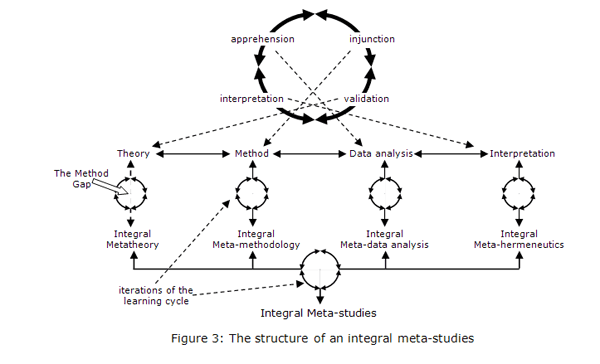
Mark Edwards - Towards an Integral Meta-Studies: Describing and Transcending Boundaries in the Development of Big Picture Science


In the newest issue of The Integral Review (9:2; June 2013), integral scholar Mark Edwards offers an excellent article on efforts toward an integrally-based meta-studies model, particularly in the realm of "big picture science."
I propose a general schema, called integral meta-studies, that describes some of the characteristics of this meta-level science. Integral here refers to the long tradition of scientific and philosophic endeavours to develop integrative models and methods. Given the disastrous outcomes of some of the totalising theories of the nineteenth century, the subsequent focus on ideas of the middle-range is entirely understandable. But middle-range theory will not resolve global problems. A more reflexive and wider conceptual vision is required.
This article appears as part of the special issue on transdisciplinary studies (International Symposium: Research Across Boundaries, Part 1).

[Image at the top is from Edwards' article at Integral World, Where's the Method to Our Integral Madness? An Outline for an Integral Meta-Studies.


Towards an Integral Meta-Studies: Describing and Transcending Boundaries in the Development of Big Picture Science [1]


by Mark G. Edwards [2]


Abstract 


We are entering a period in human civilisation when we will either act globally to establish a sustainable and sustaining network of world societies or be enmired, for the foreseeable future, in a regressive cycle of ever-deepening global crises. We will need to develop global forms of big picture science that possess institutionalised capacities for carrying out meta-level research and practice. It will be global in that such research cannot be undertaken in isolation from practical global concerns and global social movements. In this paper I propose a general schema, called integral meta-studies, that describes some of the characteristics of this meta-level science. Integral here refers to the long tradition of scientific and philosophic endeavours to develop integrative models and methods. Given the disastrous outcomes of some of the totalising theories of the nineteenth century, the subsequent focus on ideas of the middle-range is entirely understandable. But middle-range theory will not resolve global problems. A more reflexive and wider conceptual vision is required. Global problems of the scale that we currently face require a response that can navigate through theoretical pluralism and not be swallowed up by it. In saying that, twenty-first-century metatheories will need to be different from the monistic, grand theories of the past. They will have to be integrative rather than totalising, pluralistic rather than monistic, based on science and not only on philosophy, methodical rather than idiosyncratic, find inspiration in theories, methods and interpretive frameworks from the edge more than from the centre and provide means for inventing new ways of understanding as much as new technologies. Integrative metastudies describes an open system, inquiry space or clearing that has a place for many forms of scientific inquiry and their respective theories, methods, techniques of analysis and interpretive frameworks.

1. The word “integral” is used here to refer to the long tradition of integrative big pictures as exemplified in the work of such figures as Thomas Aquinas, Georg Hegel, Michil Bakunin, Vladamir Solovyov, Pitrim Sorokin, Rudolph Steiner, Jean Gebser, Aurobindo Ghose, Jacques Maritain, Bill Torbert, Ken Wilber, Ervin László, Fred Dallmyr, Ronnie Lessem and Alexander Schieffer. 

2. Mark Edwards is Assistant professor at the Business School, University of Western Australia where he teaches in the areas of business ethics and organisational transformation. Mark’s PhD thesis (awarded with distinction) was published in a series on business ethics by Routledge/Taylor-Francis in August 2010 and was awarded book of the year by Integral Leadership of the year in 2011. The book focuses on the integration of knowledge as applied to the fields of organisational transformation and sustainability. Mark’s research has been published in several leading academic journals and covers a diverse range of topics including business ethics, management studies, systems research, futures studies, psychotherapy and spirituality, sustainability and organisational transformation. mark.edwards@uwa.edu.au 


Introduction 


We are entering a period in human civilisation when we will either act globally to establish a sustainable and sustaining network of world societies or be enmired, for the foreseeable future, in a regressive cycle of ever-deepening global crises. If we are to take the former pathway then we must, as a matter of some urgency, develop and institutionalise integrative and meta-level forms of scientific sense-making. This meta-level form of sense making will complement existing disciplines to establish a multi-layered understanding of science that will have the capacity to take a reflexive perspective on current scientific and philosophical theory building and testing. We will need to develop global forms of big picture science that possess institutionalised capacities for carrying out meta-level research. It will be global in that such research cannot be undertaken in isolation from practical global concerns and global social movements. In this paper I propose a general schema, called integral meta-studies, that describes some of the characteristics of this meta-level science. Integral here refers to the long tradition of scientific and philosophic endeavours to develop integrative models and methods. There are many precursors and formative examples that I draw on in developing the integral meta-studies framework and what I want to do here is present something an overview that can help to situate meta-level scientific and philosophical studies within the current landscape of knowledge quests. Integrative metatheorising is an ambitious project. It is based on the premise that the critical appreciation and integration of diverse theoretical and methodological perspectives offers a new way forward in the development of science. It seeks to find insights through the connection of knowledge rather than the specialisation of knowledge. It takes an appreciative rather than a depreciative view towards systems of knowledge, irrespective of their place within the mainstream or the periphery. The big pictures that emerge from this process stand in contrast to the goals of mainstream social science which are almost exclusively concerned with the building and testing of middle-range theory.

Given the disastrous outcomes of some of the totalising theories of the nineteenth century, the subsequent focus on ideas of the middle-range is entirely understandable. But middle-range theory will not resolve global problems. A more reflexive and wider conceptual vision is required. Global problems of the scale that we currently face require a response that can navigate through theoretical pluralism and not be swallowed up by it. In saying that, twenty-first-century metatheories will need to be different from the monistic, grand theories of the past. They will have to be integrative rather than totalising, pluralistic rather than monistic, based on science and not only on philosophy, methodical rather than idiosyncratic, find inspiration in theories, methods and interpretive frameworks from the edge more than from the centre and provide means for inventing new ways of understanding as much as new technologies. Integrative metastudies describes an open system of knowledge acquisition that has a place for many forms of scientific inquiry and their respective theories, methods, techniques of analysis and interpretive frameworks. We have, in fact, been developing these meta-level capacities and models for a very long time and the time is now ripe for a more overt description and institutionalisation of these perspectives and practices.


The Challenge of Pluralism


The great proliferation in empirical studies that occurred through the 1970s and 1980s brought with it the rise of meta-data-analysis. The sheer outpouring of empirical information, particularly in the health and medical sciences, required a scientific response that could somehow make sense and form some overarching big picture of the mass of data pouring out of journals and scientific laboratories. Gene Glass was one of the pioneers of these early approaches to the integration of empirical findings and he proposed the term meta-analysis to describe the “analysis of a large collection of analysis results from individual studies for the purposes of integrating the findings” (Glass, 1976, p. 3). Glass described the emergence of meta-analysis as follows (1977, pp. 351–352):
By the late 1960s, the research literature had swollen to gigantic proportions. Although scholars continued to integrate studies narratively, it was becoming clear that chronologically arranged verbal descriptions of research failed to portray the accumulated knowledge. Reviewers began to make crude classifications and measurements of the conditions and results of studies. Typically, studies were classified in contingency tables by type and by whether outcomes reached statistical significance. Integrating the research literature of the 1970s demands more sophisticated techniques of measurement and statistical analysis. The accumulated findings of dozens or even hundreds of studies should be regarded as complex data points, no more comprehensible without the full use of statistical analysis than hundreds of data points in a single study could be so casually understood. Contemporary research reviewing ought to be undertaken in a style more technical and statistical than narrative and rhetorical. Toward this end, I have suggested a name to make the needed approach distinctive; I referred to this approach as the meta-analysis of research. 
Precisely this situation exists today, for not only research data but, for the multitudinous varieties of theory, methods and interpretive systems that are employed to make scientific sense of the complex worlds we inhabit today. And we need corresponding meta-level schools of scientific research in each of these realms. Indeed, we can see many different forms of these meta-level studies emerging today across all kinds of scholarly outputs. On the theory side we see the emergence of meta-level theoretical frameworks, multiparadigm studies and overarching conceptual models in many social sciences. In the study of scientific research methods we see the development of meta-methods and the associated approaches of mixed and multi-methodologies and with the variety of new epistemological orientations we see the rise of meta-level and general hermeneutics. Together, these overarching forms of analysis constitute a meta-level science and they formalise a way of developing knowledge that has been part of the human story of meaning-making for a very long time. What makes these meta-level disciplines different is that now we can build and test these big pictures from a scientific perspective.

These meta-level studies form a new layer of global research in that they emerge out of the pluralism of diverse views of reality that are present across different cultures, different political and geographical regions different social histories. Where modernistic forms integrative science have attempted to develop unified grand theories and the single big Theory of Everything, the new integrative meta-level approach recognises the postmodern turns towards interpretive, methodological and theoretical diversity. The goal then is not for a unified grand monism but an open space for pursuing scientific big picture inquiry in which multiple perspectives can be appreciatively and critically considered. Hence, this new meta-level inquiry offers a scientific response to one of the central questions of the 21st century - how are we to develop global conversations around, what Raiman Panikkar call, “the pluralisms of truth” (Panikkar, 1990, p. 16).
... truth is pluralistic because reality itself is pluralistic, not being an objectifiable entity. We subjects are also part of it. We are not only spectators of the Real, we are also co-actors and even co-authors of it. This is precisely our human dignity. 
During the twentieth-century we saw a procession of big pictures come and go with some useful insights and advances but also with often disastrous results. In the domains of politics, economics, education, commerce and trade and organisation and management we have seen a litany of big scientific ideas come and then drift off into marginality. While each of them had their partial truths and valid points, overall, when championed as complete and universal schemes of salvation, big pictures have not had a good track record. From Marxism to monetarism, from rational choice theory to marketism, from globalism to the promises of hyper-technologies - all of these big pictures have their respective insights and have resulted in great advances in understanding but they have also resulted in ideologies of various kinds that are fundamentally degrading the environmental, social, economic and intellectual resources of the planet. The human predilection for creating big pictures will continue and will grow even more as we enter further into the age globalisation. Given this, how can we develop and validate our metatheories via a more conscious form of doing science? How can we build a deep science which is integrative, pluralistic, reflexive, and appreciative of contending views rather than specialist, monistic, objectifying and aimed at finding the one true theory or method? Before looking at this I should first discuss a little more about what I mean by science and social science. I argue that meta-studies, or big picture science, will play an important role in the development of planetary culture in the coming decades and so it might be useful to describe in further detail how I view scientific activity and its role in contemporary society.
Read the whole article.

Tuesday, June 25, 2013

Michael Kimmel - The Arc from the Body to Culture: How Affect, Proprioception, Kinesthesia, and Perceptual Imagery Shape Cultural Knowledge (and vice versa)

From the new issue of The Integral Review, an interesting and theoretically complex article by neuroscientist Michael Kimmel, an expert in metaphor, imagery, socio-cultural embodiment, and literary cognition. In his most recent work, Kimmel has turned to Enactive Cognitive Science, with an ethnographic focus. His work is a perfect example of the transdisciplinary models on which this issue of Integral Review is focused, combining "phenomenological and biomechanical methods for studying improvisation in dance, martial arts, bodywork and other sophisticated interaction skills."

The Arc from the Body to Culture: How Affect, Proprioception, Kinesthesia, and Perceptual Imagery Shape Cultural Knowledge (and vice versa) 

By Michael Kimmel [1]  

Abstract 

This essay approaches the complex triadic relation between concepts, body, and culture from an angle rooted in the empirical cognitive research of the past three decades or so. Specifically, it reviews approaches to how the body gives a substrate to and shapes cultural cognition. One main section examines how the body contributes to cultural learning and another how abstract cultural concepts and reasoning are grounded in sensorimotor experience, perception, and inner somatic states. Both sections’ purpose is to survey and briefly critique different theoretical frameworks, probe into their complementarity, and summarily evaluate to what extent higher cognition is embodied. The third main section outlines elements of an epistemological framework that connects culture, concepts, and the body in a sensible way. The paper closes with a discussion of how the embodied cognition paradigm advances a rapprochement of different areas both within cognitive research and beyond.


Introduction 


The cognitive sciences are currently witnessing a surge of research that integrates questions that traditionally were the prerogative of the social sciences and humanities. One cornerstone of this development is an anti-Cartesian view of the human body as a shaper of higher cognition, somewhat parallel to the much cited “body-turn” in the social sciences. A growing camp of cognitive scientists now emphasizes that cognition is not disconnected from the human body, but grounded in sensory percepts, affect and other inner somatic experience, as well as imagery and sensorimotor activations. The debate revolves around the catchwords “embodiment” (of language or thought) and “(perceptual) grounding” or “perceptual simulation”. In this essay I will introduce empirical and theoretical developments of this field. The perspective applied takes into view the contribution of the body and bodily experience to cognition, thereby opening a compellingly fresh vista on ancient quandaries about the human condition bogged down by centuries of dualism and a general disregard for the body. Across academic disciplines contributions to this long-term paradigmatic agenda have cropped up, consolidated, and built up momentum towards a critical mass. The best indicator of “embodiment’s” coming of age is a currently emerging theory net that combines methods as well as viewpoints, radiates outwards, and stimulates empirical research.

The paper’s specific task is to demonstrate how recent research fundamentally reshapes our understanding of cultural concepts, reasoning, learning, and communication. In doing so, I will survey approaches from linguistics, psychology and anthropology that address these issues. I shall therefore deliberately insert the socio-cultural aspect into a triadic equation together with the body and cognition. This has a double implication: Researchers who understand culture as a generic property of being human use the notion of embodiment to emphasize that human knowledge is rooted not only in physical interaction with the world, but bodily mediated social intersubjectivity. A complementary viewpoint most typical of linguists and anthropologists investigates cultures (in plural), thus prompting questions like: “What is universal about the body and what varies?” and “How do human patterns of anatomy, locomotion, affect, etc. to the extent that they are transcultural, constrain or enable specific cultural manifestations?” [2]

We may begin with a couple of summary observations about recent theorizing that I aim to flesh out in due course, both as regards points of consensus and certain rifts:
1. Cognitive theory is moving away from a view of meaning encapsulated in the “mind”. As the cognitive philosopher Mark Johnson succinctly formulates in an interview, a presently growing view sees meaning as “located in the complex, dynamic arc of interactions that includes brains, bodies, environments, and cultural artifacts and institutions” (Pires de Oliveira & de Souza Bittencourt, 2008, p. 45). Correspondingly, we are currently witnessing a growth of three overlapping research trends that focus on socio-cultural, embodied, and collective/ distributed cognition, respectively. With this triple turn away from the internalistic and disembodied orientation of past cognitive theory research is reaching a point where it is effectively “growing into” the agenda formerly thought to belong to the social sciences.  
2. In the embodiment paradigm, my present focus, the body shapes human reasoning and it is a medium for acquiring conceptual skills. Thus, many recent theories bootstrap higher levels of cognition from basic perceptual and bodily skills. With this we have come to a better, although not full, understanding of abstract concepts. I propose that the foundations of abstract thought constitute a key site for our understanding of the relation between body and culture, particularly as they relate to the important but vague notion of ideological “superstructure”. In this field, there is an essential complementariness between views that develop the compositional structure of complex schemas (i.e. morphology) and those that analyze the ontogenetic development of abstract ideas.  
3. Embodied cognition views abstain from pitting the body against culture. They agree that it is false to assume that abstract “metaculture” is remote from and ontologically set apart from the body, as many traditional accounts both in the cognitive and social sciences presuppose. Many recent analyses show that bodily constituents (e.g. schemas of verticality, path, or balance) become scaffolded to shape abstract concepts, abstract concept learning often happens via bodily practices, and so forth.  
4. The precise relation between body and culture is more debated. It depends on whether we ask cultural phenomenologists, cognitive linguists, or cross-cultural psychologists, to name a few key positions. In my view, a unilateral determination of culture by a (universal) body does not match up with the joint weight of comparative research, although some approaches selectively emphasize this. We need to take scholars seriously who emphasize that inchoate body experience can be inherently cultural or that cultural models in turn filter and modulate what the body contributes to cognition. Starting from an inherently reciprocal causation between culture and body, our task is to work out the specifics and examine the relative contribution of each by domain in a cross-cultural view.  
5. Embodied theorizing is still far from monolithic regarding the specific aspects of the body it focuses on. Even when we only look at abstract concepts bodily cognition can refer to anything from kinesthetic or spatial schemas used to build metaphors, via inner affects to subtly “simulated” sensorimotor action tendencies. In fact, various strands of research rarely interact at present. As one important future site of inquiry, I shall pinpoint two complementary, but seldom combined viewpoints. One of these asks how cultural concepts help us reason and create inferences, while the other asks how cultural concepts become motivational by creating qualitatively saturated somatic states that give rise to “embodied commitments”. 
The present challenge therefore lies in connecting various perspectives in a nuanced way. An integrative view should make space both for cognitive universals and cultural situatedness, allow for several types of embodiment (e.g. affective and perceptual simulation), and specify how methods and theories at different levels converge (e.g. abstracting and context-situated views). To do this, this paper must cultivate an epistemological sensitivity, while resting on the conviction that key issues like how universal the body is and how putative universals shape cultural ideas also decisively depend on data from as many fields and as many cultures as possible. This strategy alone will allow us to incrementally build domain-specific evidence, so as to avoid premature generalizations.

Here is the plan of the essay: The remainder of this section introduces what the “body” and “embodiment” mean and in reaction to which traditions the paradigm entered the arena. The second section discusses the body’s role in cultural learning and, as a contested but decisive battleground, the nature of abstract concepts. Along the way a host of largely complementary empirical approaches to embodied concept analysis are surveyed. The third section identifies a number of epistemological challenges we face in connecting the triad “culture”, “concepts”, and "body” without succumbing to reductionisms (such as typically result from a narrow scope of research methods). [3] The concluding section traces the ways in which the cultural side of the embodied cognition paradigm calls into question disciplinary boundaries. It fosters a rapprochement between cognitive scientists, anthropologists, (social) psychologists, sociologists, and linguists, and beyond this may establish a genuine interface within a “vertically integrated” common architecture that reaches out to the humanities (cf. Slingerland 2008).

Notes from above text:
1. Michael Kimmel is based at the University of Vienna. Trained in cognitive linguistics, he has extensively published on metaphor, imagery, socio-cultural embodiment, and literary cognition. More recently he turned to Enactive Cognitive Science, with an ethnographic focus. As the leader of a research team he presently combines phenomenological and biomechanical methods for studying improvisation in dance, martial arts, bodywork and other sophisticated interaction skills.  
2. To anticipate a possible misunderstanding it should be noted that a large body of literature on cultural cognition either operates outside the embodiment paradigm (e.g. by positing propositional cultural schema, narratives, reasoning or argumentation patterns without a notable embodied aspects to them) or discusses phenomena that include embodiment, but go beyond it. It is not my present intention to review these, a task that would take a separate paper (see Shore 1996, Cienki 1999, Kimmel 2002, 2004). 
3. Note that I will avoid on purpose the debates on representationalism, objectivism vs. constructivism, and the mind-brain issue.  

Friday, June 14, 2013

Markus Molz & Mark G. Edwards: Research Across Boundaries - Introduction to the First Part of the Special Issue

This is Markus Molz's and Mark G. Edwards's introductory essay to the recent special edition of the Integral Review (Vol 9, No 2) - International Symposium: Research Across Boundaries, Part 1.
The issue stems from an international symposium, “Research across Boundaries – Advances in Theory-building,” held at the University of Luxembourg in June of 2010.

The symposium was the first to bring together many leading "boundary spanning and meta-level researchers" from more than 15 countries across all continents and as many different research areas.
In what became a set of truly global dialogues, the participants presented and commented an astounding array of contemporary integrative frameworks, as well as inter- and transdisciplinary reviews and research practices across various fields of inquiry of high relevance for the future.
And here's a little more from later in the introduction:
This special issue brings together the contributions of many of the scholars and visionaries that participated in the symposium, plus a couple of complementary papers of resonating researchers who couldn’t make it to the event itself but were keen to make a contribution nevertheless. Our invitation was to deliver summary accounts of sustained boundary-crossing research and (meta)theory-building, often of a lifetime, to colleagues rooted in other research domains. The contributors were called to make the essentials of their sophisticated views, or more focused parts thereof, accessible to the interested public and to provide extended bibliographies for those attracted to explore the original sources of their work. Our guiding idea was to encourage boundary-crossing, on a meta-level, between mature boundary-crossing approaches that, somehow paradoxically, did not yet, or barely, come in touch with each other. The scientific committee of the symposium and its helpers volunteered to identify and invite these boundary-crossing scholars and to facilitate their meta-boundary-crossing dialogues and polylogues.

As a result, the Luxembourg symposium saw contributions offered that stemmed from quantum theoretical inspirations to cybernetics and complexity approaches, from action theory to semiotics and integrative meta-theorizing. The philosophical underpinnings included metaparadigms like transdisciplinarity, integral theory, critical realism, relational contextualism, global ethics, as well as participatory and emancipatory worldviews. Issues of boundary-crossing research paradigms and communities, of sense-making tools and theory families, institutional barriers and opportunities were all intimately considered.
About the Authors/Editors:

  • Markus Molz is currently Visiting professor at the School for Transformative Leadership, Palacky University Olomouc, Manager of the University for the Future Initiative, founding Board Member of the Institute for Integral Studies, and Associate Editor of Integral Review. He has a broad background in transdisciplinary social sciences, integral studies, meta-studies, international project development, and consulting of NGOs. His interests revolve around integral pluralism, quality of life in the Great Transition, as well as social and educational innovation. His current focus is on concrete pathways for institutionalizing integrative and transformative higher education and research. e-mail: markus.molz@u4future.net
  • Mark Edwards is Assistant professor at the Business School, University of Western Australia where he teaches in the areas of business ethics and organisational transformation. Mark’s PhD thesis (awarded with distinction) was published in a series on business ethics by Routledge/Taylor-Francis in August 2010 and was awarded book of the year 2011 by Integral Leadership. The book focuses on the integration of knowledge as applied to the fields of organisational transformation and sustainability. Mark’s research has been published in several leading academic journals and covers a diverse range of topics including business ethics, management studies, systems research, futures studies, psychotherapy and spirituality, sustainability and organisational transformation. e-mail: mark.edwards@uwa.edu.au
* * * * *

Research Across Boundaries: Introduction to the First Part of the Special Issue 

Markus Molz and Mark G. Edwards
In the coming century, there will be an urgent need for scholars who go beyond the isolated facts; who make connections across the disciplines; and who begin to discover a more coherent view of knowledge and a more integrated, more authentic view of life. (Boyer, 1994, p. 118) 

Background and Foreground


In the context of an unprecedented proliferation of research specializations and the pressing problem-solving needs in society, Ernest Boyer and other scholars, have emphasized the special role for research that connects knowledge and that spans boundaries. This scholarship of integration complements traditional modes of specialization of knowledge. Major advances in boundary spanning research across the seams of separate paradigms, disciplines, cultures and contexts have been made in many places in recent years. Multi-paradigm and multi-method research, translation research movements, trans- and meta-disciplinary approaches, as well as cross-cultural or cross-sector participatory projects are emerging in and across many fields of research. It is no accident that these developments are surfacing at this juncture in planetary evolution.

Down through the ages, each generation of humanity has faced its own challenges, its own demons, and its own possibilities for expanding the possibilities. Sometimes the challenges are accepted, the will, the heart and the hands are tested, and life deepens and expands. Sometimes the challenges are rejected and avoided, our demons get the better of us, we turn in on ourselves and the possibilities afforded by human birth close down. Whatever our choices have been in the past, humanity has moved on. But something new presents itself in these current days. We are living in an unprecedented historical epoch, the Anthropocene (Steffen et al, 2011).

The human has irrevocably changed the planet. The impact of our actions are coming back to haunt us and our children. The challenges are now global, local and everything in between, they are with us now and they stretch out into the distant intergenerational future, they include the whole Earth system and every living thing that travels with her, they involve every aspect of the countless bio-social systems that network across her surface and which course through the intersubjective experience of every plant and animal. The possibilities for responding to the planetary challenges, and the implication of those responses, are extreme and they stretch out between a  vision for and acceptance of a profound deepening of planetary potentials and a life-destroying,  fear-laden rejection of the realities that demand our attention.

Science, the humanities, religion, art, the storehouses of cultural and indigenous knowledge, the world of lived practice and life experience will all generate their own contributions to meeting or avoiding the local, regional and global challenges that beset us. Many possibilities exist in considering these options but, whatever path we choose as individuals or as a single global family, never before have the global stakes been so high, never before has the need for planet-wide decision-making, for big-picture explanations and solutions been so pressing. Never before has human society, as a single entity, been required to develop a coherent global approach to dealing with the challenges that now confront it.

And it is no coincidence that the unfolding planetary challenge should also be accompanied by the emergence of global forms of knowing and of accessing knowledge. In no previous times has so much knowledge been intentionally produced, stored and disseminated, has there been such an extensive body of expertise in so many distinct research specializations. It is only now, in these last few years, that the products of so many knowledge traditions, institutions of learning, independent scholars, research collectives and commercial research sources from so many regions, cultures and historical periods have become accessible to so many people across the globe. The web and depth of knowledge is vast and it is available. But what sense can and will we make of it all? Down which pathways will all this knowledge lead us?

It is no coincidence that in these critical times of a global anthropogenic cocktail of crises, we are also immersed in an ocean of experience, of data, information and knowledge. Do we have the wisdom to not only develop shared knowledge from this ocean of information but also to make shared sense of it? And are we able to make use of the bigger pictures we gain from boundary-crossing experience and reflection to engage in large-scale and long-term coordinated action? This is needed to enable a dignified life for the many throughout the Great Transition (Raskin et al, 2002; Spratt et al, 2010). Under complex and volatile conditions boundary-crossing competence is also considered more and more important as a complement for domain-specific expertise (see e.g. Engeström, Engeström & Kärkkäinen, 1997, Horlick-Jones & Sime, 2004).

Responding to the need for shared sense making, there is a widespread and growing call today for building connections across disciplines, paradigms, cultures, and worldviews (see for instance Dussel, 2009; Giri, 2002, as well as Nelson and Raman in this issue). And indeed, in recent years various advances have been made in boundary-crossing research that facilitates (re)connections between theory and practice, facts and values, history and future, sciences and humanities, the knowledge traditions of East and West, North and South. Gasper (2004) says that
we should recognize and promote a complex intellectual 'eco-system' with multiple legitimate types of life-form, sub-system, and of interaction of ideas, inquirers and users (p. 310) … an eco-system within which many species and hybrids co-exist and interact … A complex eco-system requires a complex system of concepts and models to describe and understand it. ... Interaction requires mutually accessible and acceptable intellectual frameworks. (p. 327) 
In navigating through the hazards of the Great Transition we need conceptual visions with the requisite complexity and scope. Towards this end the Luxembourg Symposium was organized.

Read the whole essay and check out the new issue of Integral Review.