Showing posts with label Europe. Show all posts

Wednesday, February 05, 2014

Levevei - Episode 93: The emergence of integral consciousness in Europe

IEC_LOGO

From Levelei, this is an interesting podcast episode about the emergence of integral awareness and integral consciousness in Europe - where they seem to be quite ahead of America in exploring and adopting integral ideas. For example, the RSA in England has adopted Harvard professor Robert Kegan's developmental model and has also incorporated ideas from Spiral Dynamics in their social brain project and other endeavors.

This podcast also serves as a preview of the upcoming European Integral Conference which will be held 8 – 11 May in Budapest, Hungary

Episode 93: The emergence of integral consciousness in Europe

Posted by James Alexander Arnfinsen (redaktør) × February 2, 2014


Podcast: Play in new window | Download (Duration: 1:04:11 — 58.8MB) | Embed


In this episode I have the delight of connecting with Dennis Wittrock (left) from Germany and Bence Gánti from Hungary. Together they are leading the Integral Europe initiative, a community of knowledge and practice that aims to “embody, represent, teach, develop and give voice to integral consciousness and its resulting practical applications on a European basis” (from their website). In this regard they are currently in the process of organizing the first European Integral Conference which will be held 8 – 11 May in Budapest, Hungary. If you are totally new to the integral discourse I would highly recommend that you first read the introductory article by Sean Esbjörn-Hargens (see below). Dennis and Bence start of by sharing their background and the ways in which they became involved in the integral scene, before going into what they envision for the upcoming conference. For instance, how can the different projects, groups and initiatives that we see spread out in Europe come together and contribute something to the integral commons?

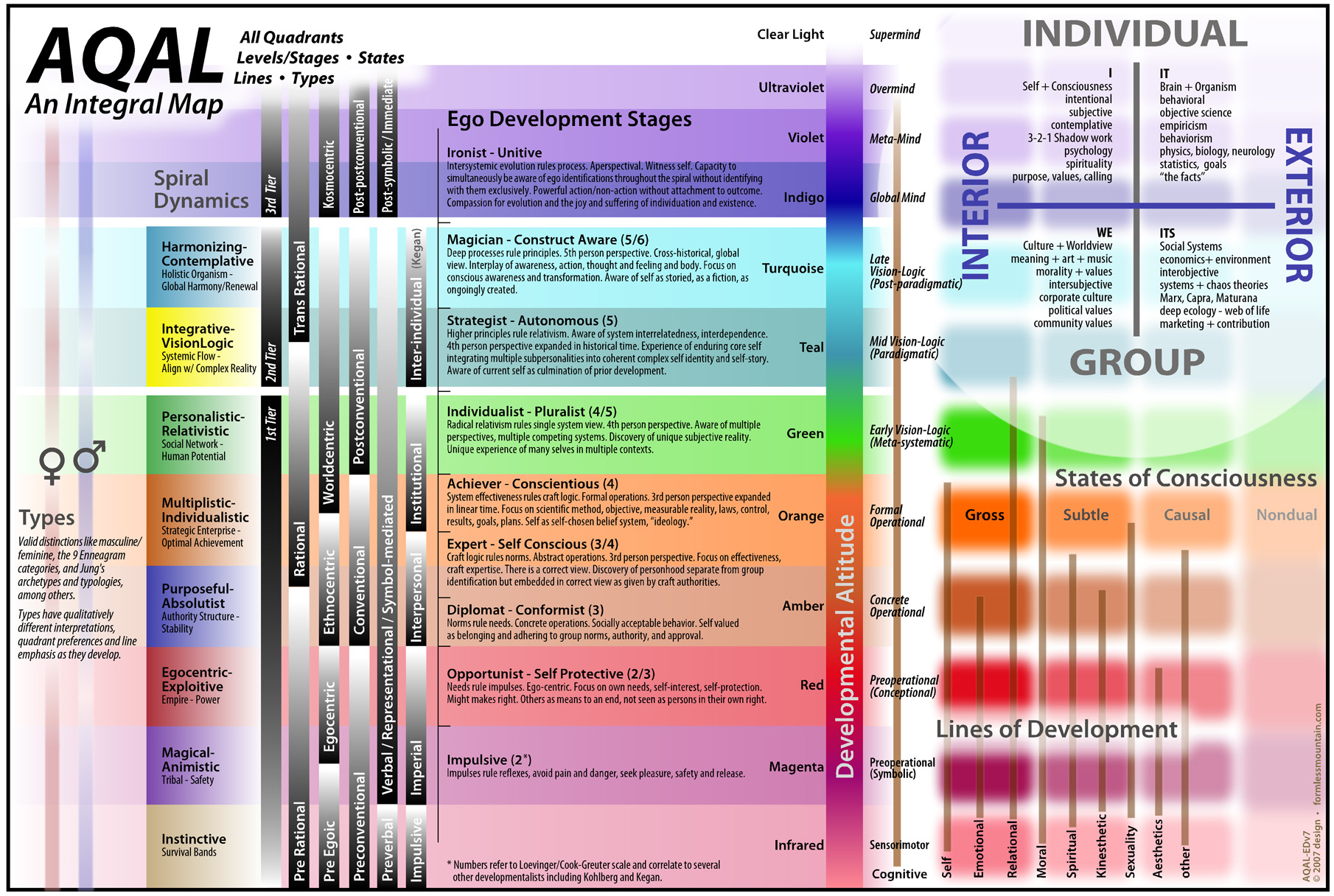
Bence goes on to explore what an actual integral conference would look and feel like. How can we transcend the constraints of traditional conferences and give space to different modalities of inquiry and holistic modes of exploration? Dennis follows up with emphasizing the value of creating a nurturing holding environment for these types of events, and he describes how the organizing group is working internally amongst themselves to strengthen their relationships and to deepen their own personal engagement. Another interesting theme that they point out is how we can truly integrate all the levels in the spiral (referring for instance to Spiral Dynamics, see chart below), and maybe especially the “green level” which is all about sharing, bonding and creating pathways between the minds and hearts of people involved. The integral movement has often criticized the “green meme”, but could it be that the integral movement is actually under green, and in this regard, truly in need of owning and growing into this level of psycho-social development? Further on we explore the fabric and potentials of a European identity, inquiring into how one could start to vivify a true European sense of soul. What does it actually entail to be European? Also, could it be that the labels and assumptions we attach to each other are creating unnecessary division? And how can we create a fertile ground for unification and coherence amongst all the people on the European continent? Following up on this theme we explore the possible unique voices and flavors of a European integral perspective. In what ways can the different European cultures contribute to the overall global commons of integral theory and practice? Towards the end we explore the potentials of the overall initiative through a little exercise where we let go of all our conceptualizations and just listen to what wants to emerge.

If you feel inspired or provoked by our conversation feel free to add your comments after the interview. You can also send in a written piece of work and get it published together with this episode. Further details can be found here.

Episode links:


Comprehensive AQAL Chart by Steve Self – click to enlarge

Wednesday, April 03, 2013

Contemporary Continental [Philosophical] Thought (Heavy on Deleuze)

This is an excellent collection of links on contemporary European (i.e., Continental) philosophy and thought, courtesy of Bookforum's Omnivore blog.


Contemporary continental thought

APR 2 2013 
9:00AM

  • Thomas Nail (Denver): Deleuze, Occupy, and the Actuality of Revolution.  
  • David R Cole (UWS): Traffic Jams: Analysing Everyday Life Using Deleuze and Guattari. 
  • From New Left Project, Samuel Grove interviews Andrew Robinson on the political philosophy of Gilles Deleuze (and part 2). 
  • John Protevi reviews Political Theory after Deleuze by Nathan Widder. 
  • Ashley Bohrer reviews Jacques Ranciere’s Althusser’s Lesson. 
  • Richard Fitch reviews Thinking the Impossible: French Philosophy since 1960 by Gary Gutting. 
  • Daniel Tutt reviews Difficult Atheism: Tracing the Death of God in Contemporary Continental Thought by Christopher Watkin. 
  • Slavoj Zizek on the three events of philosophy. 
  • Rebecca Rothfeld on why we slober over Slavoj Zizek: Or, how to be incomprehensible and relevant at the same time. 
  • You can download Everyday Life and the State by Peter Bratsis (2006).

Thursday, June 07, 2012

Gone Traveling

IOC will be quiet for the next week and a half while I wonder around central Europe with my friend, Tom. I'll post when I can, but regular blogging will resume around June 18.


Sunday, November 07, 2010

Tariq Ramadan - The Quest for Meaning

Tariq Ramadan is a very unpopular man in some circles, while others believe he offers hope for peaceful coexistence between Muslims and largely secular Europeans. He was named one of the 100 most influential people in the world by Time magazine in 2004 - here is what they said about him then:
Tariq Ramadan
Modernist or Extremist?

By BRUCE CRUMLEY


Few observers deny the seductive brilliance of Swiss philosopher and Islamic theoretician Tariq Ramadan, but disagreement over his true agenda is ferocious. Within the past half-decade, Ramadan has become enormously influential among Muslims throughout Europe. He calls for believers to embrace and practice Islam in a thoroughly modern manner. And he advises Muslims on how they can fully integrate into European societies without betraying the universal laws and values of Islam. A successful author, he sells around 50,000 audiocassettes of his speeches each year in France alone.

Detractors claim that Ramadan's messages are filled with a double language. His followers, they say, can decipher his words as a call to furtively spread fundamentalist Islam in society under the cover of modernism and integration. Critics have denounced as anti-Semitic Ramadan's recent critique of "Jewish French intellectual" reaction to the intifadeh. They were appalled when he suggested last year a "moratorium" on the stoning of adulterers in order to consider the legitimacy of the act. (In 2003, his Islamist brother Hani was dismissed as a schoolteacher after defending the stoning of women in Le Monde.)

Ramadan's fans insist that his modernist message is genuine. Some Americans will soon get a chance to judge for themselves. In September he is scheduled to teach a course at the University of Notre Dame's Institute for International Peace Studies called Religion & Conflict.
Vanity Fair very recently posted a video of Ramadan debating Islam with Christopher Hitchens, who does not agree with Ramadan (obviously, since Hitchens dislikes all religions).

Politics Daily ran an excellent feature, by Sarah Wildman, on Ramadan in April of this year. Here is a bit of that article:
Since the early 1990s, Ramadan has been known for espousing a "third way" for European Muslims. Rather than pushing them to believe they can only be Muslim or French (or German or Belgian or British . . .), he offers a way to be both. To Americans, dual identity hardly raises an eyebrow, but Europeans rarely don two at once. In addition, a deep secularity is often the norm across the Pond, in contrast to an American penchant for religiosity. These are not countries that promoted immigration in the same way that the New World did, and the loosening of the Catholic Church's influence on civic life (in France in particular) came in the late 19th and early 20th centuries with strong barriers to representation of religion in public life.
On the bright side, he is allowed in the country now after been denied a visa during the Bush administration on the grounds of terrorism risks (he was accused of donating money to a Swiss charity that then donated the money to Hamas). There are still many - mostly conservatives - who believe that he is sending coded messages to Muslims to perpetuate fundamentalist ideals. Watch the video below - from the RSA - and judge for yourself.
Renowned philosopher and scholar Tariq Ramadan asks: how can different religious traditions move beyond tolerant co-existence to mutual respect and enrichment?


Download video (mp4)


Monday, October 11, 2010

Immanuel Wallerstein - Does Social-Democracy Have a Future?

Interesting perspective - Wallerstein looks at two recent elections in Europe (Sweden and Great Britain) that suggest social democracy may be on its way to the political scrap heap of human history.

It's unclear to me if this is a step forward, or yet another form of retrenchment into more conservative and less compassionate perspectives.

What do these two elections tell us about the future of social-democracy? Social-democracy – as a movement and an ideology – is conventionally (and probably correctly) traced to the “revisionism” of Eduard Bernstein in late nineteenth-century Germany. Bernstein argued essentially that, once they obtained universal suffrage (by which he meant male suffrage), the “workers” could use elections to win office for their party, the Social-Democratic Party (SPD), and take over the government. Once they won parliamentary power, the SPD could then “enact” socialism. And therefore, he concluded, talk of insurrection as the road to power was unnecessary and indeed foolish.

What Bernstein was defining as socialism was in many ways unclear but still seemed at the time to include the nationalization of the key sectors of the economy. The history of Social-Democracy as a movement since then has been that of a slow but continuous shift away from a radical politics to a very centrist orientation.

The parties repudiated their theoretical internationalism in 1914 by lining up to support their governments during the First World War. After the Second World War, the parties algined themselves with the United States in the Cold War against the Soviet Union. And in 1959, at its Bad Godesburg conference, the German SPD officially repudiated Marxism entirely. It stated that “from a party of the working class, the Social-Democratic Party has become a party of the people.”

What the German SPD and other social-democratic parties came to stand for at that time was the social compromise called the “welfare state.” In this objective, in the period of the great expansion of the world-economy during the 1950s and 1960s, it was quite successful. And at that time, it remained a “movement” in the sense that these parties commanded the active support and allegiance of very large numbers of persons in their country.

When, however, the world-economy entered into its long stagnation beginning in the 1970s, and the world entered the period dominated by neo-liberal “globalization,” the social-democratic parties began to go further. They dropped the emphasis on the welfare state to become the advocates merely of a softer version of the primacy of the market. This was what Blair’s “new Labour” was all about. The Swedish party resisted this shift longer than others, but it too finally succumbed.

The consequence of this, however, was that Social-Democracy ceased to be a “movement” that could rally the strong allegiance and support of large numbers of persons. It became an electoral machine that lacked the passion of yesteryear.

Read the whole article.