Wednesday, September 28, 2011

Jeremy Rifkin: "The Third Industrial Revolution"

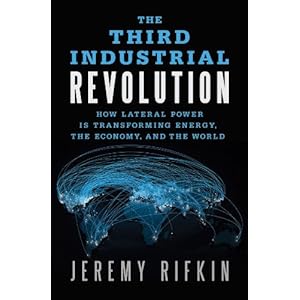
The Third Industrial Revolution: How Lateral Power Is Transforming Energy, the Economy, and the World

This was a cool segment from the Diane Rehm Show - featuring new research from a new book by Jeremy Rifkin - The The Third Industrial Revolution: How Lateral Power Is Transforming Energy, the Economy, and the World.

Jeremy Rifkin: "The Third Industrial Revolution"


U.S. economist Jeremy Rifkin the founder and president of the Foundation on Economic Trends (FOET) speaks during the 23rd congress of the Socialist International at the Lagonissi Grand Resort, about 40 kilometers (25miles) south of Athens on Monday, June 30, 2008. Close to 700 participants from 150 political parties and organisations from 120 countries will attend the Congress of the Socialist International from June 30 to July 2.  - (AP Photo/Thanassis Stavrakis)
U.S. economist Jeremy Rifkin the founder and president of the Foundation on Economic Trends (FOET) speaks during the 23rd congress of the Socialist International at the Lagonissi Grand Resort, about 40 kilometers (25miles) south of Athens on Monday, June 30, 2008. Close to 700 participants from 150 political parties and organisations from 120 countries will attend the Congress of the Socialist International from June 30 to July 2.


Guests: Jeremy Rifkin - President of the Foundation on Economic Trends, adviser to the European Union and author of "The Hydrogen Economy," "The Biotech Century," and "The End of Work."

An economist explains how internet technology and renewable energy are merging to change the way we live and work.

Author Extra: Jeremy Rifkin Answers Audience Questions

Q: The book title refers to "lateral power." What does this mean?
A: Lateral power means side-to-side power. On the Internet, millions of people share information in vast social networks, and the power of coming together side by side dwarfs the kind of centralized, top-down power that’s traditional. Converging the internet with renewable energies will allow millions of people to generate their own green electricity in their homes offices and factories and then share it across a vast energy internet, just like they now create their own information and share it online with millions of others.
Q: How could this third industrial revolution transform labor and politics?
A: Because the third industrial revolution is about lateral power, it favors small and medium-sized businesses coming together in networks to create new economic opportunities. The third industrial revolution will create thousands of new businesses and millions of new jobs. Manufacturing renewable energies, converting buildings to micro power plants, storing renewable energies in the form of hydrogen across the infrastructure, transforming the electricity grid and power and transmission lines into an energy internet, and revolutionizing the transport and logistics sector.
Q: While I'm a long-time fan of Mr. Rifkin's, he's mistaken about the feed-in tariff. The power generated by these qualified PV systems does not belong to the building/roof owner. One hundred percent of the power goes directly onto the grid. That power becomes a commodity to sell on the open market. The system may be owned by third parties that lease the factory roof; the electric power has long-term value because the cost to generate that power does not increase. Utility power does. This allows long-term investments in distributed generated power to increase in value, exactly what investors are seeking. - From Jim
A: PV systems can be owned by the local owner, which is often the case. Local owners of buildings can also lease out their infrastructure to third parties, as well. Increasingly, small and medium businesses and home owners in Europe are choosing the former course, and pooling their interests by creating producer and consumer green electricity cooperatives, in order to advance early adoption with significant scale up. In countries where there are feed-in tariffs, banks are not advancing green loans so that home owners and businesses can convert their buildings to micro power-plants. The savings in electricity is used to pay back the loans. After the loan is paid back, the electricity is virtually free for the owner.
Q: In Europe there is a larger tradition of government leadership in public investment. Here in the USA, in tradition and more particularly with the current political/budget climate, government-led solutions are problematic. We favor private-sector solutions. How are we going to lead from the private sector? Where are the niches where these technologies will develop on their own, without government subsidies or other intervention? Where are the opportunities for entrepreneurs and investors in the USA who believe in your thesis? - From Charles
A: Both the first and second industrial revolution in the U.S. required an ongoing relationship between local state and federal government, industry, and communities. It’s impossible to lay down a five- pillar infrastructure for a new industrial revolution without this kind of partnership because the five-pillar infrastructure requires comprehensive planning, which brings into the picture local governments as well as local businesses and communities.

TEDxFlanders - Molly Crockett - understanding the brain


Another cool TEDx Talk - this one from Flanders. Here is the statement from her page at (University of) Cambridge Neuroscience:
I study the neural basis of human altruism, morality and value-based decision-making. My research investigates the influence of neurotransmitters (serotonin, noradrenaline and dopamine) on the brain systems that motivate social and economic behavior. To explore these questions, I conduct experiments using pharmacological manipulations, brain imaging, psychophysiology and behavioral analysis. Understanding the mechanisms behind prosocial behavior can inform the development of social and economic institutions that promote social values over selfishness and discourage antisocial behavior.
Glad to see more research being done on pro-social behavior. And here is the background for this video.
Does your sense of fairness depend on what you ate for breakfast? Can Prozac influence your judgment of what is right or wrong? How can we encourage people to care about the welfare of others? Molly Crockett's research addresses these questions. She believes that understanding the brain can enable us to design environments that promote cooperation instead of selfishness.


Why listen to her?
Molly's research has taken her far from her native Southern California, where she studied psychology as an undergraduate at the University of California, Los Angeles. Molly's curiosity about brain chemistry led her to the University of Cambridge, where she completed her PhD in neuroscience as a Gates Scholar. Now she collaborates with economists at the University of Zürich and neuroscientists at University College London.


Web: mollycrockett.com – Twitter: @mollycrockett

Tuesday, September 27, 2011

TEDxNASA@SilconValley - Craig Venter - Synthetic Life


Here's some recent TEDx goodness, this time it's Craig Venter talking about synthetic DNA - and artificial life. Here is the article abstract from the project that created the first self-replicating artificial cell (you can read the whole article online for free - gotta love open access):
Creation of a Bacterial Cell Controlled by a Chemically Synthesized Genome


Daniel G. Gibson, John I. Glass, Carole Lartigue, Vladimir N. Noskov, .... J. Craig Venter


*To whom correspondence should be addressed. E-mail: jcventer@jcvi.org


ABSTRACT


We report the design, synthesis, and assembly of the 1.08–mega–base pair Mycoplasma mycoides JCVI-syn1.0 genome starting from digitized genome sequence information and its transplantation into a M. capricolum recipient cell to create new M. mycoides cells that are controlled only by the synthetic chromosome. The only DNA in the cells is the designed synthetic DNA sequence, including “watermark” sequences and other designed gene deletions and polymorphisms, and mutations acquired during the building process. The new cells have expected phenotypic properties and are capable of continuous self-replication.
Published Online May 20 2010
Science, 2 July 2010:
Vol. 329 no. 5987 pp. 52-56
DOI: 10.1126/science.1190719


You can read the Guardian UK article about it here.

And below is the TEDx Talk.
Synthetic Life.J. Craig Venter is a biologist who has led teams responsible for sequencing the first draft human genome, the first diploid human genome, and construction of the first self-replicating synthetic bacterial cell. He is founder and president of the J. Craig Venter Institute and founder and CEO of Synthetic Genomics, Inc.


New Scientist - A brief history of the brain

New Scientist has offered up a cool, free article, A brief history of the brain - which is brief only in comparison to a dissertation or book. For an internet post, it is quite lengthy - and very cool as a primer on the human brain, beginning in the oceans of our distant past right up to the present, when the brain seems to be shrinking.

Intelligent origins <i>(Image: <a href="http://www.agencyrush.com/Artists/Burneverything/">Burn Everything/Agency Rush</a>)</i>

A brief history of the brain


New Scientist tracks the evolution of our brain from its origin in ancient seas to its dramatic expansion in one ape – and asks why it is now shrinking
IT IS 30,000 years ago. A man enters a narrow cave in what is now the south of France. By the flickering light of a tallow lamp, he eases his way through to the furthest chamber. On one of the stone overhangs, he sketches in charcoal a picture of the head of a bison looming above a woman's naked body.
In 1933, Pablo Picasso creates a strikingly similar image, called Minotaur Assaulting Girl.
That two artists, separated by 30 millennia, should produce such similar workseems astonishing. But perhaps we shouldn't be too surprised. Anatomically at least, our brains differ little from those of the people who painted the walls of the Chauvet cave all those years ago. Their art, part of the "creative explosion" of that time, is further evidence that they had brains just like ours.
How did we acquire our beautiful brains? How did the savage struggle for survival produce such an extraordinary object? This is a difficult question to answer, not least because brains do not fossilise. Thanks to the latest technologies, though, we can now trace the brain's evolution in unprecedented detail, from a time before the very first nerve cells right up to the age of cave art and cubism.
The story of the brain begins in the ancient oceans, long before the first animals appeared. The single-celled organisms that swam or crawled in them may not have had brains, but they did have sophisticated ways of sensing and responding to their environment. "These mechanisms are maintained right through to the evolution of mammals," says Seth Grant at the Wellcome Trust Sanger Institute in Cambridge, UK. "That's a very deep ancestry."
The evolution of multicellular animals depended on cells being able to sense and respond to other cells - to work together. Sponges, for example, filter food from the water they pump through the channels in their bodies. They can slowly inflate and constrict these channels to expel any sediment and prevent them clogging up. These movements are triggered when cells detect chemical messengers like glutamate or GABA, pumped out by other cells in the sponge. These chemicals play a similar role in our brains today (Journal of Experimental Biology, vol 213, p 2310).
Read the whole article.

Sogyal Rinpoche - Three Essentials to Stabilize the View in Meditation

This is today's Glimpse of the Day from Sogyal Rinpoche - it's too long to see in a "share" so here is the whole thing - the three essentials to stabilizing the View in meditation.

The masters stress that to stabilize the View in meditation, it is essential, first of all, to accomplish this practice in a special environment of retreat, where all the favorable conditions are present; amid the distractions and busyness of the world, however much you meditate, true experience will not be born in your mind.


Second, though there is no difference in Dzogchen between meditation and everyday life, until you have found true stability through doing the practice in proper sessions, you will not be able to integrate the wisdom of meditation into your experience of daily life.


Third, even when you practice, you might be able to abide by the continual flow of Rigpa with the confidence of the View, but if you are unable to continue that flow at all times and in all situations, mixing your practice with everyday life, it will not serve as a remedy when unfavorable circumstances arise, and you will be led astray into delusion by thoughts and emotions.

Buddhist Geeks 232: The Dark Night Project with Willoughby Britton

Here is part two of Vince's interview with Willoughby Britton on Buddhist Geeks. This week they focus on the Dark Night Project, which she describes like this:
And yeah the Dark Night project, my project, is sort of the area that I specialize in and I’m collecting reports about where these difficulties fit in the bigger map. And other people might be more interested in, you know, what happens post stream entry? What does full enlightenment looked like? Those kinds of questions. My sort of population specialty has always been the people that are really struggling. And again my goal has always been to make sure that they get the support they need.
Early in the interview (like right at the beginning) she outlines some of the issues people can have as a result of beginning a meditation practice. I see what she is doing as very similar to Christina Grof's work on spiritual emergency (this article by Brant Cortright is useful). Waking up is not always a fun and pleasant experience.

BG 232: The Dark Night Project

by Willoughby Britton


BG 232: The Dark Night Project

Episode Description:


We’re joined again this week by Brown University neuroscience researcher Willougbhy Britton. Willougbhy begins this episode by going into further depth into some of the typical experiences that have been reported during her research into the difficult stages of the contemplative path. She lists out typical changes in cognition, affect (emotion), perception, and other psychological material. She also explores the typical duration of these experiences and explores some of the philosophical and practical ramifications of these stages.
Toward the end she also speaks about how she and her colleagues–all part of this emerging group of contemplative scientist hybrids–have come together to create a new contemplative development mapping project. This new generation of scientists are studying the mind, and have immersed themselves not only in scientific methodologies but also in contemplative practice.
This is part 2 of a two-part series. Listen to part 1, The Dark Side of Dharma.  
Episode Links 

    Transcript


    Monday, September 26, 2011

    Joe Perez Joins the "Protect Marc Gafni" Camp

    It was only a matter of time before Gafni found another proxy voice for his campaign of martyrdom. Joe Perez is the most recent willing puppet. With Perez, he has the perfect accomplice - Perez has been hacking away at me ever since he came back online in his most recent incarnation (one of his first acts was to "review" my blog and complain that it is not integral enough for him).

    And I'll bet Perez doesn't even realize he is being played by Gafni exactly because he has already been critical of me. If it weren't sad, it might be funny.

    As is always the case, Gafni tries to obscure the message by smearing the messenger (for example, women who broke his sacred container, Vicki Polin, Luke Ford, any and all other detractors, and most recently John Dupuy).

    John had the audacity to speak out, so Marc responds with so much love and nuance, so much righteousness, and also with a not-very-well-veiled threat:
    I did not threaten John with a lawsuit or any other such threat. Simply not true. I said to John that I would be forced to reply in a way that shares the deep context of my relationship to John and the great disappointment that I have felt around John and his character which I have called him on directly many times. That would then unmask much of the conscious or unconscious motivation behind John's blog. I wrote a long blog post which does precisely this. I am no longer sure wether anything would be served by posting it. The blogosphere is really not the place for genuine loving conversation between friends.
    Two of his favorite ploys are on display here - he said/he said games that can never be proven one way or the other, and threats of exposing personal issues from the past that may or may not be problematic.

    So now the "smear Bill Harryman campaign" is in full swing. Joe's big piece of ammunition against me is to accuse me of intellectual property theft. I addressed this in the comments to one of the posts where he again leveled the same accusations, so here is my "defense":
    I have never posted anyone's work on this blog without attributing author and source, with links. Often I have permission to do so, and equally often the authors are grateful for the additional exposure. I guess I still have not met the legal standard (or your ethical standard), so yes, I am guilty of "egregious intellectual property theft." If I have hurt anyone by posting their work here, I am deeply sorry. I have never meant to "steal" work, which is why I always include links to the original source. 
    So there it is - both an admission of being guilty as charged and an apology to anyone who has been hurt by my actions. Wow, that wasn't so hard. Why can't other people do that?

    He says that accusing Gafni of plagiarism (actually, it wasn't me - it was Rocky Anderson, one the owners of the stolen work, and whose "letter of support" from Gafni's last resurrection is still posted on Ganfi's site) is hypocrisy because I am an intellectual property pirate. He isn't accusing me of using other people's work, verbatim, and putting my name on it as though I had written it, so I think we are talking apples and oranges here.

    Are these accusations supposed to discredit the letter from Tami Simon on the original post? Is this supposed to discredit the other woman Gafni was sleeping with (mentioned in Tami's letter), in addition to the senior student, Marcy (who wrote in his defense), while not publicly disclosing his separation from Mariana? Or is it supposed to discredit the message by discrediting the messenger?

    More and more, as this wears on, I feel sorry for Mariana - she is a new mom with her first child and her world is collapsing around her. She willingly chose Gafni and in full-knowledge of his past, although she believed his retelling of the story with him as victim (always the victim), so she holds her own share in this situation.

    And then there is Zion - babies sense the emotions of those around them - what is this doing to him and his future? How I know I have contributed to the suffering of Marc, Mariana, and Zion by telling truths that no one else was willing to tell. I am sad about that. Like each of Gafni's previous children, he will probably grow up without his father - and eventually with the knowledge that his father was a deeply wounded man.

    Why I Support the Creative Commons Initiative


    The Creative Commons idea has been around for a while, but it seems very few people have adopted its use. I have been a supporter of this approach to sharing information on the web for several years - the "intellectual property" monopoly is simply a way to keep information sequestered in a capitalist legal structure, restricting the free flow of information from those who can use it and benefit from it.

    As a writer and researcher, I often come up against articles that are behind a pay-wall - and the asking price is often in the range of $30 per article (or more). The sinister thing is that authors in these journals also pay to have their articles published - and the cost to them goes WAY up if they choose an open access journal.

    Being the owner/publisher of an academic journal is a very profitable business.

    Even in the mainstream internet publications, however, information is (mostly) free on the site where it is originally posted, but sharing that information with others, with full attribution and links to the original site and post, is still a pay-per-use system.

    The argument against a Creative Commons approach for these folks usually revolves around the short-term loss of "visits," the way they count user traffic to generate advertiser dollars - the more visits, the more they can charge for ad space on the site. What they neglect, it seems to me, is the long-term benefit of exposure to readers who might not otherwise view the material or the site, who are introduced to the author, idea, or site through it being shared on another venue.

    But it seems most of the major online magazines (and magazine-like sites) don't take this longer perspective and only worry about the visits they might not get today. I hope that this will change - it is a policy based in 20th century content presentation that cannot fathom the 21st century changes in that system.

    Here is the summary statement of the Creative Commons organization, explaining their values and mission.

    Our vision is nothing less than realizing the full potential of the Internet — universal access to research and education, full participation in culture — to drive a new era of development, growth, and productivity.

    Why CC?

    The idea of universal access to research, education, and culture is made possible by the Internet, but our legal and social systems don’t always allow that idea to be realized. Copyright was created long before the emergence of the Internet, and can make it hard to legally perform actions we take for granted on the network: copy, paste, edit source, and post to the Web. The default setting of copyright law requires all of these actions to have explicit permission, granted in advance, whether you’re an artist, teacher, scientist, librarian, policymaker, or just a regular user. To achieve the vision of universal access, someone needed to provide a free, public, and standardized infrastructure that creates a balance between the reality of the Internet and the reality of copyright laws. That someone is Creative Commons.

    Our mission

    Creative Commons develops, supports, and stewards legal and technical infrastructure that maximizes digital creativity, sharing, and innovation.

    What we provide

    The infrastructure we provide consists of a set of copyright licenses and tools that create a balance inside the traditional “all rights reserved” setting that copyright law creates.
    Our tools give everyone from individual creators to large companies and institutions a simple, standardized way to keep their copyright while allowing certain uses of their work — a “some rights reserved” approach to copyright — which makes their creative, educational, and scientific content instantly more compatible with the full potential of the internet. The combination of our tools and our users is a vast and growing digital commons, a pool of content that can be copied, distributed, edited, remixed, and built upon, all within the boundaries of copyright law. We’ve worked with copyright experts around the world to make sure our licenses are legally solidglobally applicable, and responsive to our users’ needs.
    If you’d like to see what kinds of companies and organizations are using Creative Commons licenses to realize the full potential of the Internet, visit our Who Uses CC? page.
    For those creators wishing to opt out of copyright altogether, and to maximize the interoperability of data, Creative Commons provides tools that allow work to be placed as squarely as possible in the public domain.

    Where we’re going

    We build infrastructure at Creative Commons. Our users build the commons itself. We are working to increase the adoption of our tools, to support and listen to our users, and to serve as a trusted steward of interoperable commons infrastructure.

    Your support

    In order to achieve the vision of an Internet full of open content, where users are participants in innovative culture, education, and science, we depend on the backing of our users and those who believe in the potential of the Internet. We are alive and thriving thanks to the generous support of people like you. Spread the word about CC to your friends and family, and donate to help maintain Creative Commons as a robust, long-lived, and stable organization.
    Creative Commons is a Massachusetts-chartered 501(c)(3) tax-exempt charitable corporation. For more information, see the corporate charterby-laws, most recent tax return and most recent audited financial statement.

    Roya R. Rad - 6 Practical Meditation Tips


    Roya Rad has been posting frequently at Huffington Post - this usually means the person is promoting a book or some other material, but I do not see a listing for any books. Very cool, I admire that.

    6 Practical Meditation Tips

    by Roya R. Rad, MA, PsyD 
    Self Knowledge Base and Foundation, A non-profit dedicated to public education

    Meditation is the art of focusing on a single point, your quiet place within. Of the thousands of thoughts going through your mind every day, each one of them trying to grab your attention. Meditation helps you calm them down, and then you can focus on what really matters. In addition, meditation can be a reminder that all the feelings, emotions, thoughts and behaviors are originating from you and your view of life, not so much the other way around.


    Research backing the many benefits of meditation is strong. Meditation can help people physically, emotionally and mentally. It is just the matter of getting it into the routine of life and practicing it until it becomes natural.

    At the end, be patient with the process of meditation, since like any other skill, this will take some time to master. Make it a formal practice, and it will only get better. Start with breathing and work your way up. Also, don't forget to have a purpose when you are meditating. Purpose makes you engage easier and motivates you more. Be ready to get a little frustrated in the beginning, and deal with the frustration if it hits you. And don't forget to have a little faith.

    Here are some tips that may help you make meditation a practical part of your life...

    These are her tips - go to the article to read more about each.

    • Find What Meditation Style Works For You
    • Make Meditation A Formal Part Of Your Life
    • Mix And Match
    • Find A Set Spot For Your Meditation Time
    • Use Your Senses
    • Open Your Mind


    Yongey Mingyur Rinpoche Leaves Life of Comfort to Become a Wandering Monk


    Wisdom Quarterly ran this story about the well-known Tibetan Buddhist teacher Mingyur Rinpoche and his decision to leave his role as a "rock star" monk behind, returning to the old tradition of being a wandering monk. I had not heard about this, or if I had, it somehow did not register.

    Yongey Mingyur Rinpoche (b. 1975) is a meditation teacher in the Kagyu tradition of Tibetan Buddhism. He is the youngest of three sons of Tulku Urgyen (a highly respected teacher). He had a bestselling book (The Joy of Living) a few years ago and last year he released Joyful Wisdom: Embracing Change and Finding Wisdom. He has a monastery in India and has established Tergar, an international teaching and sangha organization based in the United States.

    Tergar has a "center" here in Tucson - and Rinpoche has been here to teach a few times I believe, at least one of which I was able to attend. I found him humble, very intelligent, and also quite funny. He exuded a calm that I would love to embody.

    Here is an excerpt from the article:
    Mingyur Rinpoche was living comfortably with a retinue of attendants. He was in high demand as a teacher and admired by developed world devotees in particular, for his interest in the scientific implications of meditation -- specifically its effect on brain function and the nervous system. He already had 10 years of solitary meditation retreat behind him and Tibetan Buddhist aficionados were impressed with his personal qualities.

    But Mingyur Rinpoche was not content to rest on his laurels. Nor was he interested in becoming yet another celebrity guru, living in luxury and spoiled by the adulation accorded to important lamas. One morning in June this year his attendants knocked on the door of his room at his monastery in Bodhgaya, India, and when there was no response they went in to find it empty – except for letter explaining that he had left for an indeterminate period to become a wandering yogi, meditating wherever he alighted in the Himalayas.

    "He took no money, and no possessions," explained his brother Tsoknyi Rinpoche. "He didn't take his passport, his mobile phone, or even a toothbrush."

    In his letter Mingyur Rinpoche said that from a young age he had "harbored the wish to stay in retreat and practice, wandering from place to place without any fixed location." He advised his followers not to worry about him, assuring them that in a few years they would meet again. To this day no one has any idea of his whereabouts and he has not been in touch with his family.

    Sunday, September 25, 2011

    CBS - The science behind pleasure-seeking

    CBS Sunday Morning has a segment on pleasure-seeking and how neuroscience is beginning to understand and explain how it works in the human brain. Susan Spencer offered up this report. Among the experts she talks to is Paul Bloom, Yale psychologist and author of How Pleasure Works: The New Science of Why We Like What We Like.

    The science behind pleasure-seeking

    Neuroscientists study the effects of pleasure on the brain - and how emotion may overcome reason. (CBS)
    (AP)  No matter the season, we all take part in the pursuit of pleasure, each in our own way. And although there's an art to enjoying life, it turns out there's science behind it, too. Our Cover Story is reported now by Susan Spencer of "48 Hours":
    It can be as simple as a sunset, as decadent as a dessert, or as extravagant as a weekend in Paris. But we all have our own little pleasures ...
    "Chocolate and peanuts! ... mmmmm ..."
    "I'm a Barbie collector. I have, like, over 100 Barbies."
    "I love Mexican food!"
    "The rush of cliff jumping, when you're up in the air, and you're hoping the water is deep enough, and your heart is beating a thousand miles an hour, and you SPLASH!"
    Professor Gregory Berns, a neuroeconomist at Emory University, notes that some pleasures are no less than a matter of survival.
    "Pleasure is an instantaneous feeling of something good," Dr. Berns said. "When you teach a bunch of undergraduates and teenagers like I do and I ask them to list the things that give them pleasure, sleep is always at the top of the list.
    "You have kind of the basic needs, right? So you have food, sleep, and sex. Pretty much boils down to that, if you're talking about actual pleasure," Berns laughed.
    But pleasure goes well beyond basic needs. Yale psychologist Paul Bloom says WHY we enjoy what we enjoy is very complicated.
    "It seems like we just taste food, and taste wine, we respond to our visceral sensations. But actually it is surprisingly deep," Bloom said.
    So deep, in fact, that Bloom was pleased to write a book on pleasure, which he says is as much about our brains as about our experiences.
    "Our pleasure is a response not just to the physical makeup of something, what it looks like or tastes like, or smells like, or feels like, but rather to our beliefs of what it really IS, what its real essence is," Bloom said.
    And boy, can we be fooled!
    Bloom recalls one famous experiment with wine drinkers done by scientists at Stanford and Cal Tech ...
    "Half the people are told they're drinking cheap plunk, the other half are told they're drinking something out of $100-$150 bottle," Bloom said. "It tastes better to them, if they THINK they're drinking from an expensive bottle. And it turns out that if they think they're drinking expensive wine, parts of the brain that are associated with pleasure and reward light up like a Christmas tree."
    "So if I have people over for dinner, I should add a little '1" in front of the price tag, and put it on the table?" Spencer asked.
    "That is the ultimate trick to making wine taste better," Bloom said.
    And it's the sort of trick that works only on human beings.
    "Both my dog and me enjoy drinking water when we're thirsty, but I'm the one who cares about where the water came from - whether it's bottled water, or from the tap," Bloom said. "My dog doesn't care."
    "You're the one that, if we put a higher price tag on that bottle of water, you'll enjoy it more?" suggested Spencer.
    "That's right! I might give my dog premium dog food, but the dog doesn't care that I spent a lot of money for it."
    People, on the other hand, seem to get ENORMOUS pleasure out of spending ENORMOUS sums on some very curious things.
    Was Michael Jackson's jacket really worth $1.8 million?
    Or how about President Kennedy's tape measure, which went for almost $50,000 at auction?
    Or Eric Clapton's guitar, snapped up for just under a million bucks?
    Given all that, Paul Bloom wondered what people might pay for the pleasure of owning, say, George Clooney's sweater?
    "And the answer is, a fair amount," said Bloom. "Much more than they'd pay for MY sweater, or for a brand new sweater."
    But why? For bragging rights? Or to re-sell on eBay? Apparently not ...
    Go read the whole article.