Showing posts with label story. Show all posts

Friday, September 06, 2013

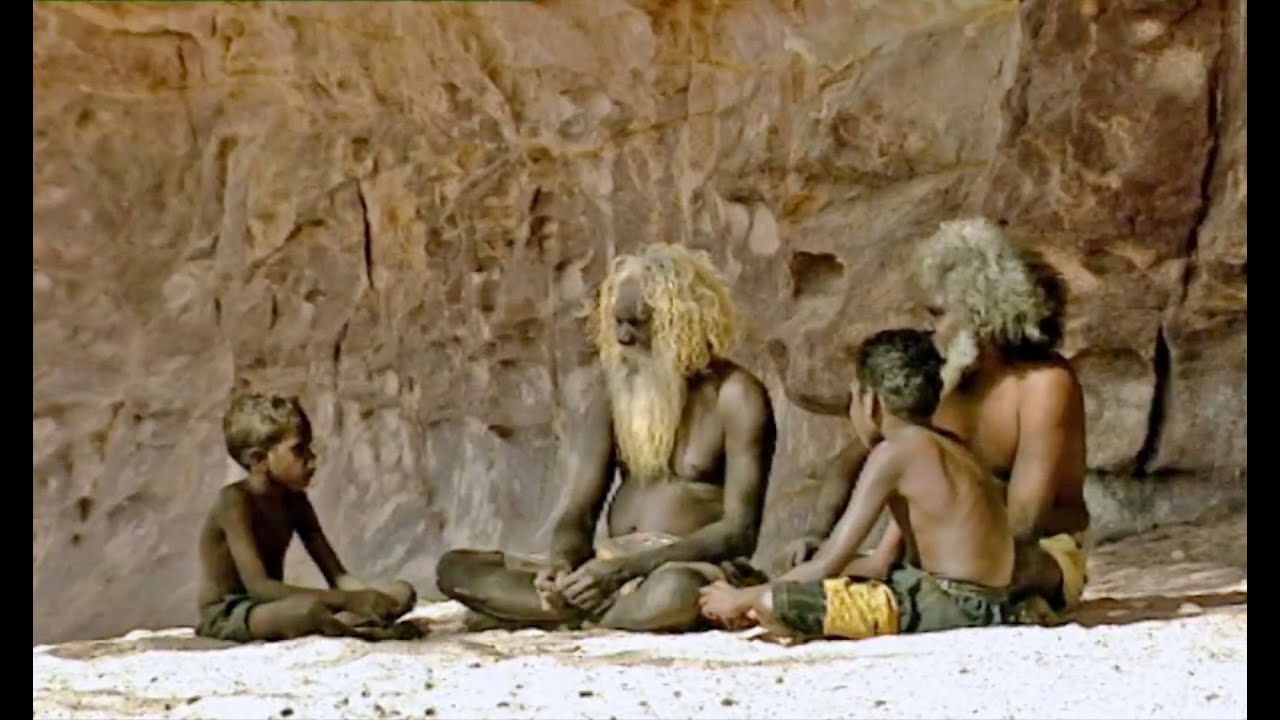
Documentary - The Men of the Fifth World (Australian Aboriginals)


The idea of the "Fifth World," strangely, comes from Native American tradition (Navajo and Hopi of the American Southwest - and before them the Aztecs of Central America), not from Australia Aboriginal tradition, as might be suggested by the title of this documentary from 2000.

The synopsis of the 52-minute film offered at the Top Documentary site, where I found this, is seriously effusive and poetic. On the other hand, it is a beautiful film of an intriguing people. Like Canada, Australia does a lot more to support the aboriginal cultures than does the United States. Still these people and their unique culture - a link to our shared human history - are in danger of fading away.


The Men of the Fifth World

They are the original inhabitants of the land called Australia by the white man. They have been there since the beginning of time, since the dream time, when everything they know was created. Their people know how to sing each and every place of this sacred country, while they contemplate Gee, the Sun God. Each song is a living map, which describes a specific path, the course of a river, a mountain or forest. If you brought together all these songs, which are passed down from generation to generation, and which come from dreams, they would compose the map of Australia.

At twilight, the humming of the Didgeridoo, their religious instrument, reminds them who they are and what they are doing there. It is the beat of their tradition, which keeps them united and attached to the land. Yaka Garimala, an Australian aborigine as foreigners call them, is going to tell you what their world is like.

His country is enormous. It is the most beautiful country in the world. They have deserts, jungles, savanna, plateaus and mountains with deep canyons carved by furious torrents. The sea is all around. Along their coast, there are bays and inlets and sacred cliffs like the one of Bickerton Island. This is where he lives.

The elders have the important task of initiating the young into their customs, explaining their history to them and teaching them to respect the traditional laws. They were already there thousands of years ago. They were around at the same time as what the white man call Homo sapiens. In the caves and caverns, they can feel the influence of the spirits of their ancestors. If you sleep there, you can see them in your dreams and receive their messages. They come and fill you with their strength, and when you wake, you feel very good.

These are sacred places for them. In the past, people lived in caves and natural shelters like those. Across all their territory, you can find paintings made by their forefathers in which they speak of the dreamtime, the creation and how they lived 50,000 years ago. In the Kakadu National Park lies a block where the rainbow serpents stopped after creating the world, and was painted on a rock so that people could see her. Over time, their forefathers left on the rocks a complete collection of images which depict their way of life and their beliefs.

Saturday, January 21, 2012

Alva Noë - Story Telling And The 'Uncanny Valley'

In this most recent entry at NPR's 13.7 Cosmos and Culture blog, philosopher Alva Noë looks at animation, narrative, and psychological reality.
Hero Boy — played by Tom Hanks — in The Polar Express
Warner Brothers: Hero Boy — played by Tom Hanks — in The Polar Express

Many an animated character wouldn't seem so unreal and dead if it didn't seem so real and alive!
This is a puzzle that has long troubled animators. If you saw Robert Zemeckis' The Polar Express, you know what I'm talking about. Remember the dead eyes of the characters, their zombie-like vacancy?

Animators do an excellent job bringing the nonhuman to life on the screen — think of WALL-E, or the enchanted broomsticks in Fantasia, not to mention Mickey Mouse himself — but they falter with the more realistically human. And isn't hard to see why.
 As Lawrence Weschler, who takes up this topic in the lead essay of his excellent new book Uncanny Valley: Adventures in Narrative, puts it:
"When a replicant's almost completely human, the slightest variance, the 1 percent that's not quite right, suddenly looms up enormously rendering the entire effect somehow creepy and monstrously alien (no longer, that is, an incredibly lifelike machine but rather a human being with something inexplicably wrong ..."
This precipitous drop off in psychological reality, or in normalcy, as you get close to verisimilitude, but not close enough, was first dubbed "the uncanny valley" in 1970 by the Japanese roboticist Masahiro Mori.

As Weschler suggests, good story telling (supported by effective sound and music) is enough to make even the dumbest doorstop think and feel on the screen. So maybe the uncanny valley has something to do with storytelling?

This is certainly not the preferred approach, which targets technology and the human perceptual system, rather than art, to explain the uncanny valley. The preferred approach goes like this:

What makes animation possible in the first place is our evolved tendency to see mind where there is none (on a sock puppet, or in a line drawing). This tendency runs counter to another basic cognitive trait, our natural hyper-sensitivity to even the most subtle inflections of face, posture, movement. The uncanny valley opens up because these two dispositions collide: we experience the mind behind the animated humanlike face — just as we can project mind onto a teddy bear — but we can't help but experience it as in some way deviant; as "a human being with something inexplicably wrong."

Two interesting upshots. First, on this approach, if animators want to bridge the uncanny valley, they'd better find a way to cover that last 1 percent; they'd better find ways more effectively to replicate that complex choreography of eyes, skin, bone, mouth and muscle that is the genuine, animate human face.

Second, there's no obstacle in principle to bridging the valley. It's just a matter of time, money and research collaboration between animators and cognitive scientists.

Now I find the suggestion that our experience of a narrative work of art could be the result of the blind operation of the visual system highly implausible. Remember, we aren't talking about real face perception here. We're talking about animated movies. We're talking about story telling! Maybe Weschler is right that story telling is the key.

Consider this: the story-telling art forms — here, for the sake of brevity, I consider only film, writing and animated film — are each driven by and capitalize on different feelings, different stances, different kinds of desires on the part of the audience.

The basic impulse driving film as a storytelling art is the impulse to look, see, and watch; when it comes to film, we like to peep and spy. Film is the voyeuristic art. Of course we know, intellectually, that what we see, when we watch a film, is the work of directors, producers, technicians, etc. But the thrill, the magic, the excitement of the movies comes from the feeling that we have a transparent window onto the lives of others. Our primitive stance is that of the witness.

Fiction writing is altogether different. We may read fiction with voracious appetites, but when we do so we do not take up the stance of the voyeur, at least not typically. No, fiction is an act of telling and what we encounter, or seem to encounter, when we read a novel, is the story teller. I don't mean the author, or even, necessarily, the narrator. Exactly who or what we encounter is very often in no way self-evident and the fun may stem from working it out. It remains the case, though, that what is revealed to us, exposed, in works of fiction, is not worlds that we seem directly to experience, as in the case of film, but, rather, the mind of the teller. Fiction is a testimonial art (and whereas film is a cult of the actor, fiction is a cult of the writer).

Now we come to cartoons. They occupy a third position still. The underlying impulse behind our fascination with animation is not the impulse to watch, nor is it the impulse to understand the story or the story teller; it is, rather, the impulse to play. Cartoons put us in the mood for play, and we do not so much watch as we participate. Cartoons are the playful art.

Back to the uncanny valley. A movie like The Polar Express traps us in a kind of rhetorical contradiction. In so far as the characters resemble living human beings, we are invited to take an interest in them; we feel the impulse to watch them; we are invited to take up the stance to them that would be appropriate to live-action movies. But in so far as we are watching what is manifestly an animated film, then we are at one and the same time pulled to take up the altogether opposed attitude appropriate to animation, that namely of viewing the characters as mere play things. We're caught in a rhetorical contradiction: real living human beings are not play things; toys are not the sort of thing we are thrilled to watch.

Cartoons don't give us glimpses of worlds, they give us worlds to play in and toys to play with. Live-action movies, in contrast, don't give us opportunities to play; they give us access to hidden worlds. Here, then, is what I propose: the uncanny valley yawns not when animators fall short in their rendering of the human body — even if in fact they do — but rather when they get confused about what kinds of stories they are telling: Are they inviting audiences to play, or giving them an opportunity to watch? In this confusion, the story dies, and with it, the light in the eyes of the characters.

You can keep up with more of what Alva Noë is thinking on Facebook and Twitter.

Wednesday, November 30, 2011

Bakari Akil II, Ph.D. - Change the Story!

Here is another older article that has been hanging around in my tabs for a while - this one looks at role theory and the narrative we construct about who we are as people.
The way you define your life affects your circumstance.


I am a huge Seth Godin fan, and recently he penned a blog post titled, The facts. He wrote:

"The story wins the day every time… Your position on just about everything, including, yes, your salary, your stock options, your credit card debt and your mortgage are almost certainly based on the story you tell yourself, not some universal fact from the universal fact database. ---Not just you, everybody."


Godin is correct. All day we are in unceasing conversations with ourselves. We tell ourselves who we are, what we should do, how we should respond and what our mission is. This intrapersonal communication governs our lives to a huge extent and affects our overall well-being. When things are good and especially when they are great the internal dialogue is most likely positive and helps move us forward. But what about when things aren't going according to plan?

What happens when we look into the mirror that is our lives and we are wholly unsatisfied? It is in these times that we need to re-evaluate the internal conversations and monitor what we are saying.

In a recent article I discussed Role Theory, which is one of my favorite topics. Role Theory asserts that there are a multitude of 'characters' that exist in our world. Some of these roles we are born into (e.g., family relationships) and others we willingly accept (marriage, jobs, friendships). Others are foisted upon us, such as stereotypes, or we are pressured into, such as competing with neighbors (commonly referred to as "Keeping up with the Joneses/Kardashians"). Regardless of the type, social norms often dictate that we accept these roles and conform to certain standards of behavior that define them.


This is great when you're 'Winning!' However, what do you do when your thought process and roles are crushing your well being?

Read the whole article.

Sunday, August 21, 2011

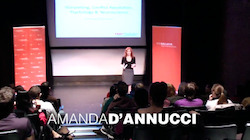
TEDxGallatin - Amanda D'Annucci - Storytelling, Psychology and Neuroscience


Cool TED Talk - much of what she discusses here explains the power and effectiveness of narrative therapy in helping to rewire brains and beliefs.

Here is the description of the talk:

Storytelling, Psychology and Neuroscience

Amanda D'Annucci is pursuing her Master's degree in the Psychology of Expression at NYU's Gallatin School of Individualized Study. She graduated from the Macaulay Honors College at Hunter College in 2009 with a B.A. in Urban Studies. She has served as an Intern at the Office of Senator Hillary Rodham Clinton, a Public Service Scholar at the Office of the Mayor in NYC, and a Summer Intern with the Ford Foundation. Amanda is currently working with Narativ, Inc, a consultancy specializing in effective communication through storytelling. Amanda is also a trainer with Story-to-College and a Peace Mover with Dance4Peace.


Storytelling is a vital yet oft under-appreciated tool for effective conflict resolution. "Stories communicate values, beliefs, hopes, fears, and dreams of a people in a way that engenders respect and understanding in the listener" (Duryea, Potts. 1993 p. 388). The art of storytelling has a psychological and neurological basis that explains our natural human predilection for narrative. Through two case studies -- one involving Israeli and Palestinian students, the other involving the Sierra Leonean civil wars -- this talk will explore personal narratives and collective myth to inspire a pure and inspiring approach to conflict resolution.


Friday, April 22, 2011

Buddhist Geeks 213: The Stories We Tell Ourselves (w/ Rev. Danny Fisher)

In this week's Buddhist Geeks podcast, Vince interviews the hardest working Buddhist blogger around - Reverend Danny Fisher. I have had the pleasure and good fortune to interact with Danny online over the years - he's a wonderful human being who, to me, embodies the Buddhist path of compassion and humility. Strangely, I think this is the first time I have heard his voice.

BG 213: The Stories We Tell Ourselves

BG 213: The Stories We Tell Ourselves

18. Apr, 2011 by Danny Fisher


Episode Description:

Buddhist scholar and Chaplain Danny Fisher, joins us to explore various stories, or narratives, that run through the Buddhist world. There are a variety of different kind of stories in the Buddhist tradition, including those that are more traditional and those which are more modern. Included in those narratives are Buddhist hagiographies (traditional teaching stories about important figures), historical narratives, and more modern narratives. Listen in as we try and piece apart what some of these stories are, and find out how the stories that we believe in affect us as individuals and communities.

Episode Links:

Transcript

Tuesday, August 31, 2010

We Make Our Lives Through Story - But the Stories may be Fiction

Two articles that sort of go together - one from NPR and one from Adbusters.

First up a story from NPR's Morning Edition on the way we construct our lives from story - the segment features Antonio Damasio, one of my favorite neuroscientists. This is part one of two - part two airs later this morning.

Shaun Parker in the Hollywood Hills in Los Angeles
Katie Falkenberg for NPR

Natural-Born Storyteller? Shaun Parker moved from Menasha, Wis., to Los Angeles nearly 20 years after an illness in his family put his adolescent dreams on hold. "I liked the idea that I was meant to be something more," Parker says. "I always said that we're kind of the sum total of the decisions we make in life, and I just felt like I could very easily make the decisions that lead me away from that path of being more, whatever it is."

First of a two-part story. Read Part 2.

Not long ago, Shaun Parker was waiting offstage at a club in Hollywood. He was about to take the microphone in front of hundreds of people and tell a story he'd been working on his entire life.

"I was so nervous, I felt like I wanted to throw up," he says.

This was more than stage fright — Parker says what was at stake for him was pretty much everything.

"I'm like, 'This is it, right? This has been the dream to come out here, and there's actors and there's writers, and there's directors out here, and the people that are true storytellers. Because I'm just some guy coming from Wisconsin,' " Parker says.

Humans have been telling stories ever since we began talking. These stories have become a kind of tool for us, as powerful as an ax or an arrow.

And although we may not be aware of it, each of us thinks of our life as if it were a story in the making.

"You're constantly rearranging the narrative of your life," says Antonio Damasio, a behavioral neurologist from the University of Southern California and author of the upcoming book Self Comes to Mind, which is about how our sense of story influences our lives. "And you're rearranging as a function of the experiences that you have had and as what you imagine your experiences in the future ought to be."

That's certainly true of Parker, an aspiring actor in Los Angeles who grew up in Menasha, Wis., a town on the northern tip of Lake Winnebago with lots of paper mills and good winter sledding.

When Parker was in eighth grade, a teacher had his class write letters to themselves. The topic: how they saw their future lives.

Parker's letter said he expected to "find somebody that I love and maybe work in a mill and get a house and have some kids."

Four years later, the teacher sent back all the letters. And when Parker read his, he realized he'd already started rewriting his future.

By then, he says, "I liked the idea that I was meant to be something more. I always said that we're kind of the sum total of the decisions we make in life, and I just felt like I could very easily make the decisions that lead me away from that path of being more, whatever it is." For Parker, that meant coming up with a life story that took him far from Menasha.

The Stories Of Our Lives

The quest for "something more" comes directly from our awareness of our own life story, Damasio says. Humans have a unique awareness that our lives are stories that begin when we're born and end when we die. And because we know we're going to die, Damasio says, we are not satisfied with merely surviving day to day. We want our personal story to mean something.

Other species don't have that same concern, Damasio says.

"I have enormous respect for nonhuman creatures," he says. "But I don't think we're going to get them to consider this 'something more' that they can be or that they ought to be."

And it's that concern about creating a meaningful life story that has pushed humans to do new things, like exploring distant lands and building great civilizations, Damasio says. It's also one reason we're drawn to tales of remarkable people like Odysseus or Joan of Arc.

In high school, Parker's inspiration was King Arthur, as portrayed in his favorite movie, Excalibur. The movie "just speaks of greater things than ourselves," Parker says. "I remember seeing it, and it made me want to believe in magic. It made me want to believe in destiny."

And it made him wonder how he could make something special of his own life.

Damasio says we frequently model our own life stories on a story we've seen on stage or at the movies.

"We begin by being spectators of a story," Damasio says. And then, at least in our minds, "we turn that into our own story."

Shaun Parker's Story

Parker focused on the part of King Arthur's story that involved the quest for true love. Arthur had Guinevere; Parker decided his destiny was a young woman named Heidi.

Shaun Parker At 'Mortified'

At the storytelling series Mortified, performers dig through old diaries and love notes to find a glimpse into their ridiculous, self-centered, pathetic and comical adolescent lives. Then they get on stage and share it with an audience of complete strangers.

At a recent Mortified show, Shaun Parker shared the story of a love letter he sent to his teenage crush. Watch a clip from his performance below. We guarantee you'll be on the floor laughing. Or crying.

"I was in the cafeteria, and I remember looking over, and I saw her walk in, and time kind of slowed," Parker says. But for a chivalrous young man like Parker, there was a problem. "I was kind of stumped by the fact that I was a senior and she was a freshman, and that did not feel right."

So he decided to wait and just be friends with Heidi until she was older. But it was hard, and after 18 months, he decided he had to declare his love in the form of a music video. Parker lip-synced to the song "Wait" by White Lion — picture a good-looking, all-American kid with a mullet, wide lapels and a long-stemmed rose.

But he never showed it to her, and instead sent an old-fashioned love letter. He soon got one back.

"Dear Shaun, you are the best friend I have ever had," Parker says as he recalls the letter. "And she ... she underlined 'friend.' "

He was crushed. [Watch Parker read Heidi's letter in the video clip to the left, from his performance at Mortified.]

Dealing With Setbacks

Setbacks aren't unique to humans, but Damasio says our response to them probably is. We see them as changing the plot line of the life story we thought we were writing, and we cope by coming up with a new narrative.

"In any moment of the present, we are buffeted between the lived past, about which we cannot do anything, and the future, the 'what next?' " Damasio says.

Humans never stop looking ahead to something better. In the same way King Arthur deals with his unfaithful queen by focusing on the Holy Grail, Parker rebounds from Heidi by imagining an entirely different future for himself: He's going to make it in the movie business.

All through college, he works on that dream. By graduation, he has an entry-level job with Disney lined up. But on the very day Parker is to leave Wisconsin, his father takes a call from his doctor.

The doctor informed his father that he had stage four prostate cancer. "So that's where my life went on pause," Parker says.

This was a major setback for Parker — one that lasted nearly two decades. But he never gave up on the life story he was determined to write for himself.

That's why, many years later, Parker stepped onto a stage in Hollywood to tell his story.

The second part of this story aired Tuesday, Aug. 31, on Morning Edition. Find out how Parker got through those two decades, and how stories help us cope with death.

This story was produced by Rebecca Davis.
So if our lives are made of story, Hudson Spivey writing at Adbusters argues that our lives are just fictions - a very postmodernist idea - except that Spivey is arguing that we are so divorced from anything "real" that we are living fictional lives.

Our Lives Are Just Fictions

Our Lives Are Just Fictions - Grounded not in reality, but in illusion.

In China people get together in the corners of parks and dance. The unofficial history of America is not a story of rugged individualism and heroic personal sacrifice in the pursuit of a dream. It is a story of democracy derailed, of a revolutionary spirit suppressed and of once-proud people reduced to servitude. | Photos by Ryan Pile (l) and Martin Parr (r)

We forget too often that our lives are just fictions, that this human life of ours – abstracted from the land, abstract in itself – is not grounded in reality, but in drama, illusion. Our lives are no different from dreams, a scattered blur from one meal to the next, from one conversation to the next, one megaplex, one strip mall, one coffee cup, one beer, one fix – a ceaseless drifting from sensation to sensation, a constant sating of the base desires.

We are raised in this “reality” so its contours are invisible to us. We see each moment but fail to see the unifying thread – the alienation of humanity from nature, the ills of domestication, the dependence of humans upon technological death machines to survive and a growing inability of these generations of young humans now in possession of the planet to connect to it in any living way. We have lost our ability to experience the grander trends as revealed through the almighty Moment. We cling to our petty satisfactions as a paddler fallen from a canoe clings to the rocks. We do not dare to imagine a life without pizza, ice cream, microwaves, transportation, convenience, comfort, ease.

The 21st century has been too kind to us so far. It holds new horizons for us as an übersoul and as an überspecies, but it remains pregnant with disaster. There must be wars, Great Wars, which span all frontiers, in which all are embroiled in conflict: the inner war spilling out into our long-abandoned commons, opening up doorways between men and women to converse freely, tearing down walls between minds and bodies, flesh and the soul. Bottles will be uncorked and men in pajamas will run terrified and bouyant through the streets. If there is not madness, there will be blood, midnight rivers of blood rushing mad like the Mississippi through the markets of the world, stampeding through those who stand still, toppling those who once towered above the meek and lowly, lifting the strong and light, buoying them up on its terrible tide …

—Hudson Spivey


Friday, January 08, 2010

American Scientist - ON THE ORIGIN OF STORIES: Evolution, Cognition, and Fiction - by Brian Boyd

Interesting review of what seems to be an interesting book (I'm lately intrigued by narrative and cognition and how they relate). The history of stories is the history of an inherently social creature.

The Play’s the Thing

Michael Bérubé

ON THE ORIGIN OF STORIES: Evolution, Cognition, and Fiction. Brian Boyd. xiv + 540 pp. The Belknap Press of Harvard University Press, 2009. $35.

Let me explain a thing or two about humanists like me. There are legions of us who reach for our guns when we hear the word genome. That’s because we’re all too familiar with the history of eugenics, and we flinch whenever someone attempts an “evolutionary” explanation of Why Society Is the Way It Is; we suspect them, with good reason, of trying to justify some outrageous social injustice on the grounds that it’s only natural. Likewise, there are legions of us who clap our hands over our ears when we hear the term evolutionary psychology. That’s because we’re all too familiar with the follies of sociobiology, and we’ve suffered through lectures claiming that our species is hardwired for middle-aged guys dumping their wives for young secretaries and students (I sat through that lecture myself) or that men run the world because women have wide hips for childbearing, whereas men can rotate three-dimensional shapes in their heads (okay, that one is a mash-up of two different lectures).

Brian Boyd is here to change all that. On the Origin of Stories attempts an evolutionary explanation of the appearance of art—and, more specifically, of the utility of fiction. From its title (with its obvious echo of Darwin) to its readings of The Odyssey and Horton Hears a Who!, Boyd’s book argues that the evolution of the brain (itself a development of some significance to the world) has slowly and fitfully managed to produce a species of primate whose members habitually try to entertain and edify one another by making stuff up.

If this sounds reductive, don’t worry: Boyd patiently explains that this isn’t your father’s sociobiology or your great-grandfather’s eugenics. To say that something is genetic is not, despite decades of bad science followed by decades of bad popularizations of bad science, to say that it is genetically determined, if “determined” means (as it usually does) “inevitably fated.” Boyd expresses some exasperation at the idea of genetic determinism, arguing that

the notion that genes shape us is less deterministic than the notion that we are the product of our environment, since the complexity and randomness of genetic recombination in sexual reproduction means that we are each the result of an unpredictably generated variation unique to each of us rather than of anything imposed from without.

Thus, writes Boyd, “we should see genes less as constraints than as enablers,” just as “we should see genes not as deniers of the role of the environment but as devices for extracting information from the environment.” Boyd acknowledges that “those uneasy about applying evolution to human behavior often assume that doing so must require stressing selfishness and competition at the expense of altruism and cooperation,” but notes that it ain’t necessarily so: “[Richard] Dawkins points out that he could with equal validity, though with less impact, have called his famous first book not The Selfish Gene but The Cooperative Gene.” Well, that’s nice to know after all these years, now that three decades of popular-science enthusiasts have convinced themselves that Nature herself speaks in the language of Ayn Rand. One hopes the word will get around.

Indeed, one of the virtues of On the Origin of Stories is that its author is up to speed on recent work in neurology, genetics and evolutionary theory. He is therefore ideally positioned to persuade his fellow humanists that a “biocultural” approach to art and literature doesn’t entail any Just So stories about how humans came to love Just So stories, or any triumphant tales of how self-replicating molecules persevered over a few billion years until they reached the telos of existence, at which point they were capable of producing Everybody Loves Raymond. For as Darwin insisted, evolution doesn’t have a telos. It consists of a series of open-ended experiments with no final end in sight: “A Darwinian system . . . remains open, unpredictable, and free. It cannot presuppose a best option, an ideal fit, a goal that can be precisely determined beforehand.”

Regrettably, Boyd stumbles out of the gate, working himself into a nasty and unnecessary self-contradiction in the first chapter, where he argues that “the cultural constructionist’s view of the mind as a blank slate is ‘a dictator’s dream,’ [quoting Steven Pinker],” for “if we were entirely socially constructed, our ‘society’ could mold us into slaves and masters, and there would be no reason to object.” This is a shallow conception of social constructionism (admittedly, a conception often promulgated by social constructionists), in which saying that “X is socially constructed” is tantamount to saying “X can be changed at will.” But what makes Boyd’s critique so unfortunate (and self-contradictory) is that he immediately proceeds to insist that, unlike social constructionism, “an evolutionary view allows for informed social change.” He goes on to note that “Owen Jones compares the law to a lever to change human behavior, and an informed knowledge of human nature to the fulcrum the lever needs to exert its force.” I’m sorry, but I think I might have missed something here. How is this evolutionary view of how to change human behavior not a dictator’s dream?

Once we get past that little tangle, however, the first half of On the Origin of Stories is exhilarating. Boyd rehearses the history of the rapid growth in hominin brain size over the past couple of million years, showing that with the development of the neocortex we’ve been endowed with all kinds of cleverness to compensate for the fact that we’re slow, weak, flat-toothed and clawless. We are thoroughly social creatures, and when we work together we can be formidable predators; accordingly, we’ve evolved various attributes that enable mutualism, such as shared attention, mirror neurons and theory of mind. The latter allows us access to something no other animal seems aware of, namely, the notion that other members of our species might have false beliefs. The survival value of art, then, is that it hones and enhances those functions of mind that in turn enhance our capacity for social interaction and exploration: “Art develops in us habits of imaginative exploration, so that we take the world as not closed and given, but open and to be shaped on our own terms.”

By refining and strengthening our sociality, by making us readier to use the resources of the imagination, and by raising our confidence in shaping life on our own terms, art fundamentally alters our relation to the world. The survival consequences may be difficult to tabulate, but they are profound. We have long felt that art matters to us. It does, objectively as well as subjectively. By focusing our attention away from the given to a world of shared, humanly created possibility, art makes all the difference.

This is rousing stuff. Not only does it reassure us that all our museum-brochure rhetoric is telling the truth, it also confirms that Friedrich Schiller was right to propose, in On the Aesthetic Education of Man (1794), that humans possess a “play-drive” that leads us to create and be amazed by art:

For, to declare it once and for all, Man plays only when he is in the full sense of the word a man, and he is only wholly Man when he is playing. This proposition . . . will, I promise you, support the whole fabric of aesthetic art, and the still more difficult art of living.

It is no slight to Boyd, surely, to say that On the Origin of Stories sometimes reads like Schiller combined with a few graduate courses in neuroscience. Whether one prefers to say, with Emily Dickinson, “If I feel physically as if the top of my head were taken off, I know that is poetry,” or, with Boyd, “Neurons in the substantia nigra and the ventral tegmental areas of the brain secrete dopamine in reaction to the surprising but not to the expected,” is surely a matter of taste.

The second half of the book, however, probably won’t go over as well with the humanists Boyd is trying to reach. He opens that half by assuring us that “a biocultural approach to literature simply requires that we take seriously that evolution has powerfully shaped not just our bodies but also our minds and behavior.” This much is incontrovertible, and I share Boyd’s hope that someday our fellow humanists will be less averse to thinking in terms of the species-wide universals we’ve inherited as part of the legacy of life on Earth. But Boyd’s application of the principle seems to me to have two weaknesses.

2010-01BREVBerubeFA.jpgClick to Enlarge ImageThe first, upon which some reviewers have already remarked, is that the resulting readings of The Odyssey and Horton Hears a Who! don’t appear to be entirely worth the journey. Much of Boyd’s approach consists of explaining how Homer and Dr. Seuss manage to win and keep our attention, and Boyd castigates contemporary literary criticism for failing to attend to this important matter. But might it not be that “Homer organized the poem in this way so as to win and keep your attention” is the kind of thing that, in literary criticism, literally goes without saying? Similarly, readers for almost three millennia have recognized that Odysseus is one crafty fellow, and that one indication of his craftiness is that he does not act on impulse; even when he’s trapped in a cave with a one-eyed giant eating his men, he takes a deep breath and comes up with a well-considered plan. Boyd explains precisely what this means in neurological terms: “Rapid-fire reactions have to be inhibited (in the orbitofrontal cortex) so that there is time to formulate and assess new options (in the dorsolateral cortex) before acting on them.” Personally, I am tremendously pleased that my species has gotten to the point at which it understands things like this. But how much is added to the history of criticism, finally, by the realization that Odysseus was doing his crafty plotting in his dorsolateral cortex?

I mean this as a real and not a rhetorical question. Boyd closes On the Origin of Stories by remarking that “evocriticism” will have to make its way by devising compelling and convincing readings of works of literature, attending not only to the universal features of human minds but also to the cultural and historical particularities of time and place. On one hand, this school of criticism will provide a desperately needed justification for literary study: “If storytelling sharpens our social cognition, prompts us to reconsider human experience, and spurs our creativity in the way that comes most naturally to us”—as it surely does—“then literary studies need not apologize.” On the other hand, evocriticism comes bearing not only a rationale but also a sword: As Boyd remarks time and again, the enemy to be vanquished is Theory,

which cuts literature off from life by emphasizing human thought and ideas as the product of only language, convention, and ideology—although Theory then tries to compensate for severing literature from three-dimensional life by insisting that it is always political or ideological.

Well, Theory-bashing can be good fun, I suppose, and some forms of theory deserve it. But it is odd to suggest that stressing “language, convention, and ideology” somehow cuts one off from “life.” And it’s even odder to note that “a fine work of art not only expresses creativity but also inspires it in those who enjoy it” but fail to consider that “theoretical” readings of language and literature caught on in the 1970s and 1980s because they were, back in the day, compelling and creative. Everyone who, like Boyd, believes that Alan Sokal killed theory dead really should go back and read Barbara Johnson on Melville’s “Billy Budd” or Paul de Man on the famous rhetorical (or is it real?) question that closes Yeats’s “Among School Children.” Even though I’ve never been a card-carrying deconstructionist myself, I was fascinated by those readings because they taught me that Melville’s novella was even more extraordinary than I’d thought, and that when you’re trying to determine whether a question is real or rhetorical, even an utterance like “Eh, what’s the difference?” can open onto a hall of mirrors. Boyd never stops to consider that maybe, just maybe, the clever human minds responsible for literature are the same clever human minds responsible for literary theory; if he had, he might have been able to say, more plausibly, that theory started (as do all our endeavors) in the impulse to play and create, and only became routine and stultifying after many weary iterations. At which point, after the 350th New Historicist reading of The Tempest, neurons in the substantia nigra and ventral tegmental areas of the brain stopped secreting dopamine.

More important, Boyd is sometimes reluctant to give culture and history their due. He scoffs, for example, at the idea that romantic love was invented at some point in the 12th century, because “cross-cultural, neurological, and cross-species studies have demonstrated the workings of romantic love across societies and even species.” This just won’t wash. Other species might court and mate for life, but they do not engage in romantic love in the sense that humanists employ the term, save perhaps for the cartoon skunk Pepé Le Pew. “Romantic love” does not mean “mammals doing it like mammals”; it refers to the conventions of courtly love, which were indeed invented in the European middle ages and cannot be found in ancient literatures or cultures. Those conventions are culturally and historically specific variations on our underlying (and polymorphous) biological imperatives, just as the institution of the Bridezilla and the $25,000 wedding is specific to our own addled time and place. Nothing about the evolutionary record, from amoebas to Homo sapiens sapiens, is denied or contravened in acknowledging this.

On the Origin of Stories is a fascinating book, even a necessary book. At its best, evocriticism can help to reorient the arts and humanities, renewing (or, in some benighted quarters, sparking) our appreciation for the creative works of human minds and hands, and leading humanists to take a fresh look at the rich evolutionary record. But it will accomplish this, I suspect, only if it is complementary to, and not sweepingly dismissive of, the intellectual traditions humans have devised for the study of human cultures.

Michael Bérubé is the Paterno Family Professor in English Literature and Science, Technology, and Society at Penn State University. He is the author of, among other books, Rhetorical Occasions: Humans and the Humanities (University of North Carolina Press, 2006) and The Left at War (New York University Press, 2009).


Monday, September 07, 2009

Fairy tales have ancient origin

Very cool.

Fairy tales have ancient origin

Popular fairy tales and folk stories are more ancient than was previously thought, according research by biologists.

Fairy tales have ancient origin

They have been told as bedtime stories by generations of parents, but fairy tales such as Little Red Riding Hood may be even older than was previously thought.

A study by anthropologists has explored the origins of folk tales and traced the relationship between varients of the stories recounted by cultures around the world.

The researchers adopted techniques used by biologists to create the taxonomic tree of life, which shows how every species comes from a common ancestor.

Dr Jamie Tehrani, a cultural anthropologist at Durham University, studied 35 versions of Little Red Riding Hood from around the world.

Whilst the European version tells the story of a little girl who is tricked by a wolf masquerading as her grandmother, in the Chinese version a tiger replaces the wolf.

In Iran, where it would be considered odd for a young girl to roam alone, the story features a little boy.

Contrary to the view that the tale originated in France shortly before Charles Perrault produced the first written version in the 17th century, Dr Tehrani found that the varients shared a common ancestor dating back more than 2,600 years.

He said: “Over time these folk tales have been subtly changed and have evolved just like an biological organism. Because many of them were not written down until much later, they have been misremembered or reinvented through hundreds of generations.

“By looking at how these folk tales have spread and changed it tells us something about human psychology and what sort of things we find memorable.

“The oldest tale we found was an Aesopic fable that dated from about the sixth century BC, so the last common ancestor of all these tales certainly predated this. We are looking at a very ancient tale that evolved over time.”

Dr Tehrani, who will present his work on Tuesday at the British Science Festival in Guildford, Surrey, identified 70 variables in plot and characters between different versions of Little Red Riding Hood.

He found that the stories could be grouped into distinct families according to how they evolved over time.

The original ancestor is thought to be similar to another tale, The Wolf and the Kids, in which a wolf pretends to be a nanny goat to gain entry to a house full of young goats.

Stories in Africa are closely related to this original tale, whilst stories from Japan, Korea, China and Burma form a sister group. Tales told in Iran and Nigeria were the closest relations of the modern European version.

Perrault’s French version was retold by the Brothers Grimm in the 19th century. Dr Tehrani said: “We don’t know very much about the processes of transmission of these stories from culture to culture, but it is possible that they may being passed along trade routes or with the movement of people.”

Professor Jack Zipes, a retired professor of German at the University of Minnesota who is an expert on fairy tales and their origins, described the work as “exciting”. He believes folk tales may have helped people to pass on tips for survival to new generations.

He said: “Little Red Riding Hood is about violation or rape, and I suspect that humans were just as violent in 600BC as they are today, so they will have exchanged tales about all types of violent acts.

“I have tried to show that tales relevant to our adaptation to the environment and survival are stored in our brains and we consistently use them for all kinds of reference points.”


Wednesday, October 08, 2008

Oliver Sacks Believes Religion is a Human Invention

As a follow-up to the Scientific American article on story-telling I posted last week, here is Oliver Sacks (at Big Think) talking about religion as a reflection of the need to tell stories.

Oliver Sacks Believes Religion is a Human Invention

The Columbia University neurologist says people are wired to need stories.


Wednesday, October 01, 2008

Scientific American Mind - The Secrets of Storytelling: Why We Love a Good Yarn


Excellent article from Scientific American Mind.

The Secrets of Storytelling: Why We Love a Good Yarn

Our love for telling tales reveals the workings of the mind

By Jeremy Hsu

When Brad Pitt tells Eric Bana in the 2004 film Troy that “there are no pacts between lions and men,” he is not reciting a clever line from the pen of a Hollywood screenwriter. He is speaking Achilles’ words in English as Homer wrote them in Greek more than 2,000 years ago in the Iliad. The tale of the Trojan War has captivated generations of audiences while evolving from its origins as an oral epic to written versions and, finally, to several film adaptations. The power of this story to transcend time, language and culture is clear even today, evidenced by Troy’s robust success around the world.

Popular tales do far more than entertain, however. Psychologists and neuroscientists have recently become fascinated by the human predilection for storytelling. Why does our brain seem to be wired to enjoy stories? And how do the emotional and cognitive effects of a narrative influence our beliefs and real-world decisions?

The answers to these questions seem to be rooted in our history as a social animal. We tell stories about other people and for other people. Stories help us to keep tabs on what is happening in our communities. The safe, imaginary world of a story may be a kind of training ground, where we can practice interacting with others and learn the customs and rules of society. And stories have a unique power to persuade and motivate, because they appeal to our emotions and capacity for empathy.

A Good Yarn
Storytelling is one of the few human traits that are truly universal across culture and through all of known history. Anthropologists find evidence of folktales everywhere in ancient cultures, written in Sanskrit, Latin, Greek, Chinese, Egyptian and Sumerian. People in societies of all types weave narratives, from oral storytellers in hunter-gatherer tribes to the millions of writers churning out books, television shows and movies. And when a characteristic behavior shows up in so many different societies, researchers pay attention: its roots may tell us something about our evolutionary past.

To study storytelling, scientists must first define what constitutes a story, and that can prove tricky. Because there are so many diverse forms, scholars often define story structure, known as narrative, by explaining what it is not. Exposition contrasts with narrative by being a simple, straightforward explanation, such as a list of facts or an encyclopedia entry. Another standard approach defines narrative as a series of causally linked events that unfold over time. A third definition hinges on the typical narrative’s subject matter: the interactions of intentional agents—characters with minds—who possess various motivations.

However narrative is defined, people know it when they feel it. Whether fiction or nonfiction, a narrative engages its audience through psychological realism—recognizable emotions and believable interactions among characters.

“Everyone has a natural detector for psychological realism,” says Raymond A. Mar, assistant professor of psychology at York University in Toronto. “We can tell when something rings false.”

But the best stories—those retold through generations and translated into other languages—do more than simply present a believable picture. These tales captivate their audience, whose emotions can be inextricably tied to those of the story’s characters. Such immersion is a state psychologists call “narrative transport.”

Researchers have only begun teasing out the relations among the variables that can initiate narrative transport. A 2004 study by psychologist Melanie C. Green, now at the University of North Carolina at Chapel Hill, showed that prior knowledge and life experience affected the immersive experience. Volunteers read a short story about a gay man attending his college fraternity’s reunion. Those who had friends or family members who were homosexual reported higher transportation, and they also perceived the story events, settings and characters to be more realistic. Transportation was also deeper for participants with past experiences in fraternities or sororities. “Familiarity helps, and a character to identify with helps,” Green explains.

Other research by Green has found that people who perform better on tests of empathy, or the capacity to perceive another person’s emotions, become more easily transported regardless of the story. “There seems to be a reasonable amount of variation, all the way up to people who can get swept away by a Hallmark commercial,” Green says.

Go read the whole post.


Tuesday, July 24, 2007

Short Story: The Experiment


[The idea for this story came to me last night as I was trying to fall asleep. It was a recently rare night of insomnia, but it bore fruit.]

The Experiment

G rinsed the razor in hot water then glanced up at the mirror. He had missed a spot, just under his chin. One careful last stroke. Cleanly shaved, he looked much younger than the 43 years he has lived.

He rinsed his face and patted it dry with a towel. No nicks.

He finished his coffee and put on a clean shirt, white, button-down, no tie. With his bald head, Levis, and Asics running shoes, he fully resembled a student.

* * *

G emerged from his flat into a street vibrant with activity, sounds, scents, and people hurrying here and there. The morning was crisp, early autumn, but not cold.

As he reached the corner, he stopped and leaned against the side of a cafe, out of the line of traffic.

He stood there quietly, seeing, hearing, smelling the city, but none of it registered. His attention was on his breath.

* * *

Time passed. Some pigeons gathered near the door of the cafe. People came and went with fresh coffee, warm pastries, always in a hurry.

More time passed.

* * *

An older woman approached G carrying a handful of bus schedules. "Excuse me, young man," she began, "can you tell me which bus I need to get to the library?"

"I'm sorry," G replied.

"Why" she asked. "Don't you know?"

"You seem to be lost," he said. "I can feel the anxiety in your voice."

"OK. Can you tell me how to get to the library or not?"

"The 43 will be by in a few minutes. Just ask the driver to drop you off at the library."

"Thank you," she said, and walked down the street to the bus stop.

* * *

The sun was nearly overhead now. G hadn't moved from his spot. A barista came out every once in a while to make sure he wasn't pan-handling her customers.

* * *

Sometime in the mid-afternoon, as the street was starting to get busy again, a young man walked toward G with a mock swagger.

"Hey man, can you spare some money for beer?"

"I'm sorry," G replied, pulling a five dollar bill from his pocket.

"Why you sorry? You helped me out," the kid said.

"You seem alone. I can see the pain in your eyes."

"I ain't alone. Whatta you, a queer or something?" The kid backed a couple of steps away.

"I'm sorry," G replied.

"Quit saying that. You better be sorry if you trying to pick me up. That ain't my thing."

"I'm sorry you're so afraid."

"Man, whatever." The kid walked toward the bus stop down the street to pan-handle the workers heading home for the day.

* * *

The pigeons were gathering again, hoping for crumbs from the evening rush. The day was fading, cool air rolling in from the Sound.

* * *

G hadn't moved from his spot.

As darkness crawled over the city, a police officer approached and stood silently in front of him.

"We got a call that you've been standing here all day," the officer began.

"I'm sorry," G replied.

"You're sorry? Have you done something to be sorry for?" The officer's hand rested on her baton.

"You seem so hardened, so contracted. Your job must be very hard."

"What are you, a shrink? Please move along or I'll have to cite you for loitering."

G stepped away from the wall and began the short walk back to his flat.

* * *

G took off his shoes as he entered his home. They were placed next to a pair of dress shoes and a pair of Asian flats. Everything was in its place.

He took off his shirt and hung it on a hanger behind the bedroom door.

Turning on the sink, he splashed cool water onto his face, patting himself dry with a hand towel.

Looking into the mirror, G Said, "I'm sorry."

He turned out the light.