Showing posts with label reform. Show all posts

Tuesday, April 08, 2014

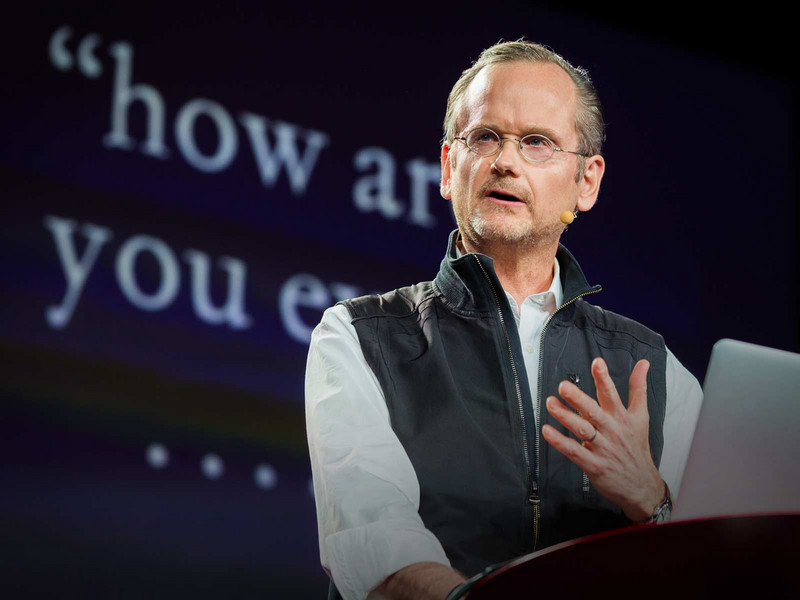
Lawrence Lessig - The Unstoppable Walk to Political Reform


I'm not as hopeful as Lessig about the progress of political reform (I suspect hell will freeze over before there is any REAL political reform). But Lessig knows things I don't know - lots of them - and he makes some interesting arguments. I hope he is correct.

Lawrence Lessig: The unstoppable walk to political reform

March 2014
Seven years ago, Internet activist Aaron Swartz convinced Lawrence Lessig to take up the fight for political reform. A year after Swartz's tragic death, Lessig continues his campaign to free US politics from the stranglehold of corruption. In this fiery, deeply personal talk, he calls for all citizens to engage, and offers a heartfelt reminder to never give up hope.


This talk was presented at an official TED Conference. TED's editors featured it among our daily selections on the home page.


Lawrence Lessig - Legal activist Lawrence Lessig has already transformed intellectual-property law with his Creative Commons innovation. Now he's focused on an even bigger problem: The US' broken political system.

Wednesday, February 20, 2013

Bookforum Omnivore - How to Fix the American Political System

From Bookforum Omnivore, an interesting collection of links to articles proposing a variety of different ways to "fix" the American political system - and none of them involve armed revolution.


How to fix the American political system

FEB 19 2013 
5:00PM


Monday, October 29, 2012

Self-Worth Theory: The Vital, Throbbing Center of Achievement Motivation


Dr. Martin V. Covington from the Department of Psychology, University of California at Berkeley, delivered this talk that sort of sums up his career in developing self-worth theory and how that relates to motivation in education.

Covington is the author of Making the Grade: A Self-Worth Perspective on Motivation and School Reform and The Will to Learn: A Guide for Motivating Young People.

This 31-page paper, Goal Theory, Motivation, and School Achievement: An Integrative Review, from the Annual Review of Psychology (2000; 51:171–200), offers a much more in-depth look at his work.

Self-Worth Theory: The Vital, Throbbing Center of Achievement Motivation

Professor Covington will share highlights of his teaching and research career by addressing the question: If we rearranged the educational experience of learners around positive motivational principles, that is, promoting the will to learn and a love of learning, what would school look like?


Thursday, February 02, 2012

Authors@Google: Rich DeMillo - Abelard to Apple (The Future of Higher Education)


Rich DeMillo believes the current higher education system is obsolete and needs to be changed - drastically - to bring it into the 21st century. He offers Apple's iTunes U and MIT's OpenCourseWare as examples of where higher education needs to look for a model of reform. His book is Abelard to Apple: The Fate of American Colleges and Universities.


Abelard to Apple
The vast majority of American college students attend two thousand or so private and public institutions that might be described as the Middle--reputable educational institutions, but not considered equal to the elite and entrenched upper echelon of the Ivy League and other prestigious schools. Richard DeMillo has a warning for these colleges and universities in the Middle: If you do not change, you are heading for irrelevance and marginalization. In Abelard to Apple, DeMillo argues that these institutions, clinging precariously to a centuries-old model of higher education, are ignoring the social, historical, and economic forces at work in today's world. In the age of iTunes, open source software, and for-profit online universities, there are new rules for higher education. DeMillo, who has spent years in both academia andin industry, explains how higher education arrived at its current parlous state and offers a road map for the twenty-first century. He describes the evolving model for higher education, from European universities based on a medieval model to American land-grant colleges to Apple's iTunes U and MIT's OpenCourseWare. He offers ten rules to help colleges reinvent themselves (including "Don't romanticize your weaknesses") and argues for a focus on teaching undergraduates. DeMillo's message--for colleges and universities, students, alumni, parents, employers, and politicians--is that any college or university can change course if it defines a compelling value proposition (one not based in "institutional envy" of Harvard and Berkeley) and imagines an institution that delivers it. 

Monday, May 02, 2011

New Evangelical Left Pushing Bounds of Christianity

This article comes from The Christian Post, so I expect it to be biased, but the author they talk to in this article is funny - Cedarville University professor Mark Smith argues that the "youthful evangelical left" are redefining the practices of Christianity (probably in ways of which he does not approve), but he doesn't see them as "real Christians." They can't possibly be members of any of the evangelical denominations - which is what he implies in this quote:
The evangelical left, he said, exists at the tip of the leftist spear and encompasses young, left-leaning Christians and liberals. Some of the evangelical left are actual Christians, he described. Smith supposes these are Christians who may also be the rebelling children of the evangelical right.
Just wait, Mr. Smith, one day you will be dead and they will be the Christian mainstream. I think there is an emerging social justice movement in the young evangelical community, and the various denominations would do well to align with it or they will see their memberships decline substantially in the next few decades.

Author: New Evangelical Left Pushing Bounds of Christianity

By Stephanie Samuel|Christian Post Reporter

For the growing evangelical left, the social justice agenda is about bringing heaven to earth, an Ohio author and Political Science professor said.

In a comparison study with the evangelical right, Cedarville University professor Mark Smith said the youthful evangelical left are pushing the bounds of Christianity to correct what they have determined to be inequality and injustice.

“Primarily when they look at America, they see a land of inequality and that inequality seems to drive much of their political passion,” explained Smith.

The evangelical left's passion, Smith described, leads them to pursue changes they believe will change America into a just society.

“The goal is to bring heaven to earth,” he concluded.

Smith, also the director of Cedarville's Center for Political Studies, has been studying the political left for an upcoming book, Meandering to Zion. The book, co-authored by Marc Clauson and Tom Mach, focuses primarily on the emerging evangelical left.

During his lecture on Thursday at the Family Research Council’s Washington, D.C., headquarters, Smith clarified that the evangelical left is separate sect from mainline Protestants, the Catholic Church or even the African-American Church.

Who are the evangelical left?

The evangelical left, he said, exists at the tip of the leftist spear and encompasses young, left-leaning Christians and liberals. Some of the evangelical left are actual Christians, he described. Smith supposes these are Christians who may also be the rebelling children of the evangelical right.

“Maybe what we are looking at is a group of young Christians who are challenging their parents’ and their grandparents’ political attachments,” he noted.

However, not all of the Christian left are believers. Others, he said, define their faith by spiritual experiences and their doctrine, by what their peers mutually agreed upon.

Despite his attempts to define the evangelical left, he said it is too early in the movement to tell who exactly makes up that cohort.

But it is clear, he concluded, that the evangelical left are practicing a type of “new gospel” where Jesus is a key political symbol.

Their Theology

The cohort very publicly invokes Jesus’ name to justify their policy positions, Smith pointed out as he displayed pictures of political protest signs to prove this point.

The slides showed protesters carrying signs such as “Jesus doesn’t love torture,” “Who would Jesus bomb?” and “What does Jesus say about homosexuality? Absolutely nothing.”

Smith explained that in the evangelical left’s version of the gospel, Jesus is a social reformer, and His authority trumps that of everyone else in the Bible. In the political sphere, the evangelical left are action-oriented and their action is centered on turning America into an equal society for all, he observed.

“Think of the Lord’s prayer: ‘Our father in heaven, Hallowed be Thy name. Thy kingdom come; Thy will be done on earth as it is in heaven.’ For the Christian left, this becomes a political doctrine. Our goal is to take what exists in heaven and to bring it to earth.”

The Christian left believe that inequality is not the will of God and is therefore a sign of injustice. "When the Christian left look at America and they see unequal income distributions, their conclusion is by definition those distributions have occurred by some injustice that's taken place," the Cedarville professor explained.

Their Issues

Therefore, instead of focusing on conservative evangelical issues such as family, marriage and abortion, the Christian left tend to focus on issues such as poverty, race and the environment. They believe that social justice is achieved when there is an equal distribution of goods such as education and economic opportunity. They turn to the government to enact their agenda while the right-wing evangelicals champion limited government.

Smith noted that President Barack Obama is seen as a figure head of the evangelical left. There are a lot of similarities between Obama and Smith’s definition of the Christian left.

Obama has asserted his Christian beliefs through his term as president. He also touts his background as a grassroots organizer. Obama champions innovation in green alternative energy industry while maintaining a nuanced view on abortion and gay rights than most Christians.

While Smith spoke favorably about the Christian left’s youthful energy, he was critical of the movement’s “unorthodox” view of Scripture. He equated their efforts to achieve a heaven on earth to a "socialist utopia" based on scripturally vague notions.

He also attacked their view that inequality is a sign of social injustice. "The reality is inequality happens for many reasons that we might not want to confront," Smith corrected. He reminded believers that the Bible gives many reasons for poverty, including slothfulness and lavish spending.

The Bible recommends that poverty by injustice be solved through the legal system, he pointed out, while insisting that government-imposed reforms should not be the answer to all social ills.

"Clearly, we have social problems. No one would deny that," Smith stated. "But that doesn't, by definition, mean that government is the best way to solve those [problems]. It isn't the most efficient, it isn't the most loving and I would say that our recent history would show that isn't the most effective."

Sunday, April 10, 2011

Education - Waiting for Superman

http://www.savvysassymoms.com/blog/wp-content/uploads/2010/10/Waiting-For-Superman.jpg

Waiting for Superman got a bad rap in my opinion as a vehicle for conservative values in education reform - while there is some truth in this, it's not the whole story. This is an important film in that it explores various ways to reform our failing educational system.

Requires DivX Video plug-in for Firefox - seems to work better in Chrome. You can aslo watch it at the host site.

Waiting for Superman

Waiting for Superman: Filmmaker Davis Guggenheim reminds us that education “statistics” have names: Anthony, Francisco, Bianca, Daisy, and Emily, whose stories make up the engrossing foundation of WAITING FOR SUPERMAN. As he follows a handful of promising kids through a system that inhibits, rather than encourages, academic growth, Guggenheim undertakes an exhaustive review of public education, surveying “drop-out factories” and “academic sinkholes,” methodically dissecting the system and its seemingly intractable problems.


This is some information from the Waiting for Superman site on what their agenda really is:

Fixing America's public education system won't be easy -- but together, it's possible.

The Waiting for "Superman" social action campaign has one primary goal: to ensure that every child receives a great education. The campaign seeks to build public awareness, ignite personal involvement and inspire real social change.

The campaign's four core initiatives are:

  • Setting academic standards that are on par with the world's best
  • Recruiting and rewarding great teachers
  • Creating and nurturing excellent schools, and
  • Increasing literacy rates

The following pages are your toolkit for educational reform. Learn more about the Waiting For "Superman" initiatives below, and find ways to take action with our "Help Your School" and "Fix the System" tips throughout this site. Help our students get the quality education they deserve. Our country's future depends on it.

And every child deserves a great education.

Every child deserves a great teacher. In other industries, the best employees are acknowledged for their exceptional contributions. A career in teaching should be no different. We can produce world-class students only if we train and support world-class teachers. Read more

There's no question that our current educational system is failing our students. The statistics are staggering: among 30 developed countries, the U.S. is ranked 25th in math and 21st in science. We need to better prepare today's generation of students starting NOW. The future depends on it. Read more

A child's destiny should not be determined by his or her zip code. But throughout most of the U.S., students are assigned to public schools based upon where they live -- with few or no alternatives. And because of this, too many kids are forced to attend chronically failing schools. All students should have access to excellent schools, but more importantly, EVERY school should be excellent. Read more

Literacy is the number-one predictor of a child's ability to succeed in school. In fact, the majority of kids who read below grade level in first grade will most likely still read below grade level in the fourth grade and may never catch up. Tutoring, giving books, or simply reading to a child fights illiteracy... one book, one student at a time. Read more

Tuesday, March 22, 2011

Said E. Dawlabani - HUMAN CAPITAL, The Future Economies of the Middle East Part 1: Reforming the Educational Systems

Said E. Dawlabani is an SDi sustainability architect - he blogs at Sustainability’s New Frontier: Where Economics Meets Memetics. A value systems approach to global economic emergence. Together with his wife, Elza S. Maalouf, they are Integral Insights (founded by Elza, who is also the president), specializing in an integrally-based Spiral Dynamics (SDi) approach to consulting, coaching, and keynote/speaking services. Integral Insights now has a quarterly E-Newsletter - and it's free to subscribe. Said writes a regular column for the newsletter and you can keep up with Elza's public speaking and teaching engagements.

Integral Insights: Quarterly E-Newsletter: Center for Human Emergence Mid-East & Global Feminine. You can also sign up for the newsletter at the bottom of the main page of the newsletter - please do.

Let's support the people who are making a real difference in the Middle East with ideas and understanding, not guns and bombs
.

In the new issue, Said has an excellent article that he shared on the SDi listserve - he has given me permission to reproduce it here.

HUMAN CAPITAL, The Future Economies of the Middle East Part 1: Reforming the Educational Systems

This is part one in a series of posts about Integral planning and design for the future of the Middle East that first appeared in Integral Insights Quarterly Newsletter.

Do you want to be a Doctor or an Engineer?

While growing up in Lebanon, this was the constant question that thousands of middle schoolers including myself were raised to answer. The world has come a long way since, but ironically these two professions remain the most honored careers in the Middle East today. As the Arab Spring continues to unfold all throughout the region one must wonder: If these young men and women taking to the streets had had gainful employment would they be rebelling against their leaders? Economic innovation has been the hallmark of peaceful advancement for First World cultures and in order for the Middle East to realize a fully diverse economy that respects all other professions as much as doctors and engineers, it must focus its next efforts on economic and educational reforms.

The development of economic and educational institutions would, for the first time establish Arab Nationalism as a collective movement that looks forward to the future of a diverse Middle East compared to one that reflects on the glory of the ancestral past while repressing the rights of many. In this part of the series, I’ll focus on the educational reforms needed as an integral part of an organic whole that will allow the Middle East to emerge into a sustainable, self reliant future. Much like what a World Bank or an IMF development program calls for, the Middle East should embark on a 10-year development program to build the region’s educational infrastructure. It should do this with its own sovereign wealth reserves to empower it with its own sense of accountability, while at the same time incorporate best global practices in its design and implementation. This program requires the bravery for taking a great leap forward and must have the visionary leadership of a fully integrated design that plans for 100 years into the future. Exceptionally integrated thought processes have to go into all the following aspects of its design:

1. INNOVATION AT THE MINISTERIAL LEVEL

a. An Education Ministry in every country in the region must be directed by an independent Committee of Visionary Leaders who have full authority in setting educational policy. This committee must make Education as the number one NATIONAL PRIORITY and its declaration must be heard in every home and on every street.

b. This Ministry must be void of any nepotism and corruption and must have an independent funding mechanism.

c. Specific advancement and performance measures must be set by this Committee of Visionary Leaders to align the educational aspirations of Arab youth with the best educational practices in the world.

d. A partnership with private educational institutions to offer broad-based scholarships based on merit for underprivileged students would act as an insurance policy against the generational ill effects of poverty.

e. A newly empowered Education Ministry must work effortlessly with regional economic centers of employment in order to determine future needs of the labor force.

f. A partnership must be created with the private sector with regional and global reach to expose students to what a work life would be like upon graduation.

2. ARCHITECTURE OF NEW SCHOOLS AND UNIVERSITIES

a. Designs that honor the past in some of its elements, but whose focus is on the learning environments that emphasize teachings that embrace the future. Create labs for the newest advances in math and science that are integrated into the classroom design.

b. Green technologies that become a part of the learning environment.

c. Computers with internet connectivity must be available at every desk.

d. Open space design that is conducive for expanding the mind and harnessing individuality and self-reflection.

e. Allocating indoor and outdoor space for sports activities and encouraging all student to participate in them.

f. Emphasis must be placed on much larger and user friendly spaces for libraries that create a continuity of learning environments outside the classroom.

g. Universities must embrace fully integrated efforts to create the necessary habitats that foster the creation and growth of native innovation. Much like King Abdullah University for Science and Technology where the University’s quest for innovation becomes the catalyst around which a new paradigm for redefining life, culture and industry takes hold.

3. TEACHERS AND ADMINISTRATORS

a. Teaching must be redefined as one of the most rewarding careers based on merit, and appropriate payscales should attract the most qualified teachers for the jobs.

b. The teaching curriculum should be geared towards establishing solid foundations in modern math and science.

c. Debate clubs must be fostered to encourage critical thinking and logical, rational and objective thought processes among students as early as possible.

d. All teachers must be put through a prequalification process to insure their capacities can deliver the outcomes needed to meet the educational goals identified by the Committee of Visionary Leaders.

e. Administrators must be constantly searching for the newest teaching innovations that are adopted into the learning environment by the most successful schools around the globe.

These are just a few recommendations that will create a starting point for the debate on educational reforms in the Arab world. A more collective view on the future of the Arab child has to be debated in order for an organically designed educational system to emerge. Without addressing the kind of educational system needed to compete in a global economy, no economic reforms of any kind would have a lasting effect. Those reforms will be addressed in the next post.

The whole article appeared at Said's site following it's introduction in the Integral Insights Newsletter.