Showing posts with label Spiral Dynamics. Show all posts

Monday, October 13, 2014

Richard Dawkins Admits That Religion ISN'T the Problem in the Mideast - and What the Problem Really Is

https://pbs.twimg.com/profile_images/486455188073349121/OzzZhX-_.png

In reality, I don't think this is any kind of huge departure from what Dawkins (and Harris and Maher) have been saying all along - he still attributes the violence to their religious beliefs.

It's disappointing to see our supposed "intellectuals" getting caught up with the trees and totally missing the forest. The Muslim jihadists practice a specific form of Islam, and it has little to do with the religion itself and everything to do with the worldview from which it emerges. The same thing is true of their politics, their cultural customs (like dietary restrictions and marrying off girls when they still children), and their educational system (teaching only the Qur'an). Each of these (religion, politics, cultural customs, and education) are trees in the forest we call a worldview.

This is where the Spiral Dynamics model can actually be useful in understanding the situation. The spiral in Spiral Dynamics (the book) emerged from Clare Graves's original theory, which uses a double helix (looks like DNA) model to show the interrelatedness of an individual's perception of life conditions with their inner neuronal systems (psychosocial development), producing a level of psychological existence. In this model, a worldview is shaped by the interplay between life conditions and cognitive development.

If we really want to change things in the Middle East, we need to understand their worldview (or worldviews) and why it motivates them to do and believe that Jihad is the answer to their problems. If we can begin to understand that, then we might look to Clare Graves' original work on "change states" and the stages of change, as well as Robert Kegan's "Immunity to Change" model.

Shocker: Leading Atheist Richard Dawkins Finally Admits That Religion ISN'T the Problem in the Mideast

The statement from the evolutionary biologist is a parting of ways with atheists who claim that religion is the primary motivator for terrorist groups.


Is Richard Dawkins changing his tune on Islam and terrorism? In a recent interview with Russia Today, the evolutionary biologist and noted atheist was questioned about the Islamic religion and its ties to ISIS and just how much responsibility it bears in the brutal beheadings carried out by the terrorist group. Dawkins said:
“Religion itself is not responsible for this... It's also this feeling of political involvement. It's a feeling that it's 'us against them.' And I think that quite a large number of young Muslims feel kind of beleaguered against the rest of the world. And so religion in some sense might be just an excuse, but I do think that a dominant part of the motivation for these young men has to be religion."
Dawkins statement is a huge divergence from the opinions of atheists like Sam Harris and Bill Maher, who continue to claim that religion is the primary motivator for radical terrorist groups like ISIS.
Harris's anti-Islamic statements have been notable. Back in 2006, he posted a statement on his blog that bordered on xenophobia: “Unless liberals realize that there are tens of millions of people in the Muslim world who are far scarier than Dick Cheney, they will be unable to protect civilization from its genuine enemies."

Dawkins' remarks don't even jibe with earlier comments he made in a piece he wrote for the Guardian back in 2001 where he contradicted the claim that terrorists are cowards:
“On the contrary, they had sufficiently effective minds braced with an insane courage, and it would pay us mightily to understand where that courage came from. It came from religion. Religion is also, of course, the underlying source of the divisiveness in the Middle East, which motivated the use of this deadly weapon in the first place.”
But now Dawkins is saying that politics plays the larger role in such radical forms of unrest and that religion is little more than a pretext for terrorism. Many on the left have been saying this for some time. In a recent piece on AlterNet, C.J. Werleman came to the same conclusion after looking into the Suicide Terrorism Database:
“...though religion can play a vital role in the recruitment and motivation of potential future suicide bombers, their real driving-force is a cocktail of motivations including politics, humiliation, revenge, retaliation and altruism. The configuration of these motivations is related to the specific circumstances of the political conflict behind the rise of suicide attacks in different countries.”
When Dawkins was asked about the motivation behind the beheadings and violence, he took a more scientific look at the biological aspect of revenge:
"There is a kind of pseudo-tribalism which uses religion as a label. And I suspect that some of these people think that this hideous violence is vengeance against, say, America, for attacking Iraq or for forming alliances with, I don't know, with Israel, say. And this vengeance becomes directed towards innocent people. There's one British man who is threatened with execution now who is an aid worker, whose motivation is purely altruistic towards the people there. [Since the interview, British aid worker David Haines was executed by ISIS.] And yet he's been scapegoated as vengeance against the US and British governments. I think vengeance is a hideous emotion, but it is one that does have a biological basis.”
This is a much-needed step for new atheists like Dawkins, who have a following in the millions of people who look to him as an expert on such issues. When he had wrongfully blamed religion as the driving force for acts of terrorism, it did a disservice to those working to address the real issue behind the Middle East's problems; it's politics, especially bad foreign policy by the U.S. and its allies, that has always played a bigger role in extremism than religion.
Again, Werleman notes the impact of these policies:
“To maintain control of the Middle East’s cheap oil supplies, we [the U.S] have engaged in industrial slaughter. To achieve our ends, we have propped despotic regimes and brutal dictators, overthrown democratically elected governments, and waged three wars in two decades on Muslim soil. All while we fund and are complicit in Israel’s illegal occupation and theft of Palestinian land.”
Those like Harris seem to ignore this fact and would rather claim that these groups claim to carry out these actions in the name of Allah as proof that they are religiously motivated.

Not understanding this difference can have catastrophic results, especially since now the U.S and its allies are dropping bombs across Iraq and Syria and carrying out the same foreign policy strategy that typically breed groups like ISIS. It is easy for us to believe that we are carrying out an ethical battle against a religious evil, but to believe so is an illusion and ignores all available evidence.

Atheists often want to vilify religion so badly they fail to see the contrary evidence right in front of them. But ignoring the evidence just to serve an anti-theistic agenda does the world no favors. It is time for other new atheists to join Richard Dawkins in accepting the evidence behind the origins of such terrorist movements, and work to solve the problems instead of disparaging an entire religion.
Dan Arel is the author of Parenting Without God and blogs at Danthropology. Follow him on Twitter @danarel.

Monday, June 30, 2014

Cultural Contexts, Developmental Capacities, and the Meta-Narratives of Ritual Abuse Survivors


I have not seen any good and comprehensive work on this topic, so I want the throw out some ideas and see what sticks. You can view this as me thinking out loud - I have no investment in being "right," I simply seek a framework within which to conceptualize cases.

Few clients we see as therapists are as challenging in their insistence on the meta-narratives of their abuse as survivors of ritual abuse. We can always work with them "as if" their stories are true and accurate, but we then run the risk of validating harmful and often pre-rational beliefs (especially with satanic abuse narratives).

In my work as a sexual trauma counselor, and as one who specializes in clients manifesting dissociative and "psychotic" symptoms, I see more claims of ritual abuse than most therapists I know. I have read Colin Ross's controversial book, Satanic Ritual Abuse: Principles of Treatment, which keeps an open mind to the possibility of organized ritual abuse. Ross recommends that, in treatment, the therapist adopt "an attitude hovering between disbelief and credulous entrapment" (from the publisher's blurb).

I'm not interested in proving or disproving the existence of vast networks of satanic ritual abuse - in part, because I see other meta-narratives in the clients with whom I work, not just the satanic ritual aspect. There is also the issue of the client experiencing a rejection of the details of their narrative as a rejection of their experience, as well. That can only be destructive and does not serve the client.

What I am interested in understanding is the etiology of the various meta-narratives and why some clients present one type over another.

Meta-Narratives of Ritual Abuse


In the time I have been doing this work, I have seen three basic meta-narratives to the ritual abuse "memories."
  • The first one is the one most people have heard of, satanic sexual abuse, and includes blood rituals, sacrifice of animals and infants, offerings of children as sexual objects to members of the "circle," and marriage of female children to satan or other demons.
  • The second one is a little less common, but shows up as having a Nazi or racist theme and structure, including child pornography, child prostitution, and child "breeding."
  • The third one involves a conspiracy by the United States government (MK-Ultra and its derivatives) to conduct secret mind control and manipulation experiments on American citizens (usually children), including induced dissociative identity disorder and the creation of super spies..  
Let's begin with the first and most common meta-narrative, satanic abuse.

The last eruption of this phenomenon into the larger society occurred in the 1980s and into the 1990s and focused on allegations of widespread satanic worship and ritual abuse of animals and children.

Many innocent people were charged with and convicted of crimes that had never happened. Many of the "recovered memories" the children presented were implanted into very suggestible minds by therapists who were ignorant of iatrogenic symptoms or had an emotional investment in "saving" these children from the hordes of satan.

According to Wikipedia's entry on Satanic Ritual Abuse, "Astrophysicist and astrobiologist Carl Sagan devoted an entire chapter of his last book, The Demon-Haunted World: Science as a Candle in the Dark (1996) to a critique of claims of recovered memories of UFO abductions and satanic ritual abuse and cited material from the newsletter of the False Memory Syndrome Foundation with approval.[62]"

The iatrogenic nature of the recovered memories used in court did more disservice to the subject of trauma memories than any other single event in the history of psychology. Survivors who, as children, naturally dissociated highly traumatic memories of abuse are now not believed when those memories return due to some form of trigger.

These recovered memories become problematic for the therapist, however, when they include satanic ritual abuse. [Please note, I have no doubt that ritual abuse exists, but the contexts in which it exists are open to discussion.] When these memories are recalled, some clients want to report to police, adding another layer of complexity to this issue.

Researchers have traditionally identified four forms of satanic ritual abuse:
  1. Cult-based ritualism in which the abuse had a spiritual or social goal for the perpetrators
  2. Pseudo-ritualism in which the goal was sexual gratification and the rituals were used to frighten or intimidate victims
  3. Psychopathological ritualism in which the rituals were due to mental disorders
  4. Crimes with ambiguous meaning (such as graffiti or vandalism) generally committed by teenagers but attributed to Satanic cults
The only ones of these I have any experience with (in my opinion) are numbers 2 and 4. Of these, number 2, "pseudo-ritualism," seems likely to be one of the more coherent explanations.

Satanic abuse is easily the oldest of the three major themes, with government and technology only becoming a theme following the Enlightenment (see A Visionary Madness for the history of the first "influencing machine" and its association with mental illness - likely PTSD with psychotic features). I would assume that racial meta-narrative is also quite old, but in the US it may not have been as prominent until the post-Reconstruction Era when the Ku Klux Klan emerged, and more likely until the Nazi holocaust against the Jews.

Embodiment of Evil


What all three of these meta-narratives have in common is the embodiment of "evil." Whether it's satan, Hitler, or the secret branches of government, each of these presents powerful evil as an explanatory factor for the sexual and physical abuse of children.

The Christian mythology of satan (the devil) is the easiest one to grasp because our society is based on Christian religious values. We might trace the fear of satanic cults back to the witch hunts in Europe during the Inquisition (witch trials began in the late 1400s).

[As an aside, there is also a tradition of Jewish cults centered around Kabbalah rituals that engage in child sexual abuse and sacrifice.]  

Despite the history, there has never been any real proof of witches or of organized satanic abuse (according to the FBI). This is from Wikipedia:
Kenneth Lanning, an FBI expert in the investigation of child sexual abuse,[150] has stated that pseudo-satanism may exist but there is "little or no evidence for ... large-scale baby breeding, human sacrifice, and organized satanic conspiracies".[46]
There are many possible alternative answers to the question of why victims are alleging things that don't seem to be true....I believe that there is a middle ground — a continuum of possible activity. Some of what the victims allege may be true and accurate, some may be misperceived or distorted, some may be screened or symbolic, and some may be "contaminated" or false. The problem and challenge, especially for law enforcement, is to determine which is which. This can only be done through active investigation. I believe that the majority of victims alleging "ritual" abuse are in fact victims of some form of abuse or trauma.[46]
Lanning produced a monograph in 1994 on SRA aimed at child protection authorities, which contained his opinion that despite hundreds of investigations no corroboration of SRA had been found. Following this report, several convictions based on SRA allegations were overturned and the defendants released.[54]
I suspect that even prior to the Christian era one tribe would fear another tribe and accuse them of molesting children (among other taboo violations). One of the dominant taboos in most, if not all, agricultural and post-agricultural societies is the one against adults having sex with children (incest and/or pedophilia). Granted, this taboo has never prevented such molestation.

With the rise of KKK influence in the 1920s, and then the Nazi racist agenda and the 1930s and 1940s, there was a "new" (racism and ethnocentrism are not new) embodiment of evil, a violent, racist, hate-based model of evil. An important aspect of this meta-narrative is racial purity, which plays out in some "recovered memories" of children being bred to produce more Aryans.

The history of technology/government conspiracy in mental illness goes back to shortly after the Enlightenment, as mentioned above (A Visionary Madness).

Following World War II, the Cold War and the rapid increase in psychopharmacology opened new doors of research and led to new efforts at bioengineering human beings. Beginning with Project Bluebird and Project Artichoke, MKUltra became the primary "special ops" program of the military and CIA.

Via Wikipedia:
Project MKUltra — sometimes referred to as the CIA's mind control program — is the code name of a U.S. government human research operation experimenting in the behavioral engineering of humans. Organized through the Scientific Intelligence Division of the Central Intelligence Agency (CIA), the project coordinated with the Special Operations Division of the U.S. Army's Chemical Corps.[1] The program began in the early 1950s, was officially sanctioned in 1953, was reduced in scope in 1964, further curtailed in 1967 and officially halted in 1973.[2] The program engaged in many illegal activities;[3][4][5] in particular it used unwitting U.S. and Canadian citizens as its test subjects, which led to controversy regarding its legitimacy.[3](p74)[6][7][8] MKUltra used numerous methodologies to manipulate people's mental states and alter brain functions, including the surreptitious administration of drugs (especially LSD) and other chemicals, hypnosis, sensory deprivation, isolation, verbal and sexual abuse, as well as various forms of torture.[9]
One challenge with this meta-narrative is that the government actually DID many of the things with which they have been charged and has either admitted to it or paid off accusers to keep them quiet. Moreover, their actions were supported by more than 80 institutions, including 44 colleges and universities, as well as hospitals, prisons and pharmaceutical companies.{Horrock, Nicholas M. (4 Aug 1977). 80 Institutions Used in C.I.A. Mind Studies: Admiral Turner Tells Senators of Behavior Control Research Bars Drug Testing Now. New York Times.}

Another issue is that the U.S. government was instrumental in the trials of Nazi doctors for their experimentation on human subjects, but then that same government experimented on its own citizens. Citizens in the U.S. have learned not to trust the government, and those prone to conspiracy thinking believe the government is still conducting experiments on human subjects, with theories ranging from "chemtrails" to HAARP (High Frequency Active Auroral Research Program) to water flouridation.

In those who subscribe to any of these meta-narratives, the identified groups, whether satanists, white supremacists, or the government, are all embodiments of evil.

Developmental Stages and Conceptions of Evil


Using the framework developed by Clare Graves and expanded by Beck and Cowan (1996), we might attribute each of the three meta-narratives to a specific worldview developmental stage.


The four stages of use are the magical/animistic (BO), the impulsive/egocentric (CP), the power/authoritarian (DQ), and the rational/strategic (ER).

[The first letter stands for the life conditions of a given stage, while the second letter stands for the biopsychosocial capacities developed to cope with those life conditions. When two stages are presented together, one is usually lower-case and one is upper-case. The stage that is dominant gets the upper-case listing. The combining of two stages indicates a transitional space between stages, and since stages are not concrete, there can be three stages listed. As an example, if you see BO/cp, the subject is transitioning from BO into cp, but more of the life conditions and/or coping skills remain in BO than have emerged as cp.]

Satanic ritual abuse

The superstition and magical beliefs of satanic abuse place its worldview in the magical/animistic stage, but there is some element of personal gain (egocentric drives) involved. In the Spiral Dynamics (SD) nomenclature, this would be defined as BO/cp - representing an early transitional period between magical and egocentric.

Nazi and Aryan themes

In addition to the egocentric and power-drive elements of the impulsive/egocentric stage, there is also a strong ethnocentric character to this stage. Within that ethnocentric drive is the belief that we (whoever is defined as "we") are God's people and anyone who is not like us is inferior and to be controlled, used, or slaughtered. In the SD nomenclature, this would be defined as CP/dq due to the underlying belief that race is a divinely given characteristic that defines one's value and role.

Technological and governmental conspiracies

Part of the worldview beneath this meta-narrative of sexual abuse is the belief in an all-powerful government that seeks control of its citizens through authoritarian power and technological manipulation. Again, this is a worldview that straddles two stages, the power/authoritarian (DQ) and the rational/strategic (ER), but the technology aspect is more prevalent, so the SD nomenclature would be dq/ER.

How this is useful


Being able to identify the subject's worldview allows us to better understand their ego development as well as, potentially, their cognitive, moral, and social development. Here is a graphic that makes correlations (not absolute in any way):


One of the things we notice here is that the magical stage correlates with symbolic thinking (preoperational) [Piaget] and with impulsive ego structures [Loevinger]. The egocentric stage correlates with conceptual cognitive skills (preoperational) and self-protective ego development. The power/authoritarian stage correlates with concrete operational cognitive skills and a conformist ego structure. Finally, the rational/strategic stage correlates with formal operational thinking, allowing for more complexity to their meta-narratives, and a self aware/conscientious ego stage, which is defined as demonstrating "an increase in self-awareness and the capacity to imagine multiple possibilities in situations" [Witherell, S., & Erickson, V.,(2001). "Teacher Education as Adult Development," Theory into Practice, 17(3), p.231].

While I hesitate to ever equate ontology with phylogeny, Jean Piaget favored a weaker version of the recapitulation theory, according to which ontogeny parallels phylogeny because the two are subject to similar external constraints, but they are not equivalent. Developmental psychology has been shown to fit within this framework - a child's cognitive development runs parallel to the cognitive development of the species through evolution [1].

Using this framework, it may be possible to use the meta-narrative of the abuse to help determine the age at which it was experienced. For example, early childhood abuse (prior to age 5) might be more likely to have a satanic theme because the child at this age still engages in magical and symbolic thinking and lacks the logic to "see through" efforts by the perpetrators to impose silence with demonic imagery and contexts.

Likewise, a child of 5-9 might be more likely to have a meta-narrative of Nazism or racism. These ages are defined by children forming peer-group cliques, often around interests or traits (segregation by race on many playgrounds).

A meta-narrative of MKUltra as the source of abuse is not likely to come from early childhood abuse - the ideas are too complicated and rational.

Conclusions


All of this is just me thinking out loud and trying to create a framework by which to better understand the narratives I hear from clients. It's always about understanding where the client is coming from and if this does not serve that purpose, then it is useless. That said, case conceptualization with survivors of ritual abuse is challenging at best, so any kind of framework that can help us make sense of their narratives is important.

I know there are many people who will reject the use of the Spiral Dynamics and integral frameworks in this conceptualization. So be it. I find the framework useful for this discussion. We need some kind of developmental system to help us make sense of clients' cognitive skills (Piaget, Commons), ego development (Loevinger, Cook-Greuter, Kegan), and values/worldviews (Graves/Beck and Cowan), among other lines of development. No other models are as inclusive as SD and integral theory.

I am very open to being wrong - so I welcome comments and criticisms.


NOTE

1. Foster, Mary LeCron (1994). "Symbolism: the foundation of culture". In Tim Ingold. Companion Encyclopedia of Anthropology. pp. p.387. Quotation:
While ontogeny does not generally recapitulate phylogeny in any direct sense (Gould 1977), both biological evolution and the stages in the child’s cognitive development follow much the same progression of evolutionary stages as that suggested in the archaeological record (Borchert and Zihlman 1990, Bates 1979, Wynn 1979) ... Thus, one child, having been shown the moon, applied the word ‘moon’ to a variety of objects with similar shapes as well as to the moon itself (Bowerman 1980). This spatial globality of reference is consistent with the archaeological appearance of graphic abstraction before graphic realism.

Friday, October 25, 2013

Empowering A Generation: An Educational Outreach Video for Young Leaders

This new video features the Spiral Dynamics model (Don Beck version), as well as the work of integral theorist Ervin Laszlo. It was posted by Mary Ann Thompson-Frenk, Co-Founder/President of The Memnosyne Institute, Executive Committee Member of NEXUS Global Youth Summit, President of John Philp Thompson Foundation, and Vice-Chair of Giordano Bruno University. Thompson-Frenk helped negotiate the first alliance in 300 years between the Hopi/Navajo nations.

Empowering A Generation: an educational outreach video for young leaders


Published on Oct 18, 2013


OFFERED FOR FREE FOR EDUCATIONAL PURPOSES ONLY

"Empowering A Generation" is a FREE educational outreach video designed to empower young 20something/30something leaders created by The Memnosyne Foundation, Nexus: Global Youth Summit, and The Club of Budapest - Americas (COBA) for the members of Nexus Youth Summit, but provides material relevant for anyone interested in learning how they can make a difference in an increasingly interconnected world.

A special thanks goes to Don E. Beck, Ervin Laszlo, Mitch Fine, and Michael Gosney for their expertise and to Tina Hui, Javier I. Kinney, and Mikuak Rai for their participation in making this video a reality!

Monday, June 17, 2013

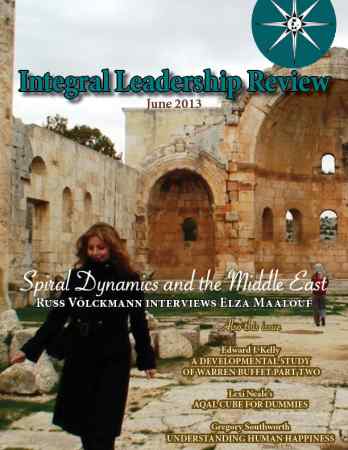
Integral Leadership Review, June 2013 Online Now


A new issue of the Integral Leadership Review is now online and, as always, open access under a Creative Commons license.

Here is the table of contents for the new issue - looks like there is a lot of good stuff to read.


Integral Leadership Review


June 2013 -Table of Contents

Leading Comments
Mark McCaslin
Leadership Quote
Leadership Coaching Tips
Darius Sebalius
Fresh Perspective
Russ Volckmann
Feature Articles
Maretha Prinsloo and Paul Barrett
Angela H. Pfaffenberger 
Exploring the Pathways to Postconventional Personality Development                                                 
Tatiana Bachkirova and Nick Shannon
John Quinlan 
Lexi Neale 
Greg Southworth
Warren Buffet’s Transformation in Leadership: Part 2                  Edward Kelly
Book Reviews
Russ Volckmann
Column
Lisa Norton
Alfonso Montuori 
Leadership Cartoon
Notes from the Field
Brian Van der Horst
Barbara N. Brown 
Pam Fuhrmann 
Vancouver, B.C., Canada: The Next Stage Facilitation                Chela Davison
Announcements
Leadership Emerging
Mark Harman
Integral Crossword
Coda  
Mark McCaslin

Thursday, November 08, 2012

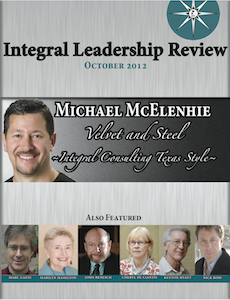
Integral Leadership Review - October 2012 Table of Contents

Now online and free to read . . . There are some good articles, as always, in this new edition. Be sure to check out Russ Volckmann's conversation with Jeff Klein on conscious capitalism, conscious business, conscious leadership. Also be sure to read Marilyn Hamilton's "Leadership to the Power of 8: Leading Self, Others, Organization, System and Supra-System."


October 2012 Table of Contents


Leading Comments

  • Russ Volckmann - Check out ilrParticles


Leadership Coaching Tips

  • Getting to the Next Level of Greatness… - Judith E. Glaser
  • How to Idiot-Proof Excellence - Amiel Handelsman


Fresh Perspective

  • Russ Volckmann - Integral Consulting with Michael McElhenie
  • Russ Volckmann - Jeff Klein and Conscious Capitalism, Conscious Business. Conscious Leadership


Feature Articles

  • Nick Ross - Epoch of Transformation: Towards a Practice of Interpersonal Leadership: Part 2
  • Oliver Ngodo - Expanding the Boundaries of Our Capacities through Working toward Experiencing Transformative Learning in Service
  • Martina Danilova - Integral Coaching as a Tool for Transformational Change
  • Marilyn Hamilton - Leadership to the Power of 8: Leading Self, Others, Organization, System and Supra-System
  • Nancy Southern Sylvia Gafney and Bernice Moore - Leaning into Complexity: Supporting Leaders Through Transformative Learning
  • John Renesch - The Conscious Organization: Workplaces for the Self-Transcended
  • Marc Gafni - Three Steps to the Democratization of Enlightenment
  • Kenton Hyatt and Cheryl De Ciantis - Values Driven Leadership
  • Michel Saloff-Coste - Why “DESIGN ME A PLANET”
  • Tom Christensen - “Game is Over. You are Enlightened.”


Book Reviews

  • Michael McElhenie - SQ21: The Twenty-One Skills of Spiritual intelligence by Cindy Wigglesworth
  • Keith Bellamy - The God Problem by Howard Bloom


Column

  • Lisa Norton - Integral Design Leadership: “Envisioning Pure Land @Taiwan”
  • Mark McCaslin - Integral North: Dispelling the Leader Myth
  • Alfonso Montuori - Transdsciplinary Reflections: Transdisciplinarity as Play and Transformation


Notes from the Field

  • Jeff Klein - A Brief Review of the 2012 Conscious Capitalism CEO Summit
  • Rafael Nasser - Don Beck and the New Face of Philanthropy
  • Giorgio Piacenza Cabrera - Emerging Integral Thinking South of the Border
  • Marilyn Hamilton - Integral City EXPO & eLaboratory
  • Jon Freeman - SDi Confab: Are you an app?
  • Sergej van Middendorp Kazuma Matoba and Barton Buechner - SIETAR Forum 2012+38 in Berlin
  • Russ Volckmann - Spiral Dynamics in Action: the Momentous Leap: The Confab 13, 9/6-9
  • Michael Stern and Michael Pergola - Working with the Deeper Field of Evolutionary Potential – A Week of Events with Stephen Busby


Learner Papers

  • Giorgio Piacenza Cabrera - Inca Wisdom and Integral Theory
  • Diane Meyer - Interpreting Along the Deckled Edge: The Artist’s Place in Leadership

Leadership Emerging

  • Barbara Maria Stafford, Ed. Bridging the Humanities-Neuroscience Divide: A Field Guide to a New Meta-Field.
  • Bob Vanourek and Gregg Vanourek. Triple Crown Leadership: Building Excellent, Ethical, and Enduring Organizations.
  • Ryan Caradonna and Jake Caines. Debunking the Leadership Myth: The Story of Conscious Leadership.
  • Stephen Brookes and Keith Grint, Eds. - The New Public Leadership Challenge.
  • Thomas E. Cronin and Michael A. Genovese - Leadership Matters: Unleashing the Power of Paradox.
  • Howard J. Leonhardt - Top 10 Takeaways from Conscious Capitalism Summit

Coda

  • Russ Volckmann - Health, Poverty and More

Thursday, March 22, 2012

March 2012 Integral Leadership Review Now Onlne


The March 2012 issue of the Integral Leadership Review is now online, featuring some excellent articles and reviews, including my review of Gary Stamper's new book, Awakening the New Masculine: The Path of the Integral Warrior (Berrett-Koehler Publishers, March 2012) - but also new articles from Eugene Pustoshkin, Mark Walsh, Michael Craig, and Don Beck.


March 2012 Table of Contents

Feature Articles

Book Reviews

Column

Notes from the Field

Leadership Emerging

Coda
  • Russ Volckmann: CODA


Friday, March 02, 2012

Don Beck on the The Master Code: The Hidden Dynamics that Shape Individuals, Design Organisations and Transform Societies


Nicholas Beecroft (Future of Western Civilization) recently interviewed Don Beck about his forthcoming book, The Master Code: The Hidden Dynamics that Shape Individuals, Design Organizations and Transform Societies. The aim small in this discussion - simply to ponder the future of Western Civilization.

I included the basic info below - there's more background on Beck at the site.


Don Beck on The Master Code: The Hidden Dynamics that Shape Individuals, Design Organisations and Transform Societies

Posted On: February 22, 2012


Dr Don Beck interviewed by Dr Nicholas Beecroft on “The Master Code: The Hidden Dynamics that Shape Individuals, Design Organizations and Transform Societies” and the Future of Western Civilization. Don wrote the following introduction to this interview:

“The real question deals with the “Rise and Fall and then Rise” of Western perspectives on “civilization.” I have often wondered why the so-called “Western Civilization” appeared to ascend in terms of complexity to “commanding heights” during the last few hundred years. This does not mean at all the “Westerners” are better humans, or should dominate any other social or geographic grouping. The work by Alfred. W. Crosby in ‘The Measure of Reality:Quantification and Western Society 1250-1600 offers one reason. This activity replaced many of the myths, superstitions and fables with hard facts, the scientific method, and rationality. This was especially apparent in the field of medicine. It help give rise to the Age of Science and the birth and spread of the 5th Code of modernity. Add into the equation the stability, discipline, high ethics and ordered thinking from The 4th Code, and you have the Puritan value system. This is neither magic nor arrogance but does explain the transitions from pre-modern to modern. The English language helped, as did the strong and positive growth themes inherent in both Jewish and Christian thought. The celebration of life, in the present, and the hope of a heaven in an afterlife, can be strong elixirs.

This does not mean everything was perfect and Civilization emerged as we climbed the ladder of “success” and material gain with all the displays of abundance. But it does suggest that this world-view also contained a repair kit in spite of failures and negative consequences to the rest of the world.

Western Civilization continued to leap into new manifestations to add “post modern” to the evolutionary flow. And, in my view, that is the critical aspect of its over all code. Adam Smith clearly combined morality and a purpose filled society as a foundation for his promotion of the “invisible hand” that will raise all the boats. But we have also learned that if such a ‘hand” extends from a sleeve full of greed, corruption, and wasteful extravagance, lit will self-destruct, as it has in recent decades. Same goes with simplistic versions of the 6th and humanitarian code that, alas, disrupted the critical contributions of the 4th (traditional-sacred) and 5th (materialistic-secular) which, when in balance, do the heavy lifting of populations as they deal with fundamental challenges and threats, producing sink holes in human emergence. Known as ‘political correctness,” it provide a false picture on what diversity really means. Our 21st Century society is full of examples. There is far greater expressions of caring and human sensitivity within the 7th and 8th Level thinking patterns.

Yet, I firmly believe that the codes within Western Civilizations will now re brand themselves, re calibrate their range and scope, and adapt their essential components in a positive manner within the language, culture, religions and traditions of the entire Earth Society. Herein lies the power within the 7th Code, the capacity to re frame the 1st Tier assemble of adaptive intelligences while generating The Master Code, designed to deal with global issues that confront us all. When Professor Clare Graves spoke of the “momentous leap” of human nature, this is what he had in mind. We all have serious work to do. New world views await us as we climb the emerging peaks of our own conscious evolution. When the whole Spiral-full of value systems are engaged in dealing with these global issues, we have an opportunity to impact the whole in new dimensions and functions. The siege of ‘perfect storms” now needs the brilliance of new sun rise, with new aspirations, effective tools, and a new and fresh spirit of humanity.”

~Dr. Don Beck 22nd February 2012.
The Spiral Dynamics Group
Global Center for Human Emergence

“It is time to get the entire global system set right by respecting all of us who exist in clans, tribes, empires, holy orders, cultures, enterprises, communes, natural habitats and are spread along the various trajectories of change. Imagine a global Intelligence that, much like a metaphoric Air traffic control system, can keep up with and direct our many life forms which are dispersed in different altitudes, moving in different directions, at different speeds, with different capacities, and all with multiple bottom lines and priorities.”
~ Extract from “The Master Code” (published later in 2012)

Wednesday, November 02, 2011

Integral Leadership Review - October 2011

A new issue of the Integral Leadership Review is out - you can see the full Table of Contents for the October 2011 issue by following the link.

Here is section of Russ Volckman's Leading Comments: Interesting Times.


This issue of ILR – and perhaps this applies to most if not all of them – has occurred in interesting times. Personally, this has been one of the busiest and challenging work and personal periods of my life. I have been learning a lot, feeling a lot, caring a lot – and the process will probably be as intense in the next few months as it has been in the last. And we have received and are sharing with you a lot of valuable and interesting material.

Imagine! Interviews with both Don Beck and Ken Wilber in the same issue! Also, there is a subtheme of articles having to do with women and integral leadership, including an article by Marilyn Hamilton. There is an excellent article by Integral Leadership Council member Alain Gautier with another by Don Dunoon (In the Leadership Mode) and Ellen Langer, each dealing with development of individuals for leader roles. And I highly recommend “Spiral Dynamics Integral in Action in a Roma Community in Romania” by Alexandre (Rico) de Faria for a truly exceptional case study.

There are a number of reviews of varying depth. I call your attention to James L. Ritchie-Dunham”s review of Maureen Metcalf and Mark Palmer, Innovative Leadership Fieldbook. This very recent publication has already been drawing attention.

Finally, I am excited that we are able to provide you with Barrett C. Brown’s “Complexity Leadership: An Overview and Key Limitations.” This is one of a number of Barrett’s papers we hope to publish in the future, papers he wrote in his PhD program (hence, it’s inclusion as a “Learner Paper”). Barrett has since completed his PhD, but we believe his work has been so valuable that we want to share as much of it as we can with you

I hope you find many things to enjoy about this issue and our innovations.

Tuesday, August 02, 2011

Don Beck - Understanding Violent Clashes of Value Systems


There is likely no time in our history when it is crucial that we understand the violent clash of values systems than we living right now. Don Beck offers his insights into this very contentious and muddled topic of discourse.

Another interview brought to you courtesy of the Integral Leadership Collaborative.

Understanding Violent Clashes of Value Systems

Don Beck has been implementing a multidimensional model for understanding societal change for more than three decades. He is employing his Spiral Dynamics Integral model to affect large-scale systems change in various sectors and societies of the world including hotspots in the Middle East, Europe and Scandinavia.

Audio and PDF files are provided below. Click to listen (or view PDF) or Right-Click (Control-Click) to download the files to your computer (recommended). Additional information is available on the Biographical Information, Conference Overview, and Conference Details pages.
And please leave your comments below. Your questions and suggestions will not only inform our conversation here on these pages, but will be brought to the the discussion panels at the conference so that these issues can be more deeply explored.

Downloads

You may need to right-click the following links and select "Save Link As" to download the file to your computer.


Thursday, May 26, 2011

Elza Maalouf - Culture: The Missing Piece From the President's Speech

http://upload.wikimedia.org/wikipedia/commons/thumb/e/ec/Syria_Damascus_Douma_Protests_2011_-_22.jpg/300px-Syria_Damascus_Douma_Protests_2011_-_22.jpg

Over at Huffington Post, Elza Maalouf wrote an interesting response to the speech President Obama gave last week about the U.S. position on Middle East conflicts, including the desire for Israel to return to their 1967 borders.

Elza does a lot of "on the ground" work in the Middle East as the President of the Center for Human Emergence, Middle East, so she has some very pertinent observations.

Culture: The Missing Piece From the President's Speech

By Elza S. Maalouf - President, Center for Human Emergence, Middle East

In his long awaited speech about the Middle East President Obama reaffirmed America's role in supporting democracy in the region, but in a world that's experiencing monumental shifts the focus on culture has to take center stage in formulating strategies for foreign policy.

We are now living in an interconnected world through knowledge and information. The transition from hegemony to a participatory leadership style with the Arab world has started but policy makers haven't fully laid out the process and the mechanisms that the Arab world needs for sustainable change. There has to be a higher degree of sophistication in the understanding of the mindsets in cultures that can support emergence of institutions that lead to democracy in Egypt, Tunisia and eventually Palestine.

It is fair to say that from a strategic perspective, the Administration should not have labeled the speech as historic unless it intended to announce a policy shift as substantial as the change that is taking place on the ground in the region. The Arab Spring remains the most dynamic unfolding of social change in more than five decades, messy no doubt, but very telling of a new narrative written by young Arabs that did not live in the mental prisons in fear of dictators that their parents lived in. This is because Shadia in Cairo can communicate with Olaf in Sweden and discuss the principles of freedom and democracy that make his country a heaven for its citizens.

The uprising is an evolutionary stage of development in Arab cultures that topples governments and dictators, but has yet to harbor enough political and social roots to move it in the direction of order and nation building. These are the cultural nuances and upward shifts in sophistication of mindsets that are taking root for the first time in the Middle East that have to be addressed. Today, the US has an unprecedented opportunity as the leader of the free world, to co-design with leading Arab states a roadmap for young Arabs that show the long and arduous road that leads to democracy.

In helping the US and the Arab States design for the profound shift that is taking place in the Middle East and for our Middle East policy to have the profound and meaningful change that lays the foundation to a peaceful long term alliance I would outline the following plan of action:

Pursue A Stratified Approach to Arab Democracy: The Arab Spring is the region's first attempt at organic nation-building since the end of the colonial era. This is the region's first attempt at building democratic structures that fit the realities on the ground of each country. Leading Arab states together with the US should advocate a plan for a systemic developmental roadmap that can become the rallying call for every Arab woman, man and child. This plan would fit the value-system landscapes of each culture and should be embodied in the spirit of the following steps:

  1. A study of the profiles of the citizens in the country seeking democracy. This step starts by assessing each individual country's history, religion, topography, and cultural evolution. Who are the Egyptians, who are the Tunisians, who are the Libyans? How has modern history in the region and in their respective countries shaped their cultural evolution? What is their psychological makeup? How has religion shaped who they are today? In an address to the Senate Committee On The Future in 1979 at the dawn Iran's Islamic revolution, Dr. Jean Houston, the foremost leader in the Human Potential Movement, advised the committee's members on the need to look at the culture as a whole when it comes to Muslim countries, and not try to impose the West's own thinking on Iran and Saudi Arabia. Otherwise, she warned, the disparity between culture and the Western notions of modernization would create an inevitable opportunity for the triumph of a fundamentalist regime. Which, of course, is what happened with the ascendance of Khomeini. Forty years later, and after our involvement in Iraq and Afghanistan it doesn't seem that our leading politicians have understood the crucial roll that culture plays in politics.
  2. Identifying each country's zones of synergy. These are the respective sources of national wealth, be it natural resources or human capital, active or dormant. This will form the basis for a viable private sector that can provide jobs that fit the landscape and various capacities of the citizens. From building cement factories and designing sustainable agricultural models for laborers to creating the most advanced hi-tech research and development companies.
  3. Studying the Forms of Governance that work. This will be the painstaking process that will take years to evolve into a coherent platform for governance. Now we can talk about what form of democracy fits those citizens who live in such dynamic landscape, and what form of institutions are needed. Would a centralized form of democracy for this stage of development fit better than a multi-party democracy?

All this should happen with an enlightened co-leadership that can create an overarching goal for a patriotic national cause that brings forth the state into the community of nations and that Shia, Sunni and Christians alike within that nation can rally behind. The importance of setting a common, overarching goal was recently confirmed to me on a trip to Oslo where I attended a presentation by Nobel Peace Prize Laureate FW De Klerk at the Oslo Center for Peace. He spoke retrospectively about the two major factors that led to democracy in South Africa, inclusivity and leadership. Stating that leaders should be able to align with their constituencies and bring all parties to the table or else the entire effort will be "like a soccer match in which one of the teams did not appear."

Nurture Infant Democracies: A bold declaration in new US foreign policy should be made towards making a conscious effort in balancing America's values and our strategic and economic interests in the region, and our willingness to compromise the pursuit of those interests if they interfere with people's aspirations for freedom. A point that was clearly stated in President Obama speech. Sadly, we are faced with a tradition of mistrust towards the United States in the Arab world, as it's often seen protecting the two things closest to it; oil and Israel. Some of that mistrust and anger is justified and some just stems from the Arab street projecting their aggression onto what professor Fawaz Gerges calls the "Far Enemy" represented by the US and Israel. When "the near enemy" is the brutal dictator who imprisons and kills his critics the far enemy becomes the favored choice on whom to project the anger of repression. A conscious look at balancing our practices abroad started with the President's speech and has to be followed with practical steps on the ground and in our foreign policy. This will go a long way in planting the seed of mutual trust and respect with the Arab street. We have to view the region through the lenses of infant democracies that need the guiding moral compass of a mature democracy.

Align with and Empower Regional Nations of Influence: To create the paradigm shift that will establish our new participatory leadership role the US should call on the major power brokers in the region like Saudi Arabia and Turkey and facilitate the stage for them to play a more assertive role in brokering political deals in return for security guarantees. Although Saudi Arabia was criticized for supporting the Bahrain regime in quelling the Shia uprising that was in part influenced by Iran and Hezbollah in Lebanon, King Abdullah remains one of the most progressive reformers in the region. He is by far one of our closest allies in deterring Iranian influence in the region. Behind the scenes the Saudis have teamed up with the Turks in an effort to pry Syria out the clutches of Iran, which if successful can pull the rug out from under the spread of Iranian-brand apocalyptic Shia ideology known as Wilayet Al Faquih, that is threatening not only Israel, but every oil rich country in the region. The unholy alliance between Iran, Hezbollah, Syria and Hamas is now being broken thanks to the behind the scenes work of the Saudis who are making strides in convincing Syria to move Hamas' headquarters to Qatar, a moderate Gulf state. This type of regional leadership should be encouraged especially when it comes from another Muslim country on which far enemy projections aren't made.

Pursue a Systemic Approach to Economic Development: The US is teaming up with Arab Gulf States to help in the economic development of emerging Arab democracies. Along with the IMF, the World Bank and the respective countries that are being rebuilt, the leaders in charge of these development plans should have an "ecosystem" approach to development that address the causes of corrupt business practices. Said E. Dawlabani, an expert on economic emergence in the Middle East writes "Egypt, which is considered to have some of the most evolved business practices in the region, is also the most corrupt. The spoils of foreign direct investment and international aid went to the elite in government, the military and their inner circle and this will not longer be tolerated by the masses of people on the street today. Business practices in most of the region are geared to make one family or one clan posses power through wealth over the next family or clan." This long-term development raodmap will not be similar to that of Europe or Japan under the Marshall Plan.
2011-05-23-Fatah2108056.jpg
The Arab Spring is signaling the birth of Industrial Age values that is emerging simultaneously with the information and knowledge age. These are the value-systems that built the modern day middle class in first world countries. This must be promoted through responsible corporate practices, and matched by transparency in governments that believe in their people as their ultimate national strength. To affect real and lasting change, a plan similar to the Marshall Plan in its ambition must be undertaken and tailored to fit the tribal and feudal mindsets that are prevalent in the region to lead them collectively to more enterprising practices based on merit not nepotism and clannish alliances. This type of commitments will require long term planning from all parties involved, especially the respective countries that are being rebuilt. Their governments and private sector have to be held accountable to higher standards in order for the entire culture to emerge and establish a permanent presence for the middle class, which is every advanced culture's insurance against chaos and collapse.

Maximize the use of Technologies that Anticipate Change: Since we don't have a full grasp on the changes that are taking place in the region, we have to gather information through technology that anticipates threats and future trends in the world and specifically in the Middle East. Technologies on the cutting edge that have made their way into advanced business practices and in the Pentagon must be applied in scanning the horizons for every variable that impacts cultural evolution. A system similar to the RAHS (Risk Assessment & Horizon Scanning) program in Singapore, which explores methods and value-system research that compliment scenario planning, is a good example. Relying on technology that scans the horizon will not only make the world a safer place, but will add complexity and precision to a diplomatic corps that can act on information in real time. Here's a partial list of political maneuvers that we should have anticipated in Egypt had we had this technology:

  • We should have known a lot more about the Muslim Brotherhood. They are ideologically organized around a set of Islamic principles yet have branched out into five factions spanning from the extremists to the more enterprising thinking factions. A few weeks ago Sheikh Qardawy a radical member of the MB who was ousted by the Mubarak regime, and was a fixture on Al Jazeera TV, made a triumphant return to Tahrir Square where he riled up the cheering crowd with his radical speech. When the young Google executive, Wael Ghoneim, who's credited with the uprising took to the stage he was booed and asked to step down immediately. The young executive had the support of more than 70% of Egyptians, while the Muslim Brotherhood had much less support, yet their ideological glue keeps them well organized, and might get them to a majority in the Parliament in the next election, even though they refused to have a candidate in the upcoming November elections.
  • Four years ago, the Egyptian Army broke rank with Mubarak when he appointed his son as his de facto successor. The army had encourages the uprising in Tahrir Square and helped direct the anger of the people towards Mubarak. Now, the demonstrators are being robbed of what they've accomplished as the army runs and governs the country. Having a general in charge could lay down a smooth transition towards democracy, but how can we anticipate what the army's intentions really are and how can we be sure the next formula for governance will be a multi-party system that does not allow for one party to dominate?
  • In order for the young women and men who started this uprising to have a say in the form of democracy their country should have, the United States in partnership with wealthy Arab States should sponsor civic institutions in Egypt, Tunisia and Palestine that teach in practical terms the principles of democracy and nation-building. Nafiz Rifaee, a Fatah leader, tells me that these young men and women have no desire to follow an ideology or an Old Guard mindset to create their political platform, they have to have a love for their country and a willingness to learn the process and mechanisms for building a democracy with viable institutions.


Building a Viable Palestinian State: The issue of Israel/Palestine is of critical importance as it's built deep in the psyche of Arab Nations when most of these Nations were gaining their independence and came to view Israel as the entity that deprived Palestinians of Nationhood. Right or wrong this is how Israel is viewed in the Arab world. Not sure if the president furthered his cause by announcing his support for a Palestinian state with 1967 borders and land swaps. He did well slapping the wrists of Israelis publicly by announcing his position on the conflict, yet did little to hold the Arabs and Palestinians accountable in the pursuit of peaceful coexistence. In a recent conversation with complexity strategist, Dr. Don Beck he explained " too often peace-making consists of stretching across a deep and historic wound, thus attempting to seal it over at the top. Unhappily, the trapped '"poison" and angry motives of pay back revenge are trapped within, only to fester and even grow more destructive." This is precisely why peace-making has to address the real causes of the conflict in a systemic and thrive and help thrive manner. It makes little difference what documents the politicians sign, unless the populations, which have been engaged in the conflict, are in step with their leaders' vision.

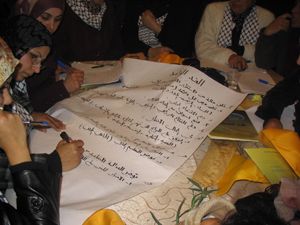
Based on the Spiral Dynamics Systems model created and field-tested in South Africa by visionary geo-political strategist Dr. Don E. Beck, who was praised by FW de Klerk recently in Oslo as one of the architects of the transition from apartheid, we have been working since 2005 with Palestinian community leaders on creating a national platform for building Palestinian institutions. Our work culminated in a Nation-Building conference in Bethlehem that provided a unique forum for community leaders including Fatah 3rd and 4th generation members that focused on the viability of a future Palestinian state. The participants called on President Abbas to set up a "nation-design conference" that would unleash the brightest minds in Palestine and throughout the world to create a developmental roadmap for Palestine based on much of the principal outlined in this article. This call for nation-building was informed by the needs and aspirations of all Palestinians, and put forth a vision of a thriving region. It honored the past while building the infrastructure necessary for the younger generation to emerge socio-economically and overcome the region's historic conflict. For moderates in Israel, a plan such as this would provide the assurance they need to enter into a partnership of mutual peace and prosperity, while quelling the extremists in Hamas and Israel's far right parties. What was amazing but not surprising was how Palestinian professional women emerged as leaders at the forefront in designing for their future state.

If the US intends to remain in a leadership position in a rapidly changing Middle East, it would benefit in adding some of the principles outlined in our work and incorporate them into a development template for a design conference that could play an essential role in creating a successful Palestinian state. This can only happen if President Abbas continues to strengthened Palestinian institutions before announcing an independent state at the UN in September and on the sole condition of Hamas dropping the antagonistic calls for Israel's destruction in its charter and acknowledging its right to exist. Another image that stayed with me from FW de Klerk's speech in Oslo is his description when of the initial intent of Apartheid to protect the Whites in a sea of Black Africans, but ended up isolating and limiting the same people it wanted to protect. I don't believe that the same conditions for Apartheid exist in Israel/Palestine -they are more complex and layered historically-- however, I can't help but compare how Israel is following similar patterns. It's only natural for me to ask at this point, where's Israel's De Klerk?

Like the president I am not claiming that this new Middle East development map will be easy to implement by the eager citizens of emerging Arab democracies. The region is going through monumental shifts that demand long term planning and the United States must be a the helm directing this change if it is to regain its status as the leader of the free world.

Elza S. Maalouf is an Arab-American futurist and cultural development specialist focusing her work on cultural and political reform in the Arab world. She is the President of the Center for Human Emergence Middle East a think tank that emphasizes the scientific understanding of cultures.