Showing posts with label purpose. Show all posts

Wednesday, October 15, 2014

Chris Guillebeau | "The Happiness of Pursuit" (Talks at Google)

http://chrisguillebeau.com/files/2014/07/hop6-1.jpg

Chris Guillebeau is the author of The Happiness of Pursuit: Finding the Quest That Will Bring Purpose to Your Life (2014) and he recently stopped by Google to talk about his new book. Here is the publisher's ad copy for the book:
A remarkable book that will both guide and inspire, The Happiness of Pursuit reveals how anyone can bring meaning into their life by undertaking a quest.

When he set out to visit all of the planet’s countries by age thirty-five, compulsive goal seeker Chris Guillebeau never imagined that his journey’s biggest revelation would be how many people like himself exist – each pursuing a challenging quest.  And, interestingly, these quests aren’t just travel-oriented.  On the contrary, they’re as diverse as humanity itself.  Some involve exploration; others the pursuit of athletic or artistic excellence; still others a battle against injustice or poverty or threats to the environment.

Everywhere that Chris visited he found ordinary people working toward extraordinary goals, making daily down payments on their dream.  These “questers” included a suburban mom pursuing a wildly ambitious culinary project, a DJ producing the world’s largest symphony, a young widower completing the tasks his wife would never accomplish, and a teenager crossing an entire ocean alone - as well as a do-it-yourselfer tackling M.I.T.’s computer-science course, a nerd turning himself into real-life James Bond, and scores of others writing themselves into the record books.

The more Chris spoke with these strivers, the more he began to appreciate the direct link between questing and long-term happiness -- how going after something in a methodical way enriches our lives -- and he was compelled to complete a comprehensive study of the phenomenon and extract the best advice.  In The Happiness of Pursuit he draws on interviews with hundreds of questers, revealing their secret motivations, their selection criteria, the role played by friends and family, their tricks for solving logistics, and the importance of documentation.

Equally fascinating is Chris’ examination of questing’s other side, including questers’ acute awareness of mortality, their struggle against monotony, and their wistful feelings once a quest has succeeded. What happens after the summit is climbed, the painting hung, the endurance record broken, the “at risk” community saved? 

A book that challenges each of us to take control – to make our lives be about something while at the same time remaining clear-eyed about the commitment -- The Happiness of Pursuit will inspire readers of every age and aspiration.  It’s a playbook for making your life count.
With that, here is the talk.

Chris Guillebeau | "The Happiness of Pursuit" (Talks at Google)


Talks at Google
Published on Oct 15, 2014


Chris discusses his latest book, The Happiness of Pursuit: Finding the Quest That Will Bring Purpose to Your Life (2014), a remarkable book that reveals how anyone can bring meaning into their life by undertaking a quest.

In this intimate gathering Chris highlights, among other things:
  • His own personal journey to every country in the world.
  • Other amazing journeys, including a man who took a 17-year vow of silence and the young woman who lived in a tree for a year as a form of social protest.
  • How quests and big adventures can bring purpose to our lives
More about the book:
A book that challenges each of us to take control – to make our lives be about something while at the same time remaining clear-eyed about the commitment -- The Happiness of Pursuit will inspire readers of every age and aspiration. It’s a playbook for making your life count.

About Chris:
Chris Guillebeau is the New York Times bestselling author of The $100 Startup and The Happiness of Pursuit. Chris travels the world and writes for a small army of remarkable people at ChrisGuillebeau.com. Follow his live updates from every country in the world at www.twitter.com/chrisguillebeau.

Every summer in Portland, Oregon, Chris hosts the World Domination Summit, a gathering of creative, remarkable people with thousands in attendance.

Monday, August 12, 2013

Omnivore - As We Evolve: Empathy, Monogamy, and Networked Minds?

This is an excellent and diverse collection of links from Bookfoum's Omnivore blog, this time dedicated to the various possibilities of evolution - past and future.


As We Evolve

AUG 8 2013 
9:00AM


Monday, December 10, 2012

Tania Lombrozo - Is It Silly To Seek Purpose In The Natural World?

From NPR's 13.7 Cosmos and Culture blog, this is an interesting look at the human need to find meaning in the world.

Does it have a purpose? Does it need a purpose?
Does it have a purpose? Does it need a purpose? | Sean Gallup/Getty Images
 
Science and religion alike grapple with some of our deepest questions: What is the purpose of life? Why is the natural world just so? Why does the biological world strike us as so exquisitely designed?
But do all questions deserve an answer? In a 2008 lecture, Richard Dawkins argued that they don't (you can hear his lecture on "The Purpose of Purpose" here). In particular, we can't always answer purpose-seeking "why" questions. Sure, science can explain why birds have wings in evolutionary terms, or how mountains form by appeal to geological processes. But can science answer a question like, "What is the purpose of a mountain?" According to Dawkins, this is a silly question that doesn't deserve an answer.

But not everyone finds questions about the purpose of mountains so silly. In a 1999 paper, developmental psychologist Deborah Kelemen asked 4- and 5-year-old children a variety of questions about the living and nonliving natural world, including "What's the mountain [in this picture] for?" Over half the children provided purpose-based answers, suggesting, for example, that the mountain was "to climb" or "to drive around." When asked to agree with a character who claimed that "mountains are made for something," or another who claimed, like Dawkins, that "this is silly," the majority of children judged the call for purpose sensible, not silly.

Perhaps more surprising, most adults aren't so different from these purpose-minded preschoolers. In a study released earlier this month (press release here), Kelemen and colleagues presented college students and college graduates with a series of explanations, some of which involved scientifically-unwarranted appeals to purpose. For example, one explanation was that "mountains fold inwards in order to maintain mass," another that "germs mutate in order to become drug resistant." Students accepted these explanations almost half the time, with an acceptance rate of 45 percent. College graduates were close behind at 40 percent and even science and humanities PhDs accepted them some of the time (15-21 percent), especially when forced to respond quickly (29-32 percent).
Is it silly to seek purpose in the natural world?

The authors of the study argue that ascribing purpose to the natural world is a "lifelong cognitive default" that can be "masked rather than replaced" by education. So even if it is silly, it may be part of the human condition, as suggested by Gary Robertson in response to Dawkins' dismissive remarks. (Dawkins conceded: "It may well be part of the human condition to ask silly questions.")

Another response is that it isn't silly, it simply isn't science. After all, purpose has traditionally fallen under the purview of religion. Kelemen sums up the findings from her research by suggesting that "our minds may be naturally more geared to religion than science." Religion may be compelling in part because it ascribes purpose, picking up where science typically leaves off.

Here's a third response, and the one I favor: there are no silly questions in science. Once we define what we mean by "mountains" and "purpose," it's an empirical question whether or not mountains are the sorts of things that have purposes, just as it's an empirical question whether zebra's stripes have a purpose (in the sense of a biological adaptation: camouflage), or whether chairs have a function (the result of intentional design: supporting sitting).

It could be that a species of super-smart aliens set up the geological conditions for mountains precisely so that humans would have somewhere to climb. If this were the case, the preschoolers would be right to say that mountains are "for climbing." Of course, this is a silly answer to the question, "What is the purpose of mountains?" But it's silly because centuries of science give us very good reasons to reject it, not because the question itself is nonsensical.

Other questions may be "silly" in the sense that they rest on a conceptual confusion ("Are mountains divisible by zero?"), or because they aren't fruitful to pursue ("Are there any mountains exactly 1,942 feet high?"), but we typically make conceptual and empirical progress by asking questions, evaluating possible answers, testing them empirically when it's possible to do so and analyzing our successes and failures – not by delimiting the set of questions considered fair game. It matters that we ask the right questions, but we learn which those are as we go.

I'm tempted to misquote Mr. Garrison from South Park, who famously quipped that "there are no stupid questions, only stupid people."

There are no silly questions, only answers that strike us as more or less silly based on our current understanding of the world.


Guest blogger Tania Lombrozo is an assistant professor of psychology at the University of California, Berkeley.

Monday, June 25, 2012

What I'm Reading, Part Two: Causal Pluralism


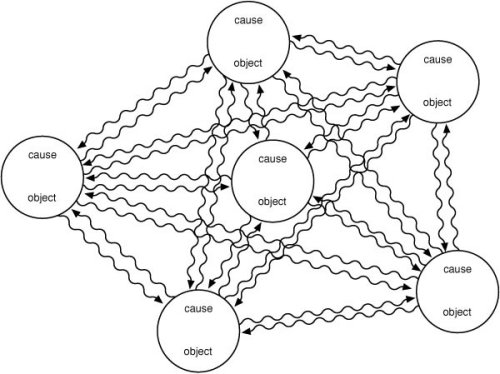
Somehow, while I was down the complex adaptive systems rabbit hole, I stumbled across another new term, causal pluralism. A quick and easy definition comes from Peter Godfrey-Smith (Harvard University):
Causal pluralism is the view that causation is not a single kind of relation or connection between things in the world. Instead, the apparently simple and univocal term "cause" is seen as masking an underlying diversity.
Leen De Vreese (Centre for Logic and Philosophy of Science; Ghent University, Belgium) argues that the field is still relatively new (as of early 2007), but the term “causal pluralism” already has accrued a variety of meanings, which he feels leads to confusion. In his paper, Disentangling Causal Pluralism, he tries to sort the threads of pluralistic approaches to causation and to identify the different perspectives held by their adherents.

I wonder if he sees the irony in trying to identify the individual ideas and perspectives that constitute the pluralist origins of causal pluralism?
Full Citation:
De Vreese, L, Weber, E. (2008). Disentangling Causal Pluralism. Robrecht Vanderbeeken, (ed.), Worldviews, Science, and Us: Studies of Analytical Metaphysics. A Selection of Topics From a Methodological Perspective. Singapore: World Scientific Publishing Company.
De Vreese identifies three basic kinds of causal pluralism:
  • conceptual causal pluralism
  • metaphysical causal pluralism
  • epistemological-methodological causal pluralism
Each of these positions has an opposite stance in the monistic causation camp.

However, his primary agenda in the paper is to reduce the (perceived) confusion in the field of causal
pluralism by identifying the perspectives being taken in relation to metaphysical causal pluralism. In essence, are there metaphysical reasons to accept causal pluralism, or is causal pluralism only a conceptual matter

He proposes three "central metaphysical questions" about causation to achieve this goal.
  • Firstly, is causation a realistic notion, or is it a mental construct? 
  • Secondly, does causation only occur as a real relation at the fundamental level of reality, or does it also occur as a real relation between objects at higher levels of reality? 
  • And lastly, does causation consist in a single empirical relation, or does it consist in diverse empirical relations deserving the label “causal”?
In answering these questions, he proposes four types of metaphysical perspectives regarding causation:
  • metaphysical causal constructivism
  • strong metaphysical causal pluralism
  • weak metaphysical causal pluralism 
  • metaphysical causal monism
He concludes his paper by making a clear distinction between conceptual and metaphysical causal pluralism from a third variation on causal pluralism, which he terms "epistemological-methodological causal pluralism." He is referring to "the importance of a pluralistic view on causation for our scientific knowledge in general on the one hand, and for assembling causal knowledge in specific domains of science on the other hand."

While he maintains that an epistemological-methodological approach to causation is still intimately related to conceptual and metaphysical causal pluralism, he feels it's still important to value this line of approach as different from the others, maintaining that "certain questions become utterly important for the sake of our knowledge."

That is one view of causal pluralism, but there are as many variations as there are authors, or at least that is how it seems to a new reader in the field.

In an article more specifically relevant to my work, Julian Reiss (Erasmus University Rotterdam, the Netherlands) published Causation in the Social Sciences: Evidence, Inference, and Purpose in Philosophy of the Social Sciences (2009).
Full Citation:
Reiss, J. (2009, Mar). Causation in the Social Sciences: Evidence, Inference, and Purpose. Philosophy of the Social Sciences, Volume 39(1); 20-40. doi: 10.1177/0048393108328150
Abstract:
All univocal analyses of causation face counterexamples. An attractive response to this situation is to become a pluralist about causal relationships. “Causal pluralism” is itself, however, a pluralistic notion. In this article, I argue in favor of pluralism about concepts of cause in the social sciences. The article will show that evidence for, inference from, and the purpose of causal claims are very closely linked.
This is definitely worth the read.

In an oft-cited paper, Christopher Hitchcock's Of Humean Bondage, he offers a classification scheme for the various forms of causal pluralism. He clarifies up front that he is interested in a pluralism of causation, not a pluralism of causes (which he claims all philosophers already accept). This paper relies more on classical logic arguments in assigning causation, but it is still useful.

Finally, Cognitive Psychology (2010) published Causal–explanatory pluralism: How intentions, functions, and mechanisms influence causal ascriptions by Tania Lombrozo, for which this is the abstract:
Both philosophers and psychologists have argued for the existence of distinct kinds of explanations, including teleological explanations that cite functions or goals, and mechanistic explanations that cite causal mechanisms. Theories of causation, in contrast, have generally been unitary, with dominant theories focusing either on counterfactual dependence or on physical connections. This paper argues that both approaches to causation are psychologically real, with different modes of explanation promoting judgments more or less consistent with each approach. Two sets of experiments isolate the contributions of counterfactual dependence and physical connections in causal ascriptions involving events with people, artifacts, or biological traits, and manipulate whether the events are construed teleologically or mechanistically. The findings suggest that when events are construed teleologically, causal ascriptions are sensitive to counterfactual dependence and relatively insensitive to the presence of physical connections, but when events are construed mechanistically, causal ascriptions are sensitive to both counterfactual dependence and physical connections. The conclusion introduces an account of causation, an ‘‘exportable dependence theory,” that provides a way to understand the contributions of physical connections and teleology in terms of the functions of causal ascriptions.
It's probably indicative of my geekiness that I am looking forward to reading this one.


Here are a few other papers, all of which are freely available online.

Sunday, March 11, 2012

Philosophy as a Way of Life - Socrates and Plotinus

Two excellent video lectures from Stanford University -John Cooper speaks in the Tanner Lecture Series.

Ancient Philosophies as a Way of Life: Socrates

January 25, 2012 - John Cooper gives the first of two lectures in the Tanner Lecture Series. This first lecture focuses on some of the ancient philosophies of Aristotle and how they apply to life today.


Platonist Philosophy as a Way of Life: Plontinus

January 26, 2012 - Professor John Cooper delivers the second of two lectures in the Tanner Lecture Series. This second lecture focuses on some of the philosophies of Plontinus and how they apply to life today.


Friday, April 01, 2011

Stuart Kauffman and Charles Hulse - What If We Could Ask The Big Questions?

http://www.wallpapers.cc/wallpapers/Stare-Into-The-Abyss.jpg

Over at NPR's 13.7 Cosmos and Culture blog, Stuart Kauffman and Charles Hulse muse on asking the big questions in life - the ones for which we are unlikely to find hard and fast answers, the ones that are mysteries even in the asking.
What if one finds, as Nietzsche stated, " ... when you look long into an abyss, the abyss also looks into you." What if, faced with the questions of meaning and purpose, one finds himself dangling at the edge of the abyss.
Excellent post.

13.7: Cosmos And Culture

What If We Could Ask The Big Questions?

Do you have enough courage to put one foot into the abyss?
Enlarge David McNew/Getty Images

Do you have enough courage to put one foot into the abyss?

What if one is running through a world where the main concerns are procuring "purple plastic penguins for the poolside," catching the latest installment of the "lives and antics of the rich and infamous" and receiving the next dose of "Wonder Bread and high fructose corn syrup?" What if, as the result of an accident, or a series of dreams about being inundated by waterspouts and of being inundated by a real waterspout, one starts asking the forbidden "questions?"

What if one starts asking: Why are we here? Why am I here now? What does it mean to be human? What is our humanity? How did the universe and life come about? What really is the nature of reality? What is time? What is space? How do we really know? What is the nature of God? Why is there evil? What is the nature of consciousness?

Who is "I"? What is beauty? Are we under the control of a deterministic universe or do we have free-will? How can we choose, if we don't really know what can happen? What is the next step in human evolution? The evolution of anything? Can we even say it? What are the goals of technology? Just because we can, should we? (Not that these are new questions, but rather, new questions to the one pondering the questions.)

What if one finds, as Nietzsche stated, " ... when you look long into an abyss, the abyss also looks into you." What if, faced with the questions of meaning and purpose, one finds himself dangling at the edge of the abyss. There, like the event horizon of a black hole, the souls of those who are foolish enough to have asked the questions before are sucked in, never to be seen again.

Yet, can't we ask?

What if one goes to science (reason) and religion (faith) for answers and finds them lacking (if not, possibly, the sources of the problem)? Those failing, what if one goes to the counselor's couch – only to laugh at the thought that such concerns are the result of unresolved childhood conflicts, repressed sexual / aggressive desires or the fear of death. (We've been there twice, maybe three times.)

Where does one go, in this time of instant oatmeal, instant messaging and instant gratification, to find the time and solitude to fully ponder these and other "deep" questions. Academia? We think not. The monastery? We doubt it. The asylum? Maybe.

How does one go face-to-face with the System and say, "Hey, we all need a few months (or years) to sort a few "things" out?"

"Get back to work (the void)," they storm. Although they may be right when they add, "And stop wasting time on those stupid questions. It will only get you in trouble."

Yet, why do the redwing blackbirds come back each year? Why do crocuses spring up next to melting snow? What more do we need? What if one just goes quietly into a forest?

So, we will end this by asking: Where in this day and age, does one go to ask the questions? Where does one go to find like "minded" people who are also seeking the answers? How does one find the time to read the great works, the space to ponder the great questions and the courage to keep one foot in reality while placing the other foot into the abyss?


Thursday, February 17, 2011

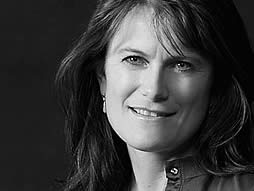
TED Talks: Jacqueline Novogratz - Inspiring a life of immersion

From TED Talks: We each want to live a life of purpose, but where to start? In this luminous, wide-ranging talk, Jacqueline Novogratz introduces us to people she's met in her work in "patient capital" -- people who have immersed themselves in a cause, a community, a passion for justice. These human stories carry powerful moments of inspiration.

Why You Should Listen to Her:

One of the most innovative players shaping philanthropy today, Jacqueline Novogratz is redefining the way problems of poverty can be solved around the world. Drawing on her past experience in banking, microfinance and traditional philanthropy, Novogratz has become a leading proponent for financing entrepreneurs and enterprises that can bring affordable clean water, housing and healthcare to poor people so that they no longer have to depend on the disappointing results and lack of accountability seen in traditional charity and old-fashioned aid.

The Acumen Fund, which she founded in 2001, has an ambitious plan: to create a blueprint for alleviating poverty using market-oriented approaches. Indeed, Acumen has more in common with a venture capital fund than a typical nonprofit. Rather than handing out grants, Acumen invests in fledgling companies and organizations that bring critical -- often life-altering -- products and services to the world's poor. Like VCs, Acumen offers not just money, but also infrastructure and management expertise. From drip-irrigation systems in India to malaria-preventing bed nets in Tanzania to a low-cost mortgage program in Pakistan, Acumen's portfolio offers important case studies for entrepreneurial efforts aimed at the vastly underserved market of those making less than $4/day.

It's a fascinating model that's shaken up philanthropy and investment communities alike. Acumen Fund manages more than $20 million in investments aimed at serving the poor. And most of their projects deliver stunning, inspiring results. Their success can be traced back to Novogratz herself, who possesses that rarest combination of business savvy and cultural sensitivity. In addition to seeking out sound business models, she places great importance on identifying solutions from within communities rather than imposing them from the outside. “People don't want handouts," Novogratz said at TEDGlobal 2005. "They want to make their own decisions, to solve their own problems.”

In her new book, The Blue Sweater: Bridging the Gap Between Rich and Poor in an Interconnected World, she tells stories from the new philanthropy, which emphasizes sustainable bottom-up solutions over traditional top-down aid.


Tags: , , , , , , , , , , , , , ,