Showing posts with label inference. Show all posts

Saturday, November 30, 2013

Yes, Your Toddler Really Is Smarter Than A 5-Year-Old (NPR)


Alison Gopnik's lab at UC Berkeley has revolutionized our understanding of infant and toddler intelligence. In some new research, Caren Walker, one of Gopnik's graduate students in cognitive development, led a study that showed that older children tend to focus on objects rather than the relationships between them. "Learning may actually harm these kids' abilities to do abstract reasoning," said Walker.

Here is the abstract followed by the NPR story on the paper.

Toddlers Infer Higher-Order Relational Principles in Causal Learning

Caren M. Walker, Alison Gopnik

Abstract

Children make inductive inferences about the causal properties of individual objects from a very young age. When can they infer higher-order relational properties? In three experiments, we examined 18- to 30-month-olds’ relational inferences in a causal task. Results suggest that at this age, children are able to infer a higher-order relational causal principle from just a few observations and use this inference to guide their own subsequent actions and bring about a novel causal outcome. Moreover, the children passed a revised version of the relational match-to-sample task that has proven very difficult for nonhuman primates. The findings are considered in light of their implications for understanding the nature of relational and causal reasoning, and their evolutionary origins.

Full Citation:
Walker, CM, and Gopnik, A. (2013, Nov 22). Toddlers Infer Higher-Order Relational Principles in Causal Learning. Psychological Science;

Yes, Your Toddler Really Is Smarter Than A 5-Year-Old


by Nancy Shute
November 25, 2013


Children under age 2 can reason abstractly, researchers say. Jandrie Lombard/iStock

Parents, does your 18-month-old seem wise beyond her years? Science says you're not fooling yourself.

Very small children can reason abstractly, researchers say, and are able to infer the relationships between objects that elude older children who get caught up on the concreteness of things.

In experiments at the University of California, Berkeley, children as young as 18 months were able to figure out the relationship between colored blocks.

The child would watch a researcher put two blocks on top of a box. If the blocks were identical, the box would play music. The majority of children were able to figure out the pattern after they were shown it just three times. They would then help the researcher pick the correct block.

The toddlers did much better at this task than do chimpanzees and other primates. The non-human primates have to practice doing the task themselves thousands of times to figure it out. And even then, it's only with lots of treats thrown in.

That's not such a big surprise. What really got the researchers' attention is that the diaper set did better at this sort of abstract thinking than children who were just a few years older.


TED Radio Hour: What Do Babies Think?

"Older kids tend to be really bad at analogies," says Caren Walker, a graduate student at in cognitive development who led the study. It was published online in the journal Psychological Science. She says that older children tend to focus on the objects rather than the relationships between them. "Learning may actually harm these kids' abilities to do abstract reasoning."

Walker is working in the lab of Alison Gopnik, a developmental psychologist who has made a career out of devising experiments that reveal the inner thoughts of children still too young to talk. Her take is that babies are smart, and in many ways smarter than adults.

In this experiment, the box actually hides a wireless doorbell, and the researcher moving the blocks controls the music by tapping a hidden button with her foot. But the illusion of control is compelling, not just for the toddlers but for the parents who watch the experiment with their children, Walker says.

The researchers tested their hypothesis by running the same experiment but letting the children see only one of the pair of blocks. They couldn't get the right answer more often than they would by chance. By contrast, 61 percent of the children got it right when they could see the blocks.

And in a third variation, almost 80 percent were able to correctly deduce that they needed to choose sets of blocks that included pairs if they were going to do the experiment.

"Even as incredibly young children, 18-month-olds are extremely powerful little learning machines," Walker told Shots.

Walker and Gopnik are repeating the same experiment with older children, to see if they do indeed lose this very early ability to think abstractly, only to regain it later in the context of language and culture.

Saturday, September 22, 2012

Crows Join Humans in the Ability to Infer Hidden Causal Agents

For those of us who love crows and ravens (and all the other amazing corvids), this is not really new information. There have been loads of other studies documenting the advanced cognitive skills of ravens and crows, especially the New Caledonian crows.

However, the fact that mainstream science is catching on the how smart crows are bodes well for their future in intelligence research. Now if we could just ban hunting and killing them.

This article is from Misc.ience - there is a second one from Wired (below):

Crows join humans in the ability to infer hidden causal agents

New Caledonian crows – smarter every time we look at them.

A fascinating new piece of research was published a couple of days ago in the journal Proceedings of the National Academy of Sciences (or PNAS for short).


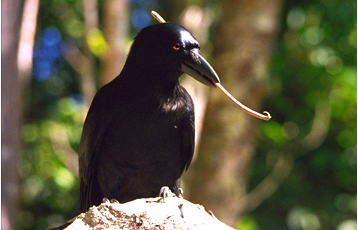
New Caledonian crow. Credit: University of Auckland

It shows that New Caledonian crows are capable of a cognitive feat previously only thought to be doable by human beings – the ability to reason about a hidden causal agent (in this case someone behind a sheet). Inference, in other words.

ResearchBlogging.org
As the (open access/free) paper explains in its opening sentences:
The ability to make inferences about hidden causal mechanisms underpins scientific and religious thought. It also facilitates the understanding of social interactions and the production of sophisticated tool-using behaviors. However, although animals can reason about the outcomes of accidental interventions, only humans have been shown to make inferences about hidden causal mechanisms."
Alex Taylor of the University of Auckland’s School of Psychology (hooray NZ!) and colleagues have shown, however, that we’re NOT the only creatures capable of doing it.

They took eight Caledonian crows – very clever birds, admittedly, who’ve previously been shown to be capable of making and using tools – and showed two series of events. Before the events, the crows had been given some experience with extracting food from a box using a tool.

Both events involved a sheet, and a stick which moved.

The first set of events: the Hidden Causal Agent (HCA)

In the first set of events, the crows were able to watch as a person (of the human sort) walked behind a blue sheet that was hanging up near to a box containing food. The box had been set up so that the crows had to turn their heads away from watching the sheet in order to get their food out.

Once the human had walked behind the sheet, the crows saw the stick poking out from behind it move, making motions towards the food box, and then they saw the human leave again.  ’Meh’, one could imagine the crows thinking, ‘makes total sense. Fudz om nom nom.’

And that’s what they did – they came down to the food box, picked up a tool and extracted their food, giving nary a glance towards the sheet.

Ah, yes. There was also a second person who came into the room with the first, stood in the corner 1.5m from the sheet with closed eyes and hands held crossed in front of their body. This second person did nothing, and then left with the first person.

The second event: the Unknown Causal Agent (UCA)

In the second set of events, they saw the stick move in the same way without someone walking behind, or walking away from, the sheet. A ghost stick!*

As in the first event, there was also a second person who did nothing at all and then left.


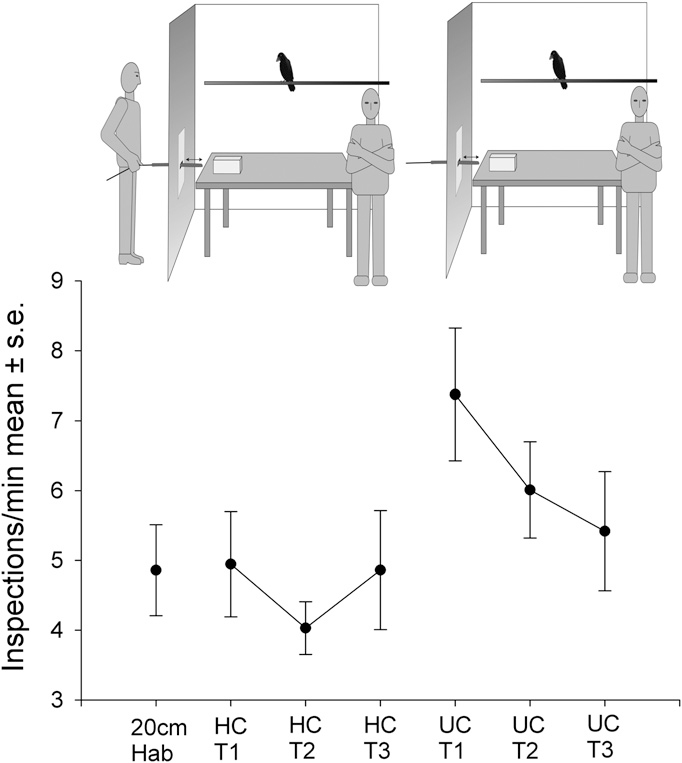
Inspection rate across conditions. Final habituation trial before testing is indicated by 20cm hab. (Upper Left ) Diagram of the HCA condition. (Upper Right) Diagram of the UCA condition. In the HCA condition, one human walked into the hide and one stood in the corner of the room. A wooden stick was then probed from the hide. The agent then exited the hide. Both humans then left the room. In the UCA condition, one human entered the cage and stood in the corner. The tool was then probed through the hole. The human then left. (Taylor, A.H. et al, 2012)

And so?
The experiment had been designed so that this stick stimulus would be a new experience for the crows, and so probably something they’d intrinsically distrust (or not like, at the very least)**.

Read the whole article. And here is another one from Wired.

Whodunit? Crows Ask That Question, Too

A New Caledonian crow uses a twig tool. Image: Mick Sibley

By Virginia Morell, ScienceNOW

Imagine hearing a distant roll of thunder and wondering what caused it. Even asking that question is a sign that you, like all humans, can perform a type of sophisticated thinking known as “causal reasoning”—inferring that mechanisms you can’t see may be responsible for something. But humans aren’t alone in this ability: New Caledonian crows can also reason about hidden mechanisms, or “causal agents,” a team of scientists report Sept. 17 in the Proceedings of the National Academy of Sciences. It’s the first time that this cognitive ability has been experimentally demonstrated in a species other than humans, and the method may help scientists understand how this type of reasoning evolved, the researchers say.


Causal reasoning is “one of the most powerful human abilities,” says Alison Gopnik, a psychologist at the University of California, Berkeley, who was not involved in the study. “It’s at the root of our understanding of the world and one another.” Indeed, it is the key mental ability for many things humans do, including inventing, making, and using tools. We develop this ability early in life: A 2007 study in Developmental Psychology reported that human infants as young as 7 months old understand that when a beanbag is tossed from behind a screen, something or someone must have thrown it. The infants infer that a “causal agent” must be involved in the motion of the flying beanbag.

But why should this ability be limited to humans? “It seems like it would make good sense for crows and many other animals to be able to distinguish between the wind rustling tree limbs and an unseen animal crashing through the canopy,” says Alex Taylor, an evolutionary psychologist at the University of Auckland in New Zealand and the lead author of the new study. Because New Caledonian crows are also inventive and skillful tool-users, Taylor and his colleagues thought the birds might have causal reasoning skills similar to those of humans.

Working on Mare Island in New Caledonia, the scientists captured eight wild crows (five adults and three juveniles) and housed them inside a large outdoor aviary. Over the next few days, the birds used a slender stick to extract food from a small box placed on a table in the aviary. Then the plot thickened: The scientists placed the food box close to a blue tarp large enough for a person to hide behind. The researchers also set up a large stick that could be poked through the tarp and waved around by a human outside the aviary pulling on a string; the moving stick posed a danger to the birds if they tried to extract the food.

The crows in the aviary then observed two different situations. In one, the “hidden causal agent” scenario, the crows saw a human enter the blind. Then, a few moments later, the stick poked through the tarp and moved back and forth 15 times. The human then exited the blind. In the “unknown causal agent” scenario, the crows saw only the stick as it emerged from the tarp and moved back and forth 15 times.

In both situations, a human also stood next to the table in the aviary, so the crows never tried to get the food. And in both cases, when the visible human left, the crows began to remove their food from the box. Yet the crows’ behavior differed depending on whether they had seen a human come and go from the blind. If the birds had seen a human stepping out of the blind, they seldom gave the stick so much as a glance as they dug out their food. But the crows that saw the stick move but no one emerge from the blind were nervous: They often stopped probing for food and studied the blue tarp and stick—apparently suspecting that someone or something unknown had caused the stick to move and that it might move again. Some even flew away from the setup.

Together, the tests show that the crows are “capable of causal reasoning,” Taylor says. “We expected the crows to initially be scared of the moving stick. Instead, they only became scared when they could not attribute the movement to a hidden human—which suggests the crows were reasoning that the stick’s movement was caused by that human.” The crows, he says, apparently don’t expect an inanimate object to move on its own, just as infants don’t expect beanbags to be tossed through the air by a toy block.

“It’s an extremely clever study,” says John Marzluff, a wildlife biologist at the University of Washington, Seattle. “Using a controlled experiment, they’ve validated what many crow hunters know—that crows keep track of hunters in blinds. Even if the crows [in this study] never see a person push the stick, they connect the dots between the location of a person and the actions they associate with people.”

The study “makes important new advances in our understanding of the extent to which nonhuman animals may be capable of causal reasoning and offers the potential to open this whole area up to scientific inquiry in animals,” adds Nicola Clayton, an experimental psychologist at the University of Cambridge in the United Kingdom. Because it suggests that causal reasoning evolved in parallel in humans and crows, the work may even “help solve the fascinating question of just how and why our human intelligence evolved,” Gopnik says.

This story provided by ScienceNOW, the daily online news service of the journal Science.

Monday, June 25, 2012

What I'm Reading, Part Two: Causal Pluralism


Somehow, while I was down the complex adaptive systems rabbit hole, I stumbled across another new term, causal pluralism. A quick and easy definition comes from Peter Godfrey-Smith (Harvard University):
Causal pluralism is the view that causation is not a single kind of relation or connection between things in the world. Instead, the apparently simple and univocal term "cause" is seen as masking an underlying diversity.
Leen De Vreese (Centre for Logic and Philosophy of Science; Ghent University, Belgium) argues that the field is still relatively new (as of early 2007), but the term “causal pluralism” already has accrued a variety of meanings, which he feels leads to confusion. In his paper, Disentangling Causal Pluralism, he tries to sort the threads of pluralistic approaches to causation and to identify the different perspectives held by their adherents.

I wonder if he sees the irony in trying to identify the individual ideas and perspectives that constitute the pluralist origins of causal pluralism?
Full Citation:
De Vreese, L, Weber, E. (2008). Disentangling Causal Pluralism. Robrecht Vanderbeeken, (ed.), Worldviews, Science, and Us: Studies of Analytical Metaphysics. A Selection of Topics From a Methodological Perspective. Singapore: World Scientific Publishing Company.
De Vreese identifies three basic kinds of causal pluralism:
  • conceptual causal pluralism
  • metaphysical causal pluralism
  • epistemological-methodological causal pluralism
Each of these positions has an opposite stance in the monistic causation camp.

However, his primary agenda in the paper is to reduce the (perceived) confusion in the field of causal
pluralism by identifying the perspectives being taken in relation to metaphysical causal pluralism. In essence, are there metaphysical reasons to accept causal pluralism, or is causal pluralism only a conceptual matter

He proposes three "central metaphysical questions" about causation to achieve this goal.
  • Firstly, is causation a realistic notion, or is it a mental construct? 
  • Secondly, does causation only occur as a real relation at the fundamental level of reality, or does it also occur as a real relation between objects at higher levels of reality? 
  • And lastly, does causation consist in a single empirical relation, or does it consist in diverse empirical relations deserving the label “causal”?
In answering these questions, he proposes four types of metaphysical perspectives regarding causation:
  • metaphysical causal constructivism
  • strong metaphysical causal pluralism
  • weak metaphysical causal pluralism 
  • metaphysical causal monism
He concludes his paper by making a clear distinction between conceptual and metaphysical causal pluralism from a third variation on causal pluralism, which he terms "epistemological-methodological causal pluralism." He is referring to "the importance of a pluralistic view on causation for our scientific knowledge in general on the one hand, and for assembling causal knowledge in specific domains of science on the other hand."

While he maintains that an epistemological-methodological approach to causation is still intimately related to conceptual and metaphysical causal pluralism, he feels it's still important to value this line of approach as different from the others, maintaining that "certain questions become utterly important for the sake of our knowledge."

That is one view of causal pluralism, but there are as many variations as there are authors, or at least that is how it seems to a new reader in the field.

In an article more specifically relevant to my work, Julian Reiss (Erasmus University Rotterdam, the Netherlands) published Causation in the Social Sciences: Evidence, Inference, and Purpose in Philosophy of the Social Sciences (2009).
Full Citation:
Reiss, J. (2009, Mar). Causation in the Social Sciences: Evidence, Inference, and Purpose. Philosophy of the Social Sciences, Volume 39(1); 20-40. doi: 10.1177/0048393108328150
Abstract:
All univocal analyses of causation face counterexamples. An attractive response to this situation is to become a pluralist about causal relationships. “Causal pluralism” is itself, however, a pluralistic notion. In this article, I argue in favor of pluralism about concepts of cause in the social sciences. The article will show that evidence for, inference from, and the purpose of causal claims are very closely linked.
This is definitely worth the read.

In an oft-cited paper, Christopher Hitchcock's Of Humean Bondage, he offers a classification scheme for the various forms of causal pluralism. He clarifies up front that he is interested in a pluralism of causation, not a pluralism of causes (which he claims all philosophers already accept). This paper relies more on classical logic arguments in assigning causation, but it is still useful.

Finally, Cognitive Psychology (2010) published Causal–explanatory pluralism: How intentions, functions, and mechanisms influence causal ascriptions by Tania Lombrozo, for which this is the abstract:
Both philosophers and psychologists have argued for the existence of distinct kinds of explanations, including teleological explanations that cite functions or goals, and mechanistic explanations that cite causal mechanisms. Theories of causation, in contrast, have generally been unitary, with dominant theories focusing either on counterfactual dependence or on physical connections. This paper argues that both approaches to causation are psychologically real, with different modes of explanation promoting judgments more or less consistent with each approach. Two sets of experiments isolate the contributions of counterfactual dependence and physical connections in causal ascriptions involving events with people, artifacts, or biological traits, and manipulate whether the events are construed teleologically or mechanistically. The findings suggest that when events are construed teleologically, causal ascriptions are sensitive to counterfactual dependence and relatively insensitive to the presence of physical connections, but when events are construed mechanistically, causal ascriptions are sensitive to both counterfactual dependence and physical connections. The conclusion introduces an account of causation, an ‘‘exportable dependence theory,” that provides a way to understand the contributions of physical connections and teleology in terms of the functions of causal ascriptions.
It's probably indicative of my geekiness that I am looking forward to reading this one.


Here are a few other papers, all of which are freely available online.