Showing posts with label chimps. Show all posts

Monday, September 30, 2013

Virginia Morell - Mournful Creatures (Animals and Grief)


From the current issue of Lapham's Quarterly, Virgina Morell has written an excellent, captivating, and extensive article on the experience of grief among animals, human and (mostly) otherwise. Brilliant writing and content that reminds me we are simply one animal among many, and little about our experience of life is unique.

Morell mentions two recent books in this section of the article: How Animals Grieve, by anthropologist Barbara J. King, and The Bonobo and the Atheist: In Search of Humanism Among the Primates, by primatologist Frans de Waal. Of the two, de Waal is the author I would most trust to get this topic correct.

~ Virginia Morell, a contributor to National Geographic, Science, and Smithsonian, is the author of the books Ancestral Passions: The Leakey Family and the Quest for Humankind's Beginnings (1996) and Blue Nile: Ethiopia's River of Magic and Mystery (2002). Her most recent book is Animal Wise: The Thoughts and Emotions of Our Fellow Creatures (2013). She blogs at Animal Wise at Psychology Today.

Mournful Creatures


Virginia Morell | Lapham's Quarterly


Animals have a great advantage over man: they never hear the clock strike, however intelligent they may be; they die without any idea of death; they have no theologians to instruct them…Their last moments are not disturbed by unwelcome and often objectionable ceremonies; it costs them nothing to be buried; no one starts lawsuits over their wills. — Voltaire

Who can say what cows feel, when they surround and stare intently on a dying or dead companion? — Charles Darwin

It is often said that our understanding and knowledge of death separates the human animal from all other animals. We alone know that we will die—that one day, suddenly or slowly, our life, our loves, our dreams will end. Surely this awareness sets us apart from the rest of the animal kingdom, we say, pointing to some of our greatest art, music, and literature—all inspired by what we know: that death awaits every living being. And yet, how very odd it is that we should be the only animal to know what life ultimately has in store for us. We share biological histories and physiologies DNA, eyes, muscles, nerves, neurons, hormones—with other animals, and these may lead to similar behaviors, thought processes, and emotions—even about death.

Take the case of Thomas, a nine-year-old chimpanzee who died in 2010 at the Chimfunshi Wildlife Orphanage Trust in Zambia, home to more than one hundred chimps. Research scientists filmed the reactions of one community of forty-three chimpanzees to Thomas’ corpse; thirty-eight of them gathered around and stayed by his side for almost twenty minutes. During that time, some of the chimps gently touched his body, smelled and studied him closely. One of those visitors was Masya, a mother carrying her dead infant (at the time, there was an outbreak of a respiratory illness among the chimps). A few days earlier, Masya had been seen placing her dead child in a grassy, sunlit patch and retreating to the shade, where she sat watching, her eyes rarely straying from her infant. Every few minutes, she strode back to the clearing to inspect her baby’s body. At times she did so hurriedly, jumping up and rushing forward as if she thought she’d detected a stirring. She studied her child’s face intently, peered into her gaping mouth and wide eyes, and brushed away the flies. Finally, she placed her knuckles softly against her infant’s neck—hoping, it seems, for any sign of life.

The chimpanzees gathered at Thomas’ side also appeared to be trying to come to grips with what had happened. One female smacked his body, hard—while the others paid close attention, looking, perhaps, for a reaction. Their faces were serious, their manner subdued. One adult male appeared even more distraught than the others; the researchers say this chimp had cared for Thomas for over four years and “had a very strong social relationship” with the dead chimp. He left and returned several times to view the body, as if unable to believe what he was seeing. Finally, he stepped between the others to get as close as possible. He scrutinized the body and erupted in frantic screams while walking rapidly over the cadaver.

Was this a chimpanzee wail of grief? Had the male friend and other chimpanzees come together to mourn Thomas? The scientists who recorded these events prefer not to use such words. Yet the chimpanzees’ behaviors—which mirror many of our own when we lose a loved one—suggest that, like us, they have trouble accepting death when it comes to one of their own. As with most emotions in animals, we do not yet understand their reactions with total clarity—but, as Charles Darwin wisely observed, they may very well have meaning. Perhaps we are the only animals with foreknowledge of death, but when it comes to grieving, we are not so unique.

The study of animal grief is a young field, largely because studies of any animal behaviors that one might think of as “human” were ignored for much of the twentieth century. It was commonly held that nonhuman animals were only reactive beings, lacking thoughts and emotions, and responding to stimuli as unthinking, unfeeling robots. Scientists were cautioned about being anthropomorphic, that is, regarding animals as they are often depicted in naive films and storybooks—as if they were people dressed up in fur or feathers. Researchers who thought they detected animal emotions—especially those that we think of as uniquely human, such as love, joy, or grief—were considered to be sentimentalists. And their reports (such as Darwin’s about the grieving cows) were dismissed as anecdotal.

In the last few decades, though, wildlife biologists have amassed so many firsthand accounts of animals caring for and mourning their dead that the idea of animal grief is no longer as suspect as it once was. Two recent books, both published in March of this year, explore the subject. How Animals Grieve, by anthropologist Barbara J. King, collects anecdotal and scientific data on grief in many kinds of animals, even some that most researchers ignore, such as rabbits, goats, and turtles. In The Bonobo and the Atheist: In Search of Humanism Among the Primates, primatologist Frans de Waal examines the biological roots of religion and morality. Since our awareness of death is often cited as the reason we developed religion, de Waal investigates whether other animals have a similar sense of their ultimate end. While King doubts that even our close chimpanzee relatives are “aware that death is coming,” de Waal suggests that older apes or elephants may have experienced enough of life to comprehend that they, too, will die. “When an old ape notices that trees are harder and harder to get into or an elephant has ever more trouble keeping up with the herd, might these individuals not apply what they have learned about life and death to their own bodies?” de Waal asks. “It’s hard to know, yet impossible to rule out.”

Scientists grappling with animal grief must find some way of framing their questions into hypotheses they can test. So far, none of them have figured out how to set up an experiment to address de Waal’s question. But they are getting closer to answering what once seemed an equally daunting problem: why do animals grieve? As King points out in her book, there are enough examples of grief in species as varied as goats, baboons, and gorillas that the emotion may be an experience shared by many species. If so, then it must have an evolutionary history and confer some benefit—that is, it must be advantageous in some way, enabling the mourner to survive long enough to reproduce and pass his or her genes to the next generation. Otherwise, natural selection would have weeded out grief long ago.

From a study of twenty-two wild-baboon females who had lost either an infant or other close relative to a predator, scientists know that the animals’ stress hormones flare for four weeks after the attack. They typically act in a “bereaved” manner, too, the researchers say, sitting apart from other baboons and not seeking out grooming (a behavior that has both social and hygienic benefits). In time, the baboons’ stress hormones subside, and they again spend time with their fellows. At first glance, it would seem that grieving would leave baboons—or other mourning animals—at great risk of either falling ill or being taken by a predator themselves. But another study, by neuroscientists Karen Wager-Smith and Athina Markou, which King discusses at length, suggests that the mourning period is actually a neurobiological necessity, particularly for any animal that forms close bonds with another individual. The researchers note that stress can inflict “microdamage” in key areas of the brain, such as the hippocampus and prefrontal cortex, both of which are concerned with memory, emotions, personality, and planning. But the brain is not a static organ; it responds dynamically to life’s events by pruning away neurons that are no longer needed and sprouting new ones. Rewiring takes time and energy, and so a period of mourning—of sleeping longer, minimizing social contact, eating less—can ultimately prove beneficial. And, indeed, all of the baboons eventually recovered from their grief, made new friends, or gave birth to new children. Grief for them can have an “adaptive value,” as evolutionary biologists are fond of saying; it enables an animal to recover from what is essentially minor brain trauma and carry on with the purpose of life—reproducing.

But discerning whatever adaptive value or evolutionary benefit grief might confer doesn’t answer another important question: how do animals experience grief? Is it at all like the sorrow we feel when a loved one dies? Can it be so all-consuming that one never recovers?

Apparently so. How else to explain the behavior of Flint, a male chimpanzee whom Jane Goodall observed at Gombe Stream National Park in Tanzania for the eight and a half years of his short life. Flint could not express in words what he felt about his mother’s death, but no one could misinterpret his actions. Flint’s mother, Flo, was in her early forties when she gave birth to her son. That’s close to old age for chimpanzees, and it may explain why Flo wasn’t the strict mother she’d been to her younger children. For whatever reason, she let Flint do whatever he pleased, nursing at her breast long past the age (four or so) when he should have been weaned, and riding on his old mother’s back until he was eight, an age when he should have been walking everywhere on his own. The pair was inseparable, and then Flo died.

“It seemed,” Goodall wrote in Through a Window, a memoir of her thirty years of chimpanzee research at Gombe, “that [Flint] had no will to survive without her Never shall I forget watching as, three days after Flo’s death, Flint climbed slowly into a tall tree near the stream [where she had died]. He walked along one of the branches, then stopped and stood motionless, staring down at an empty nest. After about two minutes he turned away and, with the movements of an old man, climbed down, walked a few steps, then lay, wide eyes staring ahead. The nest was one which he and Flo had shared a short while before Flo died.”

Flint never recovered from his loss. He grew lethargic, refused food that the researchers set out for him, and fell sick. The last time Goodall saw him alive, he was “hollow-eyed, gaunt, and utterly depressed, huddled in the vegetation close to where Flo had died…The last short journey he made, pausing to rest every few feet, was to the very place where Flo’s body had lain. There he stayed for several hours, sometimes staring and staring into the water. He struggled on a little farther, then curled up—and never moved again.”

Flint’s response was entirely maladaptive. It did not help one whit in terms of fitness; he never reproduced, his genes were not passed to the next generation. So profound was Flint’s love for his mother and his sorrow at her death that he simply gave up the will to live.
Read the whole captivating and lengthy article.

Wednesday, June 26, 2013

Gary Marcus - Neurology: The Search for What Makes Us Unique

Gary Marcus is a professor of psychology at NYU and best known, in addition to his writing in The New Yorker, The New York Times, Discover, and other magazines, for his book, Kluge: The Haphazard Evolution of The Human Mind.

In this article from the first issue of Nautilus Magazine - Marcus looks at what makes us unique as human beings. In the end, he concludes, we are only a few evolutionary tweaks (language, biology, genetics) away from being chimpanzees, which is not a bad thing at all, in my opinion.


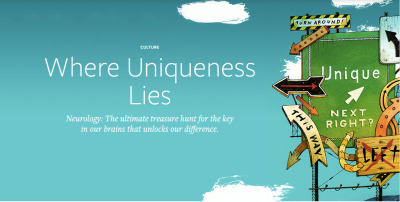
Where Uniqueness Lies

BY GARY MARCUS
ILLUSTRATION BY JOHN HENDRIX

If you dropped a dozen human toddlers on a beautiful Polynesian island with shelter and enough to eat, but no computers, no cell phones, and no metal tools, would they grow up to be like humans we recognize or like other primates? Would they invent language? Without the magic sauce of culture and technology, would humans be that different from chimpanzees?

Nobody knows. (Ethics bars the toddler test.) Since the early 1970s, scientists across the biological sciences keep stumbling on the same hint over and over again: we’re different but not nearly as different as we thought. Neuroscientists, geneticists, and anthropologists have all given the question of human uniqueness a go, seeking special brain regions, unique genes, and human-specific behaviors, and, instead, finding more evidence for common threads across species.

This year President Obama pledged $100 million to the Brain Research through Advancing Innovative Neurotechnologies (BRAIN) Initiative, and the European Commission committed one billion euros ($1.29 billion) to the Human Brain Project. The ambitious projects aim to map the circuitry and functions of the brain, and may help us better understand what makes us human. But so far science has found only the tiniest clues.

As someone who has studied language, cognitive neuroscience, and human evolution, I say that with a tinge of chagrin; my professional career has been about trying to understand the origins and development of the human mind. My colleagues and I are all still struggling to find the answers. Why has pinpointing the origins of human uniqueness proven so difficult?

In the old days, the main hypotheses were behavioral. “Humans are the only animals to use tools.” “Humans are the only animals to have culture.” “Humans are the only animals to teach their young.” But over time most of those guesses have turned out to be wrong. It’s become even more mysterious because almost everything we have found points in the opposite direction, toward what biologists call conservation—evolution’s tendency to use many of the same genes, neurotransmitters, and brain circuits, over and over again.

Consider, for example, the overall anatomy of the brain. As many people know, the human brain is divided into two hemispheres, left and right. Same for the chimpanzee. How about division into frontal, temporal, parietal, and occipital lobes? Yep, chimpanzees have that too. And so, for that matter, do horses, cats, and squirrels. The basic organization of the brain is something we share with all mammals. Could it be that which distinguishes us is the six-layer sheet that defines the wrinkly outer portion of the brain called the neocortex? Nope, chimps (and other mammals) have that too. How about Broca’s area, the part of the brain most associated with language? This, too, has a counterpart in the chimpanzee brain. Meanwhile, the organization of the human brain turns out to be far more complex than many anticipated; almost anything you might have read about brain organization a couple decades ago turns out to be radically oversimplified. Broca’s area, for instance, participates in language, just as everybody imagined, but it’s also used for muscle control, music, and perhaps even imitation. In fact, lots of other parts of the brain, like the prefrontal cortex and even the cerebellum play important roles in language. Language isn’t something that resides in a tiny, well-defined corner of the brain, but something distributed across a great deal of the brain.

To add to the challenge, brain regions don’t wear name tags (“Hello, I am Broca”), and instead their nature and boundaries must be deduced based on a host of factors such as physical landmarks (such as the hills and valleys of folded cortical tissue), the shapes of their neurons, and the ways in which they respond to different chemical stains. Even with the most advanced technologies, it’s a tough business, sort of like trying to tell whether you are in Baltimore or Philadelphia by looking out the window of a moving train. Because the two cities were built out of similar raw materials over a similar time period, many of their parts look superficially similar. All of the neocortex (the part of the brain that only mammals have) is a six-layered sheet, so different areas of the outer brain (which makes up most of the brain’s volume) wind up looking more similar than different. Even under a microscope human brain tissue looks an awful lot like primate brain tissue. We have gone from expecting (but not finding) human-specific brain regions to searching for second-order differences. We ask questions like, “Might there be a greater degree of asymmetry between the left hemisphere and right hemisphere in human beings than chimpanzees in a part of the brain known as the planum temporale?” That’s sort of like saying that New York is different from Paris because we have more water towers on the roof. It might be true, but it’s not really getting at why the two cities feel so different.

When we look at our genomes, the situation is no different. Back in the early 1970s, Mary-Claire King discovered that if you compared human and chimpanzee DNA, they were so similar that they must have been nearly identical to begin with. Now that our genomes have actually been sequenced, we know that King, who worked without the benefit of modern genomic equipment, was essentially right. Nearly every gene in the human genome has a counterpart in the chimpanzee genome, and vice versa. Even one look at the individual letters (nucleotides) reveals that our genomes are shockingly similar. Virtually every gene in our genomes—from genes for dopamine and serotonin to genes like BDNF and COMT that contribute to memory control—has a counterpart in the chimpanzee genome. And that’s true even for the gene FOXP2, that has been decisively linked to human language. Of the 715 amino acids that correspond to the part of the FOXP2 gene that codes for a protein, only two differ between human and chimpanzee versions. As of early 2013, we still don’t know which genes are vital to making us differ from chimpanzees. But we do know that genetically we are far more similar than different.

Why, if our lives are so different, is our biology so similar? The first part of the answer is obvious: human beings and chimpanzees diverged from a common ancestor only 4 to 7 million years ago. Every bit of long evolutionary history before then—150 million previous years or so as mammals, a few billion as single-celled organisms—is shared. Seven million years is fairly short by the yardstick of evolutionary change.

The second part of the answer develops from the first, and lies in the dynamics of how evolutionary change works. In principle, when an engineer builds something new, he or she has the luxury of starting from scratch, perhaps substituting a new material, like steel, for an older material, like wood, or replacing a gasoline-powered engine with an electric one—wholesale changes that can lead to radical improvements.

Evolution never has that luxury. It can’t simply take a species offline while it waits to release Humans 2.0. Instead, each new development builds on top of ancestral forms; in the immortal words of the great biologist François Jacob, evolution is like “a tinkerer who does not know exactly what he is going to produce but uses whatever he finds around him whether it be pieces of string, fragments of wood, or old cardboards; in short it works like a tinkerer who uses everything at his disposal to produce some kind of workable object.” A human brain is a primate brain, tweaked. Not something wholly new, developed from scratch to fit the needs of our particular lifestyle.

In short, humans may live very differently than chimpanzees, but the structural plans of our biology necessarily can represent only modest tinkerings to the genetic material that we inherited from our last common ancestors. Language, regardless of how it is instantiated in our brain, represents a comparatively tiny cognitive enhancement relative to the mental machinery we inherited from our last common ancestor. The same is true for the underlying biology of each of our cognitive innovations.

If it seems like scientists trying to find the basis of human uniqueness in the brain are looking for a neural needle in a haystack, it’s because they are. Whatever makes us different is built on the bedrock of a billion years of common ancestry. Humans will never abandon the quest to prove that they are special. But nor can we escape the fact that our minds are a modest tweak on an ancient plan that originated millions of years before we came onto the scene.

~ Gary Marcus is a professor of psychology at NYU. His books include Guitar Zero and Kluge: The Haphazard Evolution of The Human Mind. His essays have appeared in Wired, Discover, The Wall Street Journal, and The New York Times. He blogs on science for The New Yorker.

Wednesday, April 18, 2012

PLoS Blogs - Should Chimpanzees Have Moral Standing? An Interview with Frans de Waal

A week ago I posted a TED Talk by Frans de Waal - Moral Behavior in Animals - in which he discussed the higher morality of animals. In this interview with de Waal from PLoS Blogs, he argues that chimps should not be subject to any experiments that we do not run on humans. He also published an article in PLoS Biology,Research Chimpanzees May Get a Break,” in which he evaluated a recent Institute of Medicine report, commissioned by the National Institutes of Health to evaluate the scientific need for using chimpanzees in biomedical research.

Should Chimpanzees Have Moral Standing? An Interview with Frans de Waal


Frans de Waal (Photo: Catherine Marin)

Whether from hubris or insecurity, humans like to view our species as the crown of creation, beings beyond compare in the animal kingdom, as if our advanced cognitive and behavioral skills appeared de novo with the emergence of the Homo lineage. Few have done more to demonstrate the folly of such an anthropocentric view than Frans de Waal.

For nearly 40 years, de Waal has studied the evolutionary origins of social intelligence in primates, from capuchin monkeys to chimpanzees, eviscerating the notion that only humans are capable of empathy, emotions, altruism, and morality, and of transmitting social mores and culture. Likewise, he argues, we can’t blame nature “red in tooth and claw” for our history of violence, warfare, and male dominance.

A lifelong student of animal behavior, de Waal is C.H. Candler Professor of Psychology and director of the Living Links Center for the Advanced Study of Ape and Human Evolution at the Yerkes National Primate Research Center at Emory University. He started studying chimpanzees in 1975, and was the first to show that chimpanzees engage in coalition “politics” and practice reconciliation and conflict resolution. De Waal has explored the evidence and implications of other species’ cognitive capacities in nine books, including The Age of Empathy, which incorporates his most recent work on the evolutionary origins of morality, empathy, and emotions.

In a new article published in PLoS Biology,Research Chimpanzees May Get a Break,” de Waal considers a recent Institute of Medicine report, commissioned by the National Institutes of Health to evaluate the scientific need for using chimpanzees in biomedical research. Given what we know about the cognitive, social, emotional, and cultural attributes of chimpanzees, de Waal argues, the question is fundamentally an ethical one. And for de Waal, the answer is clear: the sort of experiments that can ethically be done on human volunteers are okay to do on chimpanzees.

I spoke with him in Vancouver at AAAS, the annual meeting of the American Association for the Advancement of Science, after his plenary talk, “Good Natured: From Primate Social Instincts to Morality.”

Gross: Your research has repeatedly drawn parallels between nonhuman primate and human cognition and behavior. In explaining your research focus, you’ve said, “For me, there is nothing more logical than to look at human society through the lens of animal behavior.” What can animal behavior tell us about human behavior?

De Waal: I’ve always looked at humans as animals and I’ve always looked at animals as having emotions and so on, and sharing cognition with humans. So for me it’s really not a contradiction. People often say, “Well, we are not animals.” That’s not something that a biologist understands actually. If we’re not animals what are we? We’re certainly not plants.

Gross: What would you say to those who argue that there are huge gaps in cognition between monkeys and apes and humans?

De Waal: Over the years the dividing line between humans, certainly between humans and the apes, has sort of become fuzzy under the influence of field work, such as the work by Jane Goodall, Toshisada Nishida, and others, and under the influence of experimental work on cognition, which has shown all sorts of capacities that we had not suspected in the apes.

Also, neuroscience has not really helped maintain the dividing line because the brain of a human doesn’t contain any parts that the brain of an ape doesn’t have. The human brain is much bigger than, let’s say, the chimpanzee brain. It’s three times bigger. But there’s nothing in there as far as we can tell that is not in a chimpanzee brain. At the microscopic level there are a few differences and they’re probably interesting, but you would think if humans are so dramatically different, as different as the philosophers have often assumed, that you would find something in the human brain that is absolutely unique and that you would say, “Well, there’s a part there that no one else has,” but we have never found it.

Gross: What are some of the seminal experiments that revealed similarities in cognitive or behavioral traits between apes and humans, suggesting we’re not in fact unique, as many like to think?

De Waal: There are many. For example, tool use used to be considered uniquely human. And then when it was found in captivity by Köhler, this is in the 1920s, people would say, “Well, but at least in the wild they never do it.” And then it was found in the wild, and then they would say, “Well, at least they don’t make tools.” And then it was found that they actually also make tools.

So tool use was one of those dividing lines. Mirror self-recognition is a key experiment that was first conducted on the apes. The language experiments, even though we now doubt what the apes do is actually what we would call “language,” they certainly put a dent in that whole claim that symbolic communication is uniquely human.

My own studies on, let’s call it “politics,” and reconciliation behavior and pro-social behavior have put a dent in things. And so I think over the years every postulate of difference between humans and apes has been at least questioned, if not knocked over. As a result, we are now in a situation that most of the differences are considered gradual rather than qualitative.

And the same is true, let’s say, between a chimp and a monkey. There are many differences between chimps and monkeys in cognitive capacities, but we consider them mostly gradual differences.

The more we look at it, even if you take the difference between, let’s say, a human and a snake or a fish, yes, between those species the differences are very radical and huge, but even these species rely on some of the learning processes and reactions that we also know of in humans.

Gross: In your PLoS Biology commentary, you note that the Institute of Medicine committee lacked expertise in key areas. What was the biggest oversight, in your opinion?

De Waal: The NIH made the curious request that ethics was going to be kept out of the discussion, which is strange since the whole reason we are discussing chimpanzees and not rats or mice is the ethical issue of why would we use the chimpanzee, which is a close [human] relative and shows so many emotions and cognitions that humans have as well. Is it justified to use chimpanzees?

To try to keep the ethics question out was, I think, a misjudgment on the part of NIH. But the IOM then put a bioethicist in charge so their response was more or less we cannot keep ethics out, let’s talk about it.

The report is very interesting because it was written by people who are not experts in chimpanzees but who listened to many experts, so they had hearings at which we spoke, for example. They were open about that and talked with us, and the resulting report is actually quite balanced.

The report basically argues that except maybe for one exception there is no urgent reason to keep using chimpanzees for biomedical studies. Their main conclusion is that the justification to keep using chimpanzees for this purpose is actually not that strong.

Gross: Yet they’ve left the door open to continue some research.

De Waal: Yes, they have left the door open for prophylactic hepatitis C vaccine testing. Normally that kind of testing would require large numbers because you want statistical power. Now, the NIH owns less than 1,000 chimps, which can certainly not all be used for that kind of testing, so we’re talking about a small sample of a couple of hundred that could potentially be used, which is not sufficient to do anything dramatic. So I don’t see it as a viable option. They have mentioned that that’s the one area in which chimps could still be extremely useful. But I’m not sure we can fill this particular need at this point.

Gross: What if there were sufficient numbers of chimps to provide the appropriate statistical power?

De Waal: Even if we had the numbers I would have questions like, Is this the best use for an animal that we consider ethically problematic to be used, because you’re going to be virally infecting them, which is something that I would want to avoid at this point. Rodent models are coming up very fast, and are likely to take the place of the apes. So even if we had the numbers, I’m questioning whether we should be doing it and whether we haven’t reached the point now in the discussion where we say let’s draw a line and say it’s over as far as chimps are concerned for biomedical research.

Gross: What in your view is the most compelling reason to stop invasive research on chimpanzees?

De Waal: The most compelling reason would be an ethical one. I myself have never done any invasive studies in chimps for exactly that reason. I don’t want to do that kind of thing on the chimpanzee because they are so mentally and psychologically close to us. Most people of my generation and younger who work with this species share this feeling. It’s almost like you’re working with humans, you know, they are very closely related to us.

It’s very easy to extend the moral qualms we would have with experiments on humans to chimpanzees. It’s much easier to extend them to chimpanzees than to, let’s say, rats or mice which are so much more distant from us.

Gross: What criteria should we use to decide what type of research on chimpanzees would be morally acceptable?

De Waal: I think we should keep doing non-invasive studies on chimpanzees, such as behavioral studies or comparative genomics, maybe non-invasive neuroscience. It’s hard to do the same imaging studies as we do on humans at the moment, but it’s going to happen, I think, one day.

For me, non-invasive would be defined as research that I would not mind doing on a human. And it does require a different mindset at NIH and maybe other funding agencies because sometimes if you submit proposals to them that include chimpanzees, they still will argue, “Well, you’re using animals, why don’t you go into the brain and manipulate it this way or that to enhance your study?”

The science community needs to change that mindset and treat chimpanzee studies basically the way they treat human studies. There’s a lot of things we cannot do on humans, and that we will not do on humans, and that will be the situation for chimpanzee research, I think, where we say, “Well, we can do all the same things that we do on humans, but that’s about it.”

Gross: In your commentary, you point out that the United States shares the distinction with Gabon of being the only nations in the world to hold chimpanzees in biomedical facilities. That’s surprising.

De Waal: The movement to remove chimpanzees out of research laboratories started to get teeth about ten years ago. The movement existed probably earlier but at least ten years ago certain countries like Japan and the Netherlands had chimpanzees in labs and said they stopped this kind of research for ethical reasons, it was very explicitly for ethical reasons.

And I think the U.S. is going to join the other countries, maybe not today, maybe not tomorrow, but it will happen because the whole trajectory – and that’s what’s pointed out in the IOM report – is in this direction. And my argument is why not get ahead of that trajectory, and why not do it now rather than wait a couple of years.

Gross: What should be done with chimpanzees that would be retired?

De Waal: There is a bit of a desire on the part of existing facilities to keep the chimpanzees there and turn the facilities into sanctuaries. But actually most existing research facilities are not particularly suited for that, because they were built for research, for shifting chimpanzees around, for having them in small groups so that you could easily work with them. They’re not optimal facilities for keeping them around. Whereas there are certain sanctuaries that have a lot of space, that have forests available for them, and I think that’s the way we should retire them. We should retire them in large social groups and hopefully still in environments in which some limited, non-invasive studies, like behavioral studies, can still be done.

I think the whole retirement issue needs to be rethought. Some money will need to be put into it. This cannot be done on the cheap, and if you look at the Netherlands and Japan, they invested quite large sums of money in the retirement of research chimpanzees.

Gross: You recently wrote a commentary called What Is an Animal Emotion?, a subject that was long considered off limits for study. Why has there been such resistance to studying emotions?

De Waal: The view of emotions in the field of animal behavior has been quite negative under the influence of the behaviorists. Skinner would say that if animals have emotions – he would put “emotions” always in quotation marks because he really didn’t believe in them – but if they have them, they’re largely irrelevant and have nothing to do with behavior.

So the view used to be very negative. And then, of course, with the cognitive revolution human emotions became a major issue. Human emotions were recognized, but the behaviorists kept a taboo on animal emotions.

That is completely changing. Not so much under the influence of behavioral scientists such as myself, even though we do our best, it has changed mostly under the influence of neuroscience. If neuroscientists test fear in humans, they see that it activates the amygdala in the brain, then they take rats and they stimulate the amygdala and they get fear responses, and they say, “Well, if the same part of the brain is involved in the same sort of responses, we should use the same terminology for the two responses so we’re going to call it fear in humans as well as in rats.”

And so the neuroscientists are much less reluctant to talk about fear, aggression, love even, affection – they use all these emotional terms because they see the correspondence between what happens in the monkey brain or the rat brain and the human brain.

As a result, the taboo on animal emotions is crumbling very rapidly and I think the behavioral scientists who are still reluctant, they need to catch up with what is happening. My feeling has always been that it’s very hard to find an emotion that humans have that a chimpanzee cannot have.

I sometimes think of guilt and shame as the only ones that are maybe left. But even for those I could make the argument that they are not as uniquely human as we often think.

But all the rest, definitely, like jealousy and affection and anger, all these kind of emotions, the physiological and behavioral signs are there and increasingly also the neurological signs, so I see no reason to keep that completely separate between human and animal.

Gross: Do you see any applications for our current understanding of this cognition continuum for animals? Are there any policy recommendations aside from the Institute of Medicine report on chimpanzees that you can see coming out of our deeper appreciation of animal capacities in cognition and behavior?

De Waal: I’m not sure that what happened with chimps is going to happen to all species because people don’t worry much about rodents. For example, when we have rodents in the home we try to get rid of them, and so I’m not sure that people are going to apply the same concern that they have for chimps or elephants to other animals.

But I do feel there is a general trend in society, in the public, and scientists need to pay attention to that, of taking animals more seriously than we used to.

And this may also have an effect in the agricultural industry, on how we treat agricultural animals, which is a much larger number than research animals, actually, and so it may have effects everywhere, effects on the ethics of how we treat animals, and this will probably also affect the biomedical community.

It doesn’t mean that we will stop doing what we’re doing but we may start doing it differently. That’s my understanding of the movement, that we will increasingly think twice before we do certain procedures on animals.

Gross: Is there anything else you’d like to say about the IOM report?

De Waal: I found the report to be quite solid. It was well-written and balanced and I was also glad to see that the NIH took it seriously. They immediately put a stop on all the research to reflect on their position. I don’t know what the outcome of their deliberations is going to be, but their reaction was a sign of the times, because society is taking the issue increasingly seriously.

Liza Gross is Senior Science Writer/Editor for PLoS Biology. You can find her on Twitter as @lizabio (views her own!).

Saturday, February 18, 2012

Metanexus - The Evolution of Personality

From Metanexus, this article is adapted from Raymond Neubauer's new book, Evolution and the Emergent Self: The Rise of Complexity and Behavioral Versatility in Nature. Neubauer looks at chimpanzees, dolphins, corvids (mainly ravens and crows), and elephants for the ways that their differing evolutionary histories have produced some similar cognitive and behavioral skills.

The Evolution of Personality

In my book, Evolution and the Emergent Self, I examine four animal groups with high relative brain size (high brain weight in comparison to body weight), and find that they have a variety of qualities in common even though they have very different evolutionary histories and live in different environments: chimpanzees, dolphins, corvids (mainly ravens and crows), and elephants. There is a remarkable convergence of behavior: They all have long-term relationships and complex societies with "politics" in which two or more individuals may form alliances against others. They appear to consider what others are thinking and can form flexible plans of deception. Hunting can involve different roles for different members that are coordinated with each other. They have complex communication with the possibility of understanding syntax in learned instructions.

Each of these species has a long period of juvenile dependency that allows for a slowly maturing nervous system that is capable of flexibility and innovation into the adult years. The variability of learning creates individual differences between members of a species and local cultural differences between groups. There is insight learning that finds quick solutions to novel problems faster than we would expect from trial and error alone.

At one level, we can simply say a more complex nervous system leads to more complex behavior. But I go further and suggest that there is an emergent self that seeks to express itself in more complex communication and social relationships, and values others of its kind more fully as individuals than do species with smaller relative brain size. We see this in long-term relationships, in what looks like mourning at the death of a conspecific, in helping behavior toward non-relatives, and in forming higher order coalitions in society. Evidence of mirror self-recognition in all four groups fits this picture of an emergent self that views itself and others with greater objectivity.

This emergent self also expresses itself in intricate manipulation of its environment. Each species has high dexterity, but the appendage employed varies widely due to their different evolutionary origins, from a hand to a beak, a trunk, or a flipper. What is constant is a large brain that is expressing itself.

This large brain also appears capable of abstraction. Each of these species is skilled at mimicry, and it could be argued that this involves a concept of the other that serves as a model. It suggests that there is a mental representation of some part of the model, such as its voice or movements, that the individual is trying to match. There also appear to be mental representations in tool making. The termite fishing sticks of chimpanzees and the leaf tools of the New Caledonian crows are made to standardized sizes that suggest preset concepts of length and width. They may then be carried long distances where they are just the right dimensions for the task at hand. This suggests a mental representation of both tool form and the goal of its use.

An emergent self sees with greater objectivity, and it can mix and match categories with high flexibility. It can combine tools in novel ways and formulate new alliances in social life. It seems to view itself with greater objectivity, as evidenced by mirror self-recognition. I suggest a physical basis for this greater objectivity in the hierarchical arrangement of circuits in a large brain. We now know that the brain is modular, with specific areas devoted to specific functions like facial recognition or short-term memory. Animals with high brain-body ratios have more modules that can be devoted to functions beyond just physiological control. A hierarchical arrangement of these modules may lead to higher derivatives from the raw data, resulting in higher levels of objectivity.

Brains as well as genes can store information, and I suggest information content may be the defining quality that distinguishes two paradigm strategies of life. Organisms of high information content in genes or brains take longer to develop for the basic reason that complex things take longer to build than simple things. They have versatility of response built into the individual and can deal with a variety of fluctuations in the environment. They have many of the characteristics of species known in ecology as K- selected: small litters with slow development of the young, allowing a long period for learning, and fairly steady population numbers since individuals have a variety of skills to cope with change.

Organisms of lower information content in genes or brains tend to develop more quickly and are known in ecology as r-selected, opportunistic species. There is less parental investment per individual, but more are produced. They have shorter, less flexible programs, and many individuals may be sacrificed to find the combinations best suited to match new conditions. These individuals can quickly take over an environment so that populations go through characteristic “boom and bust” cycles.

Humans rely on an extreme form of a strategy found repeatedly in nature—the accumulation of information to increase the versatility of response to a changing environment. Programs are encoded not only in genes and brains, but in languages, books, and computers. Our current dominance on the planet, both for good and for ill, testifies to the power of information for mastery over nature. In this sense, human culture is not an anomaly, but an extension of K-selected strategies found repeatedly in nature. It might even be suggested that a species like us is inevitable if the evolutionary process is given enough time to run. All of nature is not laboring toward greater complexity because short programs with quick development are an alternative way of dealing with change. But it may not be too far-fetched to suggest that given the right conditions and enough time, a species like us is in the cards, and the seeds of consciousness are planted within the evolutionary process.

Adapted from Evolution and the Emergent Self by Raymond L. Neubauer. Copyright (c) 2012 Columbia University Press. All rights reserved.