Showing posts with label corvids. Show all posts

Monday, April 28, 2014

Ravens Are Aware of Peers' Social Ranks


Another cool study on ravens has been released, this one published at Nature Communications, and it's open access - yay science!

Anyone who has observed ravens knows they are highly social animals. They will often mate for life (with a little polyamory among friends), and they occasionally gather in large groups to share, well, something - the days events, dudes in caveman masks who must be attacked, or good places for food, only the raven knows.

So new research indicates - singularly among birds - that ravens are aware of and remembers the social status of other ravens, even those not in their family or social group.
They found that ravens paid especial attention and seemed stressed -- displaying behaviors like head turns and body shakes -- when they hear playbacks that simulate a rank reversal in their group. They just didn’t expect a low-ranking bird to show off to a higher-ranking one -- this violates their rank relations. They were fine when the dominance structure in the playback reflects their hierarchy accurately.
The ravens also became agitated  in response to simulated rank reversals in neighboring groups, which the researchers assume to mean that ravens know who’s the alpha among unknown birds just by watching and listening to them (since there was no physical contact between groups). This is the first evidence that animals can track social rank of individuals that are not a part of their own group. 

The first article below is a summary from I Fucking Love Science, and the second is the full research article from Nature Communications.

Ravens Keep Track of Others' Ranks

April 24, 2014 | by Janet Fang
I Fucking Love Science


Two ravens nurturing their good relationship by preening each other.
Photo credit: Jorg Massen
Ravens are political animals. They can distinguish different sorts of interactions between other ravens, then alter their behavior accordingly. Like humans and other mammals, ravens not only understand, but also keep track of third party relationships. They’re the first bird known to do so.

In certain social organizations and dominance hierarchies, the key to survival is social intelligence and an understanding of community dynamics. Not only do you need to know who’s nice and who’s not to get by on a daily basis, but for every political maneuver, it’s important to know who will support whom.

To investigate this in these big brained birds, a team led by Jorg Massen from the University of Vienna, Austria, recorded audio files that contain vocal interactions between ravens and played them for a group of 16 captive ravens (Corvus corax).

They found that ravens paid especial attention and seemed stressed -- displaying behaviors like head turns and body shakes -- when they hear playbacks that simulate a rank reversal in their group. They just didn’t expect a low-ranking bird to show off to a higher-ranking one -- this violates their rank relations. They were fine when the dominance structure in the playback reflects their hierarchy accurately.

The ravens also responded to simulated rank reversals in neighboring groups, suggesting that they’ve figured out who’s boss among unknown birds just by watching and listening to them (since there was no physical contact between groups). It’s the first evidence of animals tracking rank relations of individuals that don’t belong to their own group -- a useful skill for a bird switching foraging units.

Last week, we learned about cuckoos using mafia tactics, and here’s another metaphor for you. "When Tony Blundetto made fun about Tony Soprano, as spectators of the show, we immediately recognized that this was inappropriate with regard to the dominance order within the Soprano family,” Massen says in a news release. “We make this inference not by comparing our own rank relation with the two Tony's with each other, but instead we have a mental representation of the rank relation of the two that gets violated in the turn of these events."

The findings suggest that complex cognitive abilities evolved multiple times in species as distantly related as ravens and human, solving similar social issues.

The work was published in Nature Communications this week.
[University of Vienna via Los Angeles Times]
Images: Jorg Massen
* * * * * * * * * *

Full Citation:
Massen, J. J. M. et al. (2014, Apr  22). Ravens notice dominance reversals among conspecifics within and outside their social group. Nat. Commun. 5:3679 doi: 10.1038/ncomms4679 

Ravens notice dominance reversals among conspecifics within and outside their social group

Jorg J. M. Massen, Andrius Pašukonis, Judith Schmidt & Thomas Bugnyar

Abstract


A core feature of social intelligence is the understanding of third-party relations, which has been experimentally demonstrated in primates. Whether other social animals also have this capacity, and whether they can use this capacity flexibly to, for example, also assess the relations of neighbouring conspecifics, remains unknown. Here we show that ravens react differently to playbacks of dominance interactions that either confirm or violate the current rank hierarchy of members in their own social group and of ravens in a neighbouring group. Therefore, ravens understand third-party relations and may deduce those not only via physical interactions but also by observation.

Introduction


The ‘social brain hypothesis’ (SBH)1, 2, 3 attributes the evolution of intelligence to the cognitive demands of social life. In support of the SBH, measures of social complexity and/or competence are found to correlate with neocortex size3 and reproductive success4, 5, 6. Furthermore, the type and quality of social relationships turns out to play a key role in several vertebrate societies, irrespective of group stability and the degree of fission–fusion dynamics7, 8, 9, 10. Species living with long-term pair partners, for instance, tend to have bigger brains than those forming short-term or seasonal relations11, 12. The exceptions are primates, possibly because their social life requires them to deal not only with one but several long-term relationships at a time3. Indeed, primates, not only recognize others as kin, friend or dominant but also understand third-party relationships within these kin-, friendship- and/or dominance networks13, 14, 15, 16, 17. A similar picture has been discussed for spotted hyenas, which live under social conditions comparable to primates18.

Recently, the SBH has been extended to birds19 and used to explain the apparent case of convergent evolution of intelligence in apes and corvids20. However, evidence that birds have an understanding of social dynamics similar to that of mammals is still scarce. For example, although several bird species seem to be capable of transitive inference21, 22, 23, 24, 25 (but see ref. 26), only two species have been experimentally tested for using this capacity to predict their own dominance status compared with that of a stranger27, 28. Note that these inferences are based on recent events, that is, seeing others winning or losing against a known individual, and do not necessary require knowledge about the relationship between the other individuals. The experiments clearly show, however, that the birds readily used the experience they had with one of the combatants from previous encounters. In the studies on primates and hyenas, the classification of relative rank relations also concerned group members they had ample interactions with in daily life28. It thus remains unknown whether non-human animals can deduce social relations such as relative rank between individuals they can observe but not interact with themselves.

As the largest and most widely distributed member of the corvid family, ravens are renowned for their relatively big brains and high behavioural and ecological flexibility29. Their cognitive skills are expressed primarily in the social domain: on one hand, they flexibly switch between group foraging (including active recruitment)30 and individual strategies (like providing no or false information about food, attributing perception and knowledge states about food caches to others)31; on the other hand, they form and maintain affiliate social relations aside from reproduction and engage in primate-like social strategies like support during conflicts32, and reconciliation and consolation after conflicts33. Understanding social relations of others may be key in those behaviours. Ravens also remember former group members and their relationship valence over years34, which might be important for life in non-breeder flocks where some individuals stay together over extended periods of time, whereas others do not35. A consequence of these dynamics is that ravens regularly meet conspecifics of different degrees of familiarity, many of which they have never interacted with before. As dominance rank heavily depends on affiliation status and social support by others35, raven non-breeders are ideal to test for the ability of third-party understanding between birds that regularly interact but also of those that know each other merely by observation. Therefore, here we tested 16 captive common ravens, Corvus corax, on their ability to recognize third-party rank relations of individuals they regularly interact with (group members) and those they do not (neighbouring group) by use of a playback experiment applying an expectancy violation paradigm5.

In this study we show that ravens react differently to playbacks of expected and unexpected dominance interactions of conspecifics. Consequently, ravens seem to understand third-party rank relations. As they do so, both of individuals within their own group as well as of individuals in a neighbouring group, we suggest that ravens are capable of forming representations of others’ relationships that are entirely based on observation of other’s interactions.

Results


Playbacks of group members

The final generalized linear mixed models (GLMM’s) on the delta-scores of in-group playbacks showed that ravens became more stressed and showed more self-directed behaviour when the playback violated their expectancy of rank relations compared with playbacks of expected interaction, since the models revealed a significant effect of treatment (expected versus unexpected) on self-directed behaviour (GLMM: F=7.09, df1=1, df2=57, P=0.010; Fig. 1a) and a similar, yet non-significant trend for ‘stress’ behaviour (GLMM: F=3.93, df1=1, df2=57, P=0.052; Fig. 1b).
Figure 1: Self-directed and ‘stress’ behaviour in response to in-group stimuli.

Mean±s.e.m. difference between playback and baseline (delta: Δ) of (a) self-directed behaviour and (b) ‘Stress’ behaviour, for playbacks simulating expected (purple bars) and unexpected (orange bars) dominance interactions of in-group individuals. For clarity, we added 2 to these means. n=16, GLMM: *P<0.05, #0.05<P<0.10.
In addition, the models showed an interaction effect between the sex of the subject and condition on self-directed behaviour (GLMM: interaction sex × condition: F=5.49, df1=1, df2=57, P=0.023; Fig. 2), suggesting that the main effect of condition is mainly due to the females. Post hoc analyses indeed revealed that females reacted with significantly more self-directed behaviour after an unexpected playback compared with an expected playback (Wilcoxon-signed ranks test: T+=44, n=9, P=0.011), whereas for males this difference was non-significant (Fig. 2). Furthermore, the models showed that compared to baseline, individuals became more active when their expectancy was violated, yet only when it concerned playbacks of their own sex (GLMM: interaction sex−combination × condition: F=6.65, df1=1, df2=57, P=0.013; Fig. 3). Post hoc analyses confirmed that individuals became significantly more active when they heard an unexpected playback compared with an expected playback of their own sex (Wilcoxon-signed ranks test: T+=123, n=16, P=0.004), whereas this difference was non-significant when the playback concerned individuals of the other sex (Fig. 3). Finally, we found significant effects of age on the components activity (GLMM: F=9.401, df1=1, df2=57, P=0.003), attention (GLMM: F=4.34, df1=1, df2=57, P=0.042) and ‘stress’ (GLMM: F=4.71, df1=1, df2=57, P=0.034), indicating that compared to baseline, older individuals reacted with more activity, less interest and more stress to playbacks in general, regardless of their congruence (Supplementary Fig. 1).
Figure 2: Sex differences in self-directed behaviour in response to in-group stimuli.

Mean±s.e.m. difference between playback and baseline (Δ) self-directed behaviour of males (n=7) and females (n=9), for playbacks simulating expected (purple bars) and unexpected (orange bars) dominance interactions of in-group individuals. For clarity, we added 2 to these means. GLMM and post hoc Wilcoxon-signed ranks tests: *P<0.05.
Figure 3: Activity in response to in-group stimuli of the same or of the other sex.

Mean±s.e.m. difference between playback and baseline (Δ) of activity, for playbacks simulating expected (purple bars) and unexpected (orange bars) dominance interactions of in-group individuals of the same sex and of individuals of the different sex. For clarity, we added 2 to these means. n=16, GLMM and post hoc Wilcoxon-signed ranks tests: *P<0.05; **P<0.01.

Playbacks of neighbouring group

Regarding the playbacks of out-group conspecifics, we found no main effect of treatment on the behaviour of the ravens. However, we did find significant interaction effects of the sex of the subject with treatment on vocalization (GLMM: interaction sex−combination × condition: F=4.28, df1=1, df2=57, P=0.043) and on attention: (GLMM: interaction sex−combination × condition: F=4.05, df1=1, df2=57, P=0.049), suggesting that only males respond to violations of rank relations of out-group conspecifics. Compared with baseline, males reduced their vocalizations when the playback violated their expectancy of rank relations significantly more than during playbacks of expected interaction (Wilcoxon-signed ranks test: T+=26, n=7, P=0.043), whereas for females this difference was non-significant (Fig. 4a). Similarly, males tended to reduce their behaviours indicative of showing attention compared with baseline more when the playback was unexpected than when it was expected (Wilcoxon-signed ranks test: T+=24, n=7, P=0.091), whereas for females there was no such trend (Fig. 4b). Finally, we found significant effects of the sex of the playbacked individuals on attention (GLMM: F=10.84, df1=1, df2=57, P=0.002) and self-directed behaviour (GLMM: F=5.23, df1=1, df2=57, P=0.026), suggesting that compared to baseline, individuals reacted with more interest, and less stress release to playbacks of same sex individuals in general, regardless of their congruence (Supplementary Fig. 2).
Figure 4: Vocalizations and close interest behaviour of males and females in response to out-group stimuli.

Mean±s.e.m. difference between playback and baseline (Δ) of (a) vocalizations and (b) close interest behaviour of males (n=7) and females (n=9), for playbacks simulating expected (purple bars) and unexpected (orange bars) dominance interactions of in-group individuals. For clarity, we added 2 to these means. GLMM and post hoc Wilcoxon-signed ranks tests: *P<0.05, #0.05<P<0.10.

Discussion


Our results reveal that ravens show different behaviour after playbacks that simulate a rank reversal in their group in comparison with playbacks that suggest dominance interactions in line with the current dominance hierarchy. These findings demonstrate that ravens, just like primates13, 14, 15, 16, 17, can distinguish these different types of playbacks and thus have some knowledge about the rank relations of their group members. Furthermore, male ravens responded to playbacks violating the dominance relations of their neighbouring group. This is, to our knowledge, the first experimental demonstration that non-human animals may recognize the rank relations of out-group members. Moreover, these findings strongly suggest that ravens are capable of forming representations of others’ relationships that are entirely based on observation of other’s interactions. Owing to our controlled captive set-up, we can exclude that subjects had any experience of physically interacting with members of the neighbouring group before testing. Hence, the subjects’ own ranks were independent of the ranks of the out-group members being played back, and the rank relations of out-group members could not be deduced through comparison of the absolute rank differences between the played back individuals and the tested individual (that is, the focal subject’s own rank relative to those of others).

A prevailing criticism on similar playback experiments in primates is that individuals just react more strongly to distress/submissive calls from more dominant individuals as these occur less frequently. However, out of 12 individuals used to combine the stimuli, we only included one top-ranking bird that only recently before the study became the dominant male in its group. Moreover, the ranks of the individuals that produced the submissive call in our playbacks could not significantly predict any of the response variables in both the in- and the out-group condition, respectively (GLMM: P>0.05). Thus, the effect cannot be explained by simple habituation to the submissive calls of lower-ranking birds.

Furthermore, the different response patterns to in- and out-group members indicate that the played back stimuli were meaningful to the birds. All ravens tended to react with an increase in ‘stress’ behaviour, and particularly females reacted with an increase in self-directed behaviours, which often correlates with the reduction of stress36, 37, to simulated rank reversals in their own group. Furthermore, all ravens increased activity levels when the simulated rank reversal was about members of their own sex, that is, when it concerned the position close to their own in the rank hierarchy. Consequently, (simulated) rank reversals in their own group seem stressful for ravens, especially when these reversals happen in positions close to your own rank (same sex) or when you are low in the dominance rank hierarchy (females35, 38). In contrast, when the playback concerned simulated rank reversals in the neighbouring group, they showed no signs of stress or activity but a change in vocalization and attention. Interestingly, they decreased these behaviours during violations, suggesting that they were prone to display interest to simulated interactions of known rather than unknown outcome. This corresponds to the observations that ravens are excellent in monitoring, and actively intervening, in status-related interactions of other ravens34 and the findings of previous playback experiments that ravens show a stronger vocal response to familiar than to unfamiliar conspecifics34. A sophisticated use of bystander information has also been found in the context of food caching, including judging the others’ perspectives and possibly even knowledge sates31.

Aside studies on transitive inference21, 22, 23, 24, 25, 27, 28, the current study provides the first experimental test for third-party knowledge in birds that is based on an expectancy violation paradigm as used in mammals5; yet our results fit well to the selectivity in third-party interventions of corvids observed under daily life conditions12, 32 and to the increase in heart rate measured in bystanders of third-party interactions in free-ranging graylag geese39. Taken together, these findings support the hypothesis that understanding the relationships between others is critical for navigating in a complex social world not only in mammals but also in birds. Interestingly, the social life of most birds with its relatively high degree of fission–fusion dynamics over seasons and years35 is quite different from that of the well-studied primates like baboons and vervet monkeys, which live in relatively stable groups40. Yet, social bonds and pairbond-like friendships are highly important in corvids and the other avian species of interest11, 12, creating a system of dependent ranks. This is especially true for female ravens, which substantially gain in rank by bonding to males35. The crucial role of males in raven society for gaining and maintaining status might be the reason why only males responded to simulated rank reversals in the out-group condition of our experiment. Future studies may show whether females do not know about these relations or just did not show a response in this set-up. On the basis of the current results, we argue that both male and female ravens understand the third-party rank relations of those individuals they regularly interact with (their own group), and that by mere observation male ravens also seem to have a representation of the rank relations of the members of a neighbouring group.

Methods


Subjects and housing

We used 16 sub-adult captive ravens housed in two separate social groups of eight birds each at the Haidlhof Research Station, Bad Vöslau, Austria. Both groups contained male and female peers (group 1: 3 males, 5 females; group 2: 4 males, 4 females). For a description of each individual (for example, age, rank and raising history) see Supplementary Table 1. Both groups were kept in adjacent parts of a large aviary complex (compartment A and B; Fig. 5a) for 9 months, with full visual and auditory access to the other group. Before the experiments, during a 1-month period, each group was trained to temporarily use another part of the complex, that is, birds of group 1, that traditionally were found in part B, could move to part C; birds of group 2, that traditionally used part A, could move to part B when group 1 was in C (Fig. 5b). This procedure allowed us to familiarize birds of both groups with the middle compartment B, which was subsequently used for testing. All aviary parts are enriched with trees, perches, playing devices and shallow pools for bathing. The middle compartment B is subdivided into two same-sized parts (B-I, B-II) by wire mesh panels with sliding doors and an opaque observation hut (2.5 × 2.5 m2). On experimental days, the birds received their normal diet consisting of meat, milk products, bread, vegetables and fruits twice a day. Water was available ad libitum.
Figure 5: Schematic representation of the set-up of the aviaries.

Aviaries A (18 × 10 × 5 m3), B (15 × 15 × 5 m3) and C (8 × 10 × 5 m3), housing group 1 (orange) and group 2 (yellow) during the different phases (a–c) of the experiment. The black dot represents an example of an animal in a test, the sound logo the place of the speaker from which the playback was played and the camera logo the respective place of the cameras that filmed this bird.
Ethical note
The ravens of group 1 originated from captive breeding pairs in zoos (Alpenzoo Innsbruck, Austria; Zoo Wels, Austria; and Nationalpark Bayrischer Wald, Germany) and a private owner (K Trella, Austria); those of group 2 originated from captive breeding pairs at the Konrad Lorenz Forschungsstelle in Grünau, Austria and from Lund University, Sweden. The study complied with Austrian law and local government guidelines (§ 2. Federal Law Gazette number 501/1989), and received oversight from the internal behavioural research group at the faculty of Life sciences, University of Vienna, and was authorized owing to its non-invasive character. The study subjects remained in captivity at Haidlhof Research Station after the completion of this study for further research.

Experimental design and set-up

Experiments started after all birds were comfortable with a short individual separation in the middle compartment B, while their conspecifics remained in parts A and C. For testing, the focal subject was called either into subdivision B-I or B-II, that is, in the half being closer to A or C, respectively; the loudspeaker used for playing back the stimuli was hidden in the opposite subdivision, always behind the wooden hut. Specifically, the loudspeakers’ position was such that the direction of the played back stimuli was congruent with the current position of the group that particular stimuli could come from: if the focal subject was positioned in B-I, it was tested with stimuli of group 1 from the direction of C; if it was positioned in B-II, it was tested with stimuli of group 2 from the direction of A (Fig. 5c).

Each playback contained three vocal interactions of the same individuals, each separated by 1 min. Stimuli were played from a loudspeaker (LD systems Roadboy 65, flat frequency response 80–15 kHz) connected to a MacBook Pro through a wireless system (Sennheiser EK 2000, flat frequency response 25–20 kHz). Loudness was adjusted to the natural submissive vocalization sound pressure levels. The actual playback loudness at the receiver varied depending on focal bird’s position in the aviary and the weather conditions. To hinder social learning and/or disruption of established hierarchies, the test playbacks were masked for all other animals using synchronized white-noise playbacks from two loudspeakers (LD systems Roadboy 65, flat frequency response 80–15 kHz), one directed at each groups. All loudspeakers were visually occluded for all animals.

Conditions

Focal individuals were subjected to playbacks of vocal interactions (see acoustic information below) of two other birds in an order consistent with the group’s dominance hierarchy (expected condition) and in an order inconsistent (that is, mimicking a rank reversal) with the group’s dominance hierarchy (unexpected condition). Per testing day, the birds received two sessions: one with playbacks of individuals of their own sex and one with playbacks of individuals of the different sex. In addition, animals were tested twice: once with playbacks of group members (both males and females) and once with playbacks of members of the other group (again both males and females). Consequently, all birds were tested in four conditions per in/out-group; that is, two control (expected) and two corresponding test (unexpected) conditions. The order of expected versus unexpected was counterbalanced over the tested birds within each session, the order of the played back sexes was counterbalanced over the tested birds over the two sessions per day and the order of in- or out-group playbacks were counterbalanced over the tested birds over the two testing days. For a schematic representation of all conditions please see Supplementary Table 2.

Testing lasted roughly an hour per day: after a 15-min habituation period, we played back the first stimulus to the subject (session 1, for example, own sex/congruent), and after another 15 min, we played back the second stimuli (session 2, for example, own sex/incongruent), followed by 15 min post observations. For the entire period, the behaviour of the focal subject was videotaped (using two Canon LEGRIA HD-camcorders). Models (that is, those individuals whose calls were played back) remained the same per focal subject, that is, both the expected and unexpected playback of either familiar (in-group) or unfamiliar (out-group) and of either same-sexed and different-sexed birds. For an overview of which models were used for which subject, please see Supplementary Table 1.

Acoustic recordings and stimuli preparation

The playback consisted of two types of vocalizations: self-aggrandizing display (hereafter SAD) and submissive calls41. Ravens of both sexes show SADs accompanied by a dominant posture, as a directed dominance display, which is often followed by submissive calls (Supplementary Fig. 3), and submissive posture and retreat by the subordinate individual. Note that the combination of SADs and submissive calls determined the meaning of the interaction, that is, a mild conflict with clear outcome. Ravens can show SADs also in a non-directional way, typically when they have temporarily left or are about to join the group. Acoustically, SADs can be highly variable between regions and individuals41 and a single individual may produce several distinct SAD types (personal observation). In our case, most birds within each group shared their vocal display repertoire regardless of their sex but varied in the frequency of certain SAD type usage (Supplementary Fig. 4). To create the stimuli, we used the two predominant SAD types from each group (Supplementary Table 3).

We constructed the dyadic interaction stimuli using vocalizations of six birds (three males and three females of consecutive ranks) from each group. Each stimulus approximated a dyadic interaction of a dominant (SAD vocalization) and subordinate (submissive vocalization) individual. We used the most frequent SAD type for each bird (Supplementary Table 3). Only within-sex interactions were considered. For each sex and group, this resulted in four stimuli of one rank step (two congruent and two incongruent with the actual group hierarchy) and two stimuli of two rank steps. In total, we obtained 24 playback stimuli (two groups × two sexes × three individuals × two congruency conditions).

Acoustic recordings of SADs and submissive calls were obtained between February 2011 and June 2012 from various non-experimental situations. All calls were recorded with a Sennheiser K6/ME66 shotgun microphone connected to a Marantz PMD660/Zoom H4n digital recorder or a Canon LEGRIA HD-camcorder. Best quality recordings were individually extracted, high-pass filtered at 200 Hz and peak amplitude normalized. SADs were normalized at −10 dB levels of the submissive calls to approximate the natural loudness difference between the two call types. Submissive calls are usually produced in bouts, which include adjacent calls without pause. For better approximation of the natural call occurrence, submissive calls were extracted singly or as two immediately adjacent calls.

Each individual stimulus consisted of a bout of three SADs from individual I immediately followed by a bout of five to seven submissive calls from individual II followed again by a single SAD from individual II (Fig. 6 and Supplementary Audio 1). SADs were spaced 2±0.2 s and submissive calls <0.5 s apart. The number of submissive calls varied between five and seven depending on the length of the individual calls in the stimulus. All individual calls were used no more than once within one stimulus and no more than three times within one playback session. We prepared stimuli using PRAAT 5.2.46 (ref. 42) and Adobe Audition CS5.5 software packages for mac OS X.
Figure 6: Example waveform of a playback stimulus.

Playback stimulus simulating an interaction between a dominant bird giving a bout of three SADs (individual I) followed by a bout of submissive vocalizations from a subordinate bird (individual II) and followed again by one SAD from the dominant.

Measures and data analyses

Before the experiments, we analysed the dominance hierarchies in both groups. Therefore, we provided the birds with a heap of food that could be monopolized by one individual and scored all unidirectional displacements38. We arranged these data in matrices with actors in rows and recipients in columns. We determined the dominance order most consistent with a linear hierarchy, calculating Landau’s linearity indices (h′) using MatMan 1.1 (ref. 43) and reordered matrices to best fit a linear hierarchy44, 45. We found significantly linear hierarchies in both groups (group 1: h′=0.964, n=8, P<0.001, based on 342 interactions and with 0% unknown relationships; group 2: h′=0.774, n=8, P=0.015, based on 403 interactions and 3.57% unknown relationships).

Videos of the experiments were coded with Solomon coder46 by J.S. who was blind for the congruence of the playback and for the sex of the played back individuals. Per playback, we coded 17 different behavioural variables (see Supplementary Table 4) during the 3.5 min of the playback (three playbacks a 10 s+2 min in between the three playbacks and 1 min post playback) and during the 3.5 min before the playback. Playbacks (12.5%) were recoded by Kerstin Pölzl. We used Spearman’s ρ-correlations to calculate inter-rater reliability regarding durational behaviours. All durational measures were scored almost identically, with Spearman’s ρ-correlation coefficients ranging between 0.73 and 1, and P≤0.001. Inter-rater reliability regarding point behaviours was calculated using Cohen’s κ. The value of κ was 0.68, which corresponds to a good level of agreement (91.2% agreement).

To reduce the amount of response variables, we performed a principle component analysis (PCA) on all behaviours coded during and before the playback. Note that if different sets of behaviours are found together before and after the playback, combining the two times might be hindering the PCA. Subtracting the behaviours found during the playback from the baseline before playback may lessen this problem. However, such a subtraction presumes an a priori difference between the phases, which would cause a problem for a subsequent PCA in case this difference is not present owing to a large amount of zeros in the data.

On the basis of eigenvalue (>1) and scree-plot investigation, we extracted five components that in total explained 53.4% of the overall variance of all data. On the basis of the variable loadings, the five components seem to reflect; 1, activity; 2, vocalization; 3, attention; 4, self-directed behaviour; and 5, ‘stress’ (Supplementary Table 4). Subsequently, we procured individual component scores for the five PCA components using the regression method. These component scores have a mean of zero and a variance equal to the squared multiple correlation between the estimated and the true component values.

To assess whether individuals reacted differently to playbacks with an expected interaction versus a playback with an unexpected interaction, we first calculated per component the difference between an individual’s component score during and before the playback that is, playback−baseline (delta).

Per component, we then used GLMM to assess the effect of condition (expected versus unexpected), sex of the subject, sex of the playback and age on the delta score. We ran separate analyses for the responses to in-group and to out-group stimuli. In these models, the delta of the component scores was the response variable, whereas condition, sex, sex of the playback and age were entered as fixed variables. Furthermore, as we dealt with repeated data, we structured our data as to represent the nested structure of our data. Particularly, we structured our data to be nested in each individual, which in turn were nested in one of the two groups. Consequently, we entered subject identity and group as random variables to our models. We ran models including all main effects and two-way interactions of sex and sex of the playback with condition, and several reduced models and selected the best fitting model with the Akaike Information Criteria. All reported P-values are two tailed, and we consider α≤0.05 as a significant effect. Where appropriate, we ran post hoc analyses using Wilcoxon-signed ranks tests.

References are available at the Nature site.

Saturday, December 28, 2013

Carl Zimmer - In the Human Brain, Size Really Isn’t Everything

human brain vs bird brain

From the New York Times, Carl Zimmer discusses a new paper from two Harvard neuroscientists, Randy L. Buckner and Fenna M. Krienen, on the connection (or lack of same) between brain size and mind power.

Compared to other mammals,
Human brains are different. As they got bigger, their sensory and motor cortices barely expanded. Instead, it was the regions in between, known as the association cortices, that bloomed.
On a totally unrelated approach, comparing the raven brain and the human brain reveals very few similarities, other than a similar brain size to body size correlation. However, members of the corvid family (especially the New Caledonian Crow, Ravens, and the Eurasian Magpie, the only non-mammal species known to be able to recognize itself in a mirror test.[27]) and  arguably as intelligent as and maybe more intelligent than a 5-year-old child.

In the Human Brain, Size Really Isn’t Everything

By CARL ZIMMER
Published: December 26, 2013

There are many things that make humans a unique species, but a couple stand out. One is our mind, the other our brain.

The human mind can carry out cognitive tasks that other animals cannot, like using language, envisioning the distant future and inferring what other people are thinking.

The human brain is exceptional, too. At three pounds, it is gigantic relative to our body size. Our closest living relatives, chimpanzees, have brains that are only a third as big.

Scientists have long suspected that our big brain and powerful mind are intimately connected. Starting about three million years ago, fossils of our ancient relatives record a huge increase in brain size. Once that cranial growth was underway, our forerunners started leaving behind signs of increasingly sophisticated minds, like stone tools and cave paintings.

But scientists have long struggled to understand how a simple increase in size could lead to the evolution of those faculties. Now, two Harvard neuroscientists, Randy L. Buckner and Fenna M. Krienen, have offered a powerful yet simple explanation.

In our smaller-brained ancestors, the researchers argue, neurons were tightly tethered in a relatively simple pattern of connections. When our ancestors’ brains expanded, those tethers ripped apart, enabling our neurons to form new circuits.

Dr. Buckner and Dr. Krienen call their idea the tether hypothesis, and present it in a paper in the December issue of the journal Trends in Cognitive Sciences.

“I think it presents some pretty exciting ideas,” said Chet C. Sherwood, an expert on human brain evolution at George Washington University who was not involved in the research.

Dr. Buckner and Dr. Krienen developed their hypothesis after making detailed maps of the connections in the human brain using f.M.R.I. scanners. When they compared their maps with those of other species’ brains, they saw some striking differences.

The outer layers of mammal brains are divided into regions called cortices. The visual cortex, for example, occupies the rear of the brain. That is where neurons process signals from the eyes, recognizing edges, shading and other features.

There are cortices for the other senses, too. The sensory cortices relay signals to another set of regions called motor cortices. The motor cortices send out commands. This circuit is good for controlling basic mammal behavior. “You experience something in the world and you respond to it,” Dr. Krienen said.

This relatively simple behavior is reflected in how the neurons are wired. The neurons in one region mostly make short connections to a neighboring region. They carry signals through the brain like a bucket brigade from the sensory cortices to the motor cortices.

The bucket brigade begins to take shape when mammals are still embryos. Different regions of the brain release chemical signals, which attract developing neurons.

“They will tell a neuron, ‘You’re destined to go to the back of the brain and become a visual neuron,’ for example,” Dr. Krienen said.

After mammals are born, their experiences continue to strengthen this wiring. As a mammal sees more of the world, for example, neurons in the visual cortex form more connections to the motor cortices, so that the bucket brigade moves faster and more efficiently.

Human brains are different. As they got bigger, their sensory and motor cortices barely expanded. Instead, it was the regions in between, known as the association cortices, that bloomed.

Our association cortices are crucial for the kinds of thought that we humans excel at. Among other tasks, association cortices are crucial for making decisions, retrieving memories and reflecting on ourselves.

Association cortices are also unusual for their wiring. They are not connected in the relatively simple, bucket-brigade pattern found in other mammal brains. Instead, they link to one another with wild abandon. A map of association cortices looks less like an assembly line and more like the Internet, with each region linked to others near and far.

Dr. Buckner and Dr. Krienen argue that this change occurred because of the way brains develop. In the human brain, some neurons still receive chemical signals that cause them to form a bucket brigade from the sensory cortices to the motor cortices. But because of the brain’s size, some neurons are too far from the signals to follow their commands. “They may have broken off and formed a new circuit,” Dr. Buckner said.

This new wiring may have been crucial to the evolution of the human mind. Our association cortices liberate us from the rapid responses of other mammal brains. These new brain regions can communicate without any input from the outside world, discovering new insights about our environment and ourselves.

Dr. Buckner foresees a number of ways in which the tether hypothesis could be tested. For example, many mammal brains, including chimpanzees’, have yet to be fully mapped. “We’re hoping that in the next 10 or 15 years, that might be possible,” he said.

Dr. Sherwood, the George Washington University expert, praised the hypothesis for being “fairly frugal.” The emergence of the human mind might not have been a result of a vast number of mutations that altered the fine structure of the brain. Instead, a simple increase in the growth of neurons could have untethered them from their evolutionary anchors, creating the opportunity for the human mind to emerge.

More 'Matter' Columns

Friday, November 08, 2013

Annalee Newitz - The Mysterious Tool-Making Culture Shared by Crows and Humans


From io9, Annalee Newitz presents the findings from a recent collection of studies on the evolution of tool use. Only humans and crows make tools of a specific kind for the acquisition of food - we both have learned how to use naturally available hooks or to fashion hooks to achieve a goal.

Why?

It seems, based on one of the studies presented on the evolution of tool use in the Philosophical Transactions of the Royal Society B, gathered into a special issue on the subject, that animals develop tools in response to their environments. If the tasty little beetle larvae the New Caledonian crows love to eat were easily accessible, they likely would not have developed the hook tools they use to gather the larvae.

[You can read the Introduction to the special issue, "Tool use as adaptation," by Dora Biro, Michael Haslam, and Christian Rutz, for free at the link.]

Good stuff.

The Mysterious Tool-Making Culture Shared by Crows and Humans

Annalee Newitz
11.7.2013


Many animal species use tools, from insects, elephants and sea urchins to apes, badgers and octopuses, but there are only two animals who make hooks to catch food: humans and crows. Why we both do this is a mystery — and unraveling it could explain the reasons why tool use evolved in the first place.

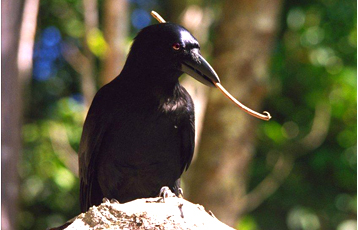
On the south Pacific island of New Caledonia, families of wild crows have developed a tool-making industry. One of their main sources of protein is beetle larvae, which are found in the rotted trunks of fallen trees. The problem is that the crows can't actually get inside the trunks with beak and claw alone. So they've learned to fish for the tasty bugs by fashioning tools out of slender sticks. Using its dextrous beak, a crow prepares the stick by stripping bark from one end. Then it tweaks the end into a small hook that looks something like the tip of a crochet needle. Carefully holding the stick in its beak, the bird dips it into bore holes in the logs, fishing out a meal.


Crow the Tool-Maker


This isn't just some genetically-programmed behavior. Crows aren't born knowing how to make these tools; they teach the technique to their young. And they can improvise, too. In one lab experiment, a crow bent the end of a wire using the edge of a glass as a cantilever. It used the hooked wire to retrieve another stick, which was long enough to reach some food it wanted. So it used one tool to make another tool — and then used that tool to grab still another tool. That's pretty sophisticated stuff.


On New Caledonia, crows use other tools as hooks, too. They carefully tear the barbed edges from the wide leaves of the pandanus plant, then dip these thin, serrated strips into bore holes, pulling up unwary insects caught on the tiny prongs.


What we don't know is how well the birds actually understand their tools. Do they just understand that sticks mean dinner? Or are they clear on what kind of sticks get the job done? Two UK biologists, James St. Clair and Christian Rutz, recently studied crow tool use on New Caledonia, and found that the birds aren't just randomly trying different kinds of sticks on their prey — they know exactly what they're doing, and quickly recognized pre-made hooks the humans offered them.

In a series of experiments where the researchers presented captured crows with different kinds of tools, the crows correctly went for the hooks, deploying them neatly to fish bits of meat out of a hole bored in a log. St. Clair and Rutz concluded that crows "paid close attention to the functional properties of hooked stick tools, with no need for trial-and-error learning." They've honed their fishing skills over generations.


As an interesting aside, St. Clair and Rutz also found that crows seem to be "left handed" and "right handed" when it comes to their fishing sticks. When crows grip these tools in their beaks, most prefer to position the non-business end of the sticks pressed against their right cheeks, rather than their left. And no matter which direction the sticks were presented to them by the researchers, the crows would make sure to position the sticks correctly — aiming the hooked end directly at the meat.

What we see in this study is one of the only detailed portraits of how crows understand their tools in the wild. There have been plenty of lab studies showing that crows can learn to be very deft tool-makers, like the one I mentioned earlier with the crow who made a hook out of wire. The problem is that animals in the lab nearly always show greater facility with tools — domestication seems to inspire more tool-using behavior.

These wild New Caledonian crows were clearly creative, making hooks, repositioning them, and adapting pre-made tools for their uses. They convinced St. Clair and Rutz that crows regard hooks in pretty much the same way humans do, as flexible tools we make to get at desirable things (such as food) that are out of reach.

While that's fascinating, it still begs the question of why some animals like crows and humans have responded to their physical limitations by making tools. Why don't all animals do it?


Opportunity, Not Necessity


Last month, St. Clair and Rutz's findings appeared in a collection of papers on the evolution of tool use in the Philosophical Transactions of the Royal Society B. As biologist Dora Biro, archaeologist Michael Haslan and Rutz remark in the introduction to this collection, we still have a lot to learn about why tool use evolves in the first place. Obviously, using tools confers a great advantage — it helps animals get food more easily, and that's probably why such a diverse range of animals have adapted to grip tools in their beaks, claws, hands, trunks and mandibles.


The question is, why does one group start using tools while another does not? A big problem is that it's hard to observe tool use in the wild, and even harder to compare the fitness of tool users with non-tool users to see whether one group clearly has an advantage over the other.

A single study conducted several years ago, of bottlenose dolphins off the coast of Australia, offered an intriguing peek at tool development in action. One group of the dolphins started gripping sponges in their beaked mouths while they foraged for food in the rough sands of the sea bottom. Other groups in the same area never "sponged." Scientists observing the two groups found virtually no difference in how many offspring each had. There was no reproductive advantage to the dolphins' tool use, and therefore it was difficult to come up with an evolutionary explanation for their behavior.


That's about to change. The authors of the new studies in the Royal Society collection do have some theories about why tool use evolved. One possibility — which could be relevant in the dolphins' case — is that tool-using groups gain access to food sources that non-tool users can't. So that means a group of tool-users can share an ecoystem with non-tool users, because they feed off different things.

Tool use is a direct result of environmental opportunity. For an animal to start using tools, it obviously has to be in an environment where tools are available, and where using tools confers an advantage. This explains why, for example, sea creatures often use other sea creatures as tools. Biological materials are more available (and less likely to rot right away) in a marine environment where few sticks and rocks are floating around in the water column.

Crucially, this explanation suggests that tool use doesn't evolve out of our needs. It develops out of what animals find in their environments. The New Caledonian crows wouldn't need to invent hooked tools if their favorite grubs typically lived in shallow holes that the birds could reach with their beaks. What this means is that animals will develop tools in response to their environments.


Other environmental factors may affect tool adoption too. Riskier environments seem to spur tool use, perhaps because food sources are more difficult to come by. And in addition, animals with large toolkits — like humans — seem to invent more tools as their populations grow. This could help explain why humanity's population explosion over the past century has been accompanied by an explosion in tool diversity, including radical new technologies.


This Is Your Brain on Tools


Another key factor in tool use seems to be social learning. Species like chimps, crows, and humans all spend an extended period of time during adolescence learning from their families and social groups. And this confers a greater advantage when it comes to tool invention.

One intriguing possibility is that when tool use has emerged in a species, it can actually change the course of its evolution, affecting both minds and bodies. Perhaps bipedalism emerged in humans partly because generations of people used their hands for tools. The people who could walk with tools in their hands, and whose hands had the best fine motor control, survived to reproduce more often than those who didn't. If tools can affect the course of our evolution, it could mean that our behavior has been changing our biology over generations.


We know from brain imaging tests that animals treat sticks, hooks, and other tools as extensions of their bodies. Could these tools have changed our brains over time, resulting in this self/tool merging at the neurological level? That's one possible reason why studies of human children show that we're born with a predisposition to use tools. Maybe the urge to make tools is itself an adaptation. And that urge is something humans might share with species like crows, who are in other ways dramatically different from us.

The fact that humans use tools doesn't make us unique among animals. Comparing ourselves with other tool users has helped us understand that the evolution of this skill is as much a reflection of our environment as it is any innate capability. Instead of looking at tools as a way we change the environment, it might be more accurate to think of tools as the most profound way our environments have changed us.

Read the collection of papers in the Philosophical Transactions of the Royal Society B.

Saturday, September 22, 2012

Crows Join Humans in the Ability to Infer Hidden Causal Agents

For those of us who love crows and ravens (and all the other amazing corvids), this is not really new information. There have been loads of other studies documenting the advanced cognitive skills of ravens and crows, especially the New Caledonian crows.

However, the fact that mainstream science is catching on the how smart crows are bodes well for their future in intelligence research. Now if we could just ban hunting and killing them.

This article is from Misc.ience - there is a second one from Wired (below):

Crows join humans in the ability to infer hidden causal agents

New Caledonian crows – smarter every time we look at them.

A fascinating new piece of research was published a couple of days ago in the journal Proceedings of the National Academy of Sciences (or PNAS for short).


New Caledonian crow. Credit: University of Auckland

It shows that New Caledonian crows are capable of a cognitive feat previously only thought to be doable by human beings – the ability to reason about a hidden causal agent (in this case someone behind a sheet). Inference, in other words.

ResearchBlogging.org
As the (open access/free) paper explains in its opening sentences:
The ability to make inferences about hidden causal mechanisms underpins scientific and religious thought. It also facilitates the understanding of social interactions and the production of sophisticated tool-using behaviors. However, although animals can reason about the outcomes of accidental interventions, only humans have been shown to make inferences about hidden causal mechanisms."
Alex Taylor of the University of Auckland’s School of Psychology (hooray NZ!) and colleagues have shown, however, that we’re NOT the only creatures capable of doing it.

They took eight Caledonian crows – very clever birds, admittedly, who’ve previously been shown to be capable of making and using tools – and showed two series of events. Before the events, the crows had been given some experience with extracting food from a box using a tool.

Both events involved a sheet, and a stick which moved.

The first set of events: the Hidden Causal Agent (HCA)

In the first set of events, the crows were able to watch as a person (of the human sort) walked behind a blue sheet that was hanging up near to a box containing food. The box had been set up so that the crows had to turn their heads away from watching the sheet in order to get their food out.

Once the human had walked behind the sheet, the crows saw the stick poking out from behind it move, making motions towards the food box, and then they saw the human leave again.  ’Meh’, one could imagine the crows thinking, ‘makes total sense. Fudz om nom nom.’

And that’s what they did – they came down to the food box, picked up a tool and extracted their food, giving nary a glance towards the sheet.

Ah, yes. There was also a second person who came into the room with the first, stood in the corner 1.5m from the sheet with closed eyes and hands held crossed in front of their body. This second person did nothing, and then left with the first person.

The second event: the Unknown Causal Agent (UCA)

In the second set of events, they saw the stick move in the same way without someone walking behind, or walking away from, the sheet. A ghost stick!*

As in the first event, there was also a second person who did nothing at all and then left.


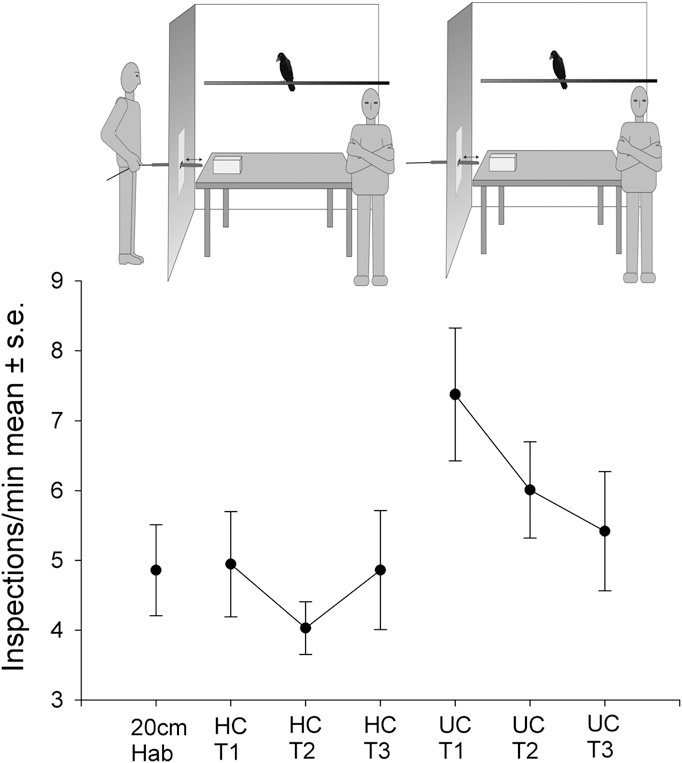
Inspection rate across conditions. Final habituation trial before testing is indicated by 20cm hab. (Upper Left ) Diagram of the HCA condition. (Upper Right) Diagram of the UCA condition. In the HCA condition, one human walked into the hide and one stood in the corner of the room. A wooden stick was then probed from the hide. The agent then exited the hide. Both humans then left the room. In the UCA condition, one human entered the cage and stood in the corner. The tool was then probed through the hole. The human then left. (Taylor, A.H. et al, 2012)

And so?
The experiment had been designed so that this stick stimulus would be a new experience for the crows, and so probably something they’d intrinsically distrust (or not like, at the very least)**.

Read the whole article. And here is another one from Wired.

Whodunit? Crows Ask That Question, Too

A New Caledonian crow uses a twig tool. Image: Mick Sibley

By Virginia Morell, ScienceNOW

Imagine hearing a distant roll of thunder and wondering what caused it. Even asking that question is a sign that you, like all humans, can perform a type of sophisticated thinking known as “causal reasoning”—inferring that mechanisms you can’t see may be responsible for something. But humans aren’t alone in this ability: New Caledonian crows can also reason about hidden mechanisms, or “causal agents,” a team of scientists report Sept. 17 in the Proceedings of the National Academy of Sciences. It’s the first time that this cognitive ability has been experimentally demonstrated in a species other than humans, and the method may help scientists understand how this type of reasoning evolved, the researchers say.


Causal reasoning is “one of the most powerful human abilities,” says Alison Gopnik, a psychologist at the University of California, Berkeley, who was not involved in the study. “It’s at the root of our understanding of the world and one another.” Indeed, it is the key mental ability for many things humans do, including inventing, making, and using tools. We develop this ability early in life: A 2007 study in Developmental Psychology reported that human infants as young as 7 months old understand that when a beanbag is tossed from behind a screen, something or someone must have thrown it. The infants infer that a “causal agent” must be involved in the motion of the flying beanbag.

But why should this ability be limited to humans? “It seems like it would make good sense for crows and many other animals to be able to distinguish between the wind rustling tree limbs and an unseen animal crashing through the canopy,” says Alex Taylor, an evolutionary psychologist at the University of Auckland in New Zealand and the lead author of the new study. Because New Caledonian crows are also inventive and skillful tool-users, Taylor and his colleagues thought the birds might have causal reasoning skills similar to those of humans.

Working on Mare Island in New Caledonia, the scientists captured eight wild crows (five adults and three juveniles) and housed them inside a large outdoor aviary. Over the next few days, the birds used a slender stick to extract food from a small box placed on a table in the aviary. Then the plot thickened: The scientists placed the food box close to a blue tarp large enough for a person to hide behind. The researchers also set up a large stick that could be poked through the tarp and waved around by a human outside the aviary pulling on a string; the moving stick posed a danger to the birds if they tried to extract the food.

The crows in the aviary then observed two different situations. In one, the “hidden causal agent” scenario, the crows saw a human enter the blind. Then, a few moments later, the stick poked through the tarp and moved back and forth 15 times. The human then exited the blind. In the “unknown causal agent” scenario, the crows saw only the stick as it emerged from the tarp and moved back and forth 15 times.

In both situations, a human also stood next to the table in the aviary, so the crows never tried to get the food. And in both cases, when the visible human left, the crows began to remove their food from the box. Yet the crows’ behavior differed depending on whether they had seen a human come and go from the blind. If the birds had seen a human stepping out of the blind, they seldom gave the stick so much as a glance as they dug out their food. But the crows that saw the stick move but no one emerge from the blind were nervous: They often stopped probing for food and studied the blue tarp and stick—apparently suspecting that someone or something unknown had caused the stick to move and that it might move again. Some even flew away from the setup.

Together, the tests show that the crows are “capable of causal reasoning,” Taylor says. “We expected the crows to initially be scared of the moving stick. Instead, they only became scared when they could not attribute the movement to a hidden human—which suggests the crows were reasoning that the stick’s movement was caused by that human.” The crows, he says, apparently don’t expect an inanimate object to move on its own, just as infants don’t expect beanbags to be tossed through the air by a toy block.

“It’s an extremely clever study,” says John Marzluff, a wildlife biologist at the University of Washington, Seattle. “Using a controlled experiment, they’ve validated what many crow hunters know—that crows keep track of hunters in blinds. Even if the crows [in this study] never see a person push the stick, they connect the dots between the location of a person and the actions they associate with people.”

The study “makes important new advances in our understanding of the extent to which nonhuman animals may be capable of causal reasoning and offers the potential to open this whole area up to scientific inquiry in animals,” adds Nicola Clayton, an experimental psychologist at the University of Cambridge in the United Kingdom. Because it suggests that causal reasoning evolved in parallel in humans and crows, the work may even “help solve the fascinating question of just how and why our human intelligence evolved,” Gopnik says.

This story provided by ScienceNOW, the daily online news service of the journal Science.

Tuesday, September 18, 2012

Corvid Brains - Crows and Jays Show Human Traits

There were two very cool stories about corvids in the press last week, one from the University of Washington in Seattle on how crows can remember faces (confirming previous studies) and another from the University of California Davis on the fact that scrub jays mourn their dead, not just individually but as a group.

The cool thing about the crow study was that the researchers developed a less invasive and traumatizing method for conducting the research. Anything that can be done to reduce the trauma is good in my book.

Both of these studies reaffirm the intelligence of corvids in particular and birds/animals in general.

Crows recall faces with human-like brain activity

U. WASHINGTON (US) — Like humans, crows recognize faces and form associations with them—and to accomplish this, the two species’ brains appear to work in similar ways.

Posted by Sandra Hines-UW on Wednesday, September 12, 2012


The findings reveal that similar processes take place in the brains of crows and humans, both of which recognize faces and form positive and associations with them based on experience. "Our approach has wide applicability and potential to improve our understanding of the neural basis for animal behavior," write the University of Washington researchers.

“The regions of the crow brain that work together are not unlike those that work together in mammals, including humans,” says John Marzluff, University of Washington professor of environmental and forest sciences. “These regions were suspected to work in birds but not documented until now.

“For example it appears that birds have a region of their brain that is analogous to the amygdala of mammals,” he says. “The amygdala is the region of the vertebrate brain where negative associations are stored as memories. Previous work primarily concerned its function in mammals while our work shows that a similar system is at work in birds.

“Our approach could be used in other animals—such as lizards and frogs—to see if the process is similar in those vertebrates as well.”


The “caring” and “threatening” masks both have neutral expressions, so the researchers could be sure the crows were remembering and responding to positive or negative associations. 


Marzluff is the lead author of a paper published this week in the online edition of the Proceedings of the National Academy of Sciences.

Previous research on the neural circuitry of animal behavior has been conducted using well-studied, often domesticated, species like rats, chickens, zebra finches, pigeons, and rhesus macaques—but not wild animals like the 12 adult male crows in this study.

The crows were captured by investigators all wearing masks that the researchers referred to as “the threatening face.” The crows were never treated in a threatening way, but the fact they’d been captured created a negative association with the mask they saw.

Then, for the four weeks they were in captivity, they were fed by people wearing a mask different from the first—this one called “the caring face.” The masks were based on actual people’s faces and both bore neutral expressions so the associations made by the crows was based on their treatment.

Awake and active
In most previous neurological studies of animals, the work usually starts by sedating the animals, Marzluff says. Instead, the new approach involved injecting a glucose fluid commonly used in brain imaging into the bodies of fully alert crows that then went back to moving freely about their cages.
The fluid flooded to the parts of the crow brains that were most active as they were exposed for about 15 minutes to someone wearing either the threatening or caring mask.

Then the birds were sedated and scans made of their brains. All the birds were returned to the wild once all the work was completed.

“Our approach has wide applicability and potential to improve our understanding of the neural basis for animal behavior,” write Marzluff and co-authors Donna Cross, Robert Miyaoka, and Satoshi Minoshima, all faculty members with the radiology department. The department funded the preliminary work while the main project was conducted using money from the University’s Royalty Research Fund.

Most neurological studies to date in birds have concerned their songs—how their brain registers what they hear, how they learn and come up with songs of their own. This new approach enables researchers to study the visual system of birds and how the brain integrates visual sensation into behavioral action, Marzluff says.

Stress reduction
Among other things the findings have implications for lowering the stress of captive animals, he says.

“By feeding and caring for birds in captivity their brain activity suggests that the birds view their keepers as valued social partners, rather than animals that must be feared. So, to keep captive animals happy we need to treat them well and do so consistently,” he says.

Intriguingly, Marzluff says the findings might also offer a way to reduce conflict between birds and endangered species on which they might be feeding. In the Mojave Desert, for instance, ravens prey on endangered desert tortoises. And on the West and East coasts, crows and ravens prey on threatened snowy plovers.

“Our studies suggest that we can train these birds to do the right thing,” Marzluff says. “By pairing a negative experience with eating a tortoise or a plover, the brain of the birds quickly learns the association. To reduce predation in a specific area we could train birds to avoid that area or that particular prey by catching them as they attempt to prey on the rare species.”

Collaborative work among neuroscientists and ecologists could be used to better understand the neural basis of cognition in widely diverse animals, says co-author Cross. For example, her suggestion to use the glucose technique prior to brain scans, so the crows could be fully awake, could be used for other animals.
A researchers wore the “caring mask” to feed the crows. (Credit: Jack DeLap/U of Washington)

Source: University of Washington
* * * * * * *

Scrub jays react to their dead

Posted On: September 11, 2012

Western scrub jays summon others to screech over the body of a dead jay, according to new research from the University of California, Davis. The birds' cacophonous "funerals" can last for up to half an hour.

Anecdotal reports have suggested that other animals, including elephants, chimpanzees and birds in the crow family, react to dead of their species, said Teresa Iglesias, the UC Davis graduate student who carried out the work. But few experimental studies have explored this behavior.

The new research by Iglesias and her colleagues appears in the Aug. 27 issue of the journal Animal Behaviour.

Western scrub jays live in breeding pairs and are not particularly social birds.

"They're really territorial and not at all friendly with other scrub-jays," Iglesias said.

Working in the backyards of homes in Davis, Calif., Iglesias set up feeding tables to encourage visits from the jays. Then she videotaped their behavior when she placed a dead jay on the ground. She compared these reactions with the birds' behavior when confronted with a dead jay that had been stuffed and mounted on a perch, a stuffed horned owl, and wood painted to represent jay feathers.

On encountering a dead jay, prostrate on the ground, jays flew into a tree and began a series of loud, screeching calls that attracted other jays. The summoned birds perched on trees and fences around the body and joined in the calling. These cacophonous gatherings could last from a few seconds to as long as 30 minutes.

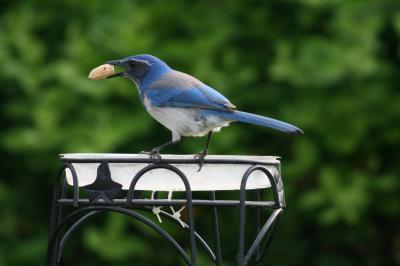
Western scrub-jay at a backyard bird feeder in Davis, CA. UC Davis researchers found the birds gather for noisy "funerals" when they encounter a dead jay. (Photo Credit: Stephanie Macey-Gallow, UC Davis.)
Jays formed similar cacophonous gatherings in response to a mounted owl, but ignored painted wood. When confronted with a mounted jay, the birds swooped in on it as if it were an intruder.

Jays typically gathered within seconds of the first bird calling, Iglesias said. If they did not, the first jay would often fly higher into a tree, apparently to call more widely.

"It looked like they were actively trying to attract attention," she said.

The purpose of the calls seems to be to alert other birds of danger, Iglesias said. But why the calls summon others, rather than warning them off, is unclear. Having more jays present might mean more eyes to locate a predator, or more numbers to drive it away, she speculates.

There might also be a learning component to the gatherings, if they help teach young jays about dangers in the environment, Iglesias said.

While reactions of animals to their dead are sometimes called "funerals," that does not imply that there is an emotional or ritual element to the behavior, Iglesias said. We simply don't know enough about the emotional life of animals to understand that.

But Iglesias isn't ruling it out. "I think there's a huge possibility that there is much more to learn about the social and emotional lives of birds," she said.