Showing posts with label hierarchies. Show all posts

Tuesday, March 05, 2013

William Grassie - The Great Matrix of Being: Understanding Natural Hierarchies

In recent post featuring Trevor Malkinson's - Rhizomatic for the People: Notes on Networks and Decentralization, I suggested that the rhizomatic philosophy of Deleuze and Guattari, in many ways, overturns some of the basic tenets of integral theory - a model that is completely hierarchical, chronological, and highly organized. Rhizomes reject hierarchies and they resist chronology and organization. Rhizomes are decentralized, organized by connections and associations and not by systems, and they seek a unification that is inherently multiple.

This is not to say, however, that hierarchies must be tossed to the dustbin of history. In fact, nature is filled with hierarchies, as are human bodies and human relationships. Most obviously, we have bodies composed of organs that are composed of cells that are compose of molecules that are composed of protons and neutrons, that are composed of quarks, and which may be composed of one-dimensional strings (if string theory turns out to be true).

Talk about a hierarchy! Ken Wilber's AQAL version of integral theory assigns these hierarchies to a quadrant model of interior vs exterior and individual vs. collective. But his model seriously neglects that rhizomatic reality of many systems, both human and otherwise.

Anyway, I often place a lot of emphasis on relational, intersubjective and rhizomatic models here, but this is largely to fill the gap in integral theory that has neglected these models. But as I said, hierarchies are also very natural and important, as William Grassie shows in this article from MetaNexus.

The Great Matrix of Being


February 26, 2013
By William Grassie

Understanding Natural Hierarchies


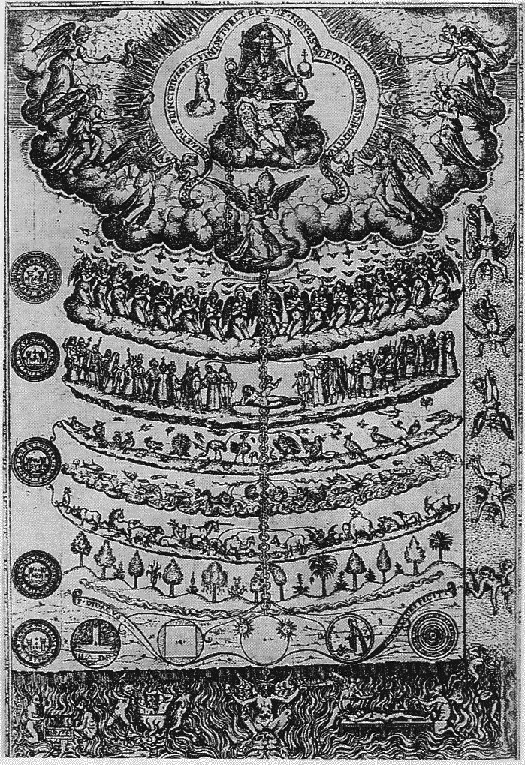
Our European ancestors once understood the universe to be a Great Chain of Being. All the entities of the world -- animal, vegetable, mineral -- were hierarchically organized. At the bottom were metals, precious metals, and precious stones. Then came plants and trees, followed by wild animals and domesticated animals. Humans were also hierarchically ordered from children to women to men and further into the different ranks of commoners, nobility, princes, and kings. The Great Chain of Being continued up into the celestial realm -- moon, stars, angels, and archangels -- to the very top where God presides over the entire creation. This scala naturae provided humans with a natural order, which they also understood to be a natural human order that structured their societies.

Retorica Christiana, written by Didacus Valdes in 1579, Source: Wiki Media

Science, or so the story goes, disrupted this view of the universe and ourselves. Copernicus, Galileo, and Kepler broke the crystalline spheres of Ptolemy and demoted Earth from the center of the universe to an insignificant periphery. Darwin understood plants and animals, including the human animal, to be evolving from common ancestors all the way back into the proverbial primordial slime. Freud showed that rational man was really an unconscious mess and hardly aware of, let alone in control of, his own thoughts and passions.

The Great Chain of Being was rendered a tangled web of happenstance in an enormous universe devoid of transcendence and meaning. God was rendered an unnecessary or incompetent creator. The new existentialists and Stoics argued that the universe was indifferent, that humans were insignificant, that our consciousness was epiphenomenal, and that our evolution merely accidental.

This turns out to be quite a distortion of the actual science and history. For while there is no Great Chain of Being, as the medievals understood it, there is most definitely a Great Matrix to which all beings belong.

Everything that exists in the universe, every process that science has discovered, every power of nature that humanity has harnessed, all that constitutes our human bodies and brains, our histories and cultures--all this and more--can be located within a number of natural hierarchies. These hierarchies define the Great Matrix of Being, and are measured in:
1) chronology
2) size
3) energy flows
4) electromagnetic radiation
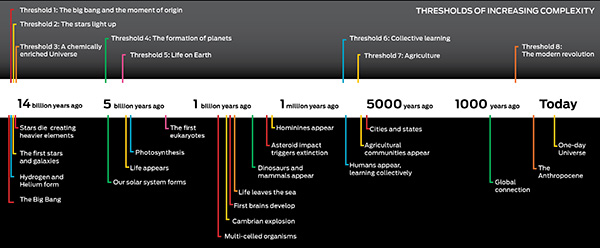
5) thresholds of emergent complexity
Let's take a look at each in turn:

1. Chronology: The universe has a scale of time measured in billions of years down to the nanosecond vibrations of cesium in atomic clocks. Our best calculations suggest that the universe is 13.7 billion years old, that the Earth is 4.6 billion years old, that humans are 200,000 years old, and that the drama of human civilization began some 12,000 years ago. Today, we call this chronological understanding of the universe and ourselves "Big History." There are currently a number of initiatives seeking to promote this curriculum in education. Chronology, however, is only one dimension of the Matrix.

Image: Big History Project Timeline uses a logarithmic scale

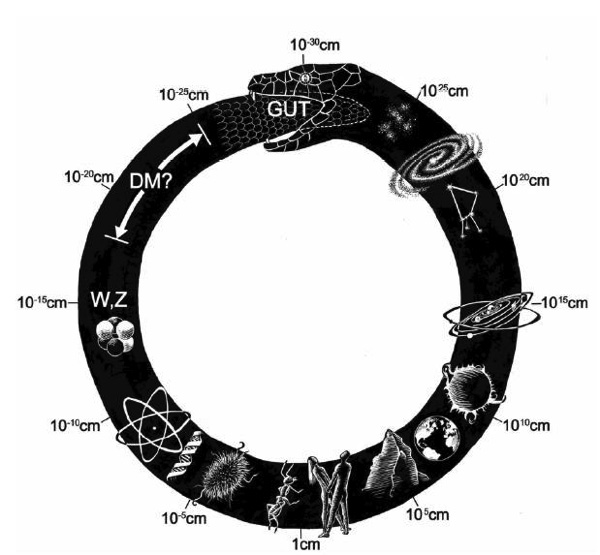
2. Size: The universe also has a size scale. The smallest unit is the Planck scale -- 1.616252 x 10⁻³⁵ m. The concepts of size and distance break down at this scale as quantum indeterminacy becomes absolute. The most distant thing that we observationally know of in the universe is the background radiation from the big bang, which is 13.7 billion light-years away from Earth (13.7 x 109) x (3 x 109 meters/second). When we talk about the very fast, the very dense, and the very hot, these concepts of space and time become elastic, but in between these extremes, size matters. And curiously, the human scale--measured in centimeters and meters--exists about halfway between the very small and the very large and is the only scale where certain types of complexity could exist.

We tend to focus on how puny we are in the scale of hundreds of billions of galaxies, but we should also remember how enormous we are when compared with the atomic and subatomic levels. Space-time is a continuum in relativity theory, but for human purposes we normally treat them separately. Chronology and size are the x and y axes that establish the Matrix in two dimensions.

3. Energy: The intensity of energy flows is another axis in the Matrix. There is no uniform measurement of energy because energy comes in so many different flavors, including heat, electrical, chemical, nuclear, and kinetic. Physicists calculate the energy of the universe at the moment of the big bang as 1019 GeV (billion electron volts). At the opposite end is absolute zero or minus 273.15 degrees Celsius (minus 459.67 degrees Fahrenheit). At both extremes, matter exhibits strange behaviors.

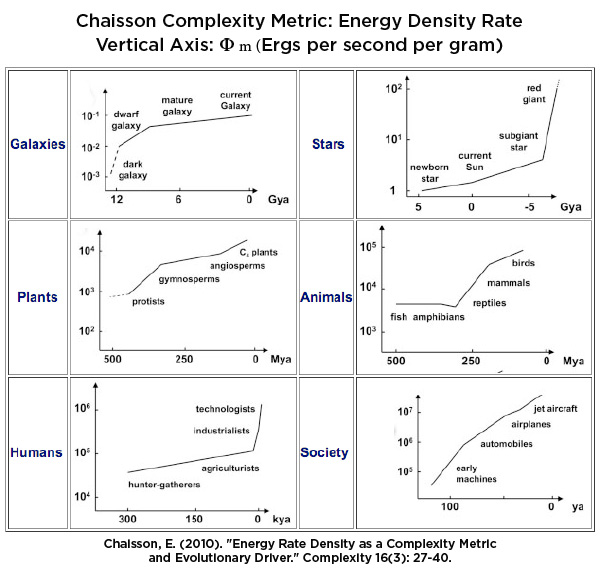
All complex phenomena in the universe can be characterized by energy gradients, which we can measure in ergs per second per gram. It is counter-intuitive, but when normalized for mass, a photosynthesizing plant has about 2,000 times the energy density flow of the sun. A mammalian body has about 20,000 times the energy density flow of the sun. The human brain, consisting of about 2 percent of our body weight but consuming about 20 percent of our food energy, has an energy density flow about 150,000 times greater than the sun. And if we include all of the energy consumed outside of our bodies in our global civilization, then many humans today achieve energy density flows millions of times greater than the sun.


4. Electromagnetic Radiation: Electromagnetism governs almost all of the phenomena that we encounter in daily life. Negatively charged electrons are bound by electromagnetic waves into orbitals around positively charged atomic nuclei. Atoms combine into complex molecules through electromagnetic geometries and preferences. All chemistry, and therefore all biology, is governed by electromagnetic forces. The ATP molecules in your cells, the neurons in your brain, the gasoline burning in your car, the food you eat, and all the electronic devices in your life--from the light bulb to the Internet--are electromagnetic.

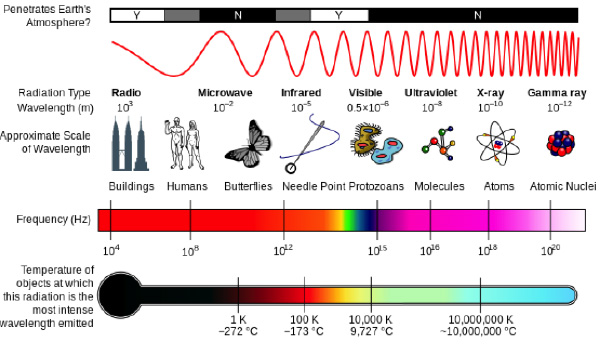
The entire spectrum of electromagnetic radiation goes from radio waves at one end, through microwave, infrared, visible, ultraviolet, and x-ray to gamma radiation at the other end, but our human eyes have evolved to see only a small range of visible light.

Electromagnetic radiation is central to all of the prosthetic "seeing" devices of science and technology -- from radio telescopes to electron microscopes. The tools by which we see, hear, touch, taste, smell, and understand the universe of the very small and the very big, the very hot and the very cold, the very fast and the very slow, all utilize the electromagnetic effect in their technologies of perception. The spectrum of electromagnetic radiation is the fourth axis in the Great Matrix of Being.

Image: Electromagnetic Spectrum Wiki Media

5. Emergent Complexity: Here we need to appeal to informed intuition and induction, rather than some discreet, measurable qualia in nature.

The epic narrative of Big History typically orients around eight thresholds of emergent complexity. For instance, the creation of the heavy elements in the stellar foundries from which we derive the elements of the periodic table was a threshold of emergent complexity necessary for complex chemistry to later evolve. When complex chemistry catalyzed life, we saw again something new and different. And when the evolution of plants and animals gave rise to species with a central nervous system, complex brains, oppositional thumbs, vocal chords, language, tool-making, and collective learning, something new emerged again in the universe, at least on one small planet.

It is important to emphasize that emergent complexity requires lower levels of complexity to exist and function. Higher orders of complexity are built bottom-up, though emergent properties cannot be fully explained from below. With thresholds of emergent complexity, the Matrix is not simply a coordinate system of reality, but now also an epic narrative of becoming.

Image: Big History Project Timeline with Thresholds of Emergent Complexity on Top.

The four dimensions in the Great Matrix of Being give us four ways of measuring reality -- by time, by scale, by energy density flow, and by thresholds of emergent complexity. All phenomena can be located within this Matrix.

But we might postulate another axis in the Matrix: a hierarchy of consciousness. The brain-mind is an emergent phenomena and potentially scalable. A roundworm in a neuroscience lab might have only a few hundred nerve cells, while a human brain has hundreds of billions of nerve cells. Surely, there are objective differences in brain-mind complexity throughout the animal kingdom. Counting nerve cells alone, however, does not really give us an adequate measure of brain-minds because brain-minds require bodies and metabolism, vocal chords and oppositional thumbs, and an enriching social and natural environment, in order to realize their potentials. Perhaps someday we may have a robust measure of consciousness that will allow us to compare dogs with cuttlefish, elephants with birds, and smart phones with smart people.

What is important to note about the Matrix is that humans are not at the top of the hierarchies, but somewhere in the middle. Complexity thrives when it is not too hot and not too cold, not too big and not too small. Different entities have different Goldilocks niches within the Matrix. The human niche is particularly favored in the Matrix for the time being--each of us a nexus of causal relationships (physical, biological, social, economic, psychological, mental), realizing extraordinary energy density flows, intensities of experience, and accelerating transformations in the modern period.

In our drive toward specialization and division of labors, we rarely reflect on these natural hierarchies and what they might mean for our understanding of science, self, and the sacred. Any concept of God adequate for modern science, for instance, must also be reconstructed in light of the Great Matrix of Being. An anthropomorphic monarch sitting on heavenly thrones no longer make sense.

"We exist in a bizarre combination of Stone Age emotions, medieval beliefs, and god-like technology," observed E.O. Wilson. To understand this schizophrenic state of affairs and transform it into something more wholesome, we need to understand how the Matrix actually works on different scales and perspectives. We need to see the emergent complexity of chemistry and cell biology. We need to understand the ubiquity of electromagnetism. We need to take account of the energy that flows through our daily lives. It is by consciously doing so that we extend our own being to the furthest edges of the universe and realize our fullest potential.

The bio-social-physical You and Me are never outside the Matrix, but in this scientific and philosophical exercise we seem to stand away, looking down on the Matrix from above. So far as we know, no other entity in the universe has achieved this capacity, and it is in this domain that humans are no longer middling creatures of the Matrix. Our self-transcendence, realized especially through the progress in science, is a super and completely natural emergent phenomena. We come to understand the Matrix from the inside out, though the Matrix knows nothing of us.


~ This article was originally published on Huffington Post Religion on 2/26/2013

Saturday, February 23, 2013

Trevor Malkinson - Rhizomatic for the People: Notes on Networks and Decentralization

This forest of aspens is actually a single organism, a rhizome.

I first came across the idea of the rhizome in Sam Mickey's article in Integral Theory in Action (SUNY Press, 2010), "Rhizomatic Contributions to Integral Ecology in Deleuze and Guattari." [The book is a collection of papers from the first bi-annual Integral Theory Conference held in 2008]. From there I discovered A Thousand Plateaus: Capitalism and Schizophrenia (1980) by Gilles Deleuze and Félix Guattari. I blogged about Deleuze and Guattari back in 2010.

A Thousand Plateaus is book two in their Capitalism and Schizophrenia series, which began with Anti-Oedipus (1972), where the first introduced and began developing their rhizomatic theory.

From Wikipedia, here is a brief definition of rhizomes:
Gilles Deleuze and Félix Guattari use the term "rhizome" and "rhizomatic" to describe theory and research that allows for multiple, non-hierarchical entry and exit points in data representation and interpretation. In A Thousand Plateaus, they oppose it to an arborescent conception of knowledge, which works with dualist categories and binary choices. A rhizome works with planar and trans-species connections, while an arborescent model works with vertical and linear connections. Their use of the "orchid and the wasp" is taken from the biological concept of mutualism, in which two different species interact together to form a multiplicity (i.e. a unity that is multiple in itself). Horizontal gene transfer would also be a good illustration.

As a model for culture, the rhizome resists the organizational structure of the root-tree system which charts causality along chronological lines and looks for the original source of "things" and looks towards the pinnacle or conclusion of those "things." A rhizome, on the other hand, is characterized by "ceaselessly established connections between semiotic chains, organizations of power, and circumstances relative to the arts, sciences, and social struggles." The rhizome presents history and culture as a map or wide array of attractions and influences with no specific origin or genesis, for a "rhizome has no beginning or end; it is always in the middle, between things, interbeing, intermezzo." The planar movement of the rhizome resists chronology and organization, instead favoring a nomadic system of growth and propagation. In this model, culture spreads like the surface of a body of water, spreading towards available spaces or trickling downwards towards new spaces through fissures and gaps, eroding what is in its way. The surface can be interrupted and moved, but these disturbances leave no trace, as the water is charged with pressure and potential to always seek its equilibrium, and thereby establish smooth space.[1]


Principles of the rhizome


Deleuze and Guattari introduce A Thousand Plateaus by outlining the concept of the rhizome (quoted from A Thousand Plateaus):
1 and 2: Principles of connection and heterogeneity: any point of a rhizome can be connected to anything other, and must be
3. Principle of multiplicity: only when the multiple is effectively treated as a substantive, "multiplicity" that it ceases to have any relation to the One
4. Principle of asignifying rupture: a rhizome may be broken, but it will start up again on one of its old lines, or on new lines
5 and 6: Principles of cartography and decalcomania: a rhizome is not amenable to any structural or generative model; it is a "map and not a tracing"
There is a lot to like about this theory - and in many ways it overturns a lot of the basic tenets of integral theory - a model that is completely hierarchical, chronological, and highly organized. Rhizomes reject hierarchies and they resist chronology and organization.

Rhizomes are decentralized, organized by connections and associations and not by systems, and they seek a unification that is inherently multiple.

This passage from Ellen E. Berry and Carol Siegel is taken from their article, "Rhizomes, Newness, and the Condition of Our Postmodernity: Editorial and a Dialogue," which appeared in the journal
rhizomes.01 (fall 2000).

Rhizomes...


[7] exists to suggest ways out of this all-too-common paralysis of our critical imaginations by providing sites for the emergence of new thinking, the not-yet-conceived. We see speculative impulses and experimental strategies as vital components of the political agenda of contemporary cultural studies: Today more than ever we require acts of radical imagination and psychic mobility as preludes to the invention of historically new modes of relationship.

[8] Although we cannot (and would not wish to) predict the nature of the strange attractions that might migrate to Rhizomes, we are particularly interested in soliciting the following:
[9] creative and critical practices that generate alternative thinking by deliberately pursuing those alternatives embedded in any idea or system, particularly what a system omits or deems unworthy of serious scrutiny. Such thinking prevents any system from promoting itself as definitive and leaves it open to other ways of knowing and being. 
[10] creative and critical practices that encourage us to unite ideas that seem most disparate or incompatible, thereby deliberately dislocating us from the known. 
[11] creative and critical practices that train us actively to desire multiple differences rather than simply tolerating them or projecting them as objects of analysis. Such practices would be unpredictable, performative, and incomplete. By "hailing" us in ways that permit entry into relation with the other even as we forego full comprehension of him/her, they thereby will also extend our empathetic and ethical capacities.
With that background, here is the beginning of an essay by Trevor Malkinson from Beams and Struts, the finest integral blog on the web.

Rhizomatic for the People - Notes on Networks and Decentralization

Written by Trevor Malkinson

“Today we see networks everywhere we look- military organizations, social movements, business formations, migration patterns, communication systems, physiological structures, linguistic relations, neural transmitters, and even personal relationships". - Hardt and Negri, Multitdue - War and Democracy in the Age of Empire


~~~~~


Introduction


January 13, 2013

For several weeks there was a rich discussion happening on the comment thread of the article Eight Perspectives On Integral Trans-Partisan Politics. In that mix Jeremy Johnson and I were voicing support for a decentralized, local oriented way of life as an important way forward politically, economically and culturally. In his entry for the original article Jeremy writes:

It [integral trans-politics] argues for a political philosophy where the elite of society rule from the top-down. But everything that is going on today – with networks of social communication, experimental peer-to-peer economic systems, and decentralization of social power – suggests that human culture is undergoing revolutionary changes.

Later in a comment he added, "I think in the young generations of today, they will be developing wholly new economic and sociological structures. And I think these will be decentralized, rhizomatic, and built upon new ways of thinking and organizing society". Later on in a comment of my own I wrote, "I agree with Jeremy that a more localized decentralized form is what is generally emerging". In response to this Kaine DeBoer, also author of 1/8 of the perspectives in the original post, responded:

 
Trevor & Jeremy re: decentralization & localization -- I have heard these sentiments echoed elsewhere. But what evidence is there that there's a larger shift towards localization? Especially here in the United States, are we even capable of it at this point? Population density when combined with available, fertile land. Manufacturing infrastructure is either in decay or is simply non-existent...

This is a fair question, and in this post I want to offer a round-up of resources that I think show that these shifts are here and happening, and also why they might be important. What follows are a potpourri of lines of flight, a mashup sketch of what I see as the shapes of a future rapidly emerging.

Update - February 11, 2013

Since I started working on this piece a few weeks ago, a steady stream of new articles have come out on this topic, and there's also been a big public debate about the importance or non-importance of decentralization and peer networks between Stephen Johnson and Evgeny Morozov. I had already used Johnson's work in a section below, and I've been trying to keep track of all the new developments while writing this piece. I've come to realized that this article is only ever going to be a slice in time look at a dynamically unfolding topic, and moreover that I'm only going to be able to get to the networks and decentralization component. The first seven sections below were written in January. The final two I've just begun working on now, and I better click publish soon before something else happens! As I said in the article announcing the closing of Beams, a rhizome is always a middle, and it's high time I absorb this wisdom in this case, as I'll never be able to contain or capture the whole of this topic. So onwards into the essay. I'll speak to the debate between Johnson and Morozov in the concluding section.
Read the whole essay.

Monday, December 31, 2012

Gerald Wiest - Neural and Mental Hierarchies


This is an interesting article from the Frontiers and Psychology open source series, Frontiers in Psychoanalysis and Neuropsychoanalysis. Psychoanalyst and neurologist Gerald Wiest looks in this article at how neural hierarchies are related to mental hierarchies and how this plays out in contemporary psychoanalytic theory.

Neural and mental hierarchies

Gerald Wiest (1,2)*
(1) Department of Neurology, Medical University Vienna, Vienna, Austria
(2) Vienna Psychoanalytical Society, Vienna, Austria


The history of the sciences of the human brain and mind has been characterized from the beginning by two parallel traditions. The prevailing theory that still influences the way current neuroimaging techniques interpret brain function, can be traced back to classical localizational theories, which in turn go back to early phrenological theories. The other approach has its origins in the hierarchical neurological theories of Hughlings-Jackson, which have been influenced by the philosophical conceptions of Herbert Spencer. Another hallmark of the hierarchical tradition, which is also inherent to psychoanalytic metapsychology, is its deeply evolutionary perspective by taking both ontogenetic and phylogenetic trajectories into consideration. This article provides an outline on hierarchical concepts in brain and mind sciences, which contrast with current cognitivistic and non-hierarchical theories in the neurosciences.
Full Citation: 
Wiest, G. (2012). Neural and mental hierarchies. Frontiers and Psychoanalysis and Neuropsychoanalysis, 3:516. doi: 10.3389/fpsyg.2012.00516

Here is the introduction to the article.

The Philosophical and Biological Foundations of a Theory


According to modern biology, the development of hierarchies distinguishes the organic from the anorganic world (Mayr, 1997). Herbert Spencer (1820–1903) was the first who – influenced by Lamarckism – provided a coherent theory on the evolution, structure, and function of the nervous system. In his “Principles of Psychology” (Spencer, 1855), he postulated that the human mind can only be fully understood by considering its phylogenetic development. In his view, the phylogeny of consciousness illustrates a general principle of evolution, namely the development from a simple, undifferentiated homogeneity to a complex, differentiated heterogeneity. This conception implies that the human mind had evolved in the same way from a simple automatic response in lower animals to higher cognitive processes in man.

Spencer envisaged the evolutionary change of neural structures toward higher complexity as a process of stratification or layering of neural formations (Figure 1). Thus, each neural formation of the nervous system not only represents impressions and experiences of the individual’s past, but also those of its ancestors. From a neurological perspective, this would mean that a lesion at a higher cerebral level unveils neural and mental functions from an earlier evolutionary stage.
FIGURE 1
 
Figure 1. Herbert Spencer’s concept of the evolutionary change in the nervous system by means of superimpositions (A′) of neural layers exemplified in a neural ganglion (A). Consequently, neural excitation does not proceed anymore from a to b but is rather following new neural formations (d, e, f, g). Image from Spencer H (The Principles of Psychology, 1896, Appleton Press).
The British neurologist John Hughlings Jackson (1834–1911), one of the founding fathers of clinical neurology, was intrigued by the correlations between Spencer’s proposed evolutionary principles of neural functioning and his clinical observations in patients with focal brain lesions. In contrast to Spencer’s interest in evolutionary aspects of brain function, Jackson was more occupied with the reverse effect of evolution, which he coined “dissolution.”

In Jackson’s view, neurological symptoms such as aphasia, hemiparesis, or epileptic seizures, represent a dissolution, i.e., a reversal of the evolution of the nervous system, caused by a cerebral lesion. Jackson found that evolutionary higher cerebral centers inhibit the lower ones and lesions at these higher centers are accompanied by the production of “negative” symptoms (e.g., a palsy due to the absence of function) and of “positive” symptoms (e.g., pyramidal signs), caused by a functional release of the lower centers. Neurological or psychiatric symptoms can in this regard provide a look into the phylogeny of neural function. In his major work entitled “Evolution and Dissolution of the Nervous System” (Taylor, 1931/1932) Jackson outlined his theory of brain function, which still belongs to the foundations of neurology. The validity of a hierarchical organization of the nervous system has subsequently been confirmed by modern neurology and neuroscience for a variety of neural systems (Kennard, 1989; Swash, 1989; Vallbo, 1989; Miller and Cohen, 2001;Greene et al., 2004). The Jacksonian concept contrasts with non-hierarchical models of brain function, such as the theories by Hebb (Brown and Milner, 2003) or Lashley (1958). These models propose that brain function, in particular cortical processing, is based on the distributed processing of cell assemblies, i.e., of neural networks. According to lesion studies, Lashley proposed for example, that memories are not localized but widely distributed across the cortex, which has not been confirmed in subsequent studies. Classical empirical studies as well as recent imaging studies – on the other hand – provide convincing evidence that the rostro-caudal axis of the frontal lobe may indeed be hierarchically organized (Goldstein and Scherer, 1941; Luria, 1966; Mesulam, 2002; Petrides, 2005; Badre and D’Esposito, 2009). However, the Jacksonian concept not only paved the way to the establishment of neurology as a scientific discipline, it also had a profound impact on Sigmund Freud and the development of psychoanalytic metapsychology.
Read the whole article.

Thursday, July 19, 2012

Jonathan S. Davies - Why Hierarchy Won't Go Away: Understanding the Limits of 'Horizontalism'


When people reach the communal stage of development, which values consensus and human bonds (the Green Stage in SDi and AQAL), there tends to be an allergy to hierarchies of any kind, but especially those that include power differentials. We see this most recently in the various iterations of the Occupy Movement - a rejection of structure and hierarchy, which likely explains their lack of success in making any substantive change.

But as Jonathan Davies argues in this article, hierarchies won't go away, no matter how much people try to impose horizontal structures, which seems particularly true in the business world. Davies believes, working from Gramsci's theory of the integral state, that an "element of hierarchy is the pre-condition of effective solidarity and democratic accountability."


May 25, 2012

Abstract:
This short paper was produced as a Research Briefing for Leicester Business School in May 2012. It explores the rise of 'horizontalism' as a hegemonic world view and then discusses its limits, applying Gramsci's theory of the integral state. The paper suggests that the concept of a 'governance genome' maybe helpful for understanding how governing institutions embody multiple modes of coordination in many variable configurations, simultaneously hierarchy, market and network. It concludes that the resistance movements influenced by horizontalism should not feel threatened by hierarchy. The concept can be wrongly conflated with domination, and an element of hierarchy is the pre-condition of effective solidarity and democratic accountability. 
Full Citation:
Davies, JS. (May 25, 2012). Why Hierarchy Won't Go Away: Understanding the Limits of 'Horizontalism'  Social Science Research Network: http://ssrn.com/abstract=2066812 or http://dx.doi.org/10.2139/ssrn.2066812

Here is a short section of the paper that describes the rise of horizontalism in Western Culture - a movement that began in earnest in the 1960s but has roots all the way back to the 1800s and groups like the Transcendentalists, the poet Walt Whitman, and the efforts to free the slaves and give women the vote.
The Rise of Horizontalism
Horizontalist ideology began its rise to prominence in the 1960s, when capitalists, riding the wave of the technological revolution, started re-describing their activities in the language of networks. Contemporary capitalism celebrates qualities such as autonomy, spontaneity, multi-tasking, conviviality, team-working, openness to others and sensitivity to difference – all characteristics associated with the good networker. For major international organisations including the World Bank, the IMF, the OECD, the United Nations and European Union, networking has also become one of the cardinal principles of ‘good governance’.

Recognizing public disaffection with representative democracy and the ‘dead hand’ of bureaucracy in public services, governments too have sought to become more flexible and responsive through networking. As David Wilson highlighted in a previous Research Briefing, the idea of networks has been especially influential in local governance, where officials across much of the world, and not only in democracies, seek to build collaborative institutions; state-civil society partnerships inspired by the idea that on-going direct cooperation with citizens is both more democratic and more efficient than a representative system where councillors or mayors simply receive a mandate (of sorts) every few years and then assume they have sufficient power and legitimacy to govern. Governments today believe they must network with citizens, businesses and civil society groups, if they are to get anything done.

If the network is a crucial medium of political and economic power, it is also the central organising principle for many of those resisting cuts and austerity. Michael Hardt and Antonio Negri depict a world where networked power, ‘Empire’, confronts its nemesis in the form of networked resistance, the ‘Multitude’. The Economics Editor of BBC Newsnight, Paul Mason, has written movingly and evocatively of how the ideas and technologies of networking inspire and organise protestors, from the scenes in Tahrir Square during the Arab Spring to the anti-capitalist protests of the Occupy Wall Street Movement. OWS is passionate in its commitment to horizontalism. Its antipathy to hierarchy is certainly well-grounded, deriving from both the experience of neoliberal authoritarianism today and the historical errors of the left: from the lumbering bureaucracies of the Labour Party and trade unions to the unspeakable dictatorships of Stalin and Mao. OWS therefore prides itself on transcending hierarchy, maximising democratic participation and perhaps even exemplifying or ‘prefiguring’ the way we might run a post-neoliberal, or even post-capitalist society. For OWS, networking is the most democratic and effective medium of resistance and also the raison d’etre of a new society transformed from the bottom-up.
The network is thus claimed by natural and social scientists, corporations, governments and citizens, by those wielding power and those opposing them. It is used variously to diagnose, analyse, prescribe and envision the world in the 21st century. In the social sciences, its influence extends throughout the core disciplines of economics, politics, sociology and geography and well beyond. Yet, despite overwhelming consensus about the reality and virtues of the network society, my research has been dedicated to critiquing it and, in essence, trying to prove it wrong. There is now a growing body of academic work coming round to the idea that, despite the immense power of the ideology of networks it neither describes the world adequately, nor serves as a blueprint for transforming it.
 You can download the PDF at the SSRN page.

Tuesday, December 20, 2011

TEDxKoeln - Adriana Lukas: Balanced Asymmetry of Networks or How to Avoid Hierarchies


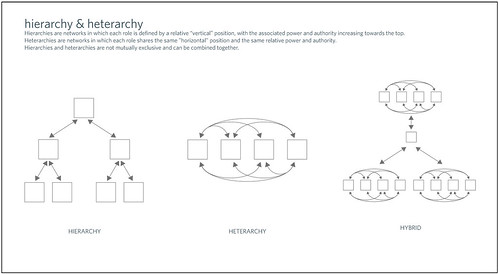
In her talk at TEDxKoeln Adriana Lukas outlines the five laws of heterarchy - "Those might one day help write recipes for building a society of peer to peer interactions." P2P does rely more on heterarchical structures, but there are inherent hierarchies in most (if not all) systems.

The P2P Foundation Wiki offers this definition of heterarchy by Timothy Wilken:
"Heterarchy is a very different breed of organizational strategy than hierarchy. It is a horizontal system with only one level of organization. All are equal within the heterarchy. Individuals within the system see each other as being on the same level. “We are a team.” “Its like a family rather than a job.” “We all respect each other.”

Heterarchy is ideal for communication and discussion, because it allows for the sharing of responsibility and authority within an informal environment. Task assignments following open discussions, produce more cooperative working relationships. In a setting where associates feel valued, openness and integrity emerge. Individuals often take much greater roles in the tasks of their departments. In this setting, there is less conflict, and this usually results in improvement in efficiency, productivity, and quality of work-life. Heterarchy creates a feeling of oneness — a feeling of community. Members of a heterarchy strongly identify with the whole system. Morale and espirit de corps are optimized. Because heterarchy is highly inclusive, all feel that they are a part of the system. This is in strong counter distinction to hierarchy's exclusiveness. Individuals within heterarchy tend to protect the system. Individuals within hierarchy often ignore the system, and sometimes even attack it. The wholistic focus of heterarchy is on the needs of the whole organization. This wholistic focus leads to collective decision making and collective responsibility.

Decision making in heterarchy is slower. It takes time to gain the consensus of all the individuals within the heterarchy. However, implementation is much more rapid because the attitudes of those responsible for implementation have been considered in the decision making process. This not only eliminates conflict, but also encourages all members to feel responsible for the successful implementation of the decision. Anyone who has ever built a house knows it is much less expensive to erase lines on a paper, than to demolish mortar, brick, and stone." (http://www.synearth.net/Restricted-Confidential/OT.pdf)
 TEDxKoeln - Adriana Lukas: Balanced Asymmetry of Networks or How to Avoid Hierarchies


TEDxKoeln - "Stories of(f) Balance" brought together passionate listeners and speakers, well able to not only be multiplicators of ideas but also to act on them, in an exchange of moving stories and bold ideas and thus TEDxKoeln joins the global discourse of concerned citizens.
I'm not sure why people are so phobic about hierarchies -  some systems function better with hierarchies and some function better with heterarchies. I'm not convinced that heterarchies are better than compassionate hierarchies - as is true in many things, both are probably useful in certain situations, even within the same system.

Thursday, April 21, 2011

Kevin Carson - Why Self-Organized Networks Will Destroy Hierarchies — A Credo

http://cb.pbsstatic.com/l/93/8693/9781419658693.jpg

Michel Bauwens, at the always educational and thought-provoking P2P Foundation, posted this "Credo" from Kevin Carson, which was originally posted at the Center for a Stateless Society on October 6, 2010. [Clicking on the image above will take you to the page for the book.]

I was not familiar with the CSS, but they have a lot of excellent content on their cite - very worth spending some time there. Carson also blogs at his Mutualist Blog: Free-Market Anti-Capitalism - this is the quote beneath the blog title:
To dissolve, submerge, and cause to disappear the political or governmental system in the economic system by reducing, simplifying, decentralizing and suppressing, one after another, all the wheels of this great machine, which is called the Government or the State. --Proudhon, General Idea of the Revolution
Cool stuff, imo - I have some more reading to do.
Why Self-Organized Networks Will Destroy Hierarchies — A Credo by Kevin Carson

Hierarchies are systematically stupid and inefficient, for the following reasons.

1. Hayekian information problems: The people in authority who make the rules interfere with the people who know how to do the job and are in direct contact with the situation. The people who make the rules know nothing about the work they’re interfering with. The people who make the rules are unaccountable to the people who do know how to do the work. Consequently, all authority-based rules create suboptimal results and irrationality when they interfere with the judgment of those in direct contact with the situation.

People in authority make stupid decisions because the people who know more than they do are their subordinates, and the only people who can hold them accountable know even less than they do.

The only way the people doing the work can get anything done is to treat irrational authority as an obstacle to be routed around, the same way the Internet treats censorship as damage and routes around it.

2. Groupthink: Hierarchies systematically suppress negative feedback on the results of their policies. As R.A. Wilson said, nobody tells the truth to a man with a gun. Hierarchies are very good at telling naked emperors how good their clothes look.

Hierarchies also systematically suppress critical thinking ability in their members. Psychological studies have found that people in positions of authority become less likely to evaluate communications based on their internal logic, and instead evaluate them based on the authority of the source.

3. Opacity from above: A major theme of “Seeing Like a State,” by James Scott, is that states try to make populations “legible” from above, and hence more amenable to control. We might add a “seeing like a boss” corrollary about the analogous phenomenon inside hierarchies. The problem is that such legibility is very costly, if not impossible, to achieve.

Hospitals are a good example. Most of the paperwork that nurses are required to fill out results from the fact that management doesn’t trust them to do what it wants them to do without some independent means of verification. But the paperwork is worthless, unless management operates on the assumption that those same nurses can be trusted to fill out the paperwork honestly. It all boils down to the fact that management knows their interests are diametrically opposed to those of the nurses, but there’s no way to actually get inside the nurses’ heads and look out through their eyes and thereby overcome this fundamental agency problem. So bosses constantly look for new, ineffectual gimmicks to get around the problem, resulting in endless layers of new paperwork that are as useless as the old paperwork.

Conclusion. To the extent that hierarchical organizations leave subordinates with freedom of exit, they are not coercive in the same way that the state is. But given that hierarchies are artificially prevalent because of state policies, and those who work within them do so as a necessary evil resulting from artificial constraints on the range of competing opportunities, the hierarchy resembles a microcosm of statist society, in which the agency and knowledge problems of authority internally mirror the irrationalities created by state authority in society at large.

So long as the predominant production methods required large aggregations of capital beyond the means of individuals and small groups, and corporate hierarchies were propped up by state ones, the cultural pathologies of hierarchy were surmountable. But technological change is rapidly eroding the requirement for capital outlays, nullifying the advantages of capital ownership, and increasing the vulnerability of hierarchy to external and internal attacks by self-organized networks.

So hierarchies, increasingly, lack the resources to compensate for their handicaps — even with help from the state. The state will only bankrupt itself, along with corporate hierarchies, in trying to prop up the old order.”

About the author:
C4SS Research Associate Kevin Carson is a contemporary mutualist author and individualist anarchist whose written work includes Studies in Mutualist Political Economy, Organization Theory: An Individualist Anarchist Perspective, and The Homebrew Industrial Revolution: A Low-Overhead Manifesto, all of which are freely available online. Carson has also written for such print publications as The Freeman: Ideas on Liberty and a variety of internet-based journals and blogs, including Just Things, The Art of the Possible, the P2P Foundation and his own Mutualist Blog.