Showing posts with label multiplicity. Show all posts

Saturday, March 05, 2016

Shrink Rap Radio #496 – Dreaming and the Dialogical Self with Prof. Hubert Hermans

http://ecx.images-amazon.com/images/I/41CitNdosCL._SX329_BO1,204,203,200_.jpg

Hubert Hermans' Dialogical Self Theory is one of the most robust and usable multiplicity-of-self models available. Dr. David Van Nuys speaks with Hermans on the dialogical self and dreams. The newest book is The Dialogical Self in Psychotherapy: An Introduction, being released today in paperback.

#496 – Dreaming and the Dialogical Self with Prof. Hubert Hermans

Hermans 0009 iov J/M

Hubert Hermans is professor emeritus at the Radboud University of Nijmegen, The Netherlands. He is best known as the creator of Dialogical Self Theory. He wrote books like The Dialogical Self: Meaning as movement (1993), co-authored by Harry Kempen, Self-Narratives: The Construction of Meaning in Psychotherapy (1995), co-authored by Els Hermans-Jansen, and Dialogical Self Theory: Positioning and Counter-Positioning in a Globalizing Society (2010), co-authored by Agnieszka Hermans-Konopka. He is editor of the Handbook of Dialogical Self Theory (2012), co-edited by Thorsten Gieser. 

Since 2002 he is president of the International Society for Dialogical Science (ISDS) and editor-in-chief of the International Journal for Dialogical Science (IJDS). He is initiator and chair of biennial International Conferences on the Dialogical Self, which are organized in different countries and continents. For his merits to society and science, he was, on behalf of the Queen of the Netherlands, decorated as Knight in the Order of the Netherlands Lion in 2002. 

Some of Hubert’s most impressive memories was when he looked, as a 6-year-old boy, in September 1944, at the passing soldiers of the American 30th Infantry Division “Old Hickory,” who liberated his place of birth, Maastricht, from the German occupation. Some months later, he survived a bomb attack which killed many neighbors living opposite his parents’ house. He describes such autobiographical events in his book Between Dreaming and Recognition Seeking (2012), in which he applies Dialogical Self Theory to his own life.

A psychology podcast by David Van Nuys, Ph.D.

Play

Tuesday, September 02, 2014

The Conversation: We’re Self-Obsessed – But Do We Understand the Nature of the Self?

This article from The Conversation on our understanding of the "self" is pretty basic, although it is interesting for what it is. The truth is that even those who have made the self the subject of their work - philosophers, neuroscientists, and other consciousness researchers - have very little agreement about whether or not we have a self, and, if so, what that self might be.

Further, there is the issue of multiplicity - the likelihood that we do not have one, unitary, continuous self but, rather, a collection of selves that are discontinuous but that the brain weaves into an illusion of a stable, persistent self.

There is also the issue of self and other, or as Martin Buber would have it, I and Thou. Without an other, from the moment of birth onward, we do not become a "self." Even after forming a solid self illusion, if we do not have contact with others, our sense of self diminishes. Buber's model is essentially relational.

Any who . . . .

We’re self-obsessed – but do we understand the nature of the self?

We live in an age of self-obsession. Everywhere we look, we encounter a preoccupation with self-interest, self-development, self-image, self-satisfaction, self-love, self-expression, self-confidence, self-help…


Michael Allen Fox - Adjunct Professor of Humanities at University of New England
31 August 2014


How much insight do we have into the philosophical problem of the self? Sara Lando

We live in an age of self-obsession. Everywhere we look, we encounter a preoccupation with self-interest, self-development, self-image, self-satisfaction, self-love, self-expression, self-confidence, self-help, self-acceptance … the list goes on.

An internet headline sounds a warning: Facebook and Twitter are creating a vain generation of self-obsessed people with childlike need for feedback, warns top scientist. In 2013 no less august an organ than the Oxford English Dictionary chose “selfie” as its “Word of the Year”.

Ask yourself whether any other time but the present could boast of successful print magazines called i or Me or Self?

“The self” is actually quite a problematic notion. Given the destiny of the self concerns us so much we could all benefit from a little insight into its nature.

I’ll present here the view that the self is an entity which constitutes itself through its own acts of choosing and doing, and which grows (and grows responsible) in the process.

The great philosophical sceptic David Hume puzzled about the self in his Treatise of Human Nature (1739):
For my part, when I enter most intimately into what I call myself, I always stumble on some particular perception or other, of heat or cold, light or shade, love or hatred, pain or pleasure. I never catch myself at any time without a perception, and never can observe anything but the perception.”
He inferred that what passes for the self is “nothing but a bundle or collection of different perceptions".

Hume was limited by his devotion to the Empiricist principle that the world must be understood solely as a construct derived from bits of experience woven together in various ways. Yet he raised a real issue: Where do we get the concept of self from and how do we justify it? Is the self to be included among the furniture of the universe, or is it merely an elusive fantasy (as Buddhism teaches)?


How much insight do we have into the philosophical problem of the self? MattysFlicks

Although there is much to debate concerning the self, belief in it can be defended.

Does this entail that it is part of our basic ontology, that is part of the inventory of what we believe to exist? Yes, and for two reasons:
  1. A sense of being someone and of having conscious awareness that is one’s own and no one else’s is essential to normal functioning in the world.
  2. Even if the concept of being a personal self is displaced within some broader spiritual or theoretical perspective, the self is no less immediately real to us right now than are physical objects, which can also be viewed at a deeper level as made up of particles and/or esoteric forms of energy.
So what is a self?

Hume is surely correct to state that it is not some thing that we can “stumble on” in our inner experience, or that is constantly present to our consciousness. Yet there is still room to argue that the self is a network of relationships forged by significant experiences (past and present), actions, and connections with people, places, things and events. The self therefore becomes “a bundle of relationships.”

And what we make of these relationships and do about them manifests who we are.

A self comes into being and perpetuates itself by means of choices and actions that create connections — relationships — with the world around us and with ourselves, which we integrate into our self-understanding as we move through life. The venerable 20th-century philosopher Bertrand Russell points out, in The Problems of Philosophy (1912), that relationships of various kinds are genuine aspects of the world that define the nature of individual entities.

One of these is what we call “reflexive self-awareness”, in which we make ourselves objects of our own scrutiny and judgement.

We might say that the self creates itself out of nothing; but more accurately, it arises out of our innate tendencies, which each of us develops in different ways, according to choice. Experiments on pre-linguistic children have shown that cooperative relationships with others are apparent at a very early age. See, for example, the work of Michael Tomasello in his book A Natural History of Human Thinking. These tendencies begin to help determine a self, even at the first stage of human development.

I suggest, then, that a self is the organised complex of relationships with people and other entities, events, states of affairs, memories and so on, established over time, and that the beliefs and values we adhere to are built up from our responses to what goes on outside as well as within our own self-consciousness. Strangely enough, this entails that the self exists within us and also extends outward spatially.

The self is, paradoxically, a self-made being.

For this reason, the question is:
What kind of self do I choose to be; and is there room in this self for the concerns of others to gain recognition and response – especially those in relation to whom I have become who I am?
Surely, confronting this question seriously is the cure for self-obsession.

Disclosure Statement
  • Michael Allen Fox does not work for, consult to, own shares in or receive funding from any company or organisation that would benefit from this article, and has no relevant affiliations.

Sunday, November 17, 2013

Remapping the Self: Neuroscience Gets Personal - Erika Casriel at TEDxNavesink


A brief but interesting talk from TEDx Navesink. Erika Casriel, an investigative journalist, has worked on staff at Rolling Stone, Vanity Fair and Forbes MediaCritic. She has written free-lance for such publications as the American Prospect, Natural Awakenings and Psychology Today, for which she wrote a cover story on overcoming shyness.

Remapping the Self: Neuroscience Gets Personal: Erika Casriel at TEDxNavesink


Published on Nov 16, 2013


Erika Casriel, investigative journalist and psychologist, discusses how self, previously thought to be the single "man in the machine" is being reconsidered as not just a single conductor, but a small orchestra of collaborative psychological functions.


"Remapping the Self," is about shifting the way we relate to our thoughts and emotions. In a raft of books such as Strangers to Ourselves: Discovering the Adaptive Unconscious, academic psychologists have been seeking to free us from our habits of self-delusion. These psychologists are rattling the bars of the safe mental cages we prefer to inhabit. I have tried to glimpse my own unconscious processes at work, and am excited and yes, embarrassed to report back to you on what I have seen.

Friday, November 01, 2013

The Multiplicity of Consciousness and the Emergence of the Self - Gerard O’Brien and Jon Opie


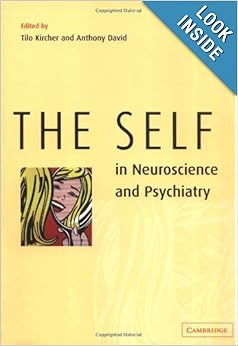
This article by Gerard O’Brien and Jon Opie appeared in The Self in Neuroscience and Psychiatry (2003). This is a draft version of the article dated 2000, but it is an excellent and interesting read - and their theory on self and consciousness is not dissimilar to that of Hubert Hermans' Dialogical Self Theory (see also Dialogical Self Theory: Positioning and Counter-Positioning in a Globalizing Society [2012] or Handbook of Dialogical Self Theory [2013]).

The Multiplicity of Consciousness and the Emergence of the Self

Gerard O’Brien and Jon Opie

Department of Philosophy, University of Adelaide, South Australia 5005
gerard.obrien@adelaide.edu.au
http://arts.adelaide.edu.au/Philosophy/gobrien.htm
jon.opie@adelaide.edu.au
http://arts.adelaide.edu.au/Philosophy/jopie.htm

In A. S. David & T. Kircher (eds.) The Self in Neuroscience and Psychiatry, Cambridge University Press, 2003. [Draft @ October 2000]

Abstract

One of the most striking manifestations of schizophrenia is thought insertion. People suffering from this delusion believe they are not the author of thoughts which they nevertheless own as experiences. It seems that a person‘s sense of agency and their sense of the boundary between mind and world can come apart. Schizophrenia thus vividly demonstrates that self awareness is a complex construction of the brain. This point is widely appreciated. What is not so widely appreciated is how radically schizophrenia challenges our assumptions about the nature of the self. Most theorists endorse the traditional doctrine of the unity of consciousness, according to which a normal human brain generates a single consciousness at any instant in time. In this paper we argue that phenomenal consciousness at each instant is actually a multiplicity: an aggregate of phenomenal elements, each of which is the product of a distinct consciousness-making mechanism in the brain. We then consider how certain aspects of self might emerge from this manifold substrate, and speculate about the origin of thought insertion.


1. Introduction


Schizophrenia is a complex and heterogeneous disease, incorporating at least three distinct subsyndromes: psycho-motor poverty (poverty of speech, lack of spontaneous movement, blunting of affect), disorganisation (inappropriate affect, disturbances of the form of thought), and reality distortion (Liddle 1987, Johnstone 1991). The reality distortion syndrome encompasses the so called "positive" symptoms of schizophrenia, which include auditory hallucinations, delusions of persecution and delusions of reference. Of these "thought insertion" is arguably the most bizarre. People suffering from this delusion believe that some of the thoughts they experience are not their own:
I look out the window and I think that the garden looks nice and the grass looks cool, but the thoughts of Eammon Andrews come into my mind… He treats my mind like a screen and flashes his thoughts onto it like you flash a picture. (Reported by Mellors 1970, p.17)
To get a feel for how bizarre this is, contrast thought insertion with the experience of hearing voices. The standard explanation of such auditory hallucinations is that the voice the schizophrenic ―hears‖ is actually inner speech which has been mis-identified as emanating from someone else. The error, in this case, is comprehensible: we‘ve all had the experience of being uncertain whether the noise we just heard was real or imagined.[1] Thought insertion, on the other hand, is not a case of mistaking an introspection for a perception. Those who suffer with this delusion are quite aware that the thought has arisen in their own minds. But despite this recognition they still disown it: the thought doesn‘t have any "my-ness" attached to it.

Given this symptomatology, it is not surprising that the working presupposition of most current research in this area (and the organising theme of the current volume) is that schizophrenia is, at least in its delusional form, a disease of the self. Despite this focus, what has not been sufficiently appreciated is how radically schizophrenia challenges our assumptions about the nature of the self. Crucial to being a human self is the possession of a certain sort of inner life, one which encompasses a distinction between one‘s own thoughts, feelings, and actions, and the world in which one is embedded. Conventional wisdom has it that this kind of self-consciousness is a unitary faculty, and, moreover, one that is of a piece with phenomenal consciousness in general. However, by demonstrating that it is possible to be aware of the boundaries of one‘s mind without acknowledging that all of the thoughts contained therein are one‘s own, the delusion of thought insertion suggests that this traditional conception of self-consciousness actually conflates two quite distinct capacities.

The first is the brain‘s capacity to distinguish its mind from the rest of the world. This capacity produces a sense of subjectivity: an awareness that certain thoughts, perceptions and feelings comprise the mental life of a single psychological subject. The second is the brain‘s capacity to distinguish between self-initiated thoughts and actions, and mental occurrences of which it is merely the passive recipient (e.g., perceptions). This capacity produces a sense of agency: the brain‘s awareness of itself as the source of the thoughts and imaginings that occur within its boundaries. [2] Thought insertion demonstrates that these two capacities can come apart: schizophrenics afflicted with this delusion believe that they are not the agents of some of the thoughts contained within their own minds. From this perspective, schizophrenia would seem to be a disease that undermines a person‘s sense of agency, while leaving their sense of subjectivity intact.

The distinction between theses two kinds of self-awareness, and the fact that they can be selectively impaired, means that it is no longer possible to talk of our experience of self as though it were a single, monolithic entity, and hence assume that there must be a single, all-encompassing explanation which does it justice. For example, the facts that explain the brain‘s capacity to draw a distinction between its mind and the world must be different from those which explain its capacity to represent itself as a cognitive agent. Furthermore, because subjects can experience certain thoughts and yet disown any agency in respect of them, the different aspects of selfhood would appear to be achievements over and above the brain‘s capacity to manufacture individual conscious experiences. In schizophrenia, in other words, we have a vivid demonstration that the self is a complex construction of the brain that is to some degree independent of its capacity to generate consciousness.

We would go further. We believe that schizophrenia offers a unique window on the cognitive operation of the brain. It reveals a relationship between the structure of consciousness and the brain‘s cognitive machinery that is very different from the conception which has dominated our thinking for centuries. Most theorists in this area, either explicitly or implicitly, endorse the traditional doctrine of the unity of consciousness, according to which a normal (intact) human brain generates a single consciousness at any instant in time (rather than several distinct consciousnesses), and hence a single stream of consciousness over time (rather than parallel tributaries). However, what we know of schizophrenia suggests that, far from being a unity, phenomenal consciousness at each instant is actually a multiplicity: an aggregate of phenomenal elements, each of which is the product of a distinct consciousness-making mechanism in the brain. We will call this, for reasons to be explained shortly, the multi-track model of consciousness, by contrast with the single-track model that is implicit in the doctrine of the unity of consciousness.

Our aim in this paper is to make good on these claims. We begin by introducing the multi-track model of consciousness, partly by contrasting it with its more conventional (single-track) counterpart, before considering the evidence for this model. We go on to consider how some aspects of self might emerge from the distributed and manifold substrate of consciousness, and enter into some speculations as to how the failure of this emergence gives rise to the symptoms of schizophrenia.


2. The Multiplicity of Consciousness


Many if not most contemporary theorists working in the field of consciousness studies endorse the doctrine of the unity of consciousness. According to this doctrine, the intact human brain produces a single consciousness at each instant, as opposed to several distinct consciousnesses. Here we argue that this doctrine is mistaken: far from being a unity, phenomenal consciousness is actually a multiplicity. Before proceeding, however, we must provide a clearer picture of what the supposed unity of consciousness entails about the way the brain makes consciousness.

2.1 What does the unity of consciousness entail?

At the outset let us quickly dispense with a naïve, albeit influential, understanding of the unity of consciousness. Some would have it that consciousness is a unity because it is a serial stream comprising a single informational content at each moment (see, for example, Penrose 1989, p.399). Like a solo chorister, who, by virtue of the limitations of the human vocal folds, can only produce one note at a time, consciousness is taken to be single-voiced or monophonic. This reading of the unity of consciousness can hardly be sustained. Even the most casual inspection of instantaneous conscious experience shows it to contain contents drawn from a number of different modalities. Sound and vision, for example, don‘t compete for a place in awareness; both are simultaneously present. You may not be able to simultaneously react to, or focus on, disparate sources of experience, but the phenomenology they generate can certainly co-occur.

If we suppose that consciousness incorporates a number of distinct contentful elements at each instant, then it is best likened to polyphonic choral music. Musical polyphony involves two or more simultaneously active voices, such that at any moment there are a number of different notes being sounded. We think it is safe to say that most theorists regard moment by moment consciousness as informationally polyphonic. However, a question immediately arises for an advocate of the unity of consciousness: If consciousness is polyphonic, in what sense is it a unity? The unity on offer can‘t be the unity of an undifferentiated whole, because, by assumption, experience is actually a composite structure: it is assembled from numerous contentful elements that have been fused together in some way. The polyphony of consciousness entails, therefore, that any proponent of the traditional doctrine of the unity of consciousness is committed to there being a single consciousness-making mechanism or process in the brain, whose task it is to bind these different contents together into a unity. On the one hand, the task of combining multiple representational contents in a single experience must be performed by some physical mechanism or process. And on the other, if we suppose that the brain implements more than one such mechanism or process, then it must be capable of simultaneously generating more than one experience, contrary to the unity doctrine.

Given this constraint, there appear to be only two roads open to the advocate of a polyphonic, but unitary consciousness: 1) treat conscious experience as the product of a single, central neural system where informational contents must be re-presented to be made conscious, or 2) opt for a somehow unitary consciousness-making process that acts simultaneously on the brain‘s many distinct information processing sites.

A representative example of the former approach is Baars‘ "Global Workspace" model of consciousness (1988, 1997). Baars begins with the premise that the brain contains a multitude of distributed, unconscious processors all operating in parallel, each highly specialised, and all competing for access to a global workspace – a kind of central information exchange for the interaction, coordination, and control of the specialists. Such coordination and control is partly a result of restrictions on access to the global workspace. At any one time only a limited number of specialists can broadcast global messages (via the workspace), since different messages may often be contradictory. Those contents are conscious which gain access to the global workspace (perhaps as a result of a number of specialists forming a coalition and ousting their rivals) and are subsequently broadcast throughout the brain (1988, pp.73-118).

In support of this model, Baars claims there is a brain structure suited to the role of workspace, namely: the Extended Reticular-Thalamic Activating System (ERTAS), which includes the reticular formation, the thalamus, and the "diffuse thalamic projection system" (p.124). The ERTAS is particularly suited to the role of "global broadcaster," given the bidirectional projection system that it incorporates. Moreover, there is "evidence of a feedback flow from cortical modules to the ERTAS" and of global information feeding "back into its own input sources." Baars suggests that "[both] kinds of feedback may serve to strengthen and stabilize a coalition of systems that work to keep a certain content on the global workspace." That is, given the competitive nature of access to consciousness, "a circulating flow of information may be necessary to keep some contents in consciousness" (p.134).

This kind of model provides an explanation for the unity of consciousness, because the ERTAS acts as an executive composer and broadcaster. Its role is to combine a number of distinct contents hailing from different sense modalities into a single work, which it then broadcasts polyphonically. The unity of consciousness, on this story, is not imposed by the seriality of the stream of contents broadcast (as would be the case with a monophonic executive), but by virtue of there being a single broadcasting mechanism.

As to the second route available to the advocate of the unity of consciousness in the face its manifest polyphony, a number of neuroscientists have suggested that distributed time-locked neural oscillations might fit the bill. Consider, for example, Damasio‘s proposal:
The integration of multiple aspects of reality, external as well as internal, in perceptual or recalled experiences, both within each modality and across modalities, depends on the time-locked co-activation of geographically separate sites of neural activity within sensory and motor cortices, rather than on a neural transfer and integration of different representations towards rostral integration sites. The conscious experience of these co-activations depends on their simultaneous, but temporary, enhancement…against the background activity on which other activations are being played out. (1989, p.39)
Damasio here explicitly repudiates the central theatre model, and builds his account around the known parcellation and distribution of information processing in the brain. What brings content-bearing activity to consciousness is its temporary enhancement as a result of time-locked co-activation with contents coded elsewhere in the brain. Time-locking "integrates" contents coded at "geographically separate sites," which are then capable of simultaneously entering consciousness. Time-locked enhancement is thus a candidate for a single consciousness-making process. This putative process occurs simultaneously at many separate sites, and is unitary in virtue of being phase-locked, or falling within a single well defined temporal window of some kind.

2.2 Single-track versus multi-track models of consciousness

It is reasonable to ask whether such approaches to consciousness are the only option. Once it is acknowledged that instantaneous consciousness is polyphonic, and once this fact is considered in the light of the parcellation of information processing in the brain, an alternative way of thinking about the relationship between the structure of consciousness and brain activity clamours for attention. Instead of requiring that the multiple contents of moment by moment experience be re-presented in some central system, or that they be integrated in a single global process, why not suppose that these contents contribute to instantaneous experience via multiple mechanisms of consciousness-making scattered across the brain?

We can‘t resist employing another musical metaphor here to clarify this alternative polyphonic model of consciousness and to distinguish it from its more orthodox counterpart (see O‘Brien & Opie 1998). Before the advent of modern studios the only way to record music was to get all the musicians in a room together, place a microphone in their midst, and start up the band. The signal from the microphone would then go through a limited amount of processing before leaving a groove on a wax disc, or more recently, a magnetic trace on a tape. Such a recording is said to be single-track, since there is no way to separate out the individual contributions of the musicians—they are packaged into a single structure. By contrast, on a multi-track recording one or more separate tracks is devoted to each musical instrument. As a result, while all the musical parts combine to make up the total sound during playback, at the level of the recording one can distinguish between them.

The polyphonic models surveyed thus far are all single-track theories of consciousness. Whether one treats conscious experience as the product of a single, central neural system where informational contents must be re-presented to be made conscious, as in Baars‘ account, or whether one opts for a unitary consciousness-making process that acts simultaneously on the brain‘s many distinct information processing sites, as in Damasio‘s story, one assumes that at the level at which it is made by the brain, instantaneous consciousness is a single thing. When it comes to consciousness-making, the normal brain has just one track. By contrast, a multi-track theory of consciousness regards instantaneous consciousness as being made up of a number of parallel tracks: a collection of phenomenal elements, each generated by a distinct mechanism in the brain.

It might be objected that information in one sensory modality sometimes influences the content of experience in another. A salient example is the McGurk effect, whereby what subjects report hearing is partly determined by what they see. [3] This looks problematic for a multi-track account because the various parts of the polyphonic mix don‘t appear to be truly independent of one another. But the multi-track account is committed only to the claim that the various parts of experience are generated locally, at the very sites where their information contents are fixed. This does not require content-fixations to be completely causally independent of one another. At any given moment there are presumably all sorts of influences, both intra-sensory and inter-sensory, criss-crossing the brain, such that conscious contents not only co-occur, but mutually influence and shape one another. Such causal links are perfectly consistent with the multi-track model, so long as the consciousness-making mechanisms themselves are manifold and localised.

The distinction between single-track and multi-track approaches to consciousness is not well-appreciated in the literature. [4] Because of their unquestioning allegiance to the traditional doctrine of the unity of consciousness, most theorists don‘t even entertain the possibility of a multi-track theory. As a result they overlook what we think is a more parsimonious account of consciousness, one that is more consistent with both our moment by moment phenomenal experience and our neuroscientific understanding of the mechanisms subserving cognition. In the next subsection we examine the evidence, both phenomenological and neuroscientific, in favour of this alternative approach to explaining how the brain makes consciousness.

2.3 Evidence for the multi-track model of consciousness

Consider, first, the phenomenological evidence. Close attention to instantaneous experience reveals it to be a complex aggregate of many elements. Right now, for example, as you concentrate on these sentences, your phenomenal experience is a very rich, comprising: visual experiences (the shapes, textures and colours of these sentences, together with other objects in the room), auditory experiences (noises from outside the room), tactile experiences (the chair pressing against your body), proprioceptive experiences (the position of your limbs), and understanding experiences (what these words and sentences mean), to name a few. These parts are relatively independent, because they can be altered or lost without substantially affecting the others (try closing your eyes for a moment); like the parallel tracks on a multi-track recording, the loss of any one mode of consciousness merely reduces the total "sound."

This independence among the parts of experience is even evident, to some extent, within modalities. Consider the figure below. It can be seen as a flight of stairs in normal orientation, with rear wall uppermost; as an inverted flight of stairs, with front wall uppermost; or even as a flat line drawing, with no perspective. And whichever of these interpretations one adopts, the details of line and colour remain the same. That is, our experience here incorporates not only lines, and regions, but also some abstract phenomenology (a sense of perspective) which is subject to a degree of voluntary control. What is striking here is the looseness of fit between the more abstract and the more concrete parts of experience. It seems that, like a sound engineer, we have some capacity to control which parts go into the mix, and how they will sound.


Figure: Inverting stairs

Although this evidence is suggestive of the multi-track model, it is strictly speaking equivocal where the single-track/multi-track distinction is concerned. The case for multi-track polyphony starts to look quite compelling, however, when these phenomenological data are combined with a range of neuroscientific findings. Neurologists have long studied the experiential consequences of brain injury. They observe complicated patterns of ablation and sparing, both across and within modalities. It is possible, for example, to lose the capacity to visually detect (or experience) motion, while retaining other aspects of visual experience (Zeki 1993, p.82), or to lose colour sensations, while retaining visual form and motion experiences (Sacks 1995, pp.1-38). Phenomenal deficits of this kind are now known to be the result of lesions in specific parts of the brain. Lesion studies have, in fact, been instrumental in establishing the degree and kinds of functional specialisation and localisation in the brain. The picture that is emerging is of a brain which divides and conquers, with broad divisions among modalities and task domains reflected in large-scale anatomical divisions (e.g., primary visual processing in occipital cortex, auditory processing in temporal cortex, planning and working memory in frontal cortex), while more fine-grained functional distinctions are reflected in correspondingly restricted anatomical divisions and loci (e.g, visual motion detection in area V5, colour processing in V4). Other kinds of studies, such as fMRI, PET, micro-electrode and ERP, which are effective over a wide range of spatial and temporal scales, have lately confirmed and enriched this picture with regard to both normal and abnormal function.

The following picture emerges: pathological losses of phenomenology are associated with brain lesions at specific sites, while transient but related alterations in experience (caused by changes in input or task demands) are found to co-vary with activity at these same sites. Thus, variations in conscious experience appear to march in lock-step with reproducible, physically localised variations in brain activity, variations, moreover, at brain sites where the relevant informational contents are thought to be encoded. From here it is a short step to the following conclusion: the brain sites that code for particular informational contents are the very sites where those contents are made conscious. Since the contents and associated brain loci are multiple, phenomenal consciousness is multi-track.

A further, tantalising, piece of evidence for the multi-track model has recently been discovered by Zeki and Bartels. They discuss experimental work on visual processing that suggests that when the different attributes of a visual scene are presented simultaneously, these attributes are not perceived at the same time. It appears that colour is perceived before orientation, which in turn is perceived before motion, the difference between colour and motion being about 60-80 ms (Bartels & Zeki 1998, p.2329). Experiments in which subjects are asked to pair two rapidly alternating states of two attributes (e.g., a bar with two possible orientations and two possible colours), reveal systematic misbinding of attributes relative to their actual time of occurrence (Zeki & Bartels 1998, p.1583). This suggests to Zeki and Bartels that there are "multiple visual micro-consciousnesses which are asynchronous with respect to each other" (p.1584), which in turns leads them to advocate a multi-track theory: "consciousness is not a unitary faculty, but…consists of many micro-consciousnesses" (Bartels & Zeki 1998, p.2327).

The upshot of all this is that the multi-track model of phenomenal consciousness has to be taken quite seriously. It is consistent with the phenomenological and neuroscientific evidence, and doesn‘t succumb to any obvious a priori objections. Rather, this model appears a viable alternative to current single-track orthodoxy.


3. The Emergence of the Self


One area where abandoning the traditional doctrine of the unity of consciousness has major ramifications is in our understanding of the self. Single-track theorists typically explain how the brain constructs a self by deploying exactly the same resources they use to explain the generation of conscious experience. From this perspective, the self and its experiences represent a package deal: the very existence of the latter presupposes the existence of the former. [5] This is part of the "conventional wisdom" to which we alluded in the introduction. But it is wisdom that is put under pressure by the symptoms of schizophrenia. Schizophrenia, in its delusional variant, is a condition that impairs some aspects of self-consciousness while leaving others intact. In particular, sense of agency can come apart from sense of subjectivity. This suggests that the self, when all is well, is a complex entity constructed out of independently conscious parts: a multiplicity, not a unity.

In this section we briefly discuss these implications of the multi-track model of consciousness for the nature of the self, and examine some recent speculations about the neurological basis of schizophrenia which support this perspective.

According to the multi-track model, conscious experience is not unitary; it is a complex amalgam of co-conscious elements, each generated by a distinct consciousness-making mechanism somewhere in the brain. If one adopts this perspective then it is no longer possible to regard self-consciousness as the product of a centralised workspace, or of a single global process such as time-locked co-activation. Consciousness ceases to be a package deal as far as its neural realisation is concerned — there are as many independent physical loci of consciousness as there are distinct information processing paths in the brain. This means, of course, that our conjectures about the degree of parcellation of self-directed experience are answerable to the neurocomputational facts. But the symptoms of schizophrenia already offer some grounds for expecting there not to be a single neural locus of self and self-consciousness. At a first pass, then, we ought to be wary of the view that the conscious self is physically unitary in the strong sense implied by the doctrine of the unity of consciousness.

As it happens, current conjectures about the neural basis of schizophrenia provide a good deal of support for this multi-track perspective on the self. It is widely held that the positive symptoms of schizophrenia are a pathology of agency, involving changes in the consciousness of action (Frith et al 1998, Georgieff & Jeannerod 1999). The leading hypothesis about the physical basis of the disease is that it results from a breakdown in communication among a number of brain regions, including frontal, temporal and cingulate cortices, and various subcortical structures. This lack of integration is thought to be a kind of temporal disconnection syndrome caused by the desynchronisation of numerous widely distributed neural systems (Cleghorn & Albert 1990, Vogeley 1999). Hand in hand with this hypothesis goes a view about the neural basis of self, namely, that it depends on many distinct centres of self-representation within the brain; from cortical regions associated with somatotopic body mapping and action mapping, through regions that function to distinguish between self-initiated and externally caused events (Georgieff & Jeannerod 1998), up to regions such as prefrontal cortex that play a crucial role in organising behaviour. Georgieff and Jeannerod conclude that:
…functions like agency or self-consciousness cannot be mapped on a single localization, even if the involved area seems to fulfill criteria for such a function, in terms of multimodal coding, spatial and temporal integration, etc. The solution to this problem would be to continue further in the direction of fractionating such broad entities as self-construct into more operational elements, and then to relate these elements to specific cortical functions. (1999, Sect. 2.2)
On a view like this, self-consciousness clearly comes out as multi-track, and the changes in sense of agency associated with schizophrenia as failures of integration among distinct self-representing regions, probably caused by their temporal disconnection.

But if phenomenal consciousness, and self-consciousness, in particular, are multi-track, what is one to make of the impression most of us have of being a single, integrated subject? Or, to put it more tendentiously: How does a self emerge from the multiplicity of consciousness? This is a difficult question, largely because there are several senses in which one might claim to be a "single subject." Without entering into that murky territory here, we can offer one relatively straightforward answer that is consistent with the multi-track model of consciousness: a self emerges when the multiple tracks of self-directed experience produced by the brain are sufficiently representationally coherent. [6] Representational coherence concerns the way the various contents of experience relate to each other. In normal circumstances we don‘t experience a ―blooming, buzzing confusion‖, but a structured world of discrete objects arrayed in space, a world in which events unfold in a regular, law-like way, and in which informational contents fall into meaningful spatiotemporal patterns. This registration of contents, which is both intra-modal (e.g., colour and form) and inter-modal (e.g., the registration of proprioceptive, auditory and visual contents as one types on a keyboard), also occurs at the level of specifically self-directed representations. Thus, I typically recognise an action as mine as I perform it, am aware of how it fits with my plans, and discover how it affect things about me (and vice versa), all in a real-time, rapidly up-dated feedback cycle.

Representational coherence is not an invariable feature of conscious experience—it is a hard-won computational achievement, as demonstrated by the many cases (often the result of trauma) in which the brain fails to produce an integrated model of the world. [7] The emergence of a self therefore presumably depends on some mechanism that acts to bring the multiple, locally generated contents of conscious experience into register with one another. In particular, such a mechanism must render coherent the multiple streams of self-representation upon which so much of our behaviour depends. A promising manoeuvre for the multi-track theorist is to appropriate one of the neural mechanisms/processes that single-track theorists deploy to explain the production of consciousness, and redeploy it in the new role of explaining the brain‘s construction of a self. For example, the multi-track theorist might focus on the ERTAS as a neural structure likely to be involved in global communication and integration, as does Baars, but treat it as a self-maker, rather than a consciousness-maker.

If we adopt this proposal then it is possible to regard instantaneous consciousness as a multiplicity, rather than a unity, and yet still claim that it is "unified." The sense in which consciousness is "unified" is not a matter of oneness, but a matter of representational coherence. Such coherence, perhaps courtesy of the ERTAS (cortico-cortical circuits may play a role too), goes some way towards explaining how a self emerges from the multiple strands of representational activity in the brain. This proposal is attractive in the current context because it is reasonable to conjecture that schizophrenia is a disease which impairs the capacity of consciousness-making mechanisms to produce a coherent set of experiences. Instead, possibly as a result of desynchronisation, these mechanisms operate in an autonomous fashion, producing experiences whose contents are disconnected and discontinuous with one another. This gives rise to the familiar symptoms of schizophrenia. In the case of delusions of thought insertion, for example, it is precisely because one part of the brain generates a thought that is representationally discontinuous with mental contents being produced elsewhere that the patient judges it to be alien, and hence disowns it. What we see here is a partial disintegration of the self, but not in the sense of the self failing to be a single thing—on the multi-track view it was never that in the first place—rather, in the sense that the many self-directed representations produced by the brain no longer hang together as a coherent system.

We finish with a word of caution. Although representational coherence may play a pivotal role in the emergence of our sense of agency, it is not clear that it can account for what we earlier termed our "sense of subjectivity." Schizophrenics and others who suffer quite radical breakdowns in the connectedness and continuity of their experience generally have no doubt that these anomalous experiences belong to them (see above). The representational incoherence of the parts of experience doesn‘t appear to undermine the phenomenal "togetherness" that characterises a single subject of experience. A multi-track theorist must therefore appeal to a different set of resources to account for this feature of consciousness. One possibility is that such subject unity depends on some feature of brain organization more basic than that which is responsible for representational coherence. For example, the very causal connectedness of the brain as a whole, which is such that a signal can pass from any part of the brain to any other via no more than half a dozen synapses, might be the physical basis of subject unity—even under conditions where representational coherence has broken down. The detailed working out of this proposal is, however, a task we must leave for another time.

Notes

1. There is evidence, however, that many of the delusions classified as verbal hallucinations are much closer in their phenomenology to thought insertion. See Graham & Stephens 1994, pp.94-97.
2. The distinction between subjectivity and agency is nicely developed in Graham & Stephens 1994.
3. See McGurk & MacDonald 1976. We owe this example to Tim Bayne. For Bayne‘s critique of the multi-track model, and our reply, see Bayne 2000 and O‘Brien & Opie 2000, respectively.
4. The only other place we have seen this distinction explicitly drawn is in a recent discussion of consciousness by Searle (2000). Searle distinguishes between what he calls the unified field approach (single-track model) and the building block approach (multi-track model). Having said that, Damasio shows himself to be alive to the possibility of a multi-track theory (see his 1999, esp.pp.123-4 and pp.165-6)
5. See, for example, Damasio 1999.
6. We use the word ‗sufficiently‘ in this characterisation advisedly, since it renders selfhood a matter of degree. We regard this as a strength of the proposal.
7. To take a single example, subjects recovering from damage to striate cortex sometimes have quite peculiar visual phenomenology as the visual elements that are normally bound individually "reappear":
At first the patient will see pure motion (usually rotary) without any form or colour. Then brightness perception returns as a pure Ganzfield – a uniform brightness covering the whole visual field. When colours develop they do so in the form of ‗space‘ or ‗film‘ colours not attached to objects. The latter develop as fragments which join together and eventually the colours enter their objects to complete the construction of the phenomenal object. (Smythies 1994, p.313)
Normal integration of colour and form to produce coherent objects is initially absent here. Schizophrenia likewise results from an inability to integrate distinct informational contents, but at the level of self-consciousness, such that self-initiated actions or thoughts fail to be recognised as one‘s own.


References

  • Baars, B.J. 1988. A Cognitive Theory of Consciousness. Cambridge University Press.
  • Baars, B.J. 1997. In the Theater of Consciousness: The Workspace of the Mind. Oxford University Press.
  • Bartels, A. & Zeki, S. 1998. The theory of multi-stage integration in the visual brain. Proc. R. Soc. Lond. B 265: 2327-32.
  • Bayne, T. 2000. The unity of consciousness: Clarification and defence. Australasian Journal of Philosophy 78: 248-54.
  • Cleghorn, J. M. & Albert, M. L. 1990. Modular disjunction in schizophrenia: A framework for a pathological psychophysiology. In A. Kales, C. N. Stefanis & J. Talbot (eds.) Recent Advances in Schizophrenia, Springer Verlag.
  • Damasio, A. 1989. Time-locked multiregional retroactivation: A systems-level proposal for the neural substrate of recall and recognition. Cognition 33: 25-62.
  • Damasio, A. 1999. The Feeling of What Happens: Body and Emotion in the Making of Consciousness. Harcourt Brace.
  • Frith, C., Rees, G. & Friston, K. 1998. Psychosis and the experience of self. Annals of the New York Academy of Sciences 843: 170-8.
  • Georgieff, N. & Jeannerod, M. 1998. Beyond consciousness of external reality: A who system for consciousness of action and self-consciousness. Consciousness and Cognition 7: 465-77.
  • Georgieff, N. & Jeannerod, M. 1999. Deconstruction of self-consciousness in schizophrenia. Contribution to the ASSC e-seminar The Human Self Construct and Prefrontal Cortex in Schizophrenia http://www.phil.vt.edu/ASSC/vogeley/georgieff1.html
  • Graham, G. & Stephens, G.L. 1994. Mind and mine. In G. Graham & G. L. Stephens (eds.) Philosophical Psychopathology. MIT Press.
  • Johnstone, E. C. 1991. Defining characteristic of schizophrenia. British Journal of Psychiatry Suppl. (13): 5-6.
  • Liddle, P. F. 1987. The symptoms of chronic schizophrenia: A re-examination of the positive-negative dichotomy. British Journal of Psychiatry 151:145-51.
  • McGurk, H. & MacDonald, J. 1976. Hearing lips and seeing voices. Nature 264: 746-48.
  • Mellors, C. S. 1970. First-rank symptoms of schizophrenia. British Journal of Psychiatry 117:15-23.
  • O‘Brien, G. & Opie, J. 1998. The disunity of consciousness. Australasian Journal of Philosophy 76: 378-95.
  • O‘Brien, G. & Opie, J. 2000. Disunity defended: A reply to Bayne. Australasian Journal of Philosophy 78: 255-63.
  • Penrose, R. 1989. The Emperor’s New Mind. Penguin.
  • Sacks, O. 1995. An Anthropologist On Mars. Picador.
  • Searle, J. 2000. Consciousness. Annual Review of Neuroscience 23: 557-78.
  • Smythies, J.R. 1994: Requiem for the Identity Theory. Inquiry 37: 311-29.
  • Vogeley, K. 1999. Cortico-cortical and subcortical implementation of the self construct. Contribution to the ASSC e-seminar The Human Self Construct and Prefrontal Cortex in Schizophrenia http://www.phil.vt.edu/ASSC/vogeley/vogeley9.html
  • Zeki, S. 1993. A Vision of the Brain. Oxford: Blackwell.
  • Zeki, S. & Bartels, A. 1998. The asynchrony of consciousness. Proceedings of the Royal Society, London, B 265: 1583-5.

Monday, October 14, 2013

David Eagleman's Secular Sermon on Knowing One's Selves


This is an excellent talk from neuroscientist David Eagleman, author of the excellent Incognito: The Secret Lives of the Brain (2011), Wednesday Is Indigo Blue: Discovering the Brain of Synesthesia (2011), and Sum: Forty Tales from the Afterlives (2009), this last one a strange and wonderful collection of short stories on possible afterlives, grounded in the complexity of our human condition.

In this talk, from Alain de Botton's The School of Life in London, Eagleman talks about our multiplicity - that we are in many ways, multiple selves rather than a single unified self. In this model, many of the selves we live through are not even available to our awareness.
"It turns out that almost everything that you think and do and you act and you believe is generated by parts of your brain that you don't have access to."
Excellent talk.

David Eagleman's Secular Sermon on Knowing One's Selves


By Trent Gilliss | Friday, September 7, 2012


During the past week, we watched and listened to a half-dozen or more "secular sermons," as Alain de Botton calls them, from The School of Life in London. These are weekday or Sunday meetings that are rich with singing and presentations by Mr. de Botton himself, as well as a wide array of outside speakers from all types of disciplines. Our task: to find about a minute of audio from one of these secular sermons that gives listeners a more visceral sense of what he's describing:
We've had terrific success by hosting what we're calling secular sermons. Why are we calling them sermons? It's to try and suggest that listening to them is not simply going to be an intellectual exercise, you know, fascinating little bit of knowledge, a way to show off to friends about new stuff you've learned. It's actually going to be something that will hope to steer how you live. So it's didactic, you know, it's explicitly moralistic not in a kind of starched, Victorian way, but in the best possible sense. It exhorts you to a kind of better, fuller life and why not? Why should these pretty quite nice maneuvers only be the preserve of religion? As I say, they really are for all of us.

We ended up excerpting part of neuroscientist David Eagleman's lecture on "being oneselves." Dr. Eagleman holds joint appointments in the Departments of Neuroscience and Psychiatry at Baylor College of Medicine in Houston, Texas, and is the founder and director of the Initiative on Neuroscience and Law. In this secular sermon, he focuses on how our conscious mind represents only a small portion of who we are: "It turns out that almost everything that you think and do and you act and you believe is generated by parts of your brain that you don't have access to."

He follows by saying that each person is not one singular body, but an amalgamation of many parts that are competing with one another. He likens our brains to conflicted democracies engaged in these internal battles with each other: emotion versus reason, how we make decisions in time and the appeal of right now, and the moral contracts (check out the part about the "Ulysses contract" at the 30-minute mark!) we make with ourselves.
"And I think the thing for all of us to think about, all the time, is how are we lashing ourselves to the mast. We all have weaknesses and things that we want to do better. And as we come to understand more about ourselves, there's this issue of what can we do to — to combat this? How can we really think hard about structuring things in our lives so we don't do the wrong things? And I think this gives us traction, you know, understanding what's going on under the hood gives us traction on old philosophical problems and ways to think about things.

Just think about the concept of virtue. I think that virtue has to do with the battles between these populations. If you've got a real drive to do something you want it so badly and yet you override that with more long-term decision making, with the parts of your brain that care about the deferred gratification verses the parts that care about, I want it right now. If you have that battle and you're successful, I think that's what we mean by a virtuous person. . . .

I think virtue comes at people's point of struggle, right when the parliament is sort of evenly balanced and they have real decision to make there about which way it tips."

Monday, July 01, 2013

Documentary - Helen: The Woman with 7 Personalities (and more)


This first documentary is a look at the life of Helen, a woman with seven identified parts, or ego states, or alters. She is a woman with dissociative identity disorder (sometimes known as structural dissociation). Her reported history includes satanic and sexual abuse as a child (the only common denominator in most DID diagnoses is severe and on-going childhood abuse and neglect).

Seven parts is a relatively small number for most reported DID cases - many reports have documented more than 10 and as many as 100 (although some of the parts in cases with such high numbers are little more than fragments of emotions belonging to one or more other parts).

Helen: The Woman with 7 Personalities

The Woman With Seven Personalities - Multiple Personality Disorder: Helen and Ruth were best friends at school. Helen, according to Ruth, was one of the prettiest and cleverest girls in the class. Whenever Ruth thinks of school she thinks of the fun times she shared with Helen. Soon after leaving school, however, they lost contact. Fourteen years later Helen and Ruth bumped into each other by chance on a train. As they sat together on the train, Helen told Ruth that she had Multiple Personality Disorder, claimed she had been satanically and sexually abused as a child and had tried to take her own life on a number of occasions. Since that meeting six years ago Ruth and Helen have begun to rekindle their old friendship. Helen wanted to make this documentary to raise awareness of Multiple Personality Disorder, now known as Dissociative Identity Disorder

This film follows Ruth on her journey of discovery into Helen's world. We accompany her as she gets to know her friend again, as she tries to find out what happened to Helen in the fourteen years they were apart and to understand what it means for Helen to live with Multiple Personality Disorder (MPD), which is now known as Dissociative Identity Disorder (DID).

Here is the list of Helen's inner family:
  • Alex, A five year old boy who loves shooting toy guns.
  • William, A six year old boy who loves the Mr. Men.
  • Adam, A lovable ten year old boy who is not allowed to play outside.
  • Brenda, An outspoken, feisty 13 year old girl
  • Karl, A sixteen year old boy with an attitude and a temper.
  • Jamie
  • Elizabeth
Helen will switch from her self personality to one of the alter personalities at a moment’s notice and have no recollection of the time spent in the other personality. Under the personalities of Karl and Brenda, Helen would drink and take drugs. She became an alcoholic and overdosed over 100 times. She has since recovered from the alcoholism and the overdoses, were clearly not fatal.

Ruth was determined to discover what may have caused these personalities to form and was horrified when Helen confided in her that she had been extensively abused as a child and had created the first personalities to distance herself from the horrors. Karl and Brenda provide escape by causing physical pain by means of self-harm to block the emotional trauma, while the younger personalities allow escape to various ages of her childhood.

But wait, there's more . . . if you simply scroll down there is another documentary on dissociative identity disorder (multiple personalities to most folks). This is an old HBO documentary from the 1990s and, while our understanding of DID has increased considering, this one-hour show provides a basic introduction to the experience and development of DID.

Oh, and just in case you think we have moved beyond the idea that dissociative identities are demon possession (an idea raised in the film below), I have worked with people with DID who were told they were possessed by demons by their church pastors, and who tried an exorcism to pray the demons away. Needless to say, it did not work.

Multiple Personalities

Film by: HBO / Michael Mierendorf / Gloria Steinem
Year: 1993
In early times, evil spirits were thought to possess people and make them act in strange and frightening ways. By the 1800’s, the study of this hysteria led some doctors to believe one person could have separately functioning personalities.

In a rare research film from the 1920’s, a woman has different personalities who believes they are separate people. One is a male that is not comfortable in women’s clothes. Another is a small child. The affliction has been known by different names, but recognized for centuries. Today it is called multiple personality disorder.

Why have they become tormented and broken into different personalities? What is the childhood pain that lies buried in the unknown depths of their mind? How can they search for the deadly memories that holds the secrets of their paths and the promise of their healing?


Thursday, March 21, 2013

Eleanor Longden at TED2013 - Living with Voices in Your Head

Eleanor Longden is one of the creators of Inter.Voice: The International Community for Hearing Voices. The video below is her talent audition for TED2013, in which she discusses her own experience of hearing voices (more on this below the article). Hearing voices is a more extreme version of the multiplicity we all have inside of us - but most of us do not hear our parts as distinct voices.


The full TED video is not available yet, but Helen Walters posted a summary of the talk.

Living with Voices in Your Head: Eleanor Longdon at TED2013 

Posted by: Helen Walters
February 28, 2013 


Photo: James Duncan Davidson 

Eleanor Longden did well at school, and gleefully entered student life at university in England. By all appearances, she was a happy, typical student … but it wasn’t true. Underneath it all, Longden was “fundamentally frightened,” and while she did a good job of concealing her fear, she was about to come undone. She started to hear the voice in the second term of that first year, a narrator in her head calmly describing everything she did in the third person. The voice was neutral, impassive, even reassuring, though it would sound frustrated were Longden to hide her anger. “It was clear that it had something to communicate to me about my emotions, particularly emotions that were remote and inaccessible,” she says.

Longden’s first fatal mistake was to tell a friend about the voice. That didn’t go so well–the implication was that normal people don’t hear voices–and she was persuaded to go to a doctor, her next mistake. ”She is digging her own grave,” the voice said at the appointment. Doctors don’t like voices in heads, and things began to unravel. Hospital admissions followed, then a diagnosis of schizophrenia, and then a “psychic civil war.” The voices increased and grew menacing, and Longden retreated into a nightmarish world. It’s hard to listen. “A vicious cycle of fear, avoidance, mistrust, misunderstanding had been established.”

Two years later, her deterioration had been dramatic. The voices had turned terrifying, and her mental health status was a catalyst for verbal, even sexual assault. A doctor told her, “Eleanor, you’d be better off with cancer; it’s easier to cure than schizophrenia.” She even attempted to drill a hole in her head to get rid of the voices.

Yet Longden is a survivor: “Many people have harmed me, and I remember them all, but the memories grow pale in comparison to the people who helped me.” With a group of supporters around her, she began a long journey back to health. She first had to understand that the voices were a reaction to traumatic childhood events. “Each voice was closely related to aspects of myself, sexual trauma, anger, shame, guilt, low self-worth,” she says. Crucially, “the most hostile and aggressive voices represented the parts that had been hurt most profoundly. These had to be shown the most compassion and care.”

Eventually, she came off medication, and returned to psychiatry … as a professional. To this day, she argues the relevance of a particular approach. The important question in psychiatry isn’t “what’s wrong with you?” but “what happened to you?”

Now Longden lives with her voices with peace, respect, compassion and acceptance. She is a part of Intervoice, the organizational body for the hearing voices movement. The group has networks in 26 countries on five continents, and it promotes a sense of dignity, solidarity and empowerment for individuals in mental distress. “We don’t have to live our lives forever defined by the damaging things that have happened to us,” she concludes. “My psychiatrist said: ‘Don’t tell me what other people have told you about yourself. Tell me about you.’”


Tweeted after the talk:
TED Live @TEDLiveHQ. @junecohen asks: Did you hear voices during your talk? Eleanor Longden: Yes, they reminded me of parts of the talk I forgot. 

 * * * * *
From the Inter.Voice site.

Eleanor Longden

May 12, 2011

How I tamed the voices in my head

When Eleanor Longden began hearing things, she soon found herself drugged, sectioned and labelled schizophrenic. Then a psychiatrist taught her how to talk back. 
By Kate Hilpern, Published: The Independent, 06 March 2007
Eleanor Longden, 25, started hearing voices when she was a teenager. But, contrary to the usual perception of inner voices, Longden says hers weren’t destructive: “It was rather mundane, simply giving me a narration of some of the day-to-day things I was doing. In many ways, the voice was companionate because it was reminding me that I was carrying on with my responsibilities despite feeling so sad inside. There was something constructive about it.”

People like Longden who admit to hearing inner voices can generally expect two outcomes: a diagnosis of insanity, and potent medication. But a group of psychiatrists and psychologists believe it’s time we reconsidered labels such as schizophrenia and the drugs used as treatment. In fact, they believe we should get people to listen to, and actually engage with, the voices inside their heads.

Longden believes her biggest mistake was in telling a friend she was at university with about her experiences. “I explained that the voices were actually quite positive, but she was horrified and insisted I see a psychiatrist, who ignored my unhappiness and homed in on the voice, assuming it meant I had no sense of normality. For example, I was quite involved with the university television station, and the psychiatrist stated in her notes that I had delusions of being a broadcaster. The second time I saw her, she suggested that I admit myself to hospital for three days for tests.”

Three days turned into three months, during which time Longden was told that if she left, she’d be sectioned and forced back. The drugs she was coerced into taking did little except cause weight gain, and the terrifying label of schizophrenia she was given was, Longden believes, directly responsible for the arrival of 12 very hostile inner voices.

Like most multiple-voice hearers, Longden says one voice was dominant. “He was demonic, and had a visual manifestation of a huge grotesque figure swathed in black. His threats were graphic and violent. The other voices, which were less clear, would back him up.”

As if this wasn’t enough, back at university Longden found herself the victim of a bullying campaign. “People had heard about where I’d been and within a week, my door in the halls of residence had been defaced, and I was spat at. I started to self-harm. The worst instance was in the student bar when a group of people asked me to stub a cigarette out on my forearm. When I did it, they cheered.”

Longden became suicidal and was sectioned. After seven weeks back in hospital, she went to stay with her parents in Bradford, where she continued to self-harm and her voices were louder than ever. Her psychiatrist told her it would almost have been better if she’d had cancer because it would be easier to cure.

Finally, the breakthrough came. “Everyone had treated me with this total lack of hope, and as completely passive. But then I was put in touch with a psychiatrist who asked me what I thought would help me. When I said I felt I could deal with the voices better when my mind was clear, he supported me to reduce the medication. Better still, he suggested that I engage with the voices because they probably had a symbolic meaning that might help me recover.”

Longden began to recognise her voices as a representation of unconscious feelings of self-loathing. This helped her to fear them less. “If they were metaphorical, it stood to reason they couldn’t have any control in the external world,” she says.

The psychiatrist encouraged her to talk back to them. “I began to question them, and their replies gave me great insight into my subconscious feelings – enormously helpful in my therapy – and then I started negotiating with them. Sometimes I’d say to the dominant one, ‘I’ll only talk to you after EastEnders,’ and he’d agree!”

Three years on, Longden is off medication. She says she’s happy, and is studying for a doctorate in clinical psychology. Although her voices sometimes return, she feels in complete control of them. “I see them as useful – almost like a stress barometer. My mum’s clue to feeling stressed is a migraine; mine is the voices.”

Dr Rufus May, a clinical psychologist, says the aim of getting people to connect with their voices is to enable them to incorporate them into their daily lives so they are not distressing. “Voices themselves are not a problem; it’s people’s relationship with them that’s important. So, rather than voices being something that we should avoid at all costs – the traditional psychiatric view – we should be trying to get people to face them, understand them and work with them.”

May says negative voices can be turned into a positive experience. “If a voice is telling someone to kill themselves, that could be signifying rage. So the voice-hearer could say, ‘Thanks for flagging this up. I’m not going to take you literally, but you’ve shown me there are things I need to change about me.’”

He even talks to his patients’ voices himself. “I ask the person to tell me verbatim what each voice is saying. I’ll ask questions such as, ‘How long have you been in Mary’s life?” and ‘Why did you come along?’ Sometimes, they’ll tell me something about the person they themselves are unaware of. After all, we’re dealing with the subconscious here.”

Sunday, February 24, 2013

Michael Hanlon - The World Next Door: Nine Theories of the Multiverse


From Aeon, Michael Hanlon gives us an overview of the "nine flavors" of the multiverse. The number comes from Brian Greene's The Hidden Reality: Parallel Universes and the Deep Laws of the Cosmos (2011) where he argues there no fewer than nine compatible versions of the multiverse. This article summarizes those flavors and adds some context.

World next door

Nine theories of the multiverse promise everything and more. But if reality is so vast and varied, where do we fit in?


by

String Theory suggests that our universe may be like a page in a book, stacked alongside tens of trillions of others. Those other realities would be right next to us now. Photo by the Esch Collection/Getty
String Theory suggests that our universe may be like a page in a book, stacked alongside tens of trillions of others. Those other realities would be right next to us now.  
Photo by the Esch Collection/Getty

Our understanding of the fundamental nature of reality is changing faster than ever before. Gigantic observatories such as the Hubble Space Telescope and the Very Large Telescope on the Paranal Mountain in Chile are probing the furthest reaches of the cosmos. Meanwhile, with their feet firmly on the ground, leviathan atom-smashers such as the Large Hadron Collider (LHC) under the Franco-Swiss border are busy untangling the riddles of the tiny quantum world.

Myriad discoveries are flowing from these magnificent machines. You may have seen Hubble’s extraordinary pictures. You will probably have heard of the ‘exoplanets’, worlds orbiting alien suns, and you will almost certainly have heard about the Higgs Boson, the particle that imbues all others with mass, which the LHC found this year. But you probably won’t know that (if their findings are taken to their logical conclusion) these machines have also detected hints that Elvis lives, or that out there, among the flaming stars and planets, are unicorns, actual unicorns with horns on their noses. There’s even weirder stuff, too: devils and demons; gods and nymphs; places where Hitler won the Second World War, or where there was no war at all. Places where the most outlandish fantasies come true. A weirdiverse, if you will. Most bizarre of all, scientists are now seriously discussing the possibility that our universe is a fake, a thing of smoke and mirrors.

All this, and more, is the stuff of the multiverse, the great roller-coaster rewriting of reality that has overturned conventional cosmology in the last decade or two. The multiverse hypothesis is the idea that what we see in the night sky is just an infinitesimally tiny sliver of a much, much grander reality, hitherto invisible. The idea has become so mainstream that it is now quite hard to find a cosmologist who thinks there’s nothing in it. This isn’t the world of the mystics, the pointy-hat brigade who see the Age of Aquarius in every Hubble image. On the contrary, the multiverse is the creature of Astronomers Royal and tenured professors at Cambridge and Cornell.

First, some semantics. The old-fashioned, pre-multiverse ‘universe’ is defined as the volume of spacetime, about 90 billion light years across, that holds all the stars we can see (those whose light has had enough time to reach us since the Big Bang). This ‘universe’ contains about 500 sextillion stars — more than the grains of sand on all the beaches of Earth — organised into about 80 billion galaxies. It is, broadly speaking, what you look up at on a clear night. It is unimaginably vast, incomprehensibly old and, until recently, assumed to be all that there is. Yet recent discoveries from telescopes and particle colliders, coupled with new mathematical insights, mean we have to discard this ‘small’ universe in favour of a much grander reality. The old universe is as a gnat atop an elephant in comparison with the new one. Moreover, the new terrain is so strange that it might be beyond human understanding.

That hasn’t stopped some bold thinkers from trying, of course. One such is Brian Greene, professor of physics and mathematics at Columbia University in New York. He turned his gaze upon the multiverse in his latest book, The Hidden Reality (2011). According to Greene, it now comes in no fewer than nine ‘flavours’, which, he says, can ‘all work together’.

The simplest version he calls the ‘quilted multiverse’. This arises from the observation that the matter and energy we can see through our most powerful telescopes have a certain density. In fact, they are just dense enough to permit a gravitationally ‘flat’ universe that extends forever, rather than looping back on itself. We know that a repulsive field pervaded spacetime just after the Big Bang: it was what caused everything to fly apart in the way that it did. If that field was large enough, we must conclude that infinite space contains infinite repetitions of the ‘Hubble volume’, the volume of space, matter and energy that is observable from Earth.
If this is correct, there might — indeed, there must — be innumerable dollops of interesting spacetime beyond our observable horizon. There will be enough of these patchwork, or ‘pocket’, universes for every single arrangement of fundamental particles to occur, not just once but an infinite number of times. It is sometimes said that, given a typewriter and enough time, a monkey will eventually come up with Hamlet. Similarly, with a fixed basic repertoire of elementary particles and an infinity of pocket universes, you will come up with everything.

In such a case, we would expect some of these patchwork universes to be identical to this one. There is another you, sitting on an identical Earth, about 10 to the power of 10 to the power of 120 light years away. Other pocket universes will contain entities of almost limitless power and intelligence. If it is allowed by the basic physical laws (which, in this scenario, will be constant across all universes), it must happen. Thus there are unicorns, and thus there are godlike beings. Thus there is a place where your evil twin lives. In an interview I asked Greene if this means there are Narnias out there, Star Trek universes, places where Elvis got a personal trainer and lived to his 90s (as has been suggested by Michio Kaku, a professor of theoretical physics at the City University of New York). Places where every conscious being is in perpetual torment. Heavens and hells. Yes, it does, it seems. And does he find this troubling? ‘Not at all,’ he replied. ‘Exciting. Well, that’s what I say in this universe, at least.’

The quilted multiverse is only the beginning. In 1999 in Los Angeles, the Russian émigré physicist Andrei Linde invited a group of journalists, myself included, to watch a fancy computer simulation. The presentation illustrated Linde’s own idea of an ‘inflationary multiverse’. In this version, the rapid period of expansion that followed the Big Bang did not happen only once. Rather, like Trotsky’s hopes for Communism, it was a constant work in progress. An enormous network of bubble universes ensued, separated by even more unimaginable gulfs than those that divide the ‘parallel worlds’ of the quilted multiverse.

Here’s another one. String Theory, the latest attempt to reconcile quantum physics with gravity, has thrown up a scenario in which our universe is a sort of sheet, which cosmologists refer to as a ‘brane’, stacked up like a page in a book alongside tens of trillions of others. These universes are not millions of light years away; indeed, they are hovering right next to you now.

That doesn’t mean we can go there, any more than we can reach other universes in the quantum multiverse, yet another ‘flavour’. This one derives from the notion that the probability waves of classical quantum mechanics are a hard-and-fast reality, not just some mathematical construct. This is the world of Schrödinger’s cat, both alive and dead; here, yet not here. Einstein called it ‘spooky’, but we know quantum physics is right. If it wasn’t, the computer on which you are reading this would not work.

The ‘many worlds’ interpretation of quantum physics was first proposed in 1957 by Hugh Everett III (father of Mark Everett, frontman of the band Eels). It states that all quantum possibilities are, in fact, real. When we roll the dice of quantum mechanics, each possible result comes true in its own parallel timeline. If this sounds mad, consider its main rival: the idea that ‘reality’ results from the conscious gaze. Things only happen, quantum states only resolve themselves, because we look at them. As Einstein is said to have asked, with some sarcasm, ‘would a sidelong glance by a mouse suffice?’ Given the alternative, the prospect of innumerable branching versions of history doesn’t seem like such a terrible bullet to bite.
Stranger still is the holographic multiverse, which implies that ‘our world’ — not just stars and galaxies but you and your bedroom, your career problems and last night’s dinner — are mere flickers of phenomena taking place on an inaccessible plane of reality. The entire perceptible realm would amount to nothing more than shapes in a shadow theatre. This sounds like pure mysticism; indeed, it sounds almost uncannily like Plato’s allegory of the cave. Yet it has some theoretical support: Stephen Hawking relies on the idea in his solution to the Black Hole information paradox, which is the riddle of what happens to information destroyed as it crosses the Event Horizon of a dark star.
String theory affords other possibilities, and yet more layers of multiverse. But the strangest (and yet potentially simplest) of all is the idea that we live in a multiverse that is fake. According to an argument first posited in 2001 by Nick Bostrom, professor of philosophy at the University of Oxford, there is a non-trivial probability that we, our world, and even the vast extensions of spacetime that we saw in the first multiverse scenarios, are no more than a gigantic computer simulation.

The idea that what we perceive as reality is no more than a construct is quite old, of course. The Simulation Argument, as it is called, has features in common with the many layers of reality posited by some traditional Buddhist thinking. The notion of a ‘pretend’ universe, on the other hand, crops up in fiction and film — examples include the Matrix franchise and The Truman Show (1998). The thing that makes Bostrom’s idea unique is the basis on which he argues for it: a series of plausible assumptions, plus a statistical calculation.

In essence, the case goes like this. If it turns out to be possible to use computers to simulate a ‘universe’ — even just part of one — with self-aware sentient entities in it, the chances are that someone, somewhere, will do this. Furthermore, as Bostrom explained it to me, ‘Look at the way our computer simulations work. When we run a simulation of, say, the weather or of a nuclear explosion [the most complex computer simulations to date performed], we do not run them once, but many thousands, millions — even billions — of times. If it turns out that it is possible to simulate — or, more correctly, generate — conscious awareness in a machine, it would be surprising if this were done only once. More likely it would be done countless billions of times over the lifetime of the advanced civilisation that is interested in such a project.’

If we start running simulations, as we soon might, given our recent advances in computing power, this would be very strong evidence that we ourselves live in a simulation. If we conclude that we are, we have some choices. I'll say more on those below.

First, we come to the most bizarre scenario of all. Brian Greene calls it the ‘ultimate multiverse’. In essence, it says that everything that can be true is true. At first glance, that seems a bit like the quilted multiverse we met earlier. According to that hypothesis, all physical possibilities are realised because there is so much stuff out there and so much space for it to do things in.
The ultimate multiverse supercharges that idea: it says that anything that is logically possible (as defined by mathematics rather than by physical reality) is actually real. Furthermore, and this is the important bit, it says that you do not necessarily need the substrate of physical matter for this reality to become incarnate. According to Max Tegmark, professor of physics at the Massachusetts Institute of Technology, the ‘Mathematical Universe Hypothesis’ can be stated as follows: ‘all structures that exist mathematically also exist physically‘. Tegmark uses a definition of mathematical existence formulated by the late German mathematician David Hilbert: it is ‘merely the freedom from contradiction’. Hence, if it is possible, it exists. We can allow unicorns but not arbitrary, logic-defying magic.

What does all this mean? If we live in a world of infinite possibilities existing across numerous dimensions, what is the point of trying to make sense of any of it? Does any of it have the slightest bearing on how we ought to live?

For the most part, scientists have no answer to these questions, except to repeat Churchill’s maxim to ‘keep buggering on’. But some have come up with tentative suggestions. Robin Hanson, an economist at George Mason University, has written several commentaries on Bostrom’s simulation thesis. His conclusions are rather depressing: ‘If our descendants prefer their simulations to be entertaining, all else equal, then you should want you and the events around you to be entertaining as well, all else equal … Be funny, outrageous, violent, sexy, strange, pathetic, heroic ... in a word “dramatic”.’

The main thing is to make your story so compelling that people want to simulate you again. Forget being good: what does morality mean in a simulated universe anyway? Instead, be interesting — be Hitler, Jesus or Princess Diana, because it magnifies the chances that you will be reincarnated the next time the universe boots up, or be brought back when the audience decides your character is too interesting to kill off.

Perhaps the most extraordinary thing about all these arguments is how drily respectable they are. Martin Rees, the British Astronomer Royal, is a fully paid-up member of the multiverse club. His main argument is that ‘our’ universe appears to have been suspiciously fine-tuned to allow the existence of life, the so-called anthropic principle. Change any of the basic parameters even slightly — the strength of the Strong Nuclear Force, or the gravitational constant — and you end up with a dull universe that is either a sea of radiation or a black hole.

There are those who see here the hand of god. Others say that the anthropic principle is just a special case of selection bias. Think of a very fat, very short man who walks into a shop looking for a suit. If it’s a small shop, he would be right to be surprised if he found a suit that fitted. But if the shop was big and had thousands of suits, of almost all conceivable dimensions, there would be no surprise at all. Similarly, we should not be amazed to discover we live in a universe that can contain life if there were a lot of universes to choose from.

Some accuse the multiversers of technical-mysticism, of putting their faith in claims that are fundamentally unfalsifiable. To confirm string theory, for example, would require a particle accelerator the size of Betelgeuse. But those who argue that this ‘isn’t science’ are on the back foot. It is just possible that the Large Hadron Collider will detect direct evidence of the extra dimensions needed by string theory, for instance, and provide hints as to whether ‘our’ gravity is the weak remnant of a force operating at far greater strength in another universe. This could happen within the decade, not in some theoretical Star Trek future. Meanwhile, better telescopes could resolve the issue of whether our universe is really ‘flat’ and infinite.

We should not be surprised by the multiverse. Every time we have taken a look at the world around us, it has expanded. Copernicus realised that the Earth was not the centre of creation. Edwin Hubble realised that the Milky Way was just one galaxy among billions. Now we suspect that ‘reality’ is, in fact, something so magnificently vast that we struggle even to comprehend the parameters of how to describe it. Brian Greene finds this amazing and, clearly, rather wonderful.

So, from my own position of profound befuddlement, do I. But I also find it rather troubling. There are things missing from the multiverse: an intelligible place for consciousness, for one. Then there is the sense that, in a world where all possibilities become certainties and anything that can happen does happen, moral purpose is even more elusive than in the old-fashioned singular universe. If your evil twin is out there (which, in an infinite ‘flat’ universe, he or she certainly is), what does it matter what you do in your bit of eternity? For half a millennium science has been chipping away at the idea that humanity is central and unique. The multiverse replaces the chisel with a wrecking ball.

Published on