Showing posts with label future. Show all posts

Thursday, November 10, 2016

"It's Still the Same United States," Says Derek Thompson at The Atlantic

I saw this article on Google + so I went to read it, because it sure doesn't feel like the same United States to me. It does not even feel like my country, a place where my values and beliefs can be at least tolerated if not accepted or shared. The actual minority (fuck the Electoral College) who elected Trump are shouting down anyone who is concerned that Trump might actually, you know, do what he has promised.

And I know there are many who share my values, because we have talked and cried together over the last 36 hours. But we feel like such a small minority at this point....

The article is brief, so I am sharing all of it here.

It's Still the Same United States

What did Americans really learn about their country on Tuesday night? 
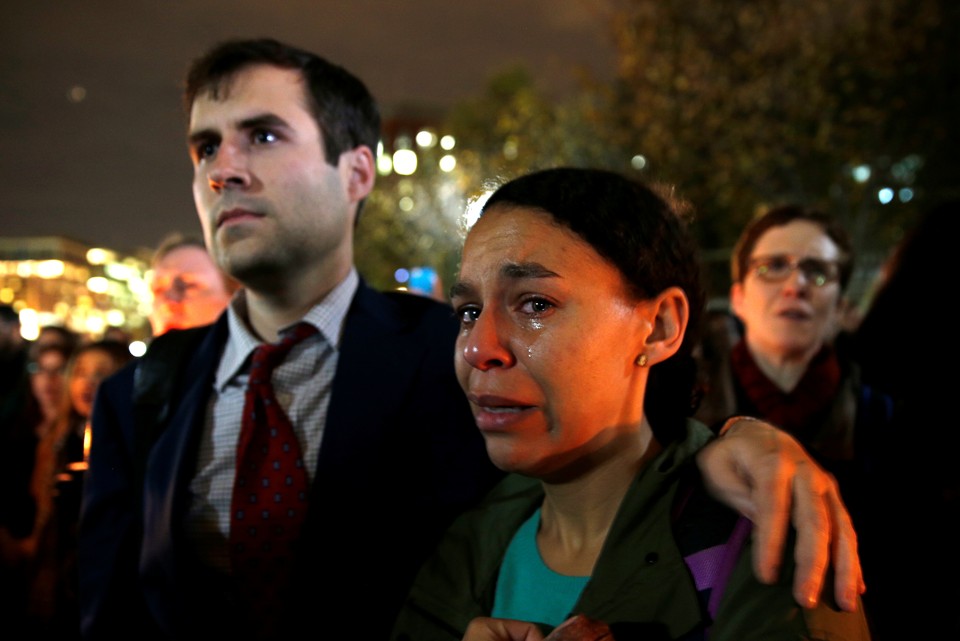
 
Kevin Lamarque / Reuters

By Derek Thompson

In the aftermath of Donald Trump’s shocking victory, many liberals woke up Wednesday morning feeling like strangers in their own country, or perhaps, as if they were the familiar ones and it was the country itself that had become the stranger. I heard it in the voices of friends. I read it in texts from family. I found it in newspaper headlines from some of my favorite writers and in tweets and Facebook messages. What kind of a country do I live in? they asked. Something important has changed. This is not the nation I thought I knew.

But America is what we thought it was. It is still a 50-50 nation, dominated by negative partisanship, in which about half of the country will reliably vote to defeat the other half for the foreseeable future. It is still a nation of propositional pluralism—“send these, the homeless, tempest-tost to me”—crossed with ineradicable xenophobia—“go back to where you came from.” It is still a country teetering on the razor’s edge of both a social-democratic revolution and 1950s-era conservatism. That’s the country Americans knew we had at midnight Tuesday morning. And it’s the nation reflected in the votes tallied on Tuesday night.

Here is what happened 36 hours ago. Hillary Clinton seems to have narrowly won the popular vote, yet narrowly lost the election, because of the geographical distribution of her support. Donald Trump won the electoral vote due to a margin of about 100,000 votes spread across Wisconsin, Michigan, and Pennsylvania. This critical difference represents about 0.04 percent of registered voters, a statistical speck. One vote in 2,500 was the difference between electing a liberal Democrat and rewarding a candidate for the most openly racist campaign in generations.

On its own, this dramatic precarity is not an inspirational thing. But it is so much more inspiring than the prevailing idea that Trump’s victory is statistical evidence that the country Clinton-voters thought they lived in has disappeared, or utterly abandoned them, or never existed in the first place.

In some ways, the current liberal mood is the mirror image of how many conservatives felt after Obama’s win in 2008. While Democrats were triumphant, convinced that the cause of modern liberalism had finally achieved escape velocity, many conservatives were despondent, convinced that the country they thought they knew had left them behind. But the future was not an extrapolation of these hopes and fears, but rather a reversion to 50-50 divisions. Eight years later, the nation is as divided as it had been eight years before in 2000, when, after another popular two-term Democratic president left office during an economic expansion, the electorate delivered a statistical tie that surprisingly handed the White House to a Republican.

It is not self-indulgent for liberals to despair about Tuesday night’s outcome. They have many reasons to fear the near future of public policy. But it’s too early for them to despair about America. In a two-party system, the binary outcome of a vote will always be a simplified expression of the complex characteristics of the electorate. The arc of history is long, with many wobbles, and nothing about Tuesday’s vote suggests that the arrow will point in any one direction for very long.
I felt compelled to comment on the article as an antidote to the prevalent anti-liberal, anti-progressive comments that had been posted (and continue to be posted).

While there is merit to the idea that the country has not changed in any significant way, the outcome of this election was about the future of the nation--not merely the next 4-8 years, but the next 50-100 years.

It is in that sense that progressives are weeping . . . for their children, grandchildren, and great grandchildren.

The winner of this election has been given the power to shape the nation far beyond his or her lifetime. That power comes through the ability to shape the Supreme Court.

Here is my comment, which has already been labeled hysterical by one troll.
Trump will have a GOP majority in the House and the Senate, will get between 1-4 nominations to the Supreme Court, and those justices will be there for the next 30-50 years. Add those justices to Alito and Roberts, both younger, ultra-conservative ideologues, and we will effectively be witness to the dismantling of most civil, environmental, and educational reforms enacted over the last 75-100 years, including Roe v. Wade.

With Trump and the GOP controlling Congress, we are likely to see the end of minimum wage laws, the destruction of the social safety net, and the demise of nearly every other government program serving the poorest of our citizens. The GOP seems unfamiliar with the notion that a nation is judged by how it treats the weakest of its citizens. Even conservative NYT editorial writer David Brooks gets that poverty is not a condition most people can escape, no matter how hard they try.

At the same time, corporate welfare likely will increase even more, while any and all regulation of Wall Street will end or be severely curtailed (Dodd-Frank will be gone), and most regulations protecting clean air, clean water, and preserving wilderness areas will be eliminated. Renewable energy investments will end so that the Arctic tundra can be drilled for oil. If you don't believe this, look at the people Trump is choosing to lead the transition at the EPA, FTC, etc.

Trump represents the end of American progress. If it were not for the damage he can do with appointments to the Supreme Court, it would only be a 4-8 year set-back. But he can shape the Court so drastically that it could take generations to undo the damage.

On ending progress, Trump's campaign slogan announced as much: Make America Great Again. I'm sorry, when WAS America great? Prior to the admittedly awful Affordable Care Act when millions of  people had NO health care? Prior to Roe v. Wade when women got abortions from unqualified providers, and often died from the procedures? Prior to the Civil Rights Act, when minorities could be denied service, prevented from using the same schools and restrooms, and prevented from voting? Prior to the New Deal when old people died in extreme poverty and workers had no protections from unreasonable work hours and unsafe conditions?

So WHEN was America great? When higher education was only open to the wealthy, when women could not vote, when minorities were not "full" people, when slavery was legal?

Anyone who proposes that the key to dealing with change is returning to the "good old days" has no idea HOW to change, what change is, and how change becomes successful. Trump is one of those people.

So progressives weep for the loss and wasting of American potential. For possible futures that are lost with a Trump presidency.

And just so you actually get it, Clinton was NOT the answer. She was only the slightly lesser of two evils.

Monday, October 27, 2014

John Crowley - Time After Time (via Lapham's Quarterly)

From Lapham's Quarterly, a fascinating and thought-provoking (and erudite) meditation on the nature of time.

Time After Time

It’s possible to live in more than one time, more than one history of the world, without feeling a pressing need to reconcile them.


By John Crowley

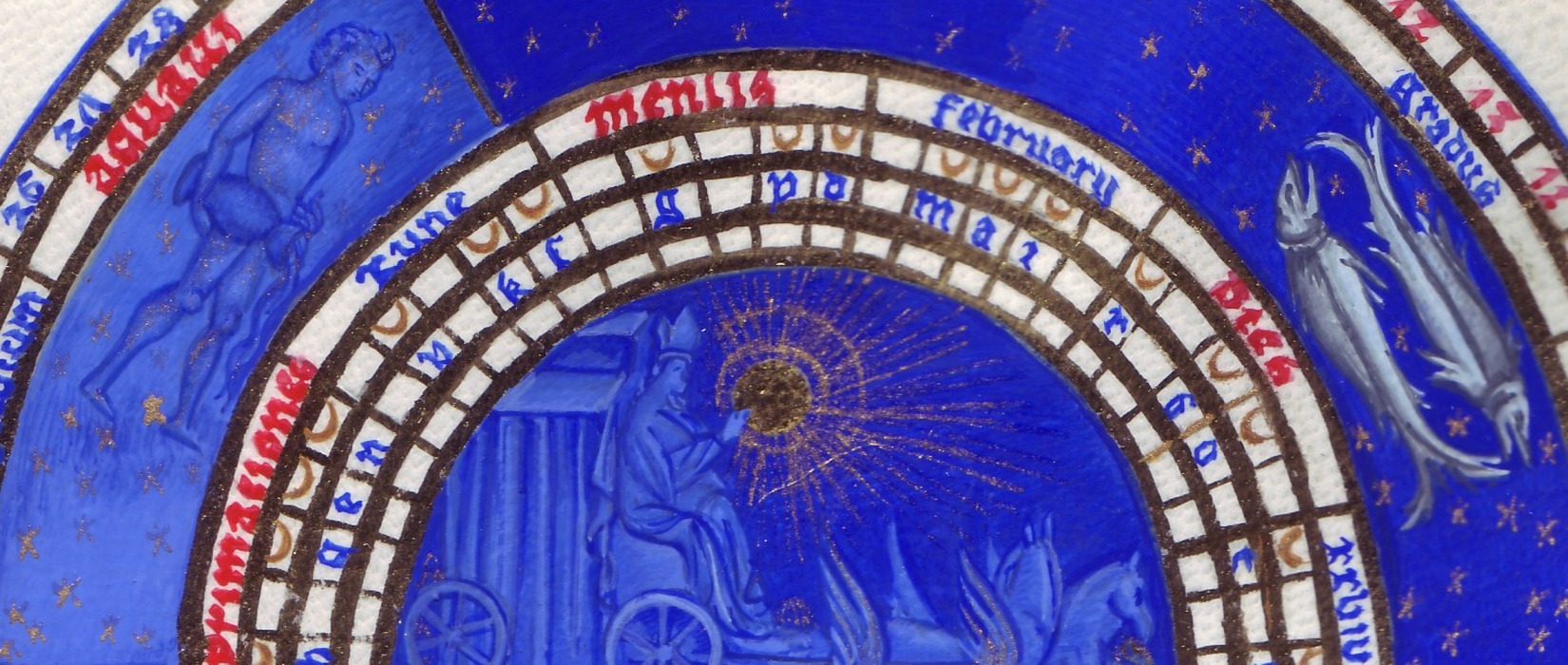
February (detail) from Les Très Riches Heures du Duc de Berry,c. 1412.

Then what is time?” St. Augustine asked himself in his Confessions. “I know what it is if no one asks; but if anyone does, then I cannot explain it.”

Augustine saw the present as a vanishing knife edge between the past, which exists no longer, and the future, which doesn’t yet. All that exists is the present; but if the present is always present and never becomes the past, it’s not time, but eternity. Augustine’s view is what the metaphysicians call “presentism,” which holds that a comprehensive description of what exists (an ontology) can and should include only what exists right now. But among the things that do exist now are surely such things as the memory of former present moments and what existed in them, and the archives and old calendars that denote or describe them. Like the dropped mitten in the Ukrainian tale that is able to accommodate animals of all sizes seeking refuge in it from the cold, the ever-vanishing present is weirdly capacious—“There’s always room for one more!”

Time is continuous, but calendars are repetitive. They end by beginning again, adding units to ongoing time just by turning in place, like a stationary bicycle. Most calendars these days are largely empty, a frame for our personal events and commitments to be entered in; but historically calendars have existed in order to control time’s passage with recurring feasts, memorials, sacred duties, public duties, and sacred duties done publicly—what the church I grew up in calls holy days of obligation. Such a calendar can model in miniature the whole of time, its first day commemorating the first day of Creation, its red-letter days the great moments of world time coming up in the same order they occurred in history, the last date the last day, when all of time begins again. The recent fascination with the Mayan “long count” calendar reflects this: the world cycle was to end when the calendar did.
It’s possible to live in more than one time, more than one history of the world, without feeling a pressing need to reconcile them. Many people live in a sacred time—what the religious historian Mircea Eliade called “a primordial mythical time made present”—and a secular time, “secular” from the Latin saeculum, an age or a generation. Sacred time, “indefinitely recoverable, indefinitely repeatable,” according to Eliade, “neither changes nor is exhausted.” In secular time, on the other hand, each year, month, second, is a unique and unrepeatable unit that disappears even as it appears in the infinitesimal present.

To live at once in a time recoverable by a particular sacred calendar and also by a time without qualities, counted as it passes, involves a sort of mental doubling that is perhaps comparable, in the richness it grants to thought and feeling, to growing up bilingual: two systems, each complete, funny when they collide, each supplying something the other lacks, bearing no command to choose between them. Like a hamster in a Run-About Ball, we can explore an endlessly generated world freely by turning inside the vehicle of our closed and demarcated calendars.

Toward the middle of the thirteenth century, a Dominican friar in Genoa, Jacobus de Voragine, set out to chronicle all that he knew about the history of the world, and to express that knowledge through the sacred events of the Christian year and the exemplary stories of the saints whose feast days filled it. There were many collections of saints’ lives and works extant in his day, called “legendaries”; Jacobus de Voragine’s very long work had larger ambitions than most. His Readings on the Saints became the medieval equivalent of a bestseller, its popularity reflected in the nickname bestowed upon it by fans and printers, The Golden Legend.

In the first sentence of his book, Jacobus divides history, “the whole time span of this present life,” into four periods. Beginning with Adam’s fall out of timeless Eden into temporality and extending up to Moses, who called mankind back to God, is the period of Deviation. The succeeding period of Renewal reaches from Moses to the birth of Jesus, the center point of history for Jacobus. That event begins the era of Reconciliation (“God and sinners reconciled” as the herald angels sing), which culminates in Jesus’ resurrection from the tomb. The last period Jacobus calls the Pilgrimage, which starts with Jesus’ departure from earth back to heaven and continues to the end of the world.

In a new study of Jacobus’ work, In Search of Sacred Time, the great medievalist Jacques Le Goff, who died in April of this year, calls The Golden Legend a “summa on time.” Jacobus, says Le Goff, intended to integrate three sorts of understandings of how time moves in order to “structure and sacralize the time of human life in such a way as will lead humanity to salvation.” The first of these time frames is the sanctorale, the history of the saints and prophets as they appear one after another through historical time. Next is the temporale, the calendar of the church and its annual feasts, offices, and celebrations, which is cyclical and begins again where it ends. Third is the eschatological time of our progress toward Judgment Day, when time stops and eternity begins. Jacobus sets a sort of temporal algorithm, three modes of time working through four periods of history yielding a yearly calendar of feasts, celebrations, and saints’ days which in turn sanctifies the life of Christians in time.
Calendars of the thirteenth century didn’t have uniform start/end dates for the year—there were a few choices—and Jacobus begins his summa not with the first day of the Roman year but with a study of the four weeks of Advent that lead up to the key event of the Nativity. Among the saints whose story Jacobus includes here is Nicholas (December 6), famed for resurrecting dismembered or drowned children, which recalls the death and resurrection of Jesus long before in history and also foreshadows their reenactment at Eastertide. The effect aimed at was to give memory the power of event, to cause a part of the past to occur in the present.

Four women dancing while Father Time looks on.  
A Dance to the Music of Time, by Nicolas Poussin, c. 1635. Wallace Collection, London.

It wasn’t only the sacred calendar that could be made to govern temporality. The four seasons themselves and even the parts of the day are subjected to arithmetical sanctification in The Golden Legend. The Mass, said at least once every day of the year, could also be interpreted as world-shaped and -sanctifying. When I was an acolyte, the Mass began, as it had for centuries, in the uncertainty and doubt of deviation: Quare me repulisti, I’d ask God, age twelve, kneeling at the altar in my cassock, et quare tristis incedo, dum affligit me inimicus? Why do you reject me, and why must I go on in sorrow, while my enemy afflicts me? Renewal and reconciliation are figured in the miraculous changing of bread and wine into the body of Jesus Christ, the center point of the Mass, as the birth of Jesus in a living body is the center of human time. And at the end, the Pilgrimage must continue—Ite, missa est. In those days I could have served at Mass in any Roman Catholic church in the world: it was everywhere the same.

The sacraments that, one by one, I partook of as I grew also had each a temporal aspect. Baptism began life anew after the mess and pain of birth and original sin; first communion began a cycle of subsequent communions, but confirmation occurred just once, marking (like the bar mitzvah) the leaving of childhood and the beginning of adult life. On ahead lay marriage and the anointing of the sick, or extreme unction, as it was alternatively named, pronounced by youth in my part of the Catholic world as “X-tree Munction” and as mysterious as it sounded. If the Christian sacraments are, as critic Terry Eagleton has lately written, “signs which accomplish what they signify,” then for me what they accomplished was the inscription of sacred time in my soul.

But even as my family and I lived by the temporale of the Catholic calendar, we measured time by an unsacred sanctorale, one just as rich with incident as Jacobus’ but that reached far further back and extended forward without limit. One that accounted for my existence but asked nothing of me; one whose truth to time was established by instances of refutation as much as by confirmation.

In November 1953, when I was eleven, Time magazine reported on the exposure of a long-ago scientific hoax; the title of the article was “End as a Man”:
For more than a generation, a shambling creature with a human skull and an apelike jaw was known to schoolchildren, Sunday-supplement readers, and serious anthropologists as “the first Englishman.” He was “Piltdown Man,” and he was supposed to have lived anywhere from 750,000 to 950,000 years ago. Last week three British scientists, armed with modern chemistry, demolished Piltdown man.
My family had a subscription to Time—its general pro-Catholic, “American Century” disposition aligned with my father’s, and it had a middlebrow aura of intelligent probity. I may have read this article—probably would have, if I saw it. I was fascinated by fossils and archaeological finds. I looked for fossils in Kentucky slate, and faked one myself when I grew restive at finding none: a nice little trilobite, etched into stone by knifepoint and pretty convincing (to me). Piltdown Man’s relics were made from a human cranium and the jaw of an ape—an orangutan, actually—and a single canine, ground down to resemble an early human’s tooth. The oddity never fit with other early humans in that ascension shown in old textbooks (and still seen in cartoons) from remotest knuckle-dragging ancestor to modern man. The fake ancestor, Time said, may not have been planted by his original discoverer: “More likely, the difficult hoax was perpetrated by an erudite joker who enjoyed in silent satisfaction his success in fooling the experts.”

One of those jokers, it would later appear, may well have been a young paleontologist and Jesuit priest who went on to formulate his own highly original theory of the descent of man from nonhuman ancestors and man’s future ascent through millennia of evolution to a posthuman omega point. Pierre Teilhard de Chardin was a hero to a certain class of educated Catholics of the 1950s: a priest and a scientist, a thinker who seemed able to reconcile two kinds of time: the immensity of unfigurable pastness and futurity, and Jacobus’ box of time shaped by God from the fiat lux to the Apocalypse.

Born in 1881 and enrolled in a Jesuit boarding school at ten years old, Teilhard in one sense exemplified the old Jesuit belief that if they have the boy they will ever after retain the man, but orthodoxy never quite retained Teilhard. He entered the novitiate at eighteen, studied the standard subjects as well as physics and geology, and later did a course in theology at Ore Place, a seminary in Sussex, England, founded by French Jesuits. It was there, he said, that he became convinced of the truth of Darwinian evolution, which “haunted my thoughts like a tune.” Ore Place was located very near to Piltdown, and Teilhard became close friends with the amateur archaeologist Charles Dawson; they often went fossil hunting together, and Teilhard found the canine tooth that appeared to match the Piltdown jaw. Dawson announced the finding of the Piltdown fossils in 1912, the year after Teilhard was ordained.

Three years before the debunking of Pilt­down Man was described in Time, Pope Pius XII in the encyclical Humani generis declared that certain aspects of Darwinian evolution weren’t intrinsically in conflict with church teachings, though (Pius said) Catholics certainly didn’t have to believe in evolution if they didn’t want to. A family like mine—observant, loyal to church tradition and doctrine, but also open-minded and disputatious, certainly did. We knew that the seven days of Creation could be taken as seven eons of vast duration, time enough for bacteria and algae to produce dinosaurs and mammoths through the workings of chance and possibility. Though for several years he worked for the church—as the medical director of a small Catholic hospital in Kentucky and then as the infirmary doctor at Notre Dame—my father leaned toward the idea of two churches, one for the smart and learned who could handle ambiguities and don’t need miracle stories or blessed crucifixes, and another for everyone else, who loved and cared for such things. A family friend, a priest who taught in the history and philosophy of science program at Notre Dame, once told us about a conference he’d attended at which he had a dispute about time with another scholar, an unbeliever; while the unbeliever’s theory of time allowed for the (theoretical) existence of angels, the priest’s did not. He thought that was amusing, and so did we. We sometimes attended his masses; he married two of my sisters. If and when Catholics like my family felt the need for a system to account for how they thought, there was Pierre Teilhard de Chardin.

Summer scene, illumination from The Very Rich Hours of the Duke of Berry 
Summer, from the Très Riches Heures du Duc de Berry, 1412–1489. Musée Condé, Chantilly, France.
 
Teilhard was a believer in deep time, the long processes of geological and biological evolution that stretched out over the billions of years of earth’s existence. He hunted fossils with Roy Chapman Andrews of the American Museum of Natural History in New York, a hero of mine in boyhood, and in the 1920s participated in the excavation of Homo erectus in China, then dubbed “Peking Man.” No one’s time scheme was longer than Teilhard’s: none began further back, or went further on. In his best-known book, The Phenomenon of Man—the one we owned—Teilhard built his universe carefully from primal atoms and molecules through living matter to consciousness and the human world, evolving without cease until transitioning finally into eternity.

For Jacobus, time begins with Adam’s fall; for Teilhard, it is the coming into being of a biosphere—the life layer of earth, as opposed to the underlying inorganic geosphere. From the Russian scientist and metaphysician Vladimir Ivanovich Vernadsky, Teilhard adopted a tripartite hierarchy of geosphere, biosphere, and noosphere, from the Greek nous, mind: the realm of thought and self-reflection, the vast and growing network of mental connections belonging only to humans. The noosphere was Teilhard’s sanctorale, that by which time makes sense in consciousness; in Julian Huxley’s formulation, which Teilhard embraced, humankind is how evolution becomes conscious of itself. As science and communication technology stretches a membrane of human connection over the whole earth, and any person can be in all places at once, then sooner or later—a very long time from now in either case, but helped on by human striving—an omega point is approached, where the universe reassembles all consciousness in itself, yet in which every individual consciousness remains separate. The last step depends on God and Christ: “a prodigious biological operation,” Teilhard wrote, “that of the redeeming incarnation.” Not so much a Second Coming as the final instantiation of an evolving divine person born in Bethlehem, Jesus is both beginning and end for Teilhard, as central to his immense loom of time as he was to Jacobus’ brief span from Adam and Eve to the end of the world.

Whether or not Teilhard as a youth at seminary was really involved in the faking of the Piltdown relics—Stephen Jay Gould thought he was, and made a circumstantial case for it in Natural History magazine in 1980—I wonder if those mismatched bones might stand metonymically for the temptation to reconcile the irreconcilable, mix the immiscible. Early in his career Teilhard was censored for unacceptable writings about original sin; in 1925—and in the very week the Scopes trial began—he signed a statement repudiating his opinions. As in the case of Galileo, it was less the threat of new knowledge that alarmed the church than the threat to doctrine. When he submitted the manuscript of The Phenomenon of Man to church censors for scrutiny in 1941—surely a year of backward progress in human evolution—it was rejected for publication, and after the war he was forbidden to teach or write on philosophical subjects. Not until after his death in 1955 did the book appear in French, and in the wake of its worldwide popularity the Holy Office—the same body that condemned Galileo—issued a warning (monitum) stating that Teilhard’s writings “abound in such ambiguities, and indeed even serious errors, as to offend Catholic doctrine,” and Catholic institutions were instructed “to protect the minds, particularly of the youth, against the dangers” they presented. Whatever Teilhard himself imagined, his thought couldn’t be easily reconciled with standard catechisms.

Then came John XXIII (recently canonized) and aggiornamento, or modernization, and the hierarchy began to perceive in Teilhard’s grand synthesis a path to resolving the tension between faith and science, which at that time seemed so urgent and so hurtful to the church. Instead of standing pat, faith had to ante up, lay a very big bet, if it was to recoup its losses. Teilhard’s thought held out the possibility that nothing needed to be given up or painstakingly reconciled; no matter how big the universe got, how long the time frame, deep time was sacred time, and the story that could be told about it could be seen to be the simple Christian story after all.

Of course the bet was hedged: “It must be regarded as an important service of Teilhard de Chardin’s that he rethought these ideas from the angle of the modern view of the world and, in spite of a not entirely unobjectionable tendency toward the biological approach, nevertheless on the whole grasped them correctly and in any case made them accessible once again”—so wrote a German theologian named Joseph Ratzinger in 1968. Such delicate reservations. Long before then I had vacated the premises.

I can’t say how or by what gradual steps the sacred calendar was erased within me, but I remember a time and place when I knew it had vanished away. It was a feast day, a holy day of obligation, in fact, August 15, the assumption of the Virgin Mary into heaven in her sanctified body. As I see it in memory I am returning from church alone along the dirt road to my house, in the Indiana August heat and dust, and—at the advancing tip of a chain of thought that I can’t recall—I said aloud I give it up; I just don’t care. I had (I thought then) no argument against it all, no case for its general untruth or absurdity; for all I knew the world was just as the church claimed it to be. I simply had no soul investment any longer in it, I was outside it then and always would be. It didn’t feel like loss, nor like liberation; it was more like the moment when you understand without surprise that you are not actually walking the streets of a strange city with odd companions but awake in your own bed. I had lost my faith, as the church would say it, though I think the reverse is just as true. In fact I’m not sure that faith was ever what I had. I think I was not capax Dei, in Augustine’s phrase: I had, and have, no capacity for God. Living in the sacred time you didn’t really need it; you didn’t even need belief. All you needed were five senses, a sacerdotal language, and the solemnities of repetition.
One by one all my family “fell away,” as the phrase used to be. My father assumed that Vatican II would be more thoroughgoing in scrubbing away indefensible doctrines than it was; what instead were removed were rituals and observances as cherished as they were peculiar, whose force in practice lay deeper than reason. My mother, for whom evolution meant mostly the advancement of the human species from exasperating stupidity and cravenness to strength and beauty, loved Teilhard, but maybe for just the reasons the church was wary of. Her other two daughters were not married by a priest, and nor was I.

It was a net loss, counted one way at least. Sacred time is also human time, linking generations to one another, binding those who do this in this way at these times with all those who in the past did likewise. My Jewish wife, from a large extended family which now includes me and our children, never had difficulty retaining many of the practices and prayers she grew up with, which connect her to past generations and to a timeless realm as well. I have never succeeded wholly in convincing her that continuing with my own traditions (those that remain) would require sincerely committing to certain metaphysical propositions, as hers—in her estimation—do not. She disputes the distinction I make between sacred and secular time. What about Halloween? A commercial holiday that the whole nation participates in, as it does in Memorial Day (both days of the dead, it occurs to me); a public community festival with roots in immemorial folk practice, that was at a particular time turned to the uses of the church. Jacobus de Voragine extols it, the feast of all the saints that ever were or ever will be, whose feast days mostly can’t be known but which fill the calendar beyond repletion. It’s among the last of the feasts he celebrates before Advent comes around again.

Presentism—the notion that everything that exists is only what can and does exist right now—is countered in metaphysics by eternalism: the idea that time is not a process but a dimension, and in that dimension all reference points have equal validity, and thus all time, past, present, and future, exists at once, extending (like space) in all directions. Augustine believed that while we live along the vanishing knife edge of the present, God has the eternalist view: God perceives time as a block, everything existing simultaneously, all complete to his sight. Teilhard might say: time is Christ’s body, and once in it we too will know all of time at once, and share that eternalist perspective.
You could say that a calendar, which seems to mark time moving from future to past, is actually an eternalist device: all possible pages, all possible dates, are already present in it, endless marchers around a Möbius strip of here-and-nowness. Most calendars measure only a year, but they also measure any year; they keep our old appointments and anniversaries forever, Christmas an eternal December 25, only the moveable feasts sliding within their fixed round of possibilities as the moon comes and goes.

I’ve never been good at keeping calendars, and my family says that I am lax on anniversaries and insufficiently moved by feast days (though I do love fireworks and Thanksgiving dinner). I keep one calendar, though: one so singular and private I can’t know if everyone, or even anyone else, has one like it—though I suspect some must. It’s without dates; the occasions that fill it have no fixed number and don’t recur in any sort of chronological order. Each is a return of some long-ago circumstance in a kind of momentary entirety: the flavor, the taste, the total sensation of it; a past moment in the present. Marcel Proust [Paris, page 132] tasting his teacake was led to remember in detail an earlier, a first instance; and (I suppose) other bites of similar cakes produced that moment for him again ever after, though perhaps with diminishing intensity. For almost all of mine I can’t discover an original, though I believe an original is what I am visited by. I can’t keep them; the calendar is self-erasing.

These instants give me nothing to ponder or to celebrate; they aren’t joyful or somber, express nothing but the intensity of felt existence. Some return many times, some never again. Sometimes they have a catalyst: lately I have felt them brought on by the deeply saturated colors of certain new cars passing me on the highway, chrome yellow, cherry red, teal. What am I reminded of? What in the chaos of my interior is being drawn out, like W. C. Fields plucking just the desired document from the apparently hopeless disorder of his rolltop desk in Man on the Flying Trapeze? Maybe nothing; maybe after all these aren’t memories—discrete moments of the past drawn into the present—but rather glimpses into a timeless time in which all moments have equal standing, are therefore not moments but the signs that Terry Eagleton says accomplish what they signify. If all that can exist in past, present, or future exists now, then the time that has passed through our consciousness, flowing continuously without marks or stops in parallel with the tick of clocks, resides there still when it is gone: choosing, in effect all by itself, what we are to know of it.

Contributor
 
John Crowley
John Crowley is the author of eleven novels, including Little, Big, the Ægypt cycle, and, most recently, Four Freedoms. He teaches creative writing at Yale University.

Wednesday, October 15, 2014

​The io9 Manifesto: Science Is Political

Damn. Straight. This is from last April (2014), but this is the first I have seen of it.

​The io9 Manifesto: Science Is Political


Annalee Newitz
4/07/14 


io9 started out in 2007 as the germ of an idea for a site about futurism, with a name that was a joke about brain implants. Six and a half years later, we've grown in size — but we've also grown up. Our 2008 manifesto still holds true, but in 2014 we've got some amendments. Here they are.


* * * *

Last month, for the first time, io9 had over 10 million unique readers in the United States alone; globally, we had 15 million. We had a staff of three when we launched in 2008; now we've got 14. Our mission has grown too.

Speculative Pop Culture

When I first conceived io9 back in 2007, I had one goal: to give readers a vision of the future that was based in scientific reality as well as science fiction. To do it, I needed to build a publication that would bring science journalism together with cultural criticism and futurist ideas. No one strand of thought would be dominant. To understand where we're headed as a civilization, we cannot privilege science over culture, nor can we afford to ignore even the most speculative predictions.

Often, the weirdest notions about the future turn out to be right.


Over time, io9 has expanded beyond its roots in science fiction. We're fascinated by any story, in any medium, that inspires people to look beyond the narrow confines of everyday life and contemplate an alternate world. I think these kinds of stories are crucial thought experiments, whether they are set in our reality or Westeros. They keep us sharp, preparing us for the day when things change so much that we'll need an education in alternate realities just to cope with this one.

Fighting for Science

Our science coverage has also changed. At this point in history, when science is under attack from many political and religious institutions, we can no longer afford to report on the latest research and call it a job well done. To advocate for science is to advocate for a political position, whether we like it or not.

Pro-science politics don't divide easily into conservative and liberal. Imagine, if you will, that people from all positions on the political spectrum came together to advocate for scientific research and education. Conservatives advocating for defense and agricultural innovations would rub shoulders with liberals pursuing sustainable energy and environmental reforms. But all would be united under the banner of rational inquiry. (And probably they would all want to go to space, too.)

Who knows what kinds of civilizational progress might come out of that crucible, where people with many political backgrounds could join forces to assure humanity's continued survival, using science?

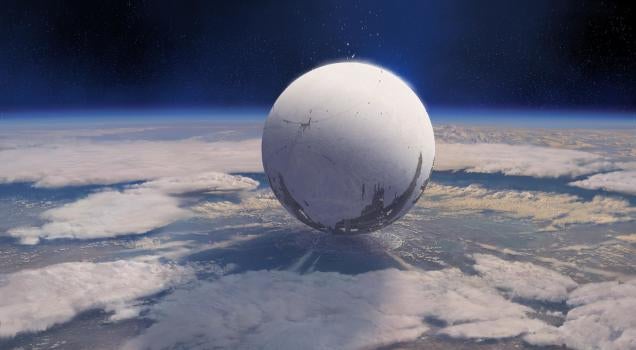
Illustration from Destiny

A Better Future

Now I want you to stretch your imagination even further, and think about how our group of politically-mixed science advocates could include cultural and ethical issues on their agenda too. What if we finally admitted that the scientific project has always been a wider cultural movement, full of guiding myths and useful fictions and passionate believers?

What if, in short, political change could be as astounding as scientific discovery and as mind-expanding as the best pop culture?

Here at io9, we aim to find out. The point of futurism isn't just to describe what comes next — it's to change it. Come with us, on our quest to build a better tomorrow.

Friday, October 03, 2014

Maya Archaeology and Its Relevance to the Modern World (Santa Fe Institute)

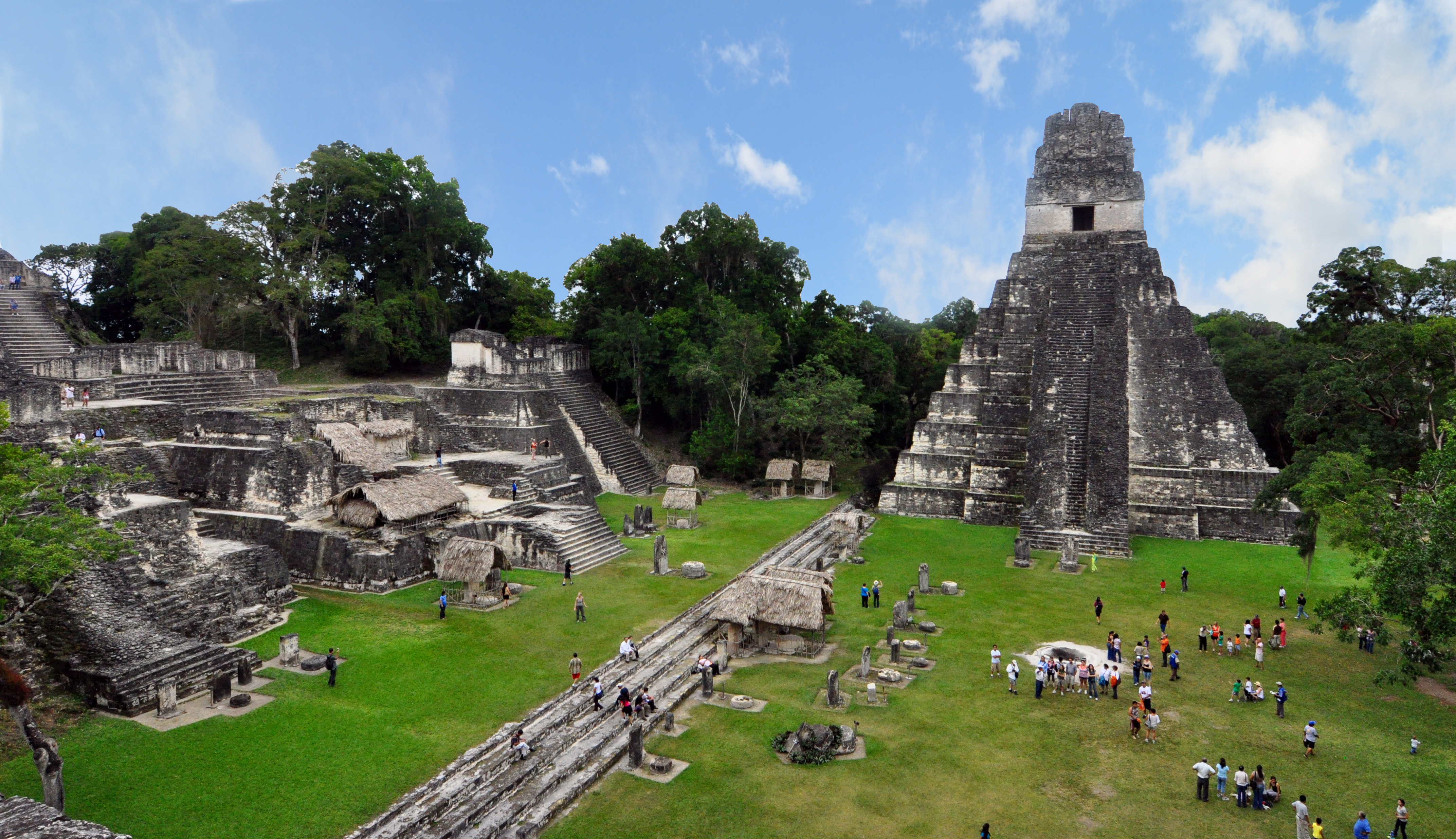
http://upload.wikimedia.org/wikipedia/commons/e/e7/Tikal_mayan_ruins_2009.jpg

Here are two interesting lectures from Santa Fe Institute President Jeremy Sabloff on the topic of archeology and its importance to how we understand our world and how it might help us shape our future.

How Insights from Archaeology Might Help Shape Our Future

Published on Sep 28, 2014


Jeremy Sabloff, President, Santa Fe Institute
September 9, 2014

Stanislaw Ulam Lecture Series: Seeing the Future in Our Past: Why Archaeology Matters

Despite its popularity, archaeology’s public perception is not as accurate as it could be. Archaeologists do not have their collective heads immersed in the past, as is often supposed, but are very much concerned with both the present and future, too. SFI President Jerry Sabloff explores how, even in the face of overwhelming data recovery and interpretive hurdles, archaeologists have developed a host of approaches that can provide new perspectives on modern problems and concerns.

* * * * *

Maya Archaeology and Its Relevance to the Modern World

Published on Sept 28, 2014


Jeremy Sabloff, President, Santa Fe Institute
September 10, 2014

Stanislaw Ulam Lecture Series: Seeing the Future in Our Past: Why Archaeology Matters

While the great architectural, artistic, and intellectual achievements of Pre-Columbian Maya peoples continue to bedazzle us for their richness, an understanding of the arc of ancient Maya civilization has relevance to problems facing the world today. SFI President Jerry Sabloff focuses on lessons about sustainability and societal resilience gleaned from new evidence relating to the decline of many major cities in the southern Maya Lowlands in the ninth century CE. He also explores heritage education and tourism in today’s Maya world, among other topics.

Sunday, February 23, 2014

Can a Physicist Explain the Future of the Human Mind?

From NPR's All Things Considered, this segment featured physicist and author Michio Kaku talking about his new book, The Future of the Mind: The Scientific Quest to Understand, Enhance, and Empower the Mind. The book will be released on February 25, 2014.

Here is the publisher's ad copy:
The New York Times best-selling author of Physics of the Impossible, Physics of the Future and Hyperspace tackles the most fascinating and complex object in the known universe: the human brain.
For the first time in history, the secrets of the living brain are being revealed by a battery of high tech brain scans devised by physicists. Now what was once solely the province of science fiction has become a startling reality. Recording memories, telepathy, videotaping our dreams, mind control, avatars, and telekinesis are not only possible; they already exist.

The Future of the Mind gives us an authoritative and compelling look at the astonishing research being done in top laboratories around the world—all based on the latest advancements in neuroscience and physics. One day we might have a "smart pill" that can enhance our cognition; be able to upload our brain to a computer, neuron for neuron; send thoughts and emotions around the world on a "brain-net"; control computers and robots with our mind; push the very limits of immortality; and perhaps even send our consciousness across the universe.

Dr. Kaku takes us on a grand tour of what the future might hold, giving us not only a solid sense of how the brain functions but also how these technologies will change our daily lives. He even presents a radically new way to think about "consciousness" and applies it to provide fresh insight into mental illness, artificial intelligence and alien consciousness.

With Dr. Kaku's deep understanding of modern science and keen eye for future developments, The Future of the Mind is a scientific tour de force--an extraordinary, mind-boggling exploration of the frontiers of neuroscience.
Here is the NPR story.

Forecasting The 'Future' By Tapping Into Human Consciousness

by NPR Staff
February 22, 2014 4:00 PM
5 min 52 sec

Now more than ever before, we have the tools to study the mysteries of consciousness. Memory, dreams, the self are now being examined using high-tech brain scans developed by physicists on the cutting edge of their field.

Dr. Michio Kaku, professor at the City College of New York, is among them. In The Future of the Mind, he gives readers a look at some of the most astonishing research in neuroscience today, and presents a vision of what future innovation might bring. NPR's Arun Rath speaks with Kaku about the advances in technology and our understanding of human consciousness.

Interview Highlights


On the organization of the brain

We used to think the brain was like a computer. But now we realize that's not true — there's no programming of the brain, there's no windows. And we think the brain is more like a large corporation. ... In a corporation, you have subdivisions that operate independently of the main office. And that's why we have an unconscious mind, because you have to have, for example, emotional reactions to things very quickly.

On what makes human consciousness special

We can imagine things far beyond our body. We can imagine social hierarchies much more complex than what we actually have, and we can simulate the future. And so these are three levels of consciousness. Consciousness-one level is understanding where we are in space. Consciousness two is where we understand our position in society: who's top dog, who's underdog, and who's in the middle. And type-three consciousness is simulating the future ... only humans have this ability to see far into the future.

The Future of the Mind is physics professor Michio Kaku's eighth book.
Courtesy of Random House
On modern technology and the mind

We've learned more in the last 10, 15 years than in all of human history. In fact, we can take the consciousness of somebody who is totally paralyzed, cannot do anything with their body, put a chip in their brain, and have that person control a laptop. They can now surf the Web, they can now write emails, answer emails, control their wheelchair, control household appliances, and even manipulate mechanical arms, and eventually a mechanical exoskeleton — and they are totally paralyzed.

Stephen Hawking, my colleague, is totally paralyzed, and he has a chip in his right glass. Next time you see him on television, look in his right frame, and you see a brain sensor which picks up radio from his brain and allows him to type mentally.

On "downloading" one's mind for the future

In the movie Back to the Future, Doc Brown is asked the question, "Do you want to see the future?" and he says, "I've always wanted to see beyond my years." You see, I'm also a futurist. I dream about the world 50, 100, maybe even 1,000 years in the future. But I also realize I'm probably not gonna see it. However, I wouldn't mind having at least a copy of myself see the future, maybe 50, 100, 1,000 years into the future. It would be a fantastic ride.

Read an excerpt from The Future of the Human Mind.
* * * * *

Here is that excerpt, brief though it is.

Excerpt: 'The Future Of The Mind'


Houdini, some historians believe, was the greatest magician who ever lived. His breathtaking escapes from locked, sealed chambers and death-defying stunts left audiences gasping. He could make people disappear and then re-emerge in the most unexpected places. And he could read people's minds.

Or, at least it seemed that way.

Houdini took pains to explain that everything he did was an illusion, a series of clever sleight-of-hand tricks. Mind reading, he would remind people, was impossible. He was so outraged that unscrupulous magicians would cheat wealthy patrons by performing cheap parlor tricks and séances that he took it upon himself to go around the country exposing fakes. He was even on a committee organized by Scientific American, which offered a generous reward to anyone who could positively prove they had psychic power. (No one ever picked up the reward.)

Houdini believed that true telepathy was impossible. But science is proving Houdini wrong.

Telepathy is now the subject of intense research at universities around the world where scientists have already been able to read individual words, images, and thoughts of our brain by combining the latest scanning technology with pattern recognition software. This could revolutionize the way we communicate with stroke and accident victims who are "locked-in" their bodies, unable to articulate their thoughts except through blinks of their eyes. But that's just the start. It might also radically change the way we interact with computers and the outside world.

As we know, the brain is electrical. In general, anytime an electron is accelerated, it gives off electromagnetic radiation. The same holds true for electrons oscillating inside the brain. It sounds like something out of science fiction or fantasy, but humans naturally emit radio waves. But these signals are too faint to be detected by others, and even if we could perceive these radio waves, it would be difficult for us to make sense of them. But computers are changing all this. Scientists have already been able to get crude approximations of a person's thoughts using EEG scans. Subjects put on a helmet of EEG sensors on their head, and concentrate on certain pictures, say, the image of a car or a house. The EEG signals were then recorded for each image and eventually, a rudimentary dictionary of thought was created, with a one-to-one correspondence between a person's thoughts and the EEG image. Then, when a person was shown a picture of another car, the computer would recognize this EEG pattern.

The advantage of EEG sensors is that they are non-invasive and quick. You simply put on a helmet containing many electrodes onto the surface of the brain and the EEG can rapidly identify signals which change every millisecond. But the problem with EEG sensors, as we have seen, is that electromagnetic waves deteriorate as they pass through the skull, and it is difficult to locate the precise source. This method can tell if you are thinking of a car versus a house, but it cannot recreate an image of the car. That is where Dr. Gallant's work comes in.

The epicenter for much of this research is the University of California at Berkeley, where I received my own Ph.D. in theoretical physics years ago. I had the pleasure of touring the laboratory of Dr. Jack Gallant, whose group has accomplished a feat once considered to be impossible: video taping people's thoughts. "This is a major leap forward reconstructing internal imagery. We are opening a window into the movies in our mind," says Dr. Gallant.

When I visited his laboratory, the first thing I noticed was the team of young, eager postdoctoral and graduate students huddled behind their computer screens, looking intently at video images that were reconstructed from someone's brain scans. Talking to his team, you feel as though you are witnessing scientific history in the making.

Dr. Gallant explained to me that first, the subject lies flat on a stretcher, which is slowly inserted head first into a huge, state-of-the-art MRI machine, costing upwards of $3 million. The subject is then shown several movie clips (such as movie trailers readily available on YouTube.) To accumulate enough data, you have to sit motionless for hours watching these clips, a truly arduous task. I asked one of the post-docs, Dr. Shinji Nishimoto, how they found volunteers who were willing to lie still for hours on end with only fragments of video footage to occupy the time. He said the people in the room, the grad students and post-docs, volunteered to be guinea pigs for their own research.

As the subject watches the movies, the MRI machine creates a 3D image of the blood flow within the brain. The MRI image looks like a vast collection of 30,000 dots or voxels. Each voxel represents a pinpoint of neural energy, and the color of the dot corresponds to the intensity of the signal and blood flow. Red dots represent points of large neural activity, while blue dots represent points of less activity. (The final image looks very much like thousands of Christmas lights in the shape of the brain. Immediately, you can see the brain is concentrating most of its mental energy in the visual cortex while watching these videos.)

At first, this color 3D collection of dots looks like gibberish. But after years of research, Dr. Gallant and his colleagues have developed a mathematical formula which begins to make connections between certain features of a picture (edges, textures, intensity, etc.) and the MRI voxels. For example, if you look at a boundary, you'll notice it's a region separating lighter and darker areas and hence the edge generates a certain pattern of voxels. By having subject after subject view such a large library of movie clips, this mathematical formula is refined, allowing the computer to analyze how all sorts of images are converted into MRI voxels. Eventually, the scientists were able to ascertain a direct correlation between certain MRI patterns of voxels and each picture. "We built a model for each voxel that describes how space and motion information in the movie is mapped into brain activity," Dr. Nishmoto told me.


From The Future of the Mind by Michio Kaku. Random House.

Wednesday, January 01, 2014

Awakening the Dreamer: Changing the Dream


This is kind of cool - a little inspiration to begin the new year. There is about 90 minutes total in the two parts of the video - the creators designed the series (actually 6 modules) to be viewed all at once.


Awakening the Dreamer: Changing the Dream

Part 1

Part 2

The Awakening the Dreamer Symposium awakens future game changers to the need for, and opportunity of, bringing forth a new future for everyone. The half-day program with skilled facilitators takes place in-person around the United States and in 77 other countries, and is also available via video that can be watched at your convenience. In this workshop, you will have the opportunity to take a stand for the sustainable, just, and fulfilling future you want to see.


Wake up to your own role in creating a new future. This new perspective of the current state of our planet features top scientific, indigenous and activist minds from around the world. Now available for the first-time ever on video, The Awakening the Dreamer, Changing the Dream Symposium empowers participants to respond to the urgency and the opportunity of our times with action and informed, grounded optimism. Taped live, the Symposium features leading-edge information, inspiring multimedia and transformative exercises for an experience like none other. Together, we can change the world.

Worksheets: Personal Plan for Getting Into Action / Declaration Card

Thursday, July 25, 2013

Time Reborn: A New Theory of Time - A New View of the World (at The RSA)


The RSA recently hosted a discussion of Lee Smolin's new book, Time Reborn: From the Crisis of Physics to the Future of the Universe. Joining Smolin are A.C. Grayling, Gillian Tett, and Bronwen Maddox. The video is a excerpt from the full discussion that can be listened to at the link below, including audience questions.


Time Reborn: A New Theory of Time - A New View of the World


Published on Jul 24, 2013

Is it possible that time is real, and that the laws of physics are not fixed? Lee Smolin, A C Grayling, Gillian Tett, and Bronwen Maddox explore the implications of such a profound re-think of the natural and social sciences, and consider how it might impact the way we think about surviving the future.

Listen to the podcast of the full event including audience questions and answers.

Follow the RSA on Twitter: http://www.twitter.com/thersaorg
Like the RSA on Facebook: http://www.facebook.com/thersaorg

Our events are made possible with the support of our Fellowship. Support us by donating or applying to become a Fellow.

Donate: http://www.thersa.org/support-the-rsa
Become a Fellow: http://www.thersa.org/fellowship/apply

Wednesday, January 16, 2013

2013 Edge Question: What *Should* We Be Worried About?

It's that time of year again, when John Brockman, founder of Edge, asks leading thinkers in a variety of fields to answer a burning question. Previous questions have included the following:
This years question, posed to 152 contributors (but only 151 responses), is What *Should* We Be Worried About?

Gary Marcus, writing for The New Yorker, asked himself the question.


THE NEW YORKER
January 15, 2013

WHAT WE SHOULD FEAR

Gary Marcus

...This year, Brockman’s panelists (myself included) agreed to take on the subject of what we should fear. There’s the fiscal cliff, the continued European economic crisis, the perpetual tensions in the Middle East. But what about the things that may happen in twenty, fifty, or a hundred years? The premise, as the science historian George Dyson put it, is that “people tend to worry too much about things that it doesn’t do any good to worry about, and not to worry enough about things we should be worrying about.” A hundred fifty contributors wrote essays for the project. The result is a recently published collection, “What *Should* We Be Worried About?” available without charge at John Brockman’s edge.org. ... [MORE]
Marcus is one of the many contributors to this year's question. However, the best response that I have read so far, and I am only skimming them this morning before working out, is from Monty Python alum and brilliant filmmaker, Terry Gilliam:

I've Given Up Asking Questions

Terry Gilliam - Screenwriter, Film director, Animator, Actor; Member, Monty Python Comedy Troupe; Director, Brazil; Fear And Loathing in Las Vegas 
I've given up asking questions. l merely float on a tsunami of acceptance of anything life throws at me... and marvel stupidly.
Nice - I'm guessing this is the one non-response. Enjoy the other answers.

2013 : WHAT *SHOULD* WE BE WORRIED ABOUT?


Contributors [ 152 ] | View All Responses [ 151 ]


—John Naughton, The Observer

THE 2013 EDGE QUESTION . . .
___________________________________________________________

We worry because we are built to anticipate the future. Nothing can stop us from worrying, but science can teach us how to worry better, and when to stop worrying.

WHAT SHOULD WE BE WORRIED ABOUT?

Tell us something that worries you (for scientific reasons), but doesn't seem to be on the popular radar yet—and why it should be. Or tell us something that you have stopped worrying about, even if others do, and why it should be taken off the radar.

___________________________________________________________


Geoffrey Miller, Nassim Nicholas Taleb, William McEwan, Helena Cronin, Dan Sperber, Martin Rees, Barbara Strauch, John Tooby, David Gelernter, Brian Eno, Seth Lloyd, W. Daniel Hillis, David M. Buss, David Bodanis, Benjamin Bergen, David Rowan, Nicholas G. Carr, Kevin Kelly, Lisa Randall, Evgeny Morozov, J. Craig Venter, Andrian Kreye, Terry Gilliam, Jennifer Jacquet, Hans Ulrich Obrist, Robert Sapolsky, Kate Jeffery, Lawrence Krauss, Tim O'Reilly, Eduardo Salcedo-Albarán, Bart Kosko, Timo Hannay, Helen Fisher, Michael Norton, Jessica Tracy, Haim Harari, Bruce Sterling, Vernor Vinge, Frank Wilczek, Sam Harris, Lee Smolin, P. Murali Doraiswamy, Marco Iacoboni, Andrew Lih, Richard Foreman, Arianna Huffington, Xeni Jardin, Christine Finn, Scott Sampson, Gino Segre, Joseph LeDoux, John Naughton, Steven Strogatz, Bruce Schneier, Kai Krause,Mario Livio, Rolf Dobelli, Randolph Nesse, Gregory Benford, Ursula Martin, David Berreby, Bruce Parker, Paul Saffo, Bruce Hood, Giulio Boccaletti, Stewart A. Kaufman, Sarah-Jayne Blakemore, William Poundstone, Victoria Stodden, Marcel Kinsbourne, Douglas T. Kenrick, Gavin Schmidt, Sherry Turkle, Stuart Firestein, Ed Regis, Daniel Haun, Joel Gold, Alison Gopnik, Seirian Sumner, Keith Devlin, Susan Blackmore, Larry Sanger, Gary Klein, Dave Winer, Rob Kurzban, Melanie Swan, Timothy Taylor, Amanda Gefter, Anton Zeilinger, Donald D. Hoffman, Leo M. Chalupa, Noga Arikha, Brian Knutson, Kirsten Bomblies, Tor Nørretranders, Jonathan Gottschall, Esther Dyson, Anthony Garrett Lisi, Simon Baron-Cohen, Daniel L. Everett, Nicholas A. Christakis, Stephon Alexander, Margaret Levi, Stephen Kosslyn & Robin Rosenberg, David Dalrymple, Andy Clark, Seth Shostak, Azra Raza, M.D., David Pizarro, Tania Lombrozo, Adam Alter, Thomas Metzinger, Matt Ridley, Paul Kedrosky, Mihalyi Csikszentmihalyi, Virginia Heffernan, Luca De Biase, Terrence J. Sejnowski, Steve Giddings, Karl Sabbagh, Dylan Evans, Laurence C. Smith, Neil Gershenfeld, Eric J. Topol, Stanislas Dehaene, Satyajit Das, Carlo Rovelli, James J. O'Donnell, Robert Provine, Rodney A. Brooks, George Dyson, Max Tegmark, Gary Marcus, Daniel Goleman, Michael Shermer, Douglas Rushkoff, Roger Highfield, David Christian, Juan Enriquez, Charles Seife, Aubrey De Grey, Nicholas Humphrey, Peter Woit, Scott Atran, Colin Tudge, Clifford Pickover, Mary Catherine Bateson, Steven Pinker, Roger Schank, Howard Gardner, Daniel C. Dennett

___________________________________________________________

Thanks to George Dyson for suggesting this year's Edge Question and to Stewart Brand, Kevin Kelly, Steven Pinker , and Nicholas Humphrey for their continued support.

___________________________________________________________

The 2013 Edge Question: Online Buzz

Sunday, December 30, 2012

Singularity 1 on 1 - Jamais Cascio: You Matter! Your Choices Make A Difference


Singularity 1 on 1 is a podcast from the Singularity Weblog, which was started as a personal journal of Socrates’ thoughts on trends, news, issues, films and people related to the technological singularity.
The site aims to spark a conversation about the impact of technology, exponential growth, and artificial intelligence.

This episode the guest is Jamais Cascio, one of the world's top 100 thinkers according to Foreign Policy. He writes and speaks on a variety of topics from technology and global warming, to war, nuclear proliferation, ethics, and sustainable development - and he is a well-known figure in the singularity circles.

Jamais Cascio on Singularity 1 on 1: You Matter! Your Choices Make A Difference.

By SOCRATES

Podcast: Play in new window | Download | Embed


Jamais Cascio is one of the worlds top 100 thinkers according to Foreign Policy. He writes and speaks on a variety of topics from technology and global warming, to war, nuclear proliferation, ethics and sustainable development. Thus my goal was to discuss most of those topics for, in one way or another, they are relevant to our future. Unfortunately I got tangled up in our discussion of the singularity and we spent most of our time on that topic. The good news, however, is that I am planning to use this as an excuse and invite Jamais to come back again on Singularity 1 on 1.

During our conversation with Jamais Cascio we cover a wide variety of topics such as: his personal story of becoming “an easily distracted generalist;” his undergraduate and graduate training in history, anthropology and political science; his views on the singularity community in general and the technological singularity and Singularity University in particular; his criticism that creators of new technology rarely consider the ethical and political implications of their inventions; what he means by saying “if I can’t dance, I don’t want to be a part of the singularity;” the benefits of irrationality and biology; mind uploading versus human augmentation; the lack of agency and assumed machine perfection as some of the most upsetting aspects of the singularity…

As always you can listen to or download the audio file above, or scroll down and watch the video interview in full.

If you want to help me produce more episodes of Singularity 1 on 1 please make a donation:


Who is Jamais Cascio?


Photo by Bart Nagel, courtesy Institute for the Future

Selected by Foreign Policy magazine as one of their Top 100 Global Thinkers, Jamais Cascio writes about the intersection of emerging technologies, environmental dilemmas, and cultural transformation, specializing in the design and creation of plausible scenarios of the future. His work focuses on the importance of long-term, systemic thinking as a catalyst for building a more resilient society. Cascio’s work appears in publications as diverse as the Atlantic Monthly, the Wall Street Journal, and Foreign Policy. He has been featured in a variety of television programs on future issues, including National Geographic Television’s SIX DEGREES, its 2008 documentary on the effects of global warming, and Canadian Broadcasting Corporation’s 2010 documentary SURVIVING THE FUTURE. Cascio speaks about future possibilities around the world, at venues including the Aspen Environment Forum, Guardian Activate Summit in London, the National Academy of Sciences in Washington DC, and TED.

In 2009, Cascio published his first non-fiction book, Hacking the Earth: Understanding the Consequences of Geoengineering, praised by Foreign Policy as “the most subtle analysis yet on the subject.” Cascio has long worked in the field of foresight strategy. In the 1990s, he served as technology specialist at scenario planning pioneer Global Business Network, and later went on to craft scenarios on topics including energy, nuclear proliferation, and sustainable development. Cascio is presently a Distinguished Fellow at the Institute for the Future in Palo Alto, and also serves as Senior Fellow at the Institute for Ethics and Emerging Technologies.

In 2003, he co-founded WorldChanging.com, the award-winning website dedicated to finding and calling attention to models, tools and ideas for building a “bright green” future. In March, 2006, he started Open the Future as his online home, writing about subjects as diverse as robot ethics and the carbon footprint of cheeseburgers.

Saturday, October 13, 2012

The RSA Debates the Economic Future of the Millennial Generation


This is a short clip from the RSA debate, but you can go listen to the podcast of the full event including audience Q&A (or use the link below).

Listen to the audio
(full recording including audience Q&A)
Please right-click link and choose "Save Link As..." to download audio file onto your computer.


The Millennials Debate

The Millennial generation have grown up in a radically changing consumer landscape, have witnessed a dramatic shift in power from producer to consumer, are connected and empowered by technological change and the social web, and yet, crucially, face an uncertain and, for many, insecure economic future.

Watch our panel as they ask: Will the entrepreneurial drive of the Millennial generation shape the zeitgeist for the first half of 21st century, harnessing transformations in the way we live and work to drive up productivity and living standards?

Speakers: Martha Lane Fox, the UK's Digital Champion, founder of Go ON UK, founder of Luckyvoice and co-founder of lastminute.com; Madsen Pirie, founder and president of the Adam Smith Institute; Ed Howker, journalist, broadcaster and co-author of "Jilted Generation: how Britain bankrupted its youth"; and Adam Lent, director of projects, RSA.

Tuesday, March 20, 2012

Social Text - Special Issue on Speculation


Some interesting articles in this new issue of Social Text - all of the articles focused in some way on speculation. Here are links and abstracts for the articles.

Speculative Life: An Introduction

In our dystopian present, the term speculation is associated with an epistemology of greed, a sanctioned terrorism, and a new dimension of imperialism no longer based in production but in abstract futures. But speculation means something else for those who refuse to give its logic over to power and profit. >>
"What will you do when the apocalypse comes??" he asked me urgently. My first reaction was to laugh derisively. But a friend made me think twice. "Who knows, maybe he's right," she said. Then came the Tsunami that devastated South Asia in 2004. And the levees that breached during Hurricane Katrina in 2005. Who's to say what's real?>>
Science fictions never present the future, only "a significant distortion of the present," as Delany wrote in 1984. But they also distort the present of anyone reading at any time, even the text's own future. The contours of Dhalgren's disintegrating city belong to the wake of 1960s countercultures and social movements, to a sexual and racial moment whose history uninformed new generations of readers will learn as they read, even if they fail to recognize it. Sexual pleasure in Delany's work links the past and present and lets a different future feel possible, even when it takes place within structuring limitations. >>
Chinese-Canadian author Larissa Lai imaginatively interrogates the boundaries of the human, alchemizes myths of origin, and embraces the impurity of the cyborg while foregrounding the politics of racialization, animality, and sexuality. Lai builds on the rich tradition of women of color writing in sf/speculative fiction by splicing together cultural theory and current events with a panoply of intertexts. Traversing past, present, and future, Lai maps the permeability of the human through the vectors of animal, creator-goddess, cyborg, and transgenic procreation. Her distinctive métissage of Chinese legend, EuroAmerican culture, Orientalist archetypes, Western popular music, and science fiction disrupts cycles of institutionalized exploitation, corporatized amnesia, and multicultural assimilation.[1] Akin to the work of Octavia Butler, Karen Tei Yamashita, and Nalo Hopkinson, Lai's...>>
China Miéville is the recipient of multiple awards for his speculative/science/weird fiction novels, and the only author ever to win three Arthur C. Clarke Awards.  His most recent novel, Embassytown, came out in May 2011 and has received enthusiastic reviews. As well as writing fiction, Miéville earned his Ph.D. at London School of Economics in International Law and is the author of Between Equal Rights, A Marxist Theory of International Law (2006).      Known for his radical fictive speculation, China Miéville is also fiercely engaged with radical politics--he stood for the House of Commons as candidate for the Socialist Alliance in the 2001 UK general election--and so is often asked about the relationship between his politics and his writing. He...>>

Race for Life

The short film accompanying musician and designer M.I.A.'s (Maya Arulpragasam, who is British of Sri Lankan Tamil descent) song "Born Free" was released in April of 2010 and immediately banned from YouTube. Arulpragasam is no stranger to controversy, since she has drawn attention to the violence perpetrated against the Tamil minority in Sri Lanka, while her music and accompanying visual work is replete with references to different forms of political violence and identification with non-western persecuted populations.One of the few female artists in contemporary popular music that fuse explicit political content with cutting edge sounds, Arulpragasam has often been accused of toying with radical chic and being politically naïve, rather than associated with a long tradition of women of color...>>

So Say We All

Race is an illusion. So say we all! But what do we intend by this saying, this performative? Denise Ferreira da Silva is but the most recent of scholars to note that, in dispelling race from its improper place in the order of the human sciences, casting it into disrespectability along with sorcery, alchemy, and other bait for the credulous, we consolidate that much more firmly the protocols of scientific rationality. But the protocols of science gave us race as an invidious distinction in the first place. Reason giveth, and reason taketh away, seems to be the faith animating the claim "Race is an illusion." But what if were to suspend such faith in the subject of Enlightenment rationality? What...>>
When it comes to dealing with misfortune and injustice, the most effective tool to use if we want to make sure that troubles will persist without relief is a simple sentence: That's water under the bridge. No use crying over spilled milk. The past is over and done with. The goose is cooked. What's done is done.Whenever people have their attention called to injuries that occurred in the past, it is almost certain that someone will pipe up with a demand that everyone cut short the desire to improve the world and, instead, to defer to the water-under-the-bridge school of history.[1]There are is perhaps no better example of the water-under-the-bridge school of thought in the settler-colonial imagination, than Orson Scott...>>
The Natives should have died off by now. To still be alive is a miracle. Can you taste two billion year old air on your breath or the remnants of primordial seas in your sweat? Do you feel e-coli breaking bread in your bowels? Does your heart synch up with these words, these poetic echoes of ancient ancestors? Self and other, simultaneously...>>