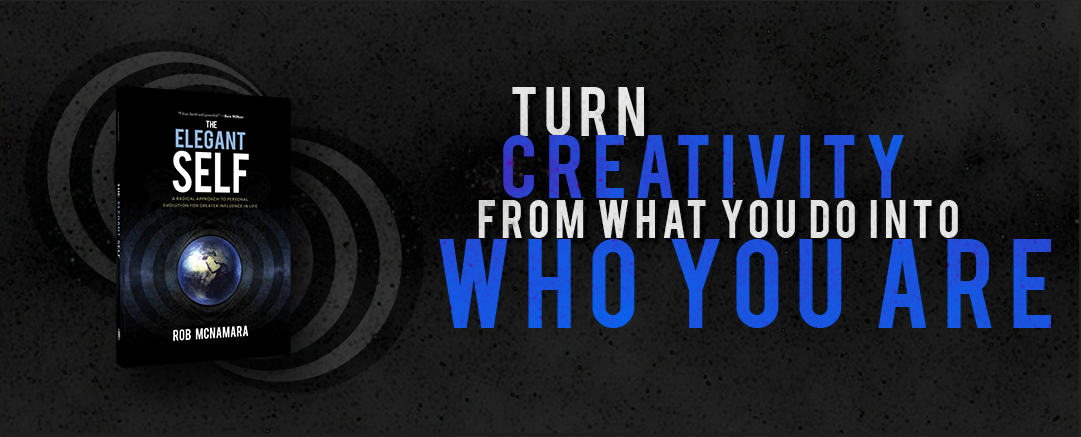
Earlier this year, Rob McNamara published his second book, The Elegant Self: A Radical Approach to Personal Evolution for Greater Influence in Life, which offers an integral development program designed to elevate our subjective reality in the same way his first book, Strength to Awaken: Make Strength Training Your Spiritual Practice and Find New Power and Purpose in Your Life (2012), offered the tools to elevate our objective, physical reality.
Back in April, Rob posted an introduction to his new book, which I am sharing below.
INTRODUCTION TO THE ELEGANT SELF
Rob McNamara is an author, performance coach, psychotherapist, and professor from Boulder Colorado, serving clients throughout North America and Europe. Rob’s book, Strength to Awaken, Make Strength Training Your Spiritual Practice and Find New Power and Purpose in Your Life (2012) sets forth to reshape integral embodiment and the evolution of integral consciousness. He is a professor of Integral, Transpersonal, and Developmental Psychology at Naropa University and has worked with Ken Wilber, the Integral Institute, and contributed to Integral Life for over a decade serving as a Core Faculty for the Integral Life Practice and Integral Spiritual Experience seminar series.
* * * * *April 24th, 2013
By Rob McNamara
This book is about the development of you. We are set to explore how you can accelerate your evolution and how the larger capacities within elegance can generate powerful change in yourself, your life and our world. You are embarking on a journey that is likely to fundamentally change you and what you are capable of.
Whether you are aware of it or not, mental development determines the underlying context of your life. It determines what you can dream of, how you are motivated, what you are capable of seeing and feeling and, thus, what you can achieve. Development sets fundamental limitations on how you communicate with others, and it powerfully shapes the concepts you hold about the world you live in. Your mental development sets the stage for how you understand (and mis-understand) yourself, and it is interwoven with how you create meaning. It defines how you can accept, embrace and embody contentment with yourself and establishes how you struggle with and deny facets of yourself. Put succinctly, mental development has far-reaching governing influence on what you are capable of accomplishing in countless ways in every area of your life.
We are about to step into the territory of human functioning that Harvard’s developmental psychologist Robert Kegan calls the “honors track” of our culture’s curriculum. This is the advanced curriculum adults need to master in order to thrive in today’s world. To be an authority, expert and to shape the fabric of discourse in today’s world requires a careful and rigorous study of the higher reaches of the adult mind. Kegan’s research is only one of our orientations, as this text also explores and draws on research into the further reaches of developmental maturity. So we are embarking on a journey in the honors track of development and beyond. This beyond is rooted in two different domains. The first is grounded in rigorous adult developmental research. The second rests on the author’s own personal experience and perspective, as well as his work with clients embarking on transformations in this domain of maturity.
The perspective and vantage point inherent in elegance, as we are to explore it, is rare. Research shows less than 1 percent of the adult population is stably accessing this honors track. Another 6 to 7 percent are in the process of transitioning from a conventional adult stage of development in this higher echelon of functioning. Approximately 35 percent of the adult population functions at a conventional stage of development. We will define these stages, and others, in depth as we get into the book, but for now we can generically orient to these three groups. The first group we find operating from a conventional adult stage of development. Next is a group where adults are transitioning from conventional to postconventional stages. Finally, we have the adults who have stabilized the honors curriculum or postconventional stage and perhaps are exploring even higher, more refined forms of human functioning, what we will be calling postautonomous development.
This book is designed to serve and engage all three groups. Individuals in the top 1 percent of functioning will likely begin to see novel ways of refining their ongoing maturation process, and discover ways to clean up or fine-tune areas where they slide back into less functional behavior, thought, feeling and relating. Individuals in the process of bridging from conventional stages into the honors track and beyond can expect to enjoy an accelerated boost to their growth process that is already under way. This will be a useful road map of the often confusing transformation that is in process.
Finally, those who are stably functioning from a conventional stage have the most to gain. This book is likely to be a dramatic stimulus for accelerated evolution. The book you now hold is going to support and challenge you in significant ways. Dramatic change may be closer than you realize. Pay close attention. There are many approaches to change and growth out there. The vast majority are rooted in helping people get to a conventional adult stage of functioning and/or expanding this level into new spheres of functioning. While these can provide immense support growing out of what we may call the adolescent mind, or the early adult mind they do not provide guidance in the territory we are headed. It is fairly safe to assume only a small percentage of books, coaching and programs focused on development are aimed to explore the territory ahead of us. The vast majority are focused on establishing and reinforcing conventional functioning, which, in many cases, actually inhibits your further development. As such, you are likely to find divergent recommendations when you contrast this book with other advice, perspectives and guidance. The important question worth holding is, What is the developmental complexity of the support and challenge I am getting? This book will guide you in refining your discernment in answering precisely this question.
WHY ELEGANCE?
As we are headed directly into a close study of some of the highest known expressions of adult maturity, you may be asking why. The reason is actually quite simple: Our human elegance is becoming a necessity. Each day, our larger developmental capacities become less a luxury that is nice to have and more a basic necessity. Elegance is not just a stage of functioning making you dramatically more efficient, capable, happy and fulfilled. You, the people your heart genuinely loves and our world legitimately require more human elegance.
Many of us live in a post-modern informational techno-economic system that yields tremendous industrial and military power on a global scale. There are now more than 7 billion precious and unique human beings living on or around Earth’s seven continents. Much of the world’s economy suffers from a global financial crisis closely interconnected to the financial problems in the United States and the eurozone. Climate change continues to be a major issue. Core questions around sustainable relationships between human beings and the environment stand to be adequately answered. Clean sustainable energy is a major global issue, especially for economic growth in impoverished countries. At the time of this writing, approximately 21,000 children died around the world today. Why? Poverty and other preventable causes explain most of the deaths. Sexism, racism, classism, sociocentricsm and ethnocentrism fuel violence, exploitation, wars and terrorism across our planet. Addiction continues to kill unknown numbers of human beings each year. Tobacco use is the leading cause of preventable death with most deaths occurring in low- and middle-income countries. If current trends persist, tobacco will account for 8 million deaths annually by 2030. Today, human beings still buy and sell other humans on our planet. Slavery is not just surviving in small pockets. As of 2010, there were more slaves than in any other point in recorded history. The International Labor Office estimates nearly 21 million human beings are treated and exchanged as slaves in various forms of forced labor.
As we tour the global issues that challenge our human community, as well as life as a whole on Earth, it appears that something novel is required. The conventional stages of adult maturity have pioneered significant advances in economics, medicine and human rights, to name just a few, yet there is also a pervasive failure to adequately respond to the complexity and demands of our current global condition. Some may even suggest that it is precisely the conventional stages of adult development (and its even less complex adolescence and earlier stages) that have given rise to many of the major problems facing today’s world. To understand, cope and skillfully respond to life’s complex demands, a qualitative leap forward into the upper echelon of adult development is perhaps now a necessity.
Continue to tour the global challenges facing humanity today. Hold them and explore these issues as an astronaut may as she circles our beautiful blue orb floating in dark open space. Next, tour your own personal life unfolding in your small section of the planet. You are likely to see a life and world in which your greater, more mature, developmental capacities are required. Perhaps you need greater social awareness, a more robust wellness initiative to refine you and your family’s health and well-being. Maybe you need a new techno-economic means to support yourself, and/or you require a novel approach to intimacy and contact while also respecting and preserving your need for personal autonomy and solitude. Perhaps, in some cases, these adaptations, among many others, are desperately needed.
So, ultimately, why are we focusing on elegance?
We need to develop and evolve. There is a powerful and adaptive force moving toward the survival and further evolution of life. The more we participate with the unfolding of evolution the greater our chances are of surviving and improving the condition of life on planet Earth. The more elegant you are, the more elegant we are together, the greater the likelihood of our survival.
We are all in this together. This is why.
So, just as you had some growing up to do in adolescence, we all have some growing up to do in adulthood as well. As it turns out, adulthood is not just one stage, as many wrongly assume. Instead, adulthood involves a series of transformations increasing our complexity, capacity and worldview. Each transformation brings novel sets of expectations, possibilities to live into and expanded ways of functioning. You need it. Your family needs your elegance. The people you work with need it. And our world most desperately needs your elegance.
HOW TO READ THIS BOOK
This book is a focused reshaping of the very structure of the way you think, create meaning, make decisions, engage and function in every facet of your life. The book you now hold will have its greatest impact upon you the more dedicated focus you give to it. You are encouraged to read this book, by itself, from cover to cover. If you are studying other personal growth literature you are encouraged to do one of two things:
1. Set aside these other books and make a commitment to resume them after you have completed this book.

2. Finish reading the book or books you find absolutely essential to your life right now. Then begin this book, by itself.The degree of focus you bring to this book determines the depth in which you can learn, absorb and ultimately grow. Clearing competing messages you are reading is an important first step. Most books focusing on personal development do not pick up the honors track curriculum, thus they will likely have divergent agendas. Ultimately the greater your focus, the greater the return you can yield from this book. So protect the focus you are bringing to your emergent elegance.
Next, commit to reading this book daily. Metabolizing parts of this book every day increases its ability to initiate changes inside of you. You may want to think of this book as a high-grade fuel that helps you function from a gear that has greater power, efficiency and fluidity than how you may typically function. Regular consumption yields greater adaptation when compared to picking up this book a few times a week, or worse, a few times per month.
For best results, do not skim or speed-read. Skimming and speed- reading are essential for quickly gaining information. This book provides a wealth of information, but this is not the essential purpose of the book you now hold. The purpose of this text is to reshape and restructure how you relate to all information and experience. Skimming and speed- reading will offer certain data points from this book but the existing structure of your mind holding this information is likely to remain unchanged. This misses the entire point of the book in your hands, as well as your elegance as a human being.
Instead, slow down and take your time. Re-read parts that are challenging and stretching you in new ways. Pause when needed. Actually stop reading when you are in the process of re-structuring the way you make sense of yourself and your experience. Stop mid-sentence and turn toward what is restructuring within. Use the journal sections following each chapter to capture key insights for later reflection and integration. Once this organizational shift has settled, return back to the beginning of the paragraph in which you stopped and continue reading.
Readers are recommended to make a commitment to read two chapters each week. You will complete the book in just under six weeks. If you are more driven and have more time for reading, reflection and integrating your study of elegance commit to reading three chapters each week. You will finish this book in just under a month if you choose this option. Regardless of which option you choose I want to emphasize again slowing down and pausing. This allows for greater integration where your mind to acclimatizes to new vantage points and more flexible ways of being.
Once you have finished this book it can serve as a powerful reference guide. When you find yourself stuck in a less mature habit that is holding you back, revisiting specific chapters and their exercises (along with your notes) is likely a powerful tool to return to. When needed, revisit sections of this text to shift, augment and open up your larger perspectives and capacities.
Finally, enjoy yourself. Development is a challenging process that almost always involves pain, dissonance and anxiety. Yet development also expands you. You grow in a larger space with greater freedom, more diversity of choice with a greater fullness and richness of experience. This basic expansion of you becoming more is also immensely pleasurable. So enjoy!
Welcome, dear friend, to the part of you that unknowingly always leans toward an unknown mystery. Welcome to a gentle, curious, open leaning toward being and becoming more.
THE ELEGANCE TRILOGY
Finally, I want to situate this book amidst a broader conversation around intimacy and relationships as well as leadership and your professional development. As the concept of elegance was shaping my thought and writing, it held what George Vaillant, Harvard University’s Director of Research for the Department of Psychiatry, refers to as the three major tasks of adulthood: identity, intimacy, and generativity. Elegance has important features to contribute to how you come to know yourself, how you cultivate and function in relationship as well as how you function personally and professionally in giving back to the world. This book takes a deep dive on what we can call your identity development. The central focus of this book is to reshape you.
You can also expect this book to impact intimacy, relationships and your professional development. While we take brief tours of how elegance can influence your intimacy and leadership abilities, I have saved more exhaustive exploration of these topics for two subsequent books. The elegance trilogy thus lays out a robust exploration of the major demands placed upon adulthood investigated from more complex developmental vantage points.
Further Resources
- 7 Free Strategies to Refine Elegance
- Learn More about The Elegant Self
- Integral Immersion: Your Life is Your Practice - An 8 week tele-course taking you on a deeper dive into powerful integral practices to evolve you. Facilitated by Diane Hamilton and Rob McNamara. [This course began April 13th.]


