Gary Younge: "Who Are We - And Should It Matter in the Twenty-First Century?"
Hundreds of people can be seen in a reflection from a mirror on Ocean Drive, in this Jan. 16, 2005, file photo, in the South Beach section of Miami Beach, Fla. (AP Photo/Alan Diaz/FILE)
In this new century, identity is at the heart of the most pressing and often violent issues of the day. In the U. S. and abroad, people often retreat into the refuges of religion, nationality, class, and race. It can be seen in the wave of social unrest that spread across England. Or in Italian Prime Minister Berlusconi’s description of undocumented workers as an “army of evil.” And seventy percent of Oklahomans voted to ban the introduction of Sharia law, though only a small portion of residents are Muslim. One journalist urges us to search for common, higher ground. He warns that if we fail, our society may become more divided than ever before. Diane and her guest talk about why identity matters.
Guests
Gary Younge, columnist for the "Guardian" and "The Nation, and author of "Stranger in a Strange Land" and "No Place Like Home."
Wednesday, September 07, 2011
Gary Younge - Who Are We - And Should It Matter in the Twenty-First Century?
This is an episode of the Diane Rehm show from a week or so back - interesting discussion.


BBC - Clever New Caledonian crows can use three tools
Long-time readers know my love of crows and other corvids (Ravens, jays, magpies, etc). Scientists have been increasingly interested in the intelligence of these birds - rivaled only by a few species of parrots in the avian world, and more intelligent than dogs, horses, most primates, and small children.
These birds create their own tools - and, more impressively, they solve problems in their minds before implementing the solution. Few other animals can do that - as far as we currently know.
 Read the whole article.
These birds create their own tools - and, more impressively, they solve problems in their minds before implementing the solution. Few other animals can do that - as far as we currently know.
Clever New Caledonian crows can use three tools | |
| |
Click to play
New Caledonian crows have given scientists yet another display of their tool-using prowess.
Scientists from New Zealand's University of Auckland have found that the birds are able to use three tools in succession to reach some food.
The crows, which use tools in the wild, have also shown other problem-solving behaviour, but this find suggests they are more innovative than was thought.
The research is published in the Proceedings of the Royal Society B.
The team headed to the South Pacific island of New Caledonia, the home of Corvus moneduloides.
They are the only birds known to craft and use tools in the wild.
Finding that the crows could solve the problem... was incredibly surprising
Alex Taylor


The discovery that they whittle branches into hooks and tear leaves into barbed probes to extract food from hard-to-reach nooks astounded scientists, who had previously thought that ability to fashion tools was unique to primates.
And further research in the laboratory and the field has revealed that New Caledonian crows are also innovative problem solvers, often rivalling primates. Experiments have shown that the birds can craft new tools out of unfamiliar materials, as well as use a number of tools in succession.
Comedians@Google: Eddie Izzard
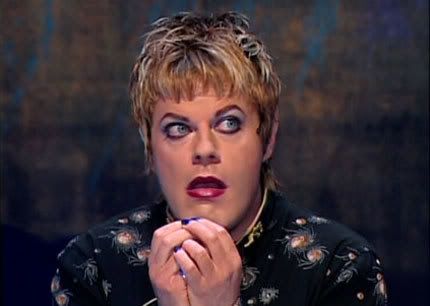
Awesome - Eddie Izzard is one of my favorite comedians ever. He may be the first postmodern, self-referential, and multi-perspectival comedian.
Comedians@Google: Eddie Izzard
Eddie Izzard stops by Google for a conversation about his life, his influences, and comedy. The interview was conducted by Mark Day.
For the uninitiated, here is an old video of one of his shows - one of the classics that made him famous.
Eddie Izzard Dress To Kill (1999)
Eddie Izzard Dress To Kill (1999)
Tuesday, September 06, 2011
Redirect Our Stories - Social Psychologist Timothy Wilson

Interesting - but I am in total agreement. For existential level dysfunctions this is certainly a very useful therapy, and one I employ. This is even a useful tool for sexual assault or molestation after the age of five or six. But for pre-verbal wounding, more commonly thought of as attachment failures, I suspect there is little that can be done with verbal approaches - these wounds to the self-system reside in the soma and the right hemisphere of the brain, largely inaccessible to verbal therapies.
Redirect with Timothy Wilson from the RSA
Professor Wilson reveals how many conventional psychological therapies and interventions, including most self-help books, can do us more harm than good. Presenting the very latest research, he shows that the key to transforming our lives lies simply in learning to redirect the stories we tell ourselves.
TEDxBrainport - Mark Post - Meet the new meat

Making meat in the laboratory sounds like a good idea to me, as long as we test it and make sure it does not contain any harmful mutations. Just think of all the suffering that could be eliminated in getting rid of factory farms, and all the land that could be repurposed.
TEDxBrainport - Mark Post - Meet the new meat
What do you think about laboratory-made meat? "Yuck" is likely your first reaction. Terms like 'Frankenburger' and 'Lab chops' might spring to mind. So why would we want to create artificial meat? Because breeding cows and pigs for their meat is inefficient. Only parts of the animal are consumed and meat consumption is outstripping supply.
Post explains that it is relatively simple to take stem cells from an animal and grow them to produce new muscle tissue. Simply add sugar, proteins and fat and get it into shape with a bit of exercise and you have created edible meat. The only problem then is to find a new role for our livestock...
Penrose strikes back in war of the cosmos
From PhysicsWorld, Roger Penrose argues back against the critics of his "conformal cyclic cosmology" model that rejects the Big Bang in favor of a cyclical universe that basically recycles itself endlessly. You can read the whole 2-page refutation here.
Here is the abstract:
Here is the abstract:
More on the low variance circles in CMB sky
(Submitted on 7 Dec 2010)
Two groups [3,4] have confirmed the results of our paper concerning the actual existence of low variance circles in the cosmic microwave background (CMB) sky. They also point out that the effect does not contradict the LCDM model - a matter which is not in dispute. We point out two discrepancies between their treatment and ours, however, one technical, the other having to do with the very understanding of what constitutes a Gaussian random signal. Both groups simulate maps using the CMB power spectrum for LCDM, while we simulate a pure Gaussian sky plus the WMAP's noise, which points out the contradiction with a common statement [3] that "CMB signal is random noise of Gaussian nature". For as it was shown in [5], the random component is a minor one in the CMB signal, namely, about 0.2. Accordingly, the circles we saw are a real structure of the CMB sky and they are not of a random Gaussian nature. Although the structures studied certainly cannot contradict the power spectrum, which is well fitted by LCDM model, we particularly emphasize that the low variance circles occur in concentric families, and this key fact cannot be explained as a purely random effect. It is, however a clear prediction of conformal cyclic cosmology.The following article summarizes the current debate and links to the two articles that argue against Penrose's interpretation of the evidence.
Penrose strikes back in war of the cosmos
Do these concentric circles offer a glimpse of before the Big Bang?
By James Dacey
Roger Penrose is defending his claim that our universe did not begin with the Big Bang but instead continually cycles through a series of lifetimes, or “aeons”. He makes his latest case in a paper submitted to the arXiv preprint server yesterday.
The recent excitement began in November when Penrose, a University of Oxford physicist, made the sensational claim that he had glimpsed a signal originating from before the Big Bang. Working with Vahe Gurzadyn of the Yerevan Physics Institute in Armenia, Penrose came to this conclusion after analysing maps from the Wilkinson Anisotropy Probe (WMAP). These maps reveal the cosmic microwave background, believed to have been created just 300,000 years after the Big Bang and offering clues to the conditions at that time.
After scrutinizing over seven years’ worth of WMAP data, as well as data from the BOOMERanG balloon experiment in Antarctica, Penrose and Gurzadyn say they have identified a series of concentric circles within the data. These circles show regions in the microwave sky in which the range of the radiation’s temperature is markedly smaller than elsewhere. According to the researchers, the patterns correspond to gravitational waves formed by the collision of black holes in the aeon that preceded our own, and they published these claims in a paper submitted to arXiv.
The paper was quickly picked up by physicsworld.com and, in no time at all, the story was causing a big stir in the blogosphere. But not everybody agrees with Penrose’s outlandish claims and to date at least two other groups have published their own independent analyses of the same CMB data, and both have taken issue with the original conclusions. The first is a paper by Moss et al and the second is written by Wehus et al – both published on arXiv.
The disagreements are subtle – and I won’t pretend I fully understand them – but in essence both groups are saying that we should not be surprised by the circles, which can easily be explained by anisotropies in the CMB. The patterns, claims Wehus’ group, are fully consistent with the accepted inflationary model of cosmology: that the universe started from a point of infinite density, expanded extremely rapidly for about a second, and has continued to expand much more slowly ever since.
But not to just sit and sulk, Penrose and Gurzadyn have already hit back with a follow up paper, published yesterday on arXiv. In the short article, they agree that the presence of circles in the CMBdoes not contradict the standard model of cosmology. However, the existence of “concentric families” of circles, they argue, cannot be explained as a purely random effect given the pure Gaussian nature of their original analysis. “It is, however a clear prediction of conformal cyclic cosmology,” they write.
The battle, it seems, is set to go on.

Monday, September 05, 2011
Fabio Fina - Trauma Healing and Sexuality

Fabio is a friend over at Facebook - he is a 2009 graduate of Naropa University with a degree in Somatic (Body-Centered) Psychotherapy. He has posted several video talks on YouTube dealing with the somatic responses to trauma.
Some of what he is talking about is the way trauma gets stored in the body - there is a series of exercises that are designed to help release trauma from the body. The book is called The Revolutionary Trauma Release Process: Transcend Your Toughest Times by David Berceli.
Four primary characteristics of Tea Party - Authoritarianism, ontological insecurity, libertarianism, and nativism

Interesting article from Talking Points Memo - not surprising, but interesting to see it quantified in a research study.
Read the whole article.Study: Tea Party Members Cultural Dispositions ‘Authoritarianism, Fear Of Change, Libertarianism And Nativism’
What are the four primary characteristics most associated with those Americans sympathetic to the Tea Party? "Authoritarianism, ontological insecurity (fear of change), libertarianism and nativism." So says one of the many findings in a study presented to the American Sociological Association on Monday.
The academic study, Cultures of the Tea Party, purports to break down the cultural attitudes of Tea Party loyalists, through a mix of polling data and interviews with tea partiers at a gathering in eastern North Carolina. The study's lead author is Andrew J. Perrin, an associate professor of sociology at the University of North Carolina-Chapel Hill, with co-authors Steven J. Tepper, an associate professor of sociology at Vanderbilt University, Neal Caren, an assistant professor of sociology at UNC, and Sally Morris, a doctoral student in sociology at UNC.
The study used polling of North Carolina and Tennessee, conducted by Public Policy Polling (D) in the Summer of 2010, and determined the cultural dispositions by measuring the responses of tea partiers to set questions. After PPP surveyed over 2,000 voters who were sympathetic to the Tea Party, researchers then reinterviewed almost 600 in the fall of 2010. Those interviews included everything from personality based queries like "Would you say it is more important that a child obeys his parents, or that he is responsible for his own actions?" to more political ones, like "Do you think immigrants who came into this country illegally but pay taxes and have not been arrested should be given the opportunity to become permanent legal residents?" The study also incudes interviews and short responses with ten participants at a Tea Party rally in Washington, NC.
Simply Freud - Allan Schore On Freud's Work: It's All in "The Right Mind"

Neurodevelopmental psychoanalyst (or more simply, neuro-psychoanalysis) Allan Schore was interviewed a little over a year ago at the Simply Freud site. Schore offers the single greatest unification of Self Psychology (derived from neo-Freudian ideas), attachment theory, neurological development, and therapeutic interventions.
His Affect Regulation and the Origin of the Self should be required reading for all counseling students.
Read the whole interview.
Allan Schore
Although some of his theories are still hotly debated, Sigmund Freud, (May 6, 1856 – September 23, 1939) is widely regarded as a trailblazer in the realm of psychiatry and psychology. The Austrian psychiatrist and neurologist, who was allegedly the first to offer a comprehensive explanation of how human behavior is determined by the conscious and unconscious forces, is regarded as the founder of psychoanalysis.
Along with the “talk therapy” that remains the staple of psychiatric treatment to this day, Freud popularized, among other notions, such concepts as the psychosexual stages of development; Oedipus complex; transference; dream symbolism; Ego, Id and Super-Ego; and the one that has become part of colloquial English more than any other psychiatric term – the Freudian slip.
Dr. Allan Schore is on the clinical faculty of the Department of Psychiatry and Biobehavioral Sciences, UCLA David Geffen School of Medicine, and at the UCLA Center for Culture, Brain, and Development. He is author of three seminal volumes, Affect Regulation and the Origin of the Self, Affect Dysregulation and Disorders of the Self and Affect Regulation and the Repair of the Self, as well as numerous articles and chapters. He is Editor of the acclaimed Norton Interpersonal Series on Interpersonal Neurobiology. His Regulation Theory, grounded in developmental neuroscience and developmental psychoanalysis, focuses on the origin, psychopathogenesis, and psychotherapeutic treatment of the early forming subjective implicit self. His contributions appear in multiple disciplines, including developmental neuroscience, psychiatry, psychoanalysis, developmental psychology, attachment theory, trauma studies, behavioral biology, clinical psychology, and clinical social work. His groundbreaking integration of neuroscience with attachment theory has led to his description as "the American Bowlby" and with psychoanalysis as "the world’s leading expert in neuropsychoanalysis."
Q: In a posthumously published work entitled Project for a Scientific Psychology, Freud tried to relate his psychological theory to neuro-anatomy and physiology but abandoned the project completely. Can you tell us why he chose not to develop this line of inquiry?
A: In the summer of 1895, Sigmund Freud became obsessed with the idea of writing an article in which he would directly link the operations of the brain and the functions of the mind. This goal seemed to be within reach, as in the previous two decades Freud had worked as a practicing neurologist. During this period, he had published over 100 scientific works. These contributions, during the seminal "golden age" of neurology, culminated in 1891 in his volume On Aphasia. His ideas about this condition and about the brain systems involved in language are still cited in today’s neurological literature. In 1893 to 1895, Freud transitioned from brain to mind in his work with Breuer. In the spring of 1895, he had completed the final chapter on psychotherapy for Studies on Hysteria. It was in this very time period that Freud thought it was in his capacities to integrate his extensive knowledge of brain anatomy and physiology with his current experiences in psychology and psychopathology in order "to furnish a psychology which shall be a natural science." He referred to this ongoing work as "Psychology for Neurologists."
Initially, Freud was confident and even elated that a solution was at hand. Breuer observed that during this time Freud’s intellect was "soaring at its highest.’’ By October, he finished the work in two notebooks totaling 100 pages. This short essay set forth, for the first time, a number of elemental constructs that would literally serve as the foundation, the bedrock of psychoanalytic theory. In this remarkable document, Freud introduced the concepts of primary and secondary processes; the principles of pleasure-unpleasure, constancy, and reality testing; the concepts of cathexis and identification; the theories of psychical regression and hallucination; the systems of perception, memory, unconscious and preconscious psychic activity; and the wish-fulfillment theory of dreams. It also contained the seeds of Freud’s developmental theory and a neuro-physiological model of affect generation.
In order to construct a systematic model of the functioning of the human mind in terms of its underlying neurobiological mechanisms, Freud had to deduce the existence of certain brain mechanisms that were not yet discovered. For example, he described the essential function of "contact barriers," yet Sherrington introduced the term "synapse" only two years after the "Project" was finished! And he referred to the critical activity of "secretory neurons" in the brainstem, yet the biogenic amines of the reticular core of the brain were not discovered until well into the 20th century.
Within one month after finishing the Project, Freud’s enthusiasm totally collapsed and he repudiated the work, and never wanted to see it again. After Freud’s death it was finally published in 1950 under a title devised by Strachey, "Project for a Scientific Psychology." It is now thought that the ideas generated in this work, many of which were incorporated into the seventh chapter of The Interpretation of Dreams, represent the source pool from which he later developed the major concepts of his psychoanalytic model. And yet, according to Sulloway, Freud "never abandoned the assumption that psychoanalysis would someday come to terms with the neuro-physiological side of mental activity."
Q: Along with Mark Solms, you’ve been credited with breathing new life into Freud’s theories with your research in the area of neuro-psychoanalysis. Can you tell us what neuro-psychoanalysis is and how are you bridging the gap between Freud’s subjective view of the mind and your objective analysis of the brain?
A: In a 1997 article in the Journal of the American Psychoanalytic Association, I suggested that the time was right for a rapprochement between psychoanalysis and neuroscience. This rapprochement has allowed for the emergence of modern neuro-psychoanalysis, and has returned to the seminal questions introduced in the Project that lie at the core of psychoanalysis. Psychoanalysis has been called the science of unconscious processes. Neuro-psychoanalysis is thus the branch of neuroscience that deals with the relationship between the mind, especially the unconscious mind, and the nervous systems. Notice I say the "nervous systems" and not "the brain," because the neuronal systems that rapidly process bodily-based information at levels beneath conscious awareness are located in both the central nervous system and the autonomic nervous system.
During the 1990’s, one hundred years after the Project and the centennial of the birth of psychoanalysis, neuro-psychoanalysis experienced an intense revitalization. In 1994, I published Affect Regulation and the Origin of theSelf, exploring the neurobiological underpinnings of developmental and clinical psychoanalysis. In parallel, throughout this "decade of the brain," the investigative tools of neuroscience were greatly expanded - advances in neuro-imaging technologies greatly enhanced the study of brain/mind/body functions. And developmental psychology and emotion research were now producing experimental data research that were directly relevant to psychoanalysis.
Sunday, September 04, 2011
Getting to Know Monkey Mind

Jami and I went to a Quaker meeting this morning - an hour of sitting in silence. No one was moved to speak, so for me it was an hour of seated (in a chair) meditation. Honestly, it's been a while since I have sat for an hour - I could tell by the pain in my knees, my back, my ass.
And I could tell by how wildly my mind swung from thought to thought - I was pretty good for the first 20-30 minutes, about the length of my usual meditations. So at about that point, the moneky woke up, had some really strong coffee, and took over. Oy vey! I need to get back to sitting for longer periods.
This Daily Om from a while back addresses monkey mind for those new to meditation.
Quiet Please!
Taming Monkey Mind in Meditation
We all have the endless chattering and noise in our head often referred to as the monkey mind.
It’s been called the monkey mind – the endless chattering in your head as you jump in your mind from thought to thought while you daydream, analyze your relationships, or worry over the future. Eventually, you start to feel like your thoughts are spinning in circles and you’re left totally confused.
One way to tame this wild creature in your head is through meditation – although the paradox is that when you clear your mind for meditation you actually invite the monkey in your mind to play. This is when you are given the opportunity to tame this mental beast by moving beyond thought – to become aware of a thought rather than thinking a thought. The difference is subtle, but significant. When you are aware of your thoughts, you can let your thoughts rise and float away without letting them pull you in different directions. Being able to concentrate is one of the tools that allows you to slow down your thought process and focus on observing your thoughts.
To develop your concentration, you may want to start by focusing on the breath while you meditate. Whenever your monkey mind starts acting up, observe your thoughts and then return your focus to your breath. Some breathing meditations call on you to focus on the rise and fall of the breath through the abdomen, while others have you concentrate on the sound of the breath. Fire can also be mesmerizing, and focusing on a candle flame is another useful tool for harnessing the mind. Keep the gaze soft and unfocused while observing the color, shape, and movement of the flame, and try not to blink. Close your eyes when you feel the need and continue watching the flame in your head. Chanting, devotional singing, and mantras also still the mind. However you choose to tame the monkey mind, do so with firm kindness. The next time the chattering arises, notice it and then allow it to go away. With practice, your monkey mind will become quiet and so will you.
B Alan Wallace - How do you acumulate merit?
Dharma Quote of the Week
"Accumulating merit" can be approached from a psychological perspective that lends itself to experiential verification or from a spiritual dimension that requires some faith. "Merit" can be understood as "spiritual power" that manifests in day-to-day experience. When merit, or spiritual power, is strong, there is little resistance to practicing Dharma and practice itself is empowered.
Tibetans explain that people who make rapid progress in Dharma, gaining one insight after another, enter practice already having a lot of merit. By the same theory, it is possible to strive diligently and make little progress. Tibetans explain this problem as being due to too little merit. Merit is the fuel that empowers spiritual practice.
How do you accumulate merit? Engaging in virtue of any sort, with your mind, your speech, or your body results in merit. Just as merit can be accumulated, it can also be dissipated by doing harm. In general, mental afflictions dissipate merit. The mental affliction that is like a black hole sucking up merit, worse than all the others, is anger. Attachment or sensual craving can get you in a lot of trouble, but it doesn't have the debilitating impact upon spiritual practice that anger does. Remember the warrior metaphor--standing at the gateway of the mind, vigilant, spear ready. The spear is for mental afflictions, especially anger. Nip anger in the bud. (p.208)
--from Buddhism with an Attitude: The Tibetan Seven-Point Mind Training by B. Alan Wallace, published by Snow Lion Publications
Buddhism with an Attitude • Now at 5O% off!
(Good until September 9th).

Sogyal Rinpoche's Glimpse of the Day
From September 4, 2011:

Dudjom Rinpoche used to tell the story of a powerful bandit in India, who, after countless successful raids, realized the terrible suffering he had been causing. He yearned for some way of atoning for what he had done, and visited a famous master. He asked him: “I am a sinner, I am in torment. What’s the way out? What can I do?”
The master looked the bandit up and down and then asked him what he was good at.
“Nothing,” replied the bandit.
“Nothing?” barked the master. “You must be good at something!”
The bandit was silent for a while, and eventually admitted: “Actually there is one thing I have a talent for, and that’s stealing.”
The master chuckled: “Good! That’s exactly the skill you’ll need now. Go to a quiet place and rob all your perceptions, and steal all the stars and planets in the sky, and dissolve them into the belly of emptiness, the all-encompassing space of the nature of mind.”
Within twenty-one days, the bandit had realized the nature of his mind, and eventually came to be regarded as one of the great saints of India.
Saturday, September 03, 2011
The Dalai Lama - Union of calm abiding and special insight
DEITY YOGA
in Action and Performance Tantra
by His Holiness the Dalai Lama,
Tsong-ka-pa, and Jeffrey Hopkinsmore...
Dalai Lama Quote of the Week
It is necessary to alternate stabilising meditation and analytical meditation...by merely cultivating non-conceptuality and non-analysis it is impossible to enter into the yoga of signlessness.
Even after emptiness has been realised, powerful and repeated analysis is needed. Merely to set one's mind on the meaning of emptiness is the mode of cultivating calm abiding observing emptiness; in order to cultivate special insight it is necessary to analyse again and again. These two modes of meditation--stabilising and analytical--are alternated until analysis itself induces even greater stablisation, at which point stabilisation and wisdom are of equal strength, this being a union of calm abiding and special insight.
In Performance as well as in Action Tantra the meditative stabilisation which is a union of calm abiding and special insight is used to gain feats for the sake of aiding sentient beings and accumulating merit quickly. (p.42)
--from Deity Yoga in Action and Performance Tantra by His Holiness the Dalai Lama, Tsong-ka-pa, and Jeffrey Hopkins, published by Snow Lion Publications
Deity Yoga • Now at 5O% off
(Good until September 9th).
Tricycle Community Special Event
Join Tricycle's Online Community-
be part of an important conversation
During the month of September, the Tricycle Community is hosting a Special Community Discussion with Snow Lion author B. Alan Wallace.
Tricycle Community members will have an opportunity to join in discussions of Alan Wallace's new book, Minding Closely: The Four Applications of Mindfulness, from September 6th to October 2nd.
For more information on this event and Tricycle's special promotions:


Joan Halifax: Compassion and the true meaning of empathy

Most of you have seen this video by now - but for those who haven't, this is great stuff. It's a bit short at around 14 minutes, so I have included another talk (below) from April of this year.
Compassion and the true meaning of empathy
Buddhist roshi Joan Halifax works with people at the last stage of life (in hospice and on death row). She shares what she's learned about compassion in the face of death and dying, and a deep insight into the nature of empathy.
Activist, anthropologist, author, caregiver, ecologist, LSD researcher, teacher, and Zen Buddhism priest -- Joan Halifax is many things to many people. Yet they all seem to agree that no matter what role she plays, Halifax is consistently courageous and compassionate. Halifax runs the Upaya Zen Center in New Mexico, a Zen Peacemaker community she opened in 1990 after founding and leading the Ojai Foundation in California for ten years. Her practice focuses on socially engaged Buddhism, which aims to alleviate suffering through meditation, interfaith cooperation, and social service.
As director of the Project on Being With Dying, Halifax has helped caregivers cope with death and dying for more than three decades. Her book Being With Dying helps clergy, community activists, medical professionals, social workers and spiritual seekers remove fear from the end of life. Halifax is a distinguished invited scholar of the U.S. Library of Congress and the only woman and Buddhist on the Tony Blair Foundation’s Advisory Council.
"She’s the most fearless person I’ve ever met." ~ Peg Reishin Murray in Shambhala Sun
Talk on Compassion at Capital University, Columbus, Ohio
This is the Keynote Address delivered at the Symposium on Undergraduate Scholarship in April, 2011.
Richard Francis - Epigenetics: The Ultimate Mystery of Inheritance

I've been meaning to post these reviews for a while now - epigenetics is changing a lot of what we have previously assumed about evolution and how genes are impacted by the environment. Turns out that genes can be altered in a single lifetime. For example, how a mother eats before and during her pregnancy - and how the father eats prior to conception - can change the genetics of their child in significant ways.
This book by Richard Francis, Epigenetics: The Ultimate Mystery of Inheritance, has received some good reviews - I'm looking forward to reading it. Here are three reviews.
Mixing Nature and Nurture
by Julia M. KleinJUNE 21, 2011
In the waning months of World War II, the Nazis, angered by Dutch resistance, retaliated with a food embargo. As a result, 22,000 people in western Holland starved to death. And the effects of the famine were not limited to a single generation. The children of malnourished mothers were born undersized. More surprising, studies found that, as adults, these men and women were more susceptible to a wide range of ailments, from diabetes and depression to breast cancer and obesity.
Neither classical genetics nor an environmental explanation suffices to unravel this phenomenon. But the new science of epigenetics – which deals with long-term alterations in gene behavior – supplies a key causal link. Epigenetics involves chemical changes in cells, sometimes random and sometimes environmentally caused. What is even more startling is that these epigenetic “marks,” as they are called, can be inherited – either directly (much like genetic mutations) or in various indirect ways.
Richard C. Francis, a neurobiologist turned science writer, has written what he says is the first popular book on this booming, cutting-edge field. Even so, reading Epigenetics: The Ultimate Mystery of Inheritance (Norton) requires an almost scholarly level of concentration. It helps to have, at the very least, a working knowledge of genetics. If the mere mention of messenger RNA, alleles and methylation (this last was new to me, too) induces panic, then this slim, intriguing volume will provoke anxiety for sure.
To his credit, Francis, relying heavily on analogy and example, does a mostly masterful job of illuminating some very thorny concepts. He introduces epigenetics with a reference to “identical,” or monozygotic, twins. We expect such twins, who are genetic clones, to be biologically similar. But there are powerful exceptions. In the instance that Francis cites, one twin was born with a disorder of sexual development known as Kallmann syndrome, while the other appeared normal.
Read the whole review at Obit.
* * * * * * *
Lamarck's Revenge
by Judith Shulevitz
August 18, 2011
Epigenetics: The Ultimate Mystery of Inheritance
by Richard Francis
W. W. Norton & Company, 234 pp., $25.95
THERE HAS BEEN a revolution in the world of genetics. It is called epigenetics. The Greek prefix “epi” implies something that comes in addition to something else; epigenetics adds to the study of genes the study of how they get turned on or off. Although a Martian eavesdropping on conversations about genetics in the popular media would surely conclude that genes and traits correspond in a one-to-one ratio, in reality the twenty thousand to twenty-five thousand genes in the human genome do not automatically spawn traits. Genes have to be turned on, or “expressed,” through a complex process that takes place in the cell, before they can encode instructions that will (in combination with other genes) affect the shapes of bodies, or their metabolic rates, or what have you. Genes can also be turned off, or “silenced.” Gene expression and gene silencing take place all the time, as a matter of course. The science writer David Shenk recently came up with this delightfully mad-scientist metaphor for the process: “Think of a giant control board inside every cell in your body. Many of those knobs and switches can be turned up/down/on/off at any time.”
Now that geneticists—along with neuroscientists, cognitive psychologists, and others who study development—have broadened their focus from the naked double helix (that is, the DNA) to the chemical attachments that make up all those knobs and switches, they must grapple with a force long thought to have little direct impact on genetic inheritance: the environment. Epigenetic processes react with great sensitivity to genes’ immediate biochemical surroundings—and even more surprisingly, they pass those reactions on to the next generation. This biochemical stew in turn reflects what organisms ate, drank, breathed, swam in, or felt. In other words, your genome is being affected by your social reality—by whether you live in a clean suburb or dirty city, eat fresh food or junk, and feel empowered or embittered by your station in life—and is likely to pass some sort of epigenetic memory of that experience to your offspring.
As paradigm shifts go, this is huge.

Read the whole article at The New Republic.
* * * * * *
Goodbye, Genetic Blueprint - What the new field of epigenetics reveals about how DNA really works.
Posted Monday, June 20, 2011
There are almost as many metaphors for genes as there are genes. One of the most familiar, and the hardest to let go of, is the tidy blueprint, at once reassuringly clear and oppressively deterministic: Our genome is the architectural plan for who we are. It tells our body how to build itself, setting our height, our health, and even our moods since before we are born. Small wonder that we imagine if we can read our genome, we will discover not just the truth of ourselves but perhaps our future, too. Remember the high hopes that spurred on the Human Genome Project in the 1990s? Though the genetic catalog is now largely complete, we still await many of the anticipated insights, and in Epigenetics: The Ultimate Mystery of Inheritance, Richard Francis, a writer with a biology Ph.D., traces the emergence of a different genetic paradigm. Our DNA shapes who we are, Francis reports from the research forefront, but it is far from a static plan or an inflexible oracle; DNA gets shaped, too. For good or ill, the forces that determine our fate can't be captured by anything so neat as a blueprint.
Francis's primer introduces a new field, whose roots predate the rise of pure genetic determinism. How is DNA itself shaped? The search for answers begins in the late-19th-century work of scientists such as Hans Driesch, whose study of sea urchin embryos revealed that the cell plays a key administrative role in an organism's development. He discovered that if you take cells from one location in the embryo—the area that will become, say, the spines--and plant them in another—the mouth area--their function changes: You don't get spines growing out of the mouth, you get a normal mouth. A cell's identity doesn't arise from a preordained genetic recipe inside it. Crucially, it is the cues that a cell gets from neighboring cells that affect how the genes inside it behave.
Read the whole article at Slate.
Friday, September 02, 2011
Upaya Dharma Podcasts - Al Kaszniak & George Chrousos & Joan Halifax & George Bonanno & Philippe Goldin: 8-25-2011: Zen Brain: Trauma, Stress, Loss, and Happiness (Part 1)
Excellent, a new series of Zen Brain talks from Joan Halifax and a host of experts (Al Kaszniak, George Chrousos, George Bonanno, and Philippe Goldin). These talks are always enlightening and entertaining.
Al Kaszniak; George Chrousos; Joan Halifax; George Bonanno; Philippe Goldin: 8-25-2011: Zen Brain: Trauma, Stress, Loss, and Happiness (Part 1)
Speakers: Al Kaszniak & George Chrousos & Joan Halifax & George Bonanno & Philippe Goldin
Recorded: Thursday Aug 25, 2011Buddhism is a path to liberation from suffering, and among the most pervasive universal triggers of suffering are trauma, stress, and loss, including bereavement. Fundamental to Buddhist teaching, and the path of Zen, is the recognition that freedom from suffering can be found through practice realization of the fundamental nature of the mental continuum as ever-changing, interdependent, and without any fixed, unchanging self at its core.Recently, scientific studies of human resilience following trauma and loss, response to stressful events, and the consequences of meditation training have begun to provide third-person evidence that converges with the first-person experience of Zen practice.In this retreat, prominent scientists and Zen practitioners will explore Buddhist, neuroscientific, and clinical science perspectives on trauma, stress, loss, and the human potential for resilience and happiness. Talks, discussions, and explorations with participants are embedded within Zazen practice throughout each day.Podcast: Play in new window | Download
Authors@Google: Father Greg Boyle

Father Gregory Boyle visited Google's Santa Monica office on Aug 11, 2011 to discuss his book Tattoos on the Heart: The Power of Boundless Compassion. This talk took place as part of the Authors@Google series.
Here is the Amazon blurb on the book, from a Publisher's Weekly starred review:
In this artful, disquieting, yet surprisingly jubilant memoir, Jesuit priest Boyle recounts his two decades of working with homies in Los Angeles County, which contains 1,100 gangs with nearly 86,000 members. Boyle's Homeboy Industries is the largest gang intervention program in the country, offering job training, tattoo removal, and employment to members of enemy gangs. Effectively straddling the debate regarding where the responsibility for urban violence lies, Boyle both recounts the despair of watching the kids you love cooperate in their own demise and levels the challenge to readers to stand in awe at what the poor have to carry rather than stand in judgment at how they carry it. From moving vignettes about gangsters breaking into tears or finding themselves worthy of love and affirmation, to moments of spiritual reflection and sidesplittingly funny banter between him and the homies, Boyle creates a convincing and even joyful treatise on the sacredness of every life. Considering that he has buried more than 150 young people from gang-related violence, the joyful tenor of the book remains an astounding literary and spiritual feat.
Father Boyle is also the founder and one of the forces behind Homeboy Industries, a gang prevention and intervention program in Los Angeles. Boyle spoke in this video as part of "GANGS: Strategies to Break the Cycle of Violence," a 2010-2011 speaker series sponsored by the Department of Social Welfare at the UCLA School of Public Affairs.
Kingsley Dennis - A New Collective Mind for a New World

Kingsley Dennis is the author of New Consciousness for a New World: How to Thrive in Transitional Times and Participate in the Coming Spiritual Renaissance - in this article for Huffington Post, he presents the idea of our cultural hypnosis, the trance-like state we live in wherein we do not examine the beliefs and values we inherit from the culture in which we are embedded.
A New Collective Mind for a New World
Kingsley Dennis, Ph.D. - Sociologist, writer, Co-Founder of WorldShift International
Posted: 8/31/11
We all share a common psychological environment that many of us, most of the time, take for granted. We often underestimate, or even neglect, the power of destructive thought and "mental pollution" upon the sensitive and responsive human membrane that constitutes our "social biosphere." How we are taught (or conditioned) to think will affect how our species manages cultural development and the culture's subsequent intervention into Earth's living systems.
It can be stated that, for the most part, humanity unknowingly participates within a cultural hypnosis. From early childhood, our experiences are established to conform to our specific cultural norm -- any anomalies are usually corrected, and the corrections then reinforced through various socializing processes, such as family, school, friends and such. Thus, our "world" is often given to us through the medium of particular cultural filters, and so each of us is literally hypnotized from infancy to perceive the world in the same way that people in our culture perceive it.
This is a very powerful behavioral and perceptual socializing mechanism. To break from this indoctrinated perceptual environment is extremely difficult and often beset with many personal problems arising from peer pressure and ties to friends and family. A shock is often necessary in order to catalyze one's own change of mind.
For a new mind to emerge during the times ahead it will be necessary for people to take power back into their own perceptual mechanisms, to empower themselves by withholding legitimacy regarding old and outdated modes of thinking. Social philosopher Willis Harman has described this by stating, "By deliberately changing their internal images of reality, people can change the world." This change, then, requires us to take back our rightful legitimacy unto ourselves, to decide carefully what we think, how we think and which beliefs we choose to adopt.
This also concerns our opinions, agreements and support, which we have previously been all too ready to give away. Our beliefs, perceptions and state of mind are crucial for how we understand the world around us. Thus, giving away our right over the power to choose how we wish to perceive the world serves to empower others over us. This, in essence, is the crux of social control, and this mechanism belongs to the paradigm of the old world and will have no place in a post-transition world.
Many of us are unsuspecting as to the degree of insecurity that governs our perceptive abilities. We focus on the immediate and seemingly ignore the long term, despite the long term having the greater urgency in scale. Our social institutions and media continue to reinforce the immediate and short term, thus strengthening our social myopia.
Our early history equipped us to live in relatively stable environments within small communities. Challenges were in the short term and nearby. The human mind thus evolved to deal with low-impact, short-term changes. The world that made our mind is now gone, and the world we have created around us is a new world; paradoxically, it is a world that we have developed limited capacity to comprehend.
It is fair to say that we now have a mismatch between the human mind we possess and the world we inhabit. Most of the momentous changes in our cultural history have taken place in the past 100 years. These days, we don't have that luxury of time as events (with long-term consequences) are rapidly changing around us, before human cultural evolution has had time to readapt.
Cultural evolution has worked more or less well until the present century; now, it finds itself hampered by an outdated human perceptual system. Contemporary society still relies too heavily -- and unconsciously -- on ancient modes of thought and ancient styles of thinking. This begs the question: Can a collective and rapid change of mind occur on this planet? In the words of neurologist Robert Ornstein, "Conscious evolution needs to take the place of unconscious cultural evolution."
Our old mind was set up to be on the lookout for insecurities and fear-inducing situations -- it was our survival apparatus. Yet this apparatus has continued to be reinforced through social conditioning. What is required now is a reinvigoration of vision: Everything that we have culturally achieved has been the result of human vision. The human imagination is a primary force; it allows the intervention of energies and guidance. It is both creative and destructive, and through it we are able to manifest the world we envision.
We now need to upgrade our visionary capacity, to open up more fully to inspired thoughts and guidance. To fail to do so will be a great loss for our species, as these are critical times for the instinctive perceptual faculties, and we need to bring these new organs of perception into being. In Masnavi, a three-volume work of mystical poetry, the revered Persian poet Jalalludin Rumi writes:
New organs of perception come into being as a result of necessity.Every change requires a change in consciousness -- this has always been the case. The 21st century will not be a place for business as usual; it will be a new epoch, and as such, it deserves a corresponding consciousness.
Therefore, O man, increase your necessity, so that you may
Increase your perception.
Subscribe to:
Posts (Atom)