Wednesday, May 18, 2011

FORA.tv - Understanding the Brain: A Work in Progress

http://media-1.web.britannica.com/eb-media/72/74272-004-3A169A5E.jpg

Nice talk by Keith Kendrick, a Systems and Behavioural Neuroscientist at the Babraham Institute in Cambridge, and Emeritus Gresham Professor of Physics.
How billions of interconnected cells in the brain can interpret and regulate all our bodily functions as well as mediate our experiences of interactions with and responses to the world around us is a huge and fascinating question that many different disciplines have attempted to tackle.

This lecture will consider what we have learned so far about the principles of neural encoding and how they may begin to explain our memories, emotions and conscious awareness.

For transcript and download versions of this lecture, please visit the event's page on the Gresham College website: Understanding the brain: a work in progress.

Printer friendly transcript.


Tuesday, May 17, 2011

Beyond Red vs. Blue: The Political Typology

[NOTE: This is another of the post's that phased out of our time-space continuum last week when Blogger went down for 36 hrs or so. Not it's back.]

The Pew Research Center has released a new poll of political viewpoints in the United States - it's interesting in that it shows we are not a two party country in our beliefs, but we are shoved into those two parties in how we select our representatives. The diversity in views is good - maybe some day we will be a multiparty nation.

Beyond Red vs. Blue: The Political Typology

With the economy still struggling and the nation involved in multiple military operations overseas, the public's political mood is fractious. In this environment, many political attitudes have become more doctrinaire at both ends of the ideological spectrum, a polarization that reflects the current atmosphere in Washington.

Yet at the same time, a growing number of Americans are choosing not to identify with either political party, and the center of the political spectrum is increasingly diverse. Rather than being moderate, many of these independents hold extremely strong ideological positions on issues such as the role of government, immigration, the environment and social issues. But they combine these views in ways that defy liberal or conservative orthodoxy.

For political leaders in both parties, the challenge is not only one of appeasing ideological and moderate "wings" within their coalitions, but rather holding together remarkably disparate groups, many of whom have strong disagreements with core principles that have defined each party's political character in recent years.

The most visible shift in the political landscape since Pew Research's previous political typology in early 2005 is the emergence of a single bloc of across-the-board conservatives. The long-standing divide between economic, pro-business conservatives and social conservatives has blurred. Today, Staunch Conservatives take extremely conservative positions on nearly all issues -- on the size and role of government, on economics, foreign policy, social issues and moral concerns. Most agree with the Tea Party and even more very strongly disapprove of Barack Obama's job performance. A second core group of Republicans -- Main Street Republicans -- also is conservative, but less consistently so.

On the left, Solid Liberals express diametrically opposing views from the Staunch Conservatives on virtually every issue. While Solid Liberals are predominantly white, minorities make up greater shares of New Coalition Democrats -- who include nearly equal numbers 0f whites, African Americans and Hispanics -- and Hard-Pressed Democrats, who are about a third African American. Unlike Solid Liberals, both of these last two groups are highly religious and socially conservative. New Coalition Democrats are distinguished by their upbeat attitudes in the face of economic struggles.

Independents have played a determinative role in the last three national elections. But the three groups in the center of the political typology have very little in common, aside from their avoidance of partisan labels. Libertarians and Post-Moderns are largely white, well-educated and affluent. They also share a relatively secular outlook on some social issues, including homosexuality and abortion. But Republican-oriented Libertarians are far more critical of government, less supportive of environmental regulations, and more supportive of business than are Post-Moderns, most of whom lean Democratic.

Disaffecteds, the other main group of independents, are financially stressed and cynical about politics. Most lean to the Republican Party, though they differ from the core Republican groups in their support for increased government aid to the poor. Another group in the center, Bystanders, largely consign themselves to the political sidelines and for the most part are not included in this analysis.

These are the principal findings of the political typology study by the Pew Research Center for the People & the Press, which sorts Americans into cohesive groups based on values, political beliefs, and party affiliation. The new study is based on two surveys with a combined sample of 3,029 adults, conducted Feb. 22-Mar. 14, 2011 and a smaller callback survey conducted April 7-10, 2011 with 1,432 of the same respondents.

Read the full report, take a quiz to find out which typology group you belong to, watch a video in which Pew Research staff describe the report and use an interactive feature to analyze the groups at the 2011 Political Typology page at people-press.org.


TED Talks - Ron Gutman: The hidden power of smiling

[NOTE: This was originally posted last week, but it disappeared into the ether during Blogger's downtime - only to suddenly reappear today.]


This is a cool TED Talk on the science of smiling.
Ron Gutman reviews a raft of studies about smiling, and reveals some surprising results. Did you know your smile can be a predictor of how long you'll live -- and that a simple smile has a measurable effect on your overall well-being? Prepare to flex a few facial muscles as you learn more about this evolutionarily contagious behavior.


Ron Gutman is the founder and CEO of HealthTap, responsible for the company's innovation, vision and product. Before this, he was founder and CEO of Wellsphere, an online consumer health company that developed the world's largest community of independent health writers; it was acquired in early 2009.

As a graduate student at Stanford, Gutman organized and led a multidisciplinary group of faculty and graduate students from the schools of Engineering, Medicine, Business, Psychology and Law to conduct research in personalized health and to design ways to help people live healthier, happier lives. He is an angel investor and advisor to health and technology companies such as Rock Health (the first Interactive Health Incubator) and Harvard Medical School's SMArt Initiative ("Substitutable Medical Apps, reusable technologies"). He's the organizer of TEDxSiliconValley. Find links to all the studies that Gutman references in his talk right here.

Who Says Science has Nothing to Say About Morality?

http://www.cfilondon.org/wp-content/uploads/2011/03/Sam-Richard_fc.jpg

Via Top Documentary Films, Sam Harris and Richard Dawkins discuss Harris's recent book, The Moral Landscape: How Science Can Determine Human Values. Taped at The Sheldonian Theatre, University of Oxford, April 12th, 2011, by ClearStory Ltd.

Although I have issues with some of Harris's positions on the power of science, especially when he gets reductionist, I do like his idea of human well-being as a moral standard - the problem, however, is who gets to decide what well-being looks like.

Who Says Science has Nothing to Say About Morality?

Who Says Science has Nothing to Say About Morality?In his new book The Moral Landscape, neuroscientist and philosopher Sam Harris challenges the commonly held view that science has nothing to say about moral issues and that religion is the best authority on meaning, values and a good life.

For Sam, the goal of The Moral Landscape is to begin a conversation about how moral truth can be understood in terms of science.

Richard Dawkins is known for his persistence in demanding a rational and scientific approach to solving life’s most fundamental questions wherever and whenever it can be applied. So, can science help us to determine how we should live in the 21st century?

These two pinnacles of rationalist thought discuss how the science of morality might be formulated and applied to human well-being at The Sheldonian Theatre, University of Oxford.

Watch the full documentary now


Michel Foucault - The Culture of the Self

http://percaritatem.com/wp-content/uploads/2010/03/Foucault-Lecturing.jpg

I found these at Archive Fire (via Apolloxias) - a cool series of Michel Foucault talking about the Western development of individual subjectivity, recorded at UC Berkeley, beginning on April 12, 1983.
The audio below presents the first in a series of three recorded lectures in which French philosopher Michel Foucault examines Western culture's conceptual development of individual subjectivity. Foucault gave these lectures, in English, at UC Berkeley, beginning on April 12, 1983, roughly a year before he died. There are some negligable distortions in the recordings.
This is the first talk of three that he gave, presented here in 7 parts.


The Science Network - Joseph LeDoux

Joseph Le Doux has written two (probably more, but I have only read two) excellent neuroscience books, Synaptic Self: How Our Brains Become Who We Are and The Emotional Brain: The Mysterious Underpinnings of Emotional Life.
Joseph Le Doux is the Henry and Lucy Moses Professor of Science, and professor of neuroscience and psychology at New York University. His research is aimed at understanding the biological mechanisms of emotional memory – particularly in how the brain learns and stores information about danger. He is also the director of the Center for the Neuroscience of Fear and Anxiety, a multi-university Center in New York City devoted to understanding pathological fear and anxiety in humans. His most recent book is Synaptic Self: How Our Brains Become Who We Are. LeDoux is also a singer and guitarist in the science-themed rock band The Amygdaloids, whose musical genre has been wittily characterized as Heavy Mental.


Crazy Wisdom: The Jack Kerouac School of Disembodied Poetics

I found this at Snag Films - interesting. When I was a poet back in the dark ages of my youth, I wanted to go to the Jack Kerouac School of Disembodied Poetics at Naropa for my MFA, while most of my peers wanted to go to the University of Iowa's MFA program, the elite of the elite programs for writers.


Crazy Wisdom: The Jack Kerouac School of Disembodied Poetics

Crazy Wisdom: The Jack Kerouac School of Disembodied Poetics

(2008) 47 min

A history of Naropa University's unique Buddhist writing program, founded by Allen Ginsberg in 1974

Founded in 1974 by Allen Ginsberg, Anne Waldman, Gregory Corso, Chögyam Trungpa Rinpoche, and many other well known poets, artists, and intellectuals, the Jack Kerouac School of Disembodied Poetics at Naropa University remains a unique haven for writers and spiritual seekers. “Crazy Wisdom” explores the program’s history, the integration of buddhism into the writing curriculum, and the inevitable changes the program has undergone over the last 35 years. It includes interviews with students and faculty members interspersed with archival audio material and footage from a documentary made about Naropa in 1978 entitled “Fried Shoes, Cooked Diamonds.”

A Film By Kate Linhardt

Monday, May 16, 2011

Lee Konstantinou - Biological Universals as Authenticity, or, What's the Matter with Steven Pinker?

http://farm3.static.flickr.com/2734/4341466423_31aa795464.jpg

Cool article from Arcade - How can you not like an article in which lovers of postmodern art are called, and I quote, "Sneering Sophmoric Status-Grabbing Bohemian Modernist/Postmodernist Beauty-Haters." Best line I have read in ages.

In all seriousness, this is actually a good critique of Steven Pinker's inaccurate understanding of modern and postmodern art in The Blank Slate: The Modern Denial of Human Nature.

Biological Universals as Authenticity, or, What's the Matter with Steven Pinker?

I'm not posting the whole article, but I did like this section quite a bit.
In The Blank Slate, Pinker does not argue that culture is epiphenomenal so much as claim that there are a list of human universals that transcend cultural difference. He writes, "My goal in this book is not to argue that genes are everything and culture is nothing--no one believes that--but to explore why the extreme position (that culture is everything) is so often seen as moderate, and the moderate position is seen as extreme." That is, in his view certain aspects of human existence are culturally variable--though no less biological for their variation--and other aspects of humanity can be found among all cultures. The fictional nature of Moya's story might suggest that delving into "Kitayama's" error is beside the point, but I think looking at what Pinker is really arguing will yield some interesting insights into the significance of Na and Kitayama's real research.

At this level of abstraction, it seems to me that Pinker's claim is hard to dispute, but the problem is that it is also hardly very interesting from the perspective of the human sciences. What Pinker fails to tell us with any level of precision is where we can find the boundary between difference and identity and what the significance of that boundary is. Pinker's appendix listing human universals is so free of relevant discussion and context as to leave the reader scratching his head--though it seems perfectly plausible that human universals, like the language faculty, exist and might tell us something about the arts. His discussion of evolutionary psychology, for this head-scratching reader at least, fails to convince, though this is more the fault of contemporary evolutionary psychology than Pinker, whose own area of expertise is linguistics.

As many reviewers have pointed out, The Blank Slate's discussion artistic production (in genetic or evolutionary or biological terms) borders on the ridiculous, quickly and problematically moving from fact to norm, abandoning science very quickly for poorly thought through moralizing. From arguments about universal human capacities to appreciate symmetry or tonality Pinker claims priority for artworks that make use of symmetry and tonality.

After embarassingly misquoting Virginia Woolf, and fundamentally misunderstanding her views on human nature, Pinker disparages "the [then] new philosophy of modernism that would dominate the elite arts and criticism for much of the twentieth century, and whose denial of human nature was carried over with a vengeance to postmodernism, which seized control in its later decades." Modernism's problem is that it allegedly denies human nature, which is a mistake because "[a]rt is in our nature--in the blood and in the bone… in the brain and in the genes… In all societies people dance, sing, decorate surfaces, and tell and act out stories."

Of course, Pinker is aware enough of how problematic his argument is to feel the need to explain the prestige of artworks (elite artworks, as I'm sure Sarah Palin would not hesitate to note) that fail to meet his Fact-Backed-Norm, and so he whips out his shopworn Bourdieu. "The conviction that artists and connoisseurs are morally advanced is a cognitive illusion, arising from the fact that our circuitry for morality is cross-wired with our circuitry for status…" We are also informed that the avant-guard tendency to "sneer[] at the bourgeoisie" is

a sophomoric grab at status with no claim to moral or political value. The fact is that the values of the middle class--personal responsibility, devotion to family and neighborhood, avoidance of macho violence, respect for liberal democracy--are good things, not bad things [as presumably postmodernists thing]. Most of the world wants to join the bourgeoisie, and most arrests are members in good standing who adopt a few bohemian affectations.

Humans who appreciate modernist or avant-garde artworks only pretend to do so because of an ultimately (in an evolutionarily psychological sense) cynical desire to gain acclaim and prestige (and fitter sexual partners, which is what the game often boils down to) or because we are "cross-wired" in weird ways:

As Bourdieu points out, only a special elite of initiates could get the point of the new works of art. And with beautiful things spewing out of printing presses and record plants, distinctive works need not be beautiful. Indeed, they had better not be, because now any schmo could have beautiful things.

We can all be grateful that Pinker doesn't have his moral-circuitry cross-wired with his status-circuitry. Certainly, none of us could imagine that there is any advantage Pinker might gain (in either a proximate or ultimate sense) in condemning the menace of Sneering Sophmoric Status-Grabbing Bohemian Modernist/Postmodernist Beauty-Haters in these terms, especially since those of us who enjoy ugly artworks (how can I deny that I am a hater of schmos?) are so powerfully dominant.

Read the whole article.


Cassandra Vieten - Understanding Why We Change

http://healinginhealthcare.files.wordpress.com/2011/04/nasa-earth-day-solar.jpg

Here is a good article from Cassandra Vieten of the Institute for Noetic Sciences. I was fortunate to see her speak a year or so ago at the Toward a Science of Consciousness conference. This article seems related to the material they presented on at that conference. The article was co-written by Marilyn Mandala Schlitz and Tina Amorok.

Understanding Why We Change

Cassandra Vieten - Director of Research, Institute of Noetic Sciences; author, Mindful Motherhood.

How do people change? How do they make significant and long-lasting shifts that affect every aspect of their lives?

Learning something new, taking a different approach, or engaging with someone with a different perspective from your own can cause noticeable changes in your everyday life. Even just watching a movie or reading a book can alter your outlook to some extent. But change with a capital "C" -- the kind that changes your beliefs, motivations, behaviors, and general way of being across all aspects of your life seems to boil down to an essential shift in worldview -- a fundamental transformation in consciousness.

Psychological theories have something to offer about how people change, but we may have something to learn from spiritual and religious traditions as well. Embedded in these traditions are sophisticated models and methods for cultivating positive change that are unfortunately inaccessible to many because they are often entrenched in, and sometimes limited by, a specific esoteric philosophy or religious dogma.

One solution to this problem is to find out what commonalities exist across many different spiritual traditions, as well as across people from all walks of life who have experienced such dramatic changes, in hopes that some essential truth about the pathway toward positive change will emerge. In a series of studies, this is what we've done.

For more than a decade, our research at the Institute of Noetic Sciences has investigated transformations in consciousness. How do they happen? What are the facilitators? What are the barriers to transforming? We believe that the more we learn about this complex and mysterious process, the more successful we'll be in helping to cultivate positive transformation in individuals, our communities, and our institutions.

To this end, we have engaged in a series of studies that included analysis of individual narratives of personal transformations, focus groups, in-depth interviews with 60 representatives of ancient and modern transformative traditions, surveys of more than 2,000 people, and longitudinal studies of people engaged in spiritual and transformative practices.

This research led us to develop a working model of consciousness transformation. While they are limited in their capacity to adequately address the complexity of an issue, models are useful because they provide a representational map of a phenomenon of interest. Just as geographical maps facilitate in-depth exploration of specific territories, this working model provides one way of framing the transformative process that we hope will guide further study.

The Noetic Sciences Change Model

I tried committing suicide and was found. That same year I started to do a 12-step program and some seminars. I worked with people who helped me have an awakening, where I heard a voice say to me that I am divine. Now I totally understand that I am a divine being having a human experience -- and my life is oriented around service to my community. (John, 45)
As I left the group and stepped onto this balcony, I walked into a world of unbelievable beauty. It was a brilliant day, the sun reflecting off the surf that broke on the rocks below. The shoreline extended south for miles, rock, sand, and waves, with the occasional seal. It was a breathtaking vista, completed by mountains just beyond the coast. I felt like the whole scene was smiling at me, awaiting my arrival, and I was flooded with contentment and the joy of feeling whole, of being blessed. It was as though I had walked through a sci-fi energy screen into a new world.

I am not a religious person, I am a very successful, highly rational businessman, but at that moment I experienced a profound spiritual awakening, an awareness that I was in a markedly altered state of being, a different reality. My awakening was this: we are all part of a single entity. I was part of all others and all others were part of me. I soared into this new awareness, losing all sense of myself as an individual. There is no me alone, only a universal us.

This great realization has vitally affected my life. Today, some forty years later, I am open to thoughts and moments of beauty and love in ways that I wasn't in my early life. I joyfully participate in the world of service. I speculate on spiritual questions and the mysteries of God and the universe. I am amazed by the majesty of the heavens at night and wonder at the magic of existence. I still live a full life as husband, father -- and now grandfather -- businessman, and social entrepreneur, but now I am also often awed by the marvel of being alive. (Richard, 70)

Whether it happens to an alcoholic hitting bottom, a soldier on the battlefield, a mother who has lost a child, or a businessman seized by a moment of wonder in nature, our research has identified a set of common factors in the transformative process -- clues indicating that while the process may be complex, it is not completely random and unpredictable.

Noetic Sciences Change Model


A transformation in consciousness begins long before most people are aware that anything is changing. Genetics, environment, peak experiences, numinous or mystical moments, life transitions -- all these primers, even if not directly experienced as transformative, lay the groundwork for what is to come. Even when people can point to a pivotal moment in their transformative journey, they can often identify, in retrospect, what might be termed "destabilizers" -- a combination of factors that set the stage.

The result is a specific episode, period of life, or series of experiences that culminate in an aha! moment. Whether an encounter of stunning beauty or one of deep pain or loss, this "moment" challenges people's previous assumptions, leading them to change the way they see the world. Attempts to fit the new experiences or realizations into their old perspective fail, often forcing their awareness to expand to make room for the new insight.

This can lead to redoubled efforts to protect against further destabilization, but it can also lead to an entirely new worldview that is capable of giving meaning to what happened. Some find religion, others convert to a different religion, yet others reject religion altogether. They may move toward spiritual or philosophical inquiry, find a teacher that is familiar with this kind of experience, or join a community of like-minded people with whom it is safe to talk about what happened. Some get obsessed with continually chasing after new epiphanies, driven by a desire to repeat the original experience, always looking and never finding. However one responds, it often leads to the discovery of a set of practices that help to integrate new insights as the transformative path unfolds.

These practices can take many forms but include four essential elements: attention toward greater self-awareness; intention toward personal growth and benefit for the community; repetition of new behaviors; and guidance from trusted people who are experienced in the practice. At this point in the cycle, people often immerse themselves in the practices and over time face the challenge of finding ways to integrate these practices into everyday life. During this period, people are often tempted to isolate their practice from the rest of their life, but in doing so, they can inadvertently stall the transformative process by not allowing new patterns of thinking and behavior to suffuse each moment of each day. As the cycle continues, life itself eventually becomes the primary practice -- whether or not a formal practice remains a part of the process.

The next common challenge is that even when practice becomes integrated into everyday life, the process can remain a personal quest -- all about me or about achieving some outcome for personal benefit. In a goal-oriented culture, this is completely natural, but for growth and development to continue, true transformation appears to require that the process move from "I" to "we." In other words, as my practice infuses my life, I cannot help but wish for and actively work toward the transformation of my community. Altruism and compassion born of shared destiny rather than duty or obligation often emerge here.

At the same time, people can become so immersed in a sense of oneness and shared responsibility that they lose sight of the complementary movement from we to me. The results of this can range from a cult mentality to becoming so fatigued by helping others that people forget to care for themselves. Equally important as serving the community is discovering how best to channel our own unique combination of talents, resources, experiences, and skills in a way that serves our own well-being. Once that sweet dance between self-actualization and self-transcendence, formal and informal practice, and receiving and giving comes more naturally, people report an experience of existence that we call "living deeply."

From equanimity in the face of life's challenges to a daily sense of wonder and awe, even the most mundane aspects of life become sacred in their own way. And this way of living makes personal transformation contagious. As people share their experiences and their presence of being with others, a collective transformation that is more than the sum of its parts begins to emerge. Individual transformations combine to create collective transformation, which in turn stimulates more individual transformations, and so on in an ever-widening expansion of our human potential.

* * * * *

This article was co-authored by Marilyn Mandala Schlitz and Tina Amorok.

For more on our research on transformation, visit www.noetic.org and see the book Living Deeply: The Art and Science of Transformation in Everyday Life.


Tags: , , , , , , , , , , , , , , , , , ,

Domenico Parisi - The other half of the embodied mind

http://thesituationist.files.wordpress.com/2010/07/nexi-the-robot.jpg
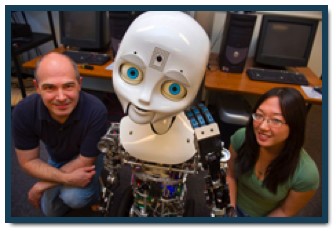
Strange article - trying to simulate embodied emotional states in a robot is like trying to simulate sexual intercourse with a mannequin. Essential elements are missing. Emotions are body-based and environmentally contingent, so how do you simulate that with a robot?

The robot in the image is Nexi, MIT's creation that can express the facial characteristics of a handful of emotions. Another robot, the Kansei robot (created by Junichi Takeno, et al) can access information and display emotions with its ultra-expressive face.

http://www.pinktentacle.com/images/kansei.jpg

Kanei looks through its database of more than 500,000 words and then correlates them with basic emotions, like happiness and sadness. The database groups words together based on news and other information.

For example, when Kansei hears the word "president," it finds associated words like "Bush," "war" and "Iraq." Thus, the word president causes Kansei to assume an expression somewhere between fear and disgust. The word "sushi" on the other hand, elicits expressions of enjoyment.

Kansei, which means "sensibility" and "emotion" in Japanese, also contains speech recognition software, a speaker to vocalize, and motors that contort artificial skin on its face into expressions.

These are cool robots, but none of this can actually simulate human emotions (not only are they embodied - physically, culturally, and environmentally - but they are also shaped by a lifetime of experience and memory.

I guess it's an interesting and useful thought experiment, if nothing else.

The other half of the embodied mind

  • Laboratory of Artificial Life and Robotics, Institute of Cognitive Sciences and Technologies, National Research Council, Rome, Italy

Embodied theories of mind tend to be theories of the cognitive half of the mind and to ignore its emotional half while a complete theory of the mind should account for both halves. Robots are a new way of expressing theories of the mind which are less ambiguous and more capable to generate specific and non-controversial predictions than verbally expressed theories. We outline a simple robotic model of emotional states as states of a sub-part of the neural network controlling the robot’s behavior which has specific properties and which allows the robot to make faster and more correct motivational decisions, and we describe possible extensions of the model to account for social emotional states and for the expression of emotions that, unlike those of current “emotional” robots, are really “felt” by the robot in that they play a well-identified functional role in the robot’s behavior.

Citation:
Parisi D (2011) The other half of the embodied mind. Frontiers in Cognition, 2:69. doi: 10.3389/fpsyg.2011.00069

Here is the introduction to this paper - it provides a solid foundation for what Parisi is doing here. The paper can be read online or downloaded as a PDF.

Introduction

In the Western cultural tradition the mind tends to be viewed as separated from the body and, in accordance with this tradition, the sciences of the mind try to understand the mind with no reference to the body. In the last few decades, however, this has changed. The cumulative and fast advances of the sciences of the body (neurosciences, evolutionary biology, genetics, the biological sciences more generally) make all attempts at studying the mind while ignoring the body less and less plausible. In fact, the idea that the mind is embodied and that to understand the mind it is necessary to take the body into consideration is being accepted by an increasing number of researchers and constitutes the premise of many important current investigations (Barsalou, 1999, 2008; Robbins and Aydede, 2009). The embodied view of the mind has led to a recognition of the importance of the actions with which the organism responds to the stimuli in determining how the world is represented in the organism’s mind, in contrast to the traditional emphasis on mental representations as either entirely abstract or derived only from sensory input. This action-based view of the mind underlies a number of important ideas such as the grounding of symbols in the interactions of the organism with the physical environment (Harnad, 1990), the mental (neural) “simulation” of actions as a crucial component of all sorts of understanding (Gallese et al., 1996; Rizzolatti and Craighero, 2004), the mental representation of objects in terms not of their sensory properties but of the actions that the objects make possible (affordances; Gibson, 1977), the action-based nature of categories (Borghi et al., 2002; Di Ferdinando and Parisi, 2004). The embodied view of the mind is also reflected in computational models which reproduce the part of the body more directly linked to the mind, i.e., the brain (artificial neural networks) and, more recently, the entire body of the organism (robotics), and which have abandoned the disembodied view of the mind which is at the basis of artificial intelligence and of conceptions of the mind as symbol manipulation.

However, although the study of the mind can greatly benefit from an embodied conception of the mind, it still has to free itself from another tradition of Western culture which constitutes an obstacle to a complete understanding of the mind: the mind tends to be identified with cognition, that is, with knowing, reasoning, deciding, and acting. But cognition is only half of the mind. The other half of the mind is its emotional half and, although the two halves of the mind continuously interact and behavior is a result of both halves, no satisfactory account of the mind can be provided if the science of the mind is only “cognitive” science. Today one speaks of “embodied cognition,” “grounded cognition,” and the mental representation of objects in terms of the actions with which organisms respond to them. But organisms, including humans, do not only have knowledge, goals, and the capacity to act. They also have motivations and emotional states which play a crucial role in their behavior. Current embodied views of the mind tend to be concerned with the cognitive half of the mind but an embodied account of the mind must be extended to the other half of the mind, its emotional half and, in fact, some psychologists and neuroscientists are trying to extend the embodied conception of the mind to emotions (see, for example, Gallese, 2008; Freina et al., 2009; Glenberg et al., 2009).

Even if one assumes that the mind generally does not contain anything which is unrelated to sensory input and motor output (which is what embodied theories assume), the cognitive and the emotional halves of the mind may not function in the same way. Input to the brain can be input from the environment but also input from inside the body, and output from the brain can be external motor output but also changes in the internal organs and systems of the body, and these different sensory inputs and motor outputs may have different characteristics and consequences. This is why we need models that capture both the cognitive half and the emotional half of the mind and their interactions. These models should explicitly indicate both similarities and differences between embodied cognition and embodied emotion.

This also applies to the study of the mind through the construction of computational models or robots. Robots are the most appropriate tools for exploring embodied theories of the mind because, although in a very simplified form, they reproduce the body of organisms and the physical organ that controls the organisms’ behavior (neuro-robots), and this is true for both physically realized robots and for robots which are simulated in a computer. However, current robots mostly try to reproduce the cognitive half of the mind but they ignore its emotional half. The robots displace themselves in the environment, move their arms and reach for objects, turn their eyes and their face, but they do not have emotions. Some current robots produce postures and movements of their bodies (mostly, the face) that in humans express emotions and they can recognize the expressed emotions of humans as a purely perceptual task, but they cannot be said to really have emotions and to really understand the emotions of others (Picard, 2000, 2003; Breazeal, 2002; Adolphs, 2005; Canamero, 2005; Dautenhahn et al., 2009; Robinson and el Kaliouby, 2009; cf. Arbib and Fellous, 2004; Fellous and Arbib, 2005). (For an attempt at understanding the functional role of emotions in behavior, see Ziemke, 2008.). The reason is quite simple. The cognitive half of the mind is the result of the interactions of the brain with the external environment or of processes self-generated inside the organism’s brain (mental life). Current robots have artificial brains which interact with the external environment and, in some cases, can even self-generate inputs and respond to these self-generated inputs (Mirolli and Parisi, 2006, 2009; Parisi, 2007). But current robotics is an external robotics: robots reproduce the external morphology of an organism’s body, the organism’s sensory and motor organs, and the interactions of the organism’s brain with the external environment. In contrast, the emotional half of the mind is the result of the interactions of the organism’s brain with the organism’s body and with the organs and systems that are inside the body. If we want to construct robots that can be said to really have emotions, what is needed is an internal robotics, that is, robots that have internal organs and systems with which the robot’s brain can interact (Parisi, 2004). Only an internal robotics can help us to better understand the emotional half of the mind and to construct a complete embodied theory of the mind.

Computational models and, more specifically, robotic models are important to understand the mind. Theories in psychology tend to be expressed verbally but verbally expressed theories have limitations because words often have different meanings for different people and because verbally expressed theories may be unable to generate specific, detailed, and non-controversial predictions. Robots are an alternative way of expressing theories. The theory is used to construct a robot and therefore, in a sense, it can be directly observed and it can contain no ambiguity because otherwise the robot cannot be constructed. Furthermore, the theory generates many specific, detailed, and uncontroversial predictions which are the behaviors exhibited by the robot. These predictions can be empirically validated by comparing them with all sorts of empirical facts: the results of behavioral experiments, data on the ecology and past evolutionary history of the organism, and data on the organism’s body and brain.

As we have said, robotic models are especially appropriate for formulating embodied theories of the mind because, by definition, a robot has a body and the robot’s behavior clearly depends on its having a body. Furthermore, since the brain is part of the body, to be consistent robots should be neuro-robots, that is, robots whose behavior is controlled by a system that resembles the structure and functioning of the brain, i.e., an artificial neural network. This has the advantage that it becomes possible to examine the internal representations contained in the robot’s “brain” (the patterns of activation and successions of patterns of activation in the robot’s neural network) and to determine if they are embodied or non-embodied representations, i.e., if they reflect the robot’s actions and the reactions of the robot’s internal organs and systems to sensory input rather than the sensory input. (This is more difficult to do with “emotional” robots which are not controlled by neural networks but by symbolic systems such as those of Breazeal and Brooks, 2005.)

What we will do in this paper is describe a number of simple robots that may help us to construct an entire theory of mind as made up of a cognitive half and an emotional half.


Buddhism Now - Ego and Mindfulness, by Corrado Pensa

Nice article here to begin the week. Buddhism Now posted some "Ego and Mindfulness" by Corrado Pensa, We can never be rid of ego and its cravings in (my opinion), but through mindfulness we can learn how to follow its cravings down the rabbit hole of attachments.

Ego and Mindfulness, by Corrado Pensa

Standing Buddha Sri Lanka. Photo © Hazel Waghorn

I would like to consider the words of Buddhadhassa Bhikkhu when he said that many people suffer mental disorders, but a much more common disease is a spiritual disease which goes by the name of ‘me’ or ‘mine’. Most of us, it seems, need to work to be healed from this illness.

What is it, then, that we usually refer to in this way? What is it that we call ‘ego’, ‘me’, or ‘mine’? Ego is the totality of what is classically called ‘afflictions’, the afflictions being attachment, aversion, and ignorance; ego is our deep habit for attachment, aversion and ignorance. In other words, ego is being attached to attachment, being attached to aversion, being attached to ignorance. Unless we taste real peace, we tend to be attached to desire. We see desire as having a value in itself, something energetic, as something which can for a while take us from our boredom and depression, etc.

Unless we taste some inner stability which gives us a little more clarity and perspective, we are easily attached to our several forms of aversion. We think we don’t care about the many resentments we have against other people, or against ourselves, and then we go into retreat and start seeing a mass of aversion. The most important thing we begin to see, however, is not the aversion itself, but that we are holding onto it as though it were a treasure and we are afraid of letting this treasure go; we are afraid that if we lose this important thing, if we start letting go of this resentment or aversion, then we shall lose our identity.

Sometimes when we hear the words ‘let go’ we think that means letting go of something fascinating. That is true to a certain extent, but much of what is meant by ‘letting go’ is related to what is painful. Out of a deep habit, we are attached to many forms of aversion, which is to say, we are attached to many forms of suffering, and we hold onto them. We are also attached to ignorance. We may know, for example, that being recollected, being mindful, is a good thing; we know we have never regretted being mindful, and yet we choose to drift along with a total lack of mindfulness. Isn’t that attachment to ignorance? Isn’t that yielding to the momentum of unawareness and to its power and strength?

We tend to conceive of ego, not as a necessary convention, but as a solid entity which is separate, which has an intrinsic existence independent of anything else. We also impute this same solidity and separateness onto everything else, onto people and events. Ego, then, is conceived as something solid, but ego is also the activity of incessantly solidifying events, people, and everything. We could say that ego is a radical denial of our belonging to a vast, flowing interconnectedness. We may be able to accept the idea, but as long as ego is strong and rampant, we are stopped, we are prevented from drinking into this flowing interconnection, because we experience ourselves as being separate, solid and basically alone in this vast world. We experience ourselves as anything but interconnectedness, anything but flowing processes.

Temple Building. Photo: © Paul Heatley

If we consider envy, we can easily see how ego (the me/mine) comes into being. On the other hand, if we had real participation in this flowing, universal interconnection, the fact that our friend John has had some success or good fortune would obviously, naturally, be something positive for us as well. There would not be any other option, any other possibility. Mudita (sympathetic joy) would be present; it would not be the object of an arduous practice, but would already be there as our nature, as the most logical and natural thing. We know how things go, however. There is usually me on this side, this one thing here, and another thing on the other side, our friend John—and also a third piece, the good fortune, which adds up to John’s dimension—so he is big and we are small; he is rich and we are poor. So we have aversion for him, aversion for ourselves, and attachment to that thing called ‘good fortune’. This is envy; this is suffering; this is the state of separation; this is ego; it is the deeply unnatural situation of our life, our suffering.

When Zen master Bankei died, an old blind man who used to sit outside the zendo said how sad he was. ‘You see,’ said the blind man, ‘since I am blind I cannot watch people’s faces, so I judge their character by the sound of their voices. And it is this way. When most people are given the news of another person’s good fortune or success they, of course, congratulate the fortunate person, but virtually always beneath the words of gladness, I hear another note, a secret note of envy, envy that it is not they themselves who have been so fortunate. Again, when most people are given the news of some calamity that has befallen another person they, of course, express their sorrow towards the afflicted person, but virtually always, beneath the words of sorrow, I hear another note, a secret note of pleasure and satisfaction that it is not they themselves upon whom the calamity has fallen. With Bankei, however, it was not so. When he expressed gladness at another’s good fortune all you heard was gladness. When he expressed his sorrow, all you heard was ­sorrow.’ This is a very beautiful and inspiring example of a situation of real interconnectedness, of really not being hindered by the spirit of separation which comes with me/mine, which is also being described very clearly in this passage.

It is also interesting to see the way ego comes into being as a result of hostility. Take, for example, a person to whom we feel hostile. What tends to happen is that we make a fixed image of that person. We extrapolate the negative side and drop the positive qualities, but more than that we drop the fact that that person has a history, that that person is a process which is not finished. We also make a fixed image of ourselves as the helpless victim, and again we do not put anything else into the picture. What happens? We suffer. There is no fluidity, no flowing-ness in this picture. Everything is solid, everything is rigid and it makes for suffering, endlessly. Take another expression of hostility—insults. We reify insults. Insults are not sounds which rise and pass away; they are stones. And we are not an open door; we are a closed door. Our ego is a closed door and the stones damage the door.

The Buddha was different. He was once being attacked and insulted by a Brahmin. This Brahmin reviled and abused the Exalted One in rude and harsh speech. When he had thus spoken, the Exalted One said, ‘As to this, what do you think Brahmin, do you receive visits from friends and colleagues, from relatives by blood or marriage, from other guests?’

‘Yes, Master Gotama, sometimes I do.’

‘As to that, what do you think, Brahmin, do you prepare for them food both dry and juicy and an opportunity for rest?’

‘Yes, Master Gotama, sometimes I do.’

‘But if they do not accept your hospitality, Brahmin, whose do those things become?’

‘If they do not accept those things, Master Gotama, they are for us.’

‘Even so here, Brahmin, that by which you revile us who do not revile, by which you scold us who do not scold, by which you abuse us who do not abuse, that we do not accept from you. It is only for you Brahmin, it is only for you. He, Brahmin, who reviles again at his reviler, who scolds back, who abuses in return him who has abused, this, Brahmin, is as if you and your visitors dine together and made good. We neither dine together with you nor make good. It is for you only Brahmin; it is only for you.’

Wall Painting Sri Lanka. Photo © Hazel Waghorn

There was this woman Thai master who often used to say, ‘This life was given to us to free ourselves from the afflictions. This is the only purpose of this life—to study pain and go beyond pain.’ So, to the extent that we reduce the afflictions, to the same extent, ego starts thinning out, and with this its separative effects and the suffering which ego brings along with it. A very crucial turning point is when we start realising, through the practice, that at every moment we have a choice. We can either identify with our impressions, reactions and mind states, or we can be mindful of those very same things. In the first case, we are endlessly strengthening ego, and in the second case, we are doing the opposite.

Maybe at this point it would be helpful to say a few things about sati, mindfulness. The first thing that I would like to emphasise is that there is a lot of emphasis in this tradition on causes and conditions. In other words, we should care about the right conditions for sati. There are a number of conditions which are favourable for the development of mindfulness. Now, sometimes people like the idea of mindfulness, but then they think that one can take just mindfulness and throw away the context in which it takes place. Perhaps one might think that one can develop an individual discipline through willpower. Well, good luck! It is not as easy as that. For centuries this tradition has been developing the fundamental dimensions of inner transformation. If we are humble enough to listen to this tradition, what do we find? We find a number of con­ditions, right condit­ions, for mind­ful­ness to arise. Listen­ing to and ­study­ing the dharma is the number one condition for this. Then there is practising meditation, going on retreats, and having some form of a sangha, community. A very specific suggestion is made in relationship to sangha and that is to associate with mindful people and to disassociate from unmindful people. We are weak; we need support. It is naïve to think that just by wanting mindfulness we can develop it. The right conditions are important.

Through training, mindfulness grows. We can, however, also use a different model; we can think of mindfulness as a clear mirror which is already here, and our task is to gradually uncover that mirror which is covered in the dust of our afflictions. We can use a gross model of discovery. This means that at the beginning of the path mindfulness has a more superficial quality about it, and then it tends to deepen more and more. Mindfulness, in the Abhidhamma literature, is often emphasised as nonsuperficiality. Remember, it is not like a cork, it is not like an empty pot which is carried away by the stream, rather is it like a stone which sinks straight to the bottom of the river. Sometimes, when we hear this, we may think, ‘No, no, this is a very rare achievement.’ It is important to understand that as soon as we start being able to sustain a little mindfulness as opposed to just having glimpses of it, we are already in this field of nonsuperficial mindfulness. We can experiment with small disappointments, small dislikes. If we are vaguely aware, the small suffering which goes with those dislikes keeps occurring, but if we manage to be firmly planted in mindfulness, the suffering either does not arise or it is very different because it is coupled with mindfulness. So that is nonsuperficiality. Also, of course, mindfulness is something which increases in time through practise.

Moss Wall Photo RSR

Mindfulness or awareness is nonjudgemental and nonconceptual. Now, this can be a little tricky because when we hear nonjudgemental mindfulness, we may think there is a judgemental mindfulness or a conceptual mindfulness. No, mindfulness is intrinsically nonjudgemental and nonconceptual, otherwise it is called ‘thinking’, it is not mindfulness. This can take a little time for us to understand. Also, it reveals the sneaky nature of ego, me/mine, because it can infiltrate our attempts at mindfulness. We know very well that when we start watching our judging, for instance, then we start judging judging. When we watch our anger we might become angry at ourselves for being angry, and more than that we start having thoughts, having judgements about what we are seeing. This is not nonjudgemental awareness. When at the beginning of the practice we come to the conclusion that mindfulness is good but it is tiring, it is not mindfulness that is tiring, it is our incessant judging that is stressful. There is a less common version of the central section of the Dependant Origination, the basic teaching of the Buddha, and this less common version says that once you have had contact between the sense organ and the object, or between the mind and the object of the mind, you have vedana which means pleasant, unpleasant or neutral sensation, reaction. After vedana, in this less common version, you immediately have proliferation, papanca. In other words, instead of having thirst, attachment, you have mental proliferation, and this is an aspect of attachment, an aspect of ego, an aspect of I/mine. When we try to apply mindfulness and at the same time are engaged in mental proliferation, then we are still within what we are observing; we are not out of it.

Krishnamurti spoke about this: ‘By being aware, I mean observing it. To observe, demands that you should not look at it with an opinion. Now, this is not easy. After twenty years of practise, this starts making sense. You should look at it, but not with your ideas, your judgements, your comparisons, your condemnation. If there is condemnation, resistance, you are not observing. You cannot look at anything without an idea, and that becomes your problem.’ And somewhere else he makes this crucial observation: ‘What is it that is observing fear? Is it the desire to get rid of fear? If it is, then this would only increase the separation and strengthen the fear.’

The beauty of the practice is that we are increasingly put in a position of seeing that we are looking at fear through the tinted glasses of ‘the desire to get rid of fear’. We are therefore looking at fear in a state of total contraction (contraction is another way of talking about ego). In a totally contracted state, there is no gentleness whatsoever. We should learn slowly and gradually, then, to undo this basic contraction.

It is said that the Buddha practised in this way. ‘If fear came while I was walking up and down, I would keep walking up and down. If fear came while I was sitting, I would continue sitting. If fear came while I was standing, I would keep standing. And if fear came while I was lying, down I would continue lying down.’

I feel there is a lot of firmness, decisiveness, in this description, but also a wave of gentleness. There is no acting out of fear; there is no kind of suppression—just allowing, on the one hand, and on the other, being firm, still, within the discomfort. This is absolutely crucial in our practice. Krishnamurti, again, says, ‘Have you ever held fear?’ Here, the element of gentleness is very strongly emphasised—‘holding’ fear.

To see the totality of life, Krishnamurti says, needs great affection, ‘If you observe yourselves you will see how little affection you have. Affection means care; affection means a sense of beauty. The sense of beauty can come about only when there is great gentleness, great consideration, care. That is the very essence of affection. When you do look in that way you will find that you look with eyes that are full of affection, not with condemnation, not with judgement, but with care. You look at yourselves with care and therefore with immense affection, and it is only when there is great affection and love that you see the total existence of life.’

I believe a very important thing for practitioners is to start right from the beginning to infuse the practice with this combination of balance, wisdom and compassion. Obviously, this is going to blossom more and more, but right from the beginning I believe it is important to feel an aspiration towards this radical gentleness, towards this unconditioned affection. At that point, whenever we are mindful, that mindfulness will have some affection or some aspiration towards tenderness, and every moment of this kind of mindfulness will be a moment of non-ego, will be a moment of real interconnection, release. This usually brings a sense of gratitude—gratitude for the practice, but also, again, unconditioned gratitude. This is different from being grateful for this or that; it is just gratefulness. So it is really worth practising.

First published in the November 2004 Buddhism Now

Corrado Pensa


Sunday, May 15, 2011

Critiquing Sam Harris's Positivism

James Shaheen at Tricycle posted some sections from an interesting article critiquing Sam Harris's positivism, which is a particular position on the importance of the scientific method:
Positivism refers to a set of epistemological perspectives and philosophies of science which hold that the scientific method is the best approach to uncovering the processes by which both physical and human events occur. Though the positivist approach has been a recurrent theme in the history of western thought from the Ancient Greeks to the present day, the concept was developed in the early 19th century by the philosopher and founding sociologist, Auguste Comte.
So in the post, Shaheen quotes Jackson Lears's article- Same Old New Atheism: On Sam Harris - which appeared at the Nations's website. Lears is a professor of history at Rutgers University - he was offering a rather critical review of Harris's most recent book, The Moral Landscape: How Science Can Determine Moral Values.

I tend to agree with his assessment - Harris has always shown the potential to develop a more integral perspective, but he has consistently failed to do so, even after having appeared on Integral Naked with Stuart Davis.

Same Old New Atheism: On Sam Harris

Jackson Lears
April 27, 2011 | This article appeared in the May 16, 2011 edition of The Nation.
Here are some excerpts:
More a habit of mind than a rigorous philosophy, positivism depends on the reductionist belief that the entire universe, including all human conduct, can be explained with reference to precisely measurable, deterministic physical processes. (This strain of positivism is not to be confused with that of the French sociologist Auguste Comte.) The decades between the Civil War and World War I were positivism’s golden age. Positivists boasted that science was on the brink of producing a total explanation of the nature of things, which would consign all other explanations to the dustbin of mythology. Scientific research was like an Easter egg hunt: once the eggs were gathered the game would be over, the complexities of the cosmos reduced to natural law. Science was the only repository of truth, a sovereign entity floating above the vicissitudes of history and power. Science was science.

Though they often softened their claims with Christian rhetoric, positivists assumed that science was also the only sure guide to morality, and the only firm basis for civilization. As their critics began to realize, positivists had abandoned the provisionality of science’s experimental outlook by transforming science from a method into a metaphysic, a source of absolute certainty. Positivist assumptions provided the epistemological foundations for Social Darwinism and pop-evolutionary notions of progress, as well as for scientific racism and imperialism. These tendencies coalesced in eugenics, the doctrine that human well-being could be improved and eventually perfected through the selective breeding of the “fit” and the sterilization or elimination of the “unfit.”

Every schoolkid knows about what happened next: the catastrophic twentieth century. Two world wars, the systematic slaughter of innocents on an unprecedented scale, the proliferation of unimaginably destructive weapons, brushfire wars on the periphery of empire—all these events involved, in various degrees, the application of scientific research to advanced technology.

And this . . . . Lears has just spent several paragraphs explaining the "rise" of the New Atheists, as they were named by the media (Richard Dawins, Daniel Dennett, Christopher Hitchens, and Sam Harris) in reply to the 9/11 terrorist attacks. They viewed "the war on terror" as a war on, in Hitchens's words, "theocratic barbarism."

Hitchens and Harris, in particular, wasted no time enlisting in Bush’s crusade, which made their critique of religion selective. It may have targeted Christianity and occasionally Judaism, but hatred and fear of Islam was its animating force. Despite their disdain for public piety, the New Atheists provided little in their critique to disturb the architects and proselytizers of American empire: indeed, Hitchens and Harris asserted a fervent rationale for it. Since 9/11, both men have made careers of posing as heroic outsiders while serving the interests of the powerful.

Of the two, Harris has the more impressive credentials. In addition to being a prolific pundit on websites, a marquee name on the lecture circuit and the author of three popular books, The End of Faith (2004), Letter to a Christian Nation (2006) and The Moral Landscape (2010), he is a practicing neuroscientist who emerges from the lab to reveal the fundamental truths he claims to have learned there. Chief among them are the destructive power of religion, which Harris always defines in the most literal and extreme terms, and the immediate global threat of radical Islam. Everything can be explained by the menace of mobilized religious dogma, which is exacerbated by liberal tolerance. Stupefied by cultural relativism, we refuse to recognize that some ways of being in the world—our own especially—are superior to others. As a consequence, we are at the mercy of fanatics who will stop at nothing until they “refashion the societies of Europe into a new Caliphate.” They are natural-born killers, and we are decadent couch potatoes. Our only defense, Harris insists, is the rejection of both religion and cultural relativism, and the embrace of science as the true source of moral value.

Harris claims he is committed to the reasonable weighing of evidence against the demands of blind faith. This is an admirable stance, but it conceals an absolutist cast of mind. He tells us that because “the well-being of conscious [and implicitly human] creatures” is the only reliable indicator of moral good, and science the only reliable means for enhancing well-being, only science can be a source of moral value. Experiments in neuroimaging, Harris argues, reveal that the brain makes no distinction between judgments of value and judgments of fact; from this finding he extracts the non sequitur that fact and value are the same. We may not know all the moral truths that research will unearth, but we will soon know many more of them. Neuroscience, he insists, is on the verge of revealing the keys to human well-being: in brains we trust.

The whole article is worth the read.

While I agree with Lears on the dangers of positivism, he also throws out some red herrings in his polemic (and I use that word in the best possible sense). He disses Harris for not talking about the "dark side" of the scientific world - the involvement of scientists with the military-industrial complex, the often hidden funding and agendas in research, the politics, and other issues:
Nor is any attention paid to the ways that chance, careerism and intellectual fashion can shape research: how they can skew data, promote the publication of some results and consign others to obscurity, channel financial support or choke it off. Rather than provide a thorough evaluation of evidence, Harris is given to sweeping, unsupported generalizations. His idea of an argument about religious fanaticism is to string together random citations from the Koran or the Bible. His books display a stunning ignorance of history, including the history of science. For a man supposedly committed to the rational defense of science, Harris is remarkably casual about putting a thumb on the scale in his arguments.
These are important, but Harris is not concerned with the shadow of science (although maybe he should be) but, rather, with how best to use its light, its gift to persuade people to stop believing in mythical beings and killing others in their name. Unfortunately, when you hear Harris or the others talk about religion, what you hear is all of the bad stuff, the shadow side, at its lowest level of development of compassion raised up as the whole or religion - any positive aspects of religion are ignored or dismissed as aberrations. That's very wrong-headed and very unfair.

What we really have here is a postmodern critique (with its abhorrence of hierarchy and rationalism) of the rational perspective (which abhors relativism and pre/post-rational thinking). It's basically one of the two major clashes we see right now, best exemplified by Michael Shermer vs. Deepak Chopra (rational vs. relativistic) and Richard Dawkins vs. all religion (rational vs. traditional/deferential). The positivists, despite often having the more valid or useful perspective, are probably going to lose both of these battles.

E.O. Wilson might be the one bright spot for them - he has been increasing integrating the hierarchical view of the positivists with the expansive view of the postmoderns - his sociobiology is still not widely accepted but he is on the right path (and others are not far behind).