Showing posts with label theoretical physics. Show all posts

Saturday, August 30, 2014

Alan Lightman - My Own Personal Nothingness

Physicist and novelist Alan Lightman is one of my favorite science authors and has been ever since I read his novel, Einstein's Dreams back in 1993. His most recent book (Jan, 2014) is The Accidental Universe: The World You Thought You Knew. [He is also the author of A Sense of the Mysterious: Science and the Human Spirit (2005).]

This cool essay comes from Nautilus magazine, Issue 16, Chapter 4, on the topic of Nothingness.


My Own Personal Nothingness


From a childhood hallucination to the halls of theoretical physics.


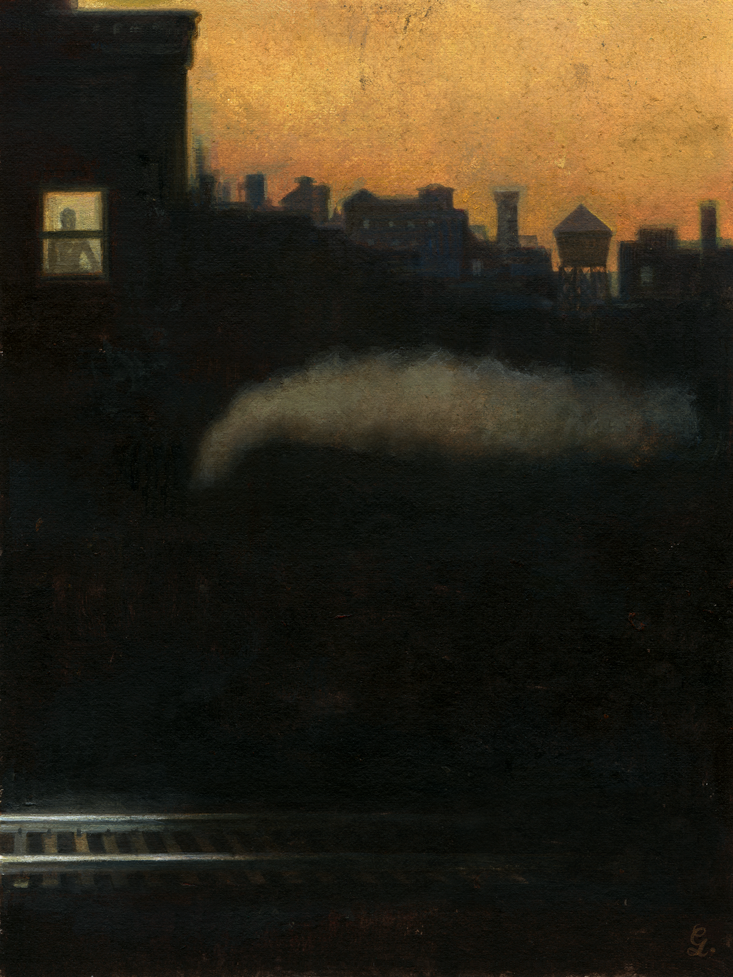
By Alan Lightman | Illustration By Gérard DuBois
August 28, 2014
“Nothing will come of nothing.”
(William Shakespeare, King Lear)

“Man is equally incapable of seeing the nothingness from which he emerges and the infinity in which he is engulfed.”
(Blaise Pascal, Pensées, The Misery of Man Without God)

“The… ‘lumniferous ether’ will prove to be superfluous as the view to be developed here will eliminate [the condition of] absolute rest in space.”
(Albert Einstein, On the Electrodynamics of Moving Bodies)
MY MOST VIVID encounter with Nothingness occurred in a remarkable experience I had as a child of 9 years old. It was a Sunday afternoon. I was standing alone in a bedroom of my home in Memphis Tennessee, gazing out the window at the empty street, listening to the faint sound of a train passing a great distance away, and suddenly I felt that I was looking at myself from outside my body. I was somewhere in the cosmos. For a brief few moments, I had the sensation of seeing my entire life, and indeed the life of the entire planet, as a brief flicker in a vast chasm of time, with an infinite span of time before my existence and an infinite span of time afterward. My fleeting sensation included infinite space. Without body or mind, I was somehow floating in the gargantuan stretch of space, far beyond the solar system and even the galaxy, space that stretched on and on and on. I felt myself to be a tiny speck, insignificant in a vast universe that cared nothing about me or any living beings and their little dots of existence, a universe that simply was. And I felt that everything I had experienced in my young life, the joy and the sadness, and everything that I would later experience, meant absolutely nothing in the grand scheme of things. It was a realization both liberating and terrifying at once. Then, the moment was over, and I was back in my body.

The strange hallucination lasted only a minute or so. I have never experienced it since. Although Nothingness would seem to exclude awareness along with the exclusion of everything else, awareness was part of that childhood experience, but not the usual awareness I would locate within the three pounds of gray matter in my head. It was a different kind of awareness. I am not religious, and I do not believe in the supernatural. I do not think for a minute that my mind actually left my body. But for a few moments I did experience a profound absence of the familiar surroundings and thoughts we create to anchor our lives. It was a kind of Nothingness.

TO UNDERSTAND anything, as Aristotle argued, we must understand what it is not, and Nothingness is the ultimate opposition to any thing. To understand matter, said the ancient Greeks, we must understand the “void,” or the absence of matter. Indeed, in the fifth century B.C., Leucippus argued that without the void there could be no motion because there would be no empty spaces for matter to move into. According to Buddhism, to understand our ego we must understand the ego-free state of “emptiness,” called śūnyatā. To understand the civilizing effects of society, we must understand the behavior of human beings removed from society, as William Golding so powerfully explored in his novel Lord of the Flies.

Following Aristotle, let me say what Nothingness is not. It is not a unique and absolute condition. Nothingness means different things in different contexts. From the perspective of life, Nothingness might mean death. To a physicist, it might mean the complete absence of matter and energy (an impossibility, as we will see), or even the absence of time and space. To a lover, Nothingness might mean the absence of the beloved. To a parent, it might mean the absence of children. To a painter, the absence of color. To a reader, a world without books. To a person impassioned with empathy, emotional numbness. To a theologian or philosopher like Pascal, Nothingness meant the timeless and spaceless infinity known only by God. When King Lear says to his daughter Cordelia, “Nothing will come of nothing,” he means that she will receive far less of his kingdom than her two fawning sisters unless she can express her boundless love for him. The second “nothing” refers to Cordelia’s silence contrasted with her sisters’ gushing adoration, while the first is her impending one-room shack compared to their opulent palaces.

Although Nothingness may have different meanings in different circumstances, I want to emphasize what is perhaps obvious: All of its meanings involve a comparison to a material thing or condition we know. That is, Nothingness is a relative concept. We cannot conceive of anything that has no relation to the material things, thoughts, and conditions of our existence. Sadness, by itself, has no meaning without reference to joy. Poverty is defined in terms of a minimum income and standard of living. The sensation of a full stomach exists in comparison to that of an empty one. The sensation of Nothingness I experienced as a child was a contrast to feeling centered in my body and in time.


 
The Commute: Alan Lightman en route to his summer home off the coast of Maine. Michael Segal

MY FIRST experience with Nothingness in the material world of science occurred when I was a graduate student in theoretical physics at the California Institute of Technology. In my second year, I took a formidable course with the title of Quantum Field Theory, which explained how all of space is filled up with “energy fields,” usually called just “fields” by physicists. There is a field for gravity and a field for electricity and magnetism, and so on. What we regard as physical “matter” is the excitation of the underlying fields. A key point is that according to the laws of quantum physics, all of these fields are constantly jittering a bit—it is an impossibility for a field to be completely dormant—and the jittering causes subatomic particles like electrons and their antiparticles, called positrons, to appear for a brief moment and then disappear again, even when there is no persistent matter. Physicists call a region of space with the lowest possible amount of energy in it the “vacuum.” But the vacuum cannot be free of fields. The fields necessarily permeate all space. And because they are constantly jittering, they are constantly producing matter and energy, at least for brief periods of time. Thus the “vacuum” in modern physics is not the void of the ancient Greeks. The void does not exist. Every cubic centimeter of space in the universe, no matter how empty it seems, is actually a chaotic circus of fluctuating fields and particles flickering in and out of existence on the subatomic scale. Thus, at the material level, there is no such thing as Nothingness.

Remarkably, the active nature of the “vacuum” has been observed in the lab. The principal example lies in the energies of electrons in hydrogen atoms, which can be measured to high accuracy by the light they emit. According to quantum mechanics, the electric and magnetic field of the vacuum is constantly producing short-lived pairs of electrons and positrons. These ghostlike particles pop out of the vacuum into being, enjoy their lives for about one-billionth of one-billionth of a second, and then disappear again.

In an isolated hydrogen atom, surrounded by seemingly empty space, the proton at the center of the atom draws the fleeting vacuum electrons toward it and repulses the vacuum positrons, causing its electrical charge to be slightly reduced. This reduction of the proton’s charge, in turn, slightly modifies the energy of the orbiting (non vacuum) electrons in a process called the Lamb shift, named after physicist Willis Lamb and first measured in 1947. The measured shift in energy is quite small, only three parts in 100 million. But it agrees very closely with the complex equations of the theory—a fantastic validation of the quantum theory of the vacuum. It is a triumph of the human mind to understand so much about empty space.

The concept of empty space—and Nothingness—played a major role in modern physics even before our understanding of the quantum vacuum. According to findings in the mid 19th century, light is a traveling wave of electromagnetic energy, and it was conventional wisdom that all waves, such as sound waves and water waves, required a material medium to carry them along. Take the air out of a room, and you will not hear someone speaking. Take the water out of a lake, and you cannot make waves. The material medium hypothesized to convey light was a gossamer substance called the “ether.” Because we can see light from distant stars, the ether had to fill up all space. Thus, there was no such thing as empty space. Space was filled with the ether.

In 1887, in one of the most famous experiments in all of physics, two American physicists at what is now Case Western Reserve University in Cleveland, Ohio attempted to measure the motion of the earth through the ether. Their experiment failed. Or rather, they could not detect any effects of the ether. Then, in 1905, the 26-year-old Albert Einstein proposed that the ether did not exist. Instead, he hypothesized that light, unlike all other waves, could propagate through completely empty space. All this was before quantum physics.

That denial of the ether, and hence embrace of a true emptiness, followed from a deeper hypothesis of the young Einstein: There is no condition of absolute rest in the cosmos. Without absolute rest, there cannot be absolute motion. You cannot say that a train is moving at a speed of 50 miles per hour in any absolute sense. You can say only that the train is moving at 50 miles per hour relative to another object, like a train station. Only the relative motion between two objects has any meaning. The reason Einstein did away with the ether is because it would have established a reference frame of absolute rest in the cosmos. With a material ether filling up all space, you could say whether an object is at rest or not, just as you can say whether a boat in a lake is at rest or in motion with respect to the water. So, through the work of Einstein, the idea of material emptiness, or Nothingness, was connected to the rejection of absolute rest in the cosmos. In sum, first there was the ether filling up all space. Then Einstein removed the ether, leaving truly empty space. Then other physicists filled space again with quantum fields. But quantum fields do not restore a reference frame of absolute rest because they are not a static material in space. Einstein’s principle of relativity remained.

One of the pioneers of quantum field theory was the legendary physicist Richard Feynman, a professor at Caltech and a member of my thesis committee. In the late 1940s, Feynman and others developed the theory of how electrons interact with the ghostly particles of the vacuum. Earlier in that decade, as a cocky young scientist, he had worked on the Manhattan Project. By the time I knew him at Caltech, in the early 1970s, Feynman had mellowed a bit but was still ready to overturn received wisdom at the drop of a hat. Every day, he wore white shirts, exclusively white shirts, because he said they were easier to match with different colored pants, and he hated to spend time fussing about his clothes. Feynman also had a strong distaste for philosophy. Although he had quite a wit, he viewed the material world in a highly straightforward manner, without caring to speculate on the purely hypothetical or subjective. He could and did talk for hours about the behavior of the quantum vacuum, but he would not waste a minute on philosophical or theological considerations of Nothingness. My experience with Feynman taught me that a person can be a great scientist without concerning him or herself with questions of “Why,” which fall beyond the scientifically provable.

However, Feynman did understand that the mind can create its own reality. That understanding was revealed in the Commencement address he gave at my graduation from Caltech in 1974. It was a boiling day in late May, outdoors of course, and we graduates were all sweating heavily in our caps and gowns. In his talk, Feynman made the point that before publishing any scientific results, we should think of all the possible ways that we could be wrong. “The first principle” he said, “is that you must not fool yourself—and you are the easiest person to fool.”


IN THE Wachowski Brothers’ landmark film The Matrix (1999), we are well into the drama before we realize that all the reality experienced by the characters—the pedestrians walking the streets, the buildings and restaurants and night clubs, the entire cityscape—is an illusion, a fake movie played in the brains of human beings by a master computer. Actual reality is a devastated and desolate planet, in which human beings are imprisoned, comatose, in leaf-like pods and drained of their life energy to power the machines. I would argue that much of what we call reality in our lives is also an illusion, and that we are much closer to dissolution, and Nothingness, than we usually acknowledge.

Let me explain. A highly unpleasant idea, but one that has been accepted by scientists over the last couple of centuries, is that we human beings, and all living beings, are completely material. That is, we are made of material atoms, and only material atoms. To be precise, the average human being consists of about 7 x 1027 atoms (7,000 trillion trillion atoms)—65 percent oxygen, 18 percent carbon, 10 percent hydrogen, 3 percent nitrogen, 1.4 percent calcium, 1.1 percent phosphorous, and traces of 54 other chemical elements. The totality of our tissues and muscles and organs and brain cells is composed of these atoms. And there is nothing else. To a vast cosmic being, each of us would appear to be an assemblage of atoms. To be sure, it is a special assemblage. A rock does not behave like a person. But the mental sensations we experience as consciousness and thought are purely material consequences of the purely material electrical and chemical interactions between neurons, which in turn are simply assemblages of atoms. And when we die, this special assemblage disassembles. The total number of atoms in our body at our last breath remains constant. Each atom could be tagged and tracked as it subsequently mingled with air and water and soil. The material would remain, scattered about. Each of us is a temporary assemblage of atoms, not more and not less. We are all on the verge of material disassemblage and dissolution.

All that having been said, the sensation of consciousness is so powerful and compelling that we endow other human beings—i.e. certain other assemblages of atoms—with a transcendent quality, some nonmaterial and magnificent essence. And as the assemblage of atoms most important to each of us is our own self, we endow ourselves with a transcendent quality—a self, an ego, an “I-ness”—that blooms far larger and more significant than merely a collection of atoms.

Likewise, our human-made institutions. We endow our art and our cultures and our codes of ethics and our laws with a grand and everlasting existence. We give these institutions an authority that extends far beyond ourselves. But in fact, all of these are constructions of our minds. That is, these institutions and codes and their imputed meanings are all consequences of exchanges between neurons, which in turn are simply material atoms. They are all mental constructions. They have no reality other than that which we give them, individually and collectively.

The Buddhists have understood this notion for centuries. It is part of the Buddhist concepts of emptiness and impermanence. The transcendent, nonmaterial, long-lasting qualities that we impart to other human beings and to human institutions are an illusion, like the computer-generated world in The Matrix. It is certainly true that we human beings have achieved what, to our minds, is extraordinary accomplishment. We have scientific theories that can make accurate predictions about the world. We have created paintings and music and literature that we consider beautiful and meaningful. We have entire systems of laws and social codes. But these things have no intrinsic value outside of our minds. And our minds are a collection of atoms, fated to disassemble and dissolve. And in that sense, we and our institutions are always approaching Nothingness.

So where do such sobering thoughts leave us? Given our temporary and self-constructed reality, how should we then live our lives, as individuals and as a society? As I have been approaching my own personal Nothingness, I have mulled these questions over quite a bit, and I have come to some tentative conclusions to guide my own life. Each person must think through these profound questions for him or herself—there are no right answers. I believe that as a society we need to realize we have great power to make our laws and other institutions whatever we wish to make them. There is no external authority. There are no external limitations. The only limitation is our own imagination. So, we should take the time to think expansively about who we are and what we want to be.

As for each of us as individuals, until the day when we can upload our minds to computers, we are confined to our physical body and brain. And, for better or for worse, we are stuck with our personal mental state, which includes our personal pleasures and pains. Whatever concept we have of reality, without a doubt we experience personal pleasure and pain. We feel. Descartes famously said, “I think, therefore I am.” We might also say, “I feel, therefore I am.” And when I talk about feeling pleasure and pain, I do not mean merely physical pleasure and pain. Like the ancient Epicureans, I mean all forms of pleasure and pain: intellectual, artistic, moral, philosophical, and so on. All of these forms of pleasure and pain we experience, and we cannot avoid experiencing them. They are the reality of our bodies and minds, our internal reality. And here is the point I have reached: I might as well live in such a way as to maximize my pleasure and minimize my pain. Accordingly, I try to eat delicious food, to support my family, to create beautiful things, and to help those less fortunate than myself because those activities bring me pleasure. Likewise, I try to avoid leading a dull life, to avoid personal anarchy, and to avoid hurting others because those activities bring me pain. That is how I should live. A number of thinkers far deeper than I, most notably the British philosopher Jeremy Bentham, have come to these same conclusions via very different routes.

What I feel and I know is that I am here now, at this moment in the grand sweep of time. I am not part of the void. I am not a fluctuation in the quantum vacuum. Even though I understand that someday my atoms will be scattered in soil and in air, that I will no longer exist, that I will join some kind of Nothingness, I am alive now. I am feeling this moment. I can see my hand on my writing desk. I can feel the warmth of the sun through the window. And looking out, I can see the pine-needled path that goes down to the sea. Now.

~ Alan Lightman is a physicist, novelist, and professor of the practice of the humanities at the Massachusetts Institute of Technology. His latest book is The Accidental Universe: The World You Thought You Knew.
Monday, June 03, 2013

Solomon Budnik - Theory of Transitional Universe (New Model of Space-Time)

I'm not quite shire what this article proves, if anything. It seems that Solomon Budnik (no affiliation provided) has an alternate theory of the universe, one which asserts that the Big Bang could not be the beginning of the universe.

I'm not quite sure if this guy makes any sense - but it's interesting (as much as I understand).

Full Citation:
Budnik, Solomon. (2013, Apr 15). Theory of Transitional Universe (New Model of Space-Time). Available at SSRN: http://ssrn.com/abstract=2251032 or http://dx.doi.org/10.2139/ssrn.2251032

Theory of Transitional Universe (New Model of Space-Time)

Solomon Budnik
Independent

April 15, 2013

Abstract:


This is a theory that makes macroscopic predictions based on dual space-time continuum which is finite in its infinity, due to its horizon and future reverse polarity.

It implies that there is an absolute frame of reference in our uniform double cone model (as observed in cosmos) which shows that the state of our universe is a deterministic function of its previous state of a primordial universe where the rotating mass of first order extended in our universe to second order in the angular momentum.

Locality assumes that the current state of space-time is determined by the states of a fixed number of previous time steps. Discretized difference equations use at least the current and previous time steps if they are second order systems like the wave equation. Physical quantities come in pairs which are called conjugate quantities. According to quantum mechanics, under some conditions, a pair of quantum systems may be described by a single wave function, which encodes the probabilities of the outcomes of experiments that may be performed on the two systems, whether jointly or individually.

It means that there couldn't be a sudden “birth” of our universe in a Big Bang without its time delayed “conception” in a previous universe.

Introduction

"We have a complete inventory of the universe," Sean Carroll, a California Institute of technology cosmologist, has said, “and it makes no sense.”

And it is obvious now that the previous cosmic model didn’t actually integrate time, for it wasn’t a space-time model per se, but a limited comprehension of the space-matter-energy correlation with wrongly perceived light-gravity-time interaction: there can’t be gravitational bending of light and time delay in non-visible cosmic spectrum (which is 95% of our universe) and in the anti-gravity field of the galaxies. So the observed effects of quasi gravitational lensing (in fact diffraction of light per position-momentum uncertainty principle) and the Shapiro delay should be rightfully attributed to the Faraday rotation and relative phase shift in the interstellar medium, the Coanda effect and shift, and the superposition, dispersion and deflection (echo) of the manmade radar beams radiated in the multi-radiated cosmos.

Moreover, light is an inhomogeneous wave (not uniform) and cannot be bent as such by the gravity. Light can indeed deviate from its rectilinear path due to "ray-optics" limit (geometrical optics) and due to nonlinear self-oscillation and chaotic interference of the particles in analogy with the free-electron-laser chaos; under such conditions the time delay can actually take place. 

So the shape of the universe is a matter of debate in physical cosmology over the local and global geometry of the universe which considers both curvature and topology, though, strictly speaking, it goes beyond both.

The Big Bang theorists have overlooked the Coriolis, Doppler, and Chladni effects in the universe, as revealed in this article to proper explain the rotation and expansion of our universe. 

So we present here a new space-time model with a 4-dimensional double cone structure of our universe (successor of primordial universe), confirmed by natural phenomena (as elaborated below) which supersedes the Big Bang theory.

In re: the ΛCDM or Lambda-CDM model is a parameterization of the Big Bang cosmological model in which the universe contains a cosmological constant (usually denoted by the Greek capital letter lambda: Λ), which is supposed to be equivalent to the energy density in otherwise  empty space. It was proposed by Albert Einstein as a modification of his original theory of general relativity to achieve a stationary universe. Einstein abandoned that concept since Hubble redshift indicated that the universe might not be stationary, contrary to Einstein’s idea that the universe is unchanging.

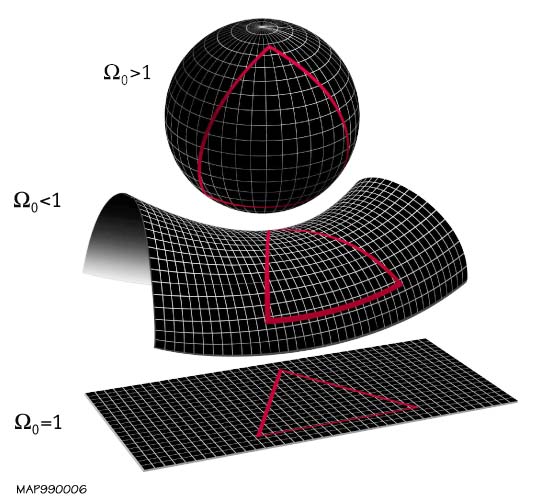
Fig.1

Shown in fig.1 is the common local geometry of the universe which is determined by whether
the density parameter Ω is greater than, less than, or equal to 1. From top to bottom: a spherical universe with Ω > 1, a hyperbolic universe with Ω < 1, and a flat universe with Ω = 1. 
Scientists reached a consensus that there was more to the universe than meets the eye. In computer simulations of our galaxy, the Milky Way, theorists found that the center would not hold. Based on what we can see of it, our galaxy doesn’t have enough mass to keep everything in place. As it rotates, it should disintegrate, shedding stars and gas in every direction.

So to advance our knowledge, a detailed study of the cosmic space has been made and elaborated in this article from a different perspective to supersede the Big Bang and Steady State concepts and modify the special theory of relativity based on new notions and discoveries in an attempt to unify Einstein's theory of relativity and the revolution of quantum mechanics. Accordingly, we present here a new space-time model – a tandem of primordial and current universes coupled at their narrowest double cone points.

Said tandem universes represent the duality of nature, as is the space-time notion and the wave–particle duality of matter.

As the distance between galaxy clusters is increasing, it is inferred that everything was closer together in the past, since galaxies and clusters have an apparent velocity directly away from our vantage point.

There was previously little evidence regarding the absolute earliest instant of the expansion. That concerns also the Big Bang (BB) concept which cannot and does not provide sufficient explanation for such an initial condition; rather, it tries to describe the supposed evolution of the universe from that point on. The Big Bang idea and model is based on the observation that galaxies seem to move away from the earth, and that radiation comes from the point where the Big Bang supposedly occurred as the alleged creation of our universe.

The BB theory doesn’t explain how the pieces of matter that had never been in contact with each other have come to equilibrium at the very same temperature and then experienced an incredible burst of expansion called "inflation." For that inflation to have taken place, the universe at the time of the Big Bang must have been filled with an unstable form of energy whose nature is not yet known and which had allegedly led to the clumping and ignition of matter, with no explosion.

This is a wrong celestial theory, for there couldn’t be a dimensionless propagation constant and equal mass distribution of matter forced to spread by the alleged quantum noise (?!).

The Big Bang is believed to have produced equal amounts of matter and antimatter. However, whenever matter and antimatter meet, they annihilate in a burst of gamma rays, so the BB theory suggests that both matter and antimatter annihilated long time ago, and the universe should consist today just of radiation.

Said erroneous assumptions can be disproved, for there were no volume dimensions or directions in the void (empty cosmic space), since it had no boundaries, and if it had had, the shock wave of the BB would had bounced back, dispersed and destroyed the cosmic matter.

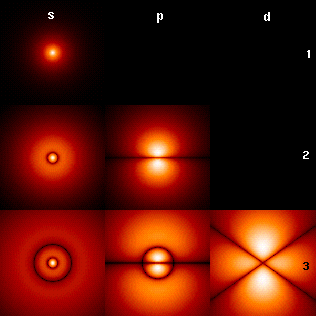
Accordingly, what the San Diego astronomers considered in 2005 to be the vestiges of sound waves that allegedly rumbled through the universe after the Big Bang, was in fact the echo of the BB, and this corresponds with my new theory of acoustics (see my book ―The Absolute Tone) where sound waves have actually not linear but spiral form of propagation, and that could be the only form of propagation in space. That space shockwave must have spread the matter and gave its spiral shape to the formation of galaxies, for a spiral is the best shape to conserve energy and resonate its elements. So we might less consider the annihilation and decay of elementary particles, but concentrate more on their resonance in space-time in a Chladni-like effect based on quantum mechanics of the dual particle-like and wave-like behavior and interactions of energy and matter, as in Förster resonance energy transfer (ill. 1).


(Ill. 1. Probability densities corresponding to the wave functions of an electron in a hydrogen atom possessing definite energy levels (increasing from the top of the image to the bottom: n = 1, 2, 3, ...) and angular momenta (increasing across from left to right: s, p, d, ...). Brighter areas correspond to higher probability density in a position measurement. Wave functions like these are directly comparable to Chladni's figures of acoustic modes of vibration in classical physics, and are indeed modes of oscillation as well, possessing a sharp energy and, thus, a definite frequency. The angular momentum and energy are quantized, and take only discrete values (as is also the case with resonant frequencies in acoustics, ill. 2, 3 below)

Compare the ill. 1 above images with the Chladni plate acoustic effects (ill. 2, 3):

(Ill. 2)

(Ill. 3)

Having this in mind, we can construct a disc-like spacecraft with a Chladni plate effect, where the atomic reactor in the center of the rotating disc would generate charged particles resonating in a modulating unison of specific frequencies amplified by the applied magnetic field and accelerated in circular groves of particles accelerator on the surface of the disc-craft, leaving behind a whirlpool of matter and propelling the craft in space like a Frisbee. (Patent rights for this spacecraft’s design and propulsion belong to the author, Solomon Budnik.) 

In re: Effects of tune modulation on particles trapped in 1D resonance islands, FERMILAB October 1993: experimental data obtained at Indiana University Cyclotron Facility for the 4th order resonance islands has confirmed this characteristic feature. The beam, driven by betatron tune modulation, was observed for the first time to travel from near the center of resonance islands toward the separatrix. The experimental data are characterized by the onset of large response at a critical modulation amplitude and frequency, which are compared with theoretical models).

http://upload.wikimedia.org/wikipedia/commons/e/e9/Drum_vibration_mode12.gif
(Ill 4. Chladni effect: vibration of a single normal mode of a circular disc with a pinned boundary condition along the entire outer edge)
Read the whole article - and then explain it to me if possible in the comments.

Sunday, April 21, 2013

Living in a Quantum Game - Pablo Arrighi and Jonathan Grattage

From COSMOS Magazine, an interesting article on the development of quantum computing and its influence on currents trends in physics, namely that some are suggesting a shift away from the study of matter to a study of information.

Living in a quantum game

By Pablo Arrighi and Jonathan Grattage
COSMOS Magazine | 20 March 2013

For scientists in the field of quantum information, the swirling chaos of space and the delicate intricacies of life are nothing more than a game.


SUPPOSE YOU ARE at a dinner party in a fancy French restaurant. During a lull in the conversation, the person on your right – who is a friend of a friend – turns to you and asks: “what do you do for a living?”

Now, suppose you belong to the first generation of scientists who have studied for PhDs in quantum information. This new field combines aspects of computer science, maths and physics, and you find it absolutely fascinating. But launching into an explanation of how all these things come together is not exactly fodder for charming dinner party repartee. The last time you answered that question honestly, the other guests politely endured a five-minute lecture. You can do better this time. So you offer a short, to-the-point answer: “I work in theoretical physics.”

“Really! But what do you do, exactly?” is the reply. Experience has taught you that the most effective answer involves travelling to conferences in exotic locations. But on this occasion, your subconscious rebels. You find that your brain is filling with concepts such as quantum cellular automata and models of computation, concepts at the core of your work. They are what get you out of bed in the morning. So you blurt out something like “models of quantum computation and the consequences for theoretical physics”. From the look on your companion’s face, you know you’ve messed up again.

QUANTUM COMPUTATION is a new, booming field that exploits the magic of quantum theory to the benefit of computing – from faster computer speeds to more secure data transfer. Discussing its importance for theoretical physics at large may not be a subject that fits neatly into a casual dinner-party conversation, but it is an idea that is increasingly having its day. Some physicists argue that physics should shift away from the study of matter, particles and forces, and instead focus on information. The concept of information is already central to physics, via notions such as entropy (fundamental in thermodynamics, entropy is the study of how energy moves in and out of a system), observers and measurements (central to Einstein’s theories of relativity and to quantum mechanics), and information exchange between systems.

But there is a growing opinion that, as these ideas are embraced, physics will become not only informational, but computational. This idea dates back to the 1970s, and states that the entire universe can be considered to be a giant computer. In this universe-computer, in all places and at all times, particles are treated as patterns of information moving across a vast grid of microprocessors, rather than material bodies colliding and scattering – much as a tennis ball can be thought of as a pattern of pixels moving across your TV screen, rather than a lump of rubber ricocheting off a grassy surface during the Wimbledon final. Digital physicists, for their part, are like characters in a video game who are desperately trying to understand the rules.

A striking result to come out of this 1970s work was Robin Gandy’s argument that the universe could be simulated by a computer with unlimited memory. Gandy was a British mathematician, logician and student of the brilliant Alan Turing, whose work on coding laid the foundation for the invention of the modern computer.

Gandy began his argument by noting that all physicists agreed on a few self-evident principles. One is that the laws of physics remain the same everywhere and at all times: if they didn’t, they wouldn’t deserve to be called laws. The second is that there are causes and there are effects; all events must have their causes in the past, and the causal influence can travel at most at the speed of light. That means information, too, can travel from one system to another no faster than the speed of light.

Finally, and somewhat controversially, Gandy stated that it is reasonable for physicists to believe any finite volume of space can only contain a finite amount of information.

YOU MIGHT BE beginning to see why dinner conversations fail to flourish with the gentle banter of theoretical physicists. But, stay with us here, for now we are getting close to the crux of the matter.

From Gandy’s third principle of finite-density information, it follows that if space were, hypothetically, divided into cubes, each cube could be described by the finite information it contained.

Moreover, Gandy’s second principle says that the state of each cube at a particular point in time, call it t+1, is determined by the state of the neighbouring cubes at time t. In other words, the state of a cube at time t+1 is obtained by applying what information theorists call a ‘local rule’, to the state of its neighbouring cubes at time t. Finally, it follows from Gandy’s first principle that this local rule is the same everywhere and at all times. So, the state of the entire universe at time t+1 can be computed by applying some fixed local rule everywhere in space.

The effect of this argument is to reduce the universe to a type of computer called a cellular automaton. You may have played with a simple cellular automaton before, in the form of the popular computer-based ‘Game of Life’, developed by British mathematician John Conway.

The Game of Life comprises a 2-D grid of cells in which each cell can be either ‘alive’ or ‘dead’. Once you have decided which cells will be alive initially, the state of any given cell at a later time will be determined by that cell’s previous state plus the states of its eight immediate neighbours, according to rules that simulate the effects of underpopulation, overcrowding and reproduction (see ‘Conway’s Game of Life’).

These rules are simple, yet it has been shown that the game is universal, meaning that it can be made to compute any known classical algorithm or set of instructions – in much the same way that simple logic gates and wires of a standard desktop PC do.

But is there any chance that the real universe we see and experience could be reduced to such a simple game?

THE PROBLEM WITH Gandy’s model – and the reason why the original digital physics project was doomed to failure – boils down to one thing: quantum physics. To understand why, let us return to our dinner party at the French restaurant, where the food is getting cold.

Against your better judgement, you launch into an explanation of quantum theory using the knives and forks on the table. You hear yourself saying: “Pick a system that can be one of two things – such as an item of cutlery, which can be either a knife or a fork.” You hold up your knife. “Well, in quantum theory, this piece of cutlery does not have to be one or the other. It can be both at the same time, a state known as superposition.” As you start to explain, you sense that your audience may not be grasping the full implications. You ponder the wisdom of an alternative explanation involving salt and pepper shakers, but before you can begin, your waiter arrives with the dessert menu.

The reason we don’t encounter superpositions of knives and forks on a daily basis is that as soon as you observe a quantum system, or take a measurement, it becomes ‘classical’ again. In classical physics, when you observe something you can have only a limited set of results: up or down, knife or fork, alive or dead. Likewise, in classical computing, the smallest unit of information, known as a bit, can take on one of two values, 0 or 1. Quantum physics throws the rulebook out and allows a superposition of states, a concept described by the famous Schrödinger’s cat thought experiment (see ‘The cat paradox’).

So, our smallest unit of quantum information, called a qubit (quantum bit), can only store a single bit of classical information, a 0 or a 1. In that sense, Gandy’s principle of finite information density remains compatible with quantum theory: we cannot effectively store more than a bit of information within a qubit. However, quantum physics says that before one observes a qubit, it is allowed to be in a superposition of states. Hence, quantum physics no longer allows for the case where each cube of space can be fully described by the finite information stored in it, and this is where Gandy’s argument falls down.

The idea of modelling the universe as a computer was resurrected in some form in the early 1980s by American theoretical physicist Richard Feynman. His idea was born out of frustration at seeing classical computers take weeks to simulate quantum physics experiments that happen faster than a blink of an eye. Intuitively, he felt that the job of simulating quantum systems could be done better by a computer that was itself a quantum system.

Like their classical counterparts, quantum computers consist of circuits. To construct quantum circuitry you need quantum wires, which are analogues of real wires carrying conventional bits (as voltages), except that they carry qubits. Classical computers are made of logic gates, which take in information (bits) and output new information (new bits). Quantum gates process qubits instead.

OVER THE PAST decade or so, experimentalists in many groups around the world have successfully implemented quantum wires and simple qubit gates. The true difficulties lie with precision of more complex qubit gates and with protecting many wires from the environment – remember, if the environment ‘observes’ the quantum wires, they become classical again.

One of us (Pablo Arrighi), along with colleagues, developed a version of Gandy’s hypothesis that accounts for the complexities of quantum mechanics. Instead of the third principle, which says that a finite volume of space contains a finite amount of information, we state that a finite volume of space can only hold a finite number of qubits.

Considering the implications of the three updated principles, we were again able to reduce the universe to a computer, a quantum version of the cellular automaton discussed earlier. A quantum cellular automaton is very much like a classical cellular automaton, except that now the cells of the grid contain qubits (see ‘How to explain the universe’). The evolution from time t to t + 1 involves applying a quantum gate operation to neighbourhoods of cells repeatedly, across space. But, there are, alas, some subtleties to quantum cellular automata that cannot be explained quite so easily in a picture. For example, the cells can now be in a superposition of states, and they can also be ‘spookily’ entangled with any other cell – the state of a cell doesn’t solely depend on those next to it.

There is, of course, a big gap between constructing a ‘toy-model’ quantum cellular automaton and applying the lessons learned from it to the real universe. But if the updated versions of Gandy’s hypotheses hold true, and we can indeed describe the universe as a gigantic quantum cellular automaton, then studying physics becomes a game of attempting to deduce the ‘program’ of the vast quantum computer that we live in.

The conventional approach to deducing the universe’s ‘program’ is, of course, not to use cellular automata or anything like them, but to probe the ‘rules of the game’ with increasingly refined physics experiments, such as those performed using the Large Hadron Collider at the CERN particle physics lab. But perhaps there is an alternative computer science-orientated method, one that attempts to find the rules deductively.

SO, WE COME BACK to what quantum information theorists in physics really do for a living. We can begin this deductive process by discarding rules that are too simple, on the grounds that we live in a complex universe.

Next, we note that all sufficiently complex rules can be made to simulate each other. In other words, if the rule of a particular quantum cellular automaton is complex enough, then it can simulate all other quantum cellular automata, even when the other automata have rules that are horrendously complicated. Analogous to the universal nature of Conway’s Game of Life, a quantum cellular automaton that can perform such a simulation is said to have intrinsic universality. If we can find the simplest, intrinsically universal rule for a quantum cellular automaton, we can use it to find the simplest and most ‘natural’ (closest to what we observe in nature) way of implementing or simulating physical phenomena – like the particles and forces that make up the universe.

Of course, it remains to be seen whether all physical phenomena can be ‘encoded’ using the concepts developed here. Many difficulties lie ahead for those of us who are trying to answer the question of how nature computes itself.

The concepts of quantum cellular automata and intrinsic universality are likely to prove key in finding simple, minimal and universal ‘toy models’ to work with in attempting to answer this question. From a computer-science point of view, reaching this goal will amount to a better understanding of physics.

Yet we are obliged to conclude with a word of caution: these ideas may not be all that helpful in a restaurant conversation. Attempting to explain them may end with the other diners deciding that you are the best person to call the next time their (classical) computer breaks down. But on a more positive note, if we can find the rules, everyone will be a winner in this game of life.


~ Pablo Arrighi and Jonathan Grattage are quantum-information scientists affiliated with the University of Grenoble and ENS de Lyon, France.

Wednesday, January 30, 2013

Bookforum Omnivore - The Vast Majority of the Universe

From Bookforum's Omnivore blog, this is a coo collection of links on cosmology, including a couple of articles on the ever-mysterious "dark matter," and an article on the largest "object" ever discovered in the universe, which is composed of 73 quasars.


The vast majority of the universe

JAN 18 2013 
9:00AM


  • From Cosmos, the vast majority of the universe is something we can't see, can't touch and is expanding the universe at ever-increasing speeds; Tamara Davis explains why dark energy poses more questions than answers. 
  • Can time just stop? Michael Byrne wonders. 
  • The God Particle: What explains the current wave of popular physics? 
  • Virginia Trimble reviews Gravity's Engines: The Other Side of Black Holes by Caleb Scharf. 
  • Dark matter mystery may soon be solved: Experiments to detect dark matter, which scientists believe makes up about a quarter of the universe, are underway and may yield direct evidence within a decade. 
  • What is string theory, and why should we bother finding out? Steven Gubser explains. 
  • Most fundamental clock ever could redefine kilogram: Physicists have created the first clock with a tick that depends on the hyper-regular frequency of matter itself. 
  • Rebecca J. Rosen on the largest structure ever observed in the universe: At 4 billion light years across, this quote-unquote "object" throws astronomical assumptions that go back to Einstein into doubt.

Friday, November 02, 2012

Lawrence Krauss Presents “Secular Sermon” on Theoretical Physics and the Meaning of Life


Alain de Botton's The School of Life brought Lawrence Krauss (Foundation Professor in the School of Earth and Space Exploration and Physics Departments at Arizona State University and director of the Origins Initiative) to London’s Conway Hall to deliver one of their signature “Secular Sermons.” You can watch his 45-minute presentation below and learn how science, as he tells it, both describes and offers an escape from reality.

Lawrence Krauss Presents “Secular Sermon” on Theoretical Physics and the Meaning of Life


October 29th, 2012


Alain de Botton, the writer who “has always tried to get ideas to impact on the way we actually live,” started The School of Life in order to offer an education crafted “according to things we all tend to care about: careers, relationships, politics, travels, families.” At its central London location, you can enroll in courses like “How to Have Better Conversations,” “How to Balance Work with Life,” and, perhaps most critically important of all,  “How to Be Cool.” This seems like just the sort of institution which won’t confront you with the sort of numerically rigorous, seemingly abstract math and science classes that gave us grief in our regular educations. Yet de Botton and his School of Life co-founders understand that just because a subject assigns aggravating homework doesn’t mark it out as irrelevant. According to Lawrence Krauss, Foundation Professor in the School of Earth and Space Exploration and Physics Departments at Arizona State University and director of the Origins Initiative, physics could hardly have more to do with your daily experiences.

The School of Life brought Krauss to London’s Conway Hall to deliver one of their signature “Secular Sermons.” (De Botton, you may know, recently published a manifesto calling for a religion for atheists.) You can watch his 45-minute presentation free online and learn how science, as he tells it, both describes and offers an escape from reality. Using examples from his field of physics, Krauss demonstrates how science, by zooming in as close as possible or zooming out as far as possible, puts our everyday concerns and quibbles in proper context. What’s more, he notes,physics has it that we’re all made up of the same bits and pieces as everything, and thus everyone, else. Have you ever heard a more elegant argument for the notion of universal connectedness? But this isn’t to say that Krauss marshals the fruits of such rigorous study in the name of warm-and-fuzzy pronouncements. When you hear him declare how physics will make you understand that “you’re even more insignificant than you thought,” you’ll know just how far his sensibility lays from either warmth or fuzziness. The life of a physicist, so I’ve heard, benefits from a little gallows humor.

Related content:

Colin Marshall hosts and produces Notebook on Cities and Culture. Follow him on Twitter at @colinmarshall.

Monday, July 16, 2012

The Wright Show - Robert Speaks w/ Lawrence Krauss on "A Universe from Nothing"


On this week's episode of The Wright Show, Robert Wright speaks with physicist Lawrence Krauss about his most recent book, A Universe from Nothing: Why There Is Something Rather than Nothing.

Here is the publisher's description of the book:
“WHERE DID THE UNIVERSE COME FROM? WHAT WAS THERE BEFORE IT? WHAT WILL THE FUTURE BRING? AND FINALLY, WHY IS THERE SOMETHING RATHER THAN NOTHING?”
 
Lawrence Krauss’s provocative answers to these and other timeless questions in a wildly popular lecture now on YouTube have attracted almost a million viewers. The last of these questions in particular has been at the center of religious and philosophical debates about the existence of God, and it’s the supposed counterargument to anyone who questions the need for God. As Krauss argues, scientists have, however, historically focused on other, more pressing issues—such as figuring out how the universe actually functions, which can ultimately help us to improve the quality of our lives.

Now, in a cosmological story that rivets as it enlightens, pioneering theoretical physicist Lawrence Krauss explains the groundbreaking new scientific advances that turn the most basic philosophical questions on their heads. One of the few prominent scientists today to have actively crossed the chasm between science and popular culture, Krauss reveals that modern science is addressing the question of why there is something rather than nothing, with surprising and fascinating results. The staggeringly beautiful experimental observations and mind-bending new theories are all described accessibly in A Universe from Nothing, and they suggest that not only can something arise from nothing, something will always arise from nothing.
It's an interesting dialogue - and of course, the Higgs Boson is part of the discussion.

The Wright Show