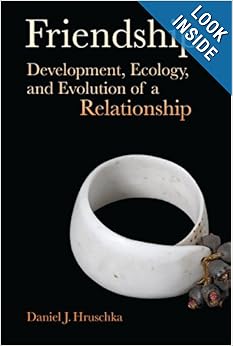
In this post, part of
a series on natural selection (originally posted at
Inspiring Science),
Sedeer el-Showk argues for natural selection and Richard Dawkins' "selfish gene" model of evolution. In doing so, he rejects the
sociobiological model of E.O. Wilson, which allows for evolutionary transformation due to group selection, as "simply wrong."
This is still the majority position in the world of evolutionary biology.
The problem with this view is that it does not account for epigenetic influences, which have been shown to not only impact the genes of the individuals, but two or more generations down the line. Epigenetic changes range from the impact of diet and nutrition to the social bonding and attachment relationships within a group (from family to tribe to community).
We will never have a complete understanding of evolution at any level - from genes to societies - until we integrate ALL of the various influencers, whether it's genes, genomes, organisms, family structures, and all the way up to societies.
The author mentions emergence, but does not seem to grasp the power emergent phenomena can exert at every level of complexity. In part, the author acknowledges this:
The selfish gene is a valuable
metaphor, but it also represents a simplified, idealized view of
independent genes acting in isolation; this is almost never true in the
real world, which is full of the sorts of context dependent, non-linear
interactions that tend to generate emergent properties.
Be sure to checkout the comments at
Nature (where this comes from) for an interesting discussion.
 October 14, 2013 | By: Sedeer el-Showk
[Note: This was originally posted as part of a series about natural selection on Inspiring Science.]
In this post, I’d like to expand a bit on the “selfish gene”, which has proven to be quite a powerful idea, and to present my thoughts on why it nevertheless provides an incomplete view of evolution. I know this can be a controversial subject, so feel free to chime in and start a discussion in the comments.
Richard Dawkins introduced the metaphor of the “selfish gene” in his popularization of the work of George C. Williams. The essential idea is that natural selection operates on genes rather than on organisms. This is because replication is the core of natural selection and the entities which are actually being replicated are genes, not organisms. When a pair of organisms mate, neither of them is actually reproduced; instead, the offspring is a mixture of the two. Their genes, however, are faithfully reproduced in the next generation, shuffled together into new combinations in the offspring’s DNA. Since genes replicate themselves from one generation to the next, it is here that natural selection can operate; genes which are more successful at reproducing themselves (i.e., are “selfish”) will be favoured by the process of selection. According to this viewpoint, genes are the real actors in the drama of evolution; individual organisms are just disposable “survival machines” which carry the genes.

This has proven to be quite an important idea, generating valuable insights and correcting misconceptions, such as earlier ideas about group selection. “Group selection” is the idea that certain behaviours have evolved for the good of the group (or species); although it's been discredited amongst evolutionary biologists, the idea still has currency with the wider public (and even among biologists in other fields). However attractive it might be, this idea is simply wrong. Altruistic behaviours can’t evolve simply as a result of the benefit to the group because there will always be cheaters and free-loaders who take advantage of the altruistic behaviour, thereby undermining the group; this is an example of a more general problem known as the tragedy of the commons. In order for altruism to be evolutionarily stable, there has to be some benefit to the altruistic individuals. The gene-centred approach resolves this problem by refocusing our attention on the level of the gene. From the gene-centred viewpoint, seemingly altruistic individuals do reap a benefit from their behaviour as long as their altruism is directed towards individuals who share their genes (such as relatives); this benefit stabilizes the altruistic behaviour against exploitation by cheaters. I might elaborate on this idea, which is called “inclusive fitness”, in another post; the main point is that the selfish gene metaphor provides a robust explanation for the evolution of altruistic individuals.
Strict adherence to this metaphor gives primacy to genes as the level at which selection actually operates, leading to the claim that selection which seems to be occurring at higher levels (such as organisms or species) can and should be reduced to selection at the level of the gene. While many biologists might be comfortable with such a strict reductionist approach, I tend to agree with those who take a different view, such as the late Stephen Jay Gould. I've written elsewhere that fitness is a metric of evolution, not a driving force; this was inspired by Gould, who charged the gene-centred approach with mistakenly thinking that changes in gene frequencies represent an evolutionary cause rather than a form of record keeping. Gould also made a strong case for the validity of selection at higher levels than the gene, arguing that organisms and species exhibit properties which cannot simply be reduced to genes. The selfish gene is a valuable metaphor, but it also represents a simplified, idealized view of independent genes acting in isolation; this is almost never true in the real world, which is full of the sorts of context dependent, non-linear interactions that tend to generate emergent properties.

Traffic jams are an example of emergent properties.
An emergent property is a new behaviour or phenomenon which is found at higher levels of organization as a result of interactions at a lower level. Traffic is a familiar example of emergent behaviour — it’s a property of a collection of cars but not of an individual car. In the realm of physics, things like temperature and pressure are emergent; an individual molecule doesn’t have a temperature or pressure, which are properties of collections of molecules like gases or liquids. An interesting thing about emergence is that the arrow of causation doesn’t only point from lower to higher levels; the properties emerging from collective behaviour can also constrain the behaviour of the individual entities. Again, traffic serves as an excellent example: while traffic emerges from the interaction of many individual cars, it also affects their behaviour, limiting and guiding them. This sort of “downwards causation” is at odds with reductionist approaches to science, including a strictly gene-centred approach to evolution.
The problem for the gene-centred view is that there are interesting properties that emerge at higher levels of biological organization. For example, spatial distribution and mate availability are properties of populations, not of individual organisms. Things like immunity and attractiveness are properties of individuals, not genes. Of course, all of these things ultimately result from the interaction of genes; the question is whether they can be trivially derived from these interactions or not. I would argue that many important traits of organisms and species are emergent, just like traffic or temperature. Some of these emergent properties, such attractiveness, play an important role in evolution; since attractiveness is a property of individuals but not of genes, this means that natural selection can’t operate solely at the level of genes. In fact, just as traffic constrains the cars that constitute it, selection on these higher level properties will act as a downwards cause on genes, meaning that a complete understanding of evolution will be impossible with an approach that focuses our attention on a single level. From this perspective, individuals are not just survival machines, but are emergent entities which play an important role in the process of natural selection.
The gene-centred view of evolution has proven to be exceptionally powerful, not only helping evolutionary biologists come up with a robust explanation for altruism but also yielding other important insights, such as the significance of conflict within and between levels (for example, between genes and genomes or cells and individuals) which has been important in understanding things like jumping genes and cancer. However, this approach has also proven to be remarkably controversial. In addition to the objections I raised above, I would also point out that the crucial distinction between replicators and individuals isn’t readily applicable in the case of bacteria and viruses, which reproduce asexually; given the ecological and evolutionary importance of these organisms, which have made up most of life for most of the history of Earth, this objection shouldn’t be casually dismissed. Clearly, there’s a great deal more that could be said on the subject of the selfish gene, but I’ll just close by acknowledging the power and elegance of the idea while cautioning against strict adherence to a reductionist approach…because the world is never that simple.
References & suggested reading:
~ The bee photo by Flickr user Todd Huffman is available on on Wikimedia Commons under a CC-BY license.
~ The traffic jam photo by Flickr user Gemma Longman is available on on Wikimedia Commons under a CC-BY license.