Showing posts with label friends. Show all posts

Monday, November 04, 2013

Daniel Hruschka - Why We Come To The Aid Of Our Friends: An Evolutionary Puzzle


Daniel Hruschka is in the anthropology department at Arizona State University up in Tempe, but I won't hold that against him. His work asks how we as humans make our culture and how culture makes us human. How does our culture influence the way we face tough ethical decisions or deal with serious illness? How do we transform culture by the force of both our best efforts and our unintentional actions? Much of his work focuses on developing novel ways of framing and testing the wealth of hypotheses in the social sciences about two specific questions—how humans stay healthy and how humans cooperate.

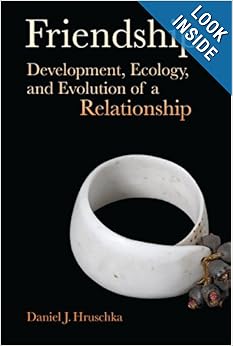
His book is Friendship: Development, Ecology, and Evolution of a Relationship (Origins of Human Behavior and Culture) (2010), another brick in the mammoth wish list I have accumulated. Here is the Amazon blurb:
Friends-they are generous and cooperative with each other in ways that appear to defy standard evolutionary expectations, frequently sacrificing for one another without concern for past behaviors or future consequences. In this fascinating multidisciplinary study, Daniel J. Hruschka synthesizes an array of cross-cultural, experimental, and ethnographic data to understand the broad meaning of friendship, how it develops, how it interfaces with kinship and romantic relationships, and how it differs from place to place. Hruschka argues that friendship is a special form of reciprocal altruism based not on tit-for-tat accounting or forward-looking rationality, but rather on mutual goodwill that is built up along the way in human relationships.
There are piles of research similar to this, all of which doesn't quite refute Richard Dawkins' "selfish gene" hypothesis, but it adds layers of complexity.

Why We Come To The Aid Of Our Friends: An Evolutionary Puzzle


Published on Jul 20, 2012
Daniel Hruschka
June 27, 2012


Friends sacrifice for one another with little concern for past behavior or consequences. Such unconditional helping provides an important buffer against hardship. But it also poses an evolutionary puzzle. How have people managed to benefit from selfless aid while avoiding exploitation by false friends? Dan Hruschka searches for clues by looking to the origins of human friendship - how it develops, how it varies across human cultures, and how it relates to social ties in other species.

Friday, July 19, 2013

Dr. Anne E. Cress Named Interim Director of University of Arizona Cancer Center

I want to give a shout out and congratulations to my friend and personal training client, Dr. Anne Cress, the new Interim Director of the University of Arizona Cancer Center. They are lucky to have her wisdom, intelligence, creativity, and dedication to integrity - traits I have enjoyed in her for more than six years.

She is without doubt one of my most dedicated and hard-working clients - and she makes me laugh and think, sometimes simultaneously, in every session.

Deep bow of respect.

Anne E. Cress Named Interim Director of UA Cancer Center

By Sara Hammond, University of Arizona Cancer Center | July 19, 2013

Cress succeeds Dr. David S. Alberts, who served as cancer center director for more than eight years until his recent retirement


Anne E. Cress, professor of cellular and molecular medicine and radiation oncology at the University of Arizona College of Medicine, has been named interim director of the University of Arizona Cancer Center. The appointment was made by Dr. Joe G.N. "Skip" Garcia, incoming UA senior vice president for health sciences, and Dr. Steve Goldschmid, dean of the UA College of Medicine.

Cress, who also is deputy dean for research affairs at the UA College of Medicine, succeeds Dr. David S. Alberts, who served as cancer center director for more than eight years until his recent retirement. Alberts remains at the UA Cancer Center to conduct research.

Cress was named a research associate in 1980 and became a research assistant professor in 1981, both in the UA's division of radiation oncology. She was named an associate professor in 1990 and attained full professorship with tenure in 1996. She was appointed professor of cell biology and anatomy (now cellular and molecular medicine) in 1999. She has been a UACC member since 1987. She also served as the College of Medicine's associate dean for research and academic affairs for six years. Her research has continuously been supported since 1981 by extramural research grants from the National Institutes of Health, the Department of Defense, and the American Cancer Society.

"Anne Cress is one of the top cancer biology scientists in the world," said Garcia. "Her breadth of knowledge about translational approaches to cancer will be crucial as she leads the UA's comprehensive cancer center through this time of transition."

Goldschmid added: "Dr. Cress's service to the University of Arizona, especially within the College of Medicine, is unparalled. Between her extensive research credentials and her administrative leadership, she is unquestionably the right person to take the reins of our cancer center at this critical time."

Cress's research is focused on stopping tumor cells "in their tracks" and preventing tumor metastasis. She is examining how cell surface molecules, called integrins, behave abnormally in tumor cells, enabling their transit along vessels and nerves to their final destination in bone.

Through her collaborative research, Cress is helping to design strategies that will prevent these harmful and painful processes from occurring and at the same time providing new ways for physicians to determine if a patient's cancer is likely to spread.

Cress has a 30-year history of contributions to interdisciplinary science through more than 100 original research publications, several major federal and foundation grant and patent awards, and national study section service chairmanships, including those organized by the National Institutes of Health, Department of Defense, and the American Cancer Society.

She received her bachelor of science in microbiology/chemistry and a doctorate in biochemistry/molecular biology from the UA. She completed postdoctoral work in cancer biology at the UA and served as a visiting professor in biochemistry at Stanford University, and completed visiting scholar sabbaticals at the Drug Development and Design Center in Brisbane, Australia, and with the Developmental Biology Group at Netherlands Cancer Institute in Amsterdam.

Her awards and honors include: Outstanding Research Investigator Award, Moffitt Cancer Center, 1999; Arizona Health Sciences Center Founder's Day Award, 2005; Elkin Award for Cancer Biology Research, Emory University, 2005; UA Cancer Center's Sydney E. Salmon, MD, Senior Investigator Award, 2008.