Survival of the ... Nicest? Check Out the Other Theory of Evolution
A new theory of human origins says cooperation—not competition—is instinctive.
by Eric Michael Johnson
posted May 03, 2013
Photo by Harlan Harris.
A century ago, industrialists like Andrew Carnegie believed that Darwin’s theories justified an economy of vicious competition and inequality. They left us with an ideological legacy that says the corporate economy, in which wealth concentrates in the hands of a few, produces the best for humanity. This was always a distortion of Darwin’s ideas. His 1871 book The Descent of Man argued that the human species had succeeded because of traits like sharing and compassion. “Those communities,” he wrote, “which included the greatest number of the most sympathetic members would flourish best, and rear the greatest number of offspring.” Darwin was no economist, but wealth-sharing and cooperation have always looked more consistent with his observations about human survival than the elitism and hierarchy that dominates contemporary corporate life.
Nearly 150 years later, modern science has verified Darwin’s early insights with direct implications for how we do business in our society. New peer-reviewed research by Michael Tomasello, an American psychologist and co-director of the Max Planck Institute for Evolutionary Anthropology in Leipzig, Germany, has synthesized three decades of research to develop a comprehensive evolutionary theory of human cooperation. What can we learn about sharing as a result?
Tomasello holds that there were two key steps that led to humans’ unique form of interdependence. The first was all about who was coming to dinner. Approximately two million years ago, a fledgling species known as Homo habilis emerged on the great plains of Africa. At the same time that these four-foot-tall, bipedal apes appeared, a period of global cooling produced vast, open environments. This climate change event ultimately forced our hominid ancestors to adapt to a new way of life or perish entirely. Since they lacked the ability to take down large game, like the ferocious carnivores of the early Pleistocene, the solution they hit upon was scavenging the carcasses of recently killed large mammals. The analysis of fossil bones from this period has revealed evidence of stone-tool cut marks overlaid on top of carnivore teeth marks. The precursors of modern humans had a habit of arriving late to the feast.
However, this survival strategy brought an entirely new set of challenges: Individuals now had to coordinate their behaviors, work together, and learn how to share. For apes living in the dense rainforest, the search for ripe fruit and nuts was largely an individual activity. But on the plains, our ancestors needed to travel in groups to survive, and the act of scavenging from a single animal carcass forced proto-humans to learn to tolerate each other and allow each other a fair share. This resulted in a form of social selection that favored cooperation: “Individuals who attempted to hog all of the food at a scavenged carcass would be actively repelled by others,” writes Tomasello, “and perhaps shunned in other ways as well.”
This evolutionary legacy can be seen in our behavior today, particularly among children who are too young to have been taught such notions of fairness. For example, in a 2011 study published in the journal Nature, anthropologist Katharina Hamann and her colleagues found that 3-year-old children share food more equitably if they gain it through cooperative effort rather than via individual labor or no work at all. In contrast, chimpanzees showed no difference in how they shared food under these different scenarios; they wouldn’t necessarily hoard the food individually, but they placed no value on cooperative efforts either. The implication, according to Tomasello, is that human evolution has predisposed us to work collaboratively and given us an intuitive sense that cooperation deserves equal rewards.
The second step in Tomasello’s theory leads directly into what kinds of businesses and economies are more in line with human evolution. Humans have, of course, uniquely large population sizes—much larger than those of other primates. It was the human penchant for cooperation that allowed groups to grow in number and eventually become tribal societies.
Humans, more than any other primate, developed psychological adaptations that allowed them to quickly recognize members of their own group (through unique behaviors, traditions, or forms of language) and develop a shared cultural identity in the pursuit of a common goal.
“The result,” says Tomasello, “was a new kind of interdependence and group-mindedness that went well beyond the joint intentionality of small-scale cooperation to a kind of collective intentionality at the level of the entire society.”
What does this mean for the different forms of business today? Corporate workplaces probably aren’t in sync with our evolutionary roots and may not be good for our long-term success as humans. Corporate culture imposes uniformity, mandated from the top down, throughout the organization. But the cooperative—the financial model in which a group of members owns a business and makes the rules about how to run it—is a modern institution that has much in common with the collective tribal heritage of our species. Worker-owned cooperatives are regionally distinct and organized around their constituent members. As a result, worker co-ops develop unique cultures that, following Tomasello’s theory, would be expected to better promote a shared identity among all members of the group. This shared identity would give rise to greater trust and collaboration without the need for centralized control.
Moreover, the structure of corporations is a recipe for worker alienation and dissatisfaction. Humans have evolved the ability to quickly form collective intentionality that motivates group members to pursue a shared goal. “Once they have formed a joint goal,” Tomasello says, “humans are committed to it.” Corporations, by law, are required to maximize profits for their investors. The shared goal among corporate employees is not to benefit their own community but rather a distant population of financiers who have no personal connection to their lives or labor.
However, because worker-owned cooperatives focus on maximizing value for their members, the cooperative is operated by and for the local community—a goal much more consistent with our evolutionary heritage. As Darwin concluded in The Descent of Man, “The more enduring social instincts conquer the less persistent instincts.” As worker-owned cooperatives continue to gain prominence around the world, we may ultimately witness the downfall of Carnegie’s “law of competition” and a return to the collaborative environments that the human species has long called home.
~ Eric Michael Johnson wrote this article for How Cooperatives Are Driving the New Economy, the Spring 2013 issue of YES! Magazine. Eric is a doctoral student in the history of science at the University of British Columbia. His research examines the interplay between evolutionary biology and politics.
Showing posts with label interdependence. Show all posts
Showing posts with label interdependence. Show all posts
Sunday, June 01, 2014
Eric Michael Johnson - Survival of the ... Nicest? Check Out the Other Theory of Evolution
This comes from Yes! Magazine. The article is about a year old, but it's message - that humans probably evolved through cooperation more than competition (as argued by E.O. Wilson, among others) - is still highly relevant as we totter down the road of incredible wealth disparity, unbridled capitalism, and wholesale destruction of the earth.


Sunday, December 29, 2013
Relational Reality: Charlene Spretnak at TEDx Manhattan Beach
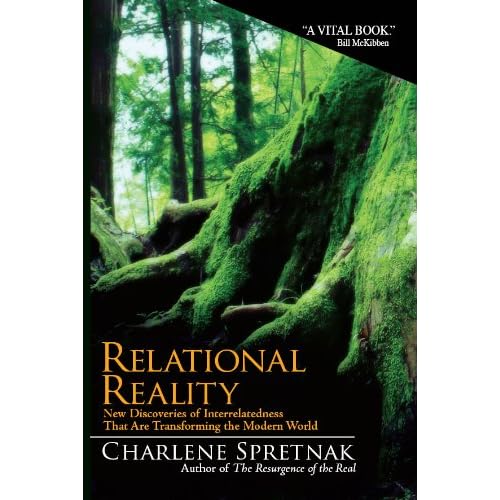
Earlier this year I posted a piece by Michel Bauwens that reviewed and excerpted Relational Reality: New Discoveries of Interrelatedness That Are Transforming the Modern World (2009), and she recently appeared at TEDx Manhattan Beach to talk about relational reality.
Relational Reality: Charlene Spretnak at TEDx Manhattan Beach
Published on Dec 27, 2013
Charlene Spretnak is an author and activist who has long been fascinated with the subject of interrelatedness. In her talk, Charlene sites several recent discoveries indicating that all of physical reality, including humans, is far more dynamically interrelated than our modern schooling had supposed. These new discoveries reveal the impact of our relationships -- with other people and with nature -- on childhood development, intelligence, healing, and our life-long health and well-being.
* * * * *
Charlene Spretnak has been intrigued throughout her life as a writer, speaker, and activist with dynamic interrelatedness. She has written eight books on various subjects in which interrelatedness plays a central role. She is particularly interested in 21st-century discoveries indicating that the physical world, including the human bodymind, is far more dynamically interrelated than modernity had assumed. Such discoveries are currently causing a “relational shift” in our institutions and systems of knowledge, as she suggests in Relational Reality (2011). Several of her books have also proposed a "map of the terrain" of emergent social-change movements and an exploration of the issues involved. She has helped to create an eco-social frame of reference and vision in the areas of social criticism (including feminism), cultural history, and religion and spirituality. Since the mid-1980s, her books have examined the multiple crises of modernity and furthered the corrective efforts that are arising. Her book Green Politics was a major catalyst for the formation of the U.S. Green Party movement, of which she is a cofounder. In 2006 Charlene Spretnak was named by the British government's Environment Department as one of the "100 Eco-Heroes of All Time." In 2012 she received the Demeter Award for lifetime achievement as "one of the premier visionary feminist thinkers of our time" from the Association for the Study of Women and Mythology. She is a professor emerita in philosophy and religion. She hosts a weekly radio program about the Relational Shift, "All Together Now," on the Progressive Radio Network (prn.fm).
She is currently working on a book about the spiritual dimensions of modern and contemporary art from the 1800 to the present (Palgrave Macmillan, Fall 2014).
In addition to many articles, op-ed pieces, and reviews, she has written the following books (plus others not listed):
Relational Reality: New Discoveries of Interrelatedness That Are Transforming the Modern World (2011)
Missing Mary: The Queen of Heaven and Her ReEmergence in the Modern Church (2004)
The Resurgence of the Real: Body, Nature, and Place in a Hypermodern World (1997)
States of Grace: The Recovery of Meaning the Postmodern Age (1991)
Sunday, November 17, 2013
Robin Courtin - Awakening our Hearts in the World (2 Parts)
From the Interdependence Project, this two-part podcast features the Ven. Robina Courtin, founder of the Liberation Prison Project, an effort to bring the dharma to prisoners. She was raised Catholic but has been a nun in the Tibetan Buddhist tradition since 1977. In this podcast, she discusses how to engage our practice without surrendering to anger or clinging to "right and wrong."
Robin Courtin - Awakening our Hearts in the World - Part 1 of 2
Submitted by Darren Dyke on Sat, 11/16/2013

In this special podcast, Ven. Robina Courtin discusses how to engage our practice without surrendering to anger or clinging to "right and wrong". We were thrilled to host this global activist, renowned teacher, and Tibetan nun for her second visit to The Interdependence Project in September 2012.
Ven. Robina returns to IDP on December 11, 2013. Details and tickets are available at this link. The talk will be podcasted for our remote listeners.
Robina Courtin was born in Melbourne, Australia, and brought up as a Catholic. Since 1977, she has lived as a Buddhist nun in the Tibetan tradition, traveling, teaching, and bringing the Dharma to people around the world, including prisoners via The Liberation Prison Project, which she founded. More information and schedule: http://robinacourtin.com/
This podcast is provided by the generosity of listeners like you. Become a Member or make a contribution to support this and other initiatives by The Interdependence Project.
You may subscribe to IDP's podcasts at this link or via iTunes at this link.
Audio File Download (right-click and "Save Link As...")
* * * * *
Robin Courtin - Awakening our Hearts in the World - Part 2 of 2

In this special podcast, Ven. Robina Courtin, discusses how to engage our practice without surrendering to anger or clinging to "right and wrong". We were thrilled to host this global activist, renowned teacher, and Tibetan nun for her second visit to The Interdependence Project in September 2012.
Ven. Robina returns to IDP on December 11, 2013. Details and tickets are available at this link. The talk will be podcasted for our remote listeners.
Robina Courtin was born in Melbourne, Australia, and brought up as a Catholic. Since 1977, she has lived as a Buddhist nun in the Tibetan tradition, traveling, teaching, and bringing the Dharma to people around the world, including prisoners via The Liberation Prison Project, which she founded. More information and schedule: http://robinacourtin.com/
This podcast is provided by the generosity of listeners like you. Become a Member or make a contribution to support this and other initiatives by The Interdependence Project.
You may subscribe to IDP's podcasts at this link or via iTunes at this link.
Audio File Download (right-click and "Save Link As...")
Friday, February 15, 2013
A New Story of the People: Charles Eisenstein at TEDxWhitechapel
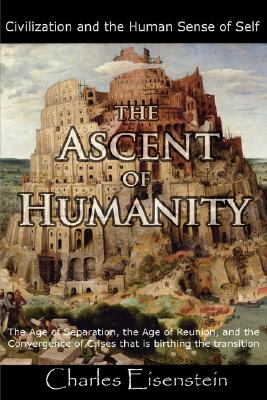
Charles Eisenstein speaks about a New Story of the People at the TEDxWhitechapel event. Eisenstein is the author of Sacred Economics: Money, Gift, and Society in the Age of Transition (2011) and The Ascent of Humanity: Civilization and the Human Sense of Self (2013, reissue). This young man (he's roughly my age, since he is also born in 1967) is a rising star in the intellectual world, and this talk gives a little glimpse of why this is true.
A New Story of the People: Charles Eisenstein at TEDxWhitechapel
Published on Feb 13, 2013
"Our hearts know that a more beautiful world is possible; but our minds do not know how it's possible". In this intelligent and inspiring talk, writer and visionary Charles Eisenstein explores how we can make the transition from the old story of separation, competition and self-interest to a new Story of the People.
Charles Eisenstein is a teacher, speaker, and writer focusing on themes of civilization, consciousness, money, and human cultural evolution.
His books (The Ascent of Humanity and Sacred Economics) as well as his other essays and blog posts on web magazines have generated a vast online following; he speaks frequently at conferences and other events, and gives numerous interviews on radio and podcasts. Writing in Ode magazine's "25 Intelligent Optimists" issue, David Korten (author of When Corporations Rule the World) called Eisenstein "one of the up-and-coming great minds of our time."
Eisenstein graduated from Yale University in 1989 with a degree in Mathematics and Philosophy, and spent the next ten years as a Chinese-English translator. He currently lives in Harrisburg, Pennsylvania with his wife and three sons.
Sunday, January 20, 2013
TED Talk - Ze Frank's Web Playroom

I had not seen this Ze Frank TED Talk until last night - it's both funny and touching. Enjoy.
Ze Frank's Web Playroom
On the web, a new "Friend" may be just a click away, but true connection is harder to find and express. Ze Frank presents a medley of zany Internet toys that require deep participation -- and reward it with something more nourishing. You're invited, if you promise you'll share.
Sunday, December 23, 2012
The Evolution of Religion Society and Consciousness with Ursula King - Burke Lecture

Nice lecture on a cool topic, from UCTV.
The Evolution of Religion Society and Consciousness with Ursula King - Burke Lecture
The discovery of evolution implies a profound revolution in human thinking and action. Ursula King, Professor Emerita of Theology and Religious Studies, University of Bristol, explores the implications of this new consciousness for religion, society, and consciousness. She describes the work of the French paleontologist and religious thinker Pierre Teilhard de Chardin who sought a new spirituality for a world in evolution. His prophetic thought about "the planetization of humanity" - what is called "globalization" today - relates to global interdependence in all areas of human endeavor, and bears on contemporary discussions about ecological and evolutionary spiritualities as well as international peace and social justice. Series: "Burke Lectureship on Religion & Society" [1/2013]
Saturday, March 03, 2012
What Is the Self?
This is a very short and cool video from the Science and Nonduality channel on YouTube.
What Is the Self?
What Is the Self?
Join the exploration: Science and Nonduality
SAND Europe - 29th May - 3rd June, 2012, Doorn, The Netherlands
SAND USA - Oct 24th-28th, 2012, San Rafael, CA
Mystics in all ages and cultures describe the self as infinite, stable and ever-present phenomena. Modern physics describe the world as a self-moving, self-designing pattern, an undivided wholeness, a dance. We, as a society, relate to the self mostly as an individual, unique, time bound form. Our common sense, as individuals and society, hasn't caught up with this picture and it still based on long-held biases and stories. The Earth is clearly round but we still act as if it was flat...
We live at the dawn of a scientific revolution, every day brings new findings from a wide range of scientific disciplines about what it means to be human. Modern science now gives us the detailed descriptions of the mechanisms our brain needs to construct what we call the self.
Could it be this illusionary image of ourselves as separate beings that is keeping us in this perpetual state of anxiety, scarcity, fear, dissatisfaction and leading us, as a society, at this very delicate point in evolution?
Video by: Zaya and Maurizio Benazzo
Wednesday, February 08, 2012
Matthew Taylor - Developing Development (with a Nod to Robert Kegan)

Matthew Taylor, Chief Executive of the RSA, is looking toward developmental psychologist Robert Kegan (of Harvard University, and author of The Evolving Self, In Over Our Heads, and Immunity to Change, among other books) for ways to advance our understanding of development. Glad to hear it - this is his blog post about this topic.
Developing development
February 6, 2012 by Matthew TaylorDid you hear about the car aerial that married a satellite dish; the wedding was a bit boring but apparently the reception was brilliant. Sadly, I can’t apply this adjective to the response I received for my set of posts over the New Year about entitlement. Yet, unabashed by the evidence that the longer I talk about an issue the less convincing I become, I am this week planning to write a series of posts on aspects of human development…..
Last Thursday I chaired an event at which Richard Sennett spoke about his new book Together. As tends to be the case with Richard’s work the book is often fascinating, sometimes inspiring and occasionally baffling. His core thesis certainly struck a chord.
Sennett joins many other thinkers in identifying both the importance of collaboration to human prospects in the 21st century but also the challenges of living and working with people – often very different to ourselves in values, backgrounds and lifestyles – in a fast moving, shrinking world. He suggests three attributes which people need to be able successfully and enduringly to function together (and alongside these, three apparently similar attributes they must supplant).
First, we must seek dialogic rather than dialectic communication (in essence this means conversation which accepts and negotiates different perspectives rather than seeking to find a single shared view). Second, we should aim for a subjunctive rather than a declaratory form of expression. Sennett writes:
‘The subjunctive mood counters Bernard Williams’ fear of the fetish of assertiveness by opening up instead an indeterminate mutual space, the space in which strangers dwell with one another…’.
Third, the sentiment that suits modern togetherness is empathy rather than sympathy:
‘Both sympathy and empathy convey recognition, and both forge a bond, but one is an embrace the other an encounter…Sympathy has usually been thought a stronger sentiment…I feel your pain puts a stress on what I feel; it activates one; own ego. Empathy is a more demanding exercise, at least in listening; the listener has to get outside him- or herself’.Rather like the objects in an impressionist painting the edges of Sennett’s concepts tend to blur into each other, but what struck me was the congruence with the idea of self-authorship developed by developmental psychologist Robert Kegan. Using a similar framework to Jean Piaget’s pioneering work on child cognitive development, Kegan’s masterwork is The Evolving Self, in which he describes the stages of psychological development, each subsuming the one before, which take place not just in childhood but throughout life.
Kegan argues not just that we should aspire to greater self-awareness but that we need to reach a higher, more empathic, level of functioning to meet the practical requirements of twenty-first century citizenship. In particular, successfully functioning in a society with diverse values, traditions and lifestyles “requires us to have a relationship to our own reactions, rather than be captive of them”. Kegan writes of an ability to “resist our tendencies to make ‘right’ or ‘true’ that which is merely familiar and ‘wrong’ or ‘false’ that which is only strange”. In a 2002 overview of survey evidence for the OECD, Kegan concluded than only one in five people across the world have achieved the competencies necessary for what he termed a ‘modernist’ or self-authoring order of consciousness.
The view that there is both the need and the scope for human beings to develop to a ‘higher’ level of functioning has many adherents. Another version lies in my articulation of the RSA strap-line ‘twenty first century enlightenment’. But many questions arise?
How distinct is such a view from well-meaning but vacuous view that it would be a better world if we were all better people?
Among the different accounts of human beings need to develop to thrive in the modern world, what are the important similarities and differences?
How credible is the view that human development can enhanced. Perhaps it happens anyway (cf the Flynn effect or Steven Pinker’s recent evidence of declining violence) or perhaps, as John Grey would no doubt argue, we flatter ourselves with the idea we can somehow transcend the flawed character of our species.
Broadly, what routes to enhanced human development hold out the greatest promise: education, culture, institutional innovation, spiritual awakening?
Specifically, what examples are there of sustained improvements in human psychological and behavioural development and can these examples be scaled?
As a strong advocate of a necessary human development thesis, my aim here is to sharpen the case rather than find holes in it. I was excited last week to be contacted by Robert Kegan himself who has said some very generous things about the RSA’s 21st century enlightenment thesis. But I am also impatient of making the same broad case time and again but not yet feeling it carries sufficient conviction let alone a concrete set of policies and practices. Of the questions above my sense is that the last is both the most important and the hardest.
Sunday, December 25, 2011
Mind and Life XXIII - Session 10 - Discussion among participants and His Holiness's final remarks
This is the final session of Mind and Life XXIII, "Ecology, Ethics and Interdependence" - Session 10: A discussion among participants and His Holiness's final remarks. Mind and Life XXIII conference features His Holiness the Dalai Lama in dialogue with contemplative scholars, activists and ecological scientists who discuss the interconnection between individual choices and environmental consequences. The conference was held at His Holiness's office in Dharamsala, India, from October 17-21, 2011.
Saturday, December 24, 2011
Mind and Life XXIII - Session 9: The Skillful Means of Activism
Here is session 9 - The Skillful Means of Activism - of "Ecology, Ethics and Interdependence", the Mind and Life XXIII conference with His Holiness the Dalai Lama in dialogue with contemplative scholars, activists and ecological scientists who discuss the interconnection between individual choices and environmental consequences. The conference was held at His Holiness's office in Dharamsala, India, from October 17-21, 2011.
Friday, December 23, 2011
Mind and Life XXIII - Session 8 - A Buddhist Perspective on the Psychology of Action and Behavior Change
Here is session 8 - A Buddhist Perspective on the Psychology of Action and Behavior Change - of "Ecology, Ethics and Interdependence", the Mind and Life XXIII conference with His Holiness the Dalai Lama in dialogue with contemplative scholars, activists and ecological scientists who discuss the interconnection between individual choices and environmental consequences. The conference was held at His Holiness's office in Dharamsala, India, from October 17-21, 2011.
Thursday, December 22, 2011
Mind and Life XXIII - Session 7: The Psychology of Action and Behavior Change
Here is session 7 - The Psychology of Action and Behavior Change - of "Ecology, Ethics and Interdependence", the Mind and Life XXIII conference with His Holiness the Dalai Lama in dialogue with contemplative scholars, activists and ecological scientists who discuss the interconnection between individual choices and environmental consequences. The conference was held at His Holiness's office in Dharamsala, India, from October 17-21, 2011.
Monday, December 19, 2011
Mind and Life XXIII - Session 6 - A Buddhist Perspective and Open Discussion
Session 6, A Buddhist Perspective and Open Discussion, of "Ecology, Ethics and Interdependence", the Mind and Life XXIII conference with His Holiness the Dalai Lama in dialogue with contemplative scholars, activists and ecological scientists who discuss the interconnection between individual choices and environmental consequences. The conference was held at His Holiness's office in Dharamsala, India, from October 17-21, 2011.
Sunday, December 18, 2011
Mind and Life XXIII - Session 5 - A Role for Theology: Models of God, the World, and the Self
Segment 5 of the Mind and Life Conference XXIII ("Ecology, Ethics and Interdependence") - A Role for Theology: Models of God, the World, and the Self - hosted by the Dalai Lama at his office in Dharamsala, India, from October 17-21, 2011.
Friday, December 16, 2011
Mind and Life XXIII - Session 4 - Environmental Ethics - What is at Stake?
Here is another installment in this years Mind and Life Conference, XXIII: "Ecology, Ethics and Interdependence," hosted by the Dalai Lama at office in Dharamsala, India, from October 17-21, 2011.
Monday, December 12, 2011
Mind and Life XXIII - Session 3 - Industrial Ecology - Connecting Everyday Activity to Planetary Crisis

Session 3: Industrial Ecology - Connecting Everyday Activity to Planetary Crisis of "Ecology, Ethics and Interdependence", the Mind and Life XXIII conference with His Holiness the Dalai Lama in dialogue with contemplative scholars, activists and ecological scientists who discuss the interconnection between individual choices and environmental consequences. The conference was held at His Holiness's office in Dharamsala, India, from October 17-21, 2011.
Sunday, December 11, 2011
Mind and Life XXIII - Session 2 - Interdependence Between the Environment and Our Health: Risk and Opportunities

I meant to post all of the videos for this conference a while back, but I got distracted or something. I blame the ADD, but more likely I simply forgot. Anyway, here is the second session from the Mind and Life XXIII Conference ( Ecology, Ethics and Interdependence), hosted by the Dalai Lama - Session 2: Interdependence Between the Environment and Our Health: Risk and Opportunities.
Subscribe to:
Posts (Atom)