Showing posts with label emotional intelligence. Show all posts

Friday, September 26, 2014

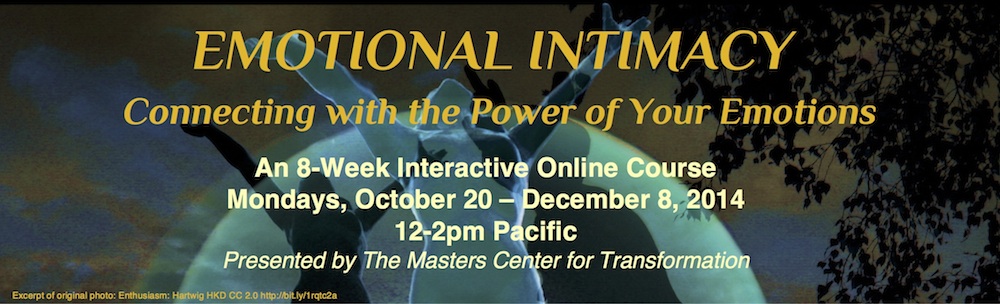
Emotional Intimacy: Connecting with the Power of Your Emotions - 8-Week Online Course

http://ecx.images-amazon.com/images/I/41QPJKox-3L._SY344_BO1,204,203,200_.jpg

This 8-week course is based on Robert Augustus Masters' excellent book, Emotional Intimacy: A Comprehensive Guide for Connecting with the Power of Your Emotions (August, 2013). If this were not a program based on Masters' book and work, and taught by one of his certified students, I would not be recommending it.

The program costs $169.00 (+ $5.22 charge) if you register by Sept. 30; $199.00 (+ $5.97 charge) if you register by Oct, 10; and $269.00 (+ $7.72 charge) after Oct. 10. The course begins on Monday, October, 20.

Here is the description:

Join us for Emotional Intimacy: Connecting with the Power of Your Emotions


Posted by admin on Sept 20, 2014


Embark on an 8-week inner quest that can transform the way you experience your emotions and revolutionize your life and relationships.


What benefits can a course on Emotional Intimacy bring to your life?
  • Deepen your understanding of the major emotions in a way that gives you skills for transformation
  • Increase your emotional intelligence–a skill that correlates with better relationships, improved social supports, and less conflict with others
  • Break free of old emotional patterns that hold you back
  • Reduce reactivity allowing you to experience more ease, connection, and emotional freedom
  • Discover the surprising role challenging emotions play in your wellbeing
  • Become more intimate with your undiscovered emotional self
  • Improve your relationships through greater emotional competence and self-knowledge
  • Learn to get off the rollercoaster of toxic emotional interactions that create conflict and pain
  • Discover more joy, resilience, and inner ease
Our Journey…


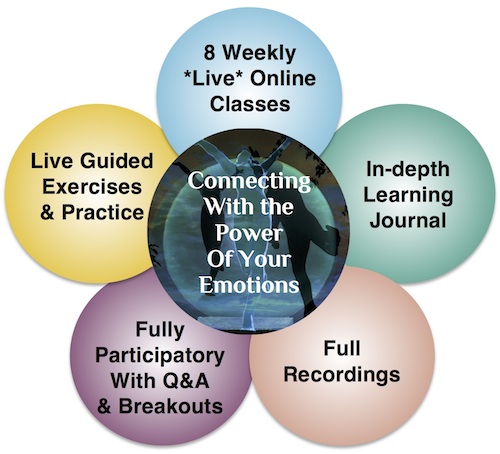
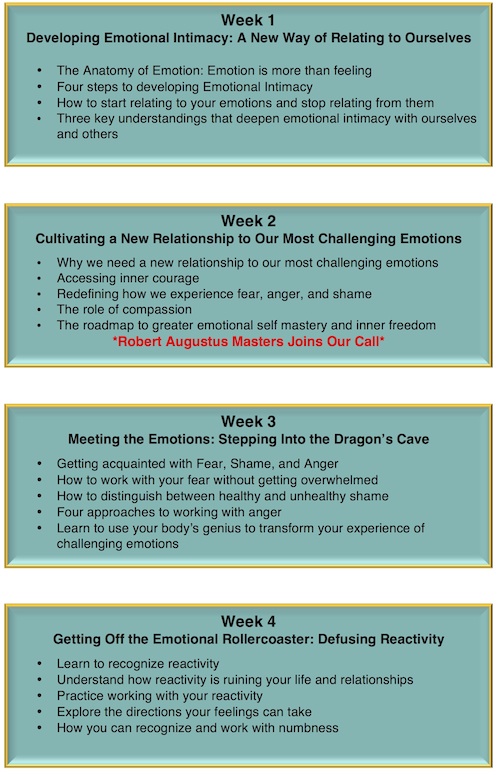
Enter a unique experiential learning environment held with deep consciousness and compassion. Connecting With the Power of Your Emotions includes original content, intimate Q&A, guided meditations and solo practices, as well as partner exercises.


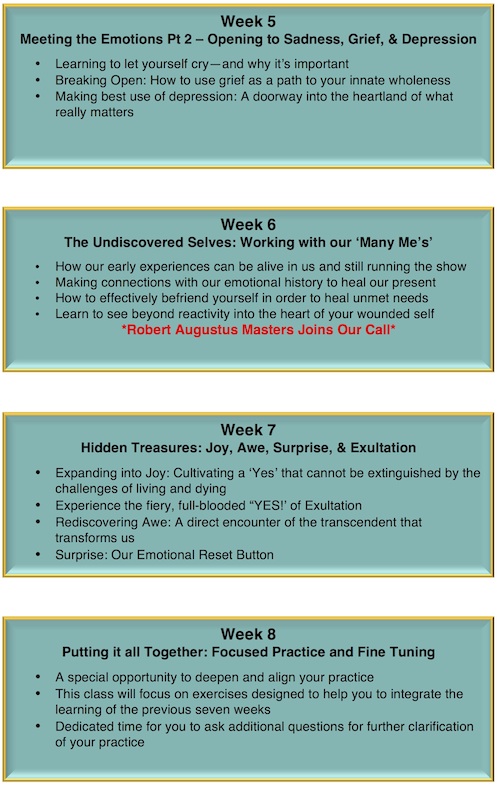
We will learn together in eight weekly 2-hour teleclasses (Mondays, October 20, 27, November 3, 10, 17, 24, December 1 and 8 at 12:00 pm Pacific Time). Additional live 60-minute Q&A and practice sessions will be held on Thursday, November 13, 5:00pm Pacific, Saturday, November 22, 4:00pm, Pacific, and Thursday, December 4, 5:00pm, Pacific to accommodate those who may be unable to attend at the regular course time.

All classes will be recorded and made available within 48-72 hours of the class for those who are unable to attend live.

Each week you will receive a Learning Journal specifically designed to support you in getting the most out of our time together. With guided pre- and post- class reflection questions and homework exercises, the Learning Journal will allow those who want to go deeper additional opportunities to get in touch with the emotions and skills we will be working on in each class.

Taught by Iyeshka Farmer, RPC, Senior Teacher/Trainer with the Masters Center for Transformation. The course will utilize and expand upon the book, “Emotional Intimacy: A Comprehensive Guide for Connecting With the Power of Your Emotions,” by Robert Augustus

Masters, PhD. Robert Augustus Masters will make special guest appearances during two of our classes (Oct. 27 and Nov. 24) for live sessions of discussion and Q&A. This is a rare and precious opportunity to speak with Dr. Masters directly.
Thursday, July 31, 2014

Emily Fletcher - Why Meditation is the New Caffeine (Google Talks)


Emily Fletcher is the founder of Ziva Meditation and the creator of zivaMIND, the first online meditation training program. She spoke recently at Google.

Emily Fletcher, Why Meditation is the New Caffeine

Published on Jul 30, 2014


Emily Fletcher, one of the world's leading experts on meditation, will explain the differences between the two most popular styles of meditation, how they affect the brain differently and the impact of stress on performance. Emily will also lead you through a simple breathing technique and guided visualization that will help balance the right and left sides of the brain.

This talk will cover:
  • How the fight or flight reaction can work for you or against you
  • Why emotional intelligence is so important for not only personal happiness, but professional success and how anyone can learn it
  • How to not let goals get in the way of success

About the Speaker:

Emily Fletcher is the founder of Ziva Meditation and the creator of zivaMIND, the first online meditation training program. She began her meditation training in Rishikesh, India and was inspired to become a meditation teacher after experiencing the profound physical and mental benefits it provided her during her 10-year career on Broadway, which included roles in Chicago, The Producers, A Chorus Line, and many others.

With her high performance background and eight years of meditation experience, Emily is perfectly suited to teach busy people how to incorporate this simple and effective practice into their lives. Emily has taught meditation to a wide range of individuals and companies including Coca Cola, Relativity Media, Colbeck Capitol, Ogilvy & Mather and in public schools in the Bronx. She is a regular guest on Huffington Post LIVE and has been a speaker on the Dr. Lisa show and with Eckhart Tolle at the Global Alliance for Transformational Entertainment.

Sunday, July 13, 2014

The Neuroscience of Emotions


Dr. Phillippe Goldin is known for his work on mindfulness and the brain. In this older lecture (from 2008) Dr. Goldin talks about why emotions are so important and the meaning of emotional intelligence. He goes on to explain the interplay of emotions and brain activity, including the implications of extreme emotions and how this leads to disease. The lecture unfolds into what happens to us emotionally and mentally when we develop empathy and compassion as a way of life. It's an older lecture, but it's still informative.

The Neuroscience of Emotions

Uploaded on Oct 13, 2008
Google Tech Talks
September 16, 2008


ABSTRACT

The ability to recognize and work with different emotions is fundamental to psychological flexibility and well-being. Neuroscience has contributed to the understanding of the neural bases of emotion, emotion regulation, and emotional intelligence, and has begun to elucidate the brain mechanisms involved in emotion processing. Of great interest is the degree to which these mechanisms demonstrate neuroplasticity in both anatomical and functional levels of the brain.

Speaker: Dr. Phillippe Goldin

Saturday, January 04, 2014

Adam Grant - The Dark Side of Emotional Intelligence

From The Atlantic:

The Dark Side of Emotional Intelligence

In some jobs, being in touch with emotions is essential. In others, it seems to be a detriment. And like any skill, being able to read people can be used for good or evil.


Adam Grant | Jan 2 2014


"Two faces" by Lajos Vajda, 1934 (Wikimedia)

Some of the greatest moments in human history were fueled by emotional intelligence. When Martin Luther King, Jr. presented his dream, he chose language that would stir the hearts of his audience. “Instead of honoring this sacred obligation” to liberty, King thundered, “American has given the Negro people a bad check.” He promised that a land “sweltering with the heat of oppression” could be “transformed into an oasis of freedom and justice,” and envisioned a future in which “on the red hills of Georgia sons of former slaves and the sons of former slave-owners will be able to sit down together at the table of brotherhood.”

Delivering this electrifying message required emotional intelligence—the ability to recognize, understand, and manage emotions. Dr. King demonstrated remarkable skill in managing his own emotions and in sparking emotions that moved his audience to action. As his speechwriter Clarence Jones reflected, King delivered “a perfectly balanced outcry of reason and emotion, of anger and hope. His tone of pained indignation matched that note for note.” Emotional intelligence is important, but the unbridled enthusiasm has obscured a dark side.

Recognizing the power of emotions, another one of the most influential leaders of the 20th century spent years studying the emotional effects of his body language. Practicing his hand gestures and analyzing images of his movements allowed him to become “an absolutely spellbinding public speaker,” says the historian Roger Moorhouse—“it was something he worked very hard on.” His name was Adolf Hitler.

Since the 1995 publication of Daniel Goleman’s bestseller, emotional intelligence has been touted by leaders, policymakers, and educators as the solution to a wide range of social problems. If we can teach our children to manage emotions, the argument goes, we’ll have less bullying and more cooperation. If we can cultivate emotional intelligence among leaders and doctors, we’ll have more caring workplaces and more compassionate healthcare. As a result, emotional intelligence is now taught widely in secondary schools, business schools, and medical schools.

Emotional intelligence is important, but the unbridled enthusiasm has obscured a dark side. New evidence shows that when people hone their emotional skills, they become better at manipulating others. When you’re good at controlling your own emotions, you can disguise your true feelings. When you know what others are feeling, you can tug at their heartstrings and motivate them to act against their own best interests.

Social scientists have begun to document this dark side of emotional intelligence. In emerging research led by University of Cambridge professor Jochen Menges, when a leader gave an inspiring speech filled with emotion, the audience was less likely to scrutinize the message and remembered less of the content. Ironically, audience members were so moved by the speech that they claimed to recall more of it.

The authors call this the awestruck effect, but it might just as easily be described as the dumbstruck effect. One observer reflected that Hitler’s persuasive impact came from his ability to strategically express emotions—he would “tear open his heart”—and these emotions affected his followers to the point that they would “stop thinking critically and just emote.” "Whenever we wanted to persuade our staff to support a particular project we always tried to break their hearts."

Leaders who master emotions can rob us of our capacities to reason. If their values are out of step with our own, the results can be devastating. New evidence suggests that when people have self-serving motives, emotional intelligence becomes a weapon for manipulating others. In a study led by the University of Toronto psychologist Stéphane Côté, university employees filled out a survey about their Machiavellian tendencies, and took a test measuring their knowledge about effective strategies for managing emotions. Then, Cote’s team assessed how often the employees deliberately undermined their colleagues. The employees who engaged in the most harmful behaviors were Machiavellians with high emotional intelligence. They used their emotional skills to demean and embarrass their peers for personal gain. In one computer company studied by Tel-Aviv University professor Gideon Kunda, a manager admitted to telling a colleague “how excited we all are with what he is doing,” but at the same time, “distancing my organization from the project,” so “when it blows up,” the company’s founder would blame the colleague.

Shining a light on this dark side of emotional intelligence is one mission of a research team led by University College London professor Martin Kilduff. According to these experts, emotional intelligence helps people disguise one set of emotions while expressing another for personal gain. Emotionally intelligent people “intentionally shape their emotions to fabricate favorable impressions of themselves,” Professor Kilduff’s team writes. “The strategic disguise of one’s own emotions and the manipulation of others’ emotions for strategic ends are behaviors evident not only on Shakespeare’s stage but also in the offices and corridors where power and influence are traded.”

Of course, people aren’t always using emotional intelligence for nefarious ends. More often than not, emotional skills are simply instrumental tools for goal accomplishment. In a study of emotions at the Body Shop, a research team led by Stanford professor Joanne Martin discovered that founder Anita Roddick leveraged emotions to inspire her employees to fundraise for charity. As Roddick explained, “Whenever we wanted to persuade our staff to support a particular project we always tried to break their hearts.” However, Roddick also encouraged employees to be strategic in the timing of their emotion expressions. In one case, after noticing that an employee often “breaks down in tears with frustration,” Roddick said it was acceptable to cry, but “I told her it has to be used. I said, ‘Here, cry at this point in the ... meeting.” When viewing Roddick as an exemplar of an emotionally intelligent leader, it becomes clear that there’s a fine line between motivation and manipulation. Walking that tightrope is no easy task. In jobs that required extensive attention to emotions, higher emotional intelligence translated into better performance. In jobs that involved fewer emotional demands, the results reversed.

In settings where emotions aren’t running high, emotional intelligence may have hidden costs. Recently, psychologists Dana Joseph of the University of Central Florida and Daniel Newman of the University of Illinois comprehensively analyzed every study that has ever examined the link between emotional intelligence and job performance. Across hundreds of studies of thousands of employees in 191 different jobs, emotional intelligence wasn’t consistently linked with better performance. In jobs that required extensive attention to emotions, higher emotional intelligence translated into better performance. Salespeople, real-estate agents, call-center representatives, and counselors all excelled at their jobs when they knew how to read and regulate emotions—they were able to deal more effectively with stressful situations and provide service with a smile.

However, in jobs that involved fewer emotional demands, the results reversed. The more emotionally intelligent employees were, the lower their job performance. For mechanics, scientists, and accountants, emotional intelligence was a liability rather than an asset. Although more research is needed to unpack these results, one promising explanation is that these employees were paying attention to emotions when they should have been focusing on their tasks. If your job is to analyze data or repair cars, it can be quite distracting to read the facial expressions, vocal tones, and body languages of the people around you. In suggesting that emotional intelligence is critical in the workplace, perhaps we’ve put the cart before the horse.

Instead of assuming that emotional intelligence is always useful, we need to think more carefully about where and when it matters. In a recent study at a healthcare company, I asked employees to complete a test about managing and regulating emotions, and then asked managers to evaluate how much time employees spent helping their colleagues and customers. There was no relationship whatsoever between emotional intelligence and helping: Helping is driven by our motivations and values, not by our abilities to understand and manage emotions. However, emotional intelligence was consequential when examining a different behavior: challenging the status quo by speaking up with ideas and suggestions for improvement.

Emotionally intelligent employees spoke up more often and more effectively. When colleagues were treated unjustly, they felt the righteous indignation to speak up, but were able to keep their anger in check and reason with their colleagues. When they went out on a limb to advocate for gender equity, emotional intelligence helped them keep their fear at bay. When they brought ideas for innovation to senior leaders, their ability to express enthusiasm helped them avoid threatening leaders. On a much smaller scale, they were able to follow Martin Luther King Jr.’s lead in rocking the boat while keeping it steady.

More than two decades have passed since psychologists Peter Salovey at Yale and John Mayer at the University of New Hampshire introduced the concept of emotional intelligence in 1990. Why has it taken us so long to develop a more nuanced view? After Daniel Goleman popularized the idea in 1995, many researchers—perhaps awestruck themselves by enthusiasm for the concept of emotional intelligence—proceeded to conduct studies that were fatally flawed. As University of Lausanne professor John Antonakis observed, “practice and voodoo science is running way ahead of rigorous research.”

One of the most persistent problems was the use of self-report measures, which asked employees to rate their own emotional abilities on items like “I can tell how people are feeling even if they never tell me” and “I am generally very good at calming someone down when he or she is upset.” Abilities cannot be accurately measured with self-reports. As emotion experts Sigal Barsade of Wharton and Donald Gibson of Fairfield University lament, “One might compare this approach to assessing mathematical skills by asking respondents, ‘How good are you at solving algebraic equations?’ rather than asking the person to actually solve an algebraic equation.”

Thanks to more rigorous research methods, there is growing recognition that emotional intelligence—like any skill—can be used for good or evil. So if we’re going to teach emotional intelligence in schools and develop it at work, we need to consider the values that go along with it and where it’s actually useful. As Professor Kilduff and colleagues put it, it is high time that emotional intelligence is “pried away from its association with desirable moral qualities.”

Monday, July 01, 2013

Tami Simon w/ Robert Augustus Masters - Emotional Intimacy: A Comprehensive Guide for Connecting with the Power of Your Emotions


Robert Augustus Masters, author of Spiritual Bypassing: When Spirituality Disconnects Us from What Really Matters (2010), an instant classic, Transformation through Intimacy, Revised Edition: The Journey toward Awakened Monogamy (2012), and many other excellent books, has published his newest book, Emotional Intimacy: A Comprehensive Guide for Connecting with the Power of Your Emotions (2013), with Sounds True, where he also released the excellent Knowing Your Shadow: Becoming Intimate with All That You Are (2013).

Here is the description of the book from Masters' website:
Emotions link our bodies, thoughts, and conditioning at multiple levels. And the capacity to be intimate with our emotions, teaches Robert Augustus Masters, is essential for creating fulfilling relationships, relationships in which awareness, love, passion, and integrity function as one. With Emotional Intimacy, this respected psychospiritual teacher and author invites us to explore: 
• How to deepen our emotional literacy
• Cultivating intimacy with all of our emotions
• The ways that we numb our unwanted feelings, and how to revive them and welcome them back
• How to identify our emotions, fully experience them, and skillfully express them
• Resolving and healing from old emotional wounds
• Gender differences in emotional literacy and expression
• Steps for bringing greater intimacy and depth into our relationships
• In-depth guidance for those facing depression, anxiety, and crippling shame
• Why “blowing off steam” can often make us feel worse, and what constitutes healthy catharsis
• Navigating activity and stimulus overload, a collective emotional pandemic of our times
• Individual chapters for fully engaging with fear, anger, joy, jealousy, shame, grief, guilt, awe, and the full spectrum of our emotions
In the two-part podcast below, Sounds True founder and CEO Tami Simon speaks with Masters about his new book, as well as other topics, including shadow work.

Robert Augustus Masters: Emotional Intimacy, Part 1

Tuesday, May 7, 2013


Robert Augustus Masters is an Integral psychotherapist, relationship expert, and spiritual teacher whose work blends the psychological and physical with the spiritual, emphasizing embodiment, emotional literacy, and the development of relational maturity. Here, Robert and Tami discuss emotional literacy and how it is lacking in our culture today. They consider differences in cultural conditioning between men and women when it comes to expressing emotions and the need to develop a toolkit to identify and work skillfully with anger. (70 minutes)

* * * * * * *

Robert Augustus Masters: Emotional Intimacy, Part 2

Tuesday, May 14, 2013


Tami Simon speaks with Dr. Robert Augustus Masters, an Integral psychotherapist, relationship expert, and spiritual teacher whose work emphasizes embodiment, emotional literacy, and the development of relational maturity. He is the author of 13 books including the new Sounds True book Emotional Intimacy, as well as the audio learning course Knowing Your Shadow. In the second part of their discussion, Tami speaks with Robert about the importance of mutual transparency in relationships, how we can engage in “connected catharsis,” the telltale signs that reveal when we are using spiritual bypassing to avoid emotional experience, and how we can start to identify and work with our own shadow material. (57 minutes)

More from Robert Augustus Masters:


Emotional Intimacy: A Comprehensive Guide for Connecting with the Power of Your Emotions, $12.70 

Knowing Your Shadow: Becoming Intimate with All That You Are, $46.87

Saturday, March 16, 2013

Cindy Wigglesworth - Empathy Precedes Compassion


This is cool column from Huffington Post by integrally-informed leadership coach and corporate consultant, Cindy Wigglesworth. She is the author of  SQ 21: The Twenty-One Skills of Spiritual Intelligence.

In this article she addresses the need for empathy (to feel into what others feel) in order to develop compassion. She presents an interesting developmental hierarchy from apathy to sympathy to empathy to compassion.

Empathy Precedes Compassion

Posted: 03/06/2013

Cindy Wigglesworth - Author of SQ 21: The Twenty-One Skills of Spiritual Intelligence, Leadership Coach and Corporate Consultant

There are lots of reasons we might not want to have empathy or "feel with" another person. Here are a few I have heard myself thinking. Do you think anything like this? 
  • This person deserves his hard times -- he has been acting like a jerk! Why should I engage with his pain?
  • Here she goes again. If I show empathy she will just sing the "victim song" even longer.
  • I don't have the emotional bandwidth to suffer along with anyone else right now. It just hurts too much.
All of these comments contain some truth. People do often create their own pain. All of us play the "victim" sometimes (some people love the role and do it a lot!). And some days we feel overwhelmed and can barely handle our own lives. And there is such a thing as too much empathy -- a topic I will take up in a future post.
Yet I am committed to living a life aligned with my understanding of spiritual intelligence. I want to behave with wisdom and compassion, while maintaining inner and outer peace, as much of the time as possible. And I believe being able to feel empathy in any situation is a skill I want to have at the ready. I see empathy as a piece of compassion-building. Why?
I use this four-level hierarchy to explain the differences between apathy, sympathy, empathy and compassion.
  1. Apathy = I don't care. You are unimportant to me.
  2. Sympathy = I see you and I am feel sorry about your plight. This can feel like one-up/one-down. The person I "feel sympathy for" may feel pitied -- which doesn't feel good. But this is a step up from apathy. I might donate money or express concern from sympathy.
  3. Empathy = I feel what you feel. This is a peer-to-peer experience. When you are sad, I feel the sadness in my body/mind/heart. This has a genuine caring texture to the person who is suffering. But you might feel like you are riding the emotional rollercoaster of emotions. You and I might feel unsafe and distance ourselves if feeling another's pain becomes too much.
  4. Compassion = I feel what you feel and it doesn't overwhelm my circuits. My wisdom circuits remain active and I modulate my emotional state. I see a larger picture. I act skillfully to relieve suffering where I can, or to sit with people who just need accompaniment in their pain (or their joy).
We may begin with apathy (lack of attention or concern) for someone or something. Then we may learn how to have sympathy for the suffering of others. Empathy moves us to feel with, to suffer with or rejoice with others. From empathy we can build to the next step -- compassion. Compassion is distinguished by its universality (I have compassion for all) and by the lack of panic or fear in it. Empathy at a global level is overwhelming. Compassion is not overwhelming because it is partnered with wisdom. Compassion sees a larger picture.
In my model of spiritual intelligence, and in my own life experience, I see no path to compassion that doesn't take us through empathy first. So I knew early in my research that I really need to understand empathy. Fortunately wonderful research has been and continues to be done in this field.
Empathy is a core emotional intelligence (EQ) skill -- being one of the 18 skills in the Emotional Competence Inventory (ECI 2.0) created by Daniel Goleman and Richard Boyatzis. They define it as "sensing others' feelings and perspectives, and taking an active interest in their concerns." It is a crucial skill for developing many of the social skills listed in the ECI fourth quadrant, labeled "Relationship Management" (or "Social Skills"). If you have read my book, you know that I have modeled the SQ four quadrants and 21 skills as a "vertical step up" from the ECI four quadrants and 18 skills. SQ and EQ are tightly connected.
In The Science of Evil: on Empathy and Cruelty (2012), Simon Baron-Cohen explains that neuroscience research has shown that there are quite a few parts of the brain (10 or more) involved in the experience of empathy. He calls these parts of the brain "the empathy circuit." He proposes that the best way to think about evil is to consider that cruelty cannot occur in the face of empathy since empathy acts as a natural brake on hurting others. How can we hurt another if we are causing equal pain to ourselves? It is an interesting hypothesis. One he hopes will be testable.
Baron-Cohen notes that not everyone who has low empathy is cruel. But he suggests we should hold the hypothesis that all people who are evil or cruel are failing to experience empathy, at least at that moment. In other words, cruelty at a minimum requires that our empathy-brakes have failed. He points out that there are many factors that cause us to not have enough empathy. These include malfunctions in any part of the brain's empathy circuit. Questions naturally arise. How much is inborn or genetic? How much is developmental -- e.g., trauma in childhood at key moments of brain development? How much is social conditioning?
There are external situations that can shut down our empathy, either for the long term or the short term. There is phenomenon labeled "in-group / out-group" dynamics. When we make someone part of an "out-group," we are saying they are not like us -- and we begin to dehumanize them. One group in power dehumanizes and attacks another that is seen as less valuable, less important, and not worthy of our empathy. This is what happens in a genocide. In a lesser form we see it in high schools and middle schools when "jocks," "geeks" or any other group makes another "less than us."
In my next posts I will discuss further the ways we can develop our empathy, what gets in the way of empathy, and how to avoid feeling overwhelmed by empathy when confronted by the pain of the world. Empathy minus the feeling of being overwhelmed moves us in the direction of compassion. It enables us to be a loving force for good in the world.
In the meantime I'd love your comments. What helps you open to empathy? What makes you tend to shut down?
For more by Cindy Wigglesworth, click here.

Friday, June 22, 2012

24EQ - World's First "Truly Global" Emotional Intelligence Conference


Looks cool - and it's free. There are some big names involved here, including Daniel Goleman, Marco Iacoboni, Dan Siegel, and David Rock.