Showing posts with label embedded mind. Show all posts

Sunday, January 04, 2015

Evan Thompson - Defining Consciousness from "Waking, Dreaming, Being"

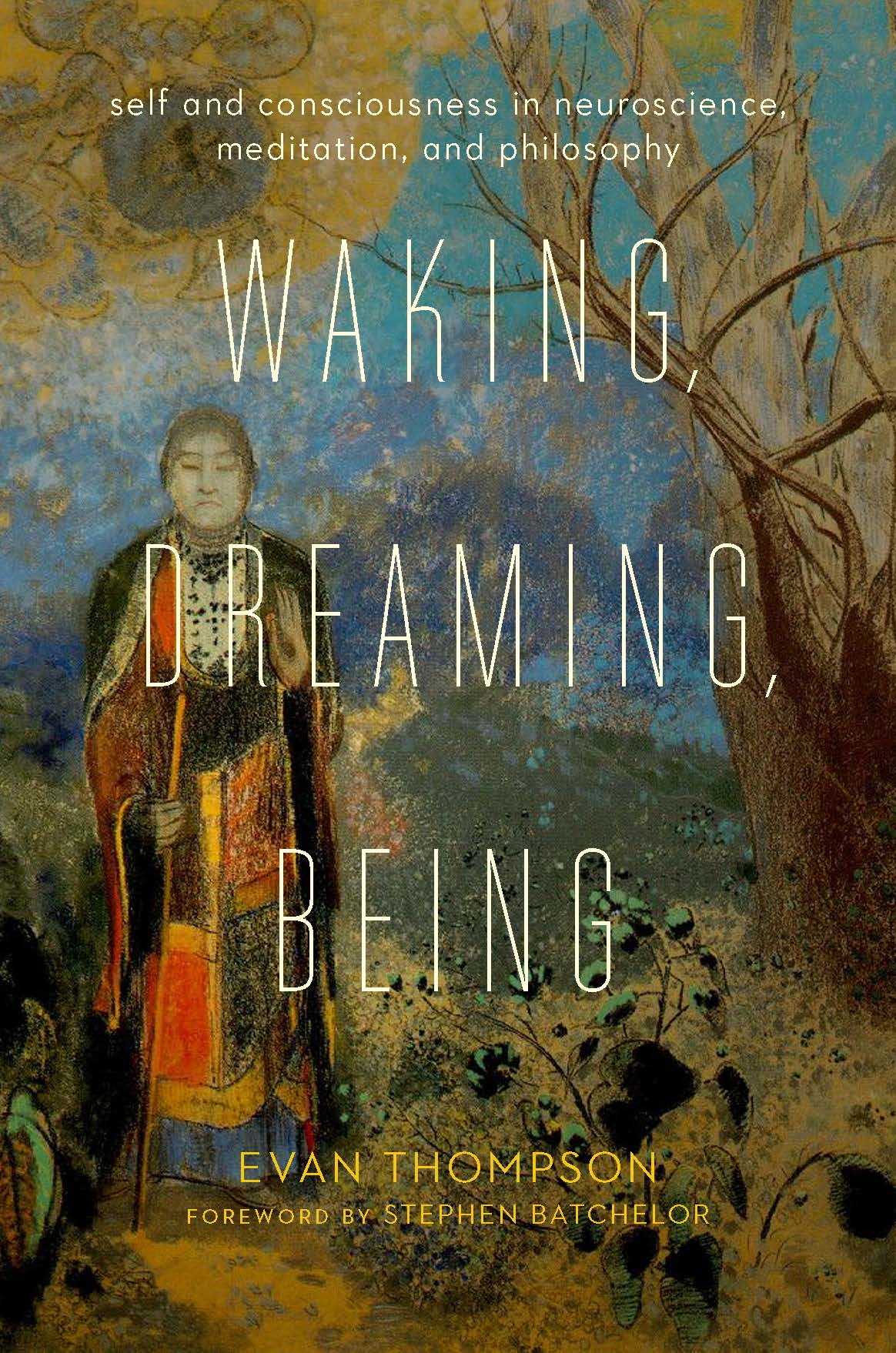
http://evanthompsondotme.files.wordpress.com/2012/11/waking-dreaming-being.jpg

Evan Thompson's new book is Waking, Dreaming, Being: Self and Consciousness in Neuroscience, Meditation, and Philosophy (2014). I'm only about 4 chapters into it at this point, but I find myself agreeing with Thompson's model of consciousness to a degree I did not anticipate. His "embodied, embedded, and relational" understanding of how consciousness functions is very similar to my own sense of consciousness.

Here are a couple of excerpts.
Moreover, the brain is always embodied, and its functioning as a support for consciousness can’t be understood apart from its place in a relational system involving the rest of the body and the environment. The physical substrate of mind is this embodied, embedded, and relational network, not the brain as an isolated system.[37]

At the same time, we can’t infer from the existential or epistemological primacy of consciousness that consciousness has ontological primacy in the sense of being the primary reality out of which everything is composed or the ground from which everything is generated. One reason we can’t jump to this conclusion is that it doesn’t logically follow. That the world as we know it is always a world for consciousness doesn’t logically entail that the world is made out of consciousness. Another reason is that thinking that consciousness has ontological primacy goes against the testimony of direct experience, which speaks to the contingency of our consciousness on the world, specifically on our living body and environment. (p. 102)
I also support his rejection of the premise that "consciousness has ontological primacy," an idea I see presented in Buddhist authors such as B Alan Wallace, Ken Wilber's integral theory, and most New Age misunderstandings of quantum mechanics (see Deepak Chopra and others of his ilk).

Over the last several years, I have become enamored of the theory of consciousness as an emergent property of matter.
The term “emergence” comes from the Latin verb emergo which means to arise, to rise up, to come up or to come forth. The term was coined by G. H. Lewes in Problems of Life and Mind (1875) who drew the distinction between emergent and resultant effects.
 ___
If we were pressed to give a definition of emergence, we could say that a property is emergent if it is a novel property of a system or an entity that arises when that system or entity has reached a certain level of complexity and that, even though it exists only insofar as the system or entity exists, it is distinct from the properties of the parts of the system from which it emerges. 
Thompson shares the emergentist position, with qualifications.
Is the view I’m presenting a version of “emergentism,” according to which consciousness is a higher-level property of living beings that emerges from lower-level biological and physical processes?[39] And if so, am I supposing that consciousness is scientifically explainable or presenting a version of “mysterianism,” the doctrine that says that the human mind is incapable of understanding how consciousness fits into the natural world?[40]
 

My view can be described as an emergentist one, in the following sense. I hold that consciousness is a natural phenomenon and that the cognitive complexity of consciousness increases as a function of the increasing complexity of living beings. Consciousness depends on physical or biological processes, but it also influences the physical or biological processes on which it depends. I also think the human
mind is capable of understanding how consciousness arises as a natural phenomenon, so I’m not a mysterian.


Nevertheless, my view differs from emergentism in its standard form, according to which physical nature, in itself, is fundamentally nonmental, yet when it’s organized in the right way, consciousness emerges. This view works with a concept of physical being that inherently excludes mental or experiential being, and then tries to show how consciousness could arise as a higher-level property of physical being so conceived. In my view, however, no concept of nature or physical being that by design excludes mental or experiential being will work to account for consciousness and its place in nature. (p. 103)
In the following passage, Thompson dismisses both the dualism of Dharmakriti and the notion of interiority of particles, a premise of Wilber's AQAL model.
Recall that Dharmakīrti reasoned in the following way: matter and consciousness have totally different natures; an effect must be of the same nature as its cause; therefore, consciousness cannot arise from or be produced by matter. This argument rejects emergentism in its standard form, for it denies that physical nature, understood as being fundamentally or essentially nonmental, is suffcient to produce or give rise to consciousness. This aspect of Dharmakīrti’s argument is hardly antiquated, for a similar and very forceful argument against standard emergentism has recently been given by the philosopher Galen Strawson.[41] In both cases, the crucial insight is that the emergence of experiental being from physical being is unintelligible, given a concept of physical phenomena as fundamentally or essentially excluding anything mental or experiential.

Whereas Dharmakīrti used his argument to support a version of mind-body dualism, Strawson uses his argument to support “panpsychism.” Dualism says that matter and consciousness have totally different natures; panpsychism says that every physical phenomenon possesses some measure of experience as part of its intrinsic nature. Neither position is attractive to me. Dharmakīrti’s dualism, which allows for modes of consciousness not dependent on the brain, doesn’t sit well with the scientific evidence, as we’ve seen. Neither does Strawson’s panpsychism. This position attributes “micro-experiences” to microphysical phenomena, despite there being no evidence for protons or electrons having any experiences of their own. Not only does ascribing “micro-experiences” to physical particles seem ad hoc, but also it gives rise to the so-called “combination problem” of how it’s possible for “micro-experiences” to coexist or combine coherently in a human or other kind of animal subject. (p. 104-105)
Thompson's point in Chapter Four, from which all of these quotes are taken, is to move the reader toward his primary philosophical position on consciousness, neurophenomenology.
Where does this leave us with regard to the project of relating consciousness to the brain, and more comprehensively, to our bodily being? Since we can’t step outside of consciousness or our embodiment, we need to work within them carefully and precisely. Instead of focusing mainly on the outward behavioral and physiological expressions of consciousness, we need to give equal attention to cultivating our experience from within. Concretely, this means we need to work with contemplative forms of mental training and embed them within a larger framework that also includes the experimental sciences of mind and life. Such a framework, in which both contemplative practice and scientific observation and measurement are seen as grounded in direct experience, is precisely what Francisco Varela had in mind when he introduced his research program of “neurophenomenology.”[43]

Neurophenomenology provides the framework for the rest of this book. (p. 105-106)
Thompson, along with by Francisco J. Varela and Eleanor Rosch first laid out a definition of neurophenomenology in their seminal book, The Embodied Mind: Cognitive Science and Human Experience (1991).

The following is an excerpt from Thompson's 2010 book, Mind in Life: Biology, Phenomenology, and the Sciences of Mind.
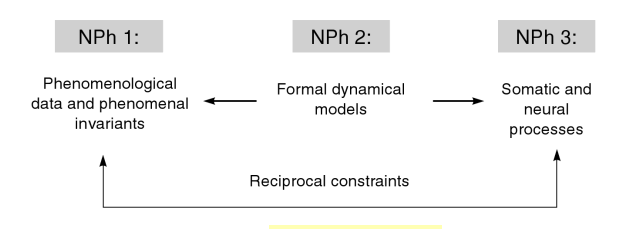
Varela formulates the “working hypothesis” of neurophenomenology in the following way: “Phenomenological accounts of the structure of experience and their counterparts in cognitive science relate to each other through reciprocal constraints” (1996. p. 343). By “reciprocal constraints” he means that phenomenological analyses can help guide and shape the scientific investigation of consciousness, and that scientific findings can in turn help guide and shape the phenomenological investigations. A crucial feature of this approach is that dynamic systems theory is supposed to mediate between phenomenology and neuroscience. Neurophenomenology thus comprises three main elements (see Figure 11.2): (1) phenomenological accounts of the structure of experience; (2) formal dynamical models of these structural invariants; and (3) realizations of these models in biological systems. Given that time-consciousness is supposed to be an acid test of the neurophenomenological enterprise, we need to see whether phenomenological accounts of the structure of time-consciousness and neurodynamical accounts of the brain processes relevant to consciousness can be related to each other in a mutually illuminating way. This task is precisely the one Varela undertakes in his neurophenomenology of time-consciousness and in his experimental research on the neurodynamics of consciousness.

Varela’s strategy is to find a common structural level of description that captures the dynamics of both the impressional-retentional-protentional flow of time-consciousness and the large-scale neural processes thought to be associated with consciousness. We have already seen how the flow of time-consciousness is self-constituting. What we now need to examine is how this self-constituting flow is supposed to be structurally mirrored at the biological level by the self-organizing dynamics of large-scale neural activity.


Figure 11.2-Neurophenomenology
Figure 11.2- Neurophenomenology

There is now little doubt in cognitive science that cognitive acts, such as the visual recognition of a face, require the rapid and transient coordination of many functionally distinct and widely distributed brain regions. Neuroscientists also increasingly believe that moment-to moment, transitive (object-directed) consciousness is associated with dynamic, large-scale neural activity rather than any single brain region or structure (Cosmelli, Lachaux, and Thompson, 2007). Hence, any model of the neural basis of mental activity, including consciousness, must account for how large-scale neural activities can operate in an integrated or coherent way from moment to moment.

This problem is known as the large-scale integration problem (Varela et al. 2001). According to dynamical neuroscience, the key variable for understanding large-scale integration is not so much the activity of the individual neural components, but rather the nature of the dynamic links among them. The neural counterparts of mental activity are thus investigated at the level of collective variables that describe emergent and changing patterns of large-scale integration. One recent approach to defining these collective variables is to measure transient patterns of synchronous oscillations between different populations of neurons (Engel, Fries, and Singer 2001; Varela et al. 2001). According to Varela (1995, 1999), these synchrony patterns define a temporal frame of momentary and transient neural integration that corresponds to the duration of the present moment of experience.
I highly recommend all three of Thompson's books that are referenced here - he is one of the leading philosophers of mind working today.

Thursday, September 18, 2014

A TRULY Integral Model of Psychological Development

http://psychologyebook.com/wp-content/uploads/2014/09/q8.jpg

Here is a TRULY integral perspective on psychological development that comes from Willis F. Overton, Thaddeus L. Bolton Professor of Psychology, Emeritus, at Temple University. A great number of his papers are available on Research Gate.

The quotations below come from a paper by three other authors, but they are heavily influenced by Overton's Relational Developmental Systems model of development (see here and here for papers by Overton describing his model).

From "Emergence, Self-Organization and Developmental Science"
By Gary Greenberg, Kristina Schmid Callina, & Megan Kiely Mueller
Advances in Child Development and Behavior, 44
http://dx.doi.org/10.1016/B978-0-12-397947-6.00004-0
"With respect to embodiment, Overton (2008) states, “embodiment [is not] about a set of genes causing behavior, or a split-off brain causing or being the mind …. Embodiment is a concept of synthesis, a bridge that joins broad areas of inquiry into a unified whole (e.g., the biological, the phenomenological, the sociocultural and environmental) as relative standpoints that together constitute the whole” (p. 3, emphasis added)." (p. 118)
Incorporating "the biological, the phenomenological, the sociocultural, and environmental" in his model, Overton has covered each of the AQAL quadrants (biological = it; phenomenological = I; sociocultural = we; and environmental = its). He does this within an embodied and embedded framework, and it is also enactive - but he uses the terms relational, or relationism instead.

This model is focused on development, but is also is applied to all other realms of inquiry, including mind and consciousness. Importantly, Overton puts a special emphasis on the embodied nature of all of these processes.
"Consistent with our definition of psychology as a biopsychosocial science, development is an embodied phenomenon (Overton, 2006, 2007). Among the implications of embodiment is that at any point in time, development cannot be understood in reference to a single variable or a single dimension, either internal or external. As we have pointed out, the study of cognitive development, brain development, personality development, or any psychological phenomenon must recognize the fusion of these processes with other internal and external dimensions of change in which they are fused. Of course, embodiment with all levels of the ecology necessarily includes the individual’s embeddedness with temporality (history) that involves at the very least ontogenetic and phylogenetic time (Elder, 1998). Furthermore, embodiment is not static; that is, due to epigenesis, developmental scientists should expect qualitative discontinuities in the nature of the embodied developing individual across time and place, both ontogenetically and phylogenetically." (p. 119)
Here, the authors adds something I have not seen explicitly stated in the AQAL model - temporality, or history. We are always embedded not just in space, but also in our unique time. The author cited here is Elder, but I have seen this same distinction made in Overton's work as well. 

Here is one last quote from Overton and Lerner, from a 2014 article that served as an introduction to a special issue of Research in Human Development.
"It will come as no surprise to the readers of this issue that we seriously embrace the relational scientific paradigm, which we have referred to as relationism and relational developmental systems (e.g., Lerner & Benson, 2013; Lerner & Overton, 2008; Overton 2010, 2013; Overton & Lerner, 2012). Briefly, the primary ontological and epistemological categories of this paradigm are (1) process (vs. Cartesian substance), (2) becoming/being (vs. Cartesian being), (3) holism (vs. Cartesian atomism), (4) relational analysis (vs. Cartesian either/or split analysis), (5) multiple perspectives (vs. Cartesian dualistic split objectivism– subjectivism), (6) coaction (vs. Cartesian split interaction), and (7) multiple forms of determination (vs. Cartesian-Newtonian efficient/material causality).
As a derivation from these relational categories, the relational developmental systems paradigm characterizes the living organism as a spontaneously active, self-creating (autopoetic, enactive), self-organizing, and self-regulating nonlinear complex adaptive system. The system’s development occurs through its own embodied activities and actions operating in a lived world of physical and sociocultural objects, according to the principle of probabilistic epigenesis. This development leads, through positive and negative feedback loops created by the system’s action, to increasing system differentiation, integration, and complexity, directed toward adaptive ends.

The categories and characterizations of relational developmental systems are abstract and form the frame within which the meanings of lower order concepts become defined. As Searle (1992) pointed out, categories and characterizations of the sort we describe lead to vocabularies, and these vocabularies ultimately affect the way we think about issues and investigate empirical questions."

Overtone and Lerner, "Fundamental Concepts and Methods in Developmental Science: A Relational Perspective." Research in Human Development, 11: 63–73, 2014.

Wednesday, June 26, 2013

Alva Noë - The Mind Is An Open Book

Philosopher Alva Noë has another interesting article at NPR's 13.7 Cosmos and Culture blog. Here is his main point, and it's a good one:
What it is to be thinking this or that, what it is to intend this or that, is precisely for one to be integrated, in the right sort of way, in a complex causal or informational network. This is controversial, but it is remarkably well established.
As always, it's a good and interesting read.

The Mind Is An Open Book

by ALVA NOË
June 21, 2013

Value and meaning come from relationships and context. A physical object, such as a quarter, only holds the value we give it. It has no intrinsic worth. iStockphoto.com

I think we're starting to see some sort of conflict between law and values, on the one hand, and technology, on the other. The conflict is unfolding in connection with the law surrounding privacy and protection from undue government and corporate surveillance.

I'm not exactly sure why people are so surprised by Edward Snowden's illegal release of information about the scope of information collection by the United States government on its own citizens. It isn't news that the U.S. has sought to monitor all electronic communications. This was reported in USA Today back in 2006; last year Wired ran an article on the construction in Utah of what may the largest building in America: a complex devoted to housing the computers needed to keep track of who is saying or sending what to whom. I mentioned the article here in a13.7 post back in June 2012.

Surprising or not, it is hard to be reassured by the president's insistence that no one is actually listening in. Many people believe that information about who is calling whom, and when, is private data, not merely company metadata. Our phone records feel personal to us.

But there is a deeper reason why President Obama's words fail to reassure, or why they should fail to reassure. This is where technological change comes in. The distinction between data and data-about-data (metadata), while superficially straight forward, is actually very delicate. And in the age of Big Data — in the age of computational systems capable of discerning patterns that are invisible to naked human intelligence — the very distinction threatens to collapse. If a sufficiently powerful entity knows the metadata, it knows the data too, at least to a close approximation.

Perhaps you read about the case a few year's ago involving Target. The store began sending coupons for pregnancy related products to a teenage girl. The girl's father was incensed. Were they trying to get her to have a kid in high school? Target's management was embarrassed and apologized profusely. It turned out the girl was pregnant. Target — no one exactly, a computerized pattern detector — surmised this before she had told her father, based on information about her shopping behavior. It is possible, as this case makes clear, to know what someone knows before she has made the information public to anyone at all

It is easy to imagine that with a little more information — gleaned from downloads, electronic swipes on public transportation, cell phone records, data about who she is in contact with and when by phone, email, social networking software, etc. — we could find out that a person is pregnant before she knows it herself. We could also find out that she doesn't know it yet, but that she ought to.

But this is just the beginning. If I have enough information about your personal history, and I know a lot about the environment in which you find yourself, then it's no mystery what you are thinking and feeling. In a way, this is just common sense. You can tell whether the person you are with is paying attention to you. A pedestrian can tell whether the car at the stop sign has registered his or her presence by seeing how the driver acts.

With enough information, minds are open.

And that's the thing. In the age of Big Data, there is — or there will be — enough information.

Actually, the point is more far-reaching still. What it is to be thinking this or that, what it is to intend this or that, is precisely for one to be integrated, in the right sort of way, in a complex causal or informational network. This is controversial, but it is remarkably well established.

Indeed, it is the very foundation of the theory of computation. Computers aren't smart because they have, inside them, clever thoughts. No. What makes the micro-electronic states of a computer intelligent, or just contentful — for example, what makes it the case that a computer is performing this or that task — is the way those internal states are hooked up, causally, and systematically, to the right kinds of inputs and outputs. Computers don't need to understand what's going on inside of them to solve problems. They are simply physical gizmos. Its the way they are hooked up to the world around them — to put it technically: the way the transitions in their internal states preserve isomorphisms with computationally significant states — that let them perform cognitively significant tasks.

Let's give a super-simple case. The coin in your pocket. It means something. It's a coin. It's currency. It has a value. It's worth 25 cents, let's say. In what does this value consist? Not in the coin itself, thought of as a piece of metal, or thought of as an artifact. No, the value consists, roughly, in the way the coin gets used and on its place in a complex web of relationships, practices and institutions.

And here's the point: if you know everything there is to know about that web, then you know everything there is to know about the coin's value. And it doesn't matter what the coin is made of (wood, plastic, metal) or even whether the coin is virtual (as so much money is and always has been).

This is a general point. Meaning, value and such like, are not intrinsic properties of things in the way that their mass or shape is. They are relational properties. Meaning is use, as Wittgenstein put it. Meaning is not intrinsic, as Dennett has put it.

This is true of us no less than it is true of coins. How could the stuff in your head carry meaning all on its own? How could brains make meaning? They can't, not any more than coins can. Our brains carry information and significance only thanks to the way they, and we, are embedded in complex causal networks.

We like to think that our thoughts are inside. We reveal them to others by making them external in the form of action, words, writings, messages and the like. That's all well and good for describing ordinary life. We can keep secrets. We can publicize our deepest yearnings.

But actually, there is no inside. Or rather, use any device you like — from the scalpel to the brain scan — and you won't find meaning, significance, value, in the head, just as you won't find value in the coin's material body. The very inside/outside distinction breaks down.

These conceptual points are at the heart of 20th century philosophy and cognitive science. They are at the heart of computer science.

But today, as we enter the era of Big Data collection and processing, they take on a new relevance for our political culture. We are on a collision course.

If you collect enough metadata, then you have collected me.

I'm not inside and my messages are not like sealed envelopes you need to open to read. The meaning isn't inside the message.

The meaning, rather, is displayed in the way the message hovers in place in the network of actions, communications, responses, needs, problems and situations that make it the message it is. And this — given the resources of Big Data — is open for your inspection.


~ You can keep up with more of what Alva Noë is thinking on Facebook and on Twitter: @alvanoe

Monday, June 17, 2013

John Danaher - Can We Upload Our Minds? Hauskeller on Mind-Uploading (Part One)

Over at the IEET site (Institute for Ethics and Emerging Technology), John Danaher has started a series of posts on uploading human minds into machines (computers). Danaher is riffing on an article by Michael Hauskeller, entitled "My Brain, My Mind, and I: Some Philosophical Assumptions of Mind-Uploading" (International Journal of Machine Consciousness; Vol. 4, No. 1 (2012): 187 -200; DOI: 10.1142/S1793843012400100).

Here is one section of Hauskeller's paper, specifically chosen for its hyperbole and anti-flesh perspective:
2. Messy Bodies 
What we witness here is what is often described as an increasing cyborgization of the human, where ‘cyborg' can be defined as a human being some of whose parts are artificial. In light of these developments it may appear not unreasonable to expect that this is only the beginning and we will progress further until we have achieved the goal that is implicitly pursued in all those innovations that couple human beings with fast-paced hyper-technology: complete independence from nature, unrestricted autonomy. For as long as we are hooked to this organic body, we will never be entirely free and safe. The organic body is a limitation that is resented by many, and that they hope we will be able to overcome not too far in the future. "Soon we could be meshing our brains to computers, living, for all practical purposes, on an "immortal" substrate, perhaps eventually discarding our messy, aging, flesh-and-bones body altogether". [Klein, 2003] The human body is not only regarded as dispensable; it is an obstacle, an enemy to be fought and to get rid of. It ages and makes us age with it, eventually annihilating us. It is "messy", disorderly and dirty; it brings chaos and decay into our lives. "Flesh-and-bones" is a material that is deemed unsuitable for an advanced, dignified, enlightened and happy existence. So let's abandon it if we can. Good riddance to bad rubbish! "If humans can merge their minds with computers, why would they not discard the human form and become an immortal being?" [Paul and Cox, 1996, 21]. 
Yet in order to become truly immortal, our goal should be to become a "cyberbeing", a being that is more than just interlinked with machines, more than just partly a machine itself, and even more than a machine in its entirety. Gradually replacing human biology and the messy organic body by a more durable and more controllable substrate is certainly a considerable improvement, but it is by no means sufficient. Why not go a step further and, if at all possible, discard the physical body altogether? That is, any particular body, any body that is essentially and not merely accidentally ours, not only something we use and can discard when proved not useful enough or no longer useful, but rather something that defines our very existence and has, as it were, pretensions of being us. In other words, why not relocate and transform our existence in such a way that we are no longer bound to any particular material substrate, be it organic or non-organic, because all we need, if anything at all, is the occasional body to-go as a communication facilitator, a hardware on which to run the program which we then will be [Moravec, 1989]. "Imagine yourself a virtual living being with senses, emotions, and a consciousness that makes our current human form seem a dim state of antiquated existence. Of being free, always free, of physical pain, able to repair any damage and with a downloaded mind that never dies". [Paul and Cox, 1996, xv] The telos, the logical end point,  of the ongoing cyborgization of the human is thus the attainment of "digital immortality", which is more than just "a radical new form of human enhancement" [Sandberg and Bostrom, 2008, 5]. Rather, the desire to conquer death, that "greatest evil" [More, 1990], is its secret heart, that which gives the demands for radical human enhancement their moral urgency. And the best chance to attain what we desire is through the as yet still theoretical possibility of mind-uploading.
If these paragraphs seems over the top, it's because they are. Hauskeller appears to be mocking some of the beliefs of the transhumanist camp. He is a believer in the situated self, the self as a product of its body-brain, it's experiences, it's cultural and environmental embeddedness, and its relationships with others (or maybe I am reading my own views into his) - its situation in temporal reality.
The brain is only one of our organs (albeit a very important one), that is, an instrument that we use in order to accomplish certain tasks in accordance with our general desire to survive in this world. My brain is situated in a body, as is my mind, which is one of my modes of existence, no more and no less. Although, let's face it, we do not have the slightest clue how conscious experience comes about and how there can be such things as selves in the first place, it is rather unlikely that mind and self are directly produced by the brain, as is commonly assumed. There is no direct evidence for that. The brain develops and changes with the experience we accumulate during our lives, and it does so because it has a particular job to do within the system that we call a living, conscious being. It rises to the occasion. That we can manipulate the mind by manipulating the brain, and that damages to our brains tend to inhibit the normal functioning of our minds, does not show that the mind is a product of what the brain does. The brain could be just a facilitator. When we look through a window and the window is then painted black, our vision is destroyed or prevented, but we cannot infer from this that the window produces our ability to see. The brain might be like a window to the mind. Surely the mind is not in any clear sense localized in the brain. Alva Noe is right when he declares the locus of consciousness to be "the dynamic life of the whole, environmentally plugged-in person or animal" [Noe, 2009, xiii] We are not our brains, we are "out of our heads", as Noe puts it, reaching out to the world as "distributed, dynamically spread-out, world-involving beings". [Noe, 2009, 82]
Suffice it to say that I am more in line with the views of Hauskeller than I am of Danaher, who, in the article below, attempts to rebut or dismiss objections to the proposition of mind-uploading.

Can we upload our minds? Hauskeller on Mind-Uploading (Part One)


John Danaher
Philosophical Disquisitions
Posted: Jun 14, 2013

A lot of people would like to live forever, or at least for much longer than they currently do. But there is one obvious impediment to this: our biological bodies break down over time and cannot (with current technologies) be sustained indefinitely. So what can be done to avoid our seemingly inevitable demise? For some, like Aubrey de Grey, the answer lies in tweaking and re-engineering our biological bodies. For others, the answer lies in the more radical solution of mind-uploading, or the technological replacement of our current biological bodies.
This solution holds a lot of promise. We already replace various body parts with artificial analogues, what with artificial limbs, organs, and sensory aids (including, more recently, things like artificial retina and cochlear implants). These artificial analogues are typically more sustainable, either through ongoing care and maintenance or renewal and replacement, than their biological equivalents. So why not go the whole hog? Why not replace every body part, including the brain, with some technological equivalent?

That is the question at the heart of Michael Hauskeller’s article “My Brain, My Mind, and I: Some Philosophical Assumptions of Mind Uploading”. The paper offers a sceptical look at some of the assumptions underlying the whole notion of mind-uploading. In this post and the next, I’m going to run through some of Hauskeller’s arguments. In the remainder of this post, I’ll try to do two things. First, I’ll look to clarify what is meant by “mind-uploading” and what we would be trying to achieve by doing it. Second, I’ll introduce the basic argument in favour of mind-uploading, the argument from functionalism, and note some obvious objections to it.

This series of posts is probably best read in conjunction with my earlier series on Nicholar Agar’s argument against uploading. That series looked at mind-uploading from a decision-theoretical perspective, and offers what is, to my mind, the most persuasive objection to mind uploading (though, I hasten to add, I’m not sure that it is overwhelmingly persuasive). Hauskeller’s arguments are more general and conceptual. Indeed, he repeatedly relies on the view that the concerns he raises are conceivable, and worth bearing in mind for that reason, and doesn’t take the further step to argue that they are possible or probable. If you are more interested in whether you should go for mind-uploading or not, I think the concerns raised by Hauskeller are possibly best fed back into Agar’s decision-theoretic framework. Still, for the pure philosophers out there — those deeply concerned with metaphysical questions of mind and identity — there is much to grapple with in Hauskeller’s paper.


1. What are we talking about and why?

In my introduction, I noted the obvious link between mind uploading and the quest for life extension. That’s probably enough to pique people’s curiosity, but if we are going to assess mind uploading in a serious way we need to clarify three important issues.

First up, we need to clarify exactly what it is we wish to preserve or prolong through mind-uploading. I think the answer is pretty obvious: we want to preserve ourselves (our selfs), where this is defined in terms of Lockean personhood. In other words, I would say that the essence of our existence consists in the fact that we are continuing subjects of experience. That is to say, sentient, self-aware, and aware of our continuing sentience over time (even after occasional bouts of unconsciousness). If we are not preserved as Lockean persons through mind-uploading, then I would suggest that there is very little to be said for it from our perspective (there may be other things to be said for it). One important thing to note here is that Lockean personhood allows for great change over time. I may have a very different set of characteristics and traits now than I did when I was five years old. That’s fine. What matters is that there is a continuing and overlapping stream of consciousness between my five year-old self and my current self. For ease of reference, I’ll refer to the claim that mind-uploading leads to the preservation and prolongation of the Lockean person as the “Mind-Uploading Thesis” (MUT).


The second thing we need to do is to clarify what we actually mean by mind-uploading. In his article, Hauskeller adopts a definition from Adam Kadmon, according to which mind-uploading is the “transfer of the brain’s mindpattern onto a different substrate”. In other words, your brain processes are modelled and then transferred from their current biological neuronal substrate, to a different substrate. This could be anything from a classic digital computer, to a device that uses artificial neurons that directly mirror and replicate the brain’s current processes. Hopefully, that is a reasonably straightforward idea. More important than the basic idea of uploading is the actual method through which it is achieved. Although there may be many such methods, for present purposes two are important:
Gradual Uploading/Replacement: The parts of the brain are gradually replaced by functionally equivalent artificial analogues. Although the original brain is, by the end of this process, destroyed, there is no precise moment at which the biological brain ceases to be and the artificial one begins. Instead, there is a step-by-step progression from wholly biological to wholly artificial. 
Discontinuous Uploading/Replacement: The brain is scanned, copied and then emulated in some digital or artificial medium, following which the original brain is destroyed. There is no gradual replacement of the parts of the biological brain.
There may be significant differences between both kinds of uploading, and these differences may have philosophical repercussions. I suspect the latter, rather than the former, is what most people have in mind when they think about uploading, but I could be wrong.

Finally, in addition to clarifying the means through which uploading is achieved, we need to clarify the kinds of existence one might have in the digital or artificial form. There are many elaborate possibilities explored in the sci-fi literature, and I would encourage people to check some of these out, but again for present purposes, I’ll limit the focus to two broad kinds of existence, with intermediate kinds obviously also possible:
Wholly Virtual Existence: Once transferred to an artificial medium, the mind ceases to interact directly with the external world (though obviously it relies on that world for some support) and instead lives in a virtual reality, with perhaps occasional communication with the external world. 
Non-virtual Existence: Once transferred to an artificial medium, the mind continues to interact directly with the external world through some set of actuators (i.e. tools for bringing about changes in the external world). These might directly replicate the human body, or involve superhuman “bodies”.
An added complication here comes in the shape of multiple copies of the same brain living out different existences in different virtual and non-virtual worlds. This should probably be factored into any complete account of mind-uploading. For an interesting fictional exploration of the idea of virtual existence with multiple copies, I would recommend Greg Egan’s book Permutation City.

Anyway, with those clarifications out of the way, we can move on to discuss the arguments for and against the MUT.

Read the whole article, and stay tuned for future installments in this series by Danaher.

Thursday, May 09, 2013

Ben Goertzel - Countering Objections to Mind Uploading (and Refuting that Countering)

In this post from IEET, Ben Goertzel offers his rebuttal to a recent article by George Dvorsky at io9 on why we will likely never be able to upload our "minds" into computers. He gave 8 reasons, none of which is the most crucial reason.

Before getting to the 9th reason, there is one REALLY important piece that has not been addressed in most of the articles I have seen - what is the definition of "mind" being used in the argument? Here is one of the possible versions of mind, from Wikipedia:

Understanding the relationship between the brain and the mind – mind-body problem is one of the central issues in the history of philosophy – is a challenging problem both philosophically and scientifically.[11] There are three major philosophical schools of thought concerning the answer: dualism, materialism, and idealism. Dualism holds that the mind exists independently of the brain;[12] materialism holds that mental phenomena are identical to neuronal phenomena;[13] and idealism holds that only mental phenomena exist.[13] 
The most straightforward scientific evidence that there is a strong relationship between the physical brain matter and the mind is the impact physical alterations to the brain have on the mind, such as with traumatic brain injury and psychoactive drug use.[14] 
In addition to the philosophical questions, the relationship between mind and brain involves a number of scientific questions, including understanding the relationship between mental activity and brain activity, the exact mechanisms by which drugs influence cognition, and the neural correlates of consciousness. 
Through most of history many philosophers found it inconceivable that cognition could be implemented by a physical substance such as brain tissue (that is neurons and synapses).[15]Philosophers such as Patricia Churchland posit that the drug-mind interaction is indicative of an intimate connection between the brain and the mind, not that the two are the same entity.[16] Descartes, who thought extensively about mind-brain relationships, found it possible to explain reflexes and other simple behaviors in mechanistic terms, although he did not believe that complex thought, and language in particular, could be explained by reference to the physical brain alone.[17]
There is a fourth option to the mind-body problem, an alternative I once named Singularism. In essence, Mind is the complex interaction between the body/brain and it's subjective experience, which is shaped and defined by its interpersonal and intersubjective context within a specific physical and temporal space.

Dan Siegel has a much simpler definition, but it's based on similar ideas to the ones I offer above - “A core aspect of the mind can be defined as an embodied and relational process that regulates the flow of energy and information.” 

The key words in Siegel's definition are embodied and relational - these are the essential elements missing from most of the definitions of mind that are used when people talk about uploading mind into computers.


Countering Objections to Mind Uploading


Ben Goertzel

Posted: May 6, 2013
By Adam Ford


Ben Goertzel, an IEET Fellow, in response to some common objections covered in an article on io9 by George Dvorsky (IEET Director) 'You'll Probably Never Upload Your Mind Into A Computer.'
Here is the beginning of the original article:

You Might Never Upload Your Brain Into a Computer


Many futurists predict that one day we'll upload our minds into computers, where we'll romp around in virtual reality environments. That's possible — but there are still a number of thorny issues to consider. Here are eight reasons why your brain may never be digitized.

Indeed, this isn't just idle speculation. Many important thinkers have expressed their support of the possibility, including the renowned futurist Ray Kurzweil (author of How to Create a Mind), roboticist Hans Moravec, cognitive scientist Marvin Minsky, neuroscientist David Eagleman, and many others.

Skeptics, of course, relish the opportunity to debunk uploads. The claim that we’ll be able to transfer our conscious thoughts to a computer, after all, is a rather extraordinary one.

But many of the standard counter-arguments tend to fall short. Typical complaints cite insufficient processing power, inadequate storage space, or the fear that the supercomputers will be slow, unstable and prone to catastrophic failures — concerns that certainly don’t appear intractable given the onslaught of Moore’s Law and the potential for megascale computation. Another popular objection is that the mind cannot exist without a body. But an uploaded mind could be endowed with a simulated body and placed in a simulated world.

To be fair, however, there are a number of genuine scientific, philosophical, ethical, and even security concerns that could significantly limit or even prevent consciousness uploads from ever happening. Here are eight of the most serious.
With that, here is the reply from Ben Goertzel, one of the most vocal supporters of mind uploads.

Objections are covered in order as they appear in the article:
1. Brain functions are not computable
2. We'll never solve the hard problem of consciousness
3. We'll never solve the binding problem
4. Panpsychism is true
5. Mind-body dualism is true
6. It would be unethical to develop
7. We can never be sure it works
8. Uploaded minds would be vulnerable to hacking and abuse
Ben Goertzel wrote a response to the io9 article: http://hplusmagazine.com/2013/04/20/g…

http://www.goertzel.org
http://opencog.org

Sunday, April 29, 2012

Big Think - You Are Not Your Brain, w/ Alva Noë


The article I posted the other day on Deepak Chopra's dualist philosophy of mind has generated quite a bit of interest. An alternative view, one which also claims we are not our brains, is offered by Big Think, where they looked at the work of Alva Noë, a philosopher and neuroscientist who rejects the mind equals brain viewpoint but does not accept dualism, either.

For what it's worth, the version of mind or consciousness that I hold (tentatively) is deeply influenced by Noë, Andy Clark, Kenneth Gergen, and various others who also reject the brain = mind model of the materialist school, but who do not resort to woo for explanations.

You Are Not Your Brain


What's the Big Idea?
“Contemporary research on consciousness in neuroscience rests on unquestioned but highly questionable foundations. Human nature is no less mysterious now than it was a hundred years ago," writes philosopher Alva Noë in his book Out of Our Heads.

It's a bold assertion in an age when fMRI has enabled us to see images of the brain functioning in real time, and when a majority of prominent public intellectuals (Stephen Hawking, Eric Kandel) have argued either implicitly or vociferously in favor of reductionism. The "brain-as-calculating machine" analogy assumes that human thought, personality, memory, and emotion are located somewhere in the gray matter protected by the skull. In other words, you -- at least, the waking you who gets out of bed in the morning -- are your brain. 
But you're not, says Noë. Just as love does not live inside the heart, consciousness is not contained in a finite space -- it's something that arises, something that occurs: a verb rather than a noun. And since the publication of Francis Crick's influential The Astonishing Hypothesis: The Scientific Search for the Soul, scientists have been looking for it in all the wrong places. Watch our video interview:


What's the Significance?
The evidence is this, says Noë: we still do not have an adequate theory for consciousness. "Everybody working in this field understands that we haven’t gotten to the stage even of having a back-of-the-envelope sketch of what a good neural theory of consciousness would look like. If I said to you, is consciousness happening in this individual cell?' you’d laugh."

A cell is obviously the wrong scale for explaining such a complicated phenomena. Neuroscientists have addressed this by simply expanding their domain: "You get bigger. You look at larger populations of cells and at the dynamic activity of those larger populations distributed in the brain spatially and over time."

What Noë is advocating is an entirely new approach -- what if we were to try expand our conception of consciousness by crossing that boundary out of the skull, to encompass "not just our bodies and our movements over time, but also the dynamic interactions that we have with the larger world around us, including the social world?"

Begin by looking at our connections, he says, and we'll find the tools for gaining insight into the nature of consciousness. In fact, lots of information that stimulates our nervous system doesn't get experienced by us. For example: "I might spend an hour talking to you and not notice what color your shirt is. In some sense I saw your shirt. It was there before me and it activated my nervous system and yet I might be unable in any way to make use of that information." It's an interesting puzzle: intuition structures our experience in a way that can't be traced back to the nervous system.

It's also an invitation to reopen an important debate that has been to some extent buried in a mire of specialization. It's okay to speculate, Noë seems to be saying, even if you're not a genius. The question is, what will we do with it?

Tell us: What do you think? Where does consciousness arise?