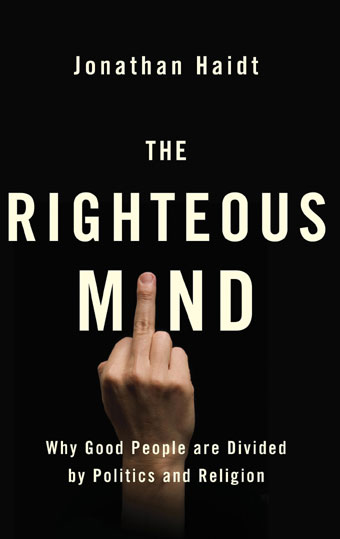
The RSA has been a particularly big supporter of Jonathan Haidt's
The Righteous Mind: Why Good People Are Divided by Politics and Religion - Haidt spoke there in early April (included below) and both
Egidijus Gecius and
Matthew Taylor have blogged about him or his appearance (also included).
Most importantly,
Matthew Kálmán Mezey wrote an in-depth response to Haidt's book, "
Beyond 'The Righteous Mind': helping Jonathan Haidt understand his own turning-points."(See below.)
To begin with, here is Haidt's appearance at the RSA:
10th Apr 2012
(full recording including audience Q&A)
Please right-click link and choose "Save Link As..." to download audio file onto your computer.
RSA Keynote
For nearly 50 years scientists have generally
agreed that selfish genes shaped human nature to be mostly selfish, with
exceptions made toward kin, partners in reciprocity, and a few other
cases. Group selection was banished from respectable discourse.
But
recent findings from multiple fields have re-opened the question.
Jonathan Haidt visits the RSA to show that human nature appears to have
been shaped by natural selection working at multiple levels, including
not just intra-group competition but also inter-group competition. Haidt
suggests that we have in our minds what amounts to a “hive switch” that
shuts down the self and makes us feel, temporarily, that we are simply a
part of a larger whole (or hive). This uniquely human ability for
self-transcendence is crucial for understanding the origins of morality
and religion.
Speaker: Jonathan Haidt, professor of social psychology, University of Virginia and author of 'The Happiness Hypothesis' and 'The Righteous Mind'.
Chair: Matthew Taylor, chief executive, RSA.
Read
Egidijus Gecius's
Mindfulness as becoming the ‘whisperer’ of J. Haidt’s elephant, posted March 13, 2012.
Read
Matthew Taylor's
Do the right thing, posted April 10, 2012.
Finally, here is the beginning of
Matthew Kálmán Mezey's article written for the appearance of Haidt at the RSA.
Just in time for Jonathan Haidt's RSA lecture tomorrow lunchtime, here are my first thoughts on his fascinating new book.
Beyond 'The Righteous Mind': helping Jonathan Haidt understand his own turning-points
Jonathan Haidt’s The Righteous Mind is
as fascinating and challenging as I felt sure it would be – sure enough
that I had even plugged the book, and Jonathan as a potential RSA
speaker, in Matthew Taylor’s blog comments from the moment I heard about
the book almost two years ago.
Yet,
at the end of it all, my concern is that Haidt risks remaining so
confined by the invisible walls of his own academic discipline that he
ends up leaving unexplored and unexplained his own two fascinating
personal turning-points - awakenings - that he makes a key part of the
book. I aim to show where we might find an explanation.
Understanding
the twists and turns, awakenings and closures, of the growing self is
the realm of the academic discipline of adult development - seemingly
off the radar of Haidt, the social psychologist. As we shall see later,
it is adult developmental psychology that could well enable Haidt to
fully fathom the deep changes in his own thinking over the last decade
or two, that he has been candid enough to share with us.
Anyone who has read Haidt’s previous book, The Happiness Hypothesis - Putting Ancient Wisdom and Philosophy to the Test of Modern Science,
won’t be surprised that the key metaphor of his new book is, once
again, the Elephant and the Rider. Haidt’s ‘Social Intuitionist’ model
argues that ‘intuitions come first, strategic reasoning second’ - the
human mind is like a large, powerful, emotional ‘Elephant’, with a
rather puny, rational ‘Rider’ sitting on top.
As Haidt puts it: “the mind is divided, like a rider on an elephant, and the rider’s job is to serve the elephant”.
Like
Kahneman’s ‘fast’ and ‘slow’ systems, the Elephant’s intuitions “arise
automatically and almost instantly”, long before “reasoning has had a
chance to get started”.
And
any moral arguments the Rider later makes are usually just “post-hoc
constructions made up on the fly”. The ‘rationalist’ model of moral
judgements developed by Lawrence Kohlberg comes particularly under fire
from Haidt - the Rider just isn’t leading the action, the Elephant is,
argues Haidt.
“The
thinking system [ie Rider] is not equipped to lead - it simply doesn’t
have the power to make things happen - but it can be a useful advisor”,
he adds.
The Righteous Mind is
also an investigation of the six moral foundations Haidt has uncovered:
Care-Harm; Liberty-Oppression; Fairness-Cheating; Loyalty-Betrayal;
Authority-Subversion; and Sanctity-Degradation. Perhaps surprisingly,
Haidt finds that conservatives use all six foundations, whilst liberals
use only three, at best.
“The
righteous mind is like a tongue with six taste receptors. Secular
Western moralities are like cuisines that try to activate just one or
two of these receptors,” he says.
This leads Haidt to conclude that liberalism “is not sufficient as a governing philosophy”.
”It tends to overreach, change too may things too quickly, and reduce the stock of moral capital inadvertently”, he says.
Haidt
also explores how “human beings are 90 per cent chimp and 10 per cent
bee” - even offering advice on how to make our organisations more
“hivish, happy and productive”.
The
book contains much else too - Haidt also discusses how between a third
and a half of the variability in political attitudes is heritable. He
sets out to debunk ‘New Atheists’ like Dawkins and Hitchens by showing
that religion does have an adaptive role, in the Darwinian sense
(Darwinian logic is a fundamental explanation throughout the book).
His moral foundations analysis of political signs and slogans - eg belonging to Occupy Wall St. - is yet more fun.
Haidt
over evolves his thinking, shares his innovations, engages with the
wider public and responds to feedback - in a way that seems very
healthy.
Challenges, reflections and future directions: (These points could be viewed as ‘criticisms’ of Haidt’s book, but they’re really just areas I’d love him to explore next).
Read the rest of the article.