Showing posts with label Rick Hanson. Show all posts

Saturday, November 01, 2014

Buddhist Geeks 336: How to HEAL the Brain’s Negativity Bias (w/ Rick Hanson)

A while ago I posted part one of this Buddhist Geeks Conference keynote address by Dr. Rick Hanson, and now the second part is available.

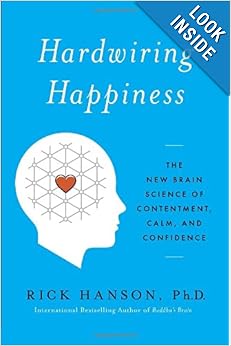
Rick Hanson, Ph.D., is a neuropsychologist and New York Times best-selling author of Hardwiring Happiness: The New Brain Science of Contentment, Calm, and Confidence (2013), Buddha's Brain: The Practical Neuroscience of Happiness, Love, and Wisdom (2009), Just One Thing: Developing a Buddha Brain One Simple Practice at a Time (2011), and Mother Nurture: A Mother's Guide to Health in Body, Mind, and Intimate Relationships (2002). Hansom is also Founder of the Wellspring Institute for Neuroscience and Contemplative Wisdom.

BG 336: How to HEAL the Brain’s Negativity Bias


by


Episode Description:


Rick Hanson, Ph.D., is a neuropsychologist, Senior Fellow of the Greater Good Science Center at UC Berkeley, and New York Times best-selling author. He’s been an invited speaker at Oxford, Stanford, and Harvard, and taught in meditation centers worldwide.

In the conclusion to his 2013 Buddhist Geeks Conference keynote address, Rick answers questions from the audience and leads them through the HEAL exercise, a process which trains the brain to reprogram its natural negativity bias towards the positive.
This is part two of a two part series.

Listen to part one BG 335: Practicing with the Brain in Mind.

Episode Links:

Rick Hanson
 
Rick Hanson, Ph.D., is a neuropsychologist and New York Times best-selling author. His books include Hardwiring Happiness, Buddha's Brain, Just One Thing, and Mother Nurture. Founder of the Wellspring Institute for Neuroscience and Contemplative Wisdom, and on the Advisory Board of the Greater Good Science Center at UC Berkeley, he's been an invited speaker at Oxford, Stanford, and Harvard, and taught in meditation centers worldwide. He has several audio programs and his free Just One Thing newsletter has over 100,000 subscribers.

Website: RickHanson.net

Monday, October 06, 2014

Buddhist Geeks 335: Practicing with the Brain in Mind (by Rick Hanson)

http://powerupproductions.tv/wp-content/uploads/2013/03/Buddhist-Geeks-Discover-the-Emerging-Faces-of-BuddhismBuddhist-Geeks-20130307.png

Here is part one of the Buddhist Geeks interview with Buddhist neuropsychologist Dr. Rick Hanson. Ever since the publication of Buddha's Brain: The Practical Neuroscience of Happiness, Love, and Wisdom (2009), Hanson has been one of the prolific and popular authors and teachers in the Buddhist world.

BG 335: Practicing with the Brain in Mind

by


Episode Description:

Rick Hanson, Ph.D., is a neuropsychologist, Senior Fellow of the Greater Good Science Center at UC Berkeley, and New York Times best-selling author. He’s been an invited speaker at Oxford, Stanford, and Harvard, and taught in meditation centers worldwide.

In this first part of the keynote address Rick presented at the 2013 Buddhist Geeks Conference, he explores the intersection between dharma practice and neuroscience. Rick explains the basic mechanisms of brain change, the power of mindfulness, how to activate the neural networks of self-compassion, how to tap the hidden power of everyday experiences to grow happiness and other inner strengths in your brain, and why our planet needs us to take charge of our Stone Age brains in the 21st century.

This is part one of a two part series.

Episode Links:
Transcript coming soon…


Rick Hanson

Rick Hanson, Ph.D., is a neuropsychologist and New York Times best-selling author. His books include Hardwiring Happiness, Buddha's Brain, Just One Thing, and Mother Nurture. Founder of the Wellspring Institute for Neuroscience and Contemplative Wisdom, and on the Advisory Board of the Greater Good Science Center at UC Berkeley, he's been an invited speaker at Oxford, Stanford, and Harvard, and taught in meditation centers worldwide. He has several audio programs and his free Just One Thing newsletter has over 100,000 subscribers.

Website: RickHanson.net

Monday, September 01, 2014

Rick Hanson - The Mechanisms of Upset and Emotional Hijacking

Here are two cool posts from Dr. Rick Hanson (Buddhist neuroscientist) on "The Machinery of Upset" and "Emotional Hijacking." Both of these posts deal with the survival mode of the brain, essentially the limbic system and brain stem, the parts of the brain that take over when we are triggered by a traumatic memory/experience.

At the bottom, there is also a definition of the amygdala hijack, a term coined by Daniel Goleman.

When the amygdala takes over, we become our fear. Making that fear an object of awareness is one way to break that fear trance.

The Machinery of Upset

posted on: August 4th, 2014 
(Emotional) life is great when we feel enthusiastic, contented, peaceful, happy, interested, loving, etc. But when we’re upset, or aroused to go looking for trouble, life ain’t so great.

To address this problem, let’s turn to a strategy used widely in science (and Buddhism, interestingly): analyze things into their fundamental elements, such as the quarks and other subatomic particles that form an atom or the Five Aggregates in Buddhism of form, feeling (the “hedonic tone” of experience as pleasant-neutral-unpleasant), perception, volitional formations, and consciousness.

We’ll apply that strategy to the machinery of getting upset. Here is a summary of the eight major “gears” of that machine – somewhat based on how they unfold in time, though they actually often happen in circular or simultaneous ways, intertwining with and co-determining each other.

The point of this close analysis, this deconstruction, is not intellectual understanding or theory, but increasing your own mindfulness into your experience, and creating more points of intervention within it to reduce the suffering you cause for yourself – and other people.

This will be more real for you if you first imagine a recent upset or two, and replay it in your mind in slow motion.

Appraisals
  • What do we focus on, what do we pick out of the larger mosaic?
  • What meaning do we give the event? How do we frame it?
  • How significant do we make it? (Is it a 2 on the Ugh scale . . . Or a 10?)
  • What intentions do we attribute to others?
  • What are the embedded beliefs about other people? The world? The past? The future?
  • In sum, what views are we attached to? -> Mainly frontal lobe and language circuits of left temporal lobe.
Self-Referencing
  • Upsets arise within the perspective of “I.”
  • What is the sense of “I” that is running at the time? Strong? Weak? Mistreated?
  • Are you taking things personally?
  • How does the sense of self change over the course of the upset (often intensifying)? -> Circuits of “self” are distributed throughout the brain.
Vulnerabilities
  • We all have vulnerabilities, which challenges penetrate through and/or get amplified by (moderated by inner and outer resources).
  • Physiological: Pain, fatigue, hunger, lack of sleep, biochemical imbalances, illness.
  • Temperamental: Anxious, rigid, angry, melancholic, spirited/ADHD.
  • Psychological: Personality, culture, effects of gender, race, sexual orientation, etc. -> Depending on its nature, a vulnerability can be embodied or represented in many ways.
Memory
  • Stimuli are interpreted in terms of episodic memories of similar experiences.
  • And in terms of implicit, emotional memories or other, unconscious associations. (Especially trauma)
  • These shade, distort, and amplify stimuli, packaging them with “spin” and sending them off to the rest of the brain. -> Hippocampus, with other memory circuits.
Aversion
  • The feeling tone of “unpleasant” is in full swing at this point, though present in the previous “gears” of survival reactivity.
  • In primitive organisms – and thus the primitive circuits of our own brain – the unpleasant/ aversion circuit is more primary than the pleasant/approach circuit since aversion often calls for all the animal’s resources and approaching does not.
  • Aversion can also be a temperamental tendency.
  • The Buddha paid much attention to aversion – such as to ill will – in his teachings, because it is so fundamental, and such a source of suffering. -> Involves the limbic system, especially the amygdala.
Bodily Activation
  • The body energizes to respond; getting upset activates the stress machinery just like getting chased by a lion.
  • Sympathetic nervous system (fight-or-flight).
  • Hypothalamus-pituitary-adrenal (HPA) axis.
  • All this triggers blood to the large muscles (hit or run), dilates pupils (see better in darkness), cascades cortisol and adrenaline, increases heart rate, etc.
  • These systems activate quickly, but their effects fade away slowly.
  • There is much collateral damage in the body and mind from chronically “going to war.”
Negative Emotions
  • Emotions are a fantastic evolutionary achievement for promoting grandchildren.
  • Both the prosocial bonding emotions of caring, compassion, love, sympathetic joy . . .
  • And the fight-or-flight emotions of fear, anger, sorrow, shame.
  • Emotions organize, mobilize the whole brain.
  • They also shade our perceptions and thoughts in self-reinforcing ways.
Loss of Executive Control
  • The survival machine is designed to make you identify yourself with your body and your emotional reactions. That identification is highly motivating for keeping yourself alive!
  • So, in an upset, there is typically a loss of “observing ego” detachment, and instead a kind of emotional hijacking – all facilitated by neural circuits in which amygdala-shaped information gets fast-tracked throughout the brain, ahead of slower frontal lobe interpretations.
  • With maturation (sometimes into the mid-twenties) and with experience, the frontal (especially prefrontal) cortices can comment on and direct emotional reactions more effectively.
* * * * *

Emotional Hijacking

posted on: September 1st, 2014 
* * * * *

Here is a definition of the "amygdala hijack" that Daniel Goleman outlined in his seminal book, Emotional Intelligence.

Amygdala hijack


From Wikipedia, the free encyclopedia

Amygdala hijack - fear caused by optical stimulus
Amygdala hijack is a term coined by Daniel Goleman in his 1996 book Emotional Intelligence: Why It Can Matter More Than IQ.[1] Drawing on the work of Joseph E. LeDoux, Goleman uses the term to describe emotional responses from people which are immediate and overwhelming, and out of measure with the actual stimulus because it has triggered a much more significant emotional threat.[2]

Definition

From the thalamus, a part of the stimulus goes directly to the amygdala while another part is sent to the neocortex or "thinking brain". If the amygdala perceives a match to the stimulus, i.e., if the record of experiences in the hippocampus tells the amygdala that it is a fight, flight or freeze situation, then the amygdala triggers the HPA (hypothalmic-pituitary-adrenal) axis and hijacks the rational brain. This emotional brain activity processes information milliseconds earlier than the rational brain, so in case of a match, the amygdala acts before any possible direction from the neocortex can be received. If, however, the amygdala does not find any match to the stimulus received with its recorded threatening situations, then it acts according to the directions received from the neo-cortex. When the amygdala perceives a threat, it can lead that person to react irrationally and destructively.[3]

Goleman states that "[e]motions make us pay attention right now — this is urgent - and gives us an immediate action plan without having to think twice. The emotional component evolved very early: Do I eat it, or does it eat me?" The emotional response "can take over the rest of the brain in a millisecond if threatened."[4][5] An amygdala hijack exhibits three signs: strong emotional reaction, sudden onset, and post-episode realization if the reaction was inappropriate.[4]

Goleman later emphasised that "self-control is crucial ...when facing someone who is in the throes of an amygdala hijack"[6] so as to avoid a complementary hijacking - whether in work situations, or in private life. Thus for example 'one key marital competence is for partners to learn to soothe their own distressed feelings...nothing gets resolved positively when husband or wife is in the midst of an emotional hijacking.'[7] The danger is that "when our partner becomes, in effect, our enemy, we are in the grip of an 'amygdala hijack' in which our emotional memory, lodged in the limbic center of our brain, rules our reactions without the benefit of logic or reason...which causes our bodies to go into a 'fight or flight' response."[8]

Positive hijacks

Goleman points out that "'not all limbic hijackings are distressing. When a joke strikes someone as so uproarious that their laughter is almost explosive, that, too, is a limbic response. It is at work also in moments of intense joy."[9]

He also cites the case of a man strolling by a canal when he saw a girl staring petrified at the water. "[B]efore he knew quite why, he had jumped into the water — in his coat and tie. Only once he was in the water did he realize that the girl was staring in shock at a toddler who had fallen in — whom he was able to rescue."[10]

Emotional relearning

LeDoux was positive about the possibility of learning to control the amygdala's hair-trigger role in emotional outbursts. "Once your emotional system learns something, it seems you never let it go. What therapy does is teach you how to control it — it teaches your neocortex how to inhibit your amygdala. The propensity to act is suppressed, while your basic emotion about it remains in a subdued form."[11]

References

  1. Nadler, Relly. "What Was I Thinking? Handling the Hijack". Retrieved 2010-04-06.
  2. "Conflict and Your Brain aka "The Amygdala Hijacking"". Retrieved 2010-04-06.
  3. Freedman, Joshua. "Hijacking of the Amygdala". Retrieved 2010-04-06.[dead link]
  4. Horowitz, Shell. "Emotional Intelligence - Stop Amygdala Hijackings". Retrieved 2010-04-06.
  5. Hughes, Dennis. "Interview with Daniel Goleman". Retrieved 2010-04-06.
  6. Daniel Goleman, Working with Emotional Intelligence (1999) p. 87
  7. Goleman, Emotional Intelligence p. 144
  8. Rita DeMaria et al., Building Intimate Relationships (2003) p. 57
  9. Goleman, Emotional Intelligence p. 14
  10. Goleman, Emotional Intelligence p. 17
  11. Goleman, Emotional Intelligence p. 213

Tuesday, July 08, 2014

Rick Hanson - Embodied Happiness: The Practical Neuroscience of Positive Emotions

http://www.rickhanson.net/books/hardwiring-happiness

Rick Hanson is the author, most recently, of Hardwiring Happiness: The New Brain Science of Contentment, Calm, and Confidence (2013). This talk is based on the book and focuses on how to switch our brains from the negativity bias they have evolved to favor to a more positive and healing orientation, one that supports resilience and well-being.

Embodied Happiness: The Practical Neuroscience of Positive Emotions

Location: Anat Baniel Method Center, San Rafael, CA
Date: September 28, 2013, 6:00-8:00pm
 

Studies show that positive emotions are the primary source of resilience, well-being, kindness toward others, and strong relationships, plus a major factor in physical health and longevity. Unfortunately, the brain evolved a negativity bias to help our ancestors survive; it's like Velcro for bad experiences but Teflon for good ones. This built-in bias creates a bottleneck in the brain that makes it hard to get the lasting value we need from our positive emotions. To solve this problem, this talk will present the four simple HEAL steps of taking in the good, which turn passing experiences into durable neural resources. With a very practical focus, we’ll explore how to use these methods to lower anxiety and frustration, and fundamentally, hardwire happiness into the body.
To learn more about the HEAL steps, this 10-minute audio walks listeners through the steps: Feeling Cared About.

Enjoy the talk.

Embodied Happiness: The Practical Neuroscience of Positive Emotions - Part I


Embodied Happiness: The Practical Neuroscience of Positive Emotions - Part II


Wednesday, May 07, 2014

Rick Hanson - Brain Science and Psychotherapy: The Next Step


This talk from Rick Hanson is a little over an hour long, and it was given at the Psychotherapy Networker Symposium in Washington DC in March, 2014. Here is part of the brochure copy for his Keynote Address:
Rick Hanson—author, neuropsychologist, and therapist—will examine the practical tools that brain science has already given us and look ahead to the next stage of how to use neuroscience to enhance our clinical craft.

In this keynote, he’ll explore both sides of psychotherapy’s love affair with the brain, examining the clinical benefits and potential pitfalls of using neuroscientific concepts in the consulting room. He’ll survey the tools that brain science has already given us and look ahead to the next stage of how we might use it to enhance our clinical craft.
He was addressing a huge crowd of therapists, so his talk is aimed at professionals more than lay people, but he is so down-to-earth in his talks that any listener will benefit from his wisdom.

Brain Science and Psychotherapy: The Next Step

May 2nd, 2014 | Rick Hanson, PhD.

Last month at the Psychotherapy Networker Symposium in Washington DC, I gave a talk to ~ 3500 people: scary but wonderful! Brain Science and Psychotherapy: The Next Step – looked at the benefits and pitfalls of brain science, plus focused on a key point: if we don’t take the time to install our useful experiences, they’re wasted on the brain; they’re momentarily pleasant but lead to no learning, no healing, no growth. Then I summarized HOW to turn passing experiences into lasting value.

Listen here:

Monday, April 21, 2014

Rick Hanson, PhD, Offers Key Points on Letting Go


Rick Hanson, PhD, is the author, most recently, of Hardwiring Happiness: The New Brain Science of Contentment, Calm, and Confidence. Among his other books are Buddha’s Brain: The Practical Neuroscience of Happiness, Love, and Wisdom and Just One Thing: Developing a Buddha Brain One Simple Practice at a Time This article comes from his blog.

Key Points of Letting Go


Rick Hanson, PhD | posted on: April 18th, 2014


“Let go a little, you’ll have a little happiness. Let go completely, you’ll be completely happy.”

Letting Go of Body Sensations
  • Ordinary breathing, focusing on exhalation, intending to let go.
  • Diaphragm breathing.
  • Breath of fire.
  • Heartmath: Breathing evenly through the heart with a positive emotion.
  • Scanning the body and releasing tension. Progressive relaxation.
  • Using imagery to relax.

Letting Go of Thoughts
  • Two fundamental errors of thought:
  • Overestimating the bad.
  • Underestimating the good.
  • Systematically argue against errors of thought, on paper or in your mind.
  • Identify “sub-personalities” generating errors of thought; thank them for sharing, ask if they have anything new to say, and then tell them to shut up.

Letting Go of Emotions
  • As with any unpleasant experience, have compassion for yourself.
  • As you release negative emotions, sense positive feelings replacing them, like security replacing fear, worth replacing shame/guilt, peacefulness replacing anger.
  • Name the feeling, own it, and accept it. For bonus points, try to choose it.
  • Imagine/sense the emotion leaving on the exhalation, or draining out of the body, or being released to the universe or even to God/the mysterious Divine.
  • Use imagery, like standing in a cool mountain stream washing pain away.
  • Sense the underlying softer, deeper, younger feelings, and then let them go.
  • Venting safely, like writing letters you don’t send, yelling, hitting something SAFE.

Letting Go of Wants
  • Same methods as with releasing emotions: Naming and accepting. Draining out of the body.
  • Releasing via imagery. Sense the underlying, positive wants, and respond to them.
  • Do a cost/benefit analysis, and choose what you really want.
  • Reflect on the suffering that is embedded, that’s inevitable, in most desires.

Letting Go of Self
  • Perspectives: The more we “self” experience – personalize it, identify with it, cling to it – the more we suffer: “no self, no problem.” The degree of self varies; it’s not an omnipresent fact; it’s continually constructed. When self is minimal or absent, notice that it’s not needed to function in life.
  • Observe the activity of self and experiment with reducing it.
  • When others are upset, see the ways it’s not about you: They’re on automatic; you’re a bit player in their drama; they are already punishing themselves; you are separate, with good boundaries.
  • Each day, take time to sense the fact of your interconnectedness with everything.

In General
  • Be the awareness of the experience, not the experience itself.
  • Notice that all experiences change.
  • Keep evoking positive feelings.
• • • • •

What practices have YOU found to be effective for letting go? I’d enjoy hearing from you in the comments section.


Rick Hanson, Ph.D., is a neuropsychologist and New York Times best-selling author. His books include Hardwiring Happiness: The New Brain Science of Contentment, Calm, and Confidence (in 13 languages), Buddha’s Brain: The Practical Neuroscience of Happiness, Love, and Wisdom (in 25 languages), Just One Thing: Developing a Buddha Brain One Simple Practice at a Time (in 13 languages), and Mother Nurture: A Mother’s Guide to Health in Body, Mind, and Intimate Relationships. Founder of the Wellspring Institute for Neuroscience and Contemplative Wisdom, and on the Advisory Board of the Greater Good Science Center at UC Berkeley, he’s been an invited speaker at Oxford, Stanford, and Harvard, and taught in meditation centers worldwide. A summa cum laude graduate of UCLA, his work has been featured on the BBC, NPR, CBC, FoxBusiness, Consumer Reports Health, U.S. News and World Report, and O Magazine and he has several audio programs with Sounds True. His weekly e-newsletter – Just One Thing – has over 100,000 subscribers, and also appears on Huffington Post, Psychology Today, and other major websites. For more information, please see his full profile at www.RickHanson.net.

Friday, April 11, 2014

Rick Hanson, PhD, The Effect of Relationships on the Evolution of the Brain

This is a brief but cool little article from Rick Hanson's blog - and this may be preaching to the choir, but it felt worth sharing.

The Effect of Relationships on the Evolution of the Brain


posted on: April 10th, 2014


Your brain is the product of 3.5 billion years of intense evolutionary pressure, including 2.7 million years as tool-using hominids and over 100,000 years as homo sapiens.

Human DNA is about 98-99% identical to chimpanzee DNA. But that crucial 1-2% difference is mainly the genetic factors affecting the brain – especially for its relationship functions. In fact, the latest science suggests that the evolution of the brain was driven in two steps having to do with the survival benefits of strong relationships.

First, among vertebrates, many bird and mammal species developed pair bonding as a way to raise children who survived. (Remember that fish and reptiles generally do not raise their young and may in fact eat them if they happen upon them soon after they hatch.)

The “computational requirements” of choosing a good mate, working things out together, and then raising young to survive – hey, it’s just sparrow and squirrel couples, but anyone who has raised kids knows what I’m talking about – required larger brains than those of reptiles or fish that dealt with similar environmental challenges but made their way in life on their own.

By the way, it may be a source of satisfaction to some that polygamous species usually have the smallest brains.

Second, building on this initial jump in brain size, among primate species, the larger the social group, the bigger the brain. (And the key word here is social , since group size alone doesn’t create a big brain; if it did, cattle would be geniuses.)

In other words, the “computational requirements” of dealing with lots of individuals – the alliances, the adversaries, all the politics! – in a baboon or ape troupe pushed the evolution of the brain.

In sum: More than learning how to use tools, more than being successful at violence, more than adapting to moving out of the forest into the grasslands of Africa, it was learning how to love and live with each other that drove human evolution!

Saturday, January 25, 2014

Rick Hanson - Mind Changing Brain Changing Mind


This is cool post from Rick Hanson's blog, and it's likely an excerpt from his new book (Hardwiring Happiness: The New Brain Science of Contentment, Calm, and Confidence). There are two things I really liked here - first, I liked his definition of mind:
By “mind” I mean the flow of information through the nervous system, most of which is forever unconscious. We privilege what’s in the field of awareness because that’s what we’re conscious of. But cultivating beneficial factors down in the basement of the brain, outside of conscious awareness, is actually more influential in the long run.
This definition is not too different from the one proposed by Dan Siegel ("A core aspect of the mind is an embodied and relational process that regulates the flow of energy and information").

I also like what Hanson says about the rest state of the mind:
[W]hen we are not activated, our natural resting state is characterized by the Five C's: Conscious, Calm, Contented, Caring, and Creative.
The five C's Hanson lists are similar to 8 C's of self-leadership in Internal Family Systems Therapy:
curiosity, compassion, calm, courage, clarity, confidence, creativity, and connectedness
I have not had a chance to read Hanson's new book yet, but it is high on my list.

Mind Changing Brain Changing Mind

posted on: January 24th, 2014

Mind Changing Brain Changing Mind

The knowledge of neuroscience has doubled in the last twenty years. It will probably double again in the next twenty years. I think that neuropsychology is, broadly, about where biology was a hundred years after the invention of the microscope: around 1725.

In contrast, Buddhism is a twenty-five-hundred-year-old tradition. You don’t need an EEG or MRI to sit and observe your own mind, to open your heart and practice with sincerity. I don’t think of neuropsychology as a replacement for traditional methods, but simply as a very useful way to understand why traditional methods work. This is helpful in our culture, since arguably the secular religion of the West is science. If you understand why something works in your own mind, that promotes conviction (saddhā, trust in the Buddha’s teachings). Understanding a little neuropsychology also helps you to emphasize or individualize those particular aspects of traditional practices that best suit your own brain; natural differences in the brain are a fundamental kind of diversity, and if teachers and meditation centers want to respond to the needs of their existing members and to reach out to new ones, they will have to take into account normal variations in the brain.

Breakthroughs in brain science create opportunities to develop new or refined methods of practice. As Buddhism spread through Tibet, China, and Japan, it learned from the cultures in those lands and developed new methods. Similarly, as Buddhism has come to the West and encountered what is arguably its dominant cultural force—science—it is beginning to draw on science for ways it, too, might be of use on the path of awakening. Not in any way to change the aims of practice—as the Buddha said, I teach one thing: suffering and its end— but to increase the skillful means to that end.

Immaterial experience leaves material, enduring traces behind. In the saying from the work of the psychologist, Donald Hebb: “Neurons that fire together, wire together.” This is a neurologically informed way to appreciate why your experience really matters, and how important it is to have a kind of mental hygiene, to really appreciate what we allow in our minds.

Perhaps your mind is running themes of threat, grievance, and loss. Or alternately, perhaps it is running heartfeltness, generosity, kindness to self and others, awakening. Whichever movie we’re running, those neurons are firing and wiring together. So learning how to use your mind to shape the wiring of your brain is a profound way to support yourself on the path of awakening.

The mind & brain co-arise co-dependently

There’s been a lot of research and clarification over the last several decades about how the brain makes the mind, and how the mind makes the brain, in a codependent, circular kind of way.

Let’s begin with some clarifications:
• By “mind” I mean the flow of information through the nervous system, most of which is forever unconscious. We privilege what’s in the field of awareness because that’s what we’re conscious of. But cultivating beneficial factors down in the basement of the brain, outside of conscious awareness, is actually more influential in the long run.

• Further, the brain is embedded in larger systems, including the nervous system as a whole, other bodily systems, and then biology, culture, and evolution. It is shaped by those systems, and also shaped by the mind itself. For simplicity I’ll just refer to the brain, but really we are talking about a vast network of interdependent causes. Much as the Buddha taught.

• There may well be transcendental factors required for the mind to exist, to operate: call those factors God, Buddhanature, the Ground, or by no name at all. Since by definition, we cannot prove the existence or non-existence of such transcendental factors either way, it is consistent with the tenets of science to acknowledge transcendental factors as a possibility. That said, and with a deep bow in their direction, we will stay within the frame of Western science.

• Within that framework, the brain is the necessary and proximally sufficient condition for the mind. (It’s only proximally sufficient because the brain is nested in a great network of causes, without which the brain could not exist.) This view, generally shared within Western science, is that every mental state is correlated with a necessary and proximally sufficient brain state.
This integration of mind and brain has three important implications. First, as your brain changes, your mind changes. Second, as your mind changes, your brain changes. Many of those changes are fleeting, as your brain changes moment to moment to support the movement of information. But many are lasting, as neurons wire together: structure builds in the brain. Mental activity is like a spring shower, leaving little traces of neural structure behind. Over time, the little tracks in the hillside draw in more water down, deepening their course. A kind of circular self-organizing dynamic gradually develops, and then the mind tends to move more and more down that channel, and soon enough you’ve got a gully.

For example, if you are using neural circuits a lot, they actually become more sensitive to stimulation, for better or worse. Over time if a region is increasingly active, it gets more blood flow, more glucose, more oxygen and so forth. Existing synapses get stronger and new synapses form. Cortical layers actually get thicker as neural structures build; for example, the thickening in the part of the brain called the insula—which senses the internal state of your body—that is due to meditation, is on the order of a two-hundredth of an inch, which may not sound like much, but that’s lots and lots of new synapses.

Remarkably, synapses began forming in your brain before you were born, and your brain will keep changing up to the point of your last breath. Since neural activity continues in an increasingly disorganized way for a few minutes after the last breath, synapses may still be forming as the lights in the great mansion of the mind slowly go out.

The third implication is the practical one, and that’s where we’ll focus: you can use your mind to change your brain to benefit your whole being— and every other being whose life you touch.

Your complex, dynamic, interdependent brain

Your brain has about a hundred billion neurons in it (see the ‘Amazing Brain Facts” insert for more basic facts about your brain). In principle, the number of possible states of the brain is the number of possible combinations of a hundred billion neurons either firing or not (“on or off”). That number is really big: ten to the millionth power, which is one followed by a million zeros. To put this in perspective, the number of particles in the known universe is about ten to the eightieth power—one followed by eighty zeros versus a million zeros. The brain—your brain, right now—is the most complex object known to science. It’s more complex than an exploding star, or climate change.

The brain functions through a mixture of specialization and lots and lots of teamwork. Parts of the brain do specialized things, like the speech centers in the left temporal and frontal lobes. On the other hand, if you map the communications pathways among the regions and specialized tissues of the brain, you see that it’s highly interconnected. It’s a little bit like tracking roadways from space or information on the Internet: a very dense network. So when people talk about specialization and function in just one place, like “The amygdala is the fear part of the brain,” or “The left hemisphere is bad and the right hemisphere is good,” it’s an inaccurate simplification.

Understanding the chaotic and sometimes wacky flux of neaural activity can allow you to take it less seriously

Within the networks of the brain, there are lots of circular loops. To simplify, there is the “A” neuron connected to the “B” neuron, connected to the “C” neuron, connected to the “D” neuron, and then back to the “A” neuron. These possibilities of recursion, as a computer programmer would call it, give you the capacity—among other things—to become aware of awareness.

Neurons also share each other. To simplify again, let’s say you activate the “C” neuron in our A-B-C-D-A loop, and the “C” neuron is shared with another loop. So there you are, irritated because the faucet’s dripping in the middle of the night, and suddenly you think about the smell of your grandmother’s cookies. Why? For some reason, there was shared circuitry in the coalitions of synapses that momentarily formed. The discursive stream of consciousness is so complex that as a system it exhibits some chaotic qualities. Understanding the chaotic and some – times frankly wacky flux of all that neural activity can allow you to take it less seriously.

Sunday, November 03, 2013

Tami Simon and Rick Hanson: Self-Directed Brain Change (2-Part Interview)


Rick Hanson's new book is Hardwiring Happiness: The New Brain Science of Contentment, Calm, and Confidence and in this two-part interview with Sounds True's Tami Simon, he discusses his companion product (through Sounds True), Self-Directed Brain Change.

Rick Hanson: Self-Directed Brain Change, Part 1

Tuesday, October 15, 2013


Tami Simon speaks with Dr. Rick Hanson, a neuropsychologist and the founder of the Wellspring Institute for Neuroscience and Contemplative Wisdom. He is the author of the books Buddha’s Brain and Hardwiring Happiness, and with Sounds True has created several audio programs, including The Enlightened Brain and the new learning course Self-Directed Brain Change. In the first half of a two-part interview, Tami speaks with Dr. Hanson about the ways we can “install” positive brain states as lasting traits; how we can respond in situations when we feel our basic needs are threatened; and the three ways of working with unpleasant experiences—letting be, letting go, and letting in. (66 minutes)

Play

 
* * * * *

Rick Hanson: Self-Directed Brain Change, Part 2

Tuesday, October 22, 2013 Tami Simon speaks with Dr. Rick Hanson, a neuropsychologist and the founder of the Wellspring Institute for Neuroscience and Contemplative Wisdom. He is the author of the books Buddha’s Brain and Hardwiring Happiness, and with Sounds True has created several audio programs, including The Enlightened Brain and the new learning course Self-Directed Brain Change. In the second half of a two-part interview, Tami speaks with Dr. Hanson about how we can move from a “red” reactive state to a “green” state of calm, how this progression aligns with the Four Noble Truths of Buddhism, and his vision for how healthy brains can change the state of our world. (63 minutes)

Play


Rick Hanson 

Rick Hanson, Ph.D., is a neuropsychologist and author of Hardwiring Happiness: The New Brain Science of Contentment, Calm, and Confidence (from Random House in October, 2013; in 4 languages), Buddha's Brain: The Practical Neuroscience of Happiness, Love, and Wisdom (New Harbinger; in 24 languages), Just One Thing: Developing a Buddha Brain One Simple Practice at a Time (New Harbinger; in 12 languages), and Mother Nurture: A Mother's Guide to Health in Body, Mind, and Intimate Relationships (Penguin). Founder of the Wellspring Institute for Neuroscience and Contemplative Wisdom and an Affiliate of the Greater Good Science Center at UC Berkeley, he's been an invited speaker at Oxford, Stanford, and Harvard, and taught in meditation centers worldwide.

More from Rick Hanson:


Self-Directed Brain Change


The Compassionate Brain


The Enlightened Brain


Stress-Proof Your Brain


Meditations to Change Your Brain