Showing posts with label Bertrand Russell. Show all posts

Friday, October 17, 2014

Russell Brand Says He Wants A ‘Revolution’

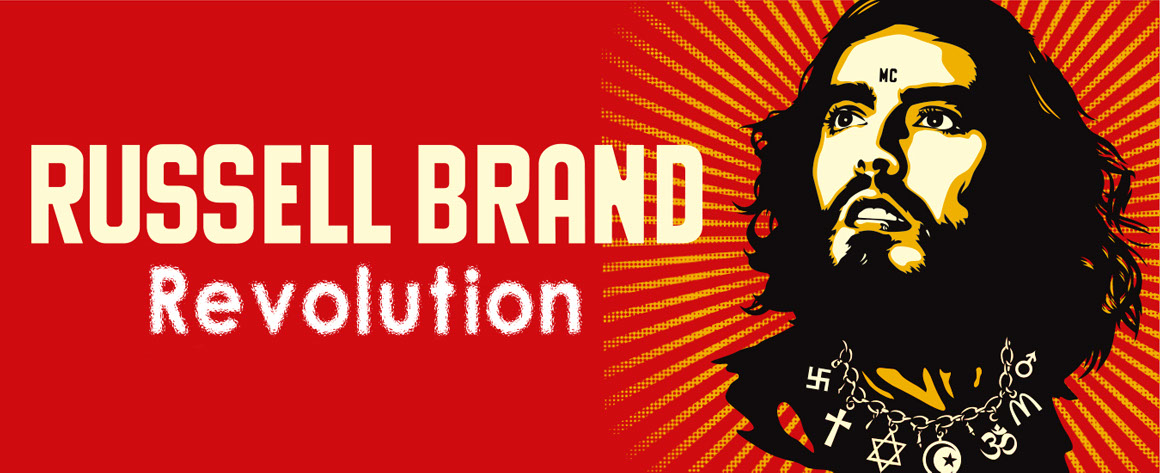
http://irishmarxism.files.wordpress.com/2013/11/russell-brand-revolution-header.jpg

Russell Brand's third book, Revolution, was just released on Tuesday (October 14), so of course he is making the rounds on NPR and various other outlets to promote his book. It seems Brand is less interested in comedy these days than he is in stirring up a revolt against the status quo. I disagree with him completely about not voting, but I can see why he and so many others feel their votes are worthless because there is no real choice.

Here is the ad copy for his book:
We all know the system isn’t working. Our governments are corrupt and the opposing parties pointlessly similar. Our culture is filled with vacuity and pap, and we are told there’s nothing we can do: “It’s just the way things are.”

In this book, Russell Brand hilariously lacerates the straw men and paper tigers of our conformist times and presents, with the help of experts as diverse as Thomas Piketty and George Orwell, a vision for a fairer, sexier society that’s fun and inclusive.

You have been lied to, told there’s no alternative, no choice, and that you don’t deserve any better. Brand destroys this illusory facade as amusingly and deftly as he annihilates Morning Joe anchors, Fox News fascists, and BBC stalwarts.

This book makes revolution not only possible but inevitable and fun.
I like Russell Brand. In many ways, he is right on target with his criticisms. But he is also naive about the citizens of England and America, who are content to be oblivious to how their corporatocracy is stealing them blind as long as they have their football (England) or football (USA).

The chances of people actually rising up and revolting are slim to none.

Russell Brand Says He Wants A ‘Revolution’

The wild, funny, blithely offensive comedian Russell Brand takes on the world’s woes with us. He says he’s got the answer.


October 15, 2014


Comedian and actor Russell Brand, on the cover of his new book, Revolution

British comedian, actor, provocateur, activist Russell Brand knows how to mix it up wild and funny. With his big mane, sharp mind, and glittering irreverence he has cut a wide swath in entertainment realms. Played the blazing rock star in Forgetting Sarah Marshall and Get Him to the Greek. Married and divorced Katy Perry. Toured doing stand-up last year with his Messiah Complex show. And now Russell Brand is going all-in on politics. Revolution, actually. Our world, our system is worn out and we know it, he says. Time for revolt. Up next On Point: Russell Brand, and revolution.

– Tom Ashbrook

Guests

Russell Brand, actor, comedian and activist. Author of the new book, Revolution. He is also author of My Booky Wook: A Memoir of Sex, Drugs, and Stand-Up and Booky Wook 2: This Time It's Personal. (@rustyrockets)


From Tom’s Reading List
Read An Excerpt Of “Revolution” By Russell Brand

Thursday, March 21, 2013

Bertrand Russell’s Ten Commandments for Living in a Healthy Democracy

Via Open Culture, this piece offers a brief summary of a 1951 article from the New York Times Magazine on “The Best Answer to Fanaticism–Liberalism,” with the subtitle: “Its calm search for truth, viewed as dangerous in many places, remains the hope of humanity.” In the article, Russell writes that “Liberalism is not so much a creed as a disposition. It is, indeed, opposed to creeds.”

Enjoy - his 10 Commandments are very intriguing.

Bertrand Russell’s Ten Commandments for Living in a Healthy Democracy


March 14th, 2013


Bertrand Russell saw the history of civilization as being shaped by an unfortunate oscillation between two opposing evils: tyranny and anarchy, each of which contain the seed of the other. The best course for steering clear of either one, Russell maintained, is liberalism.

“The doctrine of liberalism is an attempt to escape from this endless oscillation,” writes Russell in A History of Western Philosophy. “The essence of liberalism is an attempt to secure a social order not based on irrational dogma [a feature of tyranny], and insuring stability [which anarchy undermines] without involving more restraints than are necessary for the preservation of the community.”

In 1951 Russell published an article in The New York Times Magazine, “The Best Answer to Fanaticism–Liberalism,” with the subtitle: “Its calm search for truth, viewed as dangerous in many places, remains the hope of humanity.” In the article, Russell writes that “Liberalism is not so much a creed as a disposition. It is, indeed, opposed to creeds.” He continues:
But the liberal attitude does not say that you should oppose authority. It says only that you should be free to oppose authority, which is quite a different thing. The essence of the liberal outlook in the intellectual sphere is a belief that unbiased discussion is a useful thing and that men should be free to question anything if they can support their questioning by solid arguments. The opposite view, which is maintained by those who cannot be called liberals, is that the truth is already known, and that to question it is necessarily subversive.
Russell criticizes the radical who would advocate change at any cost. Echoing the Enlightenment philosopher John Locke, who had a profound influence on the authors of the Declaration of Independence and the U.S. Constitution, Russell writes:
The teacher who urges doctrines subversive to existing authority does not, if he is a liberal, advocate the establishment of a new authority even more tyrannical than the old. He advocates certain limits to the exercise of authority, and he wishes these limits to be observed not only when the authority would support a creed with which he disagrees but also when it would support one with which he is in complete agreement. I am, for my part, a believer in democracy, but I do not like a regime which makes belief in democracy compulsory.
Russell concludes the New York Times piece by offering a “new decalogue” with advice on how to live one’s life in the spirit of liberalism. “The Ten Commandments that, as a teacher, I should wish to promulgate, might be set forth as follows,” he says:
1: Do not feel absolutely certain of anything. 
2: Do not think it worthwhile to produce belief by concealing evidence, for the evidence is sure to come to light. 
3: Never try to discourage thinking, for you are sure to succeed. 
4: When you meet with opposition, even if it should be from your husband or your children, endeavor to overcome it by argument and not by authority, for a victory dependent upon authority is unreal and illusory. 
5: Have no respect for the authority of others, for there are always contrary authorities to be found. 
6: Do not use power to suppress opinions you think pernicious, for if you do the opinions will suppress you. 
7: Do not fear to be eccentric in opinion, for every opinion now accepted was once eccentric. 
8: Find more pleasure in intelligent dissent than in passive agreement, for, if you value intelligence as you should, the former implies a deeper agreement than the latter. 
9: Be scrupulously truthful, even when truth is inconvenient, for it is more inconvenient when you try to conceal it. 
10. Do not feel envious of the happiness of those who live in a fool’s paradise, for only a fool will think that it is happiness.
via Brain Pickings

Monday, February 13, 2012

Open Culture - Three Passions of Bertrand Russell (and a Collection of Free Texts)


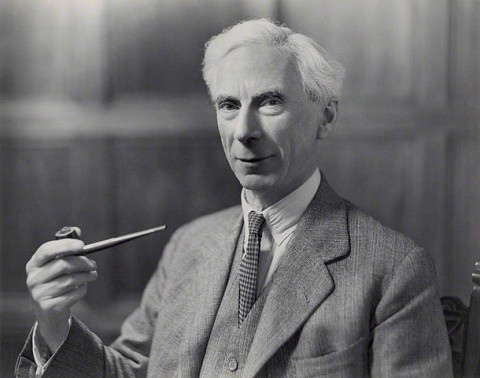
Bertrand Russell is not an easy read most times, but he is a rewarding read. Open Culture offered up a brief introduction to a documentary on Russell from 2005 for Ontario public television, AND they provide links to a whole lot of papers and books by Russell for your reading "pleasure."

Enjoy!

As a special bonus, I have included Russell talking about mysticism (at the bottom) - his argument is the same in some ways as that made by Ken Wilber in The Marriage of Sense and Soul: Integrating Science and Religion.

For mysticism to be taken seriously by science, it must be subjected to the scientific method: create a hypothesis (meditation leads to nondual experience), define the terms (what kind of meditation and for how long, and what is nonduality), perform the experiment, the compare results with others who have performed the experiment.

Russell does not go into this detail, but he does talk about about holding mysticism up to science.

Three Passions of Bertrand Russell (and a Collection of Free Texts)

Bertrand Russell on Mysticism