Showing posts with label corporatocracy. Show all posts

Friday, October 17, 2014

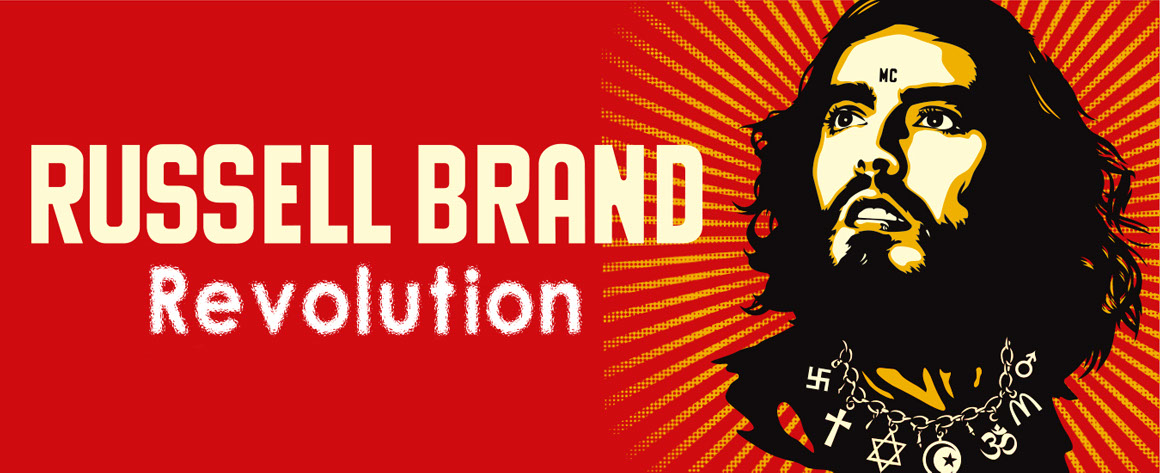
Russell Brand Says He Wants A ‘Revolution’

http://irishmarxism.files.wordpress.com/2013/11/russell-brand-revolution-header.jpg

Russell Brand's third book, Revolution, was just released on Tuesday (October 14), so of course he is making the rounds on NPR and various other outlets to promote his book. It seems Brand is less interested in comedy these days than he is in stirring up a revolt against the status quo. I disagree with him completely about not voting, but I can see why he and so many others feel their votes are worthless because there is no real choice.

Here is the ad copy for his book:
We all know the system isn’t working. Our governments are corrupt and the opposing parties pointlessly similar. Our culture is filled with vacuity and pap, and we are told there’s nothing we can do: “It’s just the way things are.”

In this book, Russell Brand hilariously lacerates the straw men and paper tigers of our conformist times and presents, with the help of experts as diverse as Thomas Piketty and George Orwell, a vision for a fairer, sexier society that’s fun and inclusive.

You have been lied to, told there’s no alternative, no choice, and that you don’t deserve any better. Brand destroys this illusory facade as amusingly and deftly as he annihilates Morning Joe anchors, Fox News fascists, and BBC stalwarts.

This book makes revolution not only possible but inevitable and fun.
I like Russell Brand. In many ways, he is right on target with his criticisms. But he is also naive about the citizens of England and America, who are content to be oblivious to how their corporatocracy is stealing them blind as long as they have their football (England) or football (USA).

The chances of people actually rising up and revolting are slim to none.

Russell Brand Says He Wants A ‘Revolution’

The wild, funny, blithely offensive comedian Russell Brand takes on the world’s woes with us. He says he’s got the answer.


October 15, 2014


Comedian and actor Russell Brand, on the cover of his new book, Revolution

British comedian, actor, provocateur, activist Russell Brand knows how to mix it up wild and funny. With his big mane, sharp mind, and glittering irreverence he has cut a wide swath in entertainment realms. Played the blazing rock star in Forgetting Sarah Marshall and Get Him to the Greek. Married and divorced Katy Perry. Toured doing stand-up last year with his Messiah Complex show. And now Russell Brand is going all-in on politics. Revolution, actually. Our world, our system is worn out and we know it, he says. Time for revolt. Up next On Point: Russell Brand, and revolution.

– Tom Ashbrook

Guests

Russell Brand, actor, comedian and activist. Author of the new book, Revolution. He is also author of My Booky Wook: A Memoir of Sex, Drugs, and Stand-Up and Booky Wook 2: This Time It's Personal. (@rustyrockets)


From Tom’s Reading List
Read An Excerpt Of “Revolution” By Russell Brand

Tuesday, May 06, 2014

Chris Hedges: We're Losing the Last Shreds of Legal Rights to Protect Ourselves from Oligarchy


From AlterNet, via Truthdig, Pulitzer Prize winning reporter, Chris Hedges looks at the loss of Constitutional Protects, largely due to the cooperation of the Obama administration, the industrial military complex, and the corporatocracy.

Here is the key quote from the article:
The goals of corporate capitalism are increasingly indistinguishable from the goals of the state. The political and economic systems are subservient to corporate profit. Debate between conventional liberals and conservatives has been replaced by empty political theater and spectacle. Corporations, no matter which politicians are in office, loot the Treasury, escape taxation, push down wages, break unions, dismantle civil society, gut regulation and legal oversight, control information, prosecute endless war, and dismantle public institutions and programs that include schools, welfare, and Social Security. And elected officials, enriched through our form of legalized corporate bribery, have no intention of halting the process.
The system has already been rigged to the point that there is little we can do, as citizens, to change this state of affairs.

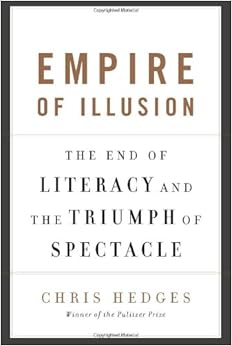
By the way, Hedges newest book is Empire of Illusion: The End of Literacy and the Triumph of Spectacle.

Chris Hedges: We're Losing the Last Shreds of Legal Rights to Protect Ourselves from Oligarchy

A ruling elite that accrues for itself total power, history has shown, eventually uses it.

May 5, 2014 | Chris Hedges


Photo Credit: WeAreChange; Screenshot / YouTube.com

The U.S. Supreme Court decision to refuse to hear our case concerning Section 1021(b)(2) of the National Defense Authorization Act (NDAA), which permits the military to seize U.S. citizens and hold them indefinitely in military detention centers without due process, means that this provision will continue to be law. It means the nation has entered a post-constitutional era. It means that extraordinary rendition of U.S. citizens on U.S. soil by our government is legal. It means that the courts, like the legislative and executive branches of government, exclusively serve corporate power — one of the core definitions of fascism. It means that the internal mechanisms of state are so corrupted and subservient to corporate power that there is no hope of reform or protection for citizens under our most basic constitutional rights. It means that the consent of the governed — a poll by OpenCongress.com showed that this provision had a 98 percent disapproval rating — is a cruel joke. And it means that if we do not rapidly build militant mass movements to overthrow corporate tyranny, including breaking the back of the two-party duopoly that is the mask of corporate power, we will lose our liberty.

“In declining to hear the case Hedges v. Obama and declining to review the NDAA, the Supreme Court has turned its back on precedent dating back to the Civil War era that holds that the military cannot police the streets of America,” said attorney Carl Mayer, who along with Bruce Afran devoted countless unpaid hours to the suit. “This is a major blow to civil liberties. It gives the green light to the military to detain people without trial or counsel in military installations, including secret installations abroad. There is little left of judicial review of presidential action during wartime.”

Afran, Mayer and I brought the case to the U.S. Southern District Court of New York in January 2012. I was later joined by co-plaintiffs Noam Chomsky, Daniel Ellsberg, journalist Alexa O’Brien, RevolutionTruth founder Tangerine Bolen, Icelandic parliamentarian Birgitta Jonsdottir and Occupy London activist Kai Wargalla.

Later in 2012 U.S. District Judge Katherine B. Forrest declared Section 1021(b)(2) unconstitutional. The Obama administration not only appealed — we expected it to appeal — but demanded that the law be immediately put back into effect until the appeal was heard. Forrest, displaying the same judicial courage she showed with her ruling, refused to do this.

The government swiftly went to the U.S. Court of Appeals for the 2nd Circuit. It asked, in the name of national security, that the court stay the district court’s injunction until the government’s appeal could be heard. The 2nd Circuit agreed. The law went back on the books. My lawyers and I surmised that this was because the administration was already using the law to detain U.S. citizens in black sites, most likely dual citizens with roots in countries such as Pakistan, Afghanistan, Somalia and Yemen. The administration would have been in contempt of court if Forrest’s ruling was allowed to stand while the federal authorities detained U.S. citizens under the statute. Government attorneys, when asked by Judge Forrest, refused to say whether or not the government was already using the law, buttressing our suspicion that it was in use.

The 2nd Circuit overturned Forrest’s ruling last July in a decision that did not force it to rule on the actual constitutionality of Section 1021(b)(2). It cited the Supreme Court ruling in Clapper v. Amnesty International, another case in which I was one of the plaintiffs, to say that I had no standing, or right, to bring the NDAA case to court. Clapper v. Amnesty International challenged the secret wiretapping of U.S. citizens under the FISA Amendments Act of 2008. The Supreme Court had ruled in Clapper that our concern about government surveillance was “speculation.” It said we were required to prove to the court that the FISA Act would be used to monitor those we interviewed. The court knew, of course, that the government does not disclose whom it is monitoring. It knew we could never offer proof. The leaks by Edward Snowden, which came out after the Supreme Court ruling, showed that the government was monitoring us all, along with those we interviewed. The 2nd Circuit used the spurious Supreme Court ruling to make its own spurious ruling. It said that because we could not show that the indefinite-detention law was about to be used against us, just as we could not prove government monitoring of our communications, we could not challenge the law. It was a dirty game of judicial avoidance on two egregious violations of the Constitution.

In refusing to hear our lawsuit the courts have overturned nearly 150 years of case law that repeatedly holds that the military has no jurisdiction over civilians. Now, a U.S. citizen charged by the government with “substantially supporting” al-Qaida, the Taliban or those in the nebulous category of “associated forces” — some of the language of Section 1021(b)(2) — is lawfully subject to extraordinary rendition on U.S. soil. And those seized and placed in military jails can be kept there until “the end of hostilities.”

Judge Forrest, in her 112-page ruling against the section, noted that under this provision of the NDAA whole categories of Americans could be subject to seizure by the military. These might include Muslims, activists, Black Bloc members and any other Americans labeled as domestic terrorists by the state. Forrest wrote that Section 1021(b)(2) echoed the 1944 Supreme Court ruling in Korematsu v. United States, which supported the government’s use of the military to detain 110,00 Japanese-Americans in internment camps without due process during World War II.

Of the refusal to hear our lawsuit, Afran said, “The Supreme Court has left in place a statute that furthers erodes basic respect for constitutional liberties, that weakens free speech and will chill the willingness of Americans to exercise their 1st Amendment rights, already in severe decline in this country.”

The goals of corporate capitalism are increasingly indistinguishable from the goals of the state. The political and economic systems are subservient to corporate profit. Debate between conventional liberals and conservatives has been replaced by empty political theater and spectacle. Corporations, no matter which politicians are in office, loot the Treasury, escape taxation, push down wages, break unions, dismantle civil society, gut regulation and legal oversight, control information, prosecute endless war and dismantle public institutions and programs that include schools, welfare and Social Security. And elected officials, enriched through our form of legalized corporate bribery, have no intention of halting the process.

The government, by ignoring the rights and needs of ordinary citizens, is jeopardizing its legitimacy. This is dangerous. When a citizenry no longer feels that it can find justice within the organs of power, when it feels that the organs of power are the enemies of freedom and economic advancement, it makes war on those organs. Those of us who are condemned as radicals, idealists and dreamers call for basic reforms that, if enacted, will make peaceful reform possible. But corporate capitalists, now unchecked by state power and dismissive of the popular will, do not see the fires they are igniting. The Supreme Court ruling on our challenge is one more signpost on the road to dystopia.

It is capitalism, not government, that is the problem. The fusion of corporate and state power means that government is broken. It is little more than a protection racket for Wall Street. And it is our job to wrest government back. This will come only through the building of mass movements.

“It is futile to be ‘anti-Fascist’ while attempting to preserve capitalism,” George Orwell wrote. “Fascism after all is only a development of capitalism, and the mildest democracy, so-called, is liable to turn into Fascism.”

Our corporate masters will not of their own volition curb their appetite for profits. Human misery and the deadly assault on the ecosystem are good for business. These masters have set in place laws that, when we rise up — and they expect us to rise up — will permit the state to herd us like sheep into military detention camps. Section 1021(b)(2) is but one piece of the legal tyranny now in place to ensure total corporate control. The corporate state also oversees the most pervasive security and surveillance apparatus in human history. It can order the assassination of U.S. citizens. It has abolished habeas corpus. It uses secret evidence to imprison dissidents, such as the Palestinian academic Mazen Al-Najjar. It employs the Espionage Act to criminalize those who expose abuses of power. A ruling elite that accrues for itself this kind of total power, history has shown, eventually uses it.


~ Chris Hedges, a Pulitzer Prize-winning reporter, writes a regular column for Truthdig every Monday. Hedges also wrote 12 books, including the New York Times bestseller “Days of Destruction, Days of Revolt (2012)," which he co-authored with the cartoonist Joe Sacco. Hedges's most recent book is "Empire of Illusion: The End of Literacy and the Triumph of Spectacle."

Monday, November 04, 2013

Charles P. Pierce - There Is Nothing Random About The LAX Shooting

The NRA likes to say that these mass shootings are random events and have nothing to do with our right to have as many guns, of any type, that we want. After all the Second Amendment (which was designed to create a citizen soldier class [mostly farmers and other non-elites] in the time before a standing army), guarantees this right.

Over at Esquire, Charles Pierce outlines the reasons these events are NOT random - they are made possible by the NRA and the other gun rights advocates. He gets bonus points for the Moloch reference at the end.

There Is Nothing Random About The LAX Shooting

By Charles P. Pierce


People make phone calls on a curb at LAX following a shooting in which a gunman opened fire at a security checkpoint. - Robyn Beck/AFP via Getty Images

LOS ANGELES -- It appears the TSA agent shot this morning four terminals over has died. That was the word carried by dozens of people who had decided to walk out of LAX in search of rental cars and whiskey, whose number I will be joining shortly. (One report has the shooter, in custody, as "a white man in a white shirt." Investigation is ongoing.) Terminal 7 is gradually coming to life again; flights here will be delayed, but we are not a crime scene, so things likely will get back to normal by nightfall. There are bomb squads with dogs wandering about. The ticketing area is abuzz with low cellphone conversations reassuring loved ones that everything's okay, and that folks are likely going to be a little late going home. Every now and again, a person in a TSA uniform will wander by. They have the 1000-yard stare going. The shock waves are weaker, but you can still feel them moving through the place. A cop just ran by. Everybody turned and stared.


There already is some talk about this event being a "random" one. But it is not. These things are becoming as regular as rain, as predictable as the summer heat. The only thing "random" about it is the shooter. He could be anyone, and that's the point. There are people who spend money making sure that he could be anyone, and there's nothing "random" about how they do that. There is nothing "random" about this country's ludicrous disinclination to regulate its firearms. There is nothing "random" about the millions of dollars that the NRA spends to convince people that they should have the right to carry their assault weapon anywhere they want to carry it, including into an airport terminal, if they so desire. There is nothing "random" about the politicians who truckle and bow to this lucrative monetization of bloody mayhem. These are all deliberate acts with predictable consequences. There is nothing "random" about how we have armed ourselves, and there is nothing "random" about the filigree of high-flown rhetoric with which we justify arming ourselves, and there is nothing "random" about how we learn nothing every time someone who could be anyone decides to exercise his Second Amendment rights by opening fire. There is nothing random about how we got where we are today, here in Terminal 7, where people have sought refuge from the bloodshed, four terminals over. There is nothing "random" at all. We have chosen insanity over reason. We have done it with our eyes open. It is time for me to walk out of the airport now. I am leaving behind a terrible event. But I am not leaving behind something accidental. I am leaving behind what America has determined must happen from time to time, if we are to be a free people. I am leaving behind what America has determined is part of the cost of being an American. I am leaving behind the blood that I am told I must accept as part of the price of being a member of a free society. I am leaving behind a place of death, and I am joining my fellow citizens, as we make an odd pilgrimage out of a place that is now another altar of the blood sacrifice that I am told we must make, regularly, in order to be truly free. I am a free citizen, I am told, of the Republic of Murder, my rights guaranteed by the Constitution of Moloch. I am leaving.

Wednesday, July 24, 2013

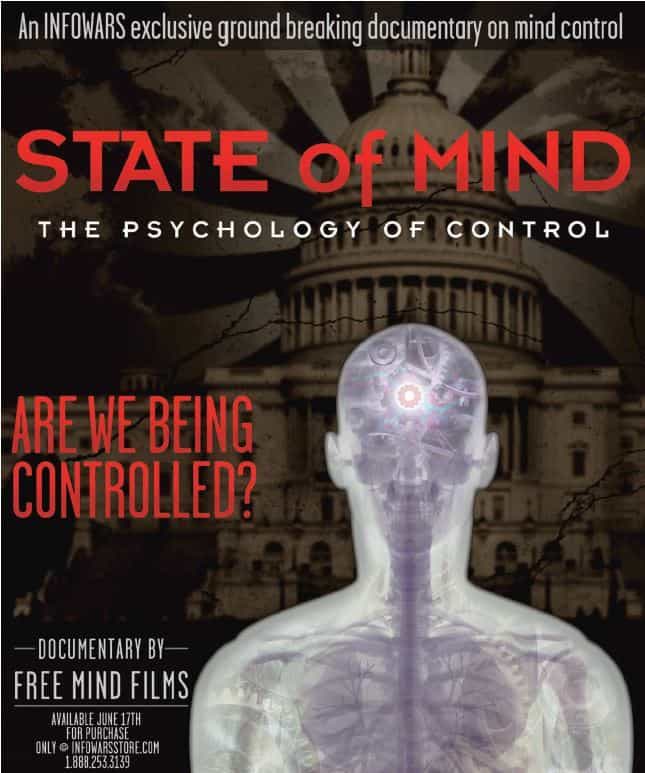
Documentary - State of Mind: The Psychology of Control


This documentary is largely conspiracy theory, in my opinion, but there are also some realities about how those in power maintain control through manipulation of information and life conditions.

Use your own discernment in watching this.

State of Mind: The Psychology of Control


If you don’t submit to control, if you’re a radical, you’re less likely to be loved. You’re not fitting in with society; you’re viewed as an outsider. There are a lot of social prohibitions about the outsider and the person who’s going to upset things. From the time we’re very young, we’re taught to worship authority, basically, because that’s our key to survival as young children. But as adults, we never go through the rights of passage that tell us how to methodically think for ourselves, and thus we’re always in a state of extended adolescence.

We take all this stuff, whether it’s the television or it’s the inculturation, the school yards, the teachers… we take this whole system, we put it into our unconscious mind, and it is the GIGO that comes out… Garbage In, Garbage Out. We simply have harnessed our own power by accepting all these beliefs as though they are factual, whether it’s the flat earth of Columbus or it’s the idea that I’m not good enough to be or to do something I’ve dreamed to do.

To the degree that the individual loses the sense of what freedom really means for him, mind control is working. Everybody’s born into this control structure, everybody’s born into authority. Everyone’s born into the situation, but just because you have an authority making decisions for you at some point when you’re very young, too young to take care of yourself, doesn’t mean you should always cater to authority your whole life. We have established a framework which for the most part works pretty good. People enter into this contract with society. That contract allows them to follow certain rules and expect certain returns on their investment of working within the framework of the contract.

Human beings form habits. At some point in our lives, many of us realize that the lives we are living are not those which we have imagined, but rather lives reflecting others’ imaginations, as if we have been unwitting actors in someone else’s script. Can be the minds of individuals harnessed by systems of psychological control?

Are the habits reflected by human beings in direct conflict with their needs to survive and thrive in this world? The enormous implications deter many of us from asking these simple questions and finding answers relevant to our daily lives. If we don’t resist all of the different information that comes our way and weigh it and use our own mind instead of what somebody else wants us to think, eventually society would become nothing more than automatons, robots. The establishment has protected itself. Unless you submit to the saturation indoctrination and adopt all its values, you can’t get in. You can get the DVD at Amazon.com.
Watch the full documentary now - 110 min

Sunday, June 30, 2013

Mark Engler - Should There Be a Maximum Wage?

It has been my position over the past decade or more that no human being is worth more than $1 million/year in salary. Further, those at the highest incomes should be those whose work is most crucial to a society's well-being: teachers, law enforcement, fire fighters, mental health professionals, physicians, and so on.

Athletes, musicians, actors and the like are often the highest paid people, aside from corporate CEOs, and I can't see that their incomes reflect their value to the society. And with CEOs, the disparity between the average employee salary and that of the CEO is often WAY out of proportion ("A typical American CEO now makes 380 times what the average worker in the country earns").

One proposal that is a step in the right direction is to the 100:1 ratio - that no CEO should make more than 100 times that of the lowest paid employee (in a company where entry level is $30K, the CEO would be limited to $3 million), Personally, I would cap that 100:1 at $1 million, i.e., the CEO can earn 100 times the lowest paid employment, but not more than $1 million.

I'm beginning to sound like some kind of socialist or Marxist.

Should There Be a Maximum Wage?

Countries like Egypt and Switzerland have placed regulations on how much executives can earn. Here’s why the U.S. should consider doing the same.


by Mark Engler
posted Jun 27, 2013

This article originally appeared in The New Internationalist.


Should our societies have a "maximum wage"? Would the world be better off if the United States had one?

Currently, Americans are debating raising the national minimum wage from $7.25 per hour to $10 per hour over the next two years. While conservatives will oppose it, such a boost shouldn't be contentious.

Such limits would motivate CEOs to augment the pay of their workers because their own raises would depend on it.

Back in 1967, the U.S. minimum wage was $1.40 per hour. That's not as measly as it sounds. Your grandparents’ tales about when ten pennies could actually buy something are not mere nostalgia. In fact, the 1967 wage had 20 percent more purchasing power than the current minimum.

Economic productivity is an even bigger part of the story. Our labor is producing more value today, but working people aren’t seeing any of the gains. Had the U.S. minimum wage kept pace with productivity increases since 1960, it would now be $22 per hour.

Who has walked away with the proceeds from all that productivity? It's a fair question, but it leads back to discussion of a maximum wage. And that's where things get controversial.

A January report from Oxfam noted, “The richest one percent has increased its income by 60 percent in the last 20 years.” It further argued that the 2012 net income of the world's top 100 billionaires—a haul of $240 billion—would be four times the amount needed to eliminate extreme poverty internationally.

While regions such as Latin America have made strides in reducing the gap between the rich and poor in the past decade, the United States has led the way in manufacturing excess at the expense of equity.

To remedy this, Larry Hanley of the Amalgamated Transport Workers Union recently proposed a “maximum wage” law that would limit an employer's income to being no more than 100 times the salary of his or her lowest-paid employee. If an entry-level worker gets $30,000 per year, the CEO would make no more than $3 million.

Other countries provide precedent for such a policy. “In Spain, the manufacturing and retail enterprises that belong to the Mondragón cooperative network limit top pay to three to nine times worker compensation,” explains author and policy analyst Sam Pizzigati, perhaps the most outspoken U.S. proponent of a maximum wage. Since 2011, Egypt and France have each pursued fixed pay ratios for leaders of state-owned enterprises. Even Switzerland, a country not known for being inhospitable to bankers, has passed restrictions on pay for bank executives and banned “golden parachute” severance packages.

Some advocates contend that a maximum wage should apply only to businesses receiving taxpayer support—in the form of bailouts, government contracts, tax abatements, or other public subsidies. Since American industry has been notoriously hungry for corporate welfare, this would cover a large portion of the U.S. economy.

Free marketeers will no doubt blast the idea of a maximum wage as the type of insane socialistic tyranny that chains everyone into the same, lowly state of mediocrity. Yet a ceiling based on a ratio between the executives at the top of a business and the grunts at the bottom doesn't set a hard cap on earnings. It merely puts to the test one of their most cherished claims: that the profits of a successful enterprise trickle down to benefit everyone.

Economists love to talk about incentives. In this case, such limits would motivate CEOs to augment the pay of their janitors, secretaries, and cashiers for a simple reason: Their own raises would depend on it.

Besides, a 100-to-1 discrepancy is hardly government-enforced equality.

It would be a considerable departure from the status quo, however. A typical American CEO now makes 380 times what the average worker in the country earns (never mind the lowest-paid).

That's not an example the world needs. And it's something that will take more than just a small boost in the minimum to fix.


~ Mark Engler is a senior analyst with Foreign Policy In Focus and author of How to Rule the World: The Coming Battle Over the Global Economy (Nation Books, 2008). He can be reached via DemocracyUprising.com. He is a contributor to The New Internationalist, where this article originally appeared.