Wednesday, July 07, 2010

MC JDub - An approach to critiques of integral theory.

http://img.youtube.com/vi/3E8CAWawn2g/0.jpg

Very good post from one of the coolest, newest integral blogs, Dignity and Disaster. In this post the intrepid author takes a look at the state of integral criticism - the major critiques of Wilber's version of integral theory in particular.

For what it's worth, this will be the subject of a panel discussion at this summer's Integral Theory Conference at JFK University.

An approach to critiques of integral theory.

When considering essential critiques of integral theory it is important first to consider just what we mean by "integral theory". In this context, of course, we are largely referring to the body of work created by Ken Wilber. Although this work is beginning to be augmented by others, both in the metatheoretical sense and in applications of the metatheory, the core of integral theory is obviously the work of Wilber. Beyond recognizing this obvious core, we must also recognize that Wilber's work is not monolithic. It is, at times, theory, metatheory, criticism, defense, polemic, application, and popularization. Wilber's work also is constantly and ever a work-in-progress with at least 5 major stages, if not more. So out of this evolving, heterogeneous mass of ideas, what, then, is the essential core of integral theory? And when we seek to offer essential critiques of integral theory, just what are we critiquing?

In brief a relatively short list of distinct areas comes to mind:

metatheoretical claims - this would be the most current metatheoretical structure Wilber has offered in which he sythesizes multiple theories into his overarching and unifying claims - roughly speaking this would be his AQAL, IMP, and IPM structures, however he may offer metatheoretical perspectives that do not fit neatly into these categories. It seems likely that the substance of these core metatheoretical claims should be Wilber's primary intellectual legacy and it is critiques of this core that are the most essential and relevant. Critical inquiry might address the degree to which integral theory successfully orients one toward individual fields of study, the degree to which anomalies or conflicts are resolved by integral theory, or the universality of its key elements.

theoretical claims - At times, Wilber allows his speculation to descend out of meta-theory and into theory itself, perhaps because he sees an implication of his metatheory that has not been metatheoretically realized, or perhaps because his understanding of his source material has led him to some position on is own. Both of these are valid areas for him to attempt. One might argue that his unique expertise is more suited to the former than the latter and one might also be justifiably skeptical of outright theoretical claims made from this secondhand standpoint without direct access to raw data and injunctions of the various theorists. If we consider the metatheoretical claims as the object of needed critique, then simple theoretical implications would be analogous to the predictions of simple theory that are tested with empirical data. The validity of those predictions are a valid test of Wilber's metatheory.
Read the whole post.


NPR - Can Genes And Brain Abnormalities Create Killers?

http://www.askdrrobert.dr-robert.com/sociopath27.jpg

I listened to this show yesterday while driving home from the gym - very interesting. My hope is that this new research will go a long way toward eliminating the death penalty. It should not absolve anyone of guilt and responsibility for what they have done, but no one should be killed for things their genetics and brain chemistry set them up to do (no one should be killed, period, but many people need a reason NOT to kill).

The guests point out - and it's important that they did - that no one is born a serial killer. You might have the genetics to be violent, but it takes an environmental trigger, such as serious abuse, to activate the genes and alter the brain chemistry.

Guests

Barbara Bradley Hagerty, correspondent, NPR's national desk
Stephen Morse, professor of psychology and law in psychiatry, University of Pennsylvania
Joshua Greene, assistant professor, Harvard University
Kent Kiehl, director of Mobile Imaging Core and Clinical Cognitive Neuroscience at the University of New Mexico

Breakthroughs in neuroscience are changing the way criminals are defended in court. Scientific research on brain scans and DNA has provided new insight on how some kinds of criminals are different from law-abiding citizens. Differences in their brains and genes may predispose them to violence.

Here is the beginning of the transcript - for those who would rather read it, the whole transcript is available.

This is TALK OF THE NATION. I'm Neal Conan in Washington.

Today, the criminal brain and what's being called neurolaw. Scientific research on brain scans and DNA provide new insight on what makes some kinds of criminals different than you and me, information that's begun to be introduced as evidence in some trials.

The data challenge how we think about right and wrong, about guilt and innocent and about the penalty to fit the crime.

NPR's Barbara Bradley Hagerty just completed a three-part series for NPR on this topic. If you missed the broadcasts on MORNING EDITION, you can find a link to them on our website, and she joins us in just a moment.

Later in the hour, what makes a psychopath, and does neuroscience tell us that once a psychopath, always a psychopath? But first, we want to hear from those of you who have questions about this new research and its implications.

We're going to focus a little bit later in the program, on how it's being introduced as evidence in courts of law, so if you've dealt with criminals as lawyers or in law enforcement, if you've come in contact with neurolaw, give us a call, 800-989-8255. Email us, talk@npr.org. You can also join the conversation at that aforementioned website. Go to npr.org. Click on TALK OF THE NATION.

NPR's Barbara Bradley Hagerty joins us here in Studio 3A. Barbara, always nice to have you on the program.

BARBARA BRADLEY HAGERTY: Thanks so much, Neal.

CONAN: Now, you got interested in the subject through a neuroscientist named James Fallon at UC Irvine.

HAGERTY: That's right, that's right. Jim Fallon has studied the brains of serial killers for something like 20 years, and he had a theory about what makes a serial killer's brain different from yours and mine. And his theory basically involves a couple of things, three things, but two of them is brain function and genes.

So he believes that the brains of serial killers operate differently. On brain scans, it looks like their orbital frontal cortex, which is right above the eyes, is a little bit less active, or a lot less active, than the amygdale, when they're processing information.

He and others believe that the orbital frontal cortex is involved with moral decision-making and ethical behavior, and it...

CONAN: Executive decisions.

HAGERTY: Right, exactly. And it puts a brake on the amygdale, which is involved with fear, and anger, and violence, and appetites and that kind of thing.

CONAN: The reptile brain.

HAGERTY: That's exactly right. So if the orbital cortex, the moral decision-making area of the brain, is not doing its job, then he believes that this person is more likely to be violent. So it's a break the brakes aren't working, essentially.

CONAN: And the genetic component of this?

HAGERTY: Yeah, that's really interesting, too. There are certain genes that have been found to be related to violence, and one in particular that's gotten a lot of attention is called the MAOA gene. It's also called the warrior gene because it regulates the serotonin system in the brain - serotonin in the brain, which affects moods, you know, think Prozac, that kind of thing.

Fallon and others have found that if you have a particular variant of this warrior gene, you are going to be predisposed toward violence. So he believes that serial killers have both a different brain function and a different genetic makeup.

CONAN: Now, it's interesting. In one of the stories you did, you talked with Jim Fallon, and among the things he did, he's using scans called PET scans, which are one kind of brain scan, and, well, among the people he tested was himself.

HAGERTY: Right.

Mr. JIM FALLON: If you look at the PET scan, I look just like one of those killers. I have the pattern, a risky pattern. In a sense, I'm a born killer. It was, frankly, a little disturbing.

You know, you start to look at yourself, and you say: I may be a sociopath. I don't think I am, but this looks exactly like psychopaths, sociopaths, that I've seen before.

CONAN: So he's got the image.

HAGERTY: Yes, you know, I've got to tell you, it's the best part of this story. About four years ago, he was at a barbecue with his mother, who was then 88 years old, and he was telling her about the science he was doing, and she said, well, Jimmy, you know, have you looked at the people in your family, your ancestors on your father's side? They're a bunch of cuckoos there.

CONAN: Of course on his father's side.

HAGERTY: On his father's side. She was, you know, quick to point that out. It turns out that in his ancestry, about eight people have been accused of murder, including Lizzie Borden - you know, Lizzie Borden, right, took an axe...

CONAN: Took an axe, gave her mother 40 whacks.

HAGERTY: Right, exactly. And so what he decided to do with this little, you know, family experiment, he got family members, his brothers, sisters, mother, wife, all his children, to do brain scans. And he also did genotyping on all of them, to see if they had the brains and the genes of a serial killer. It turns out, everyone's normal except for him.

CONAN: And obviously, though, he's not a serial killer - or at least not that we know of.

HAGERTY: Right, right. And that brings us really to the third part or the third thing that you need, he believes, to be a serial killer, and that is you need to have been abused as a child. You need to have experienced violence as a child.

So it's both nature and nurture, and it was interesting because he said this really changed his view of nature and nurture. He used to believe everything was determined by genes and brain function. But now he doesn't believe it. He thinks that, you know, maybe his great childhood was the reason that he's not behind bars right now.

Read the rest.


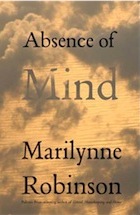
Karen Armstrong Reviews "Absence of Mind" by Marilynne Robinson

Karen Armstrong takes a look at Marilynne Robinson's new book, Absence of Mind: The Dispelling of Inwardness from the Modern Myth of the Self, based her Terry Lectures at Yale University last year.
Absence of Mind: The Dispelling of Inwardness from the Modern Myth of the Self (Terry Lectures)
by Marilynne Robinson
176pp, Yale University Press

Armstrong no doubt endorses this book because it echoes her own belief in the value of religion. For me, it's the defense of subjectivity, the belief that our inner lives have value and meaning, and serve as a way to know the world. The privileging of objective science over subjective experience is deadly to our psyches and our culture.

Absence of Mind by Marilynne Robinson

Karen Armstrong hails a profound and timely argument against the positivist world view

Karen Armstrong
Karen Armstrong
The Guardian,

Greek Orthodox bishops conduct Mass
'Bones, feathers and wishful thinking'? . . . Greek Orthodox bishops
conducting a service Photograph: Gali Tibbon/AFP/Getty Images

At the same time as the western scientific revolution empowered human beings, opened new worlds and broadened their horizons, it progressively punctured their self-esteem. Increasingly, luminaries of modern thought have told us that our minds are not to be trusted: that even though we thought we were standing on a static Earth, our planet was moving very fast indeed; that we could never be sure that our ideas corresponded to objective reality outside our own heads; that some of our noblest ideals were simply the product of repressed sexuality; and that, finally, we are deluded if we imagine that we "think", "reason," "learn" or "choose". Our minds are simply a passive conduit for an unknown, indifferent force.

In this published version of the Terry lectures, delivered at Yale University last year, the novelist Marilynne Robinson argues that positivism, the belief that science is the only reliable means to truth, has adopted a "systematically reductionist" view of human nature. Since Huxley, for example, Darwinians have found altruism problematic, as evolution would necessarily select against benevolence to another at cost to oneself. Altruism can only occur because of the "selfishness" of a gene. Thus for EO Wilson, a "soft-core altruist" expects reciprocation from either society or family; his byzantine calculations are characterised by "lying, pretence and deceit, including self-deceit, because the actor is more convincing who believes that his performance is real". Every apparently compassionate action is, therefore, simply a matter of quid pro quo.

In the same way, because it transfers useful information to somebody else and requires an expenditure of time and energy, language seems essentially altruistic. But, says the evolutionary biologist Geoffrey Miller, "evolution cannot favour altruistic information-sharing", so the complexities of language probably evolved simply for verbal courtship, "providing a sexual payoff for eloquent speaking by the male and female".

"Oh, to have been a fly on the wall!" Robinson comments wryly, when our "proto-verbal ancestors found mates through eloquent proto-speech". In the same way, art may appear to be "an exploration of experience, of the possibilities of communication, and of the extraordinary collaboration of eye and hand," but according to some neo-Darwinians, it too is simply a means of attracting sexual partners. "Leonardo and Rembrandt may have thought they were competent inquirers in their own right, but we moderns know better."

This disdainful "hermeneutics of condescension" cannot function outside of a narrow definition of relative data. Nowhere is this more apparent than in the positivist critique of religion. Daniel Dennett, for example, defines religion as "social systems whose participants avow belief in a supernatural agent or agents whose approval is to be sought". He deliberately avoids the contemplative side of faith explored by William James, as if, Robinson says, "religion were only what could be observed using the methods of anthropology or of sociology, without reference to the deeply pensive solitudes that bring individuals into congregations". Bypassing Donne, Bach, the Sufi poets and Socrates, Dennett, Dawkins and others are free to reduce the multifarious religious experience of humanity "to a matter of bones and feathers and wishful thinking, a matter of rituals and social bonding and false etiologies and the fear of death".

Robinson takes the science-versus-religion debate a stage further. More significant than this jejune attack on faith, she argues, is the disturbing fact that "the mind, as felt experience, has been excluded from important fields of modern thought" and as a result "our conception of humanity has shrunk". Robinson's argument is prophetic, profound, eloquent, succinct, powerful and timely. It is not an easy read, but one of her objectives is to help readers appreciate the complexity of these issues. To adopt such a "closed ontology", she insists, is to ignore "the beauty and the strangeness" of the individual mind as it exists in time. Subjectivity "is the ancient haunt of piety and reverence and long, long thoughts. And the literatures that would dispel such things refuse to acknowledge subjectivity, perhaps because inability has evolved into principle and method."

In the past, the voices that say "there is something more" have always been right. The positivist approach would not only marginalise religion, but also the arts, culture, history, and the classical and humanist traditions. Most prescient of all is Robinson's contention that "it is only prudent to make a very high estimate of human nature, first of all in order to contain the worst impulses of human nature, and then to liberate its best impulses."

I wish she had developed this crucial insight, because it is urgently needed at this moment of crisis in human history. If we are indeed completely in thrall to the selfish gene, why not throw all constraint to the winds and just be selfish – individually and collectively, in our politics, social arrangements, financial and economic dealings? We saw during the 20th century (not to mention the first decade of the 21st) what can happen when the "me-first" mentality is given free rein. But this was also the century of Mahatma Gandhi, Martin Luther King, and Nelson Mandela, who revealed the potential for altruism in humanity. The tens of thousands of people who flock to hear the Dalai Lama seem to recognise that this too is an essential part of human nature.

Karen Armstrong's The Case for God: What Religion Really Means is published by Bodley Head - available in paperback in September.


Meditation and Psychotherapy, by Ajahn Sumedho

Two of my favorite topics in one post, via Buddhism Now. In my opinion, and in my experience, meditation and psychotherapy are very useful in tandem, especially if the therapist is aware of Buddhism and mindfulness approaches to removing or at least lessening the clinging to self. We need therapy, or some of us do, to heal the wounding that keeps us clinging and stuck, and we need mindfulness practice to discover that we are not our wounding and we are not our emotions. Used well, they are very complementary.

Meditation and Psychotherapy, by Ajahn Sumedho

Kannon Bodhisattva ©BPG

I was invited to a conference in Gloucestershire not so long ago which was all about dealing with spiritual crises. There were therapists, psychiatrists and counselors there talking about mindfulness, because this word ‘mindfulness’ seemed to be the main topic of interest, which I thought was very good.

The way to liberate the mind is through mindfulness or awareness, and this is the essence of the Buddha’s teaching; this is the important one. It isn’t that people in general are never mindful or always heedless and ignorant, but speaking for myself, it never meant anything to me in the past; it wasn’t raised up as anything significant. I would be mindful under certain circumstances, but I didn’t know what mindfulness was; I was just that way because the conditions were there for it. And in life-endangering situations, I would be particularly mindful. People would ask me afterward, ‘Were you frightened?’ And I would say, ‘No, I was very mindful.’ It wasn’t that I had trained myself to be that way; it was just that I was naturally alert on those occasions; it just happened as part of the life-preservation instinct. We didn’t call it ‘mindfulness’, of course, and it wasn’t appreciated even though it had happened. After developing meditation over the years, however, I began to recognize and understand the power of it rather than just seeing it as a technique or a way to gain some limited state.

Psychotherapy gives a forum for talking about things that you would not perhaps talk about in other circumstances. It can be quite useful for allowing fears to become conscious, especially the darker aspects of the psyche. You can’t talk to just anybody about these things because you need someone who will listen to you without making judgments or giving advice, so having that facility can initially be quite useful as a skillful means. But if that process becomes addictive, you can get too interested in yourself as a person. In meditation, on the other hand, you don’t find your personality that interesting after a while.

Ajahn Sumedho


Tuesday, July 06, 2010

Chris Hedges: A Needed Antidote to the Worst of Commodity Culture

[PHOTO: Chetco Canyon]


Interesting article from Chris Hedges - One of the things I appreciate about my childhood is that our family vacations always involved being in nature: Death Valley, The Grand Canyon, Sequoia National Park, Yosemite, and so on. Even after my father died - and maybe especially after he died - being in nature was important - it may be the only thing that got me through my crazy teen years.

The peace and perspective (feeling small and insignificant) while climbing a mountain or wandering through a wilderness area always settled my anxiety or soothed my depression. It literally saved my life.

And that perspective may one of the ways we can save ourselves from the insanity of our current culture and its materialism.

I found this at AlterNet but it comes from TruthDig originally.

It is in solitude, contemplation and a connection with nature that we transcend our frenzied and desperate existence.

Earl Shaffer, adrift after serving in the South Pacific in World War II and struggling with the loss of his childhood friend Walter Winemiller during the assault on Iwo Jima, made his way to Mount Oglethorpe in Georgia in 1947. He headed north toward Mount Katahdin in Maine and for the next 124 days, averaging 16.5 miles a day, beat back the demons of war. His goal, he said, was to ‘‘walk the Army out of my system.’’ He was the first person to hike the full length of the Appalachian Trail.

The beauty and tranquility of the old-growth forests, the vistas that stretch for miles over unbroken treetops, the waterfalls and rivers, the severance from the noise and electronic hallucinations of modern existence, becomes, if you stay out long enough, a balm to wounds. It is in solitude, contemplation and a connection with nature that we transcend the frenzied and desperate existence imposed upon us by the distortions of a commodity culture.

The mountains that loom on the northern part of the trail in New Hampshire and Maine, most of them in the White Mountain National Forest, are also forbidding, even in summer, when winds can routinely reach 60 or 70 miles per hour accompanied by lashing rain. The highest surface wind speed recorded on the planet, 231 miles per hour, was measured on April 12, 1934, at the Mount Washington Observatory. Boulders and steep inclines become slippery and treacherous when wet and shrouded in dense fog. Thunderstorms, racing across treeless ridge lines with the speed of a freight train, turn the razor-backed peaks into lightning rods. The Penacooks, one of two Native American tribes that dominated the area, called Mount Washington, the highest peak in the Northeast, Agiochook or “place of the Great Spirit.”

The Penacooks, fearing the power of Agiochook to inflict death, did not climb to its summit. The fury you bring into the mountains is overpowered by the fury of nature itself. Nature always extracts justice. Defy nature and it obliterates the human species. The more we divorce ourselves from nature, the more we permit the natural world to be exploited and polluted by corporations for profit, the more estranged we become from the essence of life. Corporate systems, which grow our food and ship it across country in trucks, which drill deep into the ocean to extract diminishing fossil fuels and send container ships to bring us piles of electronics and cloths from China, have created fragile, unsustainable man-made infrastructures that will collapse. Corporations have, at the same time, destroyed sustainable local communities. We do not know how to grow our own food. We do not know how to make our own clothes. We are helpless appendages of the corporate state. We are fooled by virtual mirages into mistaking the busy, corporate hives of human activity and the salacious images and gossip that clog our minds as real. The natural world, the real world, on which our life depends, is walled off from view as it is systematically slaughtered. The oil gushing into the Gulf of Mexico is one assault. There are thousands more, including the coal-burning power plants dumping gases into our atmosphere that are largely unseen. Left unchecked, this arrogant defiance of nature will kill us.

“We have reached a point at which we must either consciously desire and choose and determine the future of the Earth or submit to such an involvement in our destructiveness that the Earth, and ourselves with it, must certainly be destroyed,” writer-poet Wendell Barry warns. “And we have come to this at a time when it is hard, if not impossible, to foresee a future that is not terrifying.”

Year after year I returned to these forbidding peaks from conflicts in Central America, the Middle East, Africa and the Balkans. I had a house in Maine on an 800-foot hill with no television, cell phone or Internet service. The phone number was unlisted. It rarely rang. I refused to give the number to my employer, The New York Times. I brought with me the stench of death, the cries of the wounded, the bloated bodies on the side of the road, the fear, the paranoia, the alienation, the insomnia, the anger and the despair and threw it at these mountains. I strapped my pack on in the pounding rain at trailheads and drove myself, and later my son, up mountains. I rarely stopped. Once, in a bitter rain, I crested the peak of Mount Madison in August and was immediately thrown backward by howling winds whipping across the ridge and pelting hailstones. It was impossible to reach the summit. On a hike in the remote Pemigewasset Wilderness I made a wrong turn and, fearing hypothermia, walked all night. By the time the sun rose my blisters had turned to open sores. I wrung the blood out of my socks. I go to the mountains to at once spend this fury and seek renewal, to be reminded of my tiny, insignificant place in the universe and to confront mystery. Berry writes in “The Peace of Wild Things”:

When despair for the world grows in me

and I wake in the night at the least sound

in fear of what my life and my children’s lives may be,

I go and lie down where the wood drake

rests in his beauty on the water, and the great heron feeds.

I come into the peace of wild things

who do not tax their lives with forethought

of grief. I come into the presence of still water.

And I feel above me the day-blind stars

waiting with their light. For a time

I rest in the grace of the world, and am free.

I climbed my first mountain in the White Mountain National Forest when I was 7. It was Mount Chocorua. The mountain, capped with a rocky dome and perhaps the most beautiful in the park, is named for a legendary Pequawket chief who refused to flee with his tribe to Canada and was supposedly pursued to its summit by white settlers, where he leapt to his death. It is a climb I have repeated nearly every year, now with my children. I guided trips in the mountains in college. I would lie, years later, awake in San Salvador, Gaza, Juba or Sarajevo and try to recall the sound of the wind, the smell of the pine forests and the cacophony of bird song. To know the forests and mountains were there, to know that I would return to them, gave me a psychological and physical refuge. And as my two older children grew to adulthood I dragged them up one peak after another, pushing them perhaps too hard. My college-age son is deeply connected to the mountains. He works in the summer as a guide and has spent upward of seven weeks at a time backpacking on the Appalachian Trail. My teenage daughter, perhaps reflecting her sanity, is reticent to enter the mountains with the two of us.

I stood a few days ago in a parking lot at Crawford Notch with Rick Sullivan, an Army captain and Afghanistan war veteran. It was the end of our weeklong hike in the White Mountains. Sullivan noticed a man with a T-shirt that read “Operation Iraqi Freedom.” The shirt had Arabic and English script warning motorists not to come too close or risk being shot. The man, an Iraqi veteran, was putting on a pack and told us that he was the caretaker of a camp site. He said he left the Army a year ago, drifted, drank too much and worked at a bar as a bouncer. His life was unraveling. He then answered an ad for a park caretaker. The clouds hovering on the peaks above us were an ominous gray. The caretaker said he planned to beat the rain back to the tent site. I thought of Earl Shaffer.

“You try and forget the war but you carry pieces of it with you anyway,” the caretaker said. “In the mountains, at least, I can finally sleep.”

~ Chris Hedges, a Pulitzer Prize-winning reporter, is a senior fellow at the Nation Institute. He writes a regular column for TruthDig every Monday. His latest book is Empire of Illusion: The End of Literacy and the Triumph of Spectacle.


Ontological Excess and the Being of Language - Robert Platt

Geeky cool language and being stuff - I enjoy postmodern philosophy for some reason.

Journal Reference:
Minerva - An Internet Journal of Philosophy Vol. 13 2009
Ontological Excess and the Being of Language

By Robert Platt

Abstract
This paper engages in a close reading of Badiou’s Being and Event as an occasion to investigate the ways in which being and language may be related and does so by focusing upon his idea that mathematical language, in the form of set theory, is capable of managing the ‘ontological excess’ which he associates particularly with poetic language. Because, he argues, poetic language involves a sort of willful engagement with the ‘one-effect’, the presencing of multiplicity, and thereby the only possibility for being’s emergence, is made unfeasible. The paper locates some of the affects of excess in the experience of modernism, and specifically in the poetic language of Mallarmé and Baudelaire. By considering what might be involved in ‘the saying-showing power of language’, as this idea is developed by both Wittgenstein and Heidegger, the paper seeks to show how excess is the very source of beings’ appearance in language, given that this appearance is silent and hence unsayable.

Introduction

This paper is concerned with examining the relationship between the one and the many as a ubiquitous problem for philosophical thinking generally and for ontology particularly. It engages in a close reading of Alain Badiou’s Being and Event because this text offers a detailed analysis of how we might try to think about the relationship. Badiou’s text is treated as an occasion, in the most respectful sense, to address how thinking, writing or speaking could come to terms with the issues that he raises. At stake is whether ‘the one-effect’ may be conceived in its completeness and, in particular, whether mathematics, specifically set theory, is the means for achieving this end.

The difficulty lies with the need to render, or designate, individuals as parts of a totality, given that ‘rendition’ or ‘designation’ ― in whatever form ― generates a surplus or excess over the totality. The designation creates a one-effect in what will be called its mode of transcendence. Excess transcends the totality that rendition sought to designate. But equally, each individual constitutes a totality of its own parts, where each part is one. This is the one-effect in what will be called its mode of reduction.

Since the question of the one and the many concerns itself with a relationship, issues of structure call for consideration. Any words that could be found which might begin to outline such a structure would need to address themselves to the processes of transcendence and reduction. Transcendence arises in the implication that any naming of the one - by the act of naming itself - would point to an entity greater than the sum of its parts. Hence, it is generally accepted that ’society’, or ’the human body’, has qualities which cannot be found in the aggregate of parts. Furthermore, these qualities are likely to be interpreted as the animating ones which make conception possible in the first place. It is already apparent, through the act of ’naming’, that the use of language has significant implications for the production of the one-effect. It is the aggregate, or sum, which has traditionally been identified as ‘the many’; the many are, at least potentially, the countable constituents of any totality. Accepting that the body has a finite number of countable parts allows us to think that we know when the body is complete or whole.

But, in the greatest effort to determine that which exists on the basis of that which can be counted, what should count as one part remains entirely uncertain. While language insists, if language-users are to be consistent and communicative, that what is called an arm is part of what is called a human body, there is no such insistence that the former is an irreducible part; that it is not itself composed of other parts. So what is to count as one part is, potentially, infinitely reducible.

Read the rest.


Two Cool Psychology Articles

Both of these are cool, but no time to dissect, so I'll give you the leads and let you read them.

The Bold and the Beautiful

Colorful  peacock

Personality is a complicated interplay of traits that influence well-being, cognition and mental health. The so-called Big Five personality traits include extraversion, agreeableness, conscientiousness, neuroticism and openness. It is difficult to quantify personality characteristics and their roles in mood, behavior and reasoning, but several recent studies have proclaimed the significant effect of extraversion — the trait that includes talkativeness, excitability, assertiveness and sociability — on everything from positive mood to creativity and humor.

Personality and positive mood influence cognition, including creativity, executive function and free recall. One recent study found that the more extraverted an individual, the greater the induction of positive mood. Extraverts are apparently predisposed to a happier, more positive affect; they also enjoy enhanced creativity compared to introverts — individuals who tend to be more introspective and less outgoing and sociable.

Read the rest.

By News Staff | July 3rd 2010

Neural circuitry is constantly changing to meet the challenges of its environment and ahead of his presentation on July 6th, sponsored by The Kavli Foundation, at the 7th FENS Forum of European Neuroscience in Amsterdam, Tobias Bonhoeffer, director at the Max Planck Institute of Neurobiology in Martinsried, Germany, offers insight into how new techniques enable researchers to watch this process of adaptation as never before.

What happens to our brains as we experience the outside world? Scientists have learned that the brain undergoes structural changes as it absorbs sensory data, learns and adapts, but the actual mechanism of this process is just now coming into view.

The following is an edited transcript of an interview provided by the Kavli Foundation, conducted June 10, 2010.

Could you start by giving us a brief preview of what you’ll be covering in your FENS lecture?


What we’re working on in my lab is neuronal plasticity -- how the brain adapts to changes in the environment. Such adaptations can be relatively straightforward. For example, if an animal loses a limb or an eye, the brain adapts to that and partially compensates for the missing information. Other adaptations are more subtle – when, for instance, an animal hides food for the winter and remembers the place later on. Although these things may seem quite different, they have one thing in common, namely that in both cases the brain enables an animal to adapt its behavior because of challenges in its environment.

Over the last couple of years our field has made such fundamental progress that we are now able to really look into the brain and see how it works, in the living animal. We are now able to see the changes related to such adaptations and to see how nerve cells form new connections or how connections between nerve cells are broken. This is basically what I will cover in my lecture. I will talk about our studies investigating what happens when nerve cells make new connections in vitro, i.e. in cell culture. I will on the other hand also talk about our in vivo studies, in which we study the intact organism. We are now able to look into the brain of an animal and see how nerve cell connections are made or broken, and how that relates to learning or other adaptive changes.

How close are you to understanding the mechanism of synaptic plasticity? Is there a particular knowledge breakthrough, a “Holy Grail,” that you're seeking?

Like always in science, that really depends on the level of detail with which one is satisfied. You can always, once you’ve understood something, go further and say, well, we’ve still not completely understood it, so let’s go to the next step. It’s difficult to say how far we’ve gotten. I’d say we’ve understood a couple of fundamental steps. We know, for instance, quite precisely which receptors in the brain are responsible for changes in the functional connections between nerve cells, the synapses; we also know the rules, when synapses get stronger and when they get weaker. All those things are quite well understood and have been elucidated over the last 10 to 15 years or so. But that’s not to say there isn’t plenty of stuff left to be discovered. Science is a never-ending story, which is partly also the fun of it.

In reference to the “Holy Grail,” at least in my personal lifetime or my scientific lifetime, what I would really like to be able to show is that it is really the changes in connections between nerve cells that cause information to be stored in the brain. It would be great to show for instance, that an animal learns something and you see that a thousand synapses change. Then, when you disable those thousand synapses, you see that the animal has forgotten exactly what it had learned before -- but nothing else.
Read more.


Rev. Ray Innen Parchelo - Is there room for the 'self' in religion?

blacktree.jpg image by amarti2000

A brief look at no-self in Buddhism, as interpreted by Rev. Ray Innen Parchelo, a novice Tendai priest. For another take on this topic, check out Ego: the source of most of our problems by Dzogchen Ponlop Rinpoche over at Elephant Journal.

Is there room for the 'self' in religion?

By Rev. Ray Innen Parchelo, The Ottawa Citizen July 4, 2010

Ottawa, Canada -- This is a defining question for Buddhism, one that has lead to many misunderstandings. Shakyamuni, the historical Buddha, taught that our lives are stained by three characteristics -- a pervasive lack of satisfaction, an impermanence to all phenomena and the absence of any permanent self.

There is no undying self or soul that transcends earthly life, nor are we eternal spirits trapped in mortal bodies.

Further, he identified our clinging to such a permanent self as the prime cause for human suffering, and outlined a way -- the Buddha-dharma -- for its relief. Buddhism accepts self with a twist by referring to this apparent self as "non-self," a way to remind us of its transient nature. We need a light touch when we speak of I-me-mine.

The first common misunderstanding of non-self is the accusation that Buddhism is "life-denying" or nihilistic because, the argument goes, it sees this self and this life as illusions.

Buddhism does not deny the validity of our day-to-day experience, including our sense of that as personal experience. There is no illusion. Our self, while real in a conventional sense, lacks the permanence we attribute to it. Self is no different from any other experience in that it arises and passes away.

We are encouraged to employ whatever wholesome means we have to drink deeply from our personal experience. Four aspects of self, body, breath, speech and mind, are often referred to as the Four Foundations of mindfulness of life. An acceptance and awareness of life's flow is a positive affirmation of the beauty of life and our experience of it.

Secondly, many people mis-attribute some teaching of reincarnation to Buddhism.

Clearly, since there is no permanent self, there is no entity to travel from life to life. The Buddha taught the flow of causes and consequences.

Whatever we intend and enact, be that physically or mentally, has its results.

Like the movement of a wave in the ocean, the momentum of what we think and do propels and shapes what arises in the future, but not as a personalized self.

----------
Rev. RAY INNEN PARCHELO is a novice Tendai priest and founder of the Red Maple Sangha, the first lay Buddhist community in Eastern Ontario.


Monday, July 05, 2010

Maia Duerr - The Future of Contemplative Practice in America: Buddhism in the West

This is a nice article from Patheos on the future of Western Buddhism, written by Maia Duerr and based on research she conducted for the Fetzer Institute and the Center for Contemplative Mind in Society. Interesting stuff for anyone involved in American Buddhism.

The Future of Contemplative Practice in America: Buddhism in the West

Maia DuerrBy Maia Duerr

There is an inner revolution taking place in our culture in which great numbers of people are becoming aware of the relationship of their inner lives to their outer lives. - Rob Lehman, 1999

For the Patheos summer series on the future of religion, I'd like to share some insights based on my research into the state of contemplative practices in America, conducted for the Fetzer Institute and the Center for Contemplative Mind in Society. I offer them here as Buddhism has informed much of the current popularity of these practices, and the developments described here may have some bearing upon the future of Buddhism. Following a brief introduction to the growth of contemplative practices in America, I'd like to focus on their future.

Contemplative Practices

From 2001 to 2004, the Center for Contemplative Mind in Society conducted a qualitative research project entitled the Contemplative Net. This was quite possibly the first systematic effort to map the use of contemplative practices across a diverse group of secular settings including business, healthcare, education, law, social change, and prison work. In-depth interviews were conducted with 84 professionals who incorporated contemplative practices in their work. The data was then analyzed for recurring patterns and themes, and supplemented by a media survey (e.g., collecting web, print, and broadcast media stories about contemplative practices in non-religions settings).


Read More from: The Future of Buddhism

The study confirmed the growing use of contemplative practice in non-religious settings and that it was a phenomenon worthy of further study. The complete report, titled A Powerful Silence (2004), and detailed findings can be accessed on the Center for Contemplative Mind in Society's website.

In reviewing the events of the past five years since the publication of A Powerful Silence, I believe there are five cultural indicators, which suggest that contemplative practices are moving from the periphery to the mainstream. As I look to the future, my guess is that these trends will continue and expand.

1. Mainstream media coverage of contemplative practices (as well as Buddhism)

Stories about the benefits of meditation and other practices are no longer published primarily in specialty publications, but appear with increasing frequency in venues such as USA Today, The Huffington Post, The Wall Street Journal, and The New York Times.

The 2010 PBS documentary "The Buddha" also played an important role in introducing many Americans to meditation, as well as its applications to fields such as health care, death and dying, law, and more. The film was viewed on its first PBS screening by 1.6 million people across the country. The show's companion website, which provided resources for learning to meditate, had more than 1.6 million hits by mid-April, 2010, and its Facebook page had 31,642 fans.

Media outlets that have traditionally focused on contemplative practices have also seen growth. For example, subscriptions to Shambhala Sun magazine grew 56% from 2004 to 2009. The March 2010 special issue called A Guide to Mindful Living was the bestselling issue in the magazine's entire history (Boyce, 2010).

2. Election of President Obama

Setting aside political affiliations, the election of President Obama in 2008 is one of the most interesting indicators that the American public has a strong yearning for a more contemplative way of being (albeit perhaps on an unconscious level). Mr. Obama embodies a number of qualities that are developed with contemplative practice: reflection, thoughtfulness, equanimity, and an emphasis on collaboration and interconnection. When he searched for his first Supreme Court nominee, for example, he looked for a "candidate with empathy." In a time when Americans seem to becoming more polarized, Mr. Obama's ability to respect points of view different than his own and to hold multiple truths-also dimensions of a contemplative perspective-is refreshing to many people.

3. Institutional strength

A number of institutions devoted to the study and application of contemplative practices have been established in the past five years, including the Mindfulness Awareness Research Center (based at UCLA), the Association for Contemplative Mind in Higher Education, and the Center for the Investigation of Healthy Minds. Institutions that existed prior to 2005 have grown and extended the reach of their work, such as the Mind & Life Institute, the Center for Mindfulness Medicine, Health Care, and Society, the Center for Contemplative Mind in Society, the Garrison Institute, and Upaya Zen Center's Being With Dying project.

Collectively, the events and publications being put forth by these institutions are reaching a critical mass that is raising public awareness of the benefits of contemplative practices.

4. New generation of contemplative leaders

Compared to five years ago, there are more people in leadership positions with contemplative backgrounds, and they are no longer primarily spiritual teachers. These leaders are making their own unique contributions to the contemplative process and its dissemination. Two examples in the world of technology are Meng Tan (of Google) and Greg Pass (of Twitter). Both are engineers who are also students of meditation; they have applied their skills to design tools and structures that can support reflection and insight.

5. Contemplative responses to current events

It would appear that we are becoming more skilled in creating relevant contemplative responses to contemporary situations-for example, in 2005, a program of mindfulness retreats for military veterans and their families was developed in response to the many vets who returned home from the war in Iraq suffering from PTSD. And, compared to previous years, these responses are garnering more press coverage and public attention.

Is There a Contemplative Practices Movement?

The use and integration of these practices in non-religious sectors has continued to grow. Does this represent an actual "Contemplative Movement"? In a traditional social or political movement, people typically have some awareness that they are part of that movement and make strategic (or not-so-strategic) choices in order to advance its cause. In this case, even though there is a spontaneous emergence of contemplative practices and values across diverse fields, it is likely that many of the people and institutions involved wouldn't identify themselves as part of a larger whole. Sociologist Paul Ray's theory about "Cultural Creatives" (2000) might be a useful analogy here:

While Cultural Creatives are a subculture, they lack one critical ingredient in their lives: awareness of themselves as a whole people. We call them the Cultural Creatives precisely because they are already creating a new culture. If they could see how promising this creativity is for all of us, if they could know how large their numbers are, many things might follow. These optimistic, altruistic millions might be willing to speak more frankly in public settings and act more directly in shaping a new way of life for our time and the time ahead...When we discovered the great promise of this new group, we set out to hold up a mirror for them, so they could see themselves fully. (Cultural Creatives website)

As in the case of Cultural Creatives, by naming this phenomenon we are helping people to become aware of it, perhaps thereby facilitating the next steps in its evolution.

On the Horizon

The data and anecdotal evidence from these past five years suggests that contemplative practices, many of them inspired by Buddhist teachings and practices, are being used by more people and they are finding a normative place in American life.

But are contemplative values actually being internalized or is this a more superficial level of adoption? What are the indicators that these values are being internalized?

I would suggest that we are not just looking for an increase in the numbers of people who meditate, but rather for indications that the qualities nurtured by contemplative practices are taking deeper root and supporting a cultural shift.

What would a society based on contemplative values look like? Some of the elements of it might include:

  • Awareness of our inescapable mutual interdependence and its implications for the politics of a global society;
  • Fulfillment of basic human needs and human rights for all
  • Business with a bottom line that is no longer exclusively power and profit but one that promotes ethically, spiritually, compassionate, and ecologically responsible human life
  • A medical profession committed to healing, wholeness, and compassionate decision making
  • A justice system that encourages a lawyer to have compassion for his adversary while still being a zealous advocate for his client
  • An economics that looks carefully at the relation between consumption and the pursuit of happiness

In the process of working toward this deeper level of integration, some of the challenges we need to be aware of include:

  • The American propensity toward consumerism; the tendency to turn everything into a commodity, and to look for an "easy fix."
  • Fear and misunderstanding of what contemplative practices are; suspicion that someone is trying to "take away" one's religious beliefs or convert one to another religion.
  • Our own tendency to be evangelistic about these practices. (The case of a 2003 "anti-stress" ballot measure in Denver, CO, is instructive. The initiative would have required the city to implement community-wide steps such as mass meditation sessions, piping soothing music into public buildings, and serving natural foods in school cafeterias. The measure was soundly defeated and the object of much ridicule.)

How might we address these challenges and take this nascent movement forward to the next stage of evolution? This may seem counterintuitive, but it may help to focus on our biggest vision rather than the specific means to get there. We can consider shifting the framework from encouraging the use of contemplative practices and instead emphasize a vision of a society based on contemplative values, which offers people many avenues for participation. The Charter for Compassion, sponsored by the Fetzer Institute, is an excellent example of this.

Again, the election of President Obama may be seen as an indication that many people are hungry for a kinder, gentler, and more respectful society. How can we use this strong desire to inspire people? Paul Gorman, former director of the National Religious Partnership for the Environment, suggested that, "The values and qualities that we love so much about Obama need to be named and more broadly owned." As Gorman defines it, the challenge for us is to identify and claim these values in our own lives rather than project them onto a person or an organization.

Related to this, it will be important to recognize that people have diverse ways of cultivating these qualities, some of which may look like "traditional" contemplative practices and others of which will help to define new kinds of practices. Here, we need to "walk our talk," be ready to let go of fixed ideas, and be receptive to new iterations of contemplative practice. Perhaps this will be the next turning of the wheel of dharma.

For further reading:

  • Duerr, M. (2004). A Powerful Silence: The Role of Meditation and Other Contemplative Practices in American Life and Work. Center for Contemplative Mind in Society.
  • Garrison Institute (2005). Contemplation and Education: Current Status of Programs Using Contemplative Techniques in K - 12 Educational Settings: A Mapping Report.
  • Pew Forum on Religion & Public Life (2007). U.S. Religious Landscape Survey, Summary of Key Findings, page 13. Accessed online: http://religions.pewforum.org/reports#
  • Pew website: http://pewforum.org/Age/Religion-Among-the-Millennials.aspx
  • Ray, P. (2000) Cultural Creatives. New York: Harmony Books.
  • Shapiro, S., Warren, K. and Astin, J. with Duerr, M. ed. (2008). Toward the Integration of Meditation into Higher Education: A Review of Research. Prepared for the Center for Contemplative Mind in Society.

Maia Duerr is a writer, editor, anthropologist, and founder of Five Directions Consulting. She practices Zen Buddhism and has worked with the Buddhist Peace Fellowship, Upaya Zen Center, Parallax Press, and the Center for Contemplative Mind in Society. She writes The Jizo Chronicles, a blog on socially engaged Buddhism.

Rick Hanson - Your Wise Brain Blog: How Did Humans Become Empathic?

The newest installment from Dr. Rick Hanson looks at the ways in which relationships and empathy drove human evolution. Great post on a great topic.

* * *

This blog comes from Rick Hanson, Ph.D., neuropsychologist, author, founder of the Wellspring Institute for Neuroscience and Contemplative Wisdom, and meditation teacher.

Rick is author of the best-selling book Buddha's Brain: The Practical Neuroscience of Happiness, Love, and Wisdom

See Rick's workshops and lectures for therapists and the general public.

Your Wise Brain Blog: How Did Humans Become Empathic?

Empathy

Empathy is unusual in the animal kingdom. So empathy must have had some major survival benefits for it to have evolved. What might those benefits have been?

Empathy seems to have evolved in three major steps.

First, among vertebrates, birds and mammals developed ways of rearing their young, plus forms of pair bonding – sometimes for life. This is very different from the pattern among fish and reptile species, most of which make their way in life alone. Pair bonding and rearing of young organisms increased their survival and was consequently selected for, driving the development of new mental capacities.

As neuroscientists put it, the “computational requirements” of tuning into the signals of newborn little creatures, and of operating as a couple – a sparrow couple, a mountain lion couple, that is – helped drive the enlargement of the brain over millions of years. As we all know, when you are in a relationship with someone – and especially if you are raising a family together – there’s a lot you have to take into account, negotiate, arrange, anticipate, etc. No wonder brains got bigger.

It may be a source of satisfaction to some that monogamous species typically have the largest brains in proportion to bodyweight!

Second, building on this initial jump in brain size, among primate species, the larger and more complex the social group, the bigger the brain. (And the key word here is social, since group size alone doesn’t create a big brain; if it did, cattle would be geniuses.)

In other words, the “computational requirements” of dealing with lots of individuals – the alliances, the adversaries, all the politics! – in a baboon or ape band also pushed the evolution of the brain.

Third, living in small bands in harsh conditions in Africa, and breeding mainly within their own band, our hominid and early human ancestors were under intense evolutionary pressures to develop strong teamwork as a band while they competed fiercely – and often lethally – with other bands for scarce resources. Hominids starting making stone tools about 2.5 million years ago, and during the 100,000 generations since, the brain has tripled in size; much of that new neural volume is used for interpersonal capacities such as empathy, language, cooperative planning, altruism, parent-child attachment, social cognition, and the construction of the personal self in relationships.

In sum: More than learning how to use tools, more than being successful at violence, more than adapting to moving out of the forest into the grasslands of Africa, it was the complexities of relationships that drove human evolution!

Homo sapiens means clever ape. We are clever to be sure, but we are clever in order to relate. It would be perhaps more accurate to call our species Homo sociabilis, the sociable ape.

As Charles Darwin wrote: “All sentient beings developed through natural selection in such a way that pleasant sensations serve as their guide, and especially the pleasure derived from sociability and from loving our families.”

Sociability, and the empathy at the heart of it, drove evolution – in a fundamental sense, it is empathy that has enabled this blog to be posted by me and read by you.

Empathy is in our bones. For example, infants will cry at the tape-recorded sound of other infants crying but not at a recording of their own cries. And speaking of crying, as adults, our tear glands will automatically start producing tears when we hear the crying of others, even if we have no sense of tearing up ourselves.

Perhaps an even better name for ourselves would be Homo empathicus.


The 12-Step Buddhist Podcast Episode 014 – Larry Christensen, Ph.D. on Zen and Psychotherapy

Darren Littlejohn is author of The 12-Step Buddhist - he also does a podcast at his site, which is quite good.

The 12-Step Buddhist Podcast Episode 014 – Larry Christensen, Ph.D. on Zen and Psychotherapy

June 30th, 2010 by Darren Littlejohn --> · No Comments
Visited 52 times, 4 so far today

Larry Christensen, Ph.D is the resident Zen teacher at the Portland Zen Center Larry discusses Zen, Psychotherapy, Recovery and Spirituality and offers his Three A’s prescription for integrating all.

Special thanks to Clay Giberson for the podcast intro.

Subscribe to the 12-Step Buddhist Podcast on iTunes. (If you click this link iTunes will open)

Download the file here:
Episode 014 – Larry Christensen on Zen and Psychotherapy

Or listen with the mp3 player:

VN:F [1.9.2_1090]

76 Minutes With Eddie Izzard

Eddie Izzard is the funniest man on the planet. New York Magazine spends a little time - 76 minutes to be precise - talking with him. I'll include a video at the end for those who are not familiar with his postmodern comic brilliance.

76 Minutes With Eddie Izzard

Firmly in “boy mode,” the actor and comedian takes on Mamet, chicken salad, and BP’s critics.

By Jada Yuan
Published Jul 4, 2010

While he tries to embody Jack Lawson—a macho, rather soulless lawyer endeavoring to defend a rich white man who almost certainly raped a black woman, in David Mamet’s Race on Broadway—Eddie Izzard needs to maintain, as he calls it, “boy mode.” Which means the dresses and heels are on hiatus. Boy mode was not necessary during his stand-up tour in Canada, which he concluded the day before the start of Race rehearsals. “I spent the first half of the tour in boy mode, and then I swapped to girl mode.” Izzard’s “girl off, girl on” existence, he clarifies, is “the inverse of drag.” (Izzard, who’s straight, is big on semantics.) “Drag is about costumers. I’m just trying to wear a dress. I’m a straight action-executive transvestite. Action is, ‘I’ll beat the crap out of you if you give me a hard time.’ Executive is, ‘I travel first class.’ That’s just the genetic gift I was given. When you’re born they go, ‘Okay, that one’s gay, that one’s straight, straight transvestite, bi, good at swimming, crap at swimming, good with hedgehogs, likes pictures, eats fish fingers.’ ” He doubts that the dress-wearing mixes with playing Lawson. “You try to hug that character to you.”

At Angus McIndoe, Izzard munches on a chicken salad, which, he says, he shouldn’t be eating anyway. “I don’t need food. I think I’m not designed for it. I really have come to that conclusion. I’ve heard of people in the mountains who live on berries and stuff, and I think that’s what I’m supposed to do.” He is very girl off in a Savile Row suit. Izzard comes to Race as a replacement for James Spader, who does nothing if not play skeezy lawyers well. “People don’t necessarily see me that way,” Izzard concedes, “but my brain does work in a very logical, military way. I could have been that lawyer; I would have been happy to study that at university. I did accounting and financial management, in fact.” Reviews for Race came out July 1, and the critics weren’t as convinced. There are mentions of tentativeness and botched lines, almost certainly owed to Izzard’s having just three weeks of rehearsals and one week of previews. “What do they expect? I came in very fast. Do they think that no one ever gets a line wrong on Broadway, ever? They should come and try and do it for a weekend.”

But he’s sure he’ll get it. “I’m a determined bugger,” he says. “I’m a transvestite with a career, and I ran 43 marathons in 51 days.” He’s referring to a challenge he gave himself last September to run around the U.K. with only five weeks of training (still a bit more than he had for Race). “There’s no learning how to run, I don’t think,” he says. “There’s just deciding that you want to run. This”—he points to his head—“controls it all.” He ran to raise money for the charity Sport Relief. But the run was also a journey to places from childhood, including the home in Wales where his mother died of cancer when he was 6. That early loss is what Izzard thinks drove him to seek the love of an audience. Also on the itinerary was a facility where his father worked for British Petroleum.

“We grew up with BP,” Izzard says, rather wistfully. “They are an oil company and they are what they are, but I’ve had this relationship with them that’s a sort of rich uncle, because that’s sort of what they were to our family situation. BP transferred us from refinery to refinery.” Izzard finds it hard to suppress his affection for the company, even now. “It’s a calamitous thing,” he says, “but there’s a part of me that just wants BP to do good. I need to follow more closely, but my understanding is it’s a deep well. The top casing, which was subcontracted out, has blown up, and this is all due to relaxing in the laws that came from a Bush-Cheney administration, right? And they’ve never had a breach like this before … I want the problem to go away, and I want BP to get to a better place. And in the end, if blame has to be apportioned, it should go to the right people. All you hear is BP, BP, BP. In the end, the subcontractor, they’re going to go away scot-free and BP will be blamed for everything.” I mention that BP’s had 760 OSHA violations to Exxon’s 1. “Wow,” says Izzard, reconsidering. “Then they deserve the blame.”

If he sounds like a politician—sure with the narrative if not always the facts—it’s because he plans on being one. Earlier this year, Izzard campaigned for the Labour Party in 25 cities and towns. The timing is incidental, but he sees campaigning as good practice for playing a Mamet lawyer, and vice-versa. “I think people in law get into politics because of the precision of language and precision of thought,” he says. “If people are shoving cameras in your face and saying, ‘Why do you feel Gordon Brown said this?’ or ‘What does this mean for the economy?’ you try to get some ideas out that can grab some of their imaginations or make them think at least.” He’s thinking maybe mayor of London or representative to the European Union. “I’ve already told everyone I’m a transvestite, so that should immediately stop me from going into politics, but I don’t think so.”

This is the full-length video from the DVD Definite Article.