Tuesday, April 07, 2009

Poem a Day, April 7

April 7, 2009


desire comes and goes and comes*


thistles in my socks as I walk
Maggie through the arroyo,
falsely named, as water flows
only during the summer monsoon

spring compels the mating of birds,
scraps of brush and debris
collected as nests hidden deep
in the safe arms of a cholla

ebb and flow, breathe in breathe out,
lost in thought when Maggie leaps
after a desert hare in the brush,
quickly darting away, saved by leash

camphorweed, parry's beardtongue,
desert lavender - so much subtle color
amid the infinite pale greens, pollen
softening the breeze with scent

indeed, passion comes and goes and
comes again disguised in landscape,
in flesh, her hand in mine, walking
beneath a quietly setting sun


* quote from Ann Lauterbach, "Country Life"


Lift Strong - The Book for Charity

We've all heard of Lance Armstrong's Live Strong Foundation, with their yellow bracelets, the world's most successful cancer fund-raising effort (as far as I know).

For those of us in the lifting world, Alwyn Cosgrove has gathered a large group of the best minds on training and nutrition to put together a book - Lift Strong - with 100% of the profits going to cancer research. Jason Ferruggia posted on it and I am reposting his whole entry here.

Lift Strong


If you have never heard the name Alwyn Cosgrove before let me just tell you that he is one of the top fitness experts in the world and someone we could all learn a lot from.

He is also a great friend of mine who has gone out of his way for me more times than I can remember.

Not too long ago I was overcome with sadness because I thought I was going to lose my friend. I simply couldn’t imagine how someone could battle back from Stage IV cancer yet again.

But he did.

And as a multiple time cancer survivor Alwyn is doing his part in the fight for a cure.

He has gathered the top fitness experts in the world to contribute to an 800 page manual of incredible information that is available for only $24.99. The best part is that 100% of the proceeds go to the Leukemia and Lymphoma Society.

Please help this great cause by clicking the link below:

http://www.LiftStrong.com/

Thanks,

Jason Ferruggia

Strength & Conditioning Specialist

Chief Training Adviser, Men’s Fitness Magazine

Author, Media Spokesperson, Consultant

http://www.LiftStrong.com


Mother Jones - Big Pharma Psychs Out the Shrinks


We already knew that Big Pharma has the FDA in its pocket in ways that make any prescription written for - especially in the realm of psychiatry - a crap shoot for your health.

Now we find out that when the treatment guidelines were written for depression, bipolar, and schizophrenia, the psychiatrists doing the writing were basically puppets for the pharmaceutical industry - and who is surprised by this revelation?

The "partnership" between Big Pharma and psychiatrists is unethical at best, and trending toward evil.

Big Pharma Psychs Out the Shrinks

Just about everyone by now knows how the drug industry works to poison the minds of American doctors—not that many of them have resisted drinking the Kool-Aid, which comes in the form of ego-tripping awards, junkets, dinners, research funding, and cash in exchange for endorsing or prescribing the most lucrative drugs. But even against this backdrop of sleaze, the latest news on the ties between Big Pharma and Big Psych could take your breath away.

It turns out that not just some, but most of the shrinks who wrote the American Psychiatric Association’s most recent clinical guidelines for treating depression, bipolar disorders, and schizophrenia—which together account for $25 billion in prescription drug sales annually—had financial ties to drug companies, according a study to be published in Psychotherapy and Psychosomatics, as reported in the Boston Globe.

Summarizing the findings, which were compiled by researchers largely from public records, the Kaiser Daily Health Policy Report states:

According to the study, 18 of the 20 authors of the guidelines had at least one financial tie to drug companies. Twelve authors had ties in at least three categories, such as consulting, research grants, speaking fees or stock ownership, the study found. In addition, the study found that all of the authors of schizophrenia and bipolar guidelines had relationships with the drug industry, while 60% of the authors of the depression guidelines had such connections. According to the study, more than 75% of the authors received funding for research from drug companies. In addition, one-third of the authors served on the speakers’ bureaus of drug companies, the study shows.
As anyone who’s suffered from any kind of mental health problem knows, treatment for these kinds of problems is a highly inexact science. A shrink can’t give you a blood test or an MRI to figure out precisely what’s wrong with you. So it’s often a case of diagnosis by prescription: If you feel better after you take an anti-depressant, it’s assumed that you were depressed; if you don’t feel better, well, then maybe they’ll try you on an anti-anxiety pill, or a low dose of a bipolar drug, and see how that works.

One of the researchers for the study put it this way: "the lack of biological tests for mental disorders renders psychiatry especially vulnerable to industry influence.” For this reason, she argues, it’s particularly important that the guidelines issued by psychiatry’s leading professional organization be compiled “on the basis of an objective review of the scientific evidence”—and not on whether the doctors writing them got a big grant from Merck or own stock in AstraZeneca.

Perhaps there’s another reason why these conflicts of interest are so extreme in the field of mental health. You would expect that after news like this, confidence in the psychiatric profession would drop through the floor, and patients would begin to take their shrinks’ diagnoses with a boulder of salt. But many psychiatric patients are desperately ill, highly vulnerable, and not in any position to be skeptical medical consumers.

A growing body of evidence suggests that the drug companies purposefully push doctors to push drugs on exactly these types of patients—the ones who are least equipped to push back. Look at the recent case of pharmaceutical giant Eli Lilly, which agreed to pay a record $1.4 billion dollars to settle charges that it illegally marketed the anti-psychotic drug Zyprexa as a treatment for Alzheimer’s and other forms of dementia in elderly patients. This despite the fact that the drug was not only unapproved for this “off-label” use, but had also been shown to cause obesity and diabetes. (You can watch a Zyprexa drug rep explain it all in this video.)

Now, $1.4 billion might sound like a tough punishment, until you find out that Lilly’s total sales of Zyprexa have topped $37 billion. And at least some of those sales were thanks to doctors who, with guidance from Lilly drug reps, wrote thousands of prescriptions for patients with virtually no ability to defend themselves. Can you imagine an easier group for the drug companies—and their shills in the medical profession—to victimize than old people with dementia?

After spending some time reporting on the drug industry, I can easily picture Big Pharma’s executives sitting around in their board rooms, planning which wretched, unprotected group of patients they’re going to target next.

Then again, maybe I’m just paranoid. I’m sure there’s a pill for that.

This post also appears on Unsilent Generation, James Ridgeway's blog on the politics of aging.

Financial Times - The Spirit Level: Why More Equal Societies Almost Always Do Better

This looks like an interesting book - nice to see it reviewed by the Financial Times.

The Spirit Level

Review by John Kay

Published: March 23 2009 06:00 | Last updated: March 23 2009 06:00

The Spirit Level: Why More Equal Societies Almost Always Do Better
By Richard Wilkinson and Kate Pickett
Allen Lane £20, 320 pages
FT Bookshop price: £16

homeless man in New York City subway
Neglected - A homeless man in New York City. In Wilkinson and Pickett’s book, the United States, the most unequal of all the countries considered, scores poorly on nearly all the social indicators used in their argument

For more than two decades, we have been encouraged to believe that the prosperity of the few is to the ultimate benefit of all. We should not begrudge bankers their bonuses, or oligarchs their billions. Their actions make us all better off. In 2009, this argument seems less persuasive. As taxpayers chip in yet more billions to bail out the world’s financial institutions, and economic growth in Russia and China falters, it is a timely moment to present again the case for a more equal distribution of wealth.

Richard Wilkinson has long been associated with the important and careful Whitehall studies of the social determinants of health, pioneered by Sir Michael Marmot in 1967. These analyses of the experience of British civil servants over several decades show that the incidence of illness and mortality, even among people with secure jobs and incomes, is substantially affected by social class and economic position. Wilkinson himself has been a campaigner against inequalities in health – inequalities in physical health, that is, not just inequalities in health provision – since the 1970s.

In The Spirit Level, Wilkinson and co-author Kate Pickett attempt to draw wider implications. They argue that, among the rich countries of the world, states with less inequality in incomes perform better on a wide range of social indicators. The claim is supported by evidence on diverse phenomena such as reported happiness, mortality, obesity, teenage pregnancy, social mobility, drug use and the incidence of violence.

The book will probably irritate most economists, including those who, like me, are sympathetic to its basic stance, and believe that economic success is culturally embedded. The irritation partly comes from the superficiality of the two policy chapters, which make a convoluted connection to climate change, and wax eloquently in support of worker-controlled enterprises.

But a larger source of irritation is the authors’ apparent belief that the application of regression methods to economic and social statistics is as novel to social science as it apparently is to medicine. The evidence presented in the book is mostly a series of scatter diagrams, with a regression line drawn through them. No data is provided on the estimated equations, or on relevant statistical tests. If you remove the bold lines from the diagram, the pattern of points mostly looks random, and the data dominated by a few outliers.

The United States, the most unequal of the countries considered, scores poorly on virtually all the social indicators used. Japan, rated one of the most equal, has long life expectancy, a small prison population and low levels of violence. Within Europe the Scandinavian countries are generally distinguished by high levels of both equality and social performance. These observations probably account for most of Wilkinson and Pickett’s findings.

This is not to downplay the significance of the issue. The argument is a powerful counter to any simple equation of social progress and the advance of GDP. But the causal relationships involved are complex. Many factors differentiate the US, Sweden and Japan. The ongoing World Values Study by Ronald Inglehart and associates is probably the most careful attempt – though there are others – to classify the different cultures of advanced societies. These differences feed into both observed inequality and social indicators.

An obvious conclusion is that there are many societies which perform well in terms of their own criteria. America, Sweden and Japan are just different from each other – their achievements are not really commensurable. But Wilkinson and Pickett are not content with this relativist position. The subtitle – “more equal societies almost always do better” – makes a universalist claim. The political right has often argued that inequality makes everyone better off, even if more of the benefit goes to the rich. Wilkinson and Picket want to assert instead that equality makes everyone better off, even if more of the benefit goes to the poor.

The authors provide some arguments and figures to support this proposition. If more equality means less violence, for example, the potential victims of violence benefit even more than the potential exponents of violence. Death rates among working-age men are lower in egalitarian Sweden than in less equal England and Wales. Such death rates are lower not just in the lowest social class but in all social classes, although the difference in mortality in the higher social classes is less marked. Wilkinson and Pickett offer a biological explanation for this observation – greater social equality implies less social stress, not just for the poor, but for all.

But they do not have data to support a more general claim that equality benefits the rich as well as the poor. They would have to show, for example, not just that average levels of educational attainment are higher in more equal societies, but that the educational attainments of the children of rich families are higher in more equal societies. In the paradoxical modern world in which obesity is a problem of the poor rather than the rich, they would have to show that not just the poor but the rich are fatter when resources are distributed more evenly. But they don’t.

And probably can’t. I suspect the claim that equality benefits everyone is just not supportable. Rich Americans may suffer more stress and greater risk of crime and be surrounded by a crumbling public infrastructure. But affluent people in the US believe that their higher material standard of living and the greater opportunities available to their children make them better off and it is very difficult to present a convincing argument that they are wrong.

So we shall just have to continue believing that bankers’ bonuses and preposterous remuneration packages for chief executives are bad for society, not that they are bad for the bankers and chief executives. That argument is a lot easier to present than a year or two ago.

John Kay is author of ‘The Long and Short of It: A Guide to Finance and Investment for Normally Intelligent People Who Aren’t in the Industry’ (The Erasmus Press)


JazJaz - 40 Hauntingly Beautiful Photographs Taken In Graveyards

I love graveyards, and these pictures are awesome - there are 40 at the page, so here are just a few.

40 Hauntingly Beautiful Photographs Taken In Graveyards

Onkel Wart

Photo Credit: Onkel Wart

Last week, I spent a few pleasurably-languid hours reading Neil Gaiman’s The Graveyard Book. Gaiman’s wonderful tale of a young boy - Nobody Owens - who is nurtured and protected by the ghostly denizens of a graveyard, transported me into another world, and made me contemplate about life, death and the afterlife.

I had experienced the same feelings once before. That was while reading Emily Dickinson’s “Because I could not stop for Death.”

We paused before a house that seemed
A swelling of the ground;
The roof was scarcely visible,
The cornice but a mound.

Since then ’tis centuries; but each
Feels shorter than the day
I first surmised the horses’ heads
Were toward eternity. (Lines 13-20)

Graveyards are oases of tranquility in this chaotic world. They are places where some people finally find - in Earth’s welcoming bosom - the peace and solitude they craved for their entire lives. Is there really an afterlife? No one really can tell for sure. But it sure would be great if there were one.

Here are a few images inspired by the evocative imagery that Gaiman conjures up in his book. All the images were released under various Creative Commons Licenses by their photographers.

Image Credit: E3000

Image Credit: Hugovk

Image Credit: Snake Eyes

Image Credit: Rachel Sian

Image Credit: Shots at Random

Image Credit: Anders B.


Red Wine Goes To Your Head - But Helps You Think

I am huge fan of resveratrol for many reasons, and here's a new one - it makes your brain work better. I'm taking about 600 mg a day of pure trans-resveratrol, so I'm within the dosage range in the study - but I've been taking if before bed. Maybe I need to take this stuff in the morning, or before class?

Red Wine Goes To Your Head - But Helps You Think

Main Category: Psychology / Psychiatry

Red wine extract polyphenol resveratrol could improve mental performance on demanding tasks.

This is the finding of Emma Wightman from the University of Northumbria who presented at the British Psychological Society Annual Conference in Brighton.

This research investigated whether a component of red wine would increase cerebral blood flow and consequently improve brain functions in healthy adults. Twenty four adults undertook a series of mental tests for a period of 60 minutes before which they were given either a placebo, 500mg or 1000mg of pure polyphenol resveratrol. Cerebral blood flow was monitored throughout the testing phases.

The results showed a change in blood flow to the brain and significant improvements in cognitive performance in the participants who had been given polyphenol resveratrol.

Emma commented: "This is the first time this effect has been tested in healthy adults. There is so much conflicting information these days about the effects of diet that it is interesting to see that a component you'll come across in many everyday foods, including fruit, vegetables and red wine, can have a positive effect on brain function."

The British Psychological Society Annual Conference takes place at the Holiday Inn on Brighton Seafront from 1- 3 April 2009.

Source
British Psychological Society

Monday, April 06, 2009

Poem a Day, April 6

April 6, 2009


daffodils on the table that morning,
a yellow that smelled like rebirth

now an old photograph, black
and white, in her baptism dress

what remains is never enough,
sometime it weighs too much


Brain Researchers Open Door to Editing Memory

I'm not sure I like the ethical issues this discovery raises, but the upside is the possibility that this breakthrough might be profoundly beneficial for PTSD sufferers and Alzheimer's patients.

Brain Researchers Open Door to Editing Memory

Published: April 5, 2009

Suppose scientists could erase certain memories by tinkering with a single substance in the brain. Could make you forget a chronic fear, a traumatic loss, even a bad habit.

Researchers in Brooklyn have recently accomplished comparable feats, with a single dose of an experimental drug delivered to areas of the brain critical for holding specific types of memory, like emotional associations, spatial knowledge or motor skills.

The drug blocks the activity of a substance that the brain apparently needs to retain much of its learned information. And if enhanced, the substance could help ward off dementias and other memory problems.

So far, the research has been done only on animals. But scientists say this memory system is likely to work almost identically in people.

The discovery of such an apparently critical memory molecule, and its many potential uses, are part of the buzz surrounding a field that, in just the past few years, has made the seemingly impossible suddenly probable: neuroscience, the study of the brain.

“If this molecule is as important as it appears to be, you can see the possible implications,” said Dr. Todd C. Sacktor, a 52-year-old neuroscientist who leads the team at the SUNY Downstate Medical Center, in Brooklyn, which demonstrated its effect on memory. “For trauma. For addiction, which is a learned behavior. Ultimately for improving memory and learning.”

Artists and writers have led the exploration of identity, consciousness and memory for centuries. Yet even as scientists sent men to the moon and spacecraft to Saturn and submarines to the ocean floor, the instrument responsible for such feats, the human mind, remained almost entirely dark, a vast and mostly uncharted universe as mysterious as the New World was to explorers of the past.

Now neuroscience, a field that barely existed a generation ago, is racing ahead, attracting billions of dollars in new financing and throngs of researchers. The National Institutes of Health last year spent $5.2 billion, nearly 20 percent of its total budget, on brain-related projects, according to the Society for Neuroscience.

Endowments like the Wellcome Trust and the Kavli Foundation have poured in hundreds of millions of dollars more, establishing institutes at universities around the world, including Columbia and Yale.

The influx of money, talent and technology means that scientists are at last finding real answers about the brain — and raising questions, both scientific and ethical, more quickly than anyone can answer them.

Millions of people might be tempted to erase a severely painful memory, for instance — but what if, in the process, they lost other, personally important memories that were somehow related? Would a treatment that “cleared” the learned habits of addiction only tempt people to experiment more widely?

And perhaps even more important, when scientists find a drug to strengthen memory, will everyone feel compelled to use it?

The stakes, and the wide-open opportunities possible in brain science, will only accelerate the pace of discovery.

“In this field we are merely at the foothills of an enormous mountain range,” said Dr. Eric R. Kandel, a neuroscientist at Columbia, “and unlike in other areas of science, it is still possible for an individual or small group to make important contributions, without any great expenditure or some enormous lab.”

Dr. Sacktor is one of hundreds of researchers trying to answer a question that has dumbfounded thinkers since the beginning of modern inquiry: How on earth can a clump of tissue possibly capture and store everything — poems, emotional reactions, locations of favorite bars, distant childhood scenes? The idea that experience leaves some trace in the brain goes back at least to Plato’s Theaetetus metaphor of a stamp on wax, and in 1904 the German scholar Richard Semon gave that ghostly trace a name: the engram.

What could that engram actually be?

The answer, previous research suggests, is that brain cells activated by an experience keep one another on biological speed-dial, like a group of people joined in common witness of some striking event. Call on one and word quickly goes out to the larger network of cells, each apparently adding some detail, sight, sound, smell. The brain appears to retain a memory by growing thicker, or more efficient, communication lines between these cells.

The billion-dollar question is how?

In the decades since this process was described in the 1960s and 1970s, scientists have found scores of molecules that play some role in the process. But for years the field struggled to pinpoint the purpose each one serves. The problem was not that such substances were so hard to find — on the contrary.

In a 1999 paper in the journal Nature Neuroscience, two of the most prominent researchers in brain science, Dr. Jeff W. Lichtman and Joshua R. Sanes of Harvard, listed 117 molecules that were somehow involved when one cell creates a lasting speed-dial connection with a neighbor, a process known as “long-term potentiation.”

They did not see that these findings were necessarily clarifying the picture of how memories are formed. But an oddball substance right there on their own list, it turned out, had unusual properties.

A Helpful Nudge

“You know, my dad was the one who told me to look at this molecule — he was a scientist too, my dad, he’s dead now but he had these instincts — so anyway that’s how it all started,” Dr. Sacktor was saying. He was driving from his home in Yonkers to his laboratory in the East Flatbush neighborhood of Brooklyn, with three quiches and bag of bagels bouncing in the back seat. Lunch for the lab.

The father’s advice led the son, eventually, to a substance called PKMzeta. In a series of studies, Dr. Sacktor’s lab found that this molecule was present and activated in cells precisely when they were put on speed-dial by a neighboring neuron.

In fact, the PKMzeta molecules appeared to herd themselves, like Army Rangers occupying a small peninsula, into precisely the fingerlike connections among brain cells that were strengthened. And they stayed there, indefinitely, like biological sentries.

In short: PKMzeta, a wallflower in the great swimming party of chemicals that erupts when one cell stimulates another, looked as if it might be the one that kept the speed-dial function turned on.

“After that,” Dr. Sacktor said, “we began to focus solely on PKMzeta to see how critical it really was to behavior.”

Running a lab is something like fielding a weekend soccer team. Players come and go, from Europe, India, Asia, Grand Rapids. You move players around, depending on their skills. And you bring lunch, because doctoral students logging 12-hour days in a yellowing shotgun lab in East Flatbush need to eat.

“People think that state schools like ours are low-key, laid back, and they’re right, we are,” said Robert K. S. Wong, chairman of the physiology and pharmacology department at SUNY Downstate, who brought Dr. Sacktor with him from Columbia. “You have less pressure to apply for grants, and you can take more time, I think, to work out your ideas.”

To find out what, if anything, PKMzeta meant for living, breathing animals, Dr. Sacktor walked a flight downstairs to the lab of André A. Fenton, also of SUNY Downstate, who studies spatial memory in mice and rats.

Dr. Fenton had already devised a clever way to teach animals strong memories for where things are located. He teaches them to move around a small chamber to avoid a mild electric shock to their feet. Once the animals learn, they do not forget. Placed back in the chamber a day later, even a month later, they quickly remember how to avoid the shock and do so.

But when injected — directly into their brain — with a drug called ZIP that interferes with PKMzeta, they are back to square one, almost immediately. “When we first saw this happen, I had grad students throwing their hands up in the air, yelling,” Dr. Fenton said. “Well, we needed a lot more than that” one study.

They now have it. Dr. Fenton’s lab repeated the experiment, in various ways; so has a consortium of memory researchers, each using a different method. Researchers led by Yadin Dudai at the Weizmann Institute of Science in Israel found that one dose of ZIP even made rats forget a strong disgust they had developed for a taste that had made them sick — three months earlier.

A Conscience Blocker?

“This possibility of memory editing has enormous possibilities and raises huge ethical issues,” said Dr. Steven E. Hyman, a neurobiologist at Harvard. “On the one hand, you can imagine a scenario in which a person enters a setting which elicits traumatic memories, but now has a drug that weakens those memories as they come up. Or, in the case of addiction, a drug that weakens the associations that stir craving.”

Researchers have already tried to blunt painful memories and addictive urges using existing drugs; blocking PKMzeta could potentially be far more effective.

Yet any such drug, Dr. Hyman and others argue, could be misused to erase or block memories of bad behavior, even of crimes. If traumatic memories are like malicious stalkers, then troubling memories — and a healthy dread of them — form the foundation of a moral conscience.

For those studying the biology of memory, the properties of PKMzeta promise something grander still: the prospect of retooling the engram factory itself. By 2050 more than 100 million people worldwide will have Alzheimer’s disease or other dementias, scientists estimate, and far more will struggle with age-related memory decline.

“This is really the biggest target, and we have some ideas of how you might try to do it, for instance to get cells to make more PKMzeta,” Dr. Sacktor said. “But these are only ideas at this stage.”

A substance that improved memory would immediately raise larger social concerns, as well. “We know that people already use smart drugs and performance enhancers of all kinds, so a substance that actually improved memory could lead to an arms race,” Dr. Hyman said.

Many questions in the science remain. For instance, can PKMzeta really link a network of neurons for a lifetime? If so, how? Most molecules live for no more than weeks at a time.

And how does it work with the many other substances that appear to be important in creating a memory?

“There is not going to be one, single memory molecule, the system is just not that simple,” said Thomas J. Carew, a neuroscientist at the University of California, Irvine, and president of the Society for Neuroscience. “There are going to be many molecules involved, in different kinds of memories, all along the process of learning, storage and retrieval.”

Yet as scientists begin to climb out of the dark foothills and into the dim light, they are now poised to alter the understanding of human nature in ways artists and writers have not.

Peter Bebergal - Reclaiming the Irrational from the Religious

Peter Bebergal writes an interesting article, "Reclaiming the Irrational from the Religious," on the Institute for Ethics and Emerging Technology site.

I suspect that the author is on to something important, but in talking about the irrational he does not distinguish between the prerational and the transrational - a common mistake. To the rationalist viewpoint, anything not rational is irrational, but some things are prerational (less than rational), and some things are transrational (beyond the rational).

Reclaiming the Irrational from the Religious


Peter Bebergal

Peter Bebergal

Ethical Technology

Posted: Mar 28, 2009

The rational, and quite reasonable, skepticism regarding religious belief is also in its way discouraging. As we try to imagine a human culture that is devoid of religion, we are also envisioning a human culture that is devoid of something essential to the preservation of the very culture we hope to prolong. That essential something is the irrational.

As a skeptic and rationalist myself, I am often embarrassed to have to admit that I spend considerable time cultivating those irrational aspects of myself, aspects that might look on the outside very much like religion. But this cultivation has revealed to me that what we call religion these days is just as responsible for putting the kibosh on the irrational as is the rationalists and empiricists in our midst. Both rationalists and the religious see religion as what Tim Dean in his recent post featured here calls “prescriptive,” unable to ask “why” as deeply as science. Faith trumps why, the religious might say, and whatever I cannot glean from holy texts I will chalk up to God and all his works as a mystery to behold. (Sadly and disappointingly the final episode of Battlestar Galactica opted for this very solution. It seems fiction is often more likely to find a God in the machine than even the most evangelical religious believers.)

The kind of religion that Dean finds problematic is not irrational at all, however. For the believer, the human personhood of the embryo is wholly rational, resting on the immutable, divine law. This kind of spiritual belief is only one small aspect of the religious imagination, a broad palette that at its root is not rational, and should not be critiqued with the same tools we use to judge those who believe in creationism and saddle-wearing triceratops. We cannot lump convictions about personhood with mythological cosmogonies.

Truth is, I blame religion for this confusion.

In almost every religious tradition there exists some aspect that is beyond the merely moral and legal. Perennialists like Aldous Huxley, and later people like Huston Smith, understood this to be some core mystical element. The mystical elements are often hard to come by, either because they are too esoteric and reserved for the most learned of the community, or because the hierarchy has deemed the mystical teachings to be dangerous or even heretical. Nevertheless, in almost all religious narrative, it’s the mystical that stands out far and above as the most human experiences.

Even many of the early naturalists and scientists saw their task more like that of a mystic, to uncover the secrets the divine will using a rational and exact examination of nature and natural phenomenon. Species of animals and plants, fossils and shells, could be classified and ordered in a way that showed an ordered relationship between all things, a unity that existed below (or above as it were) the empirical. They saw this relationship as a manifestation of God’s mind. Carolus Linnaeus, the father of taxonomy, was himself a devout believer. His system of taxonomy (kingdom, class, order, genus, species) are still used today, but his religious beliefs are discarded as quaint and simply a condition of his time.

As the rift between faith and science became more divisive — particularly with advent of Darwin and Freud — religionists developed various defensive strategies. One strategy, religious fundamentalism, can thus be seen as a result of the scientific revolution, as the religion scholar Karen Armstrong suggests. Religious thought, particularly in the Protestant sects, started to use the language of science and scientific methods to “prove” religious ideas. Mysticism became even less visible as the religious tried to appear more positivist.

On the other side, the scientific community became more and more embarrassed by religious sentiment in its own home, blaming the new literalism of religion as distorting scientific language. One of the more telling examples is to be found in Audubon early writings about birds, which were filled with what one might call religious or spiritual sentiments. Contemporary bird guides are dull and static by comparison, as if any sense of awe or wonder had been stripped clean, like the feathers off of a bird.

While science is certainly guilty of stripping away religious feelings from our relationship with the natural world, religion also made it more difficult to encounter our world with reverence and awe. The new creationism and Intelligent Design theories (as well as almost all literal readings of the bible) bleed religious thought of its mythological origins. Metaphor, the muscular heart of religious thought, was replaced with an unshakable stone edifice.

The physicist David Bohm intuited this important distinction. In his book Wholeness and the Implicate Order, Bohm recognizes that the kind of imagination that makes scientific and technological innovation possible is more than a linear function of the rational brain. For the quantum physicists each level of knowledge is just a ripple on the surface of another stream, never reaching the “true” nature of things. At some point, the only possible way to imagine this eternally reducible rational model, is to enter into a stream of irrational reflection.

Whether we are comfortable with it or not, this irrational reflection is what has made possible some of the most important contributions to human culture; from the Bhagavad Gita to Shakespeare, from the Sphinx to Bach. This encounter with what the theologian Rudolf Otto called the mysterium tremendem is what so much of our civilization is built on. To suggest we could simply remove it would be to disregard not only its value, but how it might teach us something about humility and, yes, maybe even a little morality.

For example, in the Hebrew Bible, the law is a late-comer to the story. First there are strange encounters in the desert, and only then do the ancient Hebrews begin to hammer out a ethic that can support the magnitude of their plight. This is the formidable power of the religious imagination, its ability to provide metaphor in the way of song, liturgy, and most importantly, story.

I am sympathetic to Dean’s position. I often find myself arguing a similar line. But to imagine a scientific future devoid of the irrational, devoid of mythmaking and ritual, looks too much like the kind of technocracy that technoprogressives would do well to argue against.


Peter Bebergal is a fellow of the IEET and a writer on consciousness, psychedelics, and religion. He is co-author of of The Faith Between Us with Scott Korb.

NPR - Smart People Really Do Think Faster

A study at UCLA has found that the smarter we are, the fast information moves through our brain. More likely, to me, is that the faster information moves through our neural nets, the smarter we are.

Smart People Really Do Think Faster

Listen Now [3 min 46 sec] add to playlist

An image showing the connectivity between brain neurons.
David Shattuck/Arthur Toga/Paul Thompson/UCLA

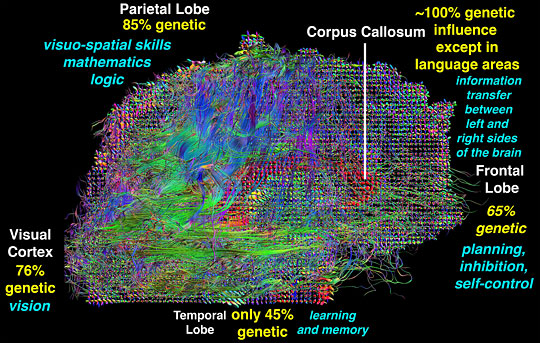
This colorful brain image is like a map of mental speed. The bright spaghetti structures represent the pathways connecting different brain cells.

An image of the pathways of the brain.
David Shattuck/Arthur Toga/Paul Thompson/UCLA

This DTI brain scan shows more of the brain's wiring. Thompson says not only are these brain scans beautiful but "these images really give you a picture of the mental speed of the brain."

All Things Considered, March 20, 2009 · The smarter the person, the faster information zips around the brain, a UCLA study finds. And this ability to think quickly apparently is inherited.

The study, published in the Journal of Neuroscience, looked at the brains and intelligence of 92 people. All the participants took standard IQ tests. Then the researchers studied their brains using a technique called diffusion tensor imaging, or DTI.

Capturing Mental Speed

DTI is a variant of magnetic resonance imaging (MRI) that can measure the structural integrity of the brain's white matter, which is made up of cells that carry nerve impulses from one part of the brain to another. The greater the structural integrity, the faster nerve impulses travel.

"These images really give you a picture of the mental speed of the brain," says Paul Thompson, Ph.D., a professor of neurology at UCLA School of Medicine.

They're also "the most beautiful images of the brain you could imagine," Thompson says. "My daughter, who's 5, says they look like little flowers at each point in the brain."

Thompson says DTI scans of the 92 participants in the study revealed a clear link between brain speed and intelligence.

"When you say someone is quick-thinking, it's genuinely true," Thompson says. "The impulses are going faster and they are just more efficient at processing information, and then making a decision based on it."

Inherited Ability

Thompson's study also found that genetic factors played a big role in brain speed.

The team was able to figure this out because the 92 people in their study were all twins. Some were identical twins, who share all the same genes. Others were non-identical twins, who share only certain genes.

By comparing the groups, the researchers were able to tease out genes associated with the structural integrity of white matter. And it turned out many of these genes were also associated with intelligence.

Richard Haier, Ph.D., emeritus professor at the University of California, Irvine, says this may explain something scientists have been wondering about for a long time.

"We know that intelligence has some genetic component," he says. "And what the Thompson study is showing is that a large part of the genetic aspect of intelligence has to do with the white matter tracks that connect different parts of the brain."

Don't Give Up Just Yet

Haier says the good news is that we're not necessarily stuck with the brain, or the brain speed, we inherit. He says thinking is like running or weightlifting. It helps to have certain genes. But anyone can get stronger or faster by working out.

The brain is like a muscle, Haier says: "The more you work it the more efficient it gets."

So people who practice the violin, or do math problems, or learn a foreign language are constantly strengthening certain pathways in their brains.

And Thompson notes that our brains, unlike our bodies, peak relatively late in life.

"The wires between the brain cells, the connections, are the things that you can modify throughout life," he says. "They change and they improve through your 40s and 50s and 60s."

Thompson says there are practical, as well as academic, reasons to measure brain speed.

The technique can spot problems such as Alzheimer's disease, which slows down the brain. And because the scans are so sensitive, they can show whether new drugs for Alzheimer's are actually working.


Paradox Art21: Art in the Twenty-First Century

Contemporary artists address contradiction, ambiguity, and truth.


Nightline Face-Off - Does Satan Exist?

Wow, people still believe rather strongly in the old myths.

Philosopher Deepak Chopra and Bishop Carlton Pearson face-off against Pastor Mark Driscoll of the Mars Hill Church and Annie Lobert, founder of the Christian ministry "Hookers for Jesus" about the existence of the Devil.

We are essentially witnessing here a battle between a pre-modern mythic worldview and more modern/postmodern worldviews based in rational spirituality. Chopra is the most "spiritual" of the panelists, but he fails to really address the problem of the pre-modern worldview being espoused by the fundamentalists on the panel.
  • 'Healthy People Don't Need Satan'
    Satan Face-off 1: Deepak Chopra and Pastor Mark share their opening statements.
  • 'The Devil Almost Took My Life'
    Satan Face-off 2: Annie Lobert and Bishop Pearson share their sides on Satan.
  • Fairytale Versus Faith
    Satan Face-off 3: Arguing Satan's existence, by examining the existence of God.
  • The Bible Has Borrowed a Lot of Myth?
    Satan Face-off 4: Panelists argue whether bible was inspired by God or by Man.
  • Driscoll Slams Pearson's Religious History
    Satan Face-off 5: Rhetoric heats up as panelists take jabs at each other.
  • 'I Was Attacked by Demons'
    Satan Face-off 6: Lobert gives wrenching testimony about her encounter with evil
  • Lobert 'Created' Demon Visions
    Satan Face-off 7: Chopra and Pearson discuss Lobert's 'Psychological Dungeon'
  • God and Satan: 'They Define Each Other'
    Satan Face-Off 8: The audience questions the panelist on faith and selfishness.
  • Audience Members Spar During Debate
    Satan Face-off 9: Woman accuses Chopra of attacking Jesus.
  • Closing Arguments: Tears and Testimony
    Satan Face-off 10: Final thoughts bring the face-off to a conclusion.

  • Sunday, April 05, 2009

    Poem a Day, April 5

    April 5, 2009


    *


    memory is a ruins of fallen leaves,
    strewn bodies, broken glass

    the 3 am hauntings, morning
    unable to clear the debris

    so I crawl into the past
    with some crayons and paint

    some color here, a scribble
    on that wall, flowers planted

    and just like that, arches where
    nothing stood, grave stones

    mark the burial of shadows,
    and the cessation of hauntings


    * image by Hareguizer, Chapter House


    The Right's Nationalistic Ignorance

    I sometimes struggle to understand how the right thinks because it is so different from how I or my friends think. I try to hold a worldcentric view, though not a relativist one. So when I read something like the following from the right-wing Big Hollywood blog, it boggles my mind.

    This kind of anti-progress, ethnocentric nationalism is a big part of the conservative worldview. To me, it strikes me as ostrich-like, head buried in the sand. Anyone who disagrees with their view is anti-American

    With the advent of World War I, we became a global community, for good or ill. At this point in time, we are much more interdependent than the author of this post can grasp. We can't undo that anymore than we can turn back time.

    Our Exceptionalism Comes From Our Constitution

    by Doug TenNapel

    I’m not a big Global Citizen. I’m not proud of how the world conducts itself, it has a terrible history and there’s nothing great about humanity other than we have a great Creator. Mankind’s achievement is only consistent in how spotty it is. Intelligence has only made us immoral with more knowledge. Technology has brought us ways to destroy more lives and project more misery with less effort and more efficiency.

    Individual countries pale compared to America. So contrast my relative shame as a global citizen with my pride, excitement and honor of being a member of the United States of America. Our country is the best. I’d say that we’re not perfect, but I hate opening any kind of door for the America haters to drive their Prius through. We have good standards, fund charities around the world and have left more of our bodies in the graveyards of other countries to defend and expand liberty than any other country in the history of the world. Our economy is the singularity of the Big Bang from which prosperity flows to the rest of the world.

    So it pains me to watch my President stand among the G20 leaders as he works hard to fit in with a bunch of really stupid countries. I admit it, I’m a jealous citizen and I don’t like to share the attention and will of my president with the rest of the world. He’s mine, not theirs. The world may think they elected President Obama, and perhaps even Obama may think that, but I don’t have a vote in the Global Community. I don’t get to participate in how China must conduct herself so I’d rather my president not give away our power, treasure and values to fit in with a global consensus of lesser countries than our own.

    The post goes to explain why Constitution makes us the best country on Earth.

    This kind of thinking in the 21st Century really seems regressive in so many ways. Makes me happy to think that the Millennials are much more likely to hold a worldcentric view.


    All in the Mind - Thomas Szasz speaks (Part 1 of 2)

    Thomas Szasz has been a renegade in the field of psychology for several decades now. He has repeated and pointedly criticized the use of drugs in psychiatry. While I often disagree with him on many topics, his arguments are thought-provoking.

    This is from the Wikipedia article linked to above:

    Szasz is a critic of the influence of modern medicine on society, which he considers to be the secularisation of religion's hold on humankind. Criticizing scientism, he targets in particular psychiatry, underscoring its campaigns against masturbation at the end of the 19th century or the use of lobotomy to treat schizophrenia. To sum up his conception of medicine, he declared:

    Since theocracy is the rule of God or its priests, and democracy the rule of the people or of the majority, pharmacracy is therefore the rule of medicine or of doctors.[1]

    He considers that:

    "The struggle for definition is veritably the struggle for life itself. In the typical Western two men fight desperately for the possession of a gun that has been thrown to the ground: whoever reaches the weapon first shoots and lives; his adversary is shot and dies. In ordinary life, the struggle is not for guns but for words; whoever first defines the situation is the victor; his adversary, the victim. For example, in the family, husband and wife, mother and child do not get along; who defines whom as troublesome or mentally sick?...[the one] who first seizes the word imposes reality on the other; [the one] who defines thus dominates and lives; and [the one] who is defined is subjugated and may be killed."[2]

    His main arguments can be summarised as follows:

    • The myth of mental illness: It is a medical metaphor to describe a behavioral disorder, such as schizophrenia, as an "illness" or "disease". Szasz wrote: "If you talk to God, you are praying; If God talks to you, you have schizophrenia. If the dead talk to you, you are a spiritualist; If you talk to the dead, you are a schizophrenic."[2] While people behave and think in ways that are very disturbing, this does not mean they have a disease. To Szasz, people with mental illness have a "fake disease," and these "scientific categories" are in fact used for power controls. Schizophrenia is "the sacred symbol of psychiatry" and, according to Szasz, is not really an illness. To be a true disease, the entity must somehow be capable of being approached, measured, or tested in scientific fashion. According to Szasz, disease must be found on the autopsy table and meet pathological definition instead of being voted into existence by members of the American Psychiatric Association. Mental illnesses are "like a" disease, argues Szasz, putting mental illness in a semantic metaphorical language arts category. Psychiatry is a pseudo-science that parodies medicine by using medical sounding words invented over the last 100 years. To be clear, heart break and heart attack belong to two completely different categories. Psychiatrists are but "soul doctors", the successors of priests, who deal with the spiritual "problems in living" that have troubled people forever. Psychiatry, through various Mental Health Acts has become the secular state religion according to Thomas Szasz. It is a social control system, which disguises itself under the claims of scientificity. The notion that biological psychiatry is a real science or a genuine branch of medicine has been challenged by other critics as well, such as Michel Foucault in Madness and Civilization (1961).
    • Separation of psychiatry and the state: State government by enforcing the use of shock therapy has abused Psychiatry with impunity.[3] If we accept that "mental illness" is a euphemism for behaviors that are disapproved of, then the state has no right to force psychiatric "treatment" on these individuals. Similarly, the state should not be able to interfere in mental health practices between consenting adults (for example, by legally controlling the supply of psychotropic drugs or psychiatric medication). The medicalization of government produces a "therapeutic state," designating someone as "insane" or as a "drug addict". In Ceremonial Chemistry (1973), he argued that the same persecution which has targeted witches, Jews, Gypsies or homosexuals now targets "drug addicts" and "insane" people. Szasz argued that all these categories of people were taken as scapegoats of the community in ritual ceremonies. To underscore this continuation of religion through medicine, he even takes as example obesity: instead of concentrating on junk food (ill-nutrition), physicians denounced hypernutrition. According to Szasz, despite their scientific appearance, the diets imposed were a moral substitute to the former fasts, and the social injunction not to be overweight is to be considered as a moral order, not as a scientific advice as it claims to be. As with those thought bad (insane people), those who took the wrong drugs (drug-addicts), medicine created a category for those who had the wrong weight (obeses). Szasz argued that psychiatrics were created in the 17th century to study and control those who erred from the medical norms of social behavior; a new specialization, drogophobia, was created in the 20th century to study and control those who erred from the medical norms of drug consumption; and then, in the 1960s, another specialization, bariatrics, was created to deal with those who erred from the medical norms concerning the weight which the body should have. Thus, he underscores that in 1970, the American Society of Bariatic Physicians (from the Greek baros, weight) had 30 members, and already 450 two years later.
    • Presumption of competence: Just as legal systems work on the presumption that a person is innocent until proven guilty, individuals accused of crimes should not be presumed incompetent simply because a doctor or psychiatrist labels them as such. Mental incompetence should be assessed like any other form of incompetence, i.e., by purely legal and judicial means with the right of representation and appeal by the accused.
    • Death control: In an analogy to birth control, Szasz argues that individuals should be able to choose when to die without interference from medicine or the state, just as they are able to choose when to conceive without outside interference. He considers suicide to be among the most fundamental rights, but he opposes state-sanctioned euthanasia. In his 2006 book about Virginia Woolf he stated that she put an end to her life by a conscious and deliberate act, her suicide being an expression of her freedom of choice.[4][5]
    • Abolition of the insanity defense: Szasz believes that testimony about the mental competence of a defendant should not be admissible in trials. Psychiatrist testifying about the mental state of an accused person's mind have about as much business as a priest testifying about the religious state of a person's soul in our courts. Insanity was a legal tactic invented to circumvent the punishments of the Church, which, at the time included confiscation of the property of those who committed suicide, which often left widows and orphans destitute. Only an insane person would do such a thing to his widow and children, it was successfully argued. Legal mercy masquerading as medicine, said Szasz.
    • Abolition of involuntary hospitalization: No one should be deprived of liberty unless he is found guilty of a criminal offense. Depriving a person of liberty for what is said to be his own good is immoral. Just as a person suffering from terminal cancer may refuse treatment, so should a person be able to refuse psychiatric treatment.
    • Our right to drugs: Drug addiction is not a "disease" to be cured through legal drugs (Methadone instead of heroin; which forgets that heroin was created in the first place to be a substitute to opium), but a social habit. Szasz also argues in favor of a drugs free-market. He criticized the war on drugs, arguing that using drugs was in fact a victimless crime. Prohibition itself constituted the crime. He shows how the war on drugs lead states to do things that would have never been considered half a century before, such as prohibiting a person from ingesting certain substances or interfering in other countries to impede the production of certain plants (e.g. coca eradication plans, or the campaigns against opium; both are traditional plants opposed by the Western world). Although Szasz is skeptical about the merits of psychotropic medications, he favors the repeal of drug prohibition. "Because we have a free market in food, we can buy all the bacon, eggs, and ice cream we want and can afford. If we had a free market in drugs, we could similarly buy all the barbiturates, chloral hydrate, and morphine we want and could afford." Szasz argued that the prohibition and other legal restrictions on drugs are enforced not because of their lethality, but in a ritualistic aim (he quotes Mary Douglas's studies of rituals). He also recalls that pharmakos, the Greek root of pharmacology, originally meant "scapegoat". Szasz dubbed pharmacology "pharmacomythology" because of its inclusion of social practices in its studies, in particular through the inclusion of the category of "addictiveness" in its programs. "Addictiveness" is a social category, argued Szasz, and the use of drugs should be apprehended as a social ritual rather than exclusively as the act of ingesting a chemical substance. There are many ways of ingesting a chemical substance, or drug (which comes from pharmakos), just as there are many different cultural ways of eating or drinking. Thus, some cultures prohibit certain types of substances, which they call "taboo", while they make use of others in various types of ceremonies.

    Szasz has been associated with the anti-psychiatry movement of the 1960s and 1970s, although he has resisted being identified as an anti-psychiatrist. He is not opposed to the practice of psychiatry if it is non-coercive. He maintains that psychiatry should be a contractual service between consenting adults with no state involvement. In a 2006 documentary film called Psychiatry: An Industry of Death released on DVD Szasz stated that involuntary mental hospitalization is a crime against humanity. Szasz also believes that, if unopposed, involuntary hospitalization will expand into "pharmacratic" dictatorship.

    This week's (and next) All in the Mind podcast is a discussion with Szasz.

    Thomas Szasz speaks (Part 1 of 2)

    In 1961 maverick psychiatrist and libertarian Professor Thomas Szasz published his controversial and influential epic, The Myth of Mental Illness. In it he argued that mental illness is a fiction and a medical metaphor. Half a century later he maintains we live in a therapeutic state—a 'pharmacracy' where psychiatry is synonymous with coercion. On the eve of his 89th birthday he joins Natasha Mitchell in conversation over two weeks about his contentious legacy.

    Show Transcript | Hide Transcript

    Transcripts published Wednesdays. Audio published by Saturday afternoons.

    Guests

    Professor Thomas Szasz
    Professor of Psychiatry Emeritus
    State University of New York Health Science Center
    Syracuse, New York
    http://www.szasz.com/

    Further Information

    We welcom your comments on Professor Szasz's interview - join Natasha Mitchell in the All in the Mind blog

    Mind and Mood on the ABC's Health and Wellbeing's Online gateway

    All in the Mind on twitter

    Email the program
    Have a go at posting your comments to the blog too, to share your thoughts with others. It's easy to do.

    Publications

    Title: Szasz Under Fire: The Psychiatric Abolitionist Faces His Critics
    Author: Edited by Jeffrey A Schaler
    Publisher: 2004
    Contributors include Thomas Szasz, R.R Kendell, K.W.M Fulford, Ray Scott Percival, Ralph Slovenko, Stanton Peele, Rita J. Simon, E. James Lieberman, Margaret A. Hagen, Margaret P. Battin and Ryan Spellecy, Richard Bentall, Ronald Pies, H. Tristam Engelhardt, Jr.

    Title: The Medicalization of Everyday Life - Selected Essays
    Author: Thomas Szasz
    Publisher: Syracuse University Press, 2007
    ISBN-13 978-0-8156-0867-7

    Title: The Myth of Mental Illness: Foundations of a Theory of Personal Conduct
    Author: Thomas Szasz
    Publisher: 1984 Harper Perennial (Revised edition), first published 1961.

    Title: The Myth of Mental Illness (original journal paper)
    Author: Thomas S. Szasz
    Publisher: American Psychologist, 15, 113-118. 1960
    URL: http://psychclassics.yorku.ca/Szasz/myth.htm
    This became the basis of Thomas Szasz's book of the same title, published the year later.

    Title: The Myth of Psychotherapy
    Author: Thomas Szasz
    Publisher: Syracuse University Press, 1988.
    ISBN-10: 0815602235

    Title: Psychiatry: The Science of Lies
    Author: Thomas Szasz
    Publisher: Syracuse University Press, 2008

    Title: Coercion As Cure: A Critical History of Psychiatry
    Author: Thomas S. Szasz
    Publisher: Transaction Publishers, 2007

    Presenter

    Natasha Mitchell

    Producer

    Natasha Mitchell/Anita Barraud