Showing posts with label income. Show all posts

Sunday, April 27, 2014

Can Thomas Piketty's "Capital in the Twenty-First Century" Inspire Real Change?


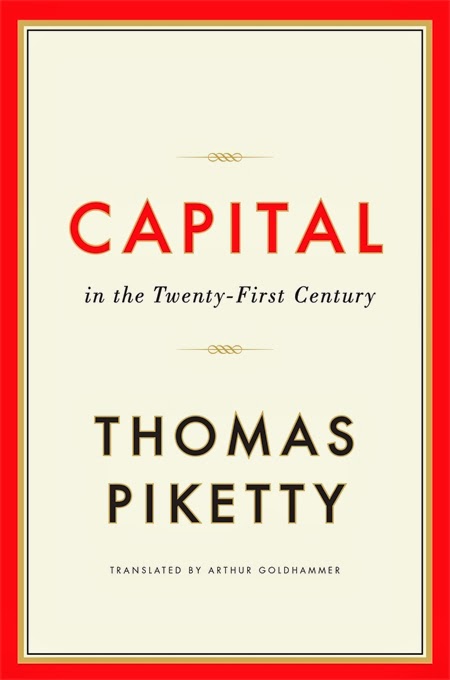
It's rare for economist who is relatively unknown to have the #1 book at Amazon, but Thomas Piketty, author of Capital in the Twenty-First Century, has done so.

Everywhere I look lately there is someone offering commentary on and support of this "revolutionary" book. Here is a selection of recent articles/videos about the book, including a talk by the author.

Here are the questions he's trying to answer in Capital:
The distribution of wealth is one of today’s most widely discussed and controversial issues. But what do we really know about its evolution over the long term? Do the dynamics of private capital accumulation inevitably lead to the concentration of wealth in ever fewer hands, as Karl Marx believed in the nineteenth century? Or do the balancing forces of growth, competition, and technological progress lead in later stages of development to reduced inequality and greater harmony among the classes, as Simon Kuznets thought in the twentieth century? What do we really know about how wealth and income have evolved since the eighteenth century, and what lessons can we derive from that knowledge for the century now under way?
To begin, here is Piketty himself talking about the thesis of his book, followed by Elizabeth Warren offering her well-educated perspective, then a LOT of article teasers to offer a variety of perspectives.


Thomas Piketty on Wealth, Income, and Inequality


Elizabeth Warren Weighs In On The Thomas Piketty Phenomenon


* * * * *

Will Hutton from The Guardian:

Capitalism simply isn't working and here are the reasons why

Economist Thomas Piketty's message is bleak: the gap between rich and poor threatens to destroy us
Suddenly, there is a new economist making waves – and he is not on the right. At the conference of the Institute of New Economic Thinking in Toronto last week, Thomas Piketty's book Capital in the Twenty-First Century got at least one mention at every session I attended. You have to go back to the 1970s and Milton Friedman for a single economist to have had such an impact.

Like Friedman, Piketty is a man for the times. For 1970s anxieties about inflation substitute today's concerns about the emergence of the plutocratic rich and their impact on economy and society. Piketty is in no doubt, as he indicates in an interview in today's Observer New Review, that the current level of rising wealth inequality, set to grow still further, now imperils the very future of capitalism. He has proved it.

* * * * *

Heidi Moore at Common Dreams (via The Guardian):

Can Thomas Piketty Re-Write the American Dream?

by Heidi Moore
Published on Sunday, April 27, 2014 by The Guardian


Piketty's immaculate research establishes that the American dream – and more broadly, the egalitarian promise of Western-style capitalism – does not, and maybe cannot, deliver on its promises. Photo: Ed Alcock for the Observer
When the movie is made about the fall of Western capitalism, Thomas Piketty will be played by Colin Firth. Piketty, whom the Financial Times called a "rock-star economist", isn't a household name – but he should be, and he has a better shot than any other economist. He is the author and researcher behind a 700-page economic manifesto, titled Capital in the 21st Century, that details the path of income inequality over several hundred years.

This sublime nerdishness is, somehow, a huge hit. It is now No 1 on Amazon's bestseller list and sold out in many bookstores. When Piketty spoke on a panel this month at New York's CUNY with three other economists – two of them Nobel-prize winners, Joseph Stiglitz and Paul Krugman – the Frenchman was the headliner. The event was so packed that the organizers had to create three overflow rooms. Weeks after the release of Capital, intellectuals are still salivating, even calling Piketty the new de Tocqueville.
* * * * *

Justin Fox at the Harvard Business Review:

Piketty’s “Capital,” in a Lot Less than 696 Pages

by Justin Fox | April 24, 2014

It was only published in English a few weeks ago, but French economist Thomas Piketty’s Capital in the Twenty-First Century has already become inescapable. The reasons start with the confluence of subject matter and author. There’s a lot of interest in economic inequality these days, and research conducted over the past 15 years by Piketty, a professor at the Paris School of Economics, is a big reason why. In the U.S., Piketty and UC Berkeley’s Emmanuel Saez transformed a tame discussion of income quintiles and deciles into a sharp debate about the skyrocketing incomes of the 1% — and the mind-boggling gains of the 0.1% and 0.01% — by gathering and publishing income tax data that nobody had bothered with before. Piketty was behind similar projects in France, Britain, Japan, and other countries.

And now this book. It is massive (696 pages) and massively ambitious (the title is a very conscious echo of Karl Marx’s Das Kapital). It came out in France last year to great acclaim, which meant that those in the English-speaking world who pay attention to such matters knew that something big was coming. Over the past few weeks it has become one of those things that everybody’s talking about just because everybody’s talking about it. That, and it really is important.
* * * * *


Sean McElwee at Salon:


Welcome to the Piketty revolution: “Capital in the 21st Century” is a game-changer (even if you never read it)

"Capital in the 21st Century" is an unexpected bestseller that could actually change the world 
Sean McElwee | Sunday, Apr 27, 2014 

Welcome to the Piketty revolution: "Capital in the 21st Century" is a game-changer (even if you never read it) 
Thomas Piketty (Credit: Reuters/Charles Platiau/Salon)
 
Anyone who’s anyone (and many more who aren’t) has written something this week about “Capital in the 21st Century,” the new treatise on income inequality by French economist Thomas Piketty.
The book was actually published early last month by Harvard University Press, but arrived to fanfare only within the insular, if august, community of economic policy researchers. So, on arrival, it might have seemed like the 700-page tome, with its academic tone and laboriously documented historical analyses, was destined to a life of obscurity. But then something strange happened. People — regular people — started to buy it in droves. By the time “Capital” surged to the top of the charts this week — so many physical copies of the book were sold that Amazon actually ran out of inventory — Thomas Piketty had become the most famous economist this side of Paul Krugman, celebrated on the left and reviled on the right.

At this point, a review or discussion of “Capital” is almost a rite of passage for an aspiring wonk. (You can read this writer’s here.) But the one question that hangs over Piketty’s meteoric rise is, in a way, the most obvious one: What does any of this actually mean?
 * * * * *

From at Updated Priors:

Capital in partial equilibrium

Tuesday, March 25, 2014
Review: Thomas Piketty, Capital in the Twenty-First Century

Piketty's primary contribution is to provide an impressive array of data on wealth and income, for several countries, beginning as early as the 1700s in some cases. Note that he does not examine consumption data. The book is an impressive feat and certainly deserves attention, as the facts Piketty provides are crucial to discussions of the evolution of capital and economic inequality in the rich countries. Many reviews have been very positive; there are a lot of positive things I could say about it, but I will leave that to others. The book suffers from some fundamental flaws; in short, while it is heavy on data it is light on serious economics. Readers will find themselves wading through hundreds of pages of opinion and ideological quips, not economic analysis, with interesting charts scattered throughout. The firehose of data can be overwhelming, which may explain why some reviewers internalized his arguments uncritically. Piketty's accomplishments with data collection are admirable. But a book of this size, with the title Capital, should include some economics.

Piketty's data on inheritance are the most interesting and persuasive to me. Inheritance still matters and plays a nontrivial role in the wealth and income distribution. Reducing wealth inequality over time, should we decide to do so, will require serious attention to the issue of inheritance, which more than any other issue lacks a tie to meritocracy (but that does not mean incentives stop mattering!). There may be other arguments, not based solely on inequality, for thinking about inheritance. That said, not all capital is created equal, and the book could have benefited from some focus on distinctions between capital types--particularly in the context of inheritance.

Sunday, June 30, 2013

Mark Engler - Should There Be a Maximum Wage?

It has been my position over the past decade or more that no human being is worth more than $1 million/year in salary. Further, those at the highest incomes should be those whose work is most crucial to a society's well-being: teachers, law enforcement, fire fighters, mental health professionals, physicians, and so on.

Athletes, musicians, actors and the like are often the highest paid people, aside from corporate CEOs, and I can't see that their incomes reflect their value to the society. And with CEOs, the disparity between the average employee salary and that of the CEO is often WAY out of proportion ("A typical American CEO now makes 380 times what the average worker in the country earns").

One proposal that is a step in the right direction is to the 100:1 ratio - that no CEO should make more than 100 times that of the lowest paid employee (in a company where entry level is $30K, the CEO would be limited to $3 million), Personally, I would cap that 100:1 at $1 million, i.e., the CEO can earn 100 times the lowest paid employment, but not more than $1 million.

I'm beginning to sound like some kind of socialist or Marxist.

Should There Be a Maximum Wage?

Countries like Egypt and Switzerland have placed regulations on how much executives can earn. Here’s why the U.S. should consider doing the same.


by Mark Engler
posted Jun 27, 2013

This article originally appeared in The New Internationalist.


Should our societies have a "maximum wage"? Would the world be better off if the United States had one?

Currently, Americans are debating raising the national minimum wage from $7.25 per hour to $10 per hour over the next two years. While conservatives will oppose it, such a boost shouldn't be contentious.

Such limits would motivate CEOs to augment the pay of their workers because their own raises would depend on it.

Back in 1967, the U.S. minimum wage was $1.40 per hour. That's not as measly as it sounds. Your grandparents’ tales about when ten pennies could actually buy something are not mere nostalgia. In fact, the 1967 wage had 20 percent more purchasing power than the current minimum.

Economic productivity is an even bigger part of the story. Our labor is producing more value today, but working people aren’t seeing any of the gains. Had the U.S. minimum wage kept pace with productivity increases since 1960, it would now be $22 per hour.

Who has walked away with the proceeds from all that productivity? It's a fair question, but it leads back to discussion of a maximum wage. And that's where things get controversial.

A January report from Oxfam noted, “The richest one percent has increased its income by 60 percent in the last 20 years.” It further argued that the 2012 net income of the world's top 100 billionaires—a haul of $240 billion—would be four times the amount needed to eliminate extreme poverty internationally.

While regions such as Latin America have made strides in reducing the gap between the rich and poor in the past decade, the United States has led the way in manufacturing excess at the expense of equity.

To remedy this, Larry Hanley of the Amalgamated Transport Workers Union recently proposed a “maximum wage” law that would limit an employer's income to being no more than 100 times the salary of his or her lowest-paid employee. If an entry-level worker gets $30,000 per year, the CEO would make no more than $3 million.

Other countries provide precedent for such a policy. “In Spain, the manufacturing and retail enterprises that belong to the Mondragón cooperative network limit top pay to three to nine times worker compensation,” explains author and policy analyst Sam Pizzigati, perhaps the most outspoken U.S. proponent of a maximum wage. Since 2011, Egypt and France have each pursued fixed pay ratios for leaders of state-owned enterprises. Even Switzerland, a country not known for being inhospitable to bankers, has passed restrictions on pay for bank executives and banned “golden parachute” severance packages.

Some advocates contend that a maximum wage should apply only to businesses receiving taxpayer support—in the form of bailouts, government contracts, tax abatements, or other public subsidies. Since American industry has been notoriously hungry for corporate welfare, this would cover a large portion of the U.S. economy.

Free marketeers will no doubt blast the idea of a maximum wage as the type of insane socialistic tyranny that chains everyone into the same, lowly state of mediocrity. Yet a ceiling based on a ratio between the executives at the top of a business and the grunts at the bottom doesn't set a hard cap on earnings. It merely puts to the test one of their most cherished claims: that the profits of a successful enterprise trickle down to benefit everyone.

Economists love to talk about incentives. In this case, such limits would motivate CEOs to augment the pay of their janitors, secretaries, and cashiers for a simple reason: Their own raises would depend on it.

Besides, a 100-to-1 discrepancy is hardly government-enforced equality.

It would be a considerable departure from the status quo, however. A typical American CEO now makes 380 times what the average worker in the country earns (never mind the lowest-paid).

That's not an example the world needs. And it's something that will take more than just a small boost in the minimum to fix.


~ Mark Engler is a senior analyst with Foreign Policy In Focus and author of How to Rule the World: The Coming Battle Over the Global Economy (Nation Books, 2008). He can be reached via DemocracyUprising.com. He is a contributor to The New Internationalist, where this article originally appeared.

Saturday, May 19, 2012

TED Talks Editors Reject Nick Hanauer's Talk on Income Inequality

This controversy has been all over Facebook (and I am sure other sites as well) as the video too hot for TED to post. The National Journal (not to be confused with the right-wing National Review) has provided a pretty good overview of the controversy.

Over the years I have learned that people love to get bent our of shape about material that is not posted - as if somehow the mere fact of it being withheld makes it important. TED does not post all of he videos they record, even at their flagship events, so I assumed this was not worth paying attention to.

However, it turns out that the topic is one I care a lot about and feel is something we MUST address if we hope to solve some of the problems in this country - income inequality. There is a reason Marx's ideas have been receiving a lot more attention in the last few years - the disparity of wealth in this country is staggering.

Too Hot for TED: Income Inequality


Seattle venture capitalist named Nick Hanauer

May 16, 2012

Here is the bulk of the article, with links to relevant materials. It appears that part of their reasons for not posting this is that Hanauer makes partisan political statements and TED has tried to be non-partisan, which has been an on-going struggle with the locally produced TEDx talks. Take that for what it's worth.

There’s one idea . . . that TED’s organizers recently decided was too controversial to spread: the notion that widening income inequality is a bad thing for America, and that as a result, the rich should pay more in taxes.

(RELATED: The Speech That's Too Hot for TED)

TED organizers invited a multimillionaire Seattle venture capitalist named Nick Hanauer – the first nonfamily investor in Amazon.com – to give a speech on March 1 at their TED University conference. Inequality was the topic – specifically, Hanauer’s contention that the middle class, and not wealthy innovators like himself, are America’s true “job creators.”

(RELATED: The Slides That Are Too Hot for TED)

“We’ve had it backward for the last 30 years,” he said. “Rich businesspeople like me don’t create jobs. Rather they are a consequence of an ecosystemic feedback loop animated by middle-class consumers, and when they thrive, businesses grow and hire, and owners profit. That’s why taxing the rich to pay for investments that benefit all is a great deal for both the middle class and the rich.”

You can’t find that speech online. TED officials told Hanauer initially they were eager to distribute it. “I want to put this talk out into the world!” one of them wrote him in an e-mail in late April. But early this month they changed course, telling Hanauer that his remarks were too “political” and too controversial for posting.

Other TED talks posted online veer sharply into controversial and political territory, including NASA scientist James Hansen comparing climate change to an asteroid barreling toward Earth, and philanthropist Melinda Gates pushing for more access to contraception in the developing world.
TED curator Chris Anderson referenced the Gates talk in an e-mail to colleagues in early April, which was also sent to Hanauer, suggesting that he didn't want to release Hanauer’s talk at the same time as the one on contraception.

Hanauer’s talk “probably ranks as one of the most politically controversial talks we've ever run, and we need to be really careful when” to post it, Anderson wrote on April 6. “Next week ain't right. Confidentially, we already have Melinda Gates on contraception going out. Sorry for the mixed messages on this.”

In early May Anderson followed up with Hanauer to inform him he’d decided not to post his talk.
National Journal e-mailed Anderson to request an interview about what made a talk on inequality more politically controversial than, for example, contraception or climate change. Anderson, who is traveling abroad, responded with an e-mail statement that appeared to swipe at the popularity of Hanauer’s speech.

"Many of the talks given at the conference or at TED-U are not released,” Anderson wrote. “We only release one a day on TED.com and there's a backlog of amazing talks from all over the world. We do not comment publicly on reasons to release or not release [a] talk. It's unfair on the speakers concerned. But we have a general policy to avoid talks that are overtly partisan, and to avoid talks that have received mediocre audience ratings."

You can read the text of Hanauer’s talk here

You can read the full story of Hanauer and his warnings about the decline of the middle class on Thursday as part of National Journal’s Restoration Calls series.

Update: 4:09 p.m.

In a May 7 email to Hanauer, forwarded to NJ, Anderson took issue with several of Hanauer's assertions in the talk, including the idea that businesspeople aren't job creators. He also made clear his aversion to the "political" nature of the talk.

"I agree with your language about ecosystems, and your dismissal of some of the mechanistic economy orthodoxy, yet many of your own statements seem to go further than those arguments justify," Anderson wrote.

"But even if the talk was rated a home run, we couldn't release it, because it would be unquestionably regarded as out and out political. We're in the middle of an election year in the US. Your argument comes down firmly on the side of one party. And you even reference that at the start of the talk. TED is nonpartisan and is fighting a constant battle with TEDx organizers to respect that principle....

"Nick, I personally share your disgust at the growth in inequality in the US, and would love to have found a way to give people a clearer mindset on the issue, without stoking a tedious partisan rehash of all the arguments we hear every day in the mainstream media.

"Alas, my judgment - and it is just a judgment, and that's why my job title is 'curator' - is that publishing your talk would not meet that goal."

Tuesday, March 01, 2011

Dr. Hans Rosling Explains Last 200 Years of World Progress in 4 Minutes (The Joy of Stats)

Several friends have posted this BBC video of a very enthusiastic Dr. Hans Rosling explaining the past 200 years of world progress in only four minutes using a fascinating graph. You can check it out below:
Hans Rosling's 200 Countries, 200 Years, 4 Minutes - The Joy of Stats

Hans Rosling's famous lectures combine enormous quantities of public data with a sport's commentator's style to reveal the story of the world's past, present and future development. Now he explores stats in a way he has never done before - using augmented reality animation. In this spectacular section of 'The Joy of Stats' he tells the story of the world in 200 countries over 200 years using 120,000 numbers - in just four minutes. Plotting life expectancy against income for every country since 1810, Hans shows how the world we live in is radically different from the world most of us imagine.