Via Aeon . . .
Box
Where does reality end and digital space begin? Projection mapping shifts the bounds of visual expression and perception.
Bot & Dolly
5 MINUTES
Can’t Place That Smell? You Must Be American
How Culture Shapes Our Senses

T. M. Luhrmann
SEPT. 5, 2014
Credit Marion Fayolle
FLORENCE, Italy — WE think of our senses as hard-wired gateways to the world. Many years ago the social psychologist Daryl J. Bem described the knowledge we gain from our senses as “zero-order beliefs,” so taken for granted that we do not even notice them as beliefs. The sky is blue. The fan hums. Ice is cold. That’s the nature of reality, and it seems peculiar that different people with their senses intact would experience it subjectively.
Yet they do. In recent years anthropologists have begun to point out that sensory perception is culturally specific. “Sensory perception,” Constance Classen, the author of “The Deepest Sense: A Cultural History of Touch,” says, “is a cultural as well as physical act.” It’s a controversial claim made famous by Marshall McLuhan’s insistence that non-literate societies were governed by spoken words and sound, while literate societies experienced words visually and so were dominated by sight. Few anthropologists would accept that straightforwardly today. But more and more are willing to argue that sensory perception is as much about the cultural training of attention as it is about biological capacity.
Now they have some quantitative evidence to support the point. Recently, a team of anthropologists and psychologists at the Max Planck Institute for Psycholinguistics and Radboud University, both in Nijmegen, the Netherlands, set out to discover how language and culture affected sensory awareness. Under the leadership of Asifa Majid and Stephen C. Levinson, they made up a kit of systematic stimuli for the traditional five senses: for sight, color chips and geometric forms; for hearing, pitch, amplitude and rhythm variations; for smell, a set of scratch-and-sniff cards; and so forth. They took these kits to over 20 cultural groups around the world. Their results upend some of our basic assumptions.
For example, it’s fairly common, in scientific literature, to find the view that “humans are astonishingly bad at odor identification and naming,” as a recent review of 30 years of experiments concluded. When ordinary people are presented with the smell of ordinary substances (coffee, peanut butter, chocolate), they correctly identify about half of them. That’s why we think of scent as a trigger for personal memory — leading to the recall of something specific, particular, uniquely our own.
It turns out that the subjects of those 30 years of experiments were mostly English-speaking. Indeed, English speakers find it easy to identify the common color in milk and jasmine flowers (“white”) but not the common scent in, say, bat droppings and the leaf of ginger root. When the research team presented what should have been familiar scents to Americans — cinnamon, turpentine, lemon, rose and so forth — they were terrible at naming them. Americans, they wrote, said things like this when presented with the cinnamon scratch-and-sniff card: “I don’t know how to say that, sweet, yeah; I have tasted that gum like Big Red or something tastes like, what do I want to say? I can’t get the word. Jesus it’s like that gum smell like something like Big Red. Can I say that? O.K. Big Red, Big Red gum.”
When the research team visited the Jahai, rain-forest foragers on the Malay Peninsula, they found that the Jahai were succinct and more accurate with the scratch-and-sniff cards. In fact, they were about as good at naming what they smelled as what they saw. They do, in fact, have an abstract term for the shared odor in bat droppings and the leaf of ginger root. Abstract odor terms are common among people on the Malay Peninsula.
The team also found that several communities — speakers of Persian, Turkish and Zapotec — used different metaphors than English and Dutch speakers to describe pitch, or frequency: Sounds were thin or thick rather than high or low. In later work, they demonstrated that the metaphors were powerful enough to disrupt perception. When Dutch speakers heard a tone while being shown a mismatched height bar (e.g., a high tone and a low bar) and were asked to sing the tone, they sang a lower tone. But the perception wasn’t influenced when they were shown a thin or thick bar. When Persian speakers heard a tone and were shown a bar of mismatched thickness, however, they misremembered the tone — but not when they were shown a bar mismatched for height.
The team also found that some of these differences could change over time. They taught the Dutch speakers to think about pitch as thin or thick, and soon these participants, too, found that their memory of a tone was affected by being shown a bar that was too thick or too thin. They found that younger Cantonese speakers had fewer words for tastes and smells than older ones, a shift attributed to rapid socioeconomic development and Western-style schooling.
I wrote this in Florence, Italy, a city famous as a feast for the senses. People say that Florence teaches you to see differently — that as the soft light moves across the ocher buildings, you see colors you never noticed before.
It taught Kevin Systrom, a co-founder of Instagram, to see differently. He attributes his inspiration to a photography class he took in Florence while at a Stanford study-abroad program about a decade ago. His teacher took away his state-of-the-art camera and insisted he use an old plastic one instead, to change the way he saw. He loved those photos, the vintage feel of them, and the way the buildings looked in the light. He set out to recreate that look in the app he built. And that has changed the way many of us now see as well.
~ T. M. Luhrmann is a professor of anthropology at Stanford and a contributing opinion writer.
When Gerald Edelman claimed, for instance, that “There is now a vast amount of empirical evidence to support the idea that consciousness emerges from the organization and operation of the brain” he assumed that the brain exists when unperceived (Edelman, 2004).So, the brain doesn't exist if there is no one to observe it? Bullshit. This kind of lazy thinking, if it's fair to call it "thinking," is why researchers outside the mainstream are so rarely taken seriously.
Objects of consciousness
Donald D. Hoffman [1] and Chetan Prakash [2]
1. Department of Cognitive Sciences, University of California, Irvine, CA, USA
2. Department of Mathematics, California State University, San Bernardino, CA, USAAbstract
Current models of visual perception typically assume that human vision estimates true properties of physical objects, properties that exist even if unperceived. However, recent studies of perceptual evolution, using evolutionary games and genetic algorithms, reveal that natural selection often drives true perceptions to extinction when they compete with perceptions tuned to fitness rather than truth: Perception guides adaptive behavior; it does not estimate a preexisting physical truth. Moreover, shifting from evolutionary biology to quantum physics, there is reason to disbelieve in preexisting physical truths: Certain interpretations of quantum theory deny that dynamical properties of physical objects have definite values when unobserved. In some of these interpretations the observer is fundamental, and wave functions are compendia of subjective probabilities, not preexisting elements of physical reality. These two considerations, from evolutionary biology and quantum physics, suggest that current models of object perception require fundamental reformulation. Here we begin such a reformulation, starting with a formal model of consciousness that we call a “conscious agent.” We develop the dynamics of interacting conscious agents, and study how the perception of objects and space-time can emerge from such dynamics. We show that one particular object, the quantum free particle, has a wave function that is identical in form to the harmonic functions that characterize the asymptotic dynamics of conscious agents; particles are vibrations not of strings but of interacting conscious agents. This allows us to reinterpret physical properties such as position, momentum, and energy as properties of interacting conscious agents, rather than as preexisting physical truths. We sketch how this approach might extend to the perception of relativistic quantum objects, and to classical objects of macroscopic scale.
Introduction
The human mind is predisposed to believe that physical objects, when unperceived, still exist with definite shapes and locations in space. The psychologist Piaget proposed that children start to develop this belief in “object permanence” around 9 months of age, and have it firmly entrenched just 9 months later (Piaget, 1954). Further studies suggest that object permanence starts as early as 3 months of age (Bower, 1974; Baillargeon and DeVos, 1991).
Belief in object permanence remains firmly entrenched into adulthood, even in the brightest of minds. Abraham Pais said of Einstein, “We often discussed his notions on objective reality. I recall that on one walk Einstein suddenly stopped, turned to me and asked whether I really believed that the moon exists only when I look at it” (Pais, 1979). Einstein was troubled by interpretations of quantum theory that entail that the moon does not exist when unperceived.
Belief in object permanence underlies physicalist theories of the mind-body problem. When Gerald Edelman claimed, for instance, that “There is now a vast amount of empirical evidence to support the idea that consciousness emerges from the organization and operation of the brain” he assumed that the brain exists when unperceived (Edelman, 2004). When Francis Crick asserted the “astonishing hypothesis” that “You're nothing but a pack of neurons” he assumed that neurons exist when unperceived (Crick, 1994).
Object permanence underlies the standard account of evolution by natural selection. As James memorably put it, “The point which as evolutionists we are bound to hold fast to is that all the new forms of being that make their appearance are really nothing more than results of the redistribution of the original and unchanging materials. The self-same atoms which, chaotically dispersed, made the nebula, now, jammed and temporarily caught in peculiar positions, form our brains” (James, 1890). Evolutionary theory, in the standard account, assumes that atoms, and the replicating molecules that they form, exist when unperceived.
Object permanence underlies computational models of the visual perception of objects. David Marr, for instance, claimed “We … very definitely do compute explicit properties of the real visible surfaces out there, and one interesting aspect of the evolution of visual systems is the gradual movement toward the difficult task of representing progressively more objective aspects of the visual world” (Marr, 1982). For Marr, objects and their surfaces exist when unperceived, and human vision has evolved to describe their objective properties.
Bayesian theories of vision assume object permanence. They model object perception as a process of statistical estimation of object properties, such as surface shape and reflectance, that exist when unperceived. As Alan Yuille and Heinrich Bülthoff put it, “We define vision as perceptual inference, the estimation of scene properties from an image or sequence of images … ” (Yuille and Bülthoff, 1996).
There is a long and interesting history of debate about which properties of objects exist when unperceived. Shape, size, and position usually make the list. Others, such as taste and color, often do not. Democritus, a contemporary of Socrates, famously claimed, “by convention sweet and by convention bitter, by convention hot, by convention cold, by convention color; but in reality atoms and void” (Taylor, 1999).
Locke proposed that “primary qualities” of objects, such as “bulk, figure, or motion” exist when unperceived, but that “secondary properties” of objects, such as “colors and smells” do not. He then claimed that “… the ideas of primary qualities of bodies are resemblances of them, and their patterns do really exist in the bodies themselves, but the ideas produced in us by these secondary qualities have no resemblance of them at all” (Locke, 1690).
Philosophical and scientific debate continues to this day on whether properties such as color exist when unperceived (Byrne and Hilbert, 2003; Hoffman, 2006). But object permanence, certainly regarding shape and position, is so deeply assumed by the scientific literature in the fields of psychophysics and computational perception that it is rarely discussed.
It is also assumed in the scientific study of consciousness and the mind-body problem. Here the widely acknowledged failure to create a plausible theory forces reflection on basic assumptions, including object permanence. But few researchers in fact give it up. To the contrary, the accepted view is that aspects of neural dynamics—from quantum-gravity induced collapses of wavefunctions at microtubules (Hameroff, 1998) to informational properties of re-entrant thalamo-cortical loops (Tononi, 2004)—cause, or give rise to, or are identical to, consciousness. As Colin McGinn puts it, “we know that brains are the de facto causal basis of consciousness, but we have, it seems, no understanding whatever of how this can be so” (McGinn, 1989).
Evolution and Perception
The human mind is predisposed from early childhood to assume object permanence, to assume that objects have shapes and positions in space even when the objects and space are unperceived. It is reasonable to ask whether this assumption is a genuine insight into the nature of objective reality, or simply a habit that is perhaps useful but not necessarily insightful.
We can look to evolution for an answer. If we assume that our perceptual and cognitive capacities have been shaped, at least in part, by natural selection, then we can use formal models of evolution, such as evolutionary game theory (Lieberman et al., 2005; Nowak, 2006) and genetic algorithms (Mitchell, 1998), to explore if, and under what circumstances, natural selection favors perceptual representations that are genuine insights into the true nature of the objective world.
Evaluating object permanence on evolutionary grounds might seem quixotic, or at least unfair, given that we just noted that evolutionary theory, as it's standardly described, assumes object permanence (e.g., of DNA and the physical bodies of organisms). How then could one possibly use evolutionary theory to test what it assumes to be true?
However, Richard Dawkins and others have observed that the core of evolution by natural selection is an abstract algorithm with three key components: variation, selection, and retention (Dennett, 1995; Blackmore, 1999). This abstract algorithm constitutes a “universal Darwinism” that need not assume object permanence and can be profitably applied in many contexts beyond biological evolution. Thus, it is possible, without begging the question, to use formal models of evolution by natural selection to explore whether object permanence is an insight or not.
Jerry Fodor has criticized the theory of natural selection itself, arguing, for instance, that it impales itself with an intensional fallacy, viz., inferring from the premise that “evolution is a process in which creatures with adaptive traits are selected” to the conclusion that “evolution is a process in which creatures are selected for their adaptive traits” (Fodor and Piattelli-Palmarini, 2010). However, Fodor's critique seems wide of the mark (Futuyma, 2010) and the evidence for evolution by natural selection is overwhelming (Coyne, 2009; Dawkins, 2009).
What, then, do we find when we explore the evolution of perception using evolutionary games and genetic algorithms? The standard answer, at least among vision scientists, is that we should find that natural selection favors veridical perceptions, i.e., perceptions that accurately represent objective properties of the external world that exist when unperceived. Steven Palmer, for instance, in a standard graduate-level textbook, states that “Evolutionarily speaking, visual perception is useful only if it is reasonably accurate … Indeed, vision is useful precisely because it is so accurate. By and large, what you see is what you get. When this is true, we have what is called veridical perception … perception that is consistent with the actual state of affairs in the environment. This is almost always the case with vision … ” (Palmer, 1999).
The argument, roughly, is that those of our predecessors whose perceptions were more veridical had a competitive advantage over those whose perceptions were less veridical. Thus, the genes that coded for more veridical perceptions were more likely to propagate to the next generation. We are, with good probability, the offspring of those who, in each succeeding generation, perceived more truly, and thus we can be confident that our own perceptions are, in the normal case, veridical.
The conclusion that natural selection favors veridical perceptions is central to current Bayesian models of perception, in which perceptual systems use Bayesian inference to estimate true properties of the objective world, properties such as shape, position, motion, and reflectance (Knill and Richards, 1996; Geisler and Diehl, 2003). Objects exist and have these properties when unperceived, and the function of perception is to accurately estimate pre-existing properties.
However, when we actually study the evolution of perception using Monte Carlo simulations of evolutionary games and genetic algorithms, we find that natural selection does not, in general, favor perceptions that are true reports of objective properties of the environment. Instead, it generally favors perceptual strategies that are tuned to fitness (Mark et al., 2010; Hoffman et al., 2013; Marion, 2013; Mark, 2013).
Why? Several principles emerge from the simulations. First, there is no free information. For every bit of information one obtains about the external world, one must pay a price in energy, e.g., in calories expended to obtain, process and retain that information. And for every calorie expended in perception, one must go out and kill something and eat it to get that calorie. So natural selection tends to favor perceptual systems that, ceteris paribus, use fewer calories. One way to use fewer calories is to see less truth, especially truth that is not informative about fitness.
Second, for every bit of information one obtains about the external world, one must pay a price in time. More information requires, in general, more time to obtain and process. But in the real world where predators are on the prowl and prey must be wary, the race is often to the swift. It is the slower gazelle that becomes lunch for the swifter cheetah. So natural selection tends to favor perceptual systems that, ceteris paribus, take less time. One way to take less time is, again, to see less truth, especially truth that is not informative about fitness.
Third, in a world where organisms are adapted to niches and require homeostatic mechanisms, the fitness functions guiding their evolution are generally not monotonic functions of structures or quantities in the world. Too much salt or too little can be devastating; something in between is just right for fitness. The same goldilocks principle can hold for water, altitude, humidity, and so on. In these cases, perceptions that are tuned to fitness are ipso facto not tuned to the true structure of the world, because the two are not monotonically related; knowing the truth is not just irrelevant, it can be inimical, to fitness.
Fourth, in the generic case where noise and uncertainty are endemic to the perceptual process, a strategy that estimates a true state of the world and then uses the utility associated to that state to govern its decisions must throw away valuable information about utility. It will in general be driven to extinction by a strategy that does not estimate the true state of the world, and instead uses all the information about utility (Marion, 2013).
Fifth, more complex perceptual systems are more difficult to evolve. Monte Carlo simulations of genetic algorithms show that there is a combinatorial explosion in the complexity of the search required to evolve more complex perceptual systems. This combinatorial explosion itself is a selection pressure toward simpler perceptual systems.
In short, natural selection does not favor perceptual systems that see the truth in whole or in part. Instead, it favors perceptions that are fast, cheap, and tailored to guide behaviors needed to survive and reproduce. Perception is not about truth, it's about having kids. Genes coding for perceptual systems that increase the probability of having kids are ipso facto the genes that are more likely to code for perceptual systems in the next generation.
The Interface Theory of Perception
Natural selection favors perceptions that are useful though not true. This might seem counterintuitive, even to experts in perception. Palmer, for instance, in the quote above, makes the plausible claim that “vision is useful precisely because it is so accurate” (Palmer, 1999). Geisler and Diehl agree, taking it as obvious that “In general, (perceptual) estimates that are nearer the truth have greater utility than those that are wide of the mark” (Geisler and Diehl, 2002). Feldman also takes it as obvious that “it is clearly desirable (say from an evolutionary point of view) for an organism to achieve veridical percepts of the world” (Feldman, 2013). Knill and Richards concur that vision “… involves the evolution of an organism's visual system to match the structure of the world … ” (Knill and Richards, 1996).
This assumption that perceptions are useful to the extent that they are true is prima facie plausible, and it comports well with the assumption of object permanence. For if our perceptions report to us a three-dimensional world containing objects with specific shapes and positions, and if these perceptual reports have been shaped by evolution to be true, then we can be confident that those objects really do, in the normal case, exist and have their positions and shapes even when unperceived.
So we find it plausible that perceptions are useful only if true, and we find it deeply counterintuitive to think otherwise. But studies with evolutionary games and genetic algorithms flatly contradict this deeply held assumption. Clearly our intuitions need a little help here. How can we try to understand perceptions that are useful but not true?
Fortunately, developments in computer technology have provided a convenient and helpful metaphor: the desktop of a windows interface (Hoffman, 1998, 2009, 2011, 2012, 2013; Mausfeld, 2002; Koenderink, 2011a; Hoffman and Singh, 2012; Singh and Hoffman, 2013). Suppose you are editing a text file and that the icon for that file is a blue rectangle sitting in the lower left corner of the desktop. If you click on that icon you can open the file and revise its text. If you drag that icon to the trash, you can delete the file. If you drag it to the icon for an external hard drive, you can create a backup of the file. So the icon is quite useful.
But is it true? Well, the only visible properties of the icon are its position, shape, and color. Do these properties of the icon resemble the true properties of the file? Clearly not. The file is not blue or rectangular, and it's probably not in the lower left corner of the computer. Indeed, files don't have a color or shape, and needn't have a well-defined position (e.g., the bits of the file could be spread widely over memory). So to even ask if the properties of the icon are true is to make a category error, and to completely misunderstand the purpose of the interface. One can reasonably ask whether the icon is usefully related to the file, but not whether it truly resembles the file.
Indeed, a critical function of the interface is to hide the truth. Most computer users don't want to see the complexity of the integrated circuits, voltages, and magnetic fields that are busy behind the scenes when they edit a file. If they had to deal with that complexity, they might never finish their work on the file. So the interface is designed to allow the user to interact effectively with the computer while remaining largely ignorant of its true architecture.
Ignorant, also, of its true causal structure. When a user drags a file icon to an icon of an external drive, it looks obvious that the movement of the file icon to the drive icon causes the file to be copied. But this is just a useful fiction. The movement of the file icon causes nothing in the computer. It simply serves to guide the user's operation of a mouse, triggering a complex chain of causal events inside the computer, completely hidden from the user. Forcing the user to see the true causal chain would be an impediment, not a help.
Turning now to apply the interface metaphor to human perception, the idea is that natural selection has not shaped our perceptions to be insights into the true structure and causal nature of objective reality, but has instead shaped our perceptions to be a species-specific user interface, fashioned to guide the behaviors that we need to survive and reproduce. Space and time are the desktop of our perceptual interface, and three-dimensional objects are icons on that desktop.
Our interface gives the impression that it reveals true cause and effect relations. When one billiard ball hits a second, it certainly looks as though the first causes the second to careen away. But this appearance of cause and effect is simply a useful fiction, just as it is for the icons on the computer desktop.
There is an obvious rejoinder: “If that cobra is just an icon of your interface with no causal powers, why don't you grab it by the tail?” The answer is straightforward: “I don't grab the cobra for the same reason I don't carelessly drag my file icon to the trash—I could lose a lot of work. I don't take my icons literally: The file, unlike its icon, is not literally blue or rectangular. But I do take my icons seriously.”
Similarly, evolution has shaped us with a species-specific interface whose icons we must take seriously. If there is a cliff, don't step over. If there is a cobra, don't grab its tail. Natural selection has endowed us with perceptions that function to guide adaptive behaviors, and we ignore them at our own peril.
But, given that we must take our perceptions seriously, it does not follow that we must take them literally. Such an inference is natural, in the sense that most of us, even the brightest, make it automatically. When Samuel Johnson heard Berkeley's theory that “To be is to be perceived” he kicked a stone and said, “I refute it thus!” (Boswell, 1986) Johnson observed that one must take the stone seriously or risk injury. From this Johnson concluded that one must take the stone literally. But this inference is fallacious.
One might object that there still is an important sense in which our perceptual icon of, say, a cobra does resemble the true objective reality: The consequences for an observer of grabbing the tail of the cobra are precisely the consequences that would obtain if the objective reality were in fact a cobra. Perceptions and internal information-bearing structures are useful for fitness-preserving or enhancing behavior because there is some mutual information between the predicted utility of a behavior (like escaping) and its actual utility. If there's no mutual information and no mechanism for increasing mutual information, fitness is low and stays that way. Here we use mutual information in the sense of standard information theory (Cover and Thomas, 2006).
This point is well-taken. Our perceptual icons do give us genuine information about fitness, and fitness can be considered an aspect of objective reality. Indeed, in Gibson's ecological theory of perception, our perceptions primarily resonate to “affordances,” those aspects of the objective world that have important consequences for fitness (Gibson, 1979). While we disagree with Gibon's direct realism and denial of information processing in perception, we agree with his emphasis on the tuning of perception to fitness.
So we must clarify the relationship between truth and fitness. In evolutionary theory it is as follows. If W denotes the objective world then, for a fixed organism, state, and action, we can think of a fitness function to be a function f:W → [0,1], which assigns to each state w of W a fitness value f(w). If, for instance, the organism is a hungry cheetah and the action is eating, then f might assign a high fitness value to world state w in which fresh raw meat is available; but if the organism is a hungry cow then f might assign a low fitness value to the same state w.
If the true probabilities of states in the world are given by a probability measure m on W, then one can define a new probability measure mf on W, where for any event A of W, mf(A) is simply the integral of f over A with respect to m; mf must of course be normalized so that mf(W) = 1.
And here is the key point. A perceptual system that is tuned to maximize the mutual information with m will not, in general, maximize mutual information with mf (Cover and Thomas, 2006). Being tuned to truth, i.e., maximizing mutual information with m, is not the same as being tuned to fitness, i.e., maximizing mutual information with mf. Indeed, depending on the fitness function f, a perceptual system tuned to truth might carry little or no information about fitness, and vice versa. It is in this sense that the interface theory of perception claims that our perceptions are tuned to fitness rather than truth.
There is another rejoinder: “The interface metaphor is nothing new. Physicists have told us for more than a century that solid objects are really mostly empty space. So an apparently solid stone isn't the true reality, but its atoms and subatomic particles are.” Physicists have indeed said this since Rutherford published his theory of the atomic nucleus in 1911 (Rutherford, 1911). But the interface metaphor says something more radical. It says that space and time themselves are just a desktop, and that anything in space and time, including atoms and subatomic particles, are themselves simply icons. It's not just the moon that isn't there when one doesn't look, it's the atoms, leptons and quarks themselves that aren't there. Object permanence fails for microscopic objects just as it does for macroscopic.
This claim is, to contemporary sensibilities, radical. But there is a perspective on the intellectual evolution of humanity over the last few centuries for which the interface theory seems a natural next step. According to this perspective, humanity has gradually been letting go of the false belief that the way H. sapiens sees the world is an insight into objective reality.
Many ancient cultures, including the pre-Socratic Greeks, believed the world was flat, for the obvious reason that it looks that way. Aristotle became persuaded, on empirical grounds, that the earth is spherical, and this view gradually spread to other cultures. Reality, we learned, departed in important respects from some of our perceptions.
But then a geocentric model of the universe, in which the earth is at the center and everything revolves around it, still held sway. Why? Because that's the way things look to our unaided perceptions. The earth looks like it's not moving, and the sun, moon, planets, and stars look like they circle a stationary earth. Not until the work of Copernicus and Kepler did we recognize that once again reality differs, in important respects, from our perceptions. This was difficult to swallow. Galileo was forced to recant in the Vatican basement, and Giordano Bruno was burned at the stake. But we finally, and painfully, accepted the mismatch between our perceptions and certain aspects of reality.
The interface theory entails that these first two steps were mere warm up. The next step in the intellectual history of H. sapiens is a big one. We must recognize that all of our perceptions of space, time and objects no more reflect reality than does our perception of a flat earth. It's not just this or that aspect of our perceptions that must be corrected, it is the entire framework of a space-time containing objects, the fundamental organization of our perceptual systems, that must be recognized as a mere species-specific mode of perception rather than an insight into objective reality.
By this time it should be clear that, if the arguments given here are sound, then the current Bayesian models of object perception need more than tinkering around the edges, they need fundamental transformation. And this transformation will necessarily have ramifications for scientific questions well-beyond the confines of computational models of object perception.
One example is the mind-body problem. A theory in which objects and space-time do not exist unperceived and do not have causal powers, cannot propose that neurons—which by hypothesis do not exist unperceived and do not have causal powers—cause any of our behaviors or conscious experiences. This is so contrary to contemporary thought in this field that it is likely to be taken as a reductio of the view rather than as an alternative direction of inquiry for a field that has yet to construct a plausible theory.
Definition of Conscious Agents
If our reasoning has been sound, then space-time and three-dimensional objects have no causal powers and do not exist unperceived. Therefore, we need a fundamentally new foundation from which to construct a theory of objects. Here we explore the possibility that consciousness is that new foundation, and seek a mathematically precise theory. The idea is that a theory of objects requires, first, a theory of subjects.
This is, of course, a non-trivial endeavor. Frank Wilczek, when discussing the interpretation of quantum theory, said, “The relevant literature is famously contentious and obscure. I believe it will remain so until someone constructs, within the formalism of quantum mechanics, an “observer,” that is, a model entity whose states correspond to a recognizable caricature of conscious awareness … That is a formidable project, extending well-beyond what is conventionally considered physics” (Wilczek, 2006).
The approach we take toward constructing a theory of consciousness is similar to the approach Alan Turing took toward constructing a theory of computation. Turing proposed a simple but rigorous formalism, now called the Turing machine (Turing, 1937; Herken, 1988). It consists of six components: (1) a finite set of states, (2) a finite set of symbols, (3) a special blank symbol, (4) a finite set of input symbols, (5) a start state, (6) a set of halt states, and (7) a finite set of simple transition rules (Hopcroft et al., 2006).Turing and others then conjectured that a function is algorithmically computable if and only if it is computable by a Turing machine. This “Church-Turing Thesis” can't be proven, but it could in principle be falsified by a counterexample, e.g., by some example of a procedure that everyone agreed was computable but for which no Turing machine existed. No counterexample has yet been found, and the Church-Turing thesis is considered secure, even definitional.
Similarly, to construct a theory of consciousness we propose a simple but rigorous formalism called a conscious agent, consisting of six components. We then state the conscious agent thesis, which claims that every property of consciousness can be represented by some property of a conscious agent or system of interacting conscious agents. The hope is to start with a small and simple set of definitions and assumptions, and then to have a complete theory of consciousness arise as a series of theorems and proofs (or simulations, when complexity precludes proof). We want a theory of consciousness qua consciousness, i.e., of consciousness on its own terms, not as something derivative or emergent from a prior physical world.
No doubt this approach will strike many as prima facie absurd. It is a commonplace in cognitive neuroscience, for instance, that most of our mental processes are unconscious processes (Bargh and Morsella, 2008). The standard account holds that well more than 90% of mental processes proceed without conscious awareness. Therefore, the proposal that consciousness is fundamental is, to contemporary thought, an amusing anachronism not worth serious consideration.
This critique is apt. It's clear from many experiments that each of us is indeed unaware of most of the mental processes underlying our actions and conscious perceptions. But this is no surprise, given the interface theory of perception. Our perceptual interfaces have been shaped by natural selection to guide, quickly and cheaply, behaviors that are adaptive in our niche. They have not been shaped to provide exhaustive insights into truth. In consequence, our perceptions have endogenous limits to the range and complexity of their representations. It was not adaptive to be aware of most of our mental processing, just as it was not adaptive to be aware of how our kidneys filter blood.
We must be careful not to assume that limitations of our species-specific perceptions are insights into the true nature of reality. My friend's mind is not directly conscious to me, but that does not entail that my friend is unconscious. Similarly, most of my mental processes are not directly conscious to me, but that does not entail that they are unconscious. Our perceptual systems have finite capacity, and will therefore inevitably simplify and omit. We are well-advised not to mistake our omissions and simplifications for insights into reality.
There are of course many other critiques of an approach that takes consciousness to be fundamental: How can such an approach explain matter, the fundamental forces, the Big Bang, the genesis and structure of space-time, the laws of physics, evolution by natural selection, and the many neural correlates of consciousness? These are non-trivial challenges that must be faced by the theory of conscious agents. But for the moment we will postpone them and develop the theory of conscious agents itself.
Conscious agent is a technical term, with a precise mathematical definition that will be presented shortly. To understand the technical term, it can be helpful to have some intuitions that motivate the definition. The intuitions are just intuitions, and if they don't help they can be dropped. What does the heavy lifting is the definition itself.
A key intuition is that consciousness involves three processes: perception, decision, and action.
In the process of perception, a conscious agent interacts with the world and, in consequence, has conscious experiences.
In the process of decision, a conscious agent chooses what actions to take based on the conscious experiences it has.
In the process of action, the conscious agent interacts with the world in light of the decision it has taken, and affects the state of the world.
Another intuition is that we want to avoid unnecessarily restrictive assumptions in constructing a theory of consciousness. Our conscious visual experience of nearby space, for instance, is approximately Euclidean. But it would be an unnecessary restriction to require that all of our perceptual experiences be represented by Euclidean spaces.
However it does seem necessary to discuss the probability of having a conscious experience, of making a particular decision, and of making a particular change in the world through action. Thus, it seems necessary to assume that we can represent the world, our conscious experiences, and our possible actions with probability spaces.We also want to avoid unnecessarily restrictive assumptions about the processes of perception, decision, and action. We might find, for instance, that a particular decision process maximizes expected utility, or minimizes expected risk, or builds an explicit model of the self. But it would be an unnecessary restriction to require this of all decisions.
However, when considering the processes of perception, decision and action, it does seem necessary to discuss conditional probability. It seems necessary, for instance, to discuss the conditional probability of deciding to take a specific action given a specific conscious experience, the conditional probability of a particular change in the world given that a specific action is taken, and the conditional probability of a specific conscious experience given a specific state of the world.
A general way to model such conditional probabilities is by the mathematical formalism of Markovian kernels (Revuz, 1984). One can think of a Markovian kernel as simply an indexed list of probability measures. In the case of perception, for instance, a Markovian kernel might specify that if the state of the world is w1, then here is a list of the probabilities for the various conscious experiences that might result, but if the state of the world is w2, then here is a different list of the probabilities for the various conscious experiences that might result, and so on for all the possible states of the world. A Markovian kernel on a finite set of states can be written as matrix in which the entries in each row sum to 1.
A Markovian kernel can also be thought of as an information channel. Cover and Thomas, for instance, define “a discrete channel to be a system consisting of an input alphabet X and output alphabet Y and a probability transition matrix p(x|y) that expresses the probability of observing the output symbol y given that we send the symbol x” (Cover and Thomas, 2006). Thus, a discrete channel is simply a Markovian kernel.
So, each time a conscious agent interacts with the world and, in consequence, has a conscious experience, we can think of this interaction as a message being passed from the world to the conscious agent over a channel. Similarly, each time the conscious agent has a conscious experience and, in consequence, decides on an action to take, we can think of this decision as a message being passed over a channel within the conscious agent itself. And when the conscious agent then takes the action and, in consequence, alters the state of the world, we can think of this as a message being passed from the conscious agent to the world over a channel. In the discrete case, we can keep track of the number of times each channel is used. That is, we can count the number of messages that are passed over each channel. Assuming that all three channels (perception, decision, action) all work in lock step, we can use one counter, N, to keep track of the number of messages that are passed.
These are some of the intuitions that underlie the definition of conscious agent that we will present. These intuitions can be represented pictorially in a diagram, as shown in Figure 1. The channel P transmits messages from the world W, leading to conscious experiences X. The channel D transmits messages from X, leading to actions G. The channel A transmits messages from G that are received as new states of W. The counter N is an integer that keeps track of the number of messages that are passed on each channel.
FIGURE 1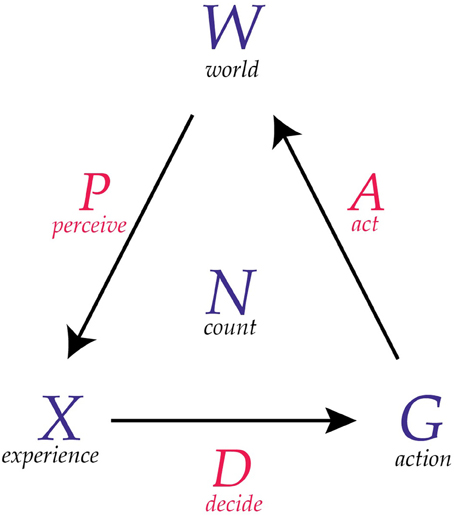
Figure 1. A diagram of a conscious agent. A conscious agent has six components as illustrated here. The maps P, D, and A can be thought of as communication channels.In what follows we will be using the notion of a measurable space. Recall that a measurable space, (X, X), is a set X together with a collection X of subsets of X, called events, that satisfies three properties: (1) X is in X; (2) X is closed under complement (i.e., if a set A is in X then the complement of A is also in X); and (3) X is closed under countable union. The collection of events X is a σ-algebra (Athreya and Lahiri, 2006). A probability measure assigns a probability to each event in X.
With these intuitions, we now present the formal definition of a conscious agent where, for the moment, we simply assume that the world is a measurable space (W, W).
* * * * *
Conflict of Interest Statement
The authors declare that the research was conducted in the absence of any commercial or financial relationships that could be construed as a potential conflict of interest.
Acknowledgments
For helpful discussions and comments on previous drafts we thank Marcus Appleby, Wolfgang Baer, Deepak Chopra, Federico Faggin, Pete Foley, Stuart Hameroff, David Hoffman, Menas Kafatos, Joachim Keppler, Brian Marion, Justin Mark, Jeanric Meller, Julia Mossbridge, Darren Peshek, Manish Singh, Kyle Stephens, and an anonymous reviewer.
References available at the Frontiers site

Synesthesia (Greek, syn = together + aisthesis = perception) is the involuntary physical experience of a cross-modal association. That is, the stimulation of one sensory modality reliably causes a perception in one or more different senses. Its phenomenology clearly distinguishes it from metaphor, literary tropes, sound symbolism, and deliberate artistic contrivances that sometimes employ the term "synesthesia" to describe their multisensory joinings. An unexpected demographic and cognitive constellation co-occurs with synesthesia: females and non-right-handers predominate, the trait is familial, and memory is superior while math and spatial navigation suffer. Synesthesia appears to be a left-hemisphere function that is not cortical in the conventional sense. The hippocampus is critical for its experience. Five clinical features comprise its diagnosis. Synesthesia is "abnormal" only in being statistically rare. It is, in fact, a normal brain process that is prematurely displayed to consciousness in a minority of individuals.By way of further introduction, here is a brief definition of synesthesia by the same author, quoted by the folks at MIT, from the introduction to his book on the subject:
Synesthesia is an involuntary joining in which the real information of one sense is accompanied by a perception in another sense. In addition to being involuntary, this additional perception is regarded by the synesthete as real, often outside the body, instead of imagined in the mind's eye. It also has some other interesting features that clearly separate it from artistic fancy or purple prose. Its reality and vividness are what make synesthesia so interesting in its violation of conventional perception. Synesthesia is also fascinating because logically it should not be a product of the human brain, where the evolutionary trend has been for increasing separation of function anatomically.
~ R. Cytowic, Synesthesia: A Union of the Senses, Springer-Verlag, NY (p.1)From a site that offers a synesthesia test, here are some of the many various forms of synesthesia:
Okay then, all of this is prelude to introducing a set of article from the Frontiers in Psychology: Cognitive Science series of new review (3) and research (5) articles into the phenomenon of synesthesia.Types of Synesthesia
Synesthesia is not a phenomenon that manifests itself in one way. In fact, synesthesia can manifest itself in many different forms, as it involves different parts of the human brain. It can range from tasting colors to smelling sounds. Synesthesia can occur between any two senses or perceptual modes. If we take into account only the five basic senses (sight, smell, sound, taste, and touch) and imagine pairings, we already have twenty different types of synesthesia. In reality, there are many more possibilities. Solomon Shereshevsky, a synesthete, reportedly experienced a link between all five of the basic senses. While this is an extreme example, it’s evidence that more than two senses can cross paths.If you’re an auditory learner, check out this video by Jamie Ward and GoCognitive! It’s worth a watch!
While there are plenty of logically possible combinations, there are several synesthesia types that occur most commonly. Let’s take a look!
Grapheme-Color Synesthesia
This is one of the most common types of synesthesia. A person who experiences this may associate/see individual letters or numbers with a specific color. Usually, two people won’t report the same color for letters and numbers. However, studies have shown that many synesthetes will see some letters the same way (for example, ‘A‘ is likely to be red).
Sound-to-Color Synesthesia
When sound triggers the visualization of colored, generic shapes, sound-to-color synesthesia is at play. For certain people, the stimuli are limited, and only a few types of sounds will trigger a perception. However, there are cases wherein many different sounds trigger color visualizations. Usually, the perceived colors appear in generic shapes – squares, circles, etc.
Number-Form Synesthesia
A number form is essentially a mental map that consists of numbers. When a person with number-form synesthesia thinks about numbers, a number map is involuntarily visualized. It is sometimes suggested that the number forms are a product of “cross-activation” between regions in the parietal lobe – a part of the brain that is involved in numerical and spatial cognition.
Personification
This type is known as ordinal-linguistic personification, or OLP. An individual who experiences this will associate ordered sequences with various personalities. Ordered sequences may include numbers, letters, months and so on. For example, a person with OLP may look at the letter ‘A’ and think in his mind that ‘A’ is a rude letter. Personally, I think it’s rather amusingly self-deprecating – but that’s just me. Check out Seattle graphic designer, Jesse Jaren’s unique portrayal of ordinal-linguistic synesthesia (shown in the graphic below) in this entertaining and informative blog post. You’ll agree, it’s pretty awesome.
In addition to thinking that certain ordinal sequences have a personality, a synesthete may also imbue a personality within an object. While occurrences have been reported early on, this is a type of synesthesia that has only gained attention from researchers in recent years.
Lexical-Gustatory Synesthesia
Lexical-gustatory synesthesia is one of the more rare synesthesia types. Synesthetes who experience this kind of synesthesia evoke different kinds of tastes when they hear certain words or phonemes. According to research, associations between the words and what a synesthete is able taste are constrained by tastes he or she has experienced early in life. So, if an individual hasn’t had mashed potatoes or bacon, they won’t be tasting those flavors as a result of this variation. What a shame!
~ Again, these are just some of the more commonly reported forms. If you have questions about personal experiences (be they similar or dissimilar to those above), feel free to contact us! We’ll do our best to respond in a timely and informative fashion!
Synesthesia: a colorful word with a touching sound?
Myrto I. Mylopoulos [1] and Tony Ro [2]
1. Philosophy Program, The Graduate Center, City University of New York, New York, NY, USASynesthesia is a fairly common condition in which individuals experience atypical responses (such as color experiences) in association with certain types of stimuli (such as non-colored letters). Although synesthesia has been described for centuries, only very recently has there been an explosive growth of systematic scientific examinations of this condition. In this article, we review and critically evaluate current methods for both assessing synesthesia and examining its psychological basis, including the “test-retest” procedure, online battery assessments, and behavioral experiments. We highlight the limitations of these methods for understanding the nature of this complex condition and propose potential solutions to address some of these limitations. We also provide a set of markers that aid in distinguishing synesthesia from other closely related psychological phenomena.
2. Department of Psychology, The City College and Graduate Center, Program in Cognitive Neuroscience, City University of New York, New York, NY, USA
Affect-related synesthesias: a prospective view on their existence, expression and underlying mechanisms
Nele Dael, Guillaume Sierro and Christine Mohr
Institute of Psychology, University of Lausanne, Lausanne, SwitzerlandThe literature on developmental synesthesia has seen numerous sensory combinations, with surprisingly few reports on synesthesias involving affect. On the one hand, emotion, or more broadly affect, might be of minor importance to the synesthetic experience (e.g., Sinke et al., 2012). On the other hand, predictions on how affect could be relevant to the synesthetic experience remain to be formulated, in particular those that are driven by emotion theories. In this theoretical paper, we hypothesize that a priori studies on synesthesia involving affect will observe the following. Firstly, the synesthetic experience is not merely about discrete emotion processing or overall valence (positive, negative) but is determined by or even altered through cognitive appraisal processes. Secondly, the synesthetic experience changes temporarily on a quantitative level according to (i) the affective appraisal of the inducing stimulus or (ii) the current affective state of the individual. These hypotheses are inferred from previous theoretical and empirical accounts on synesthesia (including the few examples involving affect), different emotion theories, crossmodal processing accounts in synesthetes, and non-synesthetes, and the presumed stability of the synesthetic experience. We hope that the current review will succeed in launching a new series of studies on “affective synesthesias.” We particularly hope that such studies will apply the same creativity in experimental paradigms as we have seen and still see when assessing and evaluating “traditional” synesthesias.
The induction of synaesthesia with chemical agents: a systematic review
David P. Luke [1] and Devin B. Terhune [2]
1. Department of Counselling & Psychology, University of Greenwich, Eltham, UKDespite the general consensus that synaesthesia emerges at an early developmental stage and is only rarely acquired during adulthood, the transient induction of synaesthesia with chemical agents has been frequently reported in research on different psychoactive substances. Nevertheless, these effects remain poorly understood and have not been systematically incorporated. Here we review the known published studies in which chemical agents were observed to elicit synaesthesia. Across studies there is consistent evidence that serotonin agonists elicit transient experiences of synaesthesia. Despite convergent results across studies, studies investigating the induction of synaesthesia with chemical agents have numerous methodological limitations and little experimental research has been conducted. Cumulatively, these studies implicate the serotonergic system in synaesthesia and have implications for the neurochemical mechanisms underlying this phenomenon but methodological limitations in this research area preclude making firm conclusions regarding whether chemical agents can induce genuine synaesthesia.
2. Department of Experimental Psychology, University of Oxford, Oxford, UK
Combined structural and functional imaging reveals cortical deactivations in grapheme-color synaesthesia
Erik O'Hanlon [1], Fiona N. Newell [1] and Kevin J. Mitchell [2]
1. School of Psychology and Institute of Neuroscience, Trinity College Dublin, Dublin, IrelandSynaesthesia is a heritable condition in which particular stimuli generate specific and consistent sensory percepts or associations in another modality or processing stream. Functional neuroimaging studies have identified potential correlates of these experiences, including, in some but not all cases, the hyperactivation of visuotemporal areas and of parietal areas thought to be involved in perceptual binding. Structural studies have identified a similarly variable spectrum of differences between synaesthetes and controls. However, it remains unclear the extent to which these neural correlates reflect the synaesthetic experience itself or additional phenotypes associated with the condition. Here, we acquired both structural and functional neuroimaging data comparing thirteen grapheme-color synaesthetes with eleven non-synaesthetes. Using voxel-based morphometry and diffusion tensor imaging, we identify a number of clusters of increased volume of gray matter, of white matter or of increased fractional anisotropy in synaesthetes vs. controls. To assess the possible involvement of these areas in the synaesthetic experience, we used nine areas of increased gray matter volume as regions of interest in an fMRI experiment that characterized the contrast in response to stimuli which induced synaesthesia (i.e., letters) vs. those which did not (non-meaningful symbols). Four of these areas showed sensitivity to this contrast in synaesthetes but not controls. Unexpectedly, in two of them, in left lateral occipital cortex and in postcentral gyrus, the letter stimuli produced a strong negative BOLD signal in synaesthetes. An additional whole-brain fMRI analysis identified 14 areas, three of which were driven mainly by a negative BOLD response to letters in synaesthetes. Our findings suggest that cortical deactivations may be involved in the conscious experience of internally generated synaesthetic percepts.
2. Smurfit Institute of Genetics and Institute of Neuroscience, Trinity College Dublin, Dublin, Ireland
Enhanced recognition memory in grapheme-color synaesthesia for different categories of visual stimuli
Jamie Ward, Peter Hovard, Alicia Jones and Nicolas Rothen
Sackler Centre for Consciousness Science and School of Psychology, University of Sussex, Brighton, UKMemory has been shown to be enhanced in grapheme-color synaesthesia, and this enhancement extends to certain visual stimuli (that don't induce synaesthesia) as well as stimuli comprised of graphemes (which do). Previous studies have used a variety of testing procedures to assess memory in synaesthesia (e.g., free recall, recognition, associative learning) making it hard to know the extent to which memory benefits are attributable to the stimulus properties themselves, the testing method, participant strategies, or some combination of these factors. In the first experiment, we use the same testing procedure (recognition memory) for a variety of stimuli (written words, non-words, scenes, and fractals) and also check which memorization strategies were used. We demonstrate that grapheme-color synaesthetes show enhanced memory across all these stimuli, but this is not found for a non-visual type of synaesthesia (lexical-gustatory). In the second experiment, the memory advantage for scenes is explored further by manipulating the properties of the old and new images (changing color, orientation, or object presence). Again, grapheme-color synaesthetes show a memory advantage for scenes across all manipulations. Although recognition memory is generally enhanced in this study, the largest effects were found for abstract visual images (fractals) and scenes for which color can be used to discriminate old/new status.
A taste for words and sounds: a case of lexical-gustatory and sound-gustatory synesthesia
Olympia Colizoli, Jaap M. J. Murre and Romke Rouw
Department of Psychology, Brain and Cognition, University of Amsterdam, Amsterdam, Netherlands
Gustatory forms of synesthesia involve the automatic and consistent experience of tastes that are triggered by non-taste related inducers. We present a case of lexical-gustatory and sound-gustatory synesthesia within one individual, SC. Most words and a subset of non-linguistic sounds induce the experience of taste, smell and physical sensations for SC. SC's lexical-gustatory associations were significantly more consistent than those of a group of controls. We tested for effects of presentation modality (visual vs. auditory), taste-related congruency, and synesthetic inducer-concurrent direction using a priming task. SC's performance did not differ significantly from a trained control group. We used functional magnetic resonance imaging to investigate the neural correlates of SC's synesthetic experiences by comparing her brain activation to the literature on brain networks related to language, music, and sound processing, in addition to synesthesia. Words that induced a strong taste were contrasted to words that induced weak-to-no tastes (“tasty” vs. “tasteless” words). Brain activation was also measured during passive listening to music and environmental sounds. Brain activation patterns showed evidence that two regions are implicated in SC's synesthetic experience of taste and smell: the left anterior insula and left superior parietal lobe. Anterior insula activation may reflect the synesthetic taste experience. The superior parietal lobe is proposed to be involved in binding sensory information across sub-types of synesthetes. We conclude that SC's synesthesia is genuine and reflected in her brain activation. The type of inducer (visual-lexical, auditory-lexical, and non-lexical auditory stimuli) could be differentiated based on patterns of brain activity.
Do you see what I hear? Vantage point preference and visual dominance in a time-space synaesthete
Michelle Jarick [1], Mark T. Stewart [2], Daniel Smilek [3] and Michael J. Dixon [3]
1. Neurocognition of Attention and Perception Lab, Department of Psychology, MacEwan University, Edmonton, AB, CanadaTime-space synaesthetes “see” time units organized in a spatial form. While the structure might be invariant for most synaesthetes, the perspective by which some view their calendar is somewhat flexible. One well-studied synaesthete L adopts different viewpoints for months seen vs. heard. Interestingly, L claims to prefer her auditory perspective, even though the month names are represented visually upside down. To verify this, we used a spatial-cueing task that included audiovisual month cues. These cues were either congruent with L's preferred “auditory” viewpoint (auditory-only and auditory + month inverted) or incongruent (upright visual-only and auditory + month upright). Our prediction was that L would show enhanced cueing effects (larger response time difference between valid and invalid targets) following the audiovisual congruent cues since both elicit the “preferred” auditory perspective. Also, when faced with conflicting cues, we predicted L would choose the preferred auditory perspective over the visual perspective. As we expected, L did show enhanced cueing effects following the audiovisual congruent cues that corresponded with her preferred auditory perspective, but that the visual perspective dominated when L was faced with both viewpoints simultaneously. The results are discussed with relation to the reification hypothesis of sequence space synaesthesia (Eagleman, 2009).
2. Department of Psychology, Willamette University, Salem, OR, USA
3. Department of Psychology, University of Waterloo, Waterloo, ON, Canada
Synaesthesia and sexuality: the influence of synaesthetic perceptions on sexual experience
Janina Nielsen [1], Tillmann H. C. Kruger [1], Uwe Hartmann [1], Torsten Passie [1,2], Thorsten Fehr [3] and Markus Zedler [1]
1. Department of Clinical Psychiatry, Social Psychiatry, and Psychotherapy, Hannover Medical School, Hannover, GermanyIntroduction: Synaesthesia is a phenomenon in which a certain stimulus induces a concurrent sensory perception; it has an estimated prevalence of 4%. Sexual arousal as an inducer for synaesthetic perceptions is rarely mentioned in the literature but can be found sometimes in case reports about subjective orgasmic experiences.
2. Department of Psychiatry, Harvard Medical School, Harvard University, Boston, MA, USA
3. Department of Neuropsychology, Center for Advanced Imaging Bremen/Magdeburg, Center for Cognitive Sciences, University Bremen, Bremen, Germany
Aims: To examine whether synaesthetic perceptions during sexual intercourse have an impact on the sexual experience and the extent of sexual trance compared to non-synaesthetes.
Methods: In total, 19 synaesthetes with sexual forms of synaesthesia (17 female; 2 male) were included as well as corresponding control data of 36 non-synaesthetic subjects (n = 55). Two questionnaires were used to assess relevant aspects of sexual function and dysfunction (a German adaption of the Brief Index of Sexual Functioning, KFSP) as well as the occurrence and extent of sexual trance (German version of the Altered States of Consciousness Questionnaire, OAVAV). Additionally qualitative interviews were conducted in some subjects to further explore the nature of sexual experiences in synaesthetes.
Main Outcome Measures: Sexual experience and extent of sexual trance during intercourse.
Results: Synaesthetes depicted significantly better overall sexual function on the KFSP with increased scores for the subscale “sexual appetence” but coevally significant lower subscale scores for “sexual satisfaction.” Sexual dysfunction was not detected in this sample. Synaesthetes depicted significantly higher levels of the subscales “oceanic boundlessness” and “visionary restructuralization” than controls using the OAVAV. Qualitative interviews revealed varying synaesthetic perceptions during the different states of arousal. Furthermore, synaesthetes reported an unsatisfactory feeling of isolation caused by the idiosyncratic perceptions.
Conclusions: Synaesthetes with sexual forms of synaesthesia seem to experience a deeper state of sexual trance without, however, enhanced satisfaction during sexual intercourse.

Brain Connections Underlying Accurate Introspection Revealed
Oct. 16, 2013 — The human mind is not only capable of cognition and registering experiences but also of being introspectively aware of these processes. Until now, scientists have not known if such introspection was a single skill or dependent on the object of reflection. Also unclear was whether the brain housed a single system for reflecting on experience or required multiple systems to support different types of introspection.
 A. This shows seed regions. B. This shows functional magnetic resonance imaging connectivity results. Top two panels: Metacognitive accuracy for perceptual decisions is associated with increased connectivity between the lateral anterior prefrontal cortex (aPFC) seed region and the right dorsal anterior cingulate cortex, bilateral putamen, right caudate and thalamus. Bottom two panels: Metacognitive accuracy for memory is associated with increased connectivity between the medial aPFC and right precuneus and the right intraparietal sulcus /inferior parietal lobule. (Credit: UCSB)
A new study by UC Santa Barbara graduate student Benjamin Baird and colleagues suggest that the ability to accurately reflect on perceptual experience and the ability to accurately reflect on memories were uncorrelated, suggesting that they are distinct introspective skills. The findings appear in the Journal of Neuroscience.
The researchers used classic perceptual decision and memory retrieval tasks in tandem with functional magnetic resonance imaging to determine connectivity to regions in the front tip of the brain, commonly referred to as the anterior prefrontal cortex. The study tested a person's ability to reflect on his or her perception and memory and then examined how individual variation in each of these capacities was linked to the functional connections of the medial and lateral parts of the anterior prefrontal cortex.
"Our results suggest that metacognitive or introspective ability may not be a single thing," Baird said. "We actually find a behavioral dissociation between the two metacognitive abilities across people, which suggests that you can be good at reflecting on your memory but poor at reflecting on your perception, or vice versa."
The newly published research adds to the literature describing the role of the medial and lateral areas of the anterior prefrontal cortex in metacognition and suggests that specific subdivisions of this area may support specific types of introspection. The findings of Baird's team demonstrate that the ability to accurately reflect on perception is associated with enhanced connectivity between the lateral region of the anterior prefrontal cortex and the anterior cingulate, a region involved in coding uncertainty and errors of performance.
In contrast, the ability to accurately reflect on memory is linked to enhanced connectivity between the medial anterior prefrontal cortex and two areas of the brain: the precuneus and the lateral parietal cortex, regions prior work has shown to be involved in coding information pertaining to memories.
The experiment assessed the metacognitive abilities of 60 participants at the Max Planck Institute for Human Cognitive and Brain Sciences in Leipzig, Germany, where Baird was a visiting researcher. The perceptual decision task consisted of visual displays with six circles of vertical alternating light and dark bars -- called Gabor gratings -- arranged around a focal point. Participants were asked to identify whether the first or second display featured one of the six areas with a slight tilt, not always an easy determination to make.
A classic in psychology literature, the memory retrieval task consisted of two parts. First, participants were shown a list of 145 words. They were then shown a second set of words and asked to distinguish those they had seen previously. After each stimulus in both the perceptual decision and the memory retrieval task, participants rated their confidence in the accuracy of their responses on a scale of 1 (low confidence) to 6 (high confidence).
"Part of the novelty of this study is that it is the first to examine how connections between different regions of the brain support metacognitive processes," Baird said. "Also, prior means of computing metacognitive accuracy have been shown to be confounded by all kinds of things, like how well you do the primary task or your inherent bias toward high or low confidence.
"Using these precise measures, we're now beginning to drill down and see how different types of introspection are actually housed in the real human brain," Baird concluded. "So it's pretty fascinating from that perspective."
Benjamin Baird, Jonathan Smallwood, Krzysztof J. Gorgolewski, and Daniel S. Margulies
+ Author Affiliations
Abstract
Convergent evidence indicates that frontopolar Brodmann area 10, and more generally the anterior prefrontal cortex (aPFC), supports the human capacity to monitor and reflect on cognition and experience. An important unanswered question, however, is whether aPFC is a homogeneous region that supports a general-purpose metacognitive ability or whether there could be regional specialization within aPFC with respect to specific types of metacognitive processes. Previous studies suggest that the lateral and medial subdivisions within aPFC may support metacognitive judgments of moment-to-moment perceptual processes and assessments of information from memory stored over longer time scales, respectively. Here we directly compared intraindividual variability in metacognitive capacity for perceptual decisions and memorial judgments and used resting-state functional connectivity (rs-fcMRI) to relate this variability to the connectivity of the medial and lateral regions of aPFC. We found a behavioral dissociation in metacognitive ability for perceptual and memorial judgments. Furthermore, functional connectivity analysis revealed distinct patterns of connectivity that correlated with individual differences in each domain. Metacognitive ability for perceptual decisions was associated with greater connectivity between lateral regions of aPFC and right dorsal anterior cingulate cortex, bilateral putamen, right caudate, and thalamus, whereas metacognitive ability for memory retrieval predicted greater connectivity between medial aPFC and the right central precuneus and intraparietal sulcus/inferior parietal lobule. Together, these results suggest that an individual's capacity for accurate introspection in the domains of perception and memory is related to the functional integrity of unique neural networks anchored in the medial and lateral regions of the aPFC.