Showing posts with label numbing. Show all posts

Sunday, August 26, 2012

Marc Lewis, Ph.D. - Addiction as Self-Medication

This brief post at the Psychology Today blog, Addicted Brains (A neuroscientist examines life on drugs) by Marc Lewis, Ph.D., looks at the "self-medication" model of addiction, the perspective that most addictions are based in efforts to numb feelings that are perceived as too overwhelming to experience. This is a model to which I adhere, mostly based on my own experience.

Lewis is the author of Memoirs of an Addicted Brain: A Neuroscientist Examines his Former Life on Drugs and co-editor of Emotion, Development, and Self-Organization: Dynamic Systems Approaches to Emotional Development.
 
Brain patterns formed by trauma sometimes need fixing—at any price

A while back I promised to survey the three most common models of addiction—disease, choice, and self-medication—and say something about the advantages and disadvantages of each. I got hung up on the choice model for a few posts: there’s so much there to think about. But now let’s look at self-medication as the essence of addiction.

The self-medication model seems to be the kindest of the three. It has the advantage of the disease model, in absolving the addict of excessive blame, but it has the additional advantage of avoiding the stigma of “disease” and all that goes with it. In fact, it gives control (agency) back to the addict, who is, after all, acting as his or her own physician. Whereas the disease model places agency in the hands of others and casts the addict as a passive victim. Furthermore, the self-medication model just might be the most accurate of the three.


The idea is simple: trauma is the root cause. Trauma includes abuse, neglect, medical emergencies, and other familiar categories, but it also includes emotional abuse, and above all loss. Loss of a parent during childhood or adolescence can take many forms, including divorce, being sent away from home (in my case) or the shutting down of one or both parents due to depression or other psychiatric problems. Trauma is often followed by post-traumatic stress disorder (PTSD), which includes partial memory loss, intrusive thoughts, anxiety and panic attacks, avoidance of particular places, people, or contexts, emotional numbing or a sense of deadness, and overwhelming feelings of guilt or shame. But if that’s not bad enough, PTSD is about 80% comorbid with other psychiatric conditions—depression and anxiety disorders being chief among them.

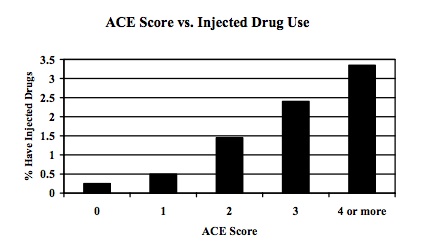
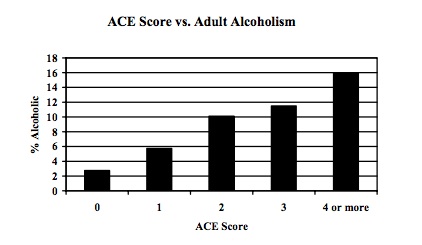
A famous study using a huge sample (17,000) looked at Adverse Childhood Experiences (ACEs) in relation to subsequent physical and mental problems. The results of the study are nicely summarized in the Sept. 25/2011 issue of The Fix. Take-home message: the relationship between trauma and addiction is unquestionable. An ACE score was calculated for each participant, based on the number of types of adverse experience they reported during childhood or adolescence. The higher the ACE score, the more likely people were to end up an alcoholic, drug-user, food-addict, or smoker (among other things). Here are two graphic examples:


These figures, which are likely to be low estimates, show a 500% increase in the incidence of adult alcoholism, and a 4,600% increase in the incidence of IV drug use, predicted by early adverse experiences. Despite criticisms of the study, based mostly on retrospective self-reporting, these correlations are huge and they are meaningful, and follow-up prospective studies are finding similar results.

So how does self-medication work? There must be something about PTSD, depression, and anxiety that gets soothed by drugs, booze, binge-eating, and other addictive hobbies. Again, it’s not complicated. PTSD, depression, and anxiety disorders all hinge on an overactive amygdala—one that is not controlled or “re-oriented” by more sophisticated (and realistic) appraisals coming from the prefrontal cortex and anterior cingulate cortex (ACC). That traumatized amygdala keeps signalling the likelihood of harm, threat, rejection, or disapproval, even when there is nothing in the environment of immediate concern. In fact, this gyrating amygdala lassos the prefrontal cortex, foisting its interpretation on the orbitofrontal cortex (and ventral ACC) rather than the other way around (which we might loosely call emotion regulation). The whole brain is dominated by limbic imperialism—making it a less-than-optimal neighbourhood in which to reside.

At the very least, drugs, booze, gambling and so forth take you out of yourself. They focus your attention elsewhere. They may rev up your excitement and anticipation of reward (in the case of speed, coke, or gambling) or they may quell anxiety directly by lowering amygdala activation (in the case of downers, opiates, booze, and maybe food). The mechanisms by which this happens are various and complex. But addicts and ex-addicts (like me) know what it feels like. If we find something that relieves the gnawing sense of wrongness, we take it, we do it, and then we do it again.

So, according to the self-medication model, addictive behaviours “medicate” depression, anxiety, and related feelings. But is that the whole story? I don’t think so, and I’ll get into why in my next post.

Wednesday, October 19, 2011

Benedict Carey - Becoming Compassionately Numb

This is an interesting article from the New York Times that I stumbled across while doing research for a workshop in compassion fatigure and resilience.

It's good to see this issue getting some attention - it's not just trauma therapists (secondary traumatization, or vicarious trauma) who experience this loss of compassion and empathy. It seems our culture is sometimes numb to the suffering of others. It's the only way I can explain the way our politicians can gut programs that provide food, shelter, and mental health care for the poor.

Becoming Compassionately Numb

Benedict Carey is a science reporter for The New York Times.

Do we have no more room in our hearts to care for this Haitian earthquake victim?

ABOUT the only thing tanking faster than consumer confidence and the Greek economy would be the global compassion index, if such a measure existed.

Consider just a few recent news items: Americans are balking at extending unemployment benefits, and even disaster relief was in doubt for a time last week in another of Washington’s budget skirmishes; Europeans are cutting payments to pensioners; and “there’s no mood for intervention” to avert famine in Somalia, according to one diplomat.

At a recent Republican presidential debate, the audience erupted into cheers upon hearing Texas’s nation-leading rate of executions.

Behind such sentiments lie genuine concerns, be they for law and order or personal responsibility, not to mention limited resources and a struggling economy. After all, a lowering tide grounds a lot of rescue boats, literally and psychologically.

Yet psychologists and primatologists have been arguing for years that compassion is an evolved instinct, rooted in the brain’s circuitry. In a new book, “The Better Angels of Our Nature,” the psychologist Steven Pinker calls empathy “the latest fashion in human nature.” Chimpanzees show evidence of compassion, as do some monkeys; even mice seem to feel the pain of close peers. But if current trends continue, rats might become a more appropriate subject of study.

Are people today — are societies — really becoming somehow more callous?

The answer is no, of course not — at least not in any fundamental sense. But compassion is a limited resource, a system rooted in cognitive networks that tire and need refueling. And it’s not always rational.
Read the whole article.

Tuesday, August 16, 2011

Daily Om - Ways We Numb Ourselves

https://blogger.googleusercontent.com/img/b/R29vZ2xl/AVvXsEhHMVYLsBxvsB8cIilcBl1AiHJDwy2dSNgsqvBUts_0FIHI3qfhPzT5Ok2t9mWaJmEwWPAYae2blz6vKxpebaf5ViLR1Ss9P-hsFWRjtDISQjrqOSY6wIkzCeoU4atyp-q3eF1U/s1600/couch_potato_watching_tv.jpg

Yesterday's Daily Om was on a subject I know all too well - I spent a good part of my life trying to be as numb as possible, sometimes veering into a functional coma. So many of us fear the pain and sadness living inside of us - no matter the source - that numbing ourselves seems like the only viable option.

It's not. Pain hurts, sadness requires surrender. But these feelings will not kill us, will not become all that we are. The only way out of them is through them - numbing just postpones the healing.
Emerging from the Grey
Ways We Numb Ourselves

Numbing yourself prevents you from confronting your issues and keeps you from ever finding resolution or peace.

We are born equipped to experience a complex array of diverse emotions. Many of us, however, are uncomfortable confronting our most powerful emotions. We may shy away from delight and despair and deny life’s colors by retreating into a world of monotone grey. We may numb ourselves to what we are truly feeling. It’s easier to suppress our emotions than to deal with them, so we may momentarily turn to pleasures such as alcohol, food, sugar, shopping and too much television. We may even numb our hearts. While it’s normal to temporarily seek distractions as a means of coping with intense emotions, numbing yourself prevents you from confronting your issues and keeps you from ever finding resolution or peace. When you are numb, there is no pain or powerlessness, but there can also be no joy or healing.

The activities that numb you may seem harmless or pleasurable, but using them to numb yourself diminishes the quality of your life. Numbing yourself so that you don’t have to feel intense emotions can often satisfy a surface need while blocking your awareness of a deeper need. You may find solace in food or shopping when what you really need is spiritual nourishment. The less you feel, the less alive you feel. Your feelings add vividness to your experiences and serve to connect you to the world around you. It is possible to disavow yourself of numbing behaviors a little at a time and once again taste life’s rich flavors. When you sense that you are engaging in a particular behavior simply to deaden your emotions, stop and ask yourself why. Examining the feelings that drive you to numb yourself can help you understand what is triggering your desire to emotionally fade out.

With each numbing activity that you cut out of your life, you’ll find yourself being more aware and experiencing a greater emotionally acuity. Senses once shrouded by the fog of numbness become sharp and acute. Traumas and pain long hidden will emerge to the forefront of your consciousness and reveal themselves so that you can heal them. You’ll discover a deeper you—a self that is comfortable experiencing and working through intense emotions with courage and grace.