Showing posts with label intersubjective. Show all posts

Monday, August 18, 2014

Simone Stirner - Notes on the State of the Subject (after Postmodernism)

The following comes from Simone Stirner, posted at Notes on Metamodernism, which I discovered thanks to Michel Bauwens' P2P Foundation blog.
Notes on Metamodernism was founded in 2009 by Timotheus Vermeulen and Robin van den Akker. They were later joined by Nadine Fessler, Hila Schachar, Luke Turner and Alison Gibbons. Today, the site features contributions by over 30 writers from across the globe, documenting anything from art to politics, critical theory to television.
A good introductory article, What is metamodernism? is available - here is the opening statement.
Metamodernism is neither a residual nor an emergent structure of feeling, but the dominant cultural logic of contemporary modernity. It can be grasped as a generational attempt to surpass postmodernism and a general response to our present, crisis-ridden moment.
This is interesting stuff.

Notes on the state of the subject

Simone Stirner
on November 2, 2011


Postmodernism announced the death of the subject, but recent developments in literature, philosophy and political agency suggest that it is alive and kicking as ever. Not in form of the modern Cartesian ego though and also not in denial of all the subjectivity-disrupting forces that postmodern theory pointed out. It returns with a great leap of faith, in a fragile moment of intersubjective trust and reveals characteristic traits that call for another vernacular, one that this webzine has come to describe as metamodern.[i]

“A prevalent discourse of a recent epoch concludes with its [the subject’s] simple liquidation”, states Jacques Derrida in an interview with Jean-Luc Nancy. The “recent epoch” Derrida is talking about is postmodernism, of course. And who would know better what postmodernism is about than the wizard of postmodern thought himself? In a discourse that casts doubt on the credulity of metanarratives, that questions the hermeneutics of meaning, the rational, self-contained subject of modernism has had a hard time indeed.For the subject at stake here, the subject allegedly liquidated in postmodernism, is the modern subject. Its beginnings can be traced back to sometime around the Renaissance and Reformation, but it is most commonly characterized in terms of the Cartesian Ego: it is strong, autonomous, reasonable and above all coherent. It has cast off determination by church doctrine and Christianity`s encompassing truths and instead goes for, as Heidegger puts it, “legislating for himself”[ii].

Postmodernism then dismantles and deconstructs all the grand-narratives and overriding truths, only this time this affects not only the grand-narrative of religion, but also the subject itself, whose status as a rational entity is seen as another grand-narrative. Backed by post-structural linguistics, the different postmodern/poststructuralist thinkers, such as Foucault, Althusser or Lacan, are taking a tough stance towards the subject and are exposing it as foreign-ruled, schizophrenic, instable, a field of discourses. The skepticism against metanarratives remains one of the greatest achievements of postmodern thinking, changing not only the face of philosophy, but influencing profoundly such fields as identity and gender politics, backing disability studies, triggering post-colonial studies and bringing the project of multiculturalism to life.

These achievements remain unchallenged. Nevertheless, over the last ten years, quite astonishing changes have happened, for instance in terms of discussing subjectivity in academia. Across a variety of disciplines – literary studies, philosophy, political theory and even psychology – calls for a rethinking of subjectivity can be heard. Publications dealing with “The return of the subject” or “The Self beyond the Postmodern Crisis“, suddenly become ubiquitous.

But also in literature, film, arts and political agency, we can witness a paradigm shift. The subject reappears and it comes with other dismissed categories such as trust, belief, coherence and even love. I would suggest that it reappears in a confined space that Peter Sloterdijk in his “Spherology” describes as a “Bubble” – an artificially created space, where in a human, intersubjective experience, the outside forces exposed by postmodern thinkers can be temporarily shut out.

In Performatism or The End of Postmodernism, the literary scholar Raoul Eshelman depicts a new kind of subject that establishes itself in spite of disruptive forces in an act of belief. This subject is a coherent self that re-introduces the possibility for identification, affection and selfhood, although not in a naïve, unreflective way.

Similarly, Karen Coats assures that there is no way the Cartesian Ego can return after all that was learned from Postmodernism – only to then sling the slogan “I love, therefore I am” into the arena of debate, calling for a rethinking of the concept of the Self, acknowledging the role of love in its construction. The writings of Lebanese-French author Amin Maalouf ask for a rethinking of the concept of identity describing it as an act of positive affirmation, which can include an attachment to a religion or land or ethnic group, while acknowledging the instability of identity as such. And even the great evangelist of postmodernism, Ihab Hassan, suddenly calls for an “Aesthetic of Trust”, where in a “world flow of ultimate mysteries”, the relation between subject and object can be redefined in terms of “profound trust”[iii].

As others have documented on this webzine, in literature as well as film or television, too, we suddenly come to meet characters who masquerade as coherent subjects. They are innovative figures who step into the scene with a quirkiness that, perhaps precisely because of their idiosyncratic authenticity, renders possible a new relation between literary hero and recipient. Furthermore, we experience a shift considering political agency: Wasn’t the subject of Postmodernism (as Slavoij Žižek doesn’t cease to remind us), essentially powerless in the workings of global capitalism? Then the symbol of the OccupyWallStreet-Protests, the fragile, yet brave and daring ballerina on top of the iron bull, definitely proves a new kind of political agent.


While all of the above mentioned fields are worth taking a closer look at, it is one artist that best exemplifies, for me, the parameters of the metamodern subject: Miranda July. Readers of this webzine might know July from James MacDowell`s articles on the “quirky” cinematic sensibility, in which MacDowell describes her self-starred movie “Me and You and Everyone We Know” as one of those post-millennial American indie comedies that convey a metamodern tone and feeling. This does not only apply to her films, however. Across the oeuvre of all-rounder July, we are confronted with moments in which bitter irony is paired to straight sincerity, fear to trust, and skepticism to optimism.

Central to all her fictional works are characters that can be described –euphemistically – as socially awkward. They are naïve to an extent that one wants to scream at them or simply turn off the TV or throw away the book; they are lonely and desperately looking for love; they are either leading terribly average lives or they are isolated and insecure to such an extent that any glimmer of optimism on their faces can only generate a feeling of pity in the spectator. Yet this doesn’t happen. July’s characters somehow manage to overcome the inescapable trap of postmodern discourse. With all their oddities, they develop a braveness and self-confidence that seems highly unreasonable, preposterous and odd in itself, but nevertheless works for them, enabling temporary, intimate relations with others that convey a great deal of beauty.

In the short-story The Sister, a sex-scene between two lonely old men is doomed by bitter skepticism, repulsion, insecurity and one man’s fear of contracting STDs. This being the “real” that postmodernists loved “rubbing observers’ our noses in“[iv], as Raoul Eshelman describes it. But the two men don’t end up being disrupted by the context, instead develop a fragile mutual understanding and emotional proximity, a space where the subject – for the time being – is safe from contextualization. It is an instance of the modern self that is stabilized despite a postmodern background.

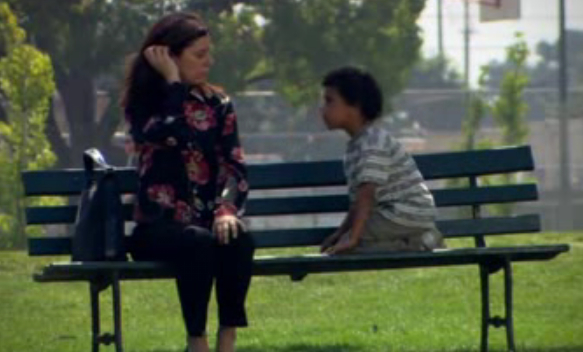
The same strategy can be observed in the relationship between a young boy and an embittered art curator in Me and You and Everyone We Know. Their relationship starts in a chat room, where the infamous line: “I want to poop back and forth, forever” is featured. The forces of discourse just hail down on the two characters, but the sincerity of the little boy and the trust of the older woman manage to form a protective shield against outside forces, leading up to a scene that contributed to the “R-Rating” of the movie in the U.S. This scene shows us two subjects in a sphere where context can get no hold of them: The boy kisses the woman, kind and forward, and she smiles for the first time in the movie. Miranda July’s fiction is full of such moments of tender weirdness.

Her interactive sculpture Eleven Heavy Things similarly deals with this possibility of subjectivity despite a hostile, postmodern context in a very unique way. The Sculpture – originally built for the Venice Biennale and later moved to New York Union Square Park, features a square-white pedestal with black inscription, reading:
This is my little girl. She is brave and clever and funny. She will have none of the problems that I have. Her heart will never be humiliated. Self-doubt will not devour her dreams.
At first glance the sculpture recalls the modern subject. It is strong and capable, standing on solid ground. If we were still in the hey-day of modernism, the scripture on the socket supporting whoever stands on it could even be read as a kind of manifesto, a messianic promise. But that is not all there’s to it. While containing space for a belief in the subject, it just as strongly contains space for its dissolution in postmodern irony: self-doubt will not devour your dreams? Seriously? You are a field of energies at the best and a Nothing dissolved in discourse at the worst.

The artwork of Miranda July thus contains, I believe, both a modern and postmodern subjectivity and thus exemplifies the space where an ingenious, metamodern subject can show itself. In this restricted area the subject is characterized by fragile belief that cannot brush aside good old postmodern irony completely – which would dissolve the subject immediately – but keeps it at bay for the moment.The installation enables the creation of a space where love can exist again. As fragile and problematic as it might seem to shut out discourse, it is carried out carefully so it doesn`t fall back into a (modern) fanatic personal-cult.

It is this oscillation between the belief in what is written to be true and the consciousness of it being utterly unlikely that makes for the beauty of the artwork and reflects a feeling that may very well be called metamodern. It is a moment of trust and love despite the harsh reality. It possesses at the same time sincerity and irony. The installation provides us with contained hope that is accompanied by a twitch of melancholy.

The reemerged subject is not the old modern one. It contains no transcendental justifications. Concepts of identity, selfhood and subjectivity can always be dismantled and deconstructed. But while the awareness about this still rightfully persists, new times call us to acknowledge that the subject nevertheless appears, in moments of intersubjectivity, in reciprocal spaces of belief, trust and love.
Notes
[i] The concept of Metamodernism and my understanding of it, is drawn from articles on metamodernism.com and Vermeulen, Tim and Robin van den Akker (2010): Notes on Metamodernism, Journal of Aesthetics & Culture, Vol. 2, 2010 DOI: 10.3402/jac.v2i0.5677

[ii] Martin Heidegger, “The Age of the World Picture,” in: The Question Concerning Technology and Other Essays, Harper and Row, (1977), New York, p. 148.

[iii] Hassan, Ihab: “Beyond Postmodernism. Toward an Aesthetic of Trust“, in: Klaus Stierstorfer (Ed.), Beyond Postmodernism. Reassessments in Literature, Theory and Culture, de Gruyter (2003), Berlin and New York, p. 211.

[iv] Eshelman, Raoul: “Performatism, or The End of Postmodernism”, in: Anthropoetics – The Electronic Journal of Generative Anthropology, Volume VI, number 2 (Fall 2000/Winter 2001)

http://www.anthropoetics.ucla.edu/ap0602/perform.htm

Sources:

Coats, Karen: ”The Role of Love in the Development of the Self: From Freund and Lacan to Children’s Stories“, in: Paul Vitz and Susan Felch (Ed.), The Self Beyond the Postmodern Crisis, ISI Books (2006), Wilmington.

Eshelman, Raoul: Performatism or The End of Postmodernism, Davis Group (2008), Aurora.

Hassan, Ihab: “Beyond Postmodernism. Toward an Aesthetic of Trust“, in: Klaus Stierstorfer (Ed.), Beyond Postmodernism. Reassessments in Literature, Theory and Culture, de Gruyter (2003), Berlin and New York.

Lyotard, Jean-François: The Postmodern Condition. A Report on Knowledge, Manchester University Press (1984), Manchester.

Miranda July: No one belongs here more than you, Canongate (2007), Edinburgh.

Miranda July: Me and You and Everyone We Know, DVD 91 min, IFC (2005)

Sloterdijk, Peter: “Sphären/1. Blasen“, Suhrkamp (1999), Frankfurt a . Main.

Top image: courtesy Miranda July. Still from Me and you and everyone we know (2005). Lower image, left: courtesy Adbusters. Occupy-poster What is your one demand? Lower image, right: courtesy Lukas Wassmann. Photo Eleven Little Things.

Thursday, May 30, 2013

Daniel Siegel - Interpersonal Neurobiology


This is a brief but cool video of Dr. Dan Siegel explaining what interpersonal neurobiology is - courtesy of Portland Professional Counseling Videos.

Interpersonal Neurobiology


Interpersonal Neurobiology, a term coined by Dr. Dan Siegel, studies the way the brain grows and is influenced by personal relationships. Recent studies have confirmed that we are hardwired to connect with one another, and we connect through our emotions. Our brains, bodies, and minds are inseparable from the emotions that animate them. When that connection fails, we experience significant distress.

Normal human development relies on the cultivation of relationships with others to form and nurture the self-regulatory circuits that enable emotion to enrich, rather than enslave, our lives. Emotionally traumatic events can wreak havoc on our family, relationships and psyche, contributing to intense feelings of anxiety, feeling rejected or abandoned, or simply a perpetual dissatisfaction or distrust of close, intimate relationships. However, experiencing truly healthy relationships can become powerful catalysts for the transformations that are at the heart of the healing process.

IPNB explores the potential for healing trauma by using positive and secure influences on the brain. Conditions once thought to be permanent now have the bright potential for healing and growth. If trauma experience can change our neurons and genes, then “positive” experiences can have potential to restore our bodies to emotional and physical health. IPNB explores subtle, non-conscious influences on our experience of others, including implicit memory, mirror neurons, and emotional resonance.

Implicit Memory – Current situations trigger past emotional memories. ” When I sit in this big comfortable chair, it reminds me of when I was a kid and I would sit in my grandfather’s lap and feel safe and warm”. Or ” I get so angry when my wife and I fight it reminds me of when I would go to my room and hear my parents yelling at each other.”

Mirror Neurons – nerve cells activate in sympathy and in the same brain location as nerve cells of the person whose actions we are watching. These neurons help us to sense what others intend and help us connect with what the other feels…We resonate with their state.

Emotional Resonance – when two people experience deep feelings and can sense what the other feels. A mutual caring that is exchanged through words, expressions, or tones. One can feel what another is feeling.

What a IPNB therapist does:
1. Initiates and creates emotional safety along with the client.
2. Demonstrates vulnerability through transparency and self revealing.
3. Assists client in moving from “talking about” situations to being in emotional exchange with therapist in the “hear and now”.
Selected Books by Daniel Siegel MD

Tuesday, February 19, 2013

The Partially Examined Life, Episode 71: Martin Buber’s “I and Thou”


The Partially Examined Life podcast took a look at Martin Buber's classic book, I and Thou. For more background, here is a bit about the book from the Stanford Encyclopedia of Philosophy.
I and Thou is considered to have inaugurated “a Copernican revolution in theology (…) against the scientific-realistic attitude” (Bloch [1983], p. 42), but it has also been criticized for its reduction of fundamental human relations to just two — the I-Thou and the I-It — of which the latter appears as a mere ‘cripple’ (Franz Rosenzweig in a letter to Buber in Sept. 1922). Walter Kaufmann, who produced a second English translation of I and Thou, went further in his criticism. While he did not regard the lack of deep impact of Buber's contributions to biblical studies, Hasidism, and Zionist politics as an indication of failure, he considered I and Thou a shameful performance in both style and content. In style the book invoked “the oracular tone of false prophets” and it was ‘more affected than honest.’ Writing in a state of “irresistible enthusiasm,” Buber lacked the critical distance needed to critique and revise his own formulations. His conception of the I-It was a “Manichean insult” while his conception of the I-Thou was ‘rashly romantic and ecstatic,’ and Buber ‘mistook deep emotional stirrings for revelation.’ (Kaufmann [1983], pp. 28-33) 
Buber always insisted that the dialogic principle, i.e., the duality of primal relations that he called the I-Thou and the I-It, was not a philosophical conception but a reality beyond the reach of discursive language. In the initial exuberance of making this discovery Buber briefly planned for I and Thou to serve as the prolegomenon to a five-volume work on philosophy, but he realized that, in Kaufmann's words, “he could not build on that foundation” and hence abandoned the plan. It has been argued, however, that Buber nevertheless solved the inherent “difficulty of dialogics that it reflects on, and speaks of, a human reality about which, in his own words, one cannot think and speak in an appropriate manner” (Bloch [1983] p. 62) by writing around it, inspired by one's conviction of its veracity. 
The debate on the strength and weakness of I and Thou as the foundation of a system hinges on the perhaps fallacious assumption that the five-volume project Buber intended to write but soon abandoned was indeed a philosophical one. Buber's contemporaneous lectures at the Freies jüdisches Lehrhaus and at the University of Frankfurt as well as his letters to Rosenzweig indicate quite clearly that he was concerned with the development of a new approach to the study of religion (Religionswissenschaft) (cf. Schottroff) rather than with a new approach to the philosophy of religion.
Enjoy the podcast.

The Partially Examined Life, Episode 71: Martin Buber’s “I and Thou”

Buber

On Buber’s 1923 book about the fundamental human position: As children, and historically (this is his version of social contract theory), we start fully absorbed in relation with another person (like, say, mom). Before that point, we have no self-consciousness, no “self” at all, really. It’s only by having these consuming “encounters” that we gradually distinguish ourselves from other people, and can then engage in what we’d normally consider “experience,” which Buber calls “the I-It relation,” wherein we can reflect on and manipulate the world.
Buber thinks that unless we can keep connected to this “I-Thou” phenomenon, through real, mature relationships (dialogue!), and maybe also through art and the appreciation of nature (we spend a lot of time trying to figure out how, as he says, you can really have an I-Thou encounter with a tree), you’re spiritually dead, treating everyone as objects and sporting a thin, pissy sense of self to boot. If you get get in the groove, on the other hand, you’ll come off all shiny and ethical and ready to transform the world. Sweet! Oh, and by the way, the “Thou,” every thou, ends up also being a direct line to God, so all you “spiritual but not religious” folks are theists after all. Nyah nyah!
Mark, Seth, and Wes are rejoined by verbose lawyer Daniel Horne to hash through this difficult and possibly mystical text. Read more about it and get the book.
End song: “Luscious You” by Mark Lint and the Fake from the album So Whaddaya Think? (2000). Download it free.
Please support the podcast by becoming a PEL Citizen or making a donation.

Tuesday, January 08, 2013

The Science of Interconnectedness: Cassandra Vieten PhD at TEDxNapaValley


I was fortunate to see Cassandra Vieten at the Toward a Science of Consciousness Conference in 2010, where she spoke about how she and her co-researchers at IONS (Institute of Noetic Science) had assembled a model that mapped out cultural-spiritual evolution in several groups (if I am remembering correctly). It struck me as a great talk then and I still remember her name, so it must have left an impression.

In this talk from TEDxNapaValley, Dr. Vieten speaks about some of her research on interconnectedness, which fits right in with her other research interests: "factors, experiences, and practices involved in psychospiritual transformation to a more meaningful, compassionate, and service-oriented way of life, and how psychology, biology, and spirituality interact to affect experience and behavior."


The Science of Interconnectedness: Cassandra Vieten PhD at TEDxNapaValley

Published on Jan 4, 2013

Cassandra Vieten PhD talks about the Science of Interconnectedness as part of the TEDxNapaValley 2012 "Connected" event.

Cassandra's Event Photos are on flickr.

Cassandra Vieten, PhD, is a licensed clinical psychologist, Director of Research at the Institute of Noetic Sciences, co-director of the Mind-Body Medicine Research Group at California Pacific Medical Center Research Institute, and co-president of the Institute for Spirituality and Psychology.

Funded by the National Institutes of Health, the State of California, and several private donors and foundations, her research has focused on spirituality and health; development and pilot testing of mindfulness-based approaches to cultivating emotional balance (primarily in the areas of addiction and pregnancy/postpartum well-being); and factors, experiences, and practices involved in psychospiritual transformation to a more meaningful, compassionate, and service-oriented way of life. Her primary interest lies in how psychology, biology, and spirituality interact to affect experience and behavior.

For more information on Cassandra and her work visit -http://noetic.org/

Tuesday, July 03, 2012

Robert D. Stolorow, Ph.D. - Scientism in Psychotherapy


Dr. Stolorow is one of the founders of the intersubjective school of psychoanalysis - which makes him very cool in my world - but he is also a leader in the philosophy of psychotherapy. He has some , serious doubts about the usefulness of evidence-based practice in psychotherapy, and rightfully so.

The evidence-based models all ignore or deny the importance and the uniqueness of each therapeutic dyad - it's the relational aspects of therapy where healing occurs, the rest is just building skills and changing behaviors.

Show Me the Evidence! 

These days, in this Insurance-Company-Driven Age of the Quick Fix, there is much talk in psychotherapy circles of “Evidence-Based Practice.” The application of this slogan has been remarkably devoid of philosophical questioning of the nature of psychotherapeutic practice or of the proper evidence for guiding the therapeutic approach to a suffering human soul.

My collaborators and I (Working Intersubjectively: Contextualism in Psychoanalytic Practice (Psychoanalytic Inquiry Book Series) - with Donna Orange and George Atwood) have applied the Aristotelian distinction between techne and phronesis to the practice of psychoanalytic therapy. Techne or technical rationality is the kind of method and knowledge required for the uniform production of things. It is exemplified in the traditional, standardized rules of psychoanalytic technique, especially as these are claimed to apply for all patients, all analysts, all analytic couples, and all relational situations. We argue “that the whole conception of psychoanalysis as technique is wrongheaded … and needs to be rethought” (p. 21). We further suggest that what is needed to ground psychoanalytic practice is not techne but phronesis or practical wisdom. Unlike techne, phronesis is a form of practical understanding that is always oriented to the particular, to the uniqueness of the individual and his or her relational situation.

Traditional psychotherapy research tends to reduce human beings and human relationships to “variables” that can be measured, calculated, and correlated.  Such procedures partake of what Heidegger calls the technological way of being or technological form of intelligibility. According to Heidegger, entities as a whole, including human beings, are intelligible in our technological era as meaningless resources to be calculated, stored, and optimized in the quest to conquer the earth. In my view, the technological way of being is also associated with the philosophical stance of scientism—the presupposition, exemplified in the scientific positivism characteristic of much research on change in psychotherapy, that the chief form of valid knowledge is that attained through experimental and quantitative methodology.

Such considerations point to the potential importance of qualitative, rather than quantitative, research. They also bring me back to a tradition in academic personality psychology—the tradition in which I was trained as a clinical psychology doctoral student at Harvard during the mid- and late 1960s—known as personology. This tradition, founded by Henry Murray at the Harvard Psychological Clinic in the 1930s, held as its basic premise the claim that knowledge of human personality can be advanced only by the systematic, in-depth study of the individual person. This emphasis on “idiographic,” rather than “nomothetic,” research was a radical departure from the philosophy of science that then dominated, and has continued to dominate, academic psychology in the United States.

I suggest that grasping the practice of psychotherapy as a form of phronesis rather than techne justifies a return to idiographic methods in studies of the psychotherapeutic relationship—methods that can investigate the unique emotional worlds of patient and psychotherapist and the specific intersubjective systems constituted by the interplay between them. It is only such idiographic research, I contend, that can illuminate the rich, complex, living relational nexus in which the psychotherapeutic process takes form.

Monday, May 14, 2012

Intersubjective Systems Theory in Psychoanalysis - An Overview


George E. Atwood, Robert D. Stolorow, and Donna M. Orange are the core theorists of intersubjective systems theory, a form of psychoanalytic practice that focuses on the relational origins of mental distress and does so through the interpersonal and intersubjective relationship of the analyst and analysand. 

These theorists, all of whom are practicing psychoanalysts, have rejected the Cartesian version of self as a unitary, isolated entity, and have likewise rejected mental illness as an intrapsychic dysfunction. In their model, which relies heavily on phenomenological philosophy as its explanatory foundation, the patient's troubles (excluding organic disease or physical trauma) exist only within the experiential and relational contexts in which they developed.

There are two powerful and often implicit beliefs that underlie most current psychotherapeutic models: (1) the Myth of Modeling, "a way of thinking which over-emphasizes the conscious, cognitive, rational and technique based aspects of the psychoanalytic encounter" (Mikko Martela and Esa Saarinen, 2008), and (2) the Myth of the Isolated Mind (Stolorow and Atwood 2002), a remnant of the Cartesian dualism that has infected Western philosophy until the middle of the 20th Century and still is embedded in modern psychology.

Intersubjective systems theory (IST, or intersubjectivity theory) proposes that minds are not isolated, unitary things that exist as individual entities, as though in a vacuum. Rather, minds exist within interpersonal and intersubjective relationships, beginning at birth (and even before) with the attachment bond to the mother, and they develop within interpersonal, intersubjective, relational contexts. 

Here is a wide-angle definition of intersubjectivity from Alex Gillespie and Flora Cornish (2009):

Gillespie, A. & Cornish, F. (2009). Intersubjectivity: Towards a Dialogical Analysis. Journal for the Theory of Social Behaviour, 40:1; 20-46.

Intersubjectivity is central to the social life of humans. Thus, unsurprisingly, research pertaining, either directly or indirectly, to intersubjectivity spans many research areas of psychology. In developmental psychology it lies just below the surface of widely used concepts such as decentration (Piaget & Inhelder, 1969), theory of mind (Doherty, 2008) and perspective taking (Martin, Sokol and Elfers, 2008). In neuroscience, intersubjectivity has recently become a popular topic with the discovery of “mirror neurons” which are thought to provide a neurological basis for imitation, theory of mind, language, and social emotions (Hurley & Chater, 2005). In the field of comparative psychology, there has been a surge of interest in intersubjectivity, in the form of investigations of possible perspective-taking amongst, for example, monkeys (Tomasello, Call and Hare, 2003) and scrub jays (Emery & Clayton, 2001). Intersubjectivity, going by various names, is also central to research on communication. Phenomena such as addressivity, double voiced discourse, and dialogue are deeply intersubjective (Linell, 2009). Intersubjectivity has also been identified as important in small group research because it has been found that mutual understanding within small groups creates increased efficiency, reliability and flexibility (Weick & Roberts, 1993). Research on self and identity has long emphasised the importance of Self’s perceptions of Other’s perceptions of Self (James, 1890; Howarth, 2002). In the field of counselling, much therapeutic effort is directed at resolving misunderstandings and feelings of being misunderstood both of which indicate dysfunctional intersubjective relations (Cooper, 2009). (p. 20)
Unfortunately, intersubjective theory falls into an area of overlap between psychology and sociology, and the insularity of each has precluded any serious cooperation in terms of research. Most of the research has been done in the realm of psychology and philosophy (especially by Stolorow and Orange).


Peter Buirski (Practicing Intersubjectively, 2005) offers a concise explanation of mind as understood by IST:
Mind, as understood by current developmental research, is a relational construction. As we have discussed previously, there is no subjectivity without intersubjectivity and there can be no intersubjectivity without subjectivity (Buirski and Haglund, 2001). That is, subjective worlds of personal experience are inextricably embedded in intersubjective systems. When viewed from a systems or contextual perspective, distinctions, like those between one-person and two-person psychologies, are revealed as too limited because worlds of personal experience encompass more than just the two people involved. (p. 4)

Kenneth Gergen (Relational Being: Beyond Self and Community, 2009) offers another way of looking at this, specifically at the therapeutic relationship within a relational context.
We now turn to the therapeutic relationship itself. From the present standpoint, how are we to understand the relationship between therapist and client, its potentials, and its efficacy? In responding to this question, we are invited to think beyond the tradition of bounded being in which the aim of therapy is to "cure" the mind of the individual client. The metaphors of the therapist as one who "plumbs the depths," or serves as a mechanic of the cognitive machinery must be bracketed. We also set aside the causal model in which the therapist acts upon the client to produce change. Rather, we are invited to view the therapist and client as engaged in a subtle and complex dance of co-action, a dance in which meaning is continuously in motion, and the outcomes of which may transform the relational life of the client.
Consider the situation: Both therapist and client enter the therapeutic relationship as multi-beings. Both carry with them the residues of multiple relationships. Therapists bring not only a repertoire of actions garnered from their history of therapeutic relations; they also carry potentials from myriad relations stretching from childhood to the present. Likewise, clients enter carrying a repertoire of actions, some deemed problematic, but alongside a trove of less obvious alternatives. The primary question, then, is whether the process of client/therapist coordination can contribute to a transformation in relationships of extended consequence. Can their dance together reverberate across the client's relational plane in such a way that more viable coordination results? This is no small challenge, for the client's plane of relationships is complex and fluid. (p. 282, Kindle Edition)
Much of IST is based in philosophy. Stolorow and his collaborators believe that in order to make sense of the therapeutic relationship, we need make objects of our subjective beliefs about the mind. If we believe in a unitary, isolated mind, we are going to relate to our clients as objects to be fixed, to see their pain as faulty scripts that we have the expertise to reprogram.


But if we believe in the social construction of mind within its physical, intrapsychic, intersubjective, and environmental contexts, then we are more likely to approach the client with a relational and co-constructive perspective on the therapeutic process, where healing comes from relationship and process (for example, the co-transference process).

This is how they explain the need for self-analysis:

Atwood, G.E., Stolorow, R.D. & Orange, D.M. (2011, Jun). The Madness and Genius of Post-Cartesian Philosophy: A Distant Mirror. Psychoanalytic Review, 98(3), 263-285.
In studying the psychological sources of philosophical ideas, we go against a pervasive opinion in contemporary intellectual circles that is rooted in Cartesianism. This opinion, perhaps surprising in its prevalence so long after the life and death of Descartes, arises from a continuing belief—one could almost say a mystical faith—in the autonomy of the life of the mind. The products of the mind are in this view to be treated as independent, self-sufficient creations, verified, falsified, or otherwise evaluated according to criteria that exist apart from the personal contexts out of which they arise. Any attempt to bring considerations of origin to bear on the understanding and development of intellectual works is seen to exemplify the unforgivable fallacy of ad hominem reasoning. It is therefore said that the study of the individual details of a thinker’s life, although perhaps of some limited interest as simple biography, can in principle have no relevance to the broader enterprise of the development or evaluation of that thinker’s work in its own terms. Intellectual constructions are claimed to have a life of their own, freely subsisting in the realm of public discourse, above and beyond the historical particularities of specific contributors’ personal life circumstances. (p. 264)

Our thesis here is that the task of self-analysis must be extended to the philosophical premises underlying psychoanalytic inquiry which, like all specific theoretical ideas in the field, also necessarily embody the analyst’s personal forms of being. Our approach to this great task is to study the individual worlds of selected post-Cartesian philosophers, with the aim of comprehending the psychological sources of each thinker’s specific repudiation of Cartesian doctrines. We hope to use the insights gained in this study as a distant mirror to which we may turn for a clarifying glimpse of how our own departures from the Cartesian view also reflect the patterns of our specific personal worlds. It is our additional faith that such an undertaking of self-reflection carries with it the possibility of the opening up of new pathways of inquiry for our discipline and the enrichment of psychoanalytic practice. (p. 266-267)
The following quotes are from Stolorow (in an interview) on the practice of IST in a clinical setting, which is it becomes useful for me as a clinician. It is important to note that there is no uniform body of technique to which all proponents of ITS adhere, nor is there any standardized or manualized series of interventions. If there is one thing upon which they all agree it's that every treatment is unique and must be created anew by its participants. So even Stolorow is only speaking for himself here, not for all the other advocates for ITS. 

Stolorow, R., & Sassenfeld, A. (2010, Summer). A Phenomenological-Contextual Psychoanalyst: Intersubjective-Systems Theory and Clinical Practice. Psychologist-Psychoanalyst: APA Division 39, Psychoanalysis; 6-10.

I describe intersubjective-systems theory as a "phenomenological contextualism." It is phenomenological in that it investigates organizations or worlds of emotional experience. It is contextual in that it claims that such organizations of emotional experience take form, both developmentally and in the therapeutic situation, in constitutive intersubjective contexts.
 
Developmentally, recurring patterns of intersubjective transaction within the developmental system give rise to principles that unconsciously organize subsequent emotional and relational experiences. Such unconscious organizing principles are the basic building blocks of the personality. They show up in the therapeutic situation in the form of transference, which intersubjective systems theory conceptualizes as unconscious organizing activity. The patient's transference experience is co-constituted by the patient's unconscious organizing principles and whatever is coming from the analyst that is lending itself to being organized by them. A parallel statement can be made about the analyst's transference. The interplay of the patient's transference and the analyst's transference is an example of what we call an intersubjective field or system.

From an intersubjective-systems perspective, all of the clinical phenomena with which psychoanalysis has been traditionally concerned: manifest psychopathology, transference, resistance, therapeutic impasses, therapeutic action, emotional conflict, indeed, the unconscious itself are seen as taking form within systems constituted by the interplay between differently organized, mutually influencing subjective worlds. (p. 6)


And more from the 2010 interview with Sassenfeld:
One's philosophical presuppositions, and one's awareness or unawareness of them, can have a monumental clinical impact. For example, the Cartesian objectivist analyst who sees himself/herself as treating deranged isolated minds and correcting "distortions" of what he/she "knows" to be true can unwittingly retraumatize his/her patients by repeating devastating early experiences of massive invalidation. On the other hand, the phenomenological-contextualist analyst, in seeking to understand and make sense out his/her patients' experiences in terms of the contexts of meaning in which they occur, no matter how bizarre these experiences may seem to be, helps to create a therapeutic bond in which genuine psychological transformation can gradually take place. (p. 6-7)

But this does not lead inevitably to some form of navel-gazing relativism.
A phenomenological, contextualist, perspectivalist stance, although embracing a fallibilistic attitude of epistemological humility and a level epistemological playing field in the therapeutic situation (no one has privileged access to truth and reality), should not be confused with postmodern nihilism or relativism. Relativity to context and to perspective is not the same thing as a relativism that considers every framework to be as good as the next. Pragmatically, some ideas are better than others in facilitating psychoanalytic inquiry and the psychoanalytic process. Moreover, we do not abandon the search for truth, that is, for lived experience.

Intersubjectivity theory holds that closer and closer approximations of such truth are gradually achieved through a psychoanalytic dialogue in which the domain of reflective awareness is enlarged for both participants. Truth, in other words, is dialogic, crystallizing from the inescapable interplay of observer and observed.

My own phenomenological orientation did not, by the way, originate in Kohut's self psychology. Its origins go back to a series of studies that George Atwood and I conducted in the early and mid-1970s investigating the personal subjective origins of four psychoanalytic theories. These studies were collected together in our first book, Faces in a Cloud, which was completed in 1976 (although not published until 1979), one year prior to the birth of Kohut's self psychology. In the concluding chapter of our book, we reasoned that, since psychoanalytic theories can be shown to a significant degree to be shaped by the personal subjectivity of their creators, what psychoanalysis needs to be is a theory of subjectivity itself--a depth psychology of personal experience broad enough to encompass, not only the phenomena that other theories address, but also these theories themselves. We christened pur proposed framework "Psychoanalytic Phenomenology," but that appellation never caught on. It was that framework that gradually evolved into intersubjective-systems theory.

A phenomenological emphasis does not in anyway entail abandonment of the exploration of unconsciousness. Going back to the father of philosophical phenomenology; Edmund Husserl, phenomenological inquiry has never been restricted to mere description of conscious experiences. Phenomenological investigation has always been centrally concerned with the structures that unconsciously organize conscious experience. Whereas philosophical phenomenologists are concerned with those structures that operate universally, a psychoanalytic phenomenologist seeks to illuminate those principles that unconsciously organize individual worlds of experience. Such principles include, importantly, those that dictate the experiences that must be prevented from coming into full being, that is, repressed, because they are prohibited or too dangerous. Intersubjective-systems theory emphasizes that all such forms of unconsciousness are constituted in relational contexts. The very boundary between conscious and unconscious (the repression barrier) is seen, not as a fixed intrapsychic structure within an isolated mind, but as a property of ongoing dynamic intersubjective systems. Phenomenology leads us inexorably to contextualism. (p. 7)
One of the key phrases, coming originally from Donna Orange, that explains ITS is "making sense together." In fact, Peter Buirski and Pamela Haglund used it for the title of their book (Making Sense Together: The Intersubjective Approach to Psychotherapy, 2001).
According to Orange (1995, p. 8), "Intersubjectivity theory sees human beings as organizers of experience, as subjects. Therefore it views psychoanalytic treatment as a dialogic attempt of two people to understand one person's organization of emotional experience by 'making sense together' of their shared experience" (p. 26)
Another note of clarification is needed here. Although ITS makes a point of the co-transference and the co-creation on the intersubjective space, there is not full equality in the relationship. I, as the therapist, am talking less than my client and offering questions, clarifications, or interpretations when I do speak, while the client is telling me the story of who s/he is and how it feels to be in that subjective space. 

In practice, what a ITS psychotherapist says in a session may look no different than what any experienced psychotherapist might say in a session. Buirski (2005) notes:
I try to articulate my grasp of the other's subjective world of experience, which is what I believe most good therapists, regardless of theory, do most of the time. Perhaps the difference lies in the inverse: what distinguishes the therapist working from the intersubjective systems perspective from the therapists working from other orientations is to be found more in what they do not do or say than in what they actually do or say. For example, we try to avoid taking an objectivist stance, assuming that we are privy to some greater authority or knowledge than the other. And we avoid pathologizing, which is revealed by a focus on the person's maladaptive behaviors or motives, like his masochism. Instead we wonder about how the person's striving for health might be obscured by behaviors or motives that appear self-defeating. (xvi-xvii). 

Finally, the following comments from Stolorow come from a 1998 article/response to another author (George Frank) who had raised objections to the ITS model. This piece is an attempt to explain the foundational ideas of intersubjective systems theory more clearly (and to discredit the critic). Stolorow and his collaborators were getting a lot of push-back from more traditional psychoanalytic therapists who thought they were staging a coup (they were, really, bringing a whole new perspective into the psychoanalytic and therapeutic equation). There are many similar articles from the 1990s, including some from Donna Orange, as well.

Stolorow, R.D. (1998). Clarifying the intersubjective perspective: A reply to George Frank. Psychoanalytic Psychology, 15(3), 424-427. doi: 10.1037/0736-9735.15.3.424

In response to Frank, G. (1998). The intersubjective school of psychoanalysis: Concerns and questions. Psychoanalytic Psychology, 15(3), 420-423. doi:10.1037/0736-9735.15.3.420

I have quoted almost all of the article since it was short and the material is less coherent without the full context.
First, the collaborators of intersubjectivity theory have not sought to create yet another "school of psychoanalysis," if what is meant by that phrase is a fixed metapsychological doctrine with accompanying rules of technique. Rather, the intersubjective perspective offers a unifying framework for conceptualizing psychoanalytic work of all theoretical schools. The hallmark of our viewpoint is a clinical sensibility emphasizing "the inescapable interplay of observer and observed" (Orange, Atwood, & Stolorow, 1997, p. 9). It is not our aim to have our theory replace Freud's "as the theory that can explain the psychological life of humans" (Frank, 1998, p. 420). On the contrary, intersubjectivity theory exists at a different level of abstraction and generality than does Freud's and other psychoanalytic theories, in that it does not posit particular psychological contents that are presumed to be universally salient in personality development and in pathogenesis. It is a process theory offering broad methodological and epistemological principles for investigating and comprehending the intersubjective contexts in which psychological phenomena, including psychoanalytic theories (Atwood & Stolorow, 1993), arise. It also provides a framework for integrating different psychoanalytic theories by contextualizing them. From an intersubjective perspective, the content themes of various metapsychological doctrines can be de-absolutized, de-universalized, and recognized as powerful metaphors and imagery that can become salient in the subjective worlds of some people under particular intersubjective circumstances (Orange et al., 1997).

Second, we have never made the absurd claim, which Frank attributed to us, that "there is no objective reality" (Frank, 1998, p. 421). We have instead consistently maintained that objective reality is unknowable by the psychoanalytic method, which investigates only subjective reality as it crystallizes within the intersubjective field of an analysis. Frank was correct when he concluded that from our point of view the analyst has no privileged access to "what is really going on between patient and analyst." All psychoanalytic understanding is interpretive. This means that there are no neutral or objective analysts, no immaculate perceptions, no God's-eye views of anything. Intersubjectivity theory holds that closer and closer approximations of "what is really going on" are gradually achieved through an analytic dialogue in which the domain of reflective selfawareness is enlarged for both participants. There is no danger of solipsism or of relativism here, only a contextual, perspectival, and fallibilistic epistemology (Orange, 1995) that consistently "opens our horizons to expanded possibilities of meaning" (Orange et al., 1997, p. 89).

Third, Frank was incorrect when he inferred that our intersubjective contextualism means that we "have moved away from" (Frank, 1998, p. 422) our focus on the invariant principles that unconsciously organize experience:
Some may see a contradiction between the concept of developmentally preestablished principles that organize subsequent experiences and our repeated contention that experience is always embedded in a constitutive intersubjective context. This contradiction is more apparent than real. A person enters any situation with an established set of ordering principles (the subject's contribution to the intersubjective system), but it is the context that determines which among the array of these principles will be called on to organize the experience. Experience becomes organized by a particular invariant principle only when there is a situation that lends itself to being so organized. The organization of experience can therefore be seen as codetermined both by preexisting principles and by an ongoing context that favors one or another of them over the others. (Stolorow & Atwood, 1992, p. 24)
Fourth, Frank confused the aim of analysis with the method of analysis when he mistakenly concluded that we advocate "analyzing] the interaction between patient and analyst to understand the nature of that interaction" (Frank, 1998, p. 422). From our perspective, the aim of an analysis has always been the illumination of the patient's world of personal experience, but the method of investigation must continually take into account its own exquisite context sensitivity:
The development of psychoanalytic understanding may be conceptualized as an intersubjective process involving a dialogue between two personal universes. The goal of this dialogue is the illumination of the inner pattern of a life, that distinctive structure of meanings that connects the different parts of an individual's world into an intelligible whole. The actual conduct of a psychoanalysis . . . comprises a series of empathic inferences into the structure of an individual's subjective life, alternating and interacting with the analyst's acts of reflection upon the involvement of his own personal reality in the ongoing investigation. (Atwood & Stolorow, 1984, p. 5)
[Intersubjectivity theory] views psychoanalysis as the dialogic attempt of two people together to understand one person's organization of emotional experience by making sense together of their intersubjectively configured experience. (Orange et al., 1997, p. 5)
Fifth, contrary to Frank's misperception, there is nothing in our view of psychoanalytic investigation that could result in "ignoring the patient's history" (Frank, 1998, p. 423):
Clinically, we find ourselves, our patients, and our psychoanalytic work always embedded in constitutive process. Process means temporality and history. To work contextually is to work developmentally. To work developmentally is to maintain a continuing sensibility to past, present, and future experience.... [It] affirms the emotional life of persons who have come from somewhere and are going somewhere. (Orange et al., 1997, p. 77)
Sixth, it is clear, I hope, that Frank (1998) seriously mischaracterized our views when he claimed that we "abandon" the intrapsychic world or adopt "an extreme position contra Freud's intrapsychic orientation" (p. 423). I close with an explicit statement of our position on this matter:
We must emphasize, because we are often misunderstood on this point [!], that the intersubjective viewpoint does not eliminate psychoanalysis's traditional focus on the intrapsychic. Rather, it contextualizes the intrapsychic. The problem with classical theory was not its focus on the intrapsychic, but its inability to recognize that the intrapsychic world, as it forms and evolves within a nexus of living systems, is profoundly context-dependent. (Orange et al., 1997, pp. 67-68)

Additional References:

Buirski, P. & Haglund, P. (2001). Making Sense Together: The Intersubjective Approach to Psychotherapy. Lanham, MD: Jason Aronson.

Buirski, P. (2005). Practicing Intersubjectively. Lanham, MD: Jason Aronson.

Gergen, K. (2009). Relational Being: Beyond Self and Community. NY: Oxford University Press.

Martela, M. & Saarinen, E. (2008). Overcoming the objectifying bias implicit in therapeutic practice – Intersubjective Systems Theory complemented with Systems Intelligence. Unpublished manuscript.

Stolorow, R.D. & Atwood, G.E. (2002). Contexts of Being: The Intersubjective Foundations of Psychological Life. Analytic Press, Hillsdale, NJ.

Tuesday, May 01, 2012

Marco Iacoboni - Intersubjectivity and Mirror Neurons

This is an excellent lecture given at UC Davis's M.I.N.D. Institute in the 2008 Distinguished Lecturer Series. Intersubjectivity of interest to me because I believe it to be the foundation for effective psychotherapy (as outlined by Stolorow, Atwood, Orange, et al).

Marco Iacoboni is one of the central theorists in the work on mirror neurons.


Marco Iacoboni - Intersubjectivity and Mirror Neurons
Marco Iacoboni, M.D., Ph.D., discusses data on mirror neurons that suggest that their role in intersubjectivity may be more accurately described as allowing interdependence. This interdependence shapes the social interactions between people, where the concrete encounter between self and other becomes shared existential meaning that connects them deeply. Series: "M.I.N.D. Institute Lecture Series on Neurodevelopmental Disorders" [6/2008]

Sunday, February 05, 2012

Carla Leone - An Intersubjective Approach to Couple Therapy

I have been working to learn intersubjective approaches to couple therapy - it requires much more attentional focus than working with individuals, but over the brief time I have been trying to use this model (having tried and rejected many of the traditional models of couple and family therapy), I have been impressed by how quickly couples can shift when they feel their partners can hear and meet their needs.

Carla Leone has written three excellent articles on working with couples from a Self Psychology and intersubjective approach - one of those papers is excerpted below (you can read the whole paper at the link in the citation below). I await a book from her - I think her approach to couple therapy is very useful.

David Shaddock has also written some good material on intersubjective couple therapy, including Contexts and Connections: An Intersubjective Systems Approach to Couples Therapy and a presentation given at the 25th Annual Conference on the Psychology of the Self, "Couples therapy as therapy: Fostering individual growth in conjoint contexts."


Citation:
Leone, C. (2008). Couple therapy from the perspective of Self Psychology and intersubjectivity theory. Psychoanalytic Psychology, Vol. 25, No. 1, 79–98. DOI: 10.1037/0736-9735.25.1.79

COUPLE THERAPY FROM THE PERSPECTIVE OF SELF PSYCHOLOGY AND INTERSUBJECTIVITY THEORY
Carla Leone, PhD

Excerpts:
A contemporary self-psychological, intersubjective psychoanalytic framework offers a wealth of concepts that are particularly applicable to the unique challenges of couples work. The concepts of selfobject experience, unconscious organizing principles, and learned relational patterns; an emphasis on listening from within the patient’s perspective; and the model’s approach to defensiveness and aggression, in particular, make it extremely useful for understanding and intervening with troubled couples. This framework differs from the classical and object relations approaches to couples treatment (e.g., Dicks, 1967; Scharff & Scharff, 1991) in a number of important ways, and thus offers an alternative psychoanalytic approach to this challenging but often powerful and rewarding form of treatment. (p. 80)

* * * * *

The concept of selfobject experience, as originally proposed by Kohut (1971, 1977, 1984) and revised and extended by others (Stolorow, Brandshaft, & Atwood, 1987), captures much of what people are generally looking for in couples’ relationships: experiences that help them consolidate and maintain a positive, cohesive sense of self. More simply, people want a partner who makes them feel better, not worse. This generally means someone understanding, positive, and affirming; someone they can look up to, admire, and lean on in times of stress, who helps with the experience, modulation and integration of affect; and someone with whom they feel a sense of essential likeness and belonging—in other words, someone who functions as a reliable source of selfobject experience.

Troubled, conflictual couples are not reliably able to provide these experiences for each other. A lack of needed selfobject experience underlies most or all couples’ presenting problems, whether the problems involve conflict or disengagement, and whether overtly about sex, money, housework, parenting, in-laws, or whatever. (p. 81)

* * * * *

Couples’ relationships are highly influenced by the extent to which each partner has developed a positive, cohesive sense of self and the ability to articulate, regulate, and integrate affect. People who have not done so are more dependent on others to provide self-functions, such as affirmation or soothing. They are more reactive to injuries or selfobject failures, and either too overwhelmed by their own affective experience or too affectively deadened to empathically grasp and respond to the experience of others. These deficits thus leave them with more intense needs for responsiveness, yet less capacity to be responsive. (p. 82)

* * * * *

Couples’ relationships are also influenced by the particular ways partners experience each other and their interactions. According to intersubjectivity theory, people experience the world through the lens of their particular organizing frameworks–unique unconscious organizing principles or templates–that formed based on early relational experiences (Stolorow, Brandshaft, & Atwood, 1987). This is a contemporary definition of transference, which differs from previous views of transference as distortion, projection, and so forth. These unconscious organizing processes influence what partners expect and fear in relationships, what they notice or attend to, the psychic “meaning” of interactions, and their emotional and behavioral responses to others. (p. 83)

* * * * *

Unconscious organizing principles or frameworks help explain how and why people so often end up with partners who are so tragically similar to early figures, despite having consciously intended to find someone very different. (p. 83)

* * * * *

The concepts of the selfobject and repetitive dimensions of experience (Stolorow, Brandshaft, & Atwood, 1987), thought to exist in a figure-ground relationship to each other, help shed light on these questions. In the early part of a relationship, the selfobject dimension of experience is generally in the foreground. Each person views the other primarily through the organizing lens of the viewer’s selfobject needs and longings–as a potential source of needed selfobject experience. Through this lens, the ways the other person meets (or seems to meet) the viewer’s selfobject needs are in clearest focus, whereas the ways they do not are seemingly not noticed or attended to. This is the wonderful, exhilarating, blissful part of the relationship, before the new partners have ever experienced each other through the lens of the repetitive dimension of experience. (p. 84)

* * * * *

At some point during this “honeymoon” or selfobject dimension phase, a selfobject failure or empathic rupture triggers the emergence of the repetitive dimension of experience. One partner then shifts to experiencing the other primarily through the lens of previous negative relational experiences. At this point, the partner’s similarities to previous disappointing others are most noticed and attended to. (p. 84)

* * * * *

A final point about how partners end up with someone so painfully similar to early figures: people do not fall for just anyone who offers the missing selfobject experiences they need. ... Rather, we are particularly attracted to those who offer important selfobject experiences and seem (consciously or unconsciously) similar to early figures in important ways. The similarities feel familiar and offer the potentially more powerful corrective experience of getting the needed responses from someone very similar to the parents or caretakers–perhaps the next best thing to getting such responses from them directly. Unfortunately, of course, the similarities set the stage for terrible repetitions of previous disappointments as well. (p. 84)

* * * * *

Self-capacities and organizing frameworks, discussed in the previous two sections, influence the way people behave in relationships. They affect how we typically cue others to our needs and feelings, what we do when we are hurt, disappointed or angry, how sexual feelings and needs are expressed, and so on. These patterns are internalized based on the interactional patterns the developing child witnessed and was part of. (p. 84-85)

* * * * *

(Note: The concept of learned relational patterns as I use it here is generally consistent with the work of Stolorow and his colleagues, discussed above, as well as with the concepts of implicit relational knowing or implicit relational procedures as discussed by the Boston Process of Change group (Lyons-Ruth, 1997), Herzog’s “relational templates” (Herzog, 2004), Beebe and Lachmann’s patterns of self and mutual regulation (Beebe & Lachmann, 2002), and the work of Mitchell and other relational theorists on relational patterns (e.g., Mitchell, 1988, 1997). For the purposes of this paper, the nuances of the distinctions between these concepts are not relevant.) (p. 85)

* * * * *

In this model, the essential goal of treatment is to help partners to become more able to function as a source of selfobject experiences for each other in a reliable, reciprocal manner. Doing so involves the ability to communicate needs clearly, grasp each other’s selfobject needs and notice each other’s cues, understand each other’s experience and behaviors, tolerate occasional empathic failures without experiencing them as threatening to the self, and repair empathic ruptures quickly. These abilities are related to the three areas discussed above: the state of the self, the organization of the experience of others (transference), and learned relational patterns.

Self-deficits are addressed by focusing on the self-experience and selfobject needs of each partner, such that the therapist becomes a source of selfobject experience for each. The goal is to facilitate the development of a more positive, cohesive sense of self, and the ability to experience and regulate affect adaptively. This process was originally conceptualized as the gradual internalization of functions initially provided by the therapist (Kohut, 1971, 1977) and later as a gradual reorganization of the experience of the self (Stolorow, Brandshaft, & Atwood, 1987). It occurs through a process of empathic immersion into the subjective inner world of each partner and the establishment of a therapeutic dialogue with each partner. Through this dialogue, each patient’s selfobject needs can be met his or her and self-experience illuminated, understood, and gradually transformed.

The dialogue also turns partners’ attention toward understanding how they came to experience themselves, others, and their current relationship as they do. The underlying meanings of each partner’s complaints are understood and illuminated, especially as they reflect unmet selfobject needs from early relationships and the influence of the repetitive dimension of experience.

The therapist and partners gradually identify and examine relationship behaviors or patterns in terms of how they developed historically and the purposes (such as defensive or protective) they are currently serving. The therapeutic relationship and the couple’s relationship serve to illuminate these old relational patterns and offer the opportunity to develop new relationships through which these old patterns and templates can be transformed.

The couple therapist focuses on developing a selfobject relationship with both partners and facilitating selfobject experience between them. She listens carefully to each partner from within that partner’s own subjective perspective and attempts to respond in an attuned manner to each partner’s selfobject needs of the moment. She attends carefully to the state of the self of each and makes every effort to make the sessions a safe place where narcissistic injury is minimized and empathic ruptures are quickly explored and repaired. The focus is on both promoting insight and understanding and on helping partners develop new relationship behaviors. Thus, interventions include empathic reflections and interpretations, setting empathic limits when needed, and directive or coaching interventions when these facilitate selfobject experience between the partners. (p. 85-86)

* * * * *

Several aspects of self-psychology theory are particularly relevant to difficulties that commonly arise in the treatment of couples. These difficulties include cases in which the therapist understands one partner more easily than the other; those in which one or both partners are easily narcissistically injured, defensive, or resistant; and partners who are blaming, hostile, and/or aggressive. Self-psychological concepts most useful when dealing with these difficulties will be discussed in turn.

Equal Empathic Immersion
The concept of listening from within the patient’s own subjective perspective is a major contribution to individual treatment, yet is perhaps even more crucial in couple work where there is another perspective to listen within. An emphasis on understanding each patient from within his or her own subjective perspective can help therapists avoid a classic pitfall of couple work: the tendency to identify with or understand one partner more easily than the other and to intentionally or unintentionally side with one against the other.

* * * * *

I have found it more helpful to pay close attention to my listening stance or vantage point and try to deliberately shift it whenever I notice that I am not equally empathically in touch with both partners. In general, whenever one partner’s view has seemed more correct, valid, or reasonable than the other’s, I have found that I am not listening to the less-valid-seeming partner from within that person’s own subjective perspective.
 
Ringstrom (1994) presented a compelling example of a couple in which the husband initially seemed to the therapist to be much more disturbed than the wife, just as the wife contended. However, when the man’s odd and alarming behaviors were explored and understood in depth from within his own perspective, what initially looked “crazy” to both the wife and therapist became much more understandable. I have had similar, though less dramatic, experiences on many occasions with couples.

Of course, deliberately shifting one’s listening stance is more easily said than done. Couple work often leads to intense emotional reactions in the therapist that can interfere with the smooth shifting of listening stances and achievement of the goal of equal empathic immersion. This work often involves sitting with partners who are intensely angry, hurt, or miserable, who are actively hurting each other before our eyes, and/or who are terribly stuck - unable to make their relationship work yet unable to get out of it. (p. 86-87)

* * * * *

Narcissistic Injury and the Rupture and Repair Sequence
The risk of narcissistic injury seems to me to be even higher in couple work than in individual treatment modalities. Partners frequently injure each other during couple sessions, and empathic ruptures between therapist and patients are also more frequent because the therapist’s attention is divided. Thus, an understanding of narcissistic vulnerability and an emphasis on the repair of empathic ruptures are particularly important in couple work.

With this in mind, when working with couples I experience myself as vigilantly, constantly monitoring the state of the self of each partner and their moment to moment sense of injury as it is conveyed verbally and nonverbally. Although I certainly watch for and process empathic ruptures in individual work as well, I am less vigilant since injuries occur less often. With couples, I scrutinize each partner for signs of injury, “sniff it out,” and intervene quickly in an effort to reduce, recognize, and repair injuries. This can involve anything from a glance that conveys “Ouch, I know that hurt” to empathic limits on hurtful, abusive behavior, to seeing partners separately in certain circumstances if they cannot avoid traumatically injuring each other when seen together.

As I have discussed in more detail elsewhere (Leone, 2001), one of my guidelines for determining when to see partners (or family members) together versus separately is the degree to which they are able to be in the same room without constant traumatic narcissistic injuries to each other. A full discussion of the advantages and disadvantages of seeing partners separately is beyond the scope of this paper, but protecting each from further traumatic injury is an important factor to be considered when making this decision.
 
When partners are seen together, it is important that the therapist help them convey their unmet needs and complaints in a manner that is sensitive to the narcissistic needs of the partner who is the target of the complaints. The goal is to make the sessions a place where selfobject experience can occur, not selfobject injury. This may require the therapist to take an active role in empathically setting limits or containing patients who are intentionally or inadvertently hurting each other. (p. 87-88)

* * * * *

For example, the therapist might say, “I understand how furious you are and how much you need to say this, but I want to help you say it in a way that increases the likelihood you can get the response you need.” The goal is to help partners take much better care of the other’s narcissistic needs while also conveying their own needs and complaints.
 
Whenever possible, the therapist can also point out and affirm any “forward edge” or growth-promoting aspects of a particular behavior or comment, whereas also noting its problematic or “trailing edge” aspects (Tolpin, 2002). (p. 88)

* * * * *

Defensiveness and Resistance as Self-Protection
Self psychology’s view of defensiveness and resistance as “obligatory measures of self-protection” (Wolf, 1984) is an important contribution to individual treatment, but is perhaps even more important in couple work where partners are often more defensive and resistant than they are in the safety and security of the individual analytic hour. For example, couple therapists frequently struggle with couples in which one or both partners firmly believe the difficulties in the relationship are caused solely or primarily by the other person. Other examples include partners who argue with or reject any critical feedback they receive and couples in which one or both partners are extremely resistant to engaging in couple treatment despite clear relationship difficulties. In such cases, a focus on listening from within each partner’s own subjective perspective (which can be imagined, in the case of a spouse who is not present) and on understanding the self-protective function of the defensive behavior can be extremely useful.

In this model, the focus is not on confronting the defensiveness or overcoming the resistance but on understanding how such behaviors serve to protect a vulnerable self. (p. 88-89)

* * * * *

Partners can also be helped to understand the function of defensiveness in themselves and each other. For example, those who are struggling with their partner’s refusal to enter couple treatment can be helped to see the partner’s reluctance to do so as natural and understandable given that person’s fears or previous experiences. I have often found that when one partner tells me the other will “never, ever, under any circumstances” agree to couple therapy, that person frequently understands very little about the reluctant partner’s reasons for refusing. When the willing partner is finally able to be empathic and responsive to the many legitimate reasons the reluctant partner has for refusing (fear of embarrassment, of being ganged up on, of retraumatization, or of loss; discomfort with a process that is not a social norm, and so on), the reluctant partner is often more amenable to reconsidering his or her decision. (p. 89)

* * * * *

Aggression and Hostility as Expressions of Narcissistic Injury
Lastly, yelling, threatening, and aggressive words or even actions can be difficult enough to deal with in individual treatment, but when multiplied times two (or three, when the therapist gets angry, as well) they can be overwhelming. Self psychology’s conceptualization of anger and aggression as secondary to narcissistic injury or perceived threat to the self (Kohut, 1972) can help therapists stay grounded in the face of chaos and respond in ways that are most likely to help people move into a more vulnerable, less hostile place. 

Aggressive behaviors, including verbal aggression, can be understood as efforts to do one or more of the following: communicate the experience of injury or threat and put a stop to the injurious behavior, demand or otherwise elicit desperately needed selfobject responses, and restore or shore up the self. Anger, especially outrage and righteous indignation, can be energizing and vitalizing (Lachmann, 2000). These feelings “pump us up,” restore a sense of power and potency, and protect us from more vulnerable feelings such as hurt, sadness, or shame (Livingston, 1998). Aggressive ways of responding to disappointment or pain and of expressing angry feelings developed through the partners’ repeated early experiences of the ways these feelings were expressed and dealt with in their families.

With these concepts in mind, the therapist can respond to anger and aggression by empathically appreciating and legitimizing the angry person’s experience while also limiting its inappropriate expression. This involves first matching the angry person’s affective tone and summarizing his or her position in an emotionally intense manner that captures the person’s experience as closely as possible. Hearing one’s angry feelings accurately and powerfully articulated can have an immediately calming effect: people don’t feel as great a need to continue ranting or building a case once it is clear that their position has been accurately understood in depth. (p. 89-90)

* * * * *

In addition to an accurate empathic encapsulation of the angry partner’s experience, the therapist may need to set empathic limits on the expression of anger to keep the session safe and to help structure and contain an out-of-control person. As discussed in the last section, the therapist should be careful to avoid using an authoritarian or reprimanding tone and should instead emphasize her empathic understanding of the reasons for the behavior, or its forward edge aspects, if any, whereas also gently limiting it. “I can see how that would have made you furious, how it would have hurt you and provoked you. And I think it’s very healthy for you to find a way to say, ‘no, I won’t be hurt in that old way anymore,’ but in order for that to happen, we’ve got to help you do this differently,” the therapist might say. (p. 90)

* * * * *

Finally, once the angry person feels thoroughly understood and is in a calmer, more reflective place, the therapist can begin to focus on exploring and making sense of the anger in terms of the concepts just discussed. Rage can be translated into the language of unmet needs and injuries, old injuries that were repeated or reactivated by the current precipitant can be identified, and the influence of the patient’s particular ways of organizing experience can be explored. The energizing, restorative, or protective functions of the anger or outrage and the influence of each partner’s early experiences of anger can be identified and understood. (p. 90)

* * * * *

Directive Interventions as Selfobject Experiences
Although understanding and explaining were the only intervention options for classical self psychologists, more recently noninterpretive interventions have been viewed as appropriate when they are experienced by the patient as a selfobject response (e.g., Bacal, 1990). For example, a number of authors have advocated a more intersubjective relatedness (Shane, Shane, & Gales, 1995) or subject-to-subject relatedness (Jacobs, 1995) between therapist and patient, when this form of relating is judged to be optimal for the patient. In this section, I suggest that directive, educating, or behavioral techniques can also be experienced as optimally responsive by some patients.

Consistent with this view, Connors (2001) recently discussed the role of active, symptom-focused techniques in the self psychologically informed treatment of anxiety disorders and behavior disorders. I agree with her assertion that “reduction of symptomatic problems strengthens the self and facilitates deeper levels of self-exploration and therapeutic involvement” (Connors, 2001, p. 74). This framework is consistent with the work of Basch (1988) regarding the “spiral” relationship between behavior change and selfesteem and his use of directive, advice-giving interventions in certain cases. It is also consistent with the work of those calling for an integration of psychoanalytic and behavioral or directive approaches (Bader, 1994; Wachtel, 1994).

The use of directive, educating or advice-giving interventions can be particularly important in the treatment of relationships, where the goal is not only self-development, but also interpersonal behavior change. Helping partners become more attuned and responsive to each other may require a more psychoeducational or directive approach at times, such as when trying to help partners learn how to comfort each other, seduce each other, express anger adaptively, or otherwise understand and respond differently to each other. (p. 93)

* * * * *

In contrast, I advocate the use of directive techniques when (and only when) they are experienced by one or both partners as a needed selfobject response or when they facilitate a selfobject experience between the partners. Thus, they may be used at any point in the treatment after the therapist has developed some empathic appreciation for each partner’s selfobject needs and a sense of how each might experience more directive interventions. From a self psychological perspective, directions, advice, exercises, and the like can be understood as idealizing selfobject functions, in which the therapist is experienced as someone who can be looked up to as a source of wisdom, care taking, and so on. Thus, they are most appropriate in the context of an idealizing transference from both partners, or when both seem to need structuring, containing or guidance. They may be especially important with patients who did not experience their parents as providing these things. (p. 94)

* * * * *

Conclusion
Self-psychology and intersubjectivity theory can be very helpful to clinicians struggling with the challenges involved in treating couples. Understanding and reframing conflicts in terms of underlying selfobject needs, the influence of unconscious organizing frameworks and learned patterns of relating help couples become better able to meet each other’s selfobject needs. Basic tenets of self psychology, including listening from within the patient’s perspective, careful attention to narcissistic vulnerability, and an understanding of the functions of defense, resistance and aggression can be particularly useful in avoiding common pitfalls of couple work. Finally, directive interventions can be useful when they are experienced by the couple as responsive to a selfobject need or as facilitating selfobject experience between them. (p. 96)