Showing posts with label existentialism. Show all posts

Tuesday, September 02, 2014

TED Talk - Jim Holt: Why Does the Universe Exist?

https://blogger.googleusercontent.com/img/b/R29vZ2xl/AVvXsEhwbjKnDgDIO1SqAllYK_bTuBKkRyAhZA1dZoWQB3Kcm1huq_P2x8NWnJuSt4pYFHPM2y2itXqIkWWGcD63k-qmLwx3O89JJ-kp4y_H979P7g0AuVSlTQ4K1q9SGUtmcpl7bwuwPw/s1600/Why+Does+the+World+Exist+book+cover.jpg

Jim Holt is one of those atheist, elitist, commie pinko scum, you know, a scientist. And in this TED Talk he offers some observations on why the world exists, after dismissing the "God + nothing = the universe" equation. Did God wonder where he came from and why?

Anyway, Holt offers an entertaining talk. He is the author of Why Does the World Exist? An Existential Detective Story (2012).

Jim Holt: Why does the universe exist?

Filmed March 2014 at TED2014


Why is there something instead of nothing? In other words: Why does the universe exist (and why are we in it)? Philosopher and writer Jim Holt follows this question toward three possible answers. Or four. Or none.

In his 2012 book Why Does the World Exist? An Existential Detective Story, Jim Holt creates a narrative out of one of the biggest questions we can ask -- and how modern scientists and philosophers are asking it. Can answers be found in many-worlds theory, in quantum mechanics, in a theology? Traveling around North America and Europe, he talks to physicists, including David Deutsch; philosophers, including Richard Swinburne; and the novelist John Updike. Why? Because as he tells Vanity Fair, "To me it’s the most sublime and awesome question in all of philosophy and all of human inquiry."

A longtime contributor to the New York Times, Slate, and the New Yorker, Holt has written on string theory, time, infinity, numbers, humor, logic, truth and bullshit, among other topics. Holt studied mathematics at the University of Virginia, and was a faculty fellow in the philosophy department at Columbia. He is now at work on a book about free will, weakness of will, self-knowledge and happiness.

Transcript

Sunday, June 02, 2013

John Danaher - Revisiting Thomas Nagel on the Absurdity of Life

At his blog, Philosophical Disquisitions, John Danaher revisits philosopher Thomas Nagel's arguments on the absurdity of life in a two-part blog-post.

Philosophical Disquisitions is a Creative Commons site.

I'm a fan of Nagel's most recent book, Mind and Cosmos: Why the Materialist Neo-Darwinian Conception of Nature Is Almost Certainly False. which has created a shit-storm in the world of evolutionary biology, with damnation also coming from philosophers Alex Rosenberg and Daniel Dennett and evolutionary psychologist Steven Pinker. Other than that book, the only other work from Nagel I have read (aside from his frequent book reviews) was “What Is It Like to Be a Bat?” (1974).

In this two-part post, Danaher looks at Nagel's work around life's absurdity (a topic I once enjoyed when reading some of the existentialists, such as Camus). This topic in Nagel's work is new to me, so I found it interesting.

Revisiting Nagel on the Absurdity of Life (Part One)

Posted by John Danaher
Saturday, April 27, 2013


Is life absurd? Should we bother with it? Does it matter either way? Rightly or wrongly, Thomas Nagel’s 1971 article, “The Absurd”, is one of the most celebrated and widely-cited contributions to the literature on these questions. I certainly am struck by how frequently people refer to it in conversations I have with them about this topic. It seems like anyone with even a dim awareness of literature will have heard of Nagel’s piece.

Even more striking is the fact that although people often aver to the opening passages, in which Nagel dismisses common arguments for the absurdity of life, they also tend to ignore or downplay the rest of the article, in which Nagel defends the absurdist view. This omission is sometimes found among non-believers, who like using the opening passages to critique theistic conceptions of meaning (e.g. William Lane Craig’s). Indeed, this is something I did in one of my old podcasts, though I believe I did discuss Nagel’s defence of absurdism in the end.

Anyway, I’m mentioning all of this because one of my current projects looks at the intersection between transhumanism and the philosophical debate over the meaning of life. As part of that project, I thought it would be worth revisiting Nagel’s famous article, and taking a closer look at its key arguments. So that’s what the next two blog posts will be about.

In this post, I’ll look at the critical phase of the article, in which Nagel dismisses commonplace arguments for absurdity. In the next post, I’ll look at his own argument for the absurdity of life.

1. A Comment on Methods and an Introduction to the Arguments

As is my wont on this blog, I want to carefully unpack and formally reconstruct Nagel’s critique of the commonplace arguments for absurdity. This turns out to be a difficult task. The oft-cited critical phase of Nagel’s article is exceptionally brief. By my estimate, it occupies slightly less than two pages of the text. What’s more, the argumentation in these pages is dense, with four separate arguments being introduced and dismissed in short order.* This means the logic is often compressed and epigrammatic; decompressing it requires a good deal of interpolation and patience.

It’s actually worth commenting on why this is since it allows me to make a meta-point, one that I think will be useful to anyone interested in analysing and evaluating arguments in a rigorous manner. The main problem is that Nagel’s presentation and critique of the four arguments is enthymematic in nature. An “enthymeme” is a compressed form of argument, common in everyday conversation and political rhetoric. As you probably know, a classical syllogism is a three-part argument consisting of a major premise (usually a statement of some abstract principle), a minor premise (some statement of fact), and a conclusion (which shows how the fact relates to the general principle). An enthymeme is a two-part argument, in which one of premises from the syllogism is left unstated. In my experience, it is the general principle that is most often left out. Thus, an enthymeme typically consists of a statement of fact and a conclusion. “It’s raining. Therefore, the traffic will be bad” is an enthymeme of this type.

You might think, given this characterisation, that enthymemes would be transparently bad arguments. After all, how can you reach a conclusion without one of the logically required elements of an argument? But in most aspects of our lives we share a good number of assumptions and principles. It’s what makes communication possible. Hence, when listening to people make enthymematic arguments, we often do them the courtesy of implying or filling in the assumptions needed to make their argument logically sound. In fact, this is such a natural courtesy, that we sometimes grant people the assumptions when we really shouldn’t — i.e. when they are actually making bad arguments.

I often tell my students that when they are assessing philosophical arguments, or when they are presenting their own, they should avoid the use of enthymemes. As much as possible, they should render every argument in its complete logical form. This way they’ll start spotting flawed principles in arguments made by others, and start defending the questionable principles in their own arguments. In many ways, cultivating this habit of mind is what philosophy is all about.

Now, in a sense, this is exactly what Nagel does in the opening passages of his article. Because he is dealing with commonplace arguments for the absurdity of life, and because these commonplace arguments tend to be enthymematic in form, one of his initial tasks is to expose the flawed principles and assumptions underlying those arguments. But what is so frustrating about these passages is how, in presenting his own criticisms, Nagel never bothers to render the commonplace arguments in their proper logical form, isolate the problematic premises, and subject them to a perspicuous evaluation. Instead, he states them in their enthymematic form, and responds in a circuitous and correspondingly enthymematic form himself.

I appreciate this might be because Nagel isn’t too concerned with the commonplace arguments in his article. His main goal is not to critique the absurdist position, but to offer a novel (in 1971!) and more persuasive defence of it. That’s perfectly legitimate. But I have more time and space to play around with, and I want to do a more thorough job on the commonplace arguments. So that’s what I’ll do in the remainder of the post. As I do so, I think you’ll begin share my view that Nagel’s objections to these arguments aren’t as good as they might first appear to be. Not that the arguments are all that great either.

2. The “Temporally Distant Mattering” Argument

The first argument Nagel deals with — for want of a better name — is the “Temporally Distant Mattering” Argument (TDMA for short). According to this argument, our lives are absurd because nothing we do now will matter at some temporally distant point, say one million years hence. Here’s what Nagel says about it:
It is often remarked that nothing we do now will matter in a million years. But if that is true, then by the same token, nothing that will be the case in a million years matters now. In particular, it does not matter now that in a million years nothing we do now will matter…Whether what we do now will matter in a million years could make the crucial difference only if its mattering in a million years depended on its mattering, period. (Nagel, 1971, p. 716)
Let’s try to unpack what Nagel is saying here by spelling out the logic of the TDMA:
(1) In order for our lives to have meaning (i.e. to not be absurd), what we do now must matter at some temporally distant point, e.g. one million years hence.
(2) Nothing we do now will matter one million years hence.
(3) Therefore, our lives are absurd.
The first premise states a condition for a meaningful life. It may be a necessary or a sufficient condition, but that doesn’t “matter” too much “right now”. It will in a moment. The second premise makes a factual claim and is the basis of the original enthymeme. I think it is of dubious merit. The problem is that this notion of “mattering” is incredibly vague. If it just means “will have some effect” on the state of the universe one million years from now, then I suspect it is false. Everything we do now may well have some causal effect on the future, however minimal that may be. Maybe it won’t have a “large effect” or an “effect of the right type”, but if that’s the concern that needs to be made much clearer.

In any event, Nagel eschews this kind of factual criticism. Instead he points to a supposed implication of premise (2), which has a knock-on effect on the plausibility of the premise (1). If I could reconstruct the argument from the quoted passage, I would put it thusly:
(4) If it is true than nothing we do now will matter one million years hence, then it is also true that nothing that happens one million years hence matters now.
(5) But if (4) is true then (1) is false.
(6) (4) is true (because (2) is true).
(7) Therefore, (1) is false.
In other words, Nagel is saying that the fact that nothing that happens in a million years matters now gives us some reason to doubt the unstated principle guiding the original objection.

I have some worries about this. While I suspect the conclusion is true, I think the argument is questionable. For one thing, it all depends on the precise meaning we give to this concept of “mattering” in premise (4). If we interpret it to mean “has some causal effect”, then it’s probably true. But if it means “has some significance for how we live our lives now”, then it’s probably false. The possible future does have some significance for our behaviour. I make decisions all the time based on what I think my possible future might be like. Granting this, why couldn’t it be true that the possible state of the universe one million years from now has an effect on how I live my life now? The claim that (4) follows from (2) doesn’t seem right to me.

There is also the nagging suspicion that Nagel’s critique really just begs the question against the original objection. Surely one of the things that is at dispute here is whether what happens one million years hence matters for us now. To claim that nothing that happens one million years hence matters now is to assume the conclusion that needs to established. Nagel may say he has established this by derivation from premise (2) but I don't think that's correct for the reasons I have just stated: the future state of the universe could make a difference to how you live your life now.

More charitably, Nagel is simply making the point that the original premise doesn’t plausibly state a sufficient condition for meaning. This much is suggested by some of his other comments:
[E]ven if what we did now were going to matter in a million years, how could that keep our present concerns from being absurd? If their mattering now is not enough to accomplish that, how would it help if they mattered a million years from now? (Nagel, 1971, p. 716)
I am quite sympathetic to this line of reasoning. Although I suggested it was possible a moment ago, it does seem odd to say that what happens one million years hence could provide the “magic ingredient” needed to avoid absurdity. The only problem here is that while premise (1) may not state a sufficient condition for meaning — and hence it seems like an odd claim — it may state a necessary condition for meaning. In other words, it may be true that mattering one million years hence plus some other factor is sufficient for meaning, even if mattering one million years hence on its own is not. This problem crops up elsewhere in Nagel’s critique.

Finally, there is a sense in which Nagel’s argument gestures toward the following sentiment:
Nothing Matters Principle: If it is true that nothing matters, then it also true that it doesn’t matter that nothing matters.
This is right, and indeed it seems like Nagel ultimately endorses it through his defence of absurdism. But it is distinct from the concerns articulated by the TDMA and does not follow from Nagel’s critique of that argument.

3. The “Smallness and Shortness” Arguments

The second and third commonplace arguments claim that the shortness and smallness of our lives render them absurd. Nagel describes them like this:
What we say to convey the absurdity of our lives often has to do with space or time: we are tiny specks in the infinite vastness of the universe; our lives are mere instants on a geological time scale, let alone a cosmic one; we will all be dead any minute. But of course none of these evident facts can be what makes life absurd, if it is absurd. For suppose we lived forever; would not a life that is absurd if it lasts seventy years be infinitely absurd if it lasted through eternity? And if our lives are absurd given our present size, why would they be any less absurd if we filled the universe (either because we were larger or because the universe was smaller)? (Nagel, 1971, p. 717)
I think Nagel is right to condemn both arguments, and I think his reasoning here is slightly stronger than it was in the first case, but we still need to be careful. Let’s unpack the logic behind both objections and clarify Nagel’s responses.

The size objection will be dealt with first. Nagel seems to interpret it thusly:
(8) In order for our lives to have meaning (i.e. not be absurd), we must not occupy too small a physical space within the universe. (Corollary: to avoid absurdity we must occupy a sufficiently large space within the universe).
(9) We occupy too small a physical space within the universe (we are mere tiny specks in the infinite vastness).
(10) Therefore, our lives are absurd.
Nagel rejects this argument on the grounds that premise (8) states neither a necessary nor a sufficient condition for meaning. And I think he’s right to do so. There is no reason to think that increased physical size would make our lives less absurd. Indeed, it might make it even more absurd. Imagine a simple box universe in which your body takes up almost the entire physical space within the box. With nothing else in the box, all you can do is sit around all day until (hopefully) the box collapses back in on itself. Surely that would be an absurd existence?

Still, I wonder whether this is an incredibly uncharitable interpretation of the commonplace argument. It could be that the premise underlying the “we are mere specks of dust”-claim is not about physical size per se, but rather about the size, extent and duration of one’s causal influence on the universe. That sounds more plausible to me since it maps onto to concerns many people have about their lives on earth, e.g. how can one person make a difference give the causal and social complexity of modern life?. This argument would raise concerns similar to those raised by the TDMA, albeit in a more precise manner.

That brings us to the shortness argument, which Nagel seems to interpret as a kind of immortality argument:
(11) In order for our lives to have meaning (i.e. not be absurd), they must go on forever.
(12) Our lives do not go on forever; they are quite short.
(13) Therefore, our lives are absurd.
This, of course, is a very common line of argument, one that features heavily in religious accounts of the meaning of life. Nagel refutes it with an equally common line of argument, which I state as follows:
(14) If a current human life with a duration of approximately 70 years (L70) is absurd, then the same kind of life with an infinite duration (L∞) will also be absurd. 
In other words, to reiterate something I said previously, indefinitely extending a lifespan does not add the magic ingredients needed for a meaningful life.

There are a couple of problems here. First, the crucial assumption of Nagel’s critique is that L∞ will be qualitatively similar to our absurd lives. But this might be wrong. Knowing that one will live forever might have significant qualitative changes on one’s life. This links to the second problem, which is that although immortality may not be sufficient for meaning, it might be necessary.

4. The “Chain of Justification” Argument

The fourth and final commonplace argument is concerned with the affect of death on the chains of justification in our lives. Nagel puts it like this:
Another inadequate argument is that because we are going to die, all chains of justification must leave off in mid-air; one studies and works to earn money to pay for clothing, housing, entertainment, food, to sustain oneself from year to year, perhaps to support a family and pursue a career — but to what final end? All of it is an elaborate journey leading nowhere. (Nagel, 1971, p. 717)
This is actually quite a complex argument, partly due to its opacity. It raises issues analogous to those raised in debates over the cosmological argument in the philosophy of religion. Specifically, issues relating to the principle of sufficient reason and the explanation of causal chains. I’m going to blur some of that complexity in my formal restatement, which is:
(14) A life consists in a finite chain of events, from E.birth . . . E.death.
(15) In order for our lives to have meaning (i.e. to not be absurd), every event that takes place within them (En) must be justified in terms of one or more proceeding events (En+1).
(16) Because life consists in a finite chain of events, at least one event within life cannot be justified in terms of some subsequent event.
(17) Therefore our lives are absurd.
Nagel rejects premise (15), which is the unstated principle guiding the original objection. There are two problems with it. First, it ignores the possibility that events within life could have intrinsic justification or meaning. In other words, their meaning or significance may not depend on any subsequent events. Thus, think of any activity or project that you pursue for its own sake, not for its subsequent benefits. For example, I play my guitar for the sake of that activity alone, not because it makes me a better person or because I want to be a successful musician. Second, the argument makes an unreasonable demand by suggesting that justifications are needed for everything in terms of something else. But this leads to an infinite regress of justification that could never be satisfied:
Since justifications must come to an end somewhere, nothing is gained by denying that they end where they appear to, within life — or by trying to subsume the multiple, often trivial ordinary justifications of action under a single controlling life scheme. We can be satisfied more easily than that. In fact, through its misrepresentation of the process of justification, the argument makes a vacuous demand. It insists that the reasons available within life are incomplete, but suggests thereby that all reasons that come to an end are incomplete. This makes it impossible to supply any reasons at all. (Nagel, 1971, p. 718)
I have little enough to say about this, except that I think it is right. I think chains of justification do have stopping points and that this could impact upon arguments for the meaning of life. Still, I find it somewhat odd that Nagel thinks this a devastating objection to the commonplace argument. Why? Well, because when he gets around to making his own argument in favour of absurdity he relies on a very similar, infinite regress-style, principle. I’ll take this up in part two.


* There is possibly a fifth argument, depending on whether you think Nagel’s remark about the fact that ‘we will all be dead any minute’ picks out an argument that is distinct from the argument about the length our lives. It is possible a point is being made here about the fragility of our lives, not their temporal duration. However, Nagel doesn’t make much of this remark subsequently so I’ve ignored that possibility. Fortunately, I wrote about this objection once before in my series on Di Muzio’s article “Theism and the Meaning of Life”.

* * * * * * *

Revisiting Nagel on the Absurdity of Life (Part Two)

Posted by John Danaher
Sunday, April 28, 2013


As an undergraduate student (in law), many many years ago,* I read Albert Camus’s book The Myth of Sisyphus. The work introduced me to absurdism, which is a philosophical position holding that life is devoid of all meaning and significance. It was a seminal moment for me, and an important stepping stone in my intellectual life.

But Camus’s book wasn’t particularly persuasive or perspicuous, so when I expressed my interest in absurdism to one of my friends (who actually did study philosophy), he recommended that I read Thomas Nagel’s famous article “The Absurd”, which he said presented a more rigorous and satisfying defence of absurdism. Does it?

Well, that’s what I’m trying to find out, several years after originally reading it. In the previous post, I looked at Nagel’s critique of the commonplace arguments for absurdity. I think I made it reasonably clear that I don’t find Nagel’s criticisms entirely convincing, largely because of a lack of clarity, but I think I also made it clear that — to be fair to the guy — critiquing those arguments wasn’t his primary aim. His aim was to present a better argument for absurdism, and the analysis of that argument is the goal of this post.

For those of you who made it through part one, rest assured that I won’t be nearly as dry or painstaking in my discussion here. That’s because, unlike the critical part of the article which lasted a mere two pages, Nagel’s positive case for absurdism runs for nearly ten pages. Subjecting each and every paragraph from those ten pages to a careful analysis and formal reconstruction would really be pushing it.

So I’ll be brief. First, I’ll set out my reconstruction of Nagel’s argument. Then, I’ll consider how he defends the key premises of that argument.

1. Nagel’s Argument for Absurdity 
Nagel starts with an observation about absurdity in everyday life. He says:
In ordinary life a situation is absurd when it includes a conspicuous discrepancy between pretension or aspiration and reality: someone gives a complicated speech in support of a motion that has already been passed; a notorious criminal is made president of a major philanthropic foundation; you declare your love over the telephone to a recorded announcement; as you are being knighted your pants fall down. (Nagel, 1971, p. 718)
I don’t know about you, but I find these examples a little odd. Some of them sound more like irony or misfortune than absurdity, but then again I’m not sure absurdity is a concept we are competent in using prior to any philosophical analysis. So I’m willing to go with the basic idea: that it is absurd when there is this mismatch between aspiration and reality.

But the paragraph quoted only talks about absurdity within someone’s life. It does not speak to the absurdity of life as a whole. What is needed for that? Nagel suggests, rather straightforwardly, that absurdity in life as whole simply requires the extension of his analysis to every event in life. In other words, life as a whole is absurd if there is a persistent and inescapable discrepancy between what we hope or desire for our lives and what reality grants us.

So what do we hope for our lives and what does reality grant us? The answer, according to Nagel, is that we treat our lives as matters of utmost seriousness (and hence seriousness is what we aspire to), but we are constantly thwarted by the fact that we can also view our life plans and goals as arbitrary and open to doubt. This gives us the basis for his argument, which runs as follows:
(1) Our lives are absurd if there is a persistent and inescapable discrepancy between our aspirations and what we can actually achieve.
(2) If we treat our lives as matters of serious concern, but they are unavoidably open to doubt and questioning, then there is a discrepancy between what we can achieve and what we desire.
(3) We treat our lives as matters of serious concern.
(4) But our life plans are always open to doubt and questioning.
(5) Therefore, our lives are absurd.
In the remainder of the post, I’ll look at how Nagel defends premises (3) and (4). They form the real backbone to his argument. The other two premises require less comment but some few words are in order. As for the first premise, which supplies the motivating principle, I noted above how the examples Nagel uses to derive this principle are odd. Still, as I also noted, I’m willing to run with it, if only because I don’t know of any other good candidate analysis of absurdity. The second premise is sort of a stipulation made by Nagel in the article, but I think it becomes more plausible if we look at how Nagel cashes out the notion of “treating one’s life with seriousness” and the “unavoidability of doubt”. I will say though — and this becomes more significant toward the end — the premise leaves open the possibility that not treating one’s life as a matter of serious concern might make it less absurd (or, rather, more livable). Nagel ends his article by endorsing this shift in attitude.

2. Defending the Premises

Let’s start with the defence of premise (3). As I said already, this premise is a little puzzling since, at the end of the article, Nagel advocates treating one’s life with irony. This suggests that even he thinks it is possible to avoid treating one’s life seriously and so to avoid the pitfalls of absurdity. But then again he also says “we take our selves seriously whether we lead serious lives or not” (p. 719).

So what exactly is Nagel driving at when he says we always treat our lives as matters of serious concern? Charitably, I think he’s saying one of two things: (i) we all easily fall into the trap of treating our lives as matters of serious concern; and/or (ii) we explicitly or implicitly desire that our lives be matters of serious concern, i.e. that they are “worth it” in some way. Consider:
[People] spend enormous quantities of energy, risk and calculation on the details [of their lives]. Think of how an ordinary individual sweats over his appearance, his health, his sex life, his emotional honesty, his social utility, his self-knowledge, the quality of his ties with family, colleagues, and friends, how well he does his job, whether he understands the world and what is going on in it. Leading a human life is a full-time occupation, to which everyone devotes decades of intense concern. (Nagel, 1971, pp 719-720)
I think there’s a lot of truth in what Nagel says here, and I see a lot of myself in this description. Although I like to think of myself as a pretty ironical individual, with a healthy appreciation for the absurd, the reality is that I devote myself to my pursuits. I think it important to write blog posts, to read academic articles, to write research papers, to talk to my family, to cultivate my friendships, to develop and sustain a meaningful relationship with my partner, and so on. What’s more, I want my efforts in each of these domains to be taken seriously by others, to be appreciated for there successes and chastised for their failures. Heck, I even devote myself with utmost conviction to cultivating my ironical and absurdist attitudes.

So I can see what Nagel is getting at, and I can see the appeal of premise (3).

But on its own premise (3) is harmless. Devoting ourselves to our projects with utmost concern would be fine if those projects were proper objects of concern. It’s at this point that premise (4) arrives on the scene to spoil the party. Premise (4) claims that we can always view our life plans and goals as arbitrary and open to doubt. Thus, I can question whether I should be writing this blog post, whether I should be pursuing a career in academia, whether I should cultivate friendships and relationships and so on. There are many options out there, many other things I could have been doing, and there is no really reason to think my chosen path in life is better or more worthwhile than those.

There’s more to premise (4) than that though. Indeed, as I’ve just described it, it doesn’t seem all that different from the bad “Chain of Justification” argument that was discussed in part one. Nagel acknowledges this and tries to differentiate the argument he is making from that bad one. He is not simply saying that we have the power to question or challenge the reasons for our actions. No; he is saying we have the power to question the entire scheme of justification that sustains our lives in the first place. In other words, that we have the power to step back from the serious business of living, to view our lives sub specie aeternitatis (under the aspect of eternity):
We step back to find that the whole system of justification and criticism, which controls our choices and supports our claims to rationality, rests on responses and habits that we never question, that we should not know how to defend without circularity, and to which we shall continue to adhere even after they are called into question. (Nagel, 1971, p. 720)
A commonly proposed escape route from this sceptical and cynical view is the “higher scheme” escape route. According to proponents of this view, our lives can regain significance and meaning if they have some role or function to play in a higher scheme, something that is bigger than ourselves. Thus, rebels fighting a revolutionary war might see their individual lives as having a significance within the revolutionary cause, or a Christian might see their lives as having significance in God’s plan for salvation. But Nagel argues that even these higher schemes can be called into question by taking the view sub specie aeternitatis. We can always question the validity and worthwhileness of the revolutionary cause or the divine plan, and this leads to an infinite regress. The solid ground we are looking for will never be found. It’s turtles all the way down.

What’s more, and this crucial, even after we take the sceptical view, we get sucked back into the business of living, and continue to take our lives seriously. Thus, although I have found myself questioning what it is all for — what value is there to my life, to the lives of my friends and family, to the existence of the human race, to the universe as whole, to the divine plan for the universe (if there is one), and so on — I still get on with the business of living, and I still take it pretty seriously. It is this juxtaposition of attitudes that lends human life its absurd and tragic aspect.

3. Concluding Thoughts

Or so, at least, Nagel argues. For him the effect of this argumentation is much like the effect of the arguments for epistemological scepticism. Once you’ve spent the requisite amount of time arguing about Descartes’ demon and wondering whether you might be a brain-in-a-vat, you will know that it’s very difficult to justify, conclusively, one’s core beliefs, such as belief in an external world. You have to just accept an arbitrary grounding and get on with it. Embracing absurdism is a little bit like that. The only antidote, according to Nagel, is to approach life with a sense of irony. That way we at least acknowledge the absurdity and avoid being overly serious. For if it is true that nothing really matters, then it is also true that it doesn’t matter that nothing matters.

I think there is much to Nagel’s argument, and certain aspects of it speak to my own experiences with doubt and philosophical questioning. But I’m still not convinced that it is correct. Premise (4) looks questionable to me. Implicitly, it relies on the belief that no life plan or pursuit is free from doubt or questioning. But as many others have argued, there may be activities and states of affairs that are intrinsically and necessarily good. These kinds of activities and states of affairs would not be open to the kinds of doubts that Nagel’s argument requires. If so, the discrepancy between aspiration and reality may not arise.

Now, I’m sure Nagel would object and tell me that even putative intrinsic goods are open to questioning, just as his argument is open to questioning, and just as everything in philosophy is open to questioning. Still, I think if we are to avoid absurdity — and I’m not saying this is something we should avoid — the “intrinsic good”-solution is likely to be the best available one. With any luck, I’ll get the chance to look at some defences of this solution in future posts.

Anyway, I’ll leave you with some Louis C.K. talking about all the benefits you get from a “basic life” (definitely NSFW!).


* 2006 to be precise. Not sure if that fits with your definition of “many many years ago”, but it seems like it from my perspective.

Thursday, May 16, 2013

Julian Baggini - I Still Love Kierkegaard

Here's a mini Kierkegaard festival for your reading and viewing entertainment. First up is philosopher Julian Baggini (author of The Ego Trick [2011], What's It All About?: Philosophy and the Meaning of Life [2007] and The Shrink and the Sage, [2012, co-authored with Antonia Macaro]) discussing his affection for Søren K.

Then, from Open Culture, an episode of a BBC documentary on philosophers (in two parts, both included below):

Marx and Kierkegaard’s many contrasts and contradictions are well represented in Episode 4 of the BBC documentary series Sea of Faith, “Prometheus Unbound”. The 1984 six-part series—named in reference to Matthew Arnold’s famous poem “Dover Beach” and hosted by radical theologian Don Cupitt—examines the ways in which the Copernican and Darwinian scientific revolutions and the work of critics of religious doctrine like Freud, Marx, Nietzsche, Strauss, and Schweitzer shook the foundations of orthodox Christianity.
Also included below is an audio lecture by Walter Kaufmann on Kierkegaard.


I still love Kierkegaard

He is the dramatic, torrential thunderstorm at the heart of philosophy and his provocation is more valuable than ever


by Julian Baggini

Illustration by Stephen Collins
Julian Baggini is a writer and founding editor of The Philosopher’s Magazine. His latest book is The Shrink and the Sage, co-authored with Antonia Macaro.

I fell for Søren Kierkegaard as a teenager, and he has accompanied me on my intellectual travels ever since, not so much side by side as always a few steps ahead or lurking out of sight just behind me. Perhaps that’s because he does not mix well with the other companions I’ve kept. I studied in the Anglo-American analytic tradition of philosophy, where the literary flourishes and wilful paradoxes of continental existentialists are viewed with anything from suspicion to outright disdain. In Paris, Roland Barthes might have proclaimed the death of the author, but in London the philosopher had been lifeless for years, as anonymous as possible so that the arguments could speak for themselves.

Discovering that your childhood idols are now virtually ancient is usually a disturbing reminder of your own mortality. But for me, realising that 5th May 2013 marks the 200th anniversary of Søren Kierkegaard's birth was more of a reminder of his immortality. It's a strange word to use for a thinker who lived with a presentiment of his own death and didn't reach his 43rd birthday. Kierkegaard was the master of irony and paradox before both became debased by careless overuse. He was an existentialist a century before Jean-Paul Sarte, more rigorously post-modern than postmodernism, and a theist whose attacks on religion bit far deeper than many of those of today’s new atheists. Kierkegaard is not so much a thinker for our time but a timeless thinker, whose work is pertinent for all ages yet destined to be fully attuned to none.

It’s easy enough to see why I fell in love with Kierkegaard. Before years of academic training does its work of desiccation, young men and women are drawn to philosophy and the humanities by the excitement of ideas and new horizons of understanding. This youthful zeal, however, is often slapped down by mature sobriety. I remember dipping into the tiny philosophy section of my school library, for example, and finding Stephan Körner’s 1955 Pelican introduction to Kant. I couldn’t make head nor tail of it. Strangely, this did not put me off philosophy, the idea of which remained more alluring than the little bit of reality I had encountered.

Kierkegaard was not so much an oasis in this desert as a dramatic, torrential thunderstorm at the heart of it. Discovering him as a 17-year-old suddenly made philosophy and religion human and exciting, not arid and abstract. In part that’s because he was a complex personality with a tumultuous biography. Even his name emanates romantic darkness. ‘Søren’ is the Danish version of the Latin severus, meaning ‘severe’, ‘serious’ or ‘strict’, while ‘Kierkegaard’ means churchyard, with its traditional associations of the graveyard.

He knew intense love, and was engaged to Regine Olsen, whom he describes in his journals as ‘sovereign queen of my heart’. Yet in 1841, after four years of courtship, he called the engagement off, apparently because he did not believe he could give the marriage the commitment it deserved. He took love, God and philosophy so seriously that he did not see how he could allow himself all three.

He was a romantic iconoclast, who lived fast and died young, but on a rollercoaster of words and ideas rather than sex and booze. During the 1840s, books poured from his pen. In 1843 alone, he published three masterpieces, Either/Or, Fear and Trembling, and Repetition.

All of this, however, was under the shadow of a deep melancholy. Five of his seven siblings died, three in the space of the same two years that claimed his mother. These tragedies fuelled the bleak religiosity of his father, who believed he had been punished for cursing God on a Jutland heath for His apparent indifference to the hard, wretched life of the young sheep farmer. When his father told Søren about this, it seems that the son adopted the curse, along with his father’s youthful sins.

Yet alongside this melancholy was a mischievous, satirical wit. Kierkegaard was a scathing critic of the Denmark of his time, and he paid the price when in 1846 The Corsair, a satirical paper, launched a series of character attacks on him, ridiculing his gait (he had a badly curved spine) and his rasping voice. Kierkegaard achieved the necessary condition of any great romantic intellectual figure, which is rejection by his own time and society. His biographer, Walter Lowrie, goes so far as to suggest that he was single-handedly responsible for the decline of Søren as a popular first name. Such was the ridicule cast upon him that Danish parents would tell their children ‘don’t be a Søren’. Today, Sorensen — son of Søren — is still the eighth most common surname in Denmark, while as a first name Søren itself doesn’t even make the top 50. It is as though Britain were full of Johnsons but no Johns.

All this was more than enough to draw my open but largely empty 17-year-old mind to him. In the battle for intellectual affections, how could the likes of A J Ayer’s Language, Truth and Logic (1936) or Willard Van Orman Quine’s Word and Object (1960) compete with Kierkegaard’s The Sickness Unto Death (1849) or Stages on Life’s Way (1845)? What is more interesting, however, is why the intellectual affair lasted even as I became a (hopefully) less impressionable, older atheist.

If Kierkegaard is your benchmark, then you judge any philosophy not just on the basis of how cogent its arguments are, but on whether it speaks to the fundamental needs of human beings trying to make sense of the world. Philosophy prides itself on challenging all assumptions but, oddly enough, in the 20th century it forgot to question why it asked the questions it did. Problems were simply inherited from previous generations and treated as puzzles to be solved. Kierkegaard is inoculation against such empty scholasticism. As he put it in his journal in 1835:
What would be the use of discovering so-called objective truth, of working through all the systems of philosophy and of being able, if required, to review them all and show up the inconsistencies within each system ... what good would it do me if truth stood before me, cold and naked, not caring whether I recognised her or not, and producing in me a shudder of fear rather than a trusting devotion?
When, for example, I became fascinated by the philosophical problem of personal identity, I also became dismayed by the unwillingness or inability of many writers on the subject to address the question of just why the problem should concern us at all. Rather than being an existential problem, it often became simply a logical or metaphysical one, a technical exercise in specifying the necessary and sufficient conditions for identifying one person as the same object at two different points in time.

So even as I worked on a PhD on the subject, located within the Anglo-American analytic tradition, I sneaked Kierkegaard in through the back door. For me, Kierkegaard defined the problem more clearly than anyone else. Human beings are caught, he said, between two modes or ‘spheres’ of existence. The ‘aesthetic’ is the world of immediacy, of here and now. The ‘ethical’ is the transcendent, eternal world. We can’t live in both, but neither fulfils all our needs since ‘the self is composed of infinitude and finitude’, a perhaps hyperbolic way of saying that we exist across time, in the past and future, but we are also inescapably trapped in the present moment.

The limitations of the ‘ethical’ are perhaps most obvious to the modern mind. The life of eternity is just an illusion, for we are all-too mortal, flesh-and-blood creatures. To believe we belong there is to live in denial of our animality. So the world has increasingly embraced the ‘aesthetic’. But this fails to satisfy us, too. If the moment is all we have, then all we can do is pursue pleasurable moments, ones that dissolve as swiftly as they appear, leaving us always running on empty, grasping at fleeting experiences that pass. The materialistic world offers innumerable opportunities for instant gratification without enduring satisfaction and so life becomes a series of diversions. No wonder there is still so much vague spiritual yearning in the West: people long for the ethical but cannot see beyond the aesthetic.

In evocative aphorisms, Kierkegaard captured this sense of being lost, whichever world we choose: "Infinitude’s despair is to lack finitude, finitude’s despair is to lack infinitude." Kierkegaard thus defined what I take to be the central puzzle of human existence: how to live in such a way that does justice both to our aesthetic and our ethical natures.

His solution to this paradox was to embrace it — too eagerly in my view. He thought that the figure of Christ — a man-made God, wholly finite and wholly infinite at the same time — was the only way to make sense of the human condition, not because it explains away life’s central paradox but because it embodies it. To become a Christian requires a ‘leap of faith’ without the safety net of reason or evidence.

Kierkegaard’s greatest illustration of this is his retelling of the story of Abraham and Isaac in Fear and Trembling (1843). Abraham is often held up as a paradigm of faith because he trusted God so much he was prepared to sacrifice his only son on his command. Kierkegaard makes us realise that Abraham acted on faith not because he obeyed a difficult order but because lifting the knife over his son defied all morality and reason. No reasonable man would have done what Abraham did. If this was a test, then surely the way to pass was to show God that you would not commit murder on command, even if that risked inviting divine wrath. If you heard God’s voice commanding you to kill, surely it would be more rational to conclude you were insane or tricked by demons than it would to follow the order. So when Abraham took his leap of faith, he took leave of reason and morality.

How insipid the modern version of faith appears in comparison. Religious apologists today might mumble about the power of faith and the limits of reason, yet they are the first to protest when it is suggested that faith and reason might be in tension. Far from seeing religious faith as a special, bold kind of trust, religious apologists are now more likely to see atheism as requiring as much faith as religion. Kierkegaard saw clearly that that faith is not a kind of epistemic Polyfilla that closes the small cracks left by reason, but a mad leap across a chasm devoid of all reason.

That is not because Kierkegaard was guilty of an anarchic irrationalism or relativistic subjectivism. It is only because he was so rigorous with his application of reason that he was able to push it to its limits. He went beyond reason only when reason could go no further, leaving logic behind only when logic refused to go on.

This was powerful stuff for a teenager such as me who was losing his religious belief. What Kierkegaard showed was that the only serious alternative to atheism or agnosticism was not what generally passes for religion but a much deeper commitment that left ordinary standards of proof and evidence completely behind. Perhaps that’s why so many of Kierkegaard’s present-day admirers are atheists. He was a Christian who nonetheless despised ‘Christendom’. To be a Christian was to stake one’s life on the absurdity of the risen Christ, to commit to an ethical standard no human can reach. This is a constant and in some ways hopeless effort at perpetually becoming what you can never fully be. Nothing could be more different from the conventional view of what being a Christian means: being born and baptised into a religion, dutifully going to Church and partaking in the sacraments. Institutionalised Christianity is an oxymoron, given that the Jesus of the Gospels spent so much time criticising the clerics of his day and never established any alternative structures. Kierkegaard showed that taking religion seriously is compatible with being against religion in almost all its actual forms, something that present-day atheists and believers should note.

Kierkegaard would undoubtedly have been both amused and appalled at what passes for debate about religion today. He would see how both sides move in herds, adhering to a collectively formed opinion, unwilling to depart from the local consensus. Too many Christians defend what happens to pass for Christianity in the culture at the time, when they should be far more sceptical that their churches really represent the teachings of their founder. Too many atheists are just as guilty of rallying around totems such as Charles Darwin and the scientific method, as though these were the pillars of the secular outlook rather than merely the current foci of its attention.

Kierkegaard’s views on religion are not the only way in which his critique of ‘the present age’ is strangely timely for us, and likely to be the same for future readers. ‘Our age is essentially one of understanding and reflection, without passion, momentarily bursting into enthusiasm,’ he wrote in 1846, ‘and shrewdly lapsing into repose.’ Passion in this sense is about bringing one’s whole self to what one does, including reasoning. What is much more common today is either a sentimental subjectivity, in which everything becomes about your own feelings or personal story; or a detached objectivity in which the motivations and interests of the researchers are deemed irrelevant. Kierkegaard insisted on going beyond this objective/subjective choice, recognising that honest intellectual work requires a sincere attempt to see things as they are and an authentic recognition of how one’s own nature, beliefs and biases inevitably shape one’s perceptions.

This central insight is nowhere more developed than in his pseudonymous works. Many of Kierkegaard’s most important books do not bear his name. On the Concept of Irony (1841) is written by Johannes Climacus; Fear and Trembling (1843) by Johannes de Silentio; Repetition (1843) by Constantin Constantius; while Either/Or (1843) is edited by Victor Eremita. This is not just some ludic, post-modern jape. What Kierkegaard understood clearly was that there is no neutral ‘objective’ point of view from which alternative ways of living and understanding the world can be judged. Rather, you need to get inside a philosophy to really see its attractions and limitations. So, for example, to see why the everyday ‘aesthetic’ life is not enough to satisfy us, you need to see how unsatisfying it is for those who live it. That’s why Kierkegaard writes from the point of view of people who live for the moment to show how empty that leaves them. Likewise, if you want to understand the impossibility of living on the eternal plane in finite human life, see the world from the point of view of someone trying to live the ethical life.

This approach makes many of Kierkegaard’s books genuine pleasures to read, as literary as they are philosophical. More importantly, the pseudonymous method enables Kierkegaard to achieve a remarkable synthesis of objectivity and subjectivity. We see how things are from a subjective point of view, and because they really are that way, a form of objectivity is achieved. This is a lesson that our present age needs to learn again. The most complete, objective point of view is not one that is abstracted from the subjective: it is one that incorporates as many subjective points of view as are relevant and needed.

This also provides the link between imagination and rationality. A detached reason that cannot enter into the viewpoints of others cannot be fully objective because it cannot access whole areas of the real world of human experience. Kierkegaard taught me the importance of attending to the internal logic of positions, not just how they stand up to outside scrutiny.

This is arguably even more vital today than it was in Kierkegaard’s time. In a pluralist world, there is no hope of understanding people who live according to different values if we only judge them from the outside, from what we imagine to be an objective point of view but is really one infused with our own subjectivity. Atheists need to know what it really means to be religious, not simply to run through arguments against the existence of God that are not the bedrock of belief anyway. No one can hope to understand emerging nations such as China, India or Brazil unless they try to see how the world looks from inside those countries.

But perhaps Kierkegaard’s most provocative message is that both work on the self and on understanding the world requires your whole being and cannot be just a compartmentalised, academic pursuit. His life and work both have a deep ethical seriousness, as well as plenty of playful, ironic elements. This has been lost today, where it seems we are afraid of taking ourselves too seriously. For Kierkegaard, irony was the means by which we could engage in serious self-examination without hubris or arrogance: ‘what doubt is to science, irony is to personal life’. Today, irony is a way of avoiding serious self-examination by believing one is above such things, a form of superiority masquerading as modesty. It might be spotty, angst-filled adolescents who are most attracted to the young Kierkegaard, but it’s us, the supposed adults, who need the 200-year-old version more than ever.

~ Published on 6 May 2013

* * * * * * *

The Philosophy of Kierkegaard, the First Existentialist Philosopher, Revisited in 1984 Documentary


May 7th, 2013


Danish philosopher Søren Kierkegaard—often considered the first existentialist—was born 200 years ago this past Sunday in Copenhagen. Writing under pseudonyms like Johannes Climacus and Johannes de Silentio, Kierkegaard attacked both the idealism of contemporary philosophers Hegel and Schelling and the bourgeois complacency of European Christendom. A highly skilled rhetorician, Kierkegaard preferred the indirect approach, deploying irony, ridicule, parody and satire in a paradoxical search for individual authenticity within a European culture he saw as beset by self-important puffery and unthinking mass movements.

While millions of readers have embraced Kierkegaard’s probing method, as many have also rejected his faith-based conclusions. Nevertheless, his strikingly eccentric skewering of the tepidly faithful and overly optimistic breathed light and heat into the nineteenth century debates among modern Christians as they confronted the findings of science and the challenges posed by world religions and materialist philosophers like Karl Marx.


Marx and Kierkegaard’s many contrasts and contradictions are well represented in Episode 4 of the BBC documentary series Sea of Faith, “Prometheus Unbound” (part one at top, part two immediately above). The 1984 six-part series—named in reference to Matthew Arnold’s famous poem “Dover Beach” and hosted by radical theologian Don Cupitt—examines the ways in which the Copernican and Darwinian scientific revolutions and the work of critics of religious doctrine like Freud, Marx, Nietzsche, Strauss, and Schweitzer shook the foundations of orthodox Christianity. Here, Kierkegaard is played in reenactments with appropriate intensity by British actor Colin Jeavons.


You can learn more about the documentary series (and purchase DVDs) here. And for more on Kierkegaard, you would be well-served by listening to Walter Kaufmann’s lecture above. For a lighter-hearted but still rigorous take on the philosopher, be sure to catch the well-read, irreverent gents at the Partially Examined Life podcast in a discussion of Kierkegaard’s earnest and often disturbing defense of existential Christianity, The Sickness Unto Death.

Related Content:
~ Josh Jones is a writer and musician based in Washington, DC. Follow him @jdmagness

Wednesday, August 01, 2012

Bookforum Omnivore - The End of Religion?

This collection of links from Bookfoum's Omnivore offers some interesting reading material, including the interview with Sam Harris (in Tablet Magazine) that I posted the other day. Also worth reading is Slavoj Zizek's rather subdued (for him), "If there is a God, then anything is permitted."

The end of religion

Jul 30 2012 |  7:00AM

  • Stephen LeDrew (York): The Evolution of Atheism: Scientific and Humanistic Approaches. 
  • From IEET, will life extension mean the end of religion? 
  • It’s a simple but very scary concept — that we live in an “Existential Atheistic Nihilist” world and universe. 
  • One of the selling points of religion is that it offers hope in a heartless world; does that mean those without religion are also without hope? 
  • A review of The Joy of Secularism: 11 Essays for How We Live Now by George Levine. 
  • An interview with Greta Christina, author of Why Are You Atheists So Angry? 99 Things That Piss off the Godless. 
  • If there is a God, then anything is permitted. 
  • What did Nietzsche mean by the death of God? Benjamen Walker and guests explore the legacy of the German philosopher's statement (and more and more and more). 
  • From Secular Web, Michael D. Reynolds on how Christianity has been destroyed. 
  • The Christian right, radical Islamists, and secular leftists agree: Sam Harris is America’s most dangerous man. 
  • A review of Difficult Atheism: Post-Theological Thinking in Alain Badiou, Jean-Luc Nancy and Quentin Meillassoux by Christopher Watkin.

Tuesday, April 05, 2011

Existential Anxiety Can Motivate Escape from Self-Awareness

http://www.1stwebdesigner.com/wp-content/uploads/2009/04/photoshopped/tree-of-death-photomanipulation.jpg

Or, in other words, thinking about death makes us anxious. This book chapter from Pelin Kesebir and Tom Pyszczynski (both from the University of Colorado at Colorado Springs) looks at the awareness of death as a motivational factor.

In my psychoanalytic study group last week, we talked briefly about how the awareness of death can be a shock to people when it hits - because they have been motivated by anxiety to avoid that awareness. For many people this comes in mid-life or so, when their own parents die.

I grew up with death, however, animals we raised and butchered for food, my father when I was 13, various people I knew in middle school and high school, then some friends after college, and most recently, my "surrogate" father last spring. Add to that the fact that I was a little goth from time to time as a teenager, sitting in cemeteries high on acid - death really does not phase me.

Maybe there was some benefit to my growing up.

Pelin Kesebir
University of Colorado at Colorado Springs

Tom Pyszczynski
University of Colorado at Colorado Springs

THE OXFORD HANDBOOK OF MOTIVATION, R. Ryan, ed., The Oxford Handbook of Motivation, New York: Oxford University Press, 2011


Abstract:
The capacity for self-reflection, which plays an important role in human self-regulation, also leads people to become aware of the limitations of their existence. Awareness of the conflict between one’s desires (e.g., to live) and the limitations of existence (e.g., the inevitability of death) creates the potential for existential anxiety. In this chapter, we review how this anxiety affects human motivation and behavior in a variety of life domains. Terror management theory and research suggests that transcending death and protecting oneself against existential anxiety are potent needs. This protection is provided by an anxiety buffering system, which imbues people with a sense of meaning and value that function to shield them against these concerns. We review evidence of how the buffering system protects against existential anxiety in four dimensions of existence - the physical, personal, social, and spiritual domains. Because self-awareness is a prerequisite for existential anxiety, escaping self-awareness can also be an effective a way to obviate the problem of existence. After elaborating on how existential anxiety can motivate escape from self-awareness, we conclude the chapter with a discussion of remaining issues and directions for future research and theory development.
Here are the first two paragraphs of the article, essentially an introduction to the chapter (by the way, there is evidence that both elephants and dolphins - and maybe ravens/crows - understand, mourn, and remember deaths, and likely reflect on their own - so human are not the only animal with this affliction):
Unlike any other animal, we humans live our lives starkly aware that, despite our most fervent desires, death will sooner or later come to us. This knowledge, combined with other uniquely human sophisticated mental abilities, inevitably leads people to ask questions about the meaning, value, and purpose of existence. Although writers and philosophers throughout the ages have pointed to the vital impact of existential concerns on the human psyche, systematic empirical investigation of how existential concerns affect human motivation began only relatively recently. The purpose of terror management theory (TMT; Greenberg, Pyszczynski, & Solomon, 1986) is to explain the role that awareness of the inevitability of death plays in diverse aspects of human life. In this chapter, we review what terror management theory and research has revealed about existential anxiety and its effects on human behavior and experience. The main tenet of TMT is that the desire to transcend the fragility of human existence by construing oneself as a valuable contributor to a meaningful universe lies at the root of a diverse array of otherwise distinct human motives.

The research we will review in this chapter focuses on a uniquely human source of motivation. Although other animals react with fear to clear and present dangers that threaten their existence, only humans have the self-awareness that leads them to realize that death is inevitable. Like other evolutionary advances, this awareness led to changes in the way motivational systems operated by building on previous evolved adaptations. Thus, existential motivation operates on other more basic motive systems—co-opting them to meet new needs and changing the way other needs other needs are pursued. We start by considering how the emergence of self-awareness changed the human condition.

Tuesday, June 08, 2010

Hive of Nerves - Feeling Alive the Existential Anxiety of Daily Life

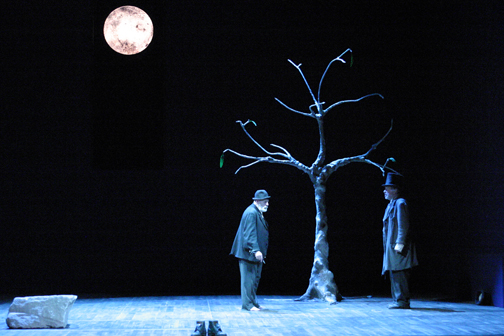
http://hitchcockian.files.wordpress.com/2008/05/where-the-fuck-is-godot.jpg

Interesting article from The American Scholar. There is a lot of talk of God and Jesus in this essay, but don't be put off by that - Wiman has some interesting observations about anxiety and the meaning of being alive within that questioning - he just happens to be coming at it from a mostly Christian perspective.

Hive of Nerves

To be alive spiritually is to feel the ultimate anxiety of existence within the trivial anxieties of everyday life

It is time that the stone grew accustomed to blooming,
That unrest formed a heart.

—Paul Celan

During a dinner with friends the talk turns, as it often does these days, to the problem of anxiety: how it is consuming everyone; how the very technologies that we have developed to save time and thereby lessen anxiety have only degraded the quality of the former and exacerbated the latter; how we all need to “give ourselves a break” before we implode. Everyone has some means of relief—tennis, yoga, a massage every Thursday—but the very way in which those activities are framed as separate from regular life suggests the extent to which that relief is temporary (if even that: a couple of us admit that our “recreational” activities partake of the same simmering, near-obsessive panic as the rest of our lives). There is something circular and static to our conversation, which doesn’t end so much as frazzle indeterminately out. And though there is always some comfort in comparing maladies, I am left with the uneasy feeling that my own private anxieties have actually increased by becoming momentarily collective—or no, not that, increased by not becoming collective, increased by the reinforcement of my loneliness within a collective context, like that penetrating but enervating stab of self one feels sometimes in an anonymous crowd. It is a full day later before it occurs to me that not once, not in any form, not even with the ghost of a suggestion, did any of us mention God.

THE GREATNESS of James Joyce’s Ulysses is partly in the way it reveals the interior chaos of a single mind during a single day, and partly in the way it makes that idiosyncratic clamor universal. However different the textures of our own lives may be, Bloom’s mind is our mind; the welter of impressions he suffers and savors is a storm we all know. And that is the book’s horror too: some form of this same fury of trivia is going on in the mind of every sentient person on the planet. How much cruelty is occasioned simply because of the noise that is within us: the din is too great for us to realize exactly what we are doing to others, or what is being done to others in our name. Thus an offhand remark, which leaves us as easily as a breath and which we think no more of than a breath, cuts a friend to the quick. And thus a whole country can be organized toward some collective insanity because there is no space in individuals to think. Life has accelerated greatly since Joyce’s time, and now, as our selves scatter into bits and bytes, and our souls, if we are conscious of them at all, diminish to little more than a vague wish for quiet, even the linear associativeness of Ulysses can seem quaint.

HOW DOES one remember God, reach for God, realize God in the midst of one’s life if one is constantly being overwhelmed by that life? It is one thing to encourage contemplation, prayer, quiet spaces in which God, or at least a galvanizing awareness of his absence (“Be present with your want of a Deity, and you shall be present with the Deity,” as the 17th-century poet Thomas Traherne puts it), can enter the mind and heart. But the reality of contemporary American life—which often seems like a kind of collective ADHD—is that any consciousness requires a great deal of resistance, and how does one relax and resist at the same time?

Commute (1)

O the screech and heat and hate
we have for each day’s commute,

the long wait at the last stop
before we go screaming

underground, while the pigeons
court and shit and rut

insolently on the tracks
because this train is always late,

always aimed at only us,
who when it comes with its

blunt snout, its thousand mouths,
cram and curse and contort

into one creature, all claws and eyes,
tunneling, tunneling, tunneling

toward money.

IN THE GOSPELS Jesus is always talking to the crowds in parables, which he later “explains” to his disciples. The dynamic is odd in a couple of ways: either the parables are obvious, and the explanations seem almost patronizing, or they are opaque, and the explanations only compound their opacity. (Or could it be—and I confess to relishing this possibility—that the explanations illustrate Christ’s wry sense of humor, which is nowhere else evident?) In any case, the notable point is just how little the explanations amount to, how completely the ultimate truths of the parables—just like dreams and poems—remain within their own occurrence.

Behind every urge to interpret is unease, anxiety. This can be a productive and necessary endeavor, whether it’s literary criticism or theology or even the dogmas and rituals of a religion (since all religion is, ultimately, an attempt to interpret God and numinous experience). Such effort deepens and complicates our initial response, even as it gives us an aperture through which to see our moments of mystery, crisis, and revelation more clearly—to give them “meanings,” to integrate them into our lives. The trouble comes when the effort to name and know an experience replaces the experience itself. Just as we seem to have grasped every level of meaning in a poem, the private and silent power that compelled us in the first place seems to drain right out of it. Just as we plant the flag of faith on a mountain of doctrine and dogma it has taken every ounce of our intellect to climb, our vision becomes a “view,” which is already clouding over, and is in any event cluttered with the trash of others who have fought their way to this same spot. Nowhere to go now but down.

“If that’s what he means,” says the student to the poetry teacher, “why doesn’t he just say it?” “If God is real,” says the parishioner to the preacher, “why doesn’t he simply storm into our lives and convince us?” The questions are vastly different in scale and relative importance, but their answers are similar. A poem, if it’s a real one, in some fundamental sense means no more and no less than the moment of its singular music and lightning insight; it is its own code to its own absolute and irreducible clarity. A god, if it’s a living one, is not outside of reality but in it, of it (though in ways it takes patience and imagination to perceive). Thus the uses and necessities of metaphor, which can flash us past our plodding resistance and habits into strange new truths. Thus the very practical effects of music, myth, image, which tease us not out of reality but deeper and more completely into it.

Christ speaks in stories as a way of preparing his followers to stake their lives on a story, because existence is not a puzzle to be solved but a narrative to be inherited, and undergone, and transformed person by person. He uses metaphors because something essential about the nature of reality—its mercurial solidity, its mathematical mystery and sacred plainness—is disclosed within them. He speaks the language of reality—speaks in terms of the physical world—because he is reality’s culmination and code, and because “this people’s mind has become dull; they have stopped their ears and shut their eyes. Otherwise, their eyes might see, their ears hear, and their mind understand, and then they might turn to me, and I would heal them.”

I DON’T THINK the “answer” to the anxiety felt by everyone at that dinner party is Christianity. In fact I’m pretty sure that is not the case, as we represented several different traditions (including no tradition)—and anyway Christ is not an answer to existence but a means of existing, and I am convinced that there is no permutation of man or mind in which he is not, in some form, present. (This from the Catholic nun, Sara Grant, speaking about, and quoting from, the Kena Upanishad: “Brahman is not ‘that which one knows,’ but that by which one knows, as though a crystal bowl were aware of the sun shining through it. ‘When he is known through all cognitions, he is rightly known.’” But it seems to me you could quote Christ himself in support of this idea: “To believe in me, is not to believe in me but in him who sent me; to see me, is to see him who sent me.”)

I do think, though, that both the problem of, and the solution to, our individual anxiety is a metaphysical one. Some modern philosophers (Heidegger, Kierkegaard) have argued that existential anxiety proceeds from being unconscious of, or inadequately conscious of, death. True, I think, but I wonder if the emphasis might be placed differently, shifted from unconscious reaction to unrealized action: that is, our anxiety is less the mind shielding itself from death than the spirit’s need to be. It is as if each of us were always hearing some strange, complicated music in the background of our lives, music which, so long as it remains in the background, is not simply distracting but manifestly unpleasant, because it demands the attention we are giving to other things. It is not hard to hear this music, but it is very difficult indeed to learn to hear it as music.

Who is it that clasps and kneads my naked feet, till they unfold,
till all is well, till all is utterly well? the lotus-lilies of the feet!

I tell you it is no woman, it is no man, for I am alone.
And I fall asleep with the gods, the gods
that are not, or that are
according to the soul’s desire,
like a pool into which we plunge, or do not plunge.

THE OPERATIVE WORD in these lines from D. H. Lawrence, who wasn’t a conventionally religious person, is soul. It’s a word that has become almost embarrassing for many contemporary people, unless it is completely stripped of its religious meaning. Perhaps that’s just what it needs sometimes: to be stripped of its religious meaning, in the sense that faith itself sometimes needs to be stripped of its social and historical incrustations and returned to its first, churchless incarnation in the human heart. That’s what the 20th century was, a kind of windstorm-scouring of all we thought was knowledge and truth and ours—until it became too strong for us, or we too weak for it, and “the self replaced the soul with the fist of survival” (Fanny Howe). Anxiety comes from the self as ultimate concern, from the fact that the self cannot bear this ultimate concern: it buckles and wavers under the strain, and eventually, inevitably, it breaks.

“GLIMMERINGS are what the soul’s composed of,” writes the Irish poet Seamus Heaney, an interesting—and, I think, accurate—thought, if the word glimmerings is read as both literal and metaphorical: the soul is not simply the agent that does the seeing (the entity to which metaphorical glimmerings are given), it is in some way the things that are seen (the world that glimmers); or, perhaps more accurately, it is the verb that makes an exchange between the self and reality, or the self and other selves, possible. It is the soul that turns perception into communication, and communication—even if it’s just between one man and the storm of atoms around him—into communion.

THE MEANINGS that God calls us to in our lives are never abstract. Though the call may ask us to redefine, or refine, what we know as life, it does not demand a renunciation of life in favor of something beyond it. Moreover, the call itself is always comprised of life. That is, it is not some hitherto unknown voice to which we respond; it is life calling to life. People think that diagnosing the apostle Paul with epilepsy or some related disorder nullifies any notion that God might truly have revealed something of himself on that road to Damascus. But God speaks to us by speaking through us, and any meaning we arrive at in this life is comprised of the irreducible details of the life that is around us at any moment. “I think there is no light in the world / but the world,” writes George Oppen. “And I think there is light.”

THERE IS A DISTINCTION to be made between the anxiety of daily existence, which we talk about endlessly, and the anxiety of existence, which we rarely mention at all. The former fritters us into dithering, distracted creatures. The latter attests to—and, if attended to, discloses—our souls. And yet it is a distinction without a difference, perhaps, and as crucial to eventually overcome as it is to initially understand, for to be truly alive means to feel one’s ultimate existence within one’s daily existence, to feel one’s trivial, frittering anxieties acquiring a lightness, a rightness, a meaning. So long as anxiety is merely something to be alleviated, it is not life, or we are not alive enough to experience it as such.

I DON’T MEAN to be describing an intellectual transformation, or a transformation that is available only to “intellectuals.” I suppose that for many people—people inclined to read essays like this one, for instance—the transformation might seem to begin with a mental decision and a definite application of the will. In fact, I think taking such a step indicates that some rift of meaning and feeling has already opened inside of us, and we are clutching, consciously or unconsciously, at the rock face and rubble above this sudden abyss. In the end if we are to integrate our anxieties into our lives—and thereby alleviate them—any merely intellectual understanding of them is inadequate.

Consciousness among contemporary Western intellectuals is an “apprehensive” quality: that is to say, we become conscious by taking hold of, or apprehending, our selves and reality, by standing apart from them. Not at all coincidentally, we grow apprehensive as we do so (for where, exactly, are we standing?). There are other, fuller ways of being in the world, which Eastern religions, as well as Christian mysticism, strive to articulate. (Meister Eckhart: “It is not that we should abandon, neglect or deny our inner self, but we should learn to work precisely in it, with it and from it in such a way that interiority turns into effective action and effective action leads back to interiority and we become used to acting without any compulsion.”) But again, the best evidence comes not from books but from people, some of whom would never think to pick up a book. Suddenly I am seeing someone out of my own childhood, recalling a habit of mind too attentive to be called passive, too intuitive to be called thought. I am thinking (thinking!) of a presence so in love with life, so in tune with time, that death seemed only to drive her further in.

She who in her last days loved too well to lose
A single weed to namelessness, in creosote,
Blue gramma, goatsbeard that is not thriving, is,
Amid the cattails’ brittle whisper whispers
O Law’, Honey, ain’t this a praiseful thing.

THE ITCH inside of contentment, or the itch that perhaps is contentment, as if despite our problems with anxiety, inner rest required outer restlessness, as if peace with ourselves and our times were found only within frenzy. Or, for some, never found at all. W. B. Yeats:

Through winter-time we call on spring,
And through the spring on summer call,
And when abounding hedges ring
Declare that winter’s best of all;
And after that there’s nothing good
Because the spring-time has not come—
Nor know that what disturbs our blood
Is but its longing for the tomb.

This is life as pure death wish. There is a sense in which Yeats is right: what we seek is meaning for our ceaseless, anxious, and always-anticipatory actions, and death is part of that meaning. Any life that does not take account of death, that does not, in one way or another, hear the annihilating silence inside every sound, the nullifying stillness within every action, is a life that can neither harness nor redress that dark energy—which is to say, a life of which death already has possession. Yeats’s mistake, though, is to make death the entire meaning of life, which, ultimately, makes not only our anxieties, but also our actions, meaningless. Here’s another take:

WHEN God at first made Man,
Having a glass of blessings standing by—
Let us (said He) pour on him all we can;
Let the world’s riches, which dispersed lie,
Contract into a span.

So strength first made a way,
Then beauty flow’d, then wisdom, honour, pleasure:
When almost all was out, God made a stay,
Perceiving that, alone of all His treasure,
Rest in the bottom lay.

For if I should (said He)
Bestow this jewel also on My creature,
He would adore My gifts instead of Me,
And rest in Nature, not the God of Nature:
So both should losers be.

Yet let him keep the rest,
But keep them with repining restlessness;
Let him be rich and weary, that at least,
If goodness lead him not, yet weariness
May toss him to My breast.

In this poem, “The Pulley” by George Herbert, our very restlessness is a gift, as it reminds us, even when we are most content, what we most need and why we are on this earth at all. The poem is perhaps theologically suspect (why this rat’s maze of a world for a known result?) but intuitively true. We are driven ceaselessly onward in this life and are certain of our desires only until we realize them, at which point they seem to dissolve and shimmer further off, like a heat mirage on a road down which we can’t stop racing. Unlike Yeats, though, for whom that road ends at a massive wall into which we finally, fatally slam, for Herbert the very permanence of our longing is proof of longing’s eventual fruition. Which is not to say, though, that this fruition is forever forestalled. It isn’t “heaven,” exactly, except insofar as we learn to see, as he says in another poem, “Heaven in Ordinarie.”

AT FIRST, attending to the anxiety of existence can seem like a zero-sum game. Any attention turned toward the truth of the spirit is attention turned away from all we have come to think of as “life.” Thus we parcel out our moments of devotion—a church service here and there, a walk in the woods, a couple of hours of meditation a week—all the while maintaining the frenzy of our usual existence outside of those moments. This is inevitable, for the initial demands of the spirit are intense, but it is not sustainable, for the soul is not piecemeal. We are left with this paradox: only by hearing the furthest call of consciousness can we hear the call of ordinary life, but only by claiming the most mundane and jangling details of our lives can that rare and ulterior music of the soul merge with what Seamus Heaney calls “the music of what happens.”

IT IS A STRANGE THING how sometimes merely to talk honestly of God, even if it is only to articulate our feelings of separation and confusion, can bring peace to our spirits. You thought you were unhappy because this or that was off in your relationship, this or that was wrong in your job, but the reality is that your sadness stemmed from your aversion to, your stalwart avoidance of, God. The other problems may very well be true, and you will have to address them, but what you feel when releasing yourself to speak of the deepest needs of your spirit is the fact that no other needs could be spoken of outside of that context. You cannot work on the structure of your life if the ground of your being is unsure.

THE FIRST STEP in the life of the spirit is learning to let yourself experience those moments when life and time seem at once suspended and concentrated, that paradox of attentive oblivion out of which any sustaining faith grows. These moments may not be—and at first almost certainly will not be—“meditative.” They are more likely to break into your awareness, or into what you thought was awareness (“inbreaking” is the theological term for Christ’s appearance in the world and in our lives—there is no coaxing it, no way to earn it, no way to prepare except to hone your capacity to respond, which is, finally, your capacity to experience life, and death). This is why we cannot separate one part of our existence, or one aspect of our awareness, from another, for there is a seed of peace in the most savage clamor. There is a kind of seeing that, fusing attention and submission, becomes a kind of being, wherein you may burrow into the very chaos that buries you, and even the most binding ties can become a means of release.

Commute (2)

There is a dreamer
all good conductors

know to look for
when the last stop is made

and the train is ticking cool,
some lover, loner, or fool

who has lived so hard
he jerks awake

in the graveyard,
where he sees

coming down the aisle
a beam of light

whose end he is,
and what he thinks are chains

becoming keys . . .

KEYS TO WHAT, though? For I can’t end with that flourish of poetry and privacy. Art, like religious devotion, either adds life or steals it; it is never neutral; either it impels one back toward life or is merely one more means of keeping life at arm’s length. (The subject matter and tone of art have less to do with this than many people think: nothing palls the soul like a forced epiphany, and one can be elated and energized by a freshly articulate despair.) Keys to what? In this poem, the keys are, on one level, to the constraints felt in the earlier section (the miserable commute, the crush of others, the “screech and heat and hate”), which prove to be their own means of release (“what he thought were chains / becoming keys”). On another level, the keys are to the mysteries of death; or, rather, the key is to the blunt, immutable, physical fact of death (the train “graveyard”), which opens, if only for a moment, to reveal a mystery.

And now it’s over. Now the man on the train—like the man who imagined him (me!), like Paul God-struck outside of Damascus (alas, it wasn’t quite like that for me)—must move. Now the revelation either becomes part of his life or is altogether lost to it. Either his actions acquire a deeper purpose, and begin to echo and counterpoint each other, or the moment and the man slip back into unfeeling frenzy, and the screech and heat and hate of his days lock metallically around him again.

Death is the only lens for true transcendence, but, paradoxically, transcendence is possible only when we cease being conscious of our own death. I don’t mean that we are unconscious of our own death, but that we pass through what we think of as consciousness—that “apprehensiveness” I mentioned, that standing-apart-from and taking-hold-of—into something more profound. What you feel in amateur photographs—it’s a large part of the poignancy—is the pressure, or the lack of pressure, actually, of all the reality missing from the picture, which is really just a chopped-off piece of life. An artist, on the other hand, makes you feel just how much missing life is contained within a given image; it is as if the image is surrounded with, enlivened and even created by, the invisible, the unknowable, the absent. It’s not accurate to say that someone who has learned to see like this has forgotten that there is a lens between himself and life. It’s more that the lens has become so intuitive and fluent that it’s just another, clearer eye.

That dinner party with which I began this essay was a failure of mine—not of nerve, exactly, for nothing I have said in this essay had even crossed my mind at that point. No, it was a failure of consciousness, which is always a spiritual failure. I believe there is a kind of existence in which meditation and communication, epiphanies and busyness, death and life, God and not—all these apparent antinomies are merged and made into one awareness. I am a long way from realizing such perception myself, but I have lifted the lens to my eye—there is a sense in which it must be voluntarily lifted, even if, perhaps especially if, it has been roughly thrust there by circumstance—and am learning.

Christian Wiman is the editor of Poetry magazine and the author of two books of poems. His most recent book is Ambition and Survival.