Offering multiple perspectives from many fields of human inquiry that may move all of us toward a more integrated understanding of who we are as conscious beings.
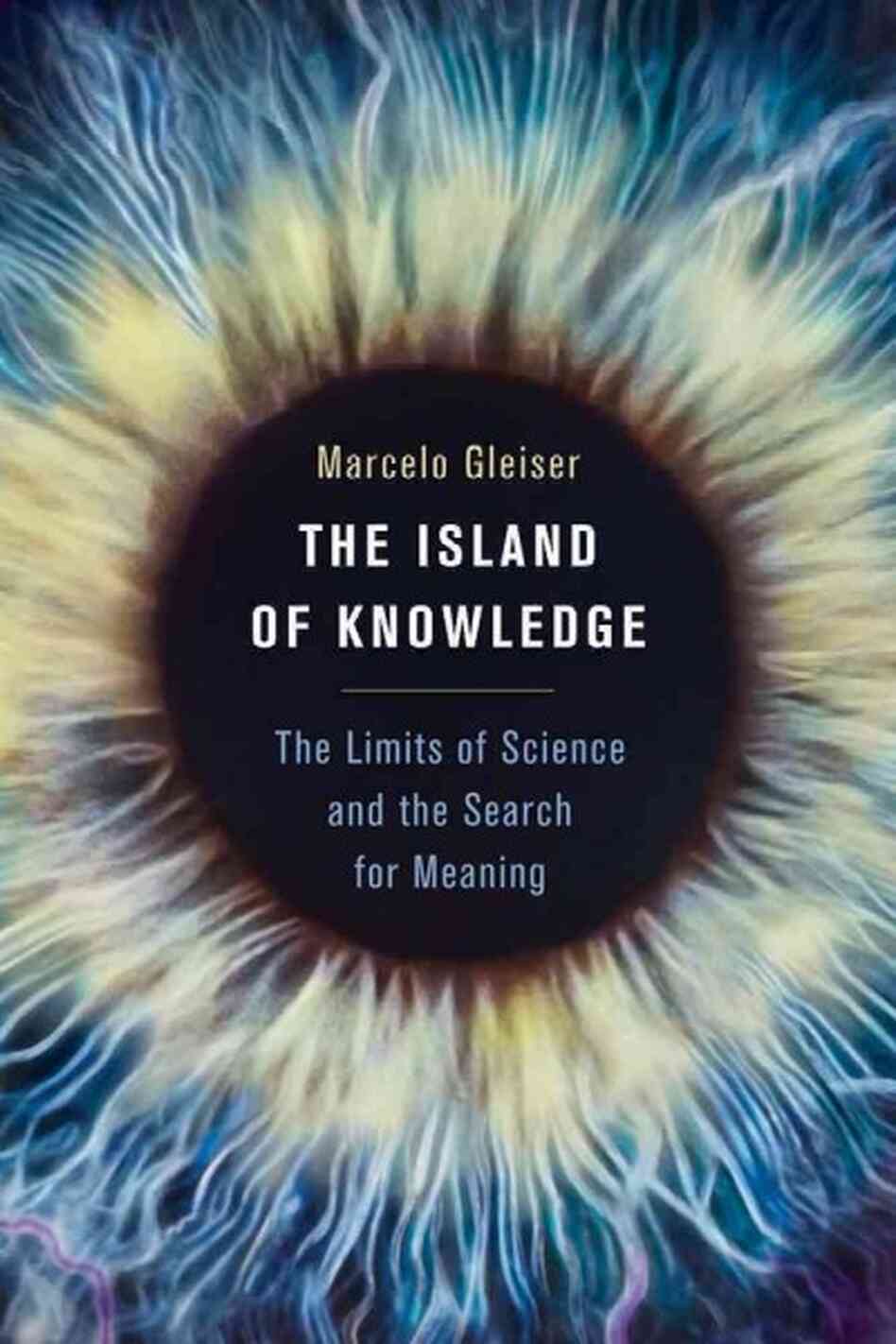
Here is the publisher's ad copy for the new book from Amazon:
Do all questions have answers? How much can we know about the world? Is there such a thing as an ultimate truth?
To be human is to want to know, but what we are able to observe is only a tiny portion of what’s “out there.” In The Island of Knowledge,
physicist Marcelo Gleiser traces our search for answers to the most
fundamental questions of existence. In so doing, he reaches a
provocative conclusion: science, the main tool we use to find answers,
is fundamentally limited.
These limits to our knowledge arise
both from our tools of exploration and from the nature of physical
reality: the speed of light, the uncertainty principle, the
impossibility of seeing beyond the cosmic horizon, the incompleteness
theorem, and our own limitations as an intelligent species. Recognizing
limits in this way, Gleiser argues, is not a deterrent to progress or a
surrendering to religion. Rather, it frees us to question the meaning
and nature of the universe while affirming the central role of life and
ourselves in it. Science can and must go on, but recognizing its limits
reveals its true mission: to know the universe is to know ourselves.
Telling the dramatic story of our quest for understanding, The Island of Knowledge
offers a highly original exploration of the ideas of some of the
greatest thinkers in history, from Plato to Einstein, and how they
affect us today. An authoritative, broad-ranging intellectual history of
our search for knowledge and meaning, The Island of Knowledge is a unique view of what it means to be human in a universe filled with mystery.
Gleiser is a smart and entertaining guy, so this is likely a fun read.
Jim Holt is one of those atheist, elitist, commie pinko scum, you know, a scientist. And in this TED Talk he offers some observations on why the world exists, after dismissing the "God + nothing = the universe" equation. Did God wonder where he came from and why?
Why is there something instead of nothing? In other words: Why does the universe exist (and why are we in it)? Philosopher and writer Jim Holt follows this question toward three possible answers. Or four. Or none. In his 2012 book Why Does the World Exist? An Existential Detective Story, Jim Holt creates a narrative out of one of the biggest questions we can ask -- and how modern scientists and philosophers are asking it. Can answers be found in many-worlds theory, in quantum mechanics, in a theology? Traveling around North America and Europe, he talks to physicists, including David Deutsch; philosophers, including Richard Swinburne; and the novelist John Updike. Why? Because as he tells Vanity Fair, "To me it’s the most sublime and awesome question in all of philosophy and all of human inquiry." A longtime contributor to the New York Times, Slate, and the New Yorker, Holt has written on string theory, time, infinity, numbers, humor, logic, truth and bullshit, among other topics. Holt studied mathematics at the University of Virginia, and was a faculty fellow in the philosophy department at Columbia. He is now at work on a book about free will, weakness of will, self-knowledge and happiness.
From Bookforum's Omnivore blog, another cool collection of links related to philosophy and philosophers. One of the cool papers is by Marc Fleurbaey (Princeton) and Alex Voorhoeve (LSE): On the Social and Personal Value of Existence - here is the abstract.
If a potential person would have a good life if he were to come into existence, can we coherently regard his coming into existence as better for him than his never coming into existence? And can we regard the situation in which he never comes into existence as worse for him? In this paper, we argue that both questions should be answered affirmatively. We also explain where prominent arguments to differing conclusions go wrong. Finally, we explore the relevance of our answers to issues in population ethics.
Regardless of the kind of life a person may have, I know a LOT of people who, given the choice, would choose to never have been born.
Thomas Grundmann (Cologne): Doubts about Philosophy? The Alleged Challenge from Disagreement.
Do philosophers talk nonsense? Ian Dearden on an inquiry into the possibility of illusions of meaning; and have philosophical accusations of talking nonsense been treated with unmerited respect?
Dreams of reason: Anthony Gottlieb interviewed by Richard Marshall.
From Pop Music and Philosophy, Joseph Len Miller on an example of the distinction between metaphysics ("I'm sexy") and epistemology ("and I know it"); and who says rappers don't know philosophy?
Reason and romance, the world’s most cerebral marriage: Derek Parfit and Janet Radcliffe-Richards believe that philosophy should guide behaviour — their marriage shows that it can.
What do philosophers do, outside of academia, that is? Rebecca J. Rosen wonders.
Have you ever thought you could be just like Aristotle, if you just had the right push? A look at how to become a philosopher.
In this two-part post, Danaher looks at Nagel's work around life's absurdity (a topic I once enjoyed when reading some of the existentialists, such as Camus). This topic in Nagel's work is new to me, so I found it interesting.
Is life absurd? Should we bother with it? Does it matter either way? Rightly or wrongly, Thomas Nagel’s 1971 article, “The Absurd”, is one of the most celebrated and widely-cited contributions to the literature on these questions. I certainly am struck by how frequently people refer to it in conversations I have with them about this topic. It seems like anyone with even a dim awareness of literature will have heard of Nagel’s piece. Even more striking is the fact that although people often aver to the opening passages, in which Nagel dismisses common arguments for the absurdity of life, they also tend to ignore or downplay the rest of the article, in which Nagel defends the absurdist view. This omission is sometimes found among non-believers, who like using the opening passages to critique theistic conceptions of meaning (e.g. William Lane Craig’s). Indeed, this is something I did in one of my old podcasts, though I believe I did discuss Nagel’s defence of absurdism in the end. Anyway, I’m mentioning all of this because one of my current projects looks at the intersection between transhumanism and the philosophical debate over the meaning of life. As part of that project, I thought it would be worth revisiting Nagel’s famous article, and taking a closer look at its key arguments. So that’s what the next two blog posts will be about. In this post, I’ll look at the critical phase of the article, in which Nagel dismisses commonplace arguments for absurdity. In the next post, I’ll look at his own argument for the absurdity of life. 1. A Comment on Methods and an Introduction to the Arguments As is my wont on this blog, I want to carefully unpack and formally reconstruct Nagel’s critique of the commonplace arguments for absurdity. This turns out to be a difficult task. The oft-cited critical phase of Nagel’s article is exceptionally brief. By my estimate, it occupies slightly less than two pages of the text. What’s more, the argumentation in these pages is dense, with four separate arguments being introduced and dismissed in short order.* This means the logic is often compressed and epigrammatic; decompressing it requires a good deal of interpolation and patience. It’s actually worth commenting on why this is since it allows me to make a meta-point, one that I think will be useful to anyone interested in analysing and evaluating arguments in a rigorous manner. The main problem is that Nagel’s presentation and critique of the four arguments is enthymematic in nature. An “enthymeme” is a compressed form of argument, common in everyday conversation and political rhetoric. As you probably know, a classical syllogism is a three-part argument consisting of a major premise (usually a statement of some abstract principle), a minor premise (some statement of fact), and a conclusion (which shows how the fact relates to the general principle). An enthymeme is a two-part argument, in which one of premises from the syllogism is left unstated. In my experience, it is the general principle that is most often left out. Thus, an enthymeme typically consists of a statement of fact and a conclusion. “It’s raining. Therefore, the traffic will be bad” is an enthymeme of this type. You might think, given this characterisation, that enthymemes would be transparently bad arguments. After all, how can you reach a conclusion without one of the logically required elements of an argument? But in most aspects of our lives we share a good number of assumptions and principles. It’s what makes communication possible. Hence, when listening to people make enthymematic arguments, we often do them the courtesy of implying or filling in the assumptions needed to make their argument logically sound. In fact, this is such a natural courtesy, that we sometimes grant people the assumptions when we really shouldn’t — i.e. when they are actually making bad arguments. I often tell my students that when they are assessing philosophical arguments, or when they are presenting their own, they should avoid the use of enthymemes. As much as possible, they should render every argument in its complete logical form. This way they’ll start spotting flawed principles in arguments made by others, and start defending the questionable principles in their own arguments. In many ways, cultivating this habit of mind is what philosophy is all about. Now, in a sense, this is exactly what Nagel does in the opening passages of his article. Because he is dealing with commonplace arguments for the absurdity of life, and because these commonplace arguments tend to be enthymematic in form, one of his initial tasks is to expose the flawed principles and assumptions underlying those arguments. But what is so frustrating about these passages is how, in presenting his own criticisms, Nagel never bothers to render the commonplace arguments in their proper logical form, isolate the problematic premises, and subject them to a perspicuous evaluation. Instead, he states them in their enthymematic form, and responds in a circuitous and correspondingly enthymematic form himself. I appreciate this might be because Nagel isn’t too concerned with the commonplace arguments in his article. His main goal is not to critique the absurdist position, but to offer a novel (in 1971!) and more persuasive defence of it. That’s perfectly legitimate. But I have more time and space to play around with, and I want to do a more thorough job on the commonplace arguments. So that’s what I’ll do in the remainder of the post. As I do so, I think you’ll begin share my view that Nagel’s objections to these arguments aren’t as good as they might first appear to be. Not that the arguments are all that great either. 2. The “Temporally Distant Mattering” Argument The first argument Nagel deals with — for want of a better name — is the “Temporally Distant Mattering” Argument (TDMA for short). According to this argument, our lives are absurd because nothing we do now will matter at some temporally distant point, say one million years hence. Here’s what Nagel says about it:
It is often remarked that nothing we do now will matter in a million years. But if that is true, then by the same token, nothing that will be the case in a million years matters now. In particular, it does not matter now that in a million years nothing we do now will matter…Whether what we do now will matter in a million years could make the crucial difference only if its mattering in a million years depended on its mattering, period. (Nagel, 1971, p. 716)
Let’s try to unpack what Nagel is saying here by spelling out the logic of the TDMA:
(1) In order for our lives to have meaning (i.e. to not be absurd), what we do now must matter at some temporally distant point, e.g. one million years hence. (2) Nothing we do now will matter one million years hence. (3) Therefore, our lives are absurd.
The first premise states a condition for a meaningful life. It may be a necessary or a sufficient condition, but that doesn’t “matter” too much “right now”. It will in a moment. The second premise makes a factual claim and is the basis of the original enthymeme. I think it is of dubious merit. The problem is that this notion of “mattering” is incredibly vague. If it just means “will have some effect” on the state of the universe one million years from now, then I suspect it is false. Everything we do now may well have some causal effect on the future, however minimal that may be. Maybe it won’t have a “large effect” or an “effect of the right type”, but if that’s the concern that needs to be made much clearer. In any event, Nagel eschews this kind of factual criticism. Instead he points to a supposed implication of premise (2), which has a knock-on effect on the plausibility of the premise (1). If I could reconstruct the argument from the quoted passage, I would put it thusly:
(4) If it is true than nothing we do now will matter one million years hence, then it is also true that nothing that happens one million years hence matters now. (5) But if (4) is true then (1) is false. (6) (4) is true (because (2) is true). (7) Therefore, (1) is false.
In other words, Nagel is saying that the fact that nothing that happens in a million years matters now gives us some reason to doubt the unstated principle guiding the original objection. I have some worries about this. While I suspect the conclusion is true, I think the argument is questionable. For one thing, it all depends on the precise meaning we give to this concept of “mattering” in premise (4). If we interpret it to mean “has some causal effect”, then it’s probably true. But if it means “has some significance for how we live our lives now”, then it’s probably false. The possible future does have some significance for our behaviour. I make decisions all the time based on what I think my possible future might be like. Granting this, why couldn’t it be true that the possible state of the universe one million years from now has an effect on how I live my life now? The claim that (4) follows from (2) doesn’t seem right to me. There is also the nagging suspicion that Nagel’s critique really just begs the question against the original objection. Surely one of the things that is at dispute here is whether what happens one million years hence matters for us now. To claim that nothing that happens one million years hence matters now is to assume the conclusion that needs to established. Nagel may say he has established this by derivation from premise (2) but I don't think that's correct for the reasons I have just stated: the future state of the universe could make a difference to how you live your life now. More charitably, Nagel is simply making the point that the original premise doesn’t plausibly state a sufficient condition for meaning. This much is suggested by some of his other comments:
[E]ven if what we did now were going to matter in a million years, how could that keep our present concerns from being absurd? If their mattering now is not enough to accomplish that, how would it help if they mattered a million years from now? (Nagel, 1971, p. 716)
I am quite sympathetic to this line of reasoning. Although I suggested it was possible a moment ago, it does seem odd to say that what happens one million years hence could provide the “magic ingredient” needed to avoid absurdity. The only problem here is that while premise (1) may not state a sufficient condition for meaning — and hence it seems like an odd claim — it may state a necessary condition for meaning. In other words, it may be true that mattering one million years hence plus some other factor is sufficient for meaning, even if mattering one million years hence on its own is not. This problem crops up elsewhere in Nagel’s critique. Finally, there is a sense in which Nagel’s argument gestures toward the following sentiment:
Nothing Matters Principle: If it is true that nothing matters, then it also true that it doesn’t matter that nothing matters.
This is right, and indeed it seems like Nagel ultimately endorses it through his defence of absurdism. But it is distinct from the concerns articulated by the TDMA and does not follow from Nagel’s critique of that argument. 3. The “Smallness and Shortness” Arguments The second and third commonplace arguments claim that the shortness and smallness of our lives render them absurd. Nagel describes them like this:
What we say to convey the absurdity of our lives often has to do with space or time: we are tiny specks in the infinite vastness of the universe; our lives are mere instants on a geological time scale, let alone a cosmic one; we will all be dead any minute. But of course none of these evident facts can be what makes life absurd, if it is absurd. For suppose we lived forever; would not a life that is absurd if it lasts seventy years be infinitely absurd if it lasted through eternity? And if our lives are absurd given our present size, why would they be any less absurd if we filled the universe (either because we were larger or because the universe was smaller)? (Nagel, 1971, p. 717)
I think Nagel is right to condemn both arguments, and I think his reasoning here is slightly stronger than it was in the first case, but we still need to be careful. Let’s unpack the logic behind both objections and clarify Nagel’s responses. The size objection will be dealt with first. Nagel seems to interpret it thusly:
(8) In order for our lives to have meaning (i.e. not be absurd), we must not occupy too small a physical space within the universe. (Corollary: to avoid absurdity we must occupy a sufficiently large space within the universe). (9) We occupy too small a physical space within the universe (we are mere tiny specks in the infinite vastness). (10) Therefore, our lives are absurd.
Nagel rejects this argument on the grounds that premise (8) states neither a necessary nor a sufficient condition for meaning. And I think he’s right to do so. There is no reason to think that increased physical size would make our lives less absurd. Indeed, it might make it even more absurd. Imagine a simple box universe in which your body takes up almost the entire physical space within the box. With nothing else in the box, all you can do is sit around all day until (hopefully) the box collapses back in on itself. Surely that would be an absurd existence? Still, I wonder whether this is an incredibly uncharitable interpretation of the commonplace argument. It could be that the premise underlying the “we are mere specks of dust”-claim is not about physical size per se, but rather about the size, extent and duration of one’s causal influence on the universe. That sounds more plausible to me since it maps onto to concerns many people have about their lives on earth, e.g. how can one person make a difference give the causal and social complexity of modern life?. This argument would raise concerns similar to those raised by the TDMA, albeit in a more precise manner. That brings us to the shortness argument, which Nagel seems to interpret as a kind of immortality argument:
(11) In order for our lives to have meaning (i.e. not be absurd), they must go on forever. (12) Our lives do not go on forever; they are quite short. (13) Therefore, our lives are absurd.
This, of course, is a very common line of argument, one that features heavily in religious accounts of the meaning of life. Nagel refutes it with an equally common line of argument, which I state as follows:
(14) If a current human life with a duration of approximately 70 years (L70) is absurd, then the same kind of life with an infinite duration (L∞) will also be absurd.
In other words, to reiterate something I said previously, indefinitely extending a lifespan does not add the magic ingredients needed for a meaningful life. There are a couple of problems here. First, the crucial assumption of Nagel’s critique is that L∞ will be qualitatively similar to our absurd lives. But this might be wrong. Knowing that one will live forever might have significant qualitative changes on one’s life. This links to the second problem, which is that although immortality may not be sufficient for meaning, it might be necessary. 4. The “Chain of Justification” Argument The fourth and final commonplace argument is concerned with the affect of death on the chains of justification in our lives. Nagel puts it like this:
Another inadequate argument is that because we are going to die, all chains of justification must leave off in mid-air; one studies and works to earn money to pay for clothing, housing, entertainment, food, to sustain oneself from year to year, perhaps to support a family and pursue a career — but to what final end? All of it is an elaborate journey leading nowhere. (Nagel, 1971, p. 717)
This is actually quite a complex argument, partly due to its opacity. It raises issues analogous to those raised in debates over the cosmological argument in the philosophy of religion. Specifically, issues relating to the principle of sufficient reason and the explanation of causal chains. I’m going to blur some of that complexity in my formal restatement, which is:
(14) A life consists in a finite chain of events, from E.birth . . . E.death. (15) In order for our lives to have meaning (i.e. to not be absurd), every event that takes place within them (En) must be justified in terms of one or more proceeding events (En+1). (16) Because life consists in a finite chain of events, at least one event within life cannot be justified in terms of some subsequent event. (17) Therefore our lives are absurd.
Nagel rejects premise (15), which is the unstated principle guiding the original objection. There are two problems with it. First, it ignores the possibility that events within life could have intrinsic justification or meaning. In other words, their meaning or significance may not depend on any subsequent events. Thus, think of any activity or project that you pursue for its own sake, not for its subsequent benefits. For example, I play my guitar for the sake of that activity alone, not because it makes me a better person or because I want to be a successful musician. Second, the argument makes an unreasonable demand by suggesting that justifications are needed for everything in terms of something else. But this leads to an infinite regress of justification that could never be satisfied:
Since justifications must come to an end somewhere, nothing is gained by denying that they end where they appear to, within life — or by trying to subsume the multiple, often trivial ordinary justifications of action under a single controlling life scheme. We can be satisfied more easily than that. In fact, through its misrepresentation of the process of justification, the argument makes a vacuous demand. It insists that the reasons available within life are incomplete, but suggests thereby that all reasons that come to an end are incomplete. This makes it impossible to supply any reasons at all. (Nagel, 1971, p. 718)
I have little enough to say about this, except that I think it is right. I think chains of justification do have stopping points and that this could impact upon arguments for the meaning of life. Still, I find it somewhat odd that Nagel thinks this a devastating objection to the commonplace argument. Why? Well, because when he gets around to making his own argument in favour of absurdity he relies on a very similar, infinite regress-style, principle. I’ll take this up in part two.
* There is possibly a fifth argument, depending on whether you think Nagel’s remark about the fact that ‘we will all be dead any minute’ picks out an argument that is distinct from the argument about the length our lives. It is possible a point is being made here about the fragility of our lives, not their temporal duration. However, Nagel doesn’t make much of this remark subsequently so I’ve ignored that possibility. Fortunately, I wrote about this objection once before in my series on Di Muzio’s article “Theism and the Meaning of Life”.
As an undergraduate student (in law), many many years ago,* I read Albert Camus’s book The Myth of Sisyphus. The work introduced me to absurdism, which is a philosophical position holding that life is devoid of all meaning and significance. It was a seminal moment for me, and an important stepping stone in my intellectual life. But Camus’s book wasn’t particularly persuasive or perspicuous, so when I expressed my interest in absurdism to one of my friends (who actually did study philosophy), he recommended that I read Thomas Nagel’s famous article “The Absurd”, which he said presented a more rigorous and satisfying defence of absurdism. Does it? Well, that’s what I’m trying to find out, several years after originally reading it. In the previous post, I looked at Nagel’s critique of the commonplace arguments for absurdity. I think I made it reasonably clear that I don’t find Nagel’s criticisms entirely convincing, largely because of a lack of clarity, but I think I also made it clear that — to be fair to the guy — critiquing those arguments wasn’t his primary aim. His aim was to present a better argument for absurdism, and the analysis of that argument is the goal of this post. For those of you who made it through part one, rest assured that I won’t be nearly as dry or painstaking in my discussion here. That’s because, unlike the critical part of the article which lasted a mere two pages, Nagel’s positive case for absurdism runs for nearly ten pages. Subjecting each and every paragraph from those ten pages to a careful analysis and formal reconstruction would really be pushing it. So I’ll be brief. First, I’ll set out my reconstruction of Nagel’s argument. Then, I’ll consider how he defends the key premises of that argument. 1. Nagel’s Argument for Absurdity
Nagel starts with an observation about absurdity in everyday life. He says:
In ordinary life a situation is absurd when it includes a conspicuous discrepancy between pretension or aspiration and reality: someone gives a complicated speech in support of a motion that has already been passed; a notorious criminal is made president of a major philanthropic foundation; you declare your love over the telephone to a recorded announcement; as you are being knighted your pants fall down. (Nagel, 1971, p. 718)
I don’t know about you, but I find these examples a little odd. Some of them sound more like irony or misfortune than absurdity, but then again I’m not sure absurdity is a concept we are competent in using prior to any philosophical analysis. So I’m willing to go with the basic idea: that it is absurd when there is this mismatch between aspiration and reality. But the paragraph quoted only talks about absurdity within someone’s life. It does not speak to the absurdity of life as a whole. What is needed for that? Nagel suggests, rather straightforwardly, that absurdity in life as whole simply requires the extension of his analysis to every event in life. In other words, life as a whole is absurd if there is a persistent and inescapable discrepancy between what we hope or desire for our lives and what reality grants us. So what do we hope for our lives and what does reality grant us? The answer, according to Nagel, is that we treat our lives as matters of utmost seriousness (and hence seriousness is what we aspire to), but we are constantly thwarted by the fact that we can also view our life plans and goals as arbitrary and open to doubt. This gives us the basis for his argument, which runs as follows:
(1) Our lives are absurd if there is a persistent and inescapable discrepancy between our aspirations and what we can actually achieve. (2) If we treat our lives as matters of serious concern, but they are unavoidably open to doubt and questioning, then there is a discrepancy between what we can achieve and what we desire. (3) We treat our lives as matters of serious concern. (4) But our life plans are always open to doubt and questioning. (5) Therefore, our lives are absurd.
In the remainder of the post, I’ll look at how Nagel defends premises (3) and (4). They form the real backbone to his argument. The other two premises require less comment but some few words are in order. As for the first premise, which supplies the motivating principle, I noted above how the examples Nagel uses to derive this principle are odd. Still, as I also noted, I’m willing to run with it, if only because I don’t know of any other good candidate analysis of absurdity. The second premise is sort of a stipulation made by Nagel in the article, but I think it becomes more plausible if we look at how Nagel cashes out the notion of “treating one’s life with seriousness” and the “unavoidability of doubt”. I will say though — and this becomes more significant toward the end — the premise leaves open the possibility that not treating one’s life as a matter of serious concern might make it less absurd (or, rather, more livable). Nagel ends his article by endorsing this shift in attitude. 2. Defending the Premises
Let’s start with the defence of premise (3). As I said already, this premise is a little puzzling since, at the end of the article, Nagel advocates treating one’s life with irony. This suggests that even he thinks it is possible to avoid treating one’s life seriously and so to avoid the pitfalls of absurdity. But then again he also says “we take our selves seriously whether we lead serious lives or not” (p. 719). So what exactly is Nagel driving at when he says we always treat our lives as matters of serious concern? Charitably, I think he’s saying one of two things: (i) we all easily fall into the trap of treating our lives as matters of serious concern; and/or (ii) we explicitly or implicitly desire that our lives be matters of serious concern, i.e. that they are “worth it” in some way. Consider:
[People] spend enormous quantities of energy, risk and calculation on the details [of their lives]. Think of how an ordinary individual sweats over his appearance, his health, his sex life, his emotional honesty, his social utility, his self-knowledge, the quality of his ties with family, colleagues, and friends, how well he does his job, whether he understands the world and what is going on in it. Leading a human life is a full-time occupation, to which everyone devotes decades of intense concern. (Nagel, 1971, pp 719-720)
I think there’s a lot of truth in what Nagel says here, and I see a lot of myself in this description. Although I like to think of myself as a pretty ironical individual, with a healthy appreciation for the absurd, the reality is that I devote myself to my pursuits. I think it important to write blog posts, to read academic articles, to write research papers, to talk to my family, to cultivate my friendships, to develop and sustain a meaningful relationship with my partner, and so on. What’s more, I want my efforts in each of these domains to be taken seriously by others, to be appreciated for there successes and chastised for their failures. Heck, I even devote myself with utmost conviction to cultivating my ironical and absurdist attitudes. So I can see what Nagel is getting at, and I can see the appeal of premise (3). But on its own premise (3) is harmless. Devoting ourselves to our projects with utmost concern would be fine if those projects were proper objects of concern. It’s at this point that premise (4) arrives on the scene to spoil the party. Premise (4) claims that we can always view our life plans and goals as arbitrary and open to doubt. Thus, I can question whether I should be writing this blog post, whether I should be pursuing a career in academia, whether I should cultivate friendships and relationships and so on. There are many options out there, many other things I could have been doing, and there is no really reason to think my chosen path in life is better or more worthwhile than those. There’s more to premise (4) than that though. Indeed, as I’ve just described it, it doesn’t seem all that different from the bad “Chain of Justification” argument that was discussed in part one. Nagel acknowledges this and tries to differentiate the argument he is making from that bad one. He is not simply saying that we have the power to question or challenge the reasons for our actions. No; he is saying we have the power to question the entire scheme of justification that sustains our lives in the first place. In other words, that we have the power to step back from the serious business of living, to view our lives sub specie aeternitatis (under the aspect of eternity):
We step back to find that the whole system of justification and criticism, which controls our choices and supports our claims to rationality, rests on responses and habits that we never question, that we should not know how to defend without circularity, and to which we shall continue to adhere even after they are called into question. (Nagel, 1971, p. 720)
A commonly proposed escape route from this sceptical and cynical view is the “higher scheme” escape route. According to proponents of this view, our lives can regain significance and meaning if they have some role or function to play in a higher scheme, something that is bigger than ourselves. Thus, rebels fighting a revolutionary war might see their individual lives as having a significance within the revolutionary cause, or a Christian might see their lives as having significance in God’s plan for salvation. But Nagel argues that even these higher schemes can be called into question by taking the view sub specie aeternitatis. We can always question the validity and worthwhileness of the revolutionary cause or the divine plan, and this leads to an infinite regress. The solid ground we are looking for will never be found. It’s turtles all the way down. What’s more, and this crucial, even after we take the sceptical view, we get sucked back into the business of living, and continue to take our lives seriously. Thus, although I have found myself questioning what it is all for — what value is there to my life, to the lives of my friends and family, to the existence of the human race, to the universe as whole, to the divine plan for the universe (if there is one), and so on — I still get on with the business of living, and I still take it pretty seriously. It is this juxtaposition of attitudes that lends human life its absurd and tragic aspect. 3. Concluding Thoughts
Or so, at least, Nagel argues. For him the effect of this argumentation is much like the effect of the arguments for epistemological scepticism. Once you’ve spent the requisite amount of time arguing about Descartes’ demon and wondering whether you might be a brain-in-a-vat, you will know that it’s very difficult to justify, conclusively, one’s core beliefs, such as belief in an external world. You have to just accept an arbitrary grounding and get on with it. Embracing absurdism is a little bit like that. The only antidote, according to Nagel, is to approach life with a sense of irony. That way we at least acknowledge the absurdity and avoid being overly serious. For if it is true that nothing really matters, then it is also true that it doesn’t matter that nothing matters. I think there is much to Nagel’s argument, and certain aspects of it speak to my own experiences with doubt and philosophical questioning. But I’m still not convinced that it is correct. Premise (4) looks questionable to me. Implicitly, it relies on the belief that no life plan or pursuit is free from doubt or questioning. But as many others have argued, there may be activities and states of affairs that are intrinsically and necessarily good. These kinds of activities and states of affairs would not be open to the kinds of doubts that Nagel’s argument requires. If so, the discrepancy between aspiration and reality may not arise. Now, I’m sure Nagel would object and tell me that even putative intrinsic goods are open to questioning, just as his argument is open to questioning, and just as everything in philosophy is open to questioning. Still, I think if we are to avoid absurdity — and I’m not saying this is something we should avoid — the “intrinsic good”-solution is likely to be the best available one. With any luck, I’ll get the chance to look at some defences of this solution in future posts. Anyway, I’ll leave you with some Louis C.K. talking about all the benefits you get from a “basic life” (definitely NSFW!).
* 2006 to be precise. Not sure if that fits with your definition of “many many years ago”, but it seems like it from my perspective.
Okay, he really does not answer every mystery of existence in this interesting documentary, but he does ask a whole mess of people, from a pizza cook to Richard Dawkins and Leonard Susskind, a co-founder of String Theory.
What are the answers to the great questions of life, and who is certain they know the truth others have been struggling to find for centuries? For The Nature of Existence, Roger Nygard prepared a questionnaire with 85 weighty philosophical questions, ranging from Why do we exist? and Do we have free will? to Who created God? and Is there a moral yardstick that applies to all cultures? Nygard then set out to interview as many people who might have something to say about his list of imponderables as possible, ranging from biologist and author Richard Dawkins, physicist and String Theory creator Leonard Susskind, and Indian spiritual leader Sri Sri Ravi Shankar to a born-again Christian wrestler, the director of The Empire Strikes Back, a pair of self-proclaimed druids, and a pizza cook. The result is a witty, thought-provoking, and often surprising study in the greatest mysteries of life.
Why do we exist and what are we supposed to do about it? What started the Universe and was it a mistake? Does God exist and why does he seem so interested in our sex lives? I wrote the toughest 85 questions I could think of, about our purpose and the nature of existence, and then asked hundreds of people all over the globe, such as: Indian holy man Sri Sri Ravi Shankar (The Art of Living), evolutionary biologist Richard Dawkins (The God Delusion), 24th generation Chinese Taoist Master Zhang Chengda, Stanford physicist Leonard Susskind (co-discoverer of string theory), wrestler Rob Adonis (founder of Ultimate Christian Wrestling), confrontational evangelist Brother Jed Smock, novelist Orson Scott Card (Ender’s Game), director Irvin Kershner (Star Wars: The Empire Strikes Back), Stonehenge Druids Rollo Maughfling and King Arthur Pendragon and many more…
From The RSA, British philosopher John Gray discusses his newest book, The Silence of Animals. This is a shorter video of the event - but there is a link below to the whole talk, including audience questions.
Here is a brief summary of the book from Amazon:
A searching, captivating look at the persistence of myth in our modern world “By nature volatile and discordant, the human animal looks to silence for relief from being itself while other creatures enjoy silence as their birthright.” In a book by turns chilling and beautiful, John Gray continues the thinking that made his Straw Dogs such a cult classic.
Gray draws on an extraordinary array of memoirs, poems, fiction, and philosophy to reimagine our place in the world. Writers as varied as Ballard, Borges, Freud, and Conrad have been mesmerized by forms of human extremity—experiences on the outer edge of the possible or that tip into fantasy and myth. What happens to us when we starve, when we fight, when we are imprisoned? And how do our imaginations leap into worlds way beyond our real experience?
The Silence of Animals is consistently fascinating, filled with unforgettable images and a delight in the conundrum of our existence—an existence that we decorate with countless myths and ideas, where we twist and turn to avoid acknowledging that we too are animals, separated from the others perhaps only by our self-conceit. In the Babel we have created for ourselves, it is the silence of animals that both reproaches and bewitches us.
Jim Holt’s Why Does the World Exist?: An Existential Detective Story is a portrait gallery of leading modern philosophers. He visited each of them in turn, warning them in advance that he was coming to discuss with them a single question: “Why is there something rather than nothing?” He reports their reactions to this question, and embellishes their words with descriptions of their habits and personalities. Their answers give us vivid glimpses of the speakers but do not solve the riddle of existence. The philosophers are more interesting than the philosophy. Most of them are eccentric characters who have risen to the top of their profession. They think their deep thoughts in places of unusual beauty such as Paris and Oxford. They are heirs to an ancient tradition of academic hierarchy, in which disciples sat at the feet of sages, and sages enlightened disciples with Delphic utterances. The universities of Paris and Oxford have maintained this tradition for eight hundred years. The great world religions have maintained it even longer. Universities and religions are the most durable of human institutions. According to Holt, the two most influential philosophers of the twentieth century were Martin Heidegger and Ludwig Wittgenstein, Heidegger supreme in continental Europe, Wittgenstein in the English-speaking world. Heidegger was one of the founders of existentialism, a school of philosophy that was especially attractive to French intellectuals. Heidegger himself lost his credibility in 1933 when he accepted the position of rector of the University of Freiburg under the newly established Hitler government and became a member of the Nazi Party. Existentialism continued to flourish in France after it faded in Germany.
Wittgenstein, unlike Heidegger, did not establish an ism. He wrote very little, and everything that he wrote was simple and clear. The only book that he published during his lifetime was Tractatus Logico-Philosophicus, written in Vienna in 1918 and published in England with a long introduction by Bertrand Russell in 1922. It fills less than two hundred small pages, even though the original German and the English translation are printed side by side. I was lucky to be given a copy of the Tractatus as a prize when I was in high school. I read it through in one night, in an ecstasy of adolescent enthusiasm. Most of it is about mathematical logic. Only the last five pages deal with human problems. The text is divided into numbered sections, each consisting of one or two sentences. For example, section 6.521 says: “The solution of the problem of life is seen in the vanishing of this problem. Is not this the reason why men, to whom after long doubting the sense of life became clear, could not then say wherein this sense consisted?” The most famous sentence in the book is the final section 7: “Wherof one cannot speak, thereof one must be silent.”
I found the book enlightening and liberating. It said that philosophy is simple and has limited scope. Philosophy is concerned with logic and the correct use of language. All speculations outside this limited area are mysticism. Section 6.522 says: “There is indeed the inexpressible. This shows itself. It is the mystical.” Since the mystical is inexpressible, there is nothing more to be said. Holt summarizes the difference between Heidegger and Wittgenstein in nine words: “Wittgenstein was brave and ascetic, Heidegger treacherous and vain.” These words apply equally to their characters as human beings and to their intellectual output.
Wittgenstein’s intellectual asceticism had a great influence on the philosophers of the English-speaking world. It narrowed the scope of philosophy by excluding ethics and aesthetics. At the same time, his personal asceticism enhanced his credibility. During World War II, he wanted to serve his adopted country in a practical way. Being too old for military service, he took a leave of absence from his academic position in Cambridge and served in a menial job, as a hospital orderly taking care of patients. When I arrived at Cambridge University in 1946, Wittgenstein had just returned from his six years of duty at the hospital. I held him in the highest respect and was delighted to find him living in a room above mine on the same staircase. I frequently met him walking up or down the stairs, but I was too shy to start a conversation. Several times I heard him muttering to himself: “I get stupider and stupider every day.” Finally, toward the end of my time in Cambridge, I ventured to speak to him. I told him I had enjoyed reading the Tractatus, and I asked him whether he still held the same views that he had expressed twenty-eight years earlier. He remained silent for a long time and then said, “Which newspaper do you represent?” I told him I was a student and not a journalist, but he never answered my question.
Wittgenstein’s response to me was humiliating, and his response to female students who tried to attend his lectures was even worse. If a woman appeared in the audience, he would remain standing silent until she left the room. I decided that he was a charlatan using outrageous behavior to attract attention. I hated him for his rudeness. Fifty years later, walking through a churchyard on the outskirts of Cambridge on a sunny morning in winter, I came by chance upon his tombstone, a massive block of stone lightly covered with fresh snow. On the stone was written the single word, “WITTGENSTEIN.” To my surprise, I found that the old hatred was gone, replaced by a deeper understanding. He was at peace, and I was at peace too, in the white silence. He was no longer an ill-tempered charlatan. He was a tortured soul, the last survivor of a family with a tragic history, living a lonely life among strangers, trying until the end to express the inexpressible.
The philosophers that Holt interviewed wander over a wide landscape. The main theme of their discussions is a disagreement between two groups that I call materialists and Platonists. Materialists imagine a world built out of atoms. Platonists imagine a world built out of ideas. This division into two categories is a gross simplification, lumping together people with a great variety of opinions. Like taxonomists who name species of plants and animals, observers of the philosophical scene may be splitters or lumpers. Splitters like to name many species; lumpers like to name few.
Holt is a splitter and I am a lumper. Philosophers are mostly splitters, dividing their ways of thinking into narrow specialties such as theism or deism or humanism or panpsychism or axiarchism. Examples of each of these isms are to be seen in Holt’s collection. I find it more convenient to lump them into two big groups, one obsessed with matter and the other obsessed with mind. Holt asks them to explain why the world exists. For the materialists, the question concerns the origin of space and time and particles and fields, and the relevant branch of science is physics. For the Platonists, the question concerns the origin of meaning and purpose and consciousness, and the relevant science is psychology. The most impressive of the Platonists is John Leslie, who spent most of his life teaching philosophy at the University of Guelph and is now living in retirement on the west coast of Canada. He calls himself an extreme axiarchist. The word “axiarchism” is Greek for “value rules,” meaning that the world is built out of ideas, and the Platonic idea of the Good gives value to everything that exists. Leslie takes seriously Plato’s image of the cave as a metaphor of human life. We live in a cave, seeing only shadows cast on the wall by light streaming in from the entrance. The real objects outside the cave are ideas, and all the things that we perceive inside are imperfect images of ideas. Evil exists because our images are distorted. The ultimate reality hidden from our view is Goodness. Goodness is a strong enough force to pull the universe into existence. Leslie understands that this explanation of existence is a poetic fantasy rather than a logical argument. Fantasy comes to the rescue when logic fails. The whole range of Plato’s thinking is embodied in his dialogues, which are dramatic reconstructions of the conversations of his master Socrates. They are based on imagination, not on logic. In 1996 Leslie published a book, The End of the World, taking a gloomy view of the human situation. He was calculating the probable future duration of the human species, basing his argument on the Copernican principle, which says that the situation of the human observer in the cosmos should be in no way exceptional. Copernicus gave his name to this principle when he moved the earth from its position at the center of the Aristotelian universe and put it into a more modest position as one of the planets orbiting around the sun. Leslie argued that the Copernican principle should apply to our position in time as well as to our position in space. As observers of the passage of time, we should not put ourselves into a privileged position at the beginning of the history of our species. As Copernican observers, we should expect to be in an average position in our history, rather than close to the beginning. Therefore, we should expect the future duration of our species to be not much longer than its past. Since we know that our species originated about a hundred thousand years ago, we should expect it to become extinct about a hundred thousand years from now. When Leslie published this prognostication, I protested strongly against it, claiming that it was a technically wrong use of the theory of probability. In fact Leslie’s argument was technically correct. The reason I did not like the argument was that I did not like the conclusion. I thought that the universe had a purpose, and that our minds were a part of that purpose. Since the goodness of the universe was revealed in our existence as observers, we could rely on the goodness of the universe to allow us to continue to exist. I opposed Leslie’s argument because I was a better Platonist than he was.
The antithesis of John Leslie is David Deutsch, whose book The Beginning of Infinity I recently reviewed in these pages. Holt visited Deutsch at his home in a village a few miles from Oxford. The chapter describing the visit is entitled “The Magus of the Multiverse.” Deutsch is a professional physicist who uses physics as a basis for philosophical speculation. Unlike most philosophers, he understands quantum mechanics and feels at home in a quantum universe. He likes the many-universe interpretation of quantum mechanics, invented in the 1950s by Hugh Everett, who was then a student in Princeton. Everett imagined the quantum universe as an infinite assemblage of ordinary universes all existing simultaneously. He called the assemblage the multiverse.
The essence of quantum physics is unpredictability. At every instant, the objects in our physical environment—the atoms in our lungs and the light in our eyes—are making unpredictable choices, deciding what to do next. According to Everett and Deutsch, the multiverse contains a universe for every combination of choices. There are so many universes that every possible sequence of choices occurs in at least one of them. Each universe is constantly splitting into many alternative universes, and the alternatives are recombining when they arrive at the same final state by different routes. The multiverse is a huge network of possible histories diverging and reconverging as time goes on. The “quantum weirdness” that we observe in the behavior of atoms, the “spooky action at a distance” that Einstein famously disliked, is the result of universes recombining in unexpected ways. According to Deutsch, each of us exists in the multiverse as a crowd of almost identical creatures, traveling together through time along closely related histories, splitting and recombining constantly like the atoms of which we are composed. He does not claim to have an answer to the question “Why does the multiverse exist?” or to the easier question “What is the nature of consciousness?” He sees ahead of us a long future of slow exploration, answering philosophical questions that we do not yet know how to ask. One of the questions that we know how to ask but not to answer is: “Does quantum computing play an essential role in our consciousness?” For Deutsch, the physics of quantum computing is the most promising clue that may lead us to a deeper understanding of our existence. He theorizes, Holt tells us, that “all the different parallel universes in the multiverse” could “be coaxed into collaborating on a single computation.” There are many other kinds of multiverse besides the Everett version. Multiverse models are fashionable in recent theories of cosmology. Holt went to see the Russian cosmologist Alex Vilenkin at Tufts University in Boston. Unlike Deutsch, Vilenkin has multiple universes disconnected and widely separated from each other. Each arises out of nothing by a process known as quantum tunneling, spontaneously crossing the barrier between nonexistence and existence with no expenditure of energy. Universes spring into existence with precisely zero total energy, the positive energy of matter being equal and opposite to the negative energy of gravitation. Mass comes free because energy is zero. The title of the Vilenkin chapter is “The Ultimate Free Lunch?” Holt describes a conversation between the young physicist George Gamow and the old physicist Albert Einstein when both of them were in Princeton. Gamow, the original inventor of the idea of quantum tunneling, explained to Einstein the possibility of the free lunch. Einstein was so astonished that he stopped in the middle of the street and was almost run over by a car.
Opinions vary widely concerning the proper limits of science. For me, the multiverse is philosophy and not science. Science is about facts that can be tested and mysteries that can be explored, and I see no way of testing hypotheses of the multiverse. Philosophy is about ideas that can be imagined and stories that can be told. I put narrow limits on science, but I recognize other sources of human wisdom going beyond science. Other sources of wisdom are literature, art, history, religion, and philosophy. The multiverse has its place in philosophy and in literature.
My favorite version of the multiverse is a story told by the philosopher Olaf Stapledon, who died in 1950. He taught philosophy at the University of Liverpool. In 1937 he published a novel, Star Maker, describing his vision of the multiverse. The book was marketed as science fiction, but it has more to do with theology than with science. The narrator has a vision in which he travels through space visiting alien civilizations from the past and the future, his mind merging telepathically with some of their inhabitants who join him on his journey. Finally, this “cosmical mind” encounters the Star Maker, an “eternal and absolute spirit” who has created all of these worlds in a succession of experiments. Each experiment is a universe, and as each experiment fails he learns how to design the next experiment a little better. His first experiment is a simple piece of music, a rhythmic drumbeat exploring the texture of time. After that come many more works of art, exploring the possibilities of space and time with gradually increasing complexity. Our own universe comes somewhere in the middle, a big improvement on its predecessors but still destined for failure. Its flaws will bring it to a tragic end. Far outside the range of our understanding will be the later experiments, avoiding the mistakes that the Star Maker made with our own universe, and leading the way to ultimate perfection. Stapledon’s multiverse, conceived in the shadow of the approaching horrors of World War II, is an imaginative attempt to grapple with the problem of good and evil. For most of the twenty-five centuries since written history began, philosophers were important. Two groups of philosophers, Confucius and Lao Tse in China, and Socrates, Plato, and Aristotle in Greece, were dominant figures in the cultures of Asia and Europe for two thousand years. Confucius and Aristotle set the style of thinking for Eastern and Western civilizations. They not only spoke to scholars but also to rulers. They had a deep influence in the practical worlds of politics and morality as well as in the intellectual worlds of science and scholarship. In more recent centuries, philosophers were still leaders of human destiny. Descartes and Montesquieu in France, Spinoza in Holland, Hobbes and Locke in England, Hegel and Nietzsche in Germany, set their stamp on the divergent styles of nations as nationalism became the driving force in the history of Europe. Through all the vicissitudes of history, from classical Greece and China until the end of the nineteenth century, philosophers were giants playing a dominant role in the kingdom of the mind. Holt’s philosophers belong to the twentieth and twenty-first centuries. Compared with the giants of the past, they are a sorry bunch of dwarfs. They are thinking deep thoughts and giving scholarly lectures to academic audiences, but hardly anybody in the world outside is listening. They are historically insignificant. At some time toward the end of the nineteenth century, philosophers faded from public life. Like the snark in Lewis Carroll’s poem, they suddenly and silently vanished. So far as the general public was concerned, philosophers became invisible.
The fading of philosophy came to my attention in 1979, when I was involved in the planning of a conference to celebrate the hundredth birthday of Einstein. The conference was held in Princeton, where Einstein had lived, and our largest meeting hall was too small for all the people who wanted to come. A committee was set up to decide who should be invited. When the membership of the committee was announced, there were loud protests from people who were excluded. After acrimonious discussions, we agreed to have three committees, each empowered to invite one third of the participants. One committee was for scientists, one for historians of science, and one for philosophers of science.
After the three committees had made their selections, we had three lists of names of people to be invited. I looked at the lists of names and was immediately struck by their disconnection. With a few exceptions, I knew personally all the people on the science list. On the history list, I knew the names, but I did not know the people personally. On the philosophy list, I did not even know the names. In earlier centuries, scientists and historians and philosophers would have known one another. Newton and Locke were friends and colleagues in the English parliament of 1689, helping to establish constitutional government in England after the bloodless revolution of 1688. The bloody passions of the English Civil War were finally quieted by establishing a constitutional monarchy with limited powers. Constitutional monarchy was a system of government invented by philosophers. But in the twentieth century, science and history and philosophy had become separate cultures. We were three groups of specialists, living in separate communities and rarely speaking to each other. When and why did philosophy lose its bite? How did it become a toothless relic of past glories? These are the ugly questions that Jim Holt’s book compels us to ask. Philosophers became insignificant when philosophy became a separate academic discipline, distinct from science and history and literature and religion. The great philosophers of the past covered all these disciplines. Until the nineteenth century, science was called natural philosophy and officially recognized as a branch of philosophy. The word “scientist” was invented by William Whewell, a nineteenth-century Cambridge philosopher who became master of Trinity College and put his name on the building where Wittgenstein and I were living in 1946. Whewell introduced the word in the year 1833. He was waging a deliberate campaign to establish science as a professional discipline distinct from philosophy. Whewell’s campaign succeeded. As a result, science grew to a dominant position in public life, and philosophy shrank. Philosophy shrank even further when it became detached from religion and from literature. The great philosophers of the past wrote literary masterpieces such as the Book of Job and the Confessions of Saint Augustine. The latest masterpieces written by a philosopher were probably Friedrich Nietzsche’s Thus Spoke Zarathustra in 1885 and Beyond Good and Evil in 1886. Modern departments of philosophy have no place for the mystical.
From The Observer (UK), this is an interesting conversation between a philosopher and a physicist on whether philosophy or science is better suited to answer life's most pressing questions. Although, I have to say this is somewhat pointless since neither alone will ever answer all of the questions, or any one question in full.
Each needs the other - philosophy of mind and consciousness have certainly been influenced and improved by neuroscience; and there could certainly be more philosophy of ethics included in the world of science.
Philosopher Julian Baggini fears that, as we learn more and more about the universe, scientists are becoming increasingly determined to stamp their mark on other disciplines. Here, he challenges theoretical physicist Lawrence Krauss over 'mission creep' among his peers
Does philosophy or science have all the big answers?
Julian Baggini No one who has understood even a fraction of what science has told us about the universe can fail to be in awe of both the cosmos and of science. When physics is compared with the humanities and social sciences, it is easy for the scientists to feel smug and the rest of us to feel somewhat envious. Philosophers in particular can suffer from lab-coat envy. If only our achievements were so clear and indisputable! How wonderful it would be to be free from the duty of constantly justifying the value of your discipline. However – and I'm sure you could see a "but" coming – I do wonder whether science hasn't suffered from a little mission creep of late. Not content with having achieved so much, some scientists want to take over the domain of other disciplines. I don't feel proprietorial about the problems of philosophy. History has taught us that many philosophical issues can grow up, leave home and live elsewhere. Science was once natural philosophy and psychology sat alongside metaphysics. But there are some issues of human existence that just aren't scientific. I cannot see how mere facts could ever settle the issue of what is morally right or wrong, for example. Some of the things you have said and written suggest that you share some of science's imperialist ambitions. So tell me, how far do you think science can and should offer answers to the questions that are still considered the domain of philosophy? Lawrence Krauss Thanks for the kind words about science and your generous attitude. As for your "but" and your sense of my imperialist ambitions, I don't see it as imperialism at all. It's merely distinguishing between questions that are answerable and those that aren't. To first approximation, all the answerable ones end up moving into the domain of empirical knowledge, aka science. Getting to your question of morality, for example, science provides the basis for moral decisions, which are sensible only if they are based on reason, which is itself based on empirical evidence. Without some knowledge of the consequences of actions, which must be based on empirical evidence, then I think "reason" alone is impotent. If I don't know what my actions will produce, then I cannot make a sensible decision about whether they are moral or not. Ultimately, I think our understanding of neurobiology and evolutionary biology and psychology will reduce our understanding of morality to some well-defined biological constructs. The chief philosophical questions that do grow up are those that leave home. This is particularly relevant in physics and cosmology. Vague philosophical debates about cause and effect, and something and nothing, for example – which I have had to deal with since my new book appeared – are very good examples of this. One can debate until one is blue in the face what the meaning of "non-existence" is, but while that may be an interesting philosophical question, it is really quite impotent, I would argue. It doesn't give any insight into how things actually might arise and evolve, which is really what interests me. JB I've got more sympathy with your position than you might expect. I agree that many traditional questions of metaphysics are now best approached by scientists and you do a brilliant job of arguing that "why is there something rather than nothing?" is one of them. But we are missing something if we say, as you do, that the "chief philosophical questions that do grow up are those that leave home". I think you say this because you endorse a principle that the key distinction is between empirical questions that are answerable and non-empirical ones that aren't. My contention is that the chief philosophical questions are those that grow up without leaving home, important questions that remain unanswered when all the facts are in. Moral questions are the prime example. No factual discovery could ever settle a question of right or wrong. But that does not mean that moral questions are empty questions or pseudo-questions. We can think better about them and can even have more informed debates by learning new facts. What we conclude about animal ethics, for example, has changed as we have learned more about non-human cognition. What is disparagingly called scientism insists that, if a question isn't amenable to scientific solution, it is not a serious question at all. I would reply that it is an ineliminable feature of human life that we are confronted with many issues that are not scientifically tractable, but we can grapple with them, understand them as best we can and we can do this with some rigour and seriousness of mind. It sounds to me as though you might not accept this and endorse the scientistic point of view. Is that right? LK In fact, I've got more sympathy with your position than you might expect. I do think philosophical discussions can inform decision-making in many important ways, by allowing reflections on facts, but that ultimately the only source of facts is via empirical exploration. And I agree with you that there are many features of human life for which decisions are required on issues that are not scientifically tractable. Human affairs and human beings are far too messy for reason alone, and even empirical evidence, to guide us at all stages. I have said I think Lewis Carroll was correct when suggesting, via Alice, the need to believe several impossible things before breakfast. We all do it every day in order to get out of bed – perhaps that we like our jobs, or our spouses, or ourselves for that matter. Where I might disagree is the extent to which this remains time-invariant. What is not scientifically tractable today may be so tomorrow. We don't know where the insights will come from, but that is what makes the voyage of discovery so interesting. And I do think factual discoveries can resolve even moral questions. Take homosexuality, for example. Iron age scriptures might argue that homosexuality is "wrong", but scientific discoveries about the frequency of homosexual behaviour in a variety of species tell us that it is completely natural in a rather fixed fraction of populations and that it has no apparent negative evolutionary impacts. This surely tells us that it is biologically based, not harmful and not innately "wrong". In fact, I think you actually accede to this point about the impact of science when you argue that our research into non-human cognition has altered our view of ethics. I admit I am pleased to have read that you agree that "why is there something rather than nothing?" is a question best addressed by scientists. But, in this regard, as I have argued that "why" questions are really "how" questions, would you also agree that all "why" questions have no meaning, as they presume "purpose" that may not exist? JB It would certainly be foolish to rule out in advance the possibility that what now appears to be a non-factual question might one day be answered by science. But it's also important to be properly sceptical about how far we anticipate science being able to go. If not, then we might be too quick to turn over important philosophical issues to scientists prematurely. Your example of homosexuality is a case in point. I agree that the main reasons for thinking it is wrong are linked with outmoded ways of thought. But the way you put it, it is because science shows us that homosexual behaviour "is completely natural", "has no apparent negative evolutionary impacts", is "biologically based" and "not harmful" that we can conclude it is "not innately 'wrong'". But this mixes up ethical and scientific forms of justification. Homosexuality is morally acceptable, but not for scientific reasons. Right and wrong are not simply matters of evolutionary impacts and what is natural.