Showing posts with label embodied. Show all posts

Tuesday, September 16, 2014

Perspective Taking: Building a Neurocognitive Framework for Integrating the “Social” and the “Spatial”

http://autasticavenues.com/wp-content/uploads/2014/04/Perspective.jpg

This article is an editorial introduction to the Research Topic Perspective Taking: building a neurocognitive framework for integrating the “social” and the “spatial”. In part, this overview looks at some of the previous articles in this research topic (of which there are many) and partly it raises questions and directions for future research.

Several articles from the series are linked to below.

Full Citation: 
Hamilton AFC, Kessler K, and Creem-Regehr SH. (2014, Jun 11). Perspective taking: building a neurocognitive framework for integrating the “social” and the “spatial.” Frontiers in Human Neuroscience; 8:403. doi: 10.3389/fnhum.2014.00403

Perspective taking: building a neurocognitive framework for integrating the “social” and the “spatial”

Antonia F. de C. Hamilton [1], Klaus Kessler [2] and Sarah H. Creem-Regehr [3]
1. Institute of Cognitive Neuroscience, University College London, London, UK
2. Aston Brain Centre, School of Life and Health Sciences, Aston University, Birmingham, UK
3. Department of Psychology, University of Utah, Salt Lake City, UT, USA

From carrying a table to pointing at the moon, interacting with other people involves spatial awareness of one's own body and the other's body and viewpoint. In the past, social cognition has often focused on tasks like belief reasoning, which is abstracted away from spatial and bodily representations. There is also a strong tradition of work on spatial and object representation which does not consider social interactions. The 24 papers in this research topic represent the growing body of work which links the spatial and the social. The diversity of methods and approaches used here reveal that this is a vibrant and growing research area which can tell us more than the study of either topic in isolation.

Online mental transformations of spatial representations are often believed to rely on action simulation and other “embodied” processing and three papers in the current research topic provide new evidence for this process. Surtees and colleagues reveal that embodied egocentric transformations are used for visual as well as for spatial perspective taking, extending the generality of the embodied processing principle (Surtees et al., 2013). Braithwaite et al.'s contribution distinguishes between embodied and disembodied body-related hallucinations, showing that only the latter speeds up perspective taking (Braithwaite et al., 2013). Gardner and colleagues also highlight distinct processing routes towards perspective taking outcomes, where some individuals use embodied- while others use abstract (unembodied) calculation strategies (Gardner et al., 2013).

Several of the papers in this research topic have a focus on action systems in perspective taking. Creem-Regehr et al. analyze the literature on human judgments of other's affordances and how this relates to spatial perspective taking, concluding that these are complementary processes that work to inform understanding of another's behavior (Creem-Regehr et al., 2013). Maguinness et al. look at how observing another's action of lifting influences the discrimination of the weight of the objects lifted, and how this is modulated by age (Maguinness et al., 2013). Pezzulo et al. propose that that sensorimotor representations are recalibrated in social contexts to create shared action spaces serving joint action or more generally, social interaction (Pezzulo et al., 2013). Furlanetto et al. present a study examining the role of both gaze and action on perspective taking, finding the intriguing result that when gaze and action intention conflict, spontaneous perspective taking is increased (Furlanetto et al., 2013). Together, these papers suggest that perception, action and spatial processing all interact with and contribute to social cognition.

Direct interactions between spatial factors and social factors can be seen in a variety of domains, including emotional stimuli such as threat and pain. Takahashi et al. use virtual reality to show that potentially threatening objects are perceived as closer to the participant (Takahashi et al., 2013). Clements-Stephens et al. investigate the influence of the presence of an agent and the role of social skills on spatial perspective taking, finding a complex relationship among tasks, targets, and context (Clements-Stephens et al., 2013). Finally, the impact of perspective taking on observation of other's pain is examined by Canizales et al, finding both subjective evaluation and neural somatosensory responses are modulated by the perspective taken (Canizales et al., 2013).

The relevance of social and visuospatial perspective taking for successful communication is emphasized in five contributions in this research topic. Focusing on the integration of action- and spatial- perspective taking, Beveridge and Pickering propose that alignment of spatial perspectives may serve as a prerequisite for action language simulations (Beveridge and Pickering, 2013), in which language users adopt a particular action-perspective or frame-of-reference (FOR). Johannsen and De Ruiter show that priming of a relative FOR can dominate an a priori preference for an intrinsic FOR in communication, while communicative success is predicted by the amount to which interlocutors adapt to each other's strategies—whatever these are (Johannsen and Ruiter, 2013). De Boer and colleagues approach the question of communicative success from the angle of individual traits and report that motivational as well general-purpose cognitive abilities play a crucial role (De Boer et al., 2013). The flexibility of perspective taking in communication is further highlighted by Galati and Avraamides who show that people weigh multiple cues (including social ones) to consider the relative difficulty of perspective-taking for each partner, and adapt behavior to minimize collective effort (Galati and Avraamides, 2013). In this context cultural background could make a difference. Wu and colleagues report that Westerners and East-Asians differ in their strategies of controlling ego- vs. other-centred perspective taking outcomes but are similar in their immediate (egocentric) integration of communication context (Wu et al., 2013).

Developmental and neuroscientific approaches are also important in understanding perspective taking. New data from Hirai and colleagues shows that people with William syndrome find it hard to perform a level 2 visual perspective taking (VPT2) task, and this may be due to difficulties in spatial processing of body postures (Hirai et al., 2013). These data complement the review from Pearson et al. which shows that children with autism also find these VPT2 tasks hard (Pearson et al., 2013). Though Williams syndrome and autism are sometimes considered to have opposite effects on social cognition, here the intersection of spatial and social processing seems to be difficult for both populations. Moll et al. argue against the traditional view that VPT is simpler than cognitive perspective taking (theory of mind) and suggest that social coordination and communication occurs developmentally prior to full VPT abilities (Moll and Kadipasaoglu, 2013). This view contrasts with the paper from Wheatley and colleagues which suggests that in human evolution, brain systems for spatial processing have been repurposed for social cognition (Parkinson and Wheatley, 2013). Finally, Schurz and colleagues report a meta-analysis of fMRI data showing that perspective taking and theory of mind engage overlapping brain regions (Schurz et al., 2013). Together, these studies show clear links between spatial and social processing, and the question of which is “primary” may become an important debate in the future.

Finally, advances in our experimental data need to be interpreted in a solid theoretical framework. Several rival theories are available. Gross and Profitt make the claim that social connections can modulate participant's perception of space (Gross and Proffitt, 2013). Sun and Wang consider how both spatial and social problems can be conceptualized in terms of different frames of reference, and can be broken down to similar low-level components (Sun and Wang, 2014). May and Wendt evaluate theoretical accounts of perspective taking with a focus on two different tasks that require laterality judgments (May and Wendt, 2013). Limanowski and Blankenburg take a very different approach, providing an account of the experience of “self” in terms of the free energy principle that a brain functions to minimize surprise (Limanowski and Blankenburg, 2013).

Overall, the variety of papers in this research topic reflect the diversity and dynamism of the field. Recognition of the importance of studying spatial and social information processing in the same framework has come from many angles. Future studies can examine how these different types of task can scaffold each other and interact, possibly in an embodied fashion, to enable humans to cooperate and engage in a social space.

Conflict of Interest Statement

The authors declare that the research was conducted in the absence of any commercial or financial relationships that could be construed as a potential conflict of interest.


References

  • Beveridge, M. E. L., and Pickering, M. J. (2013). Perspective taking in language: integrating the spatial and action domains. Front. Hum. Neurosci. 7:577. doi: 10.3389/fnhum.2013.00577 Pubmed Abstract | Pubmed Full Text | CrossRef Full Text
  • Braithwaite, J. J., James, K., Dewe, H., Medford, N., Takahashi, C., and Kessler, K. (2013). Fractionating the unitary notion of dissociation: disembodied but not embodied dissociative experiences are associated with exocentric perspective-taking. Front. Hum. Neurosci. 7:719. doi: 10.3389/fnhum.2013.00719  Pubmed Abstract | Pubmed Full Text | CrossRef Full Text
  • Canizales, D. L., Voisin, J. I. A., Michon, P.-E., Roy, M.-A., and Jackson, P. L. (2013). The influence of visual perspective on the somatosensory steady-state response during pain observation. Front. Hum. Neurosci. 7:849. doi: 10.3389/fnhum.2013.00849 Pubmed Abstract | Pubmed Full Text | CrossRef Full Text
  • Clements-Stephens, A. M., Vasiljevic, K., Murray, A. J., and Shelton, A. L. (2013). The role of potential agents in making spatial perspective taking social. Front. Hum. Neurosci. 7:497. doi: 10.3389/fnhum.2013.00497 Pubmed Abstract | Pubmed Full Text | CrossRef Full Text
  • Creem-Regehr, S. H., Gagnon, K. T., Geuss, M. N., and Stefanucci, J. K. (2013). Relating spatial perspective taking to the perception of other's affordances: providing a foundation for predicting the future behavior of others. Front. Hum. Neurosci. 7:596. doi: 10.3389/fnhum.2013.00596 Pubmed Abstract | Pubmed Full Text | CrossRef Full Text
  • De Boer, M., Toni, I., and Willems, R. M. (2013). What drives successful verbal communication? Front. Hum. Neurosci. 7:622. doi: 10.3389/fnhum.2013.00622 Pubmed Abstract | Pubmed Full Text | CrossRef Full Text
  • Furlanetto, T., Cavallo, A., Manera, V., Tversky, B., and Becchio, C. (2013). Through your eyes: incongruence of gaze and action increases spontaneous perspective taking. Front. Hum. Neurosci. 7:455. doi: 10.3389/fnhum.2013.00455 Pubmed Abstract | Pubmed Full Text | CrossRef Full Text
  • Galati, A., and Avraamides, M. N. (2013). Flexible spatial perspective-taking: conversational partners weigh multiple cues in collaborative tasks. Front. Hum. Neurosci. 7:618. doi: 10.3389/fnhum.2013.00618 Pubmed Abstract | Pubmed Full Text | CrossRef Full Text
  • Gardner, M. R., Brazier, M., Edmonds, C. J., and Gronholm, P. C. (2013). Strategy modulates spatial perspective-taking: evidence for dissociable disembodied and embodied routes. Front. Hum. Neurosci. 7:457. doi: 10.3389/fnhum.2013.00457 Pubmed Abstract | Pubmed Full Text | CrossRef Full Text
  • Gross, E. B., and Proffitt, D. (2013). The economy of social resources and its influence on spatial perceptions. Front. Hum. Neurosci. 7:772. doi: 10.3389/fnhum.2013.00772 Pubmed Abstract | Pubmed Full Text | CrossRef Full Text
  • Hirai, M., Muramatsu, Y., Mizuno, S., Kurahashi, N., Kurahashi, H., and Nakamura, M. (2013). Developmental changes in mental rotation ability and visual perspective-taking in children and adults with Williams syndrome. Front. Hum. Neurosci. 7:856. doi: 10.3389/fnhum.2013.00856 Pubmed Abstract | Pubmed Full Text | CrossRef Full Text
  • Johannsen, K., and Ruiter, J. P. De. (2013). Reference frame selection in dialog: priming or preference? Front. Hum. Neurosci. 7:667. doi: 10.3389/fnhum.2013.00667 Pubmed Abstract | Pubmed Full Text | CrossRef Full Text
  • Limanowski, J., and Blankenburg, F. (2013). Minimal self-models and the free energy principle. Front. Hum. Neurosci. 7:547. doi: 10.3389/fnhum.2013.00547 Pubmed Abstract | Pubmed Full Text | CrossRef Full Text
  • Maguinness, C., Setti, A., Roudaia, E., and Kenny, R. A. (2013). Does that look heavy to you? Perceived weight judgment in lifting actions in younger and older adults. Front. Hum. Neurosci. 7:795. doi: 10.3389/fnhum.2013.00795 Pubmed Abstract | Pubmed Full Text | CrossRef Full Text
  • May, M., and Wendt, M. (2013). Visual perspective taking and laterality decisions: Problems and possible solutions. Front. Hum. Neurosci. 7:549. doi: 10.3389/fnhum.2013.00549 Pubmed Abstract | Pubmed Full Text | CrossRef Full Text
  • Moll, H., and Kadipasaoglu, D. (2013). The primacy of social over visual perspective-taking. Front. Hum. Neurosci. 7:558. doi: 10.3389/fnhum.2013.00558 Pubmed Abstract | Pubmed Full Text | CrossRef Full Text
  • Parkinson, C., and Wheatley, T. (2013). Old cortex, new contexts: re-purposing spatial perception for social cognition. Front. Hum. Neurosci. 7:645. doi: 10.3389/fnhum.2013.00645 Pubmed Abstract | Pubmed Full Text | CrossRef Full Text
  • Pearson, A., Ropar, D., and Hamilton, A. F. D. C. (2013). A review of visual perspective taking in autism spectrum disorder. Front. Hum. Neurosci. 7:652. doi: 10.3389/fnhum.2013.00652 Pubmed Abstract | Pubmed Full Text | CrossRef Full Text
  • Pezzulo, G., Iodice, P., Ferraina, S., and Kessler, K. (2013). Shared action spaces: a basis function framework for social re-calibration of sensorimotor representations supporting joint action. Front. Hum. Neurosci. 7:800. doi: 10.3389/fnhum.2013.00800 Pubmed Abstract | Pubmed Full Text | CrossRef Full Text
  • Schurz, M., Aichhorn, M., Martin, A., and Perner, J. (2013). Common brain areas engaged in false belief reasoning and visual perspective taking: a meta-analysis of functional brain imaging studies. Front. Hum. Neurosci. 7:712. doi: 10.3389/fnhum.2013.00712 Pubmed Abstract | Pubmed Full Text | CrossRef Full Text
  • Sun, Y., and Wang, H. (2014). Insight into others' minds: spatio-temporal representations by intrinsic frame of reference. Front. Hum. Neurosci. 8:58. doi: 10.3389/fnhum.2014.00058 Pubmed Abstract | Pubmed Full Text | CrossRef Full Text
  • Surtees, A., Apperly, I., and Samson, D. (2013). The use of embodied self-rotation for visual and spatial perspective-taking. Front. Hum. Neurosci. 7:698. doi: 10.3389/fnhum.2013.00698 Pubmed Abstract | Pubmed Full Text | CrossRef Full Text
  • Takahashi, K., Meilinger, T., Watanabe, K., and Bülthoff, H. H. (2013). Psychological influences on distance estimation in a virtual reality environment. Front. Hum. Neurosci. 7:580. doi: 10.3389/fnhum.2013.00580 Pubmed Abstract | Pubmed Full Text | CrossRef Full Text
  • Wu, S., Barr, D. J., Gann, T. M., and Keysar, B. (2013). How culture influences perspective taking: differences in correction, not integration. Front. Hum. Neurosci. 7:822. doi: 10.3389/fnhum.2013.00822 Pubmed Abstract | Pubmed Full Text | CrossRef Full Text

Here are several of the articles from this topic section, arranged by newest at the top (I think). There are two more pages worth of older articles here (scroll down).


Insight into others’ minds: spatio-temporal representations by intrinsic frame of reference

Yanlong Sun and Hongbin Wang

Hypothesis & TheoryRecent research has seen a growing interest in connections between domains of spatial and social cognition. Much evidence indicates that processes of representing space in distinct frames of reference (FOR) contribute to basic spatial abilities as ...
Published on 14 February 2014 | Front. Hum. Neurosci. doi: 10.3389/fnhum.2014.00058

* * *


Developmental changes in mental rotation ability and visual perspective-taking in children and adults with Williams syndrome

Masahiro Hirai, Yukako Muramatsu, Seiji Mizuno, Naoko Kurahashi, Hirokazu Kurahashi and Miho Nakamura

Original ResearchWilliams syndrome (WS) is a genetic disorder caused by the partial deletion of chromosome 7. Individuals with WS have atypical cognitive abilities, such as hypersociability and compromised visuospatial cognition, although the mechanisms underlying ...
Published on 11 December 2013 | Front. Hum. Neurosci. doi: 10.3389/fnhum.2013.00856

* * *


The influence of visual perspective on the somatosensory steady-state response during pain observation

Dora Linsey Canizales, Julien IA Voisin, Pierre-Emmanuel Michon, Marc-André Roy and Philip L. Jackson

Original ResearchThe observation and evaluation of other's pain activate part of the neuronal network involved in the actual experience of pain, including those regions subserving the sensori-discriminative dimension of pain. This was largely interpreted as ...
Published on 09 December 2013 | Front. Hum. Neurosci. doi: 10.3389/fnhum.2013.00849

* * *


How culture influences perspective taking: differences in correction, not integration

Shali Wu, Dale J Barr, Timothy Matthew Gann and Boaz Keysar

Original ResearchIndividuals from East Asian (Chinese) backgrounds have been shown to exhibit greater sensitivity to a speaker's perspective than Western (US) participants when resolving referentially ambiguous expressions. We show that this cultural difference ...
Published on 02 December 2013 | Front. Hum. Neurosci. doi: 10.3389/fnhum.2013.00822

* * *


Shared action spaces: a basis function framework for social re-calibration of sensorimotor representations supporting joint action

Giovanni Pezzulo, Pierpaolo Iodice, Stefano Ferraina and Klaus Kessler

Hypothesis & TheoryThe article explores the possibilities of formalizing and explaining the mechanisms that support spatial and social perspective alignment sustained over the duration of a social interaction. The basic proposed principle is that in social contexts the ...
Published on 26 November 2013 | Front. Hum. Neurosci. doi: 10.3389/fnhum.2013.00800

* * *


Does that look heavy to you? Perceived weight judgment in lifting actions in younger and older adults

Corrina Maguinness, Annalisa Setti, Eugenie Roudaia and Rose Anne Kenny

Original ResearchWhen interpreting other people’s movements or actions, observers may not only rely on the visual cues available in the observed movement, but they may also be able to ‘put themselves in the other person’s shoes’ by engaging brain systems involved in ...
Published on 25 November 2013 | Front. Hum. Neurosci. doi: 10.3389/fnhum.2013.00795

* * *


The economy of social resources and its influence on spatial perceptions

Elizabeth Blair Gross and Dennis Proffitt

ReviewSurvival for any organism, including people, is a matter if resource management. To ensure survival, people necessarily budget their resources. Our spatial perceptions contribute to resource budgeting by scaling the environment to our available ...
Published on 19 November 2013 | Front. Hum. Neurosci. doi: 10.3389/fnhum.2013.00772

* * *


The use of embodied self-rotation for visual and spatial perspective-taking

Andrew David Ridley Surtees, Ian A Apperly and Dana Samson

Original ResearchPrevious research has shown that calculating if something is to someone’s left or right involves a simulative process recruiting representations of our own body in imagining ourselves in the position of the other person (Kessler & Rutherford, ...
Published on 05 November 2013 | Front. Hum. Neurosci. doi: 10.3389/fnhum.2013.00698

* * *


Common brain areas engaged in false belief reasoning and visual perspective taking: a meta-analysis of functional brain imaging studies

Matthias Schurz, Markus Aichhorn, Anna Martin and Josef Perner

Original ResearchWe performed a quantitative meta-analysis of functional neuroimaging studies to identify brain areas which are commonly engaged in social and visuo-spatial perspective taking. Specifically, we compared brain activation found for visual-perspective ...
Published on 01 November 2013 | Front. Hum. Neurosci. doi: 10.3389/fnhum.2013.00712

* * *


Fractionating the unitary notion of dissociation: disembodied but not embodied dissociative experiences are associated with exocentric perspective-taking

Jason Braithwaite, Kelly James, Hayley Dewe, Nick Medford, Chie Takahashi and Klaus Kessler

Original ResearchIt has been argued that hallucinations which appear to involve shifts in egocentric perspective (i.e., the out-of-body experience: OBE) reflect specific biases in exocentric perspective-taking processes. Via a newly devised perspective-taking task, ...
Published on 30 October 2013 | Front. Hum. Neurosci. doi: 10.3389/fnhum.2013.00719

* * *


Reference frame selection in dialog: priming or preference?

Katrin Johannsen and Jan P. De Ruiter

Original ResearchWe investigate effects of priming and preference on frame of reference (FOR) selection in dialogue. In a first study, we determine FOR preferences for specific object configurations to establish a baseline. In a second study, we focus on the ...
Published on 16 October 2013 | Front. Hum. Neurosci. doi: 10.3389/fnhum.2013.00667

Tuesday, December 31, 2013

Mapping Emotions On The Body: Love Makes Us Warm All Over

From NPR's Shots column, here is an excellent overview of some new research into how emotions are mapped on the body. The article is based on a study by Lauri Nummenmaa, Enrico Glerean, Riitta Hari, and Jari Hietanen and published Monday in the Proceedings of the National Association for Science.

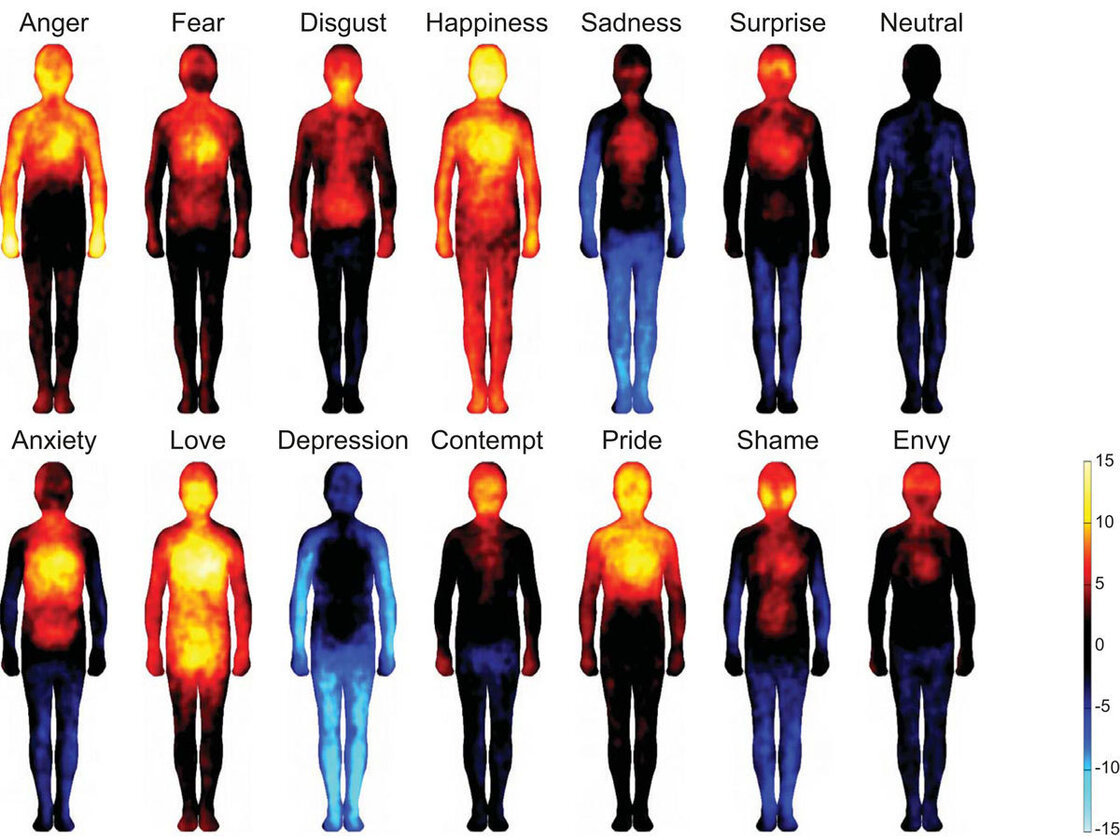
By asking subjects which areas of the body become activated and deactivated during specific emotions, the researchers were able to construct the sensation maps below. Pretty cool stuff.

Mapping Emotions On The Body: Love Makes Us Warm All Over

by Michaeleen Doucleff
December 30, 2013

People drew maps of body locations where they feel basic emotions (top row) and more complex ones (bottom row). Hot colors show regions that people say are stimulated during the emotion. Cool colors indicate deactivated areas. Image courtesy of Lauri Nummenmaa, Enrico Glerean, Riitta Hari, and Jari Hietanen.

Close your eyes and imagine the last time you fell in love. Maybe you were walking next to your sweetheart in a park or staring into each other's eyes over a latte.

Where did you feel the love? Perhaps you got "butterflies in your stomach" or you're heart raced with excitement.

When a team of scientists in Finland asked people to map out where they felt different emotions on their bodies, it found that the results were surprisingly consistent, even across cultures.


People reported that happiness and love sparked activity across nearly the entire body, while depression had the opposite effect: It dampened feelings in the arms, legs and head. Danger and fear triggered strong sensations in the chest area, the volunteers said. And anger was one of the few emotions that activated the arms.

The scientists hope that these body emoticons may one day help psychologists diagnose or treat mood disorders.

"Our emotional system in the brain sends signals to the body so we can deal with our situation," says Lauri Nummenmaa, a psychologist at Aalto University who lead the study.

"Say you see a snake and you feel fear," Nummenmaa says. "Your nervous system increases oxygen to your muscles and raises your heart rate so you can deal with the threat. It's an automated system. We don't have to think about it."

That idea has been known for centuries. But scientists still don't agree on whether these bodily changes are distinct for each emotion and whether this pattern serves as a way for the mind to consciously identify emotions.

Basic emotions, such as happiness, sadness and fear, form the building blocks for more complex feelings. Toddatkins/Wikimedia.org

To try and figure out that out, Nummenmaa and his team ran a simple computer experiment with about 700 volunteers from Finland, Sweden and Taiwan.

The team showed the volunteers two blank silhouettes of person on a screen and then told the subjects to think about one of 14 emotions: love, disgust, anger, pride, etc. The volunteers then painted areas of the body that felt stimulated by that emotion. On the second silhouette, they painted areas of the body that get deactivated during that emotion.

"People find the experiment quite amusing. It's quite fun," Nummenmaa tells Shots. "We kept the questions online so you try the experiment yourself." (You can try it here.)

Not everybody painted each emotion in the same way. But when the team averaged the maps together, signature patterns emerged for each emotion. The team published these sensation maps Monday in the Proceedings of the National Academy of Sciences.

The team still doesn't know how these self-reported sensations match with the physiological responses that occur with emotion.

But previous studies have found marked changes in bodily sensations in mood disorders, Nummenmaa says. "For instance, with depression sometimes people have pain in their chest."

And there's even some evidence that when you change your own body language — like your posture or stance — you can alter your mind.

Neuroscientist Antonio Damasio, who was not involved in this study, says he's "delighted" by Nummenmaa's findings because they offer more support for what he's been suggesting for years: Each emotion activates a distinct set of body parts, he thinks, and the mind's recognition of those patterns helps us consciously identify that emotion.

"People look at emotions as something in relation to other people," Damasio, who is a professor at the University of Southern California, says. "But emotions also have to do with how we deal with the environment — threats and opportunities." For those, Damasio says, you need your body as well as your mind.

Saturday, December 29, 2012

Willems and Francken - Embodied Cognition: Taking the Next Step


This article is new from Frontiers in Cognitive Science (open source science and neuroscience writing), one of the group of Frontiers in Psychology publications. In this article, the authors seek to take stock of the current research into embodied cognition (which they feel is too non-specific), and from there they want to formulate directions for how this field can be studied in a more fruitful fashion.

Embodied cognition: taking the next step


Roel M. Willems1,2* and Jolien C. Francken1
1Donders Institute for Brain, Cognition and Behaviour, Radboud University Nijmegen, Netherlands2Max Planck Institute for Psycholinguistics, Nijmegen, Netherlands
Recent years have seen a large amount of empirical studies related to “embodied cognition.” While interesting and valuable, there is something dissatisfying with the current state of affairs in this research domain. Hypotheses tend to be underspecified, testing in general terms for embodied versus disembodied processing. The lack of specificity of current hypotheses can easily lead to an erosion of the embodiment concept, and result in a situation in which essentially any effect is taken as positive evidence. Such erosion is not helpful to the field and does not do justice to the importance of embodiment. Here we want to take stock, and formulate directions for how it can be studied in a more fruitful fashion. As an example we will describe few example studies that have investigated the role of sensori-motor systems in the coding of meaning (“embodied semantics”). Instead of focusing on the dichotomy between embodied and disembodied theories, we suggest that the field move forward and ask how and when sensori-motor systems and behavior are involved in cognition.
Full Citation: 
Willems RM and Francken JC (2012) Embodied cognition: taking the next step. Frontiers in Psychology; 3:582. doi: 10.3389/fpsyg.2012.00582

Here are the first two sections of the paper to give you an idea where the authors are going with this piece.

Introduction: Exciting Embodiment


In the last two decades, cognitive science has embraced the thesis of “embodiment.” Embodied cognition stresses the intertwined nature of thinking and acting, and as such is an antidote to the traditional divide between cognition on the one hand and perception and action on the other. The excitement about embodiment within cognitive science lies mainly in its promise to destroy the traditional “sandwich” (or “hamburger”) model of cognitive processing, with its strict perception-cognition-action scheme (e.g., Hurley, 2001). The sandwich model regards “thinking” as the real stuff (the beef so to say), and takes perception and action as separated slave systems, providing input to cognitive processors (perception) and executing its commands (action).

Instead, embodied cognition stresses that perception and action are directly relevant for our thinking, and that it is a mistake to regard them as separate. The thesis comes in various formats, and a more in depth coverage is beyond the scope of this article (e.g., O’Regan, 1992; Van Gelder, 1995; Clark, 1997; Barsalou, 1999; Wilson, 2002; Noe, 2004;Gallagher, 2005; Wheeler, 2005).

In this paper we want to take stock and see what embodiment has done for a particular research domain in cognitive science, namely the study of semantic representations. With respect to semantic representations, embodied cognition is related to the claim of modality-specific versus abstract representations, in which modality-specific views predict sensori-motor cortex to be constitutive of conceptual representations (see Kiefer and Pulvermüller, 2012 for an excellent recent overview).

This being an opinion paper, it is by no means our intention to give an overview of the field. Instead we highlight certain studies, where we could have chosen others. Of particular importance is that we have chosen to ignore the neuropsychological literature regarding semantic representations (see e.g., Gainotti, 2000; Caramazza and Mahon, 2003;Kiefer and Pulvermüller, 2012).

The Erosion of a Concept: The Case of Embodied Semantics Representations


Often embodied cognition is defined very broadly. When we for example look at experiments investigating “embodied semantics,” an important prediction is that understanding sensori-motor concepts leads to activation of sensori-motor cortices. So when people read about hand and foot actions, parts of the motor cortex involved in moving the hands and the feet are activated (e.g., Hauk et al., 2004; Tettamanti et al., 2005). Although interesting from the sandwich model perspective, it is unfortunate that the main hypothesis often does not go beyond predicting “involvement” of sensori-motor cortices (see also Binder and Desai, 2011; see alsoChatterjee, 2010).

An illustration of this lack of specificity is how easily embodied cognition can capture strikingly different findings. For instance, Buccino et al. (2005)used single-pulse TMS to stimulate the hand or foot/leg motor area while participants were listening to sentences expressing foot and hand actions. Reaction times (RTs) and motor evoked potentials (MEPs) were specifically modulated for the effector involved in the described action: a hand-action-related sentence produced decreased MEPs in the hand area and slower RTs when subjects responded with their hand. The authors conclude that the processing of language modulates the activity of the motor system in an effector specific way. However, in another TMS study with a similar designPulvermuller et al. (2005a) report that faster RTs are observed to hand/arm words after stimulation of the hand area.

It is striking that although the results are opposite (slower versus faster RTs), both are taken as confirmation of the embodied semantics theory. Instead, the researchers could have elaborated more about the reason of their divergent findings. For instance, maybe the differences arise because the interference occurs at a decision making level after semantic analysis (Mahon and Caramazza, 2008; Chatterjee, 2010). By formulating more specific hypotheses, e.g., here on the direction of the effect and the underlying mechanism, these findings could have been more informative. It strikes us as disappointing to not go beyond the conclusion of involvementof cortical motor areas; the pattern of results suggests that something more interesting is going on than motor cortex activation in response to action words. One is left with the question what result would be taken as evidence against embodied cognition?

Another sign of an underspecified theory is that similar findings can be interpreted as evidence in favor as well as against embodiment. Take the studies of Saygin et al. (2010) and Bedny et al. (2008).

First, Saygin et al. showed activation of perceptual (visual) areas when subjects were reading sentences describing motion. More specifically, they found increased BOLD levels in motion sensitive area MT+ when participants read sentences like “The wild horse crossed the barren field” versus “The black horse stood in the barren field” (Saygin et al., 2010). Second, in the study of Bedny et al. participants judged pairs of words that implied motion (animals, e.g., “the horse,” “the dog”), had intermediate implied motion (tools, e.g., “the sword,” “the axe”), or had little implied motion (natural kinds, e.g., “the bush,” “the pebble”). These authors did not find modulation of MT+ activity for words with different motion ratings. Regions within posterior lateral temporal cortex were more active when comparing verbs and nouns, independent of the amount of motion associations of the words.

A general theory of embodiment would have predicted both studies to find modulation in area MT+ related to amount of motion expressed in the materials. The fact that the one study does observe such modulation, and the other does not is an interesting clue to the context-dependence of sensory cortex activations during language comprehension or as Saygin et al. (2010) p. 2486) put it: “the choice of task and stimuli can influence the power to detect modulations of MT+ by linguistic events.” Instead, what happens is that one set of authors interpret their findings as in line with embodied cognition, and the other set of authors interprets their findings as evidence against embodiment, since they show that retrieval of sensory motor features is not obligatory during word comprehension (Bedny et al., 2008). The differences in their findings can probably be attributed to the differences in design. However, both studies generalize their results to the question of whether it supports an embodied or disembodied account, and it is in this interpretation stage that opposite conclusions are drawn.

Many experiments are driven by the “embodied versus disembodied” distinction. This is not a fruitful approach, and in the next section we will show that such a broad distinction does not do justice to the experimental findings that are available. To foreshadow our conclusion: Instead of quarreling about embodied versus disembodied, the field should take the next step and ask the question when and how sensori-motor cortices play a role in understanding.

Tuesday, September 11, 2012

Georg Northoff - From Emotions to Consciousness – A neuro-phenomenal and neuro-relational approach


This excellent article comes from the always open access Frontiers in Emotion Science (part of the "Frontiers" series of journals). In this article, Northoff extends the James-Lange theory of emotions, which posits that the environment has an indirect but modulating role on emotional feelings "via the body and its sensorimotor and vegetative functions." In his extension, the environment has a direct and "constitutional role in emotional feelings." Northoff calls his model the relational concept of emotional feeling, and he suggests that the "environment itself is constitutive of emotional feeling rather than the bodily representation of the environment."

This is a little geeky, but it represents the shift that is occurring in neuroscience toward a more embedded and embodied view of human experience.

From emotions to consciousness – a neuro-phenomenal and neuro-relational approach

  • Mind, Brain Imaging and Neuroethics Research Unit, Institute of Mental Health Research, University of Ottawa, Ottawa, ON, Canada
The James–Lange theory considers emotional feelings as perceptions of physiological body changes. This approach has recently resurfaced and modified in both neuroscientific and philosophical concepts of embodiment of emotional feelings. In addition to the body, the role of the environment in emotional feeling needs to be considered. I here claim that the environment has not merely an indirect and instrumental, i.e., modulatory role on emotional feelings via the body and its sensorimotor and vegetative functions. Instead, the environment may have a direct and non-instrumental, i.e., constitutional role in emotional feelings. This implies that the environment itself is constitutive of emotional feeling rather than the bodily representation of the environment. I call this the relational concept of emotional feeling. The present paper discusses recent data from neuroimaging that investigate emotions in relation to interoceptive processing and the brain’s intrinsic activity. These data show the intrinsic linkage of interoceptive stimulus processing to both exteroceptive stimuli and the brain’s intrinsic activity. This is possible only if the differences between intrinsic activity and intero- and exteroceptive stimuli is encoded into neural activity. Such relational coding makes possible the assignment of subjective and affective features to the otherwise objective and non-affective stimulus. I therefore consider emotions to be intrinsically affective and subjective as it is manifest in emotional feelings. The relational approach thus goes together with what may be described as neuro-phenomenal approach. Such neuro-phenomenal approach does not only inform emotions and emotional feeling but is also highly relevant to better understand the neuronal mechanisms underlying consciousness in general.

Full Citation: 
Northoff, G. (2012, Aug 31). From emotions to consciousness – a neuro-phenomenal and neuro-relational approach. Front. Psychology 3:303. doi: 10.3389/fpsyg.2012.00303

Here is the introduction to the paper, which offers some background on the way emotions have been understood in contemporary neuroscience.

Introduction

The well-known James–Lange theory determined feelings as perceptions of physiological body changes in the autonomic, hormonal, and motor systems. Once we become aware of physiological bodily changes induced by danger, we feel fear and subjectively experience emotional feelings. James (1884, p. 190) consequently considered bodily changes as central to emotional feelings; “we feel sorry because we cry, angry because we strike, afraid because we tremble, and not that we cry, strike, or tremble, because we are sorry, angry, or fearful, as the case may be.” Modern empirical versions of this theory resurface in current neuroscientific models of emotion as, for instance, in Damasio and others (Damasio, 1999, 2010; Craig, 2003, 2004, 2005, 2009, 2011; Bechara, 2004; Niedenthal, 2007).

Conceptually, the embodied approach to emotion emphasizes the crucial role of the body in emotional feeling. If the body and its vegetative and sensorimotor function play a crucial role in constituting emotional feelings, the body can no longer be considered in a merely objective way but rather as subjective and experienced – the mere Koerper as objective body must be distinguished from the lived body as subjectively experienced body in emotional feeling (Colombetti and Thompson, 2005, 2007; Colombetti, 2008)1.

The emphasis on the body raises the question for the role of the environment in constituting emotional feelings. The body stands in direct contact with the environment via its sensorimotor functions which are emphasized in recent body-based, e.g., embodied concepts of emotional feelings (see Niedenthal et al., 2005; Niedenthal, 2007). The body is supposed to represent the environment in sensorimotor terms and it is these bodily representations that are considered crucial in constituting emotional feelings. The environment may have then an indirect and modulatory role via the body in the constitution of the emotional feelings.

One could also imagine that the environment has a direct and constitutive role in emotional feeling; the environment may then directly constitute emotional feeling independent of the body’s sensorimotor (and vegetative) functions. In this case, emotional feelings should be constituted directly by the respective person’s and its brain’s relation to the social environment (see below for definition) rather than indirectly via bodily representations. Since the person-environment relation is crucial here, I call such approach the relational concept of emotional feeling (see Northoff, 2004 for a general outline of such relational approach and Ben-Ze’ev, 1993 for the characterization of perception as relational).

The general aim of the present paper is to review recent human imaging data on emotional feelings in relation to both interoceptive processing and the brain’s intrinsic activity. This will be accompanied by discussing the empirical and conceptual implications of these data which I assume to favor a relational approach to emotions. Such relational concept characterizes emotions and emotional feeling to be intrinsically affective and subjective. Neuronally I assume this to be related to the interaction of the stimuli with the brain’s intrinsic activity, i.e., rest-stimulus interaction (see below for definition). Finally, the empirical and conceptual implications of such relational approach to emotions for consciousness are pointed out.

Wednesday, July 25, 2012

Thanissara - Embodied Dharma


This is a whole series of 18 talks by Thanissara on Embodied Dharma that were give at the Cloud Mountain Retreat Center over ten days in June, 2012. All of these talks are posted at Dharma Seed, a wonderful resource for Buddhist teachings offered at various retreat centers around the country.

Embodied Dharma

2012-06-14 (10 days) Cloud Mountain Retreat Center

Thanissara


Donate to Thanissara
Thanissara's Website

Thanissara, a practitioner since 1975, was a Theravada nun for 12 years in the tradition of Ajahn Chah and has taught internationally the last 20 years. She is co-founder and director of Dharmagiri Hermitage and Outreach in South Africa and spends time between there and the US. She has an MA in Mindfulness Psychotherapy Practice from Karuna Institute and Middx University UK and is currently co-facilitator of the Community Dharma Leader at Spirit Rock

2012-07-04 1. Buddha's Essential Guidance 19:45
  Thanissara
path as both gradual and immediate - succinct teaching of 'refrain from the unwholesome, lift up the good & purify the heart.'

2012-07-04 2. First Foundation of Mindfulness 39:25
  Thanissara
training of 'mano-vinnana' attention - withdrawing the mind from its preoccupations, working with the breath, way to one.

2012-07-04 3. Basic Sanity 43:51
  Thanissara
sanity of mindfulness, mindfulness leading to insight into the nature of the body, simplicity, getting back on track

2012-07-04 4. Guided Meditation on the Body 41:28
  Thanissara

2012-07-04 5. Samadhi - Path into Here & Now 42:15
   Thanissara
deepening presence here & now, 5 jhana factors, fruits of samadhi

2012-07-04 6. Jhana Factors & Balanced Effort 25:22
  Thanissara
cultivating balance and depth of inner well being

2012-07-04 7. Hindrances & Stopping 39:49
  Thanissara
stopping the momentum of the mind.. a serial killer stops and awakens

2012-07-04 8. Balance of Calm & Insight 36:15
  Thanissara
mindfulness & clear comprehension in tandem with insight & wise reflection - two kinds of peace

2012-07-04 9. Contemplating Change & Worldly Winds 30:45
  Thanissara
reflecting on change - the doorway into the changeless - maintaining well being in the face of change through wisdom

2012-07-04 10. Training of Mind 37:52
  Thanissara
practice as preparation for when the hindrances hit - vitakkasantana sutta - skilful training of thought

2012-07-04 11. Four Truths 42:10
  Thanissara
contemplation and practice of the 4 truths

2012-07-04 12. Practice of the Four Truths 33:45
  Thanissara
where there is samsara is nibbana

2012-07-04 13. Leap Beyond 54:29
  Thanissara
heart sutra and kuan yin

2012-07-04 14. Original Mind 35:36
  Thanissara
guided meditation pointing out 'mind'

2012-07-04 15. Divine Within Human 53:57
  Thanissara
4 brahma viharas & bodhicitta

2012-07-04 16. Guided Brahma Vihara Meditation 35:17
  Thanissara
drawing on themes of the 4 brahma viharas - kindness, compassion, joy & equanimity - infused with the divine bodhicitta of Kuan Yin

2012-07-04 17. Daily Life Practice 31:29
  Thanissara

2012-07-04 18. Taking Precepts 29:45
  Thanissara
the value of ethics as a foundation for practice and as a protection of all beings