This interesting piece comes from the
Diet Soap podcast on the
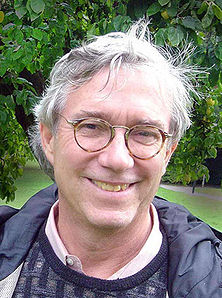
Critical Theory site. For a lot of people, mathematician, computer scientist, philosopher, and sci-fi author Rudy Rucker (Rudolf von Bitter Rucker) is best known as the author of the four cyberpunk novels comprising the
Ware Tetralogy (the first two of which won the Philip K Dick Award). But he is also the author of several non-fiction books, most notably
Infinity and the Mind: The Science and Philosophy of the Infinite (2004), as well as
The Fourth Dimension: A Guided Tour of the Higher Universes (1985),
Mind Tools: The Five Levels of Mathematical Reality (1988) and
The
Lifebox, the Seashell, and the Soul: What Gnarly Computation Taught Me
About Ultimate Reality, the Meaning of Life, and How to Be Happy (2006), among many other books.
As a fiction author, Rucker identifies himself as a transrealist (from
Wikipedia):
Transrealism is a literary mode that mixes the techniques of incorporating fantastic elements used in science fiction with the techniques of describing immediate perceptions from naturalistic realism. While combining the strengths of the two approaches, it is largely a reaction to their perceived weaknesses. Transrealism addresses the escapism and disconnect with reality of science fiction by providing for superior characterization through autobiographical features and simulation of the author's acquaintances. It addresses the tiredness and boundaries of realism by using fantastic elements to create new metaphors for psychological change and to incorporate the author's perception of a higher reality in which life is embedded. One possible source for this higher reality is the increasingly strange models of the universe put forward in theoretical astrophysics.
Its main proponent and prominent figure is science fiction author Rudy Rucker. Rucker coined the term "transrealism" after reading Philip K Dick's A Scanner Darkly described as "transcendental autobiography," and expounded the principles of transrealism in a short essay titled "A Transrealist Manifesto" in 1983. Rucker applied many of these principles in his short stories and novels, notably White Light and Saucer Wisdom. Damien Broderick has identified some other authors that have at some time utilized transrealist tropes to include Martin Amis, Margaret Atwood, Iain Banks, John Barth, J.G. Ballard, John Calvin Batchelor, Jonathan Carroll, Philip K. Dick especially, Karen Joy Fowler, Lisa Goldstein, James Morrow, Thomas Pynchon, Joanna Russ and James Tiptree Jr. [1]
While the Wikipedia entry sees transrealism as part of the
slipstream literature genre, it sounds an awful lot like a form of postmodernist story-telling. Interested readers can check out Rucker's
Transrealist Manifesto (1983).
August 30th, 2013 | by Doug Lain
Rudy Rucker is a cyberpunk author, a mathematician, and a Transrealist. Known for his book Ware Tetralogy (four novels in one volume), Rucker’s most current book is “The Big Aha.” In this episode of the philosophy podcast Diet Soap the ideas of Transrealism and Baudrillard’s Hyperrealism are juxtaposed through sound clips and audio collage.
Rudy Rucker on Transrealism:
The Transrealist writes about immediate perceptions in a fantastic way. Any literature which is not about actual reality is weak and enervated. But the genre of straight realism is all burnt out. Who needs more straight novels? The tools of fantasy and SF offer a means to thicken and intensify realistic fiction. By using fantastic devices it is actually possible to manipulate subtext. The familiar tools of SF — time travel, antigravity, alternate worlds, telepathy, etc. — are in fact symbolic of archetypal modes of perception. Time travel is memory, flight is enlightenment, alternate worlds symbolize the great variety of individual world-views, and telepathy stands for the ability to communicate fully. This is the “Trans” aspect. The “realism” aspect has to do with the fact that a valid work of art should deal with the world the way it actually is. Transrealism tries to treat not only immediate reality, but also the higher reality in which life is embedded.
Listen below.